
Market Overview
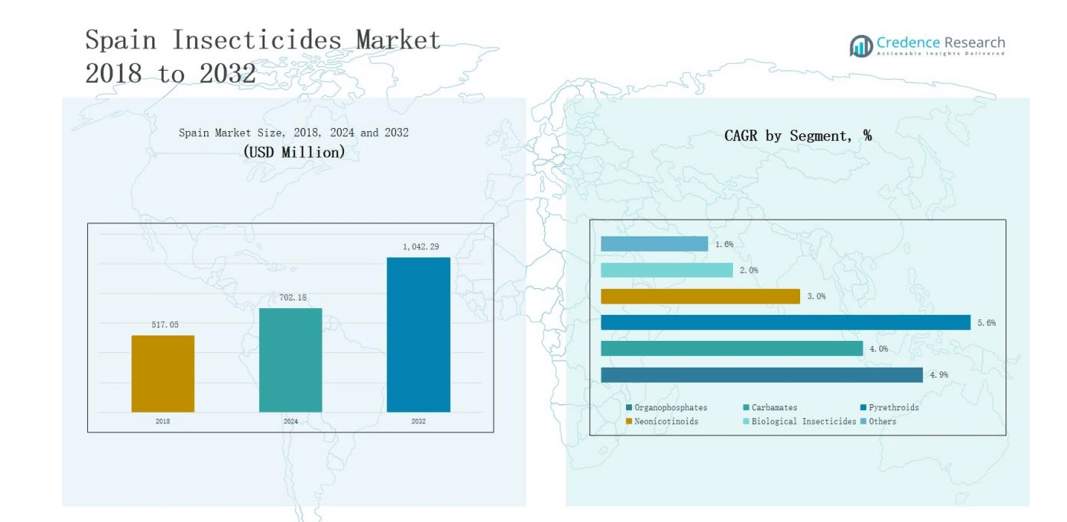
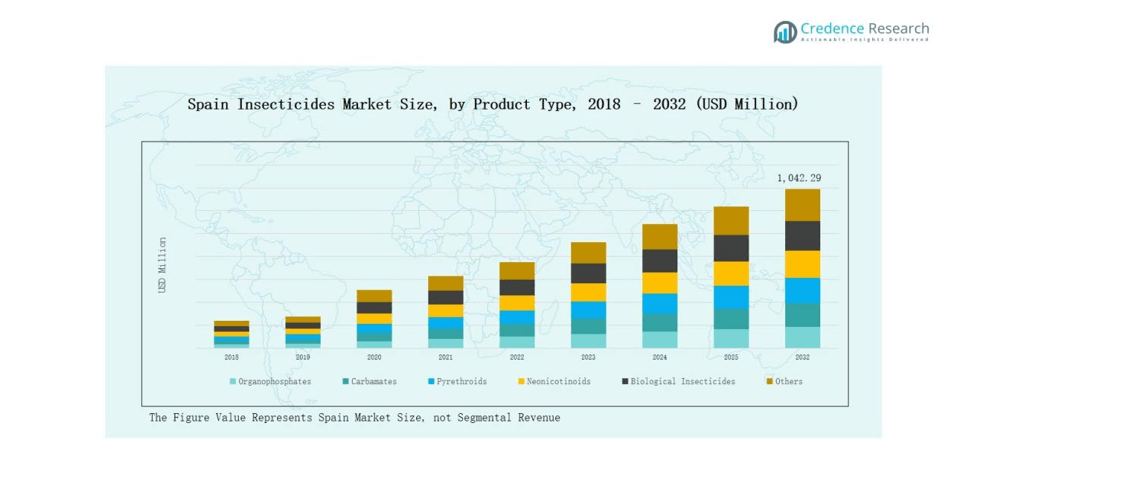
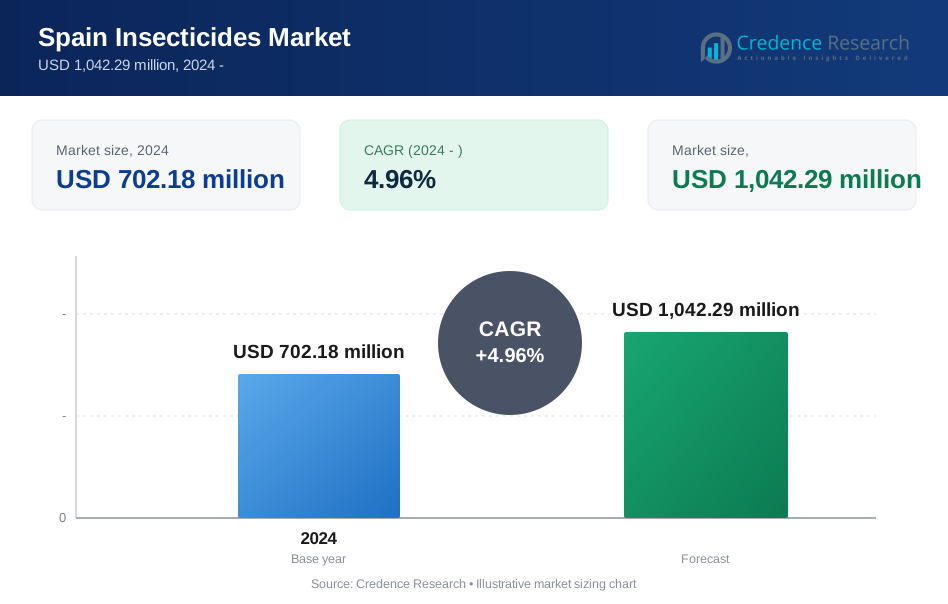
Spain Insecticides Market size was valued at USD 517.05 million in 2018 to USD 702.18 million in 2024 and is anticipated to reach USD 1,042.29 million by 2032, at a CAGR of 4.96% during the forecast period.
| REPORT ATTRIBUTE | DETAILS |
|---|---|
| Historical Period | 2020-2023 |
| Base Year | 2024 |
| Forecast Period | 2025-2032 |
| Spain Insecticides Market Size 2024 | USD 702.18 million |
| Spain Insecticides Market, CAGR | 4.96% |
| Spain Insecticides Market Size 2032 | USD 1,042.29 million |
The Spain Insecticides Market is shaped by the presence of global leaders and strong regional firms. Key players include Syngenta, Bayer CropScience, BASF SE, FMC Corporation, ADAMA, Nufarm, Dow AgroSciences, Sipcam Iberica, Atanor, and Indukern. These companies compete through diverse product portfolios, investments in biological insecticides, and compliance with stringent EU regulations. Their strategies focus on innovation, distribution partnerships, and sustainable solutions to address pest resistance and residue concerns. Regionally, Eastern Spain led the market with a 26% share in 2024, supported by greenhouse vegetable cultivation, citrus farming, and rapid adoption of eco-friendly formulations. This leadership highlights the region’s role in advancing both traditional and biological insecticide demand across Spain.
Market Insights
- The Spain Insecticides Market grew from USD 517.05 million in 2018 to USD 702.18 million in 2024 and will reach USD 1,042.29 million by 2032.
- Eastern Spain led with 26% share in 2024, driven by greenhouse vegetables, citrus farming, and adoption of sustainable insecticide solutions.
- Organophosphates dominated by product type with 32% share, followed by pyrethroids at 21% and neonicotinoids at 17% in 2024.
- Agriculture remained the leading application with 68% share in 2024, while forestry, turf, and public health accounted for smaller but steady shares.
- Key players include Syngenta, Bayer CropScience, BASF SE, FMC Corporation, ADAMA, Nufarm, Dow AgroSciences, Sipcam Iberica, Atanor, and Indukern.
Market Segment Insights
By Product Type
Organophosphates led the Spain insecticides market with a 32% share in 2024, supported by their effectiveness across cereals, fruits, and vegetables. Pyrethroids followed with 21% share, benefiting from lower toxicity and strong application in orchards and vineyards. Neonicotinoids held 17% share, mainly in citrus and olive crops, though EU restrictions on pollinator safety are expected to slow their future growth. Carbamates accounted for 15% share, largely applied in horticulture, while biological insecticides gained 10% share, driven by rising demand for organic farming solutions and sustainable crop protection.
- For instance, Bayer Crop Science manufactures and markets various pyrethroid insecticides, including different formulations under the Decis brand, for pest control on a wide range of crops worldwide.
By Application
Agriculture dominated the Spain insecticides market with a 68% share in 2024, supported by intensive cultivation of cereals, citrus fruits, olives, and greenhouse vegetables. Forestry accounted for 12% share, reflecting pest management in pine plantations and forest reserves. Turf and landscape applications captured 8%, mainly in urban green spaces, while public health usage stood at 7%, focused on mosquito and vector control. The remaining 5% share came from other applications, including household and specialty uses.
- For instance, Syngenta España partnered with greenhouse growers in Almería to expand the use of its insecticide Minecto Alpha®, a chemical insecticide, for integrated pest management in tomatoes and peppers. Minecto Alpha® is not a biological-based product.
Market Overview
Expansion of High-Value Crops
Spain’s insecticides market benefits from the expansion of high-value crops such as citrus, olives, grapes, and greenhouse vegetables. These crops face significant pest pressure, driving strong demand for effective insect control solutions. Farmers increasingly invest in advanced insecticide formulations to protect yield and quality, which supports steady revenue growth. The export orientation of Spain’s fruit and vegetable sector further accelerates adoption, as compliance with global quality standards requires consistent pest management strategies across different product types.
- For instance, Bayer introduced its Vynyty Citrus® pheromone-based biological insecticide for Spanish citrus orchards, aimed at controlling the citrus fruit fly while reducing chemical residues in export-bound produce.
Rising Adoption of Integrated Pest Management (IPM)
The growing adoption of Integrated Pest Management (IPM) programs is boosting insecticide demand, especially biological and low-toxicity options. Farmers are aligning with EU sustainability regulations by using chemical and biological products in combination to reduce resistance and environmental impact. This shift has encouraged investments in bio-insecticides and targeted formulations that complement IPM systems. The approach not only enhances long-term crop protection efficiency but also supports Spain’s positioning as a leader in sustainable and eco-friendly agriculture within Europe.
- For instance, GreenField Biocontrol utilizes natural predator releases and habitat manipulation to support biodiversity and reduce chemical pesticide dependency, reinforcing sustainable IPM adoption in European farming.
Strong Government and EU Support for Agriculture
Government support and EU agricultural policies continue to shape insecticide demand in Spain. Subsidies for modernizing farming practices and strict crop protection standards create a market where advanced insecticides are essential. The Common Agricultural Policy (CAP) and local initiatives promote productivity, export competitiveness, and compliance with food safety requirements. These measures encourage both large-scale farms and smallholders to adopt innovative insect control products, ensuring consistent demand across segments despite increasing regulatory scrutiny on chemical formulations.
Key Trends & Opportunities
Shift Toward Biological Insecticides
A major trend is the accelerating shift toward biological insecticides, which accounted for 10% of Spain’s market in 2024. Rising consumer demand for organic produce and EU restrictions on harmful chemicals are driving this transition. Companies are introducing biopesticides based on natural extracts, microbial formulations, and pheromone-based traps. Greenhouse farming, particularly in Almería and Murcia, is a hotspot for adoption, as growers seek eco-friendly solutions that maintain yields while reducing chemical residues. This creates strong opportunities for global and local players.
- For instance, Government subsidy programs under Spain's CAP Strategic Plan (2023–2027) have facilitated wider use of biofungicides, especially for high-value crops such as grapes and citrus fruits, reflecting increased investment in eco-friendly pest control solutions by local and global players.
Digitalization and Precision Agriculture
Spain’s insecticides market is also witnessing opportunities through digital farming and precision agriculture. Tools like drone spraying, remote sensing, and AI-based pest monitoring are improving the efficiency of insecticide application. These technologies reduce wastage, improve targeting, and align with sustainability goals. The adoption of smart farming practices among large agricultural cooperatives is creating demand for specialized insecticide formulations tailored for precision delivery. This trend is expected to accelerate as digital infrastructure and farm management technologies expand in Spain.
- For instance, in January 2024, the Spanish Agrarian Guarantee Fund (FEGA) launched the SIEX platform, enabling 800,000 farms to digitally report crop treatments and optimize pesticide application through data integration.
Key Challenges
Stringent EU Regulatory Restrictions
A major challenge for Spain’s insecticides market is the tightening EU regulatory framework, which restricts active ingredients deemed harmful to human health and pollinators. The ban on certain neonicotinoids and stricter residue limits directly affect product availability. Companies face higher costs for reformulation, registration, and compliance testing. While this shift aligns with sustainability goals, it limits flexibility for farmers who rely on chemical protection against pests, often forcing them to adopt costlier or less effective alternatives in the short term.
Rising Incidence of Pest Resistance
Pest resistance to widely used chemical formulations is becoming a significant barrier to market growth in Spain. Over-reliance on organophosphates and pyrethroids has led to resistance in insects such as whiteflies and aphids, reducing product efficacy. This trend pressures farmers to rotate chemicals more frequently or combine them with biological alternatives, increasing production costs. For manufacturers, it necessitates continuous innovation in active ingredients, which involves lengthy development timelines and high R&D expenditure, delaying immediate returns on new product launches.
Price Volatility and Import Dependence
Spain’s insecticides market faces pricing challenges due to raw material volatility and import dependence. Many active ingredients and intermediates are sourced from global suppliers, particularly in Asia. Supply chain disruptions, currency fluctuations, and rising energy costs directly impact pricing structures. Farmers, especially smallholders, struggle with affordability when costs increase sharply. This volatility limits consistent adoption, particularly of advanced formulations, and creates uncertainty for distributors and manufacturers aiming to maintain stable margins in a highly competitive marketplace.
Regional Analysis
Northern Spain
Northern Spain accounted for 28% share in 2024, driven by strong agricultural activity in cereals, vineyards, and fruit orchards. Farmers in this region rely heavily on pyrethroids and organophosphates for pest management in grapes and apples. It benefits from well-developed agricultural cooperatives that ensure effective product distribution. Greenhouse production in parts of the region also contributes to rising use of biological insecticides. The Spain Insecticides Market in Northern Spain continues to expand due to the growing adoption of integrated pest management practices. Demand growth remains steady despite increasing EU regulations on chemical formulations.
Central Spain
Central Spain held 22% share in 2024, with cereals and olive cultivation shaping insecticide demand. Organophosphates and carbamates remain widely used due to their broad-spectrum effectiveness on soil pests and leaf miners. It faces pressure to reduce chemical residues, creating opportunities for bio-based alternatives. Farmers in Castilla-La Mancha are gradually introducing neonicotinoids for olive and vineyard protection. Distribution networks are strong, supported by national suppliers and global companies. The Spain Insecticides Market in Central Spain is shaped by a balance of traditional chemical demand and emerging biological solutions.
Eastern Spain
Eastern Spain captured 26% share in 2024, led by greenhouse cultivation of vegetables in Valencia and Murcia. Pyrethroids and biological insecticides dominate this market due to strict EU residue controls and strong export orientation. It benefits from advanced irrigation systems and adoption of precision farming methods that improve insecticide application. Citrus cultivation is another key driver, requiring targeted neonicotinoid usage for pest control. Regional cooperatives play a central role in introducing sustainable formulations. The Spain Insecticides Market in Eastern Spain shows strong growth potential supported by technology adoption and organic farming trends.
Southern Spain
Southern Spain represented 24% share in 2024, with Andalusia leading demand through extensive olive and citrus farming. Organophosphates and pyrethroids are dominant due to their proven performance in large-scale plantations. It is also witnessing growth in biopesticides as olive growers face increasing restrictions on chemical residues. Regional focus on high-value export crops is pushing farmers to invest in advanced formulations. The distribution presence of multinationals supports availability and competitive pricing. The Spain Insecticides Market in Southern Spain maintains a critical role in national production, balancing traditional chemical reliance with sustainability-focused adoption.
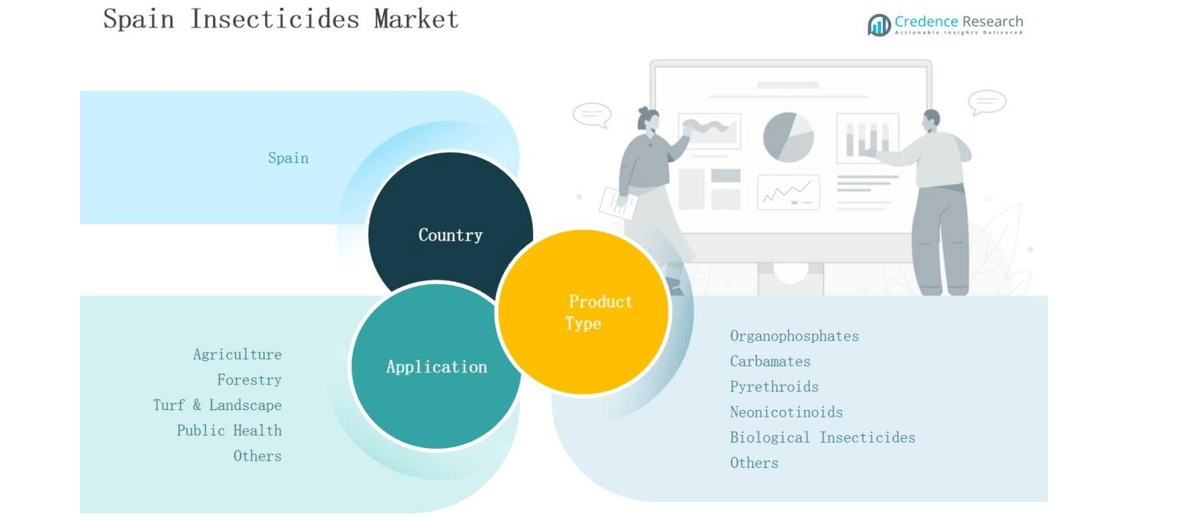
Market Segmentations:
By Product Type
- Organophosphates
- Carbamates
- Pyrethroids
- Neonicotinoids
- Biological Insecticides
- Others
By Application
- Agriculture
- Forestry
- Turf & Landscape
- Public Health
- Others
By Region
- North Spain
- Central Spain
- East Spain
- Southern Spain
Competitive Landscape
The Spain Insecticides Market is highly competitive, shaped by the presence of multinational corporations and strong regional players. Leading companies such as Syngenta, Bayer CropScience, BASF SE, FMC Corporation, and ADAMA hold significant positions through broad product portfolios and advanced formulations tailored to cereals, citrus, and olive crops. Local firms, including Sipcam Iberica and Indukern, strengthen competition by offering cost-effective solutions and niche biological products aligned with EU sustainability directives. Companies invest heavily in research and development to address regulatory restrictions and rising demand for bio-insecticides. Strategic partnerships with cooperatives and distributors enhance market reach, while product differentiation focuses on residue compliance, resistance management, and eco-friendly solutions. The competitive landscape is further defined by innovation in biological insecticides, which gain traction in greenhouse and organic farming. Overall, the market reflects a balanced mix of global expertise and regional adaptability, ensuring consistent product availability and ongoing shifts toward sustainable pest management.
Key Players
- Syngenta
- FMC Corporation
- Dow AgroSciences
- ADAMA
- Bayer CropScience
- Nufarm
- BASF SE
- Sipcam Iberica
- Atanor
- Indukern
Recent Developments
- In July 2024, Syngenta introduced Pyrevert 5% EC, the market's most concentrated natural Pyrethrin insecticide targeting multiple pests including aphids and whiteflies in Spain.
- On July 28, 2025, Ambienta acquired Agronova Biotech, a Spanish biotechnology firm specializing in biological crop solutions. This marks Ambienta’s entrance into the Spanish sustainable agriculture landscape.
- In March 2025, Sumitomo Chemical fully acquired Philagro and announced plans to acquire Kenogard, strengthening its crop protection portfolio in Spain.
- On June 17, 2025, Bayer and Kimitec collaborated to introduce two new biological products: Ambition Complete Gen2 and Ambition Secure Gen2, developed through their alliance.
Report Coverage
The research report offers an in-depth analysis based on Product Type, Application and Region. It details leading market players, providing an overview of their business, product offerings, investments, revenue streams, and key applications. Additionally, the report includes insights into the competitive environment, SWOT analysis, current market trends, as well as the primary drivers and constraints. Furthermore, it discusses various factors that have driven market expansion in recent years. The report also explores market dynamics, regulatory scenarios, and technological advancements that are shaping the industry. It assesses the impact of external factors and global economic changes on market growth. Lastly, it provides strategic recommendations for new entrants and established companies to navigate the complexities of the market.
Future Outlook
- Demand for biological insecticides will continue to rise in greenhouse and organic farming.
- Regulatory pressure from the EU will drive reformulation of chemical insecticides.
- Integrated pest management practices will gain wider adoption across major crop segments.
- Digital farming tools will support more precise and efficient insecticide applications.
- Neonicotinoid usage will decline due to stricter pollinator safety regulations.
- Olive and citrus farming will remain the largest consumers of insecticides in Spain.
- Local players will expand their role by offering cost-effective and eco-friendly solutions.
- Export-oriented agriculture will sustain demand for residue-compliant insecticide products.
- Pest resistance challenges will push companies to innovate in active ingredients.
- Distribution partnerships with cooperatives will strengthen market penetration in rural regions.
Request a Free Sample
Fill in your details and we'll send you a free sample report.
- Sample data tables & charts
- Research methodology
Need a Custom Version of This Report?
Tailor the scope, geography, or segments to your exact requirements.
- Custom geography or segment scope
- Direct access to our analyst team
Frequently Asked Questions
What is the current market size for Spain Insecticides Market, and what is its projected size in 2032?
Which Spain Insecticides Market segment held the largest share in 2024?
What are the primary factors fueling the growth of the Spain Insecticides Market?
Who are the leading companies in the Spain Insecticides Market?
Table of Content
Chapter 1. Report Introduction
- 1.1 Report Description & Purpose
- 1.1.1 Report Title & Market Definition
- 1.1.2 Unique Selling Propositions (USP) & Key Differentiators
- 1.1.3 Value Proposition for Stakeholders
- 1.2 Research Objectives
- 1.2.1 Market Sizing Objectives (Volume & Revenue)
- 1.2.2 Segmentation Objectives
- 1.2.3 Competitive Intelligence Objectives
- 1.2.4 Forecast & Scenario Objectives
- 1.3 Report Scope
- 1.3.1 Spain Insecticides Scope – Types & Subtypes Covered
- 1.3.2 Geographic Scope – Regions & Countries Covered
- 1.3.3 Historical Period, Base Year & Forecast Period (2024; forecast to the forecast period)
- 1.3.4 Inclusions & Exclusions
- 1.4 HS Code & Classification Framework
- 1.5 Currency, Units & Pricing Basis
- 1.6 Target Stakeholders
- 1.7 Limitations & Assumptions
Chapter 2. Executive Summary
- 2.1 Global Spain Insecticides Market Snapshot
- 2.1.1 Market Size – Historical (2024) & Forecast (the forecast period) (2024: USD 702.18 million → forecast year: USD 1,042.29 million)
- 2.1.2 Volume & Revenue – Global Totals
- 2.1.3 Key Market Highlights – Top Five Facts
- 2.2 Spain Insecticides Market Segmentation Snapshot
- 2.2.1 Market Split by Region – 2024 vs.
- 2.3 Competitive Snapshot
- 2.3.1 Top 10 Players by Revenue Share – 2024
- 2.3.2 Top 10 Players by Volume Share – 2024
- 2.3.3 Recent Strategic Developments (18-Month Summary)
- 2.4 Key Investment Highlights & Strategic Conclusions
Chapter 3. Spain Insecticides Market Dynamics & Industry Analysis
- 3.1 Market Overview & Context
- 3.1.1 Spain Insecticides Market Position in the Broader Automotive Value Chain
- 3.1.2 OEM vs. Replacement Market Dynamics
- 3.1.3 Market Maturity & Development Stage by Region
- 3.2 Spain Insecticides Market Drivers
- 3.3 Spain Insecticides Market Restraints & Challenges
- 3.4 Spain Insecticides Market Opportunities
- 3.5 Porter's Five Forces Analysis
- 3.5.1 Threat of New Entrants
- 3.5.2 Bargaining Power of Suppliers
- 3.5.3 Bargaining Power of Buyers
- 3.5.4 Threat of Substitutes
- 3.5.5 Competitive Rivalry – Intensity Assessment
- 3.6 Spain Insecticides Value Chain Analysis
- 3.6.1 Upstream – Raw Material/Input Suppliers
- 3.6.1.1 Raw Material/Input 1
- 3.6.1.2 Raw Material/Input 2
- 3.6.1.3 Raw Material/Input 3
- 3.6.2 Midstream – Production/Manufacturing/Service Delivery
- 3.6.2.1 Production/Process Overview
- 3.6.2.2 Key Facility Locations & Capacity by Manufacturer
- 3.6.3 Downstream – Distribution & End Consumer
- 3.6.3.1 Primary Channel – B2B/OEM
- 3.6.3.2 Secondary Channels – Dealer, Retail, Online, Direct
- 3.6.4 Value Chain Profitability Analysis
- 3.6.1 Upstream – Raw Material/Input Suppliers
- 3.7 PESTEL Analysis
- 3.7.1 Political Factors
- 3.7.2 Economic Factors
- 3.7.3 Social Factors
- 3.7.4 Technological Factors
- 3.7.5 Environmental Factors
- 3.7.6 Legal Factors
- 3.8 Spain Insecticides Supply Chain Analysis
- 3.8.1 Raw Material/Input Supply Risk Assessment
- 3.8.2 Manufacturing Concentration Risk (Geographic Exposure)
- 3.8.3 Trade Disruption Impact Analysis
- 3.9 Regulatory & Policy Landscape
Note: The regulatory and policy landscape section covers regulations based on their applicability to the market, Spain Insecticides category, geography, and scope of the study. Only regulatory frameworks with a material impact on operations, compliance, trade, sustainability, or market access are analyzed in detail.
Chapter 4. Key Investment Pockets & Opportunity Analysis
- 4.1 Spain Insecticides Market Attractiveness Analysis
- 4.1.1 By Region – Investment Attractiveness Matrix (Volume × CAGR)
- 4.2 Absolute Revenue Growth Opportunity
- 4.2.1 By Region – Absolute USD Growth Through the forecast period
- 4.3 Incremental Volume Opportunity
- 4.3.1 By Region – Incremental Volume Through the forecast period
- 4.3.2 Segment – Incremental Volume
- 4.4 Emerging Submarket Opportunity Deep Dive (Subject to Applicability)
- 4.5 Emerging Market Opportunity Scorecards
- 4.5.1 United States
- 4.5.2 Europe
- 4.5.3 Asia
- 4.5.4 Middle East & Africa
Note: Emerging Market Opportunity Scorecards will be included based on relevance and strategic importance. Regions listed are indicative and may vary depending on data availability and market dynamics.
Chapter 5. Spain Insecticides Import-Export Analysis & Trade Flows
- 5.1 Global Trade Overview
- 5.1.1 Global Export Value by Country (2024)
- 5.1.2 Global Export Volume by Country (2024)
- 5.1.3 Global Import Value by Country (2024)
- 5.1.4 Global Import Volume by Country (2024)
- 5.1.5 Net Trade Balance by Country (2024)
- 5.2 Export Analysis – Segment
- 5.2.1 Type 1 (HS Code)
- 5.2.2 Type 2 (HS Code)
- 5.2.3 Type 3 (HS Code)
- 5.2.4 Type 4 (HS Code)
- 5.2.5 Type 5 (HS Code)
- 5.3 Import Analysis – Segment
- 5.3.1 Type 1 (HS Code)
- 5.3.2 Type 2 (HS Code)
- 5.3.3 Type 3 (HS Code)
- 5.3.4 Type 4 (HS Code)
- 5.3.5 Type 5 (HS Code)
- 5.4 Average Unit Trade Prices
- 5.4.1 Average Export Price – Segment & Country
- 5.4.2 Average Import Price – Segment & Source Country
- 5.4.3 Price Trends (2024)
- 5.5 Key Trade Route Analysis
- 5.5.1 Trade Route 1
- 5.5.2 Trade Route 2
- 5.5.3 Trade Route 3
- 5.5.4 Trade Route 4
- 5.5.5 Trade Route 5
- 5.6 Trade Policy Impact Assessment
- 5.6.1 US Anti-Dumping & Section 301 Tariffs
- 5.6.2 EU Customs Union Impact
- 5.6.3 Major Free Trade Agreements
- 5.6.4 USMCA Rules of Origin
Note: Trade policy analysis will be included only where relevant to the Spain Insecticides market.
Chapter 6. Competitive Landscape & Company Benchmarking
- 6.1 Spain Insecticides Market Concentration & Structure
- 6.1.1 Herfindahl-Hirschman Index (HHI) – vs. 2024
- 6.1.2 Tier 1, Tier 2 & Tier 3 Market Structure
- 6.1.3 Global, Regional & Local Player Dynamics
- 6.2 Spain Insecticides Market Share Analysis – 2024
- 6.2.1 Global Revenue Share by Company
- 6.2.2 Global Volume Share by Company
- 6.2.3 Regional Revenue Share
- 6.2.4 Market Share Evolution ( vs. 2024)
- 6.2.5 OEM Segment Share by Company
- 6.2.6 Replacement Segment Share by Company
- 6.3 Production/Delivery Capacity & Facility Analysis
- 6.3.1 Global Installed Capacity
- 6.3.2 Capacity Utilization Rates
- 6.3.3 Production/Output Volume
- 6.3.4 Facility Locations & Capacity Map
- 6.3.5 Planned Capacity Additions
- 6.4 Spain Insecticides Competitive Benchmarking Matrix
- 6.4.1 Revenue, Volume, CAGR & Profitability Comparison
- 6.4.2 Channel Revenue Mix
- 6.4.3 Geographic Revenue Exposure
- 6.4.4 R&D Intensity
- 6.4.5 Sustainability Maturity
- 6.5 Strategic Developments in Spain Insecticides (Last 24 Months)
- 6.5.1 Mergers, Acquisitions & Divestments
- 6.5.2 New Spain Insecticides Launches
- 6.5.3 Facility Expansions
- 6.5.4 Strategic Alliances, Joint Ventures & Partnerships
- 6.5.5 Distribution Expansion & Market Entry
- 6.5.6 Sustainability & ESG Initiatives
- 6.6 Competitive Strategy Mapping
- 6.6.1 Leader, Challenger, Follower & Niche Classification
- 6.6.2 Pricing Strategy Comparison
- 6.6.3 Channel Strategy Matrix
Note: Strategic developments are included based on their materiality and the availability of reliable information.
Chapter 7. Global Spain Insecticides Market – By Distribution Channel
- 7.1 Segment Overview
- 7.1.1 Volume & Revenue Split by Channel (2024 & )
- 7.1.2 Channel Mix Evolution (the forecast period)
Chapter 8. Regional Market Analysis – Global Overview
- 8.1 Global Regional Overview
- 8.1.1 Regional Volume Share
- 8.1.2 Regional Revenue Share
- 8.1.3 Regional Volume by Region
- 8.1.4 Regional Revenue by Region
- 8.1.5 Regional Forecast Through the forecast period
- 8.2 Cross-Regional Segment Analysis
- 8.2.1 By Distribution Channel
- 8.2.2 By Brand/Price Tier
Chapter 9. North America Spain Insecticides Market
- 9.1 United States
- 9.2 Canada
- 9.3 Mexico
Chapter 10. Europe Spain Insecticides Market
- 10.1 Germany
- 10.2 France
- 10.3 Italy
- 10.4 United Kingdom
- 10.5 Spain
- 10.6 Poland
- 10.7 Russia
- 10.8 Netherlands
- 10.9 Belgium
- 10.10 Sweden
- 10.11 Denmark
- 10.12 Norway
- 10.13 Rest of Europe
Chapter 11. Asia Pacific Spain Insecticides Market
- 11.1 China
- 11.2 India
- 11.3 Japan
- 11.4 South Korea
- 11.5 Thailand
- 11.6 Indonesia
- 11.7 Vietnam
- 11.8 Malaysia
- 11.9 Australia
- 11.10 Rest of Asia Pacific
Chapter 12. Latin America Spain Insecticides Market
- 12.1 Brazil
- 12.2 Argentina
- 12.3 Colombia
- 12.4 Chile
- 12.5 Rest of Latin America
Chapter 13. Middle East Spain Insecticides Market
- 13.1 Saudi Arabia
- 13.2 United Arab Emirates
- 13.3 Turkey
- 13.4 Israel
- 13.5 Iran
- 13.6 Rest of the Middle East
Chapter 14. Africa Spain Insecticides Market
- 14.1 South Africa
- 14.2 Egypt
- 14.3 Nigeria
- 14.4 Morocco
- 14.5 Rest of Africa
Chapter 15. Spain Insecticides Company Profiles
- 15.1 [Company 01]
- 15.1.1 Company Overview
- 15.1.2 Key Management Personnel
- 15.1.3 Products & Services Portfolio
- 15.1.4 Financial Performance
- 15.1.5 Key Market Focus & Geographic Presence
- 15.1.6 Recent Developments & Strategic Initiatives
Note: The company profile list is preliminary and may change based on research findings, market developments, data availability, and client requirements.
Chapter 16. Appendices
- Appendix A – List of Abbreviations & Acronyms
- Appendix B – Industry Classification Code Reference – Full Series
- Appendix C – Production & Capacity Data Tables
- Appendix D – End-Use & Demand Base Tables
- Appendix E – Consumption & Replacement Rate Assumptions
- Appendix F – ASP Reference Tables
- Appendix G – Manufacturing & Facility Database
- Appendix H – Import-Export Data Tables
- Appendix I – Regulatory Summary Tables
- Appendix J – Primary Research Participant List (Anonymized)
- Appendix K – Primary Research Questionnaire Framework
- Appendix L – Data Sources & Bibliography
- Appendix M – Market Size Divergence & Source Comparison
Chapter 17. Research Methodology
- 17.1 Research Framework & Philosophy
- 17.2 Secondary Research – Sources, Hierarchy & Data Extraction
- 17.3 Data Modeling – Bottom-Up & Top-Down Market Sizing
- 17.4 Primary Research – Stakeholder Framework, LOI & Sample Sizes
- 17.5 Forecast Methodology – Regression, Scenario & Sensitivity Analysis
- 17.6 Quality Control – Four-Layer Validation Framework
- 17.7 Limitations & Standard Assumptions
- 17.8 Disclaimer
