Broth makers, feed mills and salt rules anchor demand
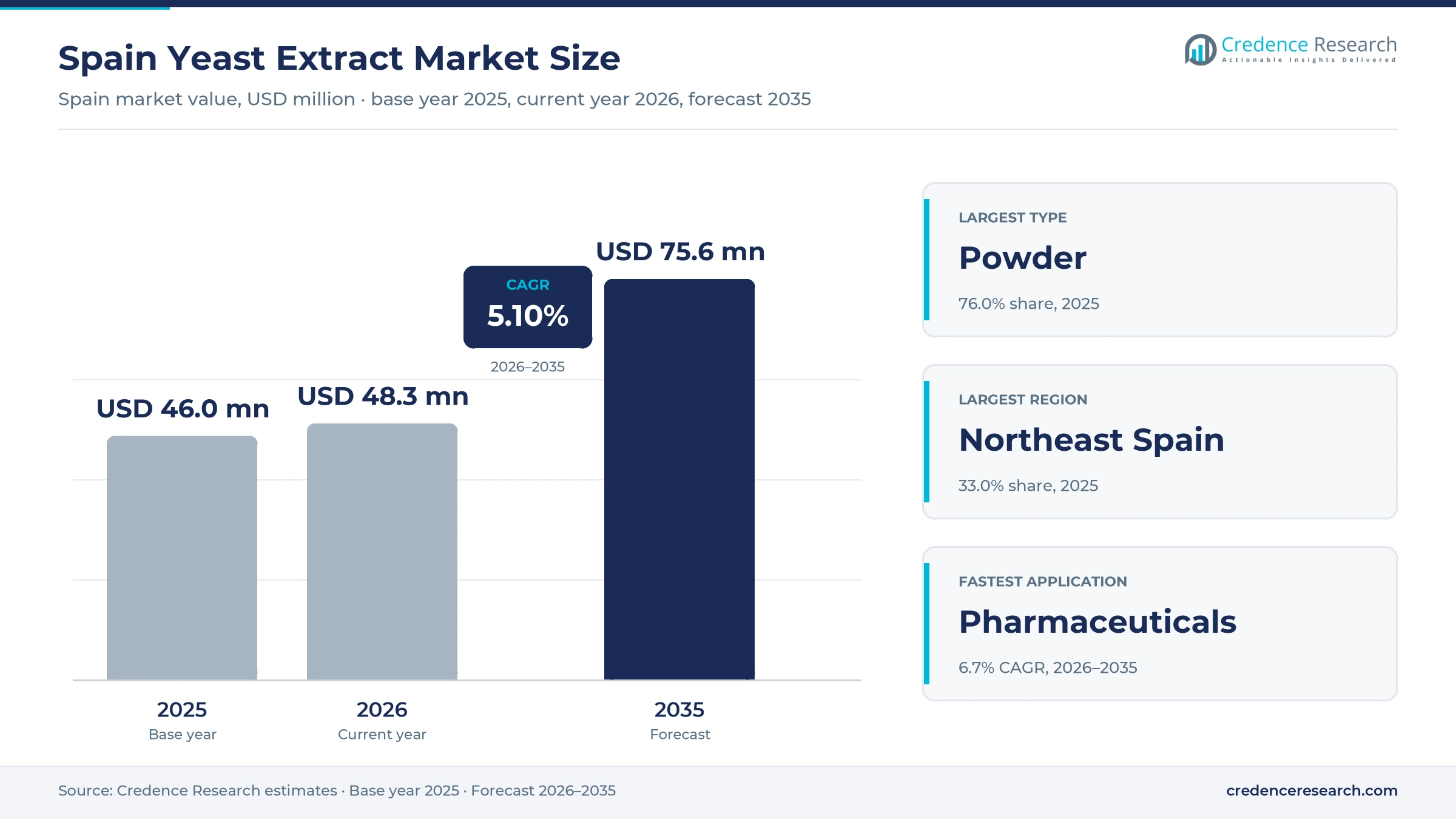
The Spain yeast extract market was valued at USD 46.0 million in 2025 and is projected to increase from USD 48.3 million in 2026 to USD 75.6 million by 2035, registering a CAGR of 5.10% during 2026–2035. Demand comes from broth, soup, sauce and processed meat makers that use savory grades to hold flavor at lower salt, from compound feed and pet food plants that buy yeast nutrients and palatants, and from fermentation users that need nitrogen and vitamin sources. Northeast Spain held the largest share, 33.0% in 2025, because Catalonia and Aragon combine the densest meat, feed and food processing base. Central Spain grows fastest at 5.5% a year, a Credence Research estimate based on feed and food plant demand in Castilla y León and the Madrid distributor base. The main commercial change is supplier consolidation, after Lesaffre took over dsm-firmenich's yeast extract business in 2024 and folded it into Biospringer, which narrows the field of Western suppliers Spanish buyers can tender between.
Imported savory grades serve broth, meat and feed makers
The market counts soluble extracts made by breaking down baker's or brewer's yeast cells through autolysis or added enzymes, then removing the cell walls and drying or concentrating the soluble fraction. Buyers are broth and soup makers, sauce and ready meal producers, cured and processed meat plants, compound feed mills, pet food makers and fermentation and pharmaceutical laboratories, which purchase powders and pastes on annual contract or through ingredient distributors.
Live and dried baker's yeast, selenium-enriched feed yeast, yeast cell walls and nutritional yeast flakes are wider yeast products and sit outside this market, although the same groups often sell them through one sales team. Finished seasoning blends and broth granules that contain yeast extract are counted only for their yeast extract content, not their full retail value.
Spain Yeast Extract Market Insights
- The Spain yeast extract market was valued at USD 46.0 million in 2025 and is projected to reach USD 75.6 million by 2035, growing at a 5.10% CAGR during 2026–2035.
- Northeast Spain held 33.0% of 2025 value, because Catalonia alone produced 21.9% of Spanish industrial turnover in 2024, according to INE.
- Powder held 76.0% of 2025 value, because broth granules, stock cubes and snack seasonings all take dry savory blends.
- Plain bread sold in Spain has been capped at 1.31 grams of salt per 100 grams since April 2022 under Royal Decree 308/2019.
- Pharmaceuticals grow fastest among applications at 6.7% a year during 2026–2035, as fermentation buyers pay for ultrafiltered and peptone grades.
Powder and baker's yeast lead as pharma grades grow fastest
Powder leads while paste gains in liquid broths
Based on type, the market is categorized into powder and paste. Powder led with 76.0% of 2025 value because broth granules, stock cubes and snack coatings need free-flowing dry blends, and Gallina Blanca's Avecrem chicken granules list yeast extract beside monosodium glutamate, Open Food Facts records show. Paste grows fastest at 5.6% a year as liquid broths and chilled ready meals expand, and the same brand's 1-liter vegetable broth lists yeast extract at under 2% of its recipe. Paste suits those wet formats because it dissolves without dust and adds body as well as taste.
Food leads while pharmaceutical grades grow fastest
Based on application, the market is categorized into food and beverages, pharmaceuticals, animal feed and others. Food & Beverages led with 70.0% of 2025 value because broths, sauces, cured meats and ready meals carry most savory dosing in an industry that produced EUR 162.4 billion of food and drink in 2024, according to FIAB. Pharmaceutical use grows fastest at 6.7% a year from a small base, as probiotics and biotech fermentation plants buy ultrafiltered and peptone grades, which Angel Yeast promoted to Spanish distributors at CPHI Barcelona in October 2023. Animal feed ranks second, carried by pork and pet food volume.
Baker's yeast leads as brewer's yeast gains on spent supply
Based on source, the market is categorized into baker's yeast and brewer's yeast. Baker's Yeast led with 66.0% of 2025 value because molasses-grown yeast gives food makers a neutral, consistent taste base and AB Mauri runs a yeast plant at Villarrubia, Córdoba, that supplies compressed and cream yeast to Spanish bakers. Brewer's Yeast grows fastest at 5.4% a year, as Spain is the second-largest beer producer in the EU and its brewers produced 4.0 billion liters of beer above 0.5% alcohol in 2024, 12.3% of EU output, according to Eurostat. That volume leaves a large spent-yeast stream for debittered extract and feed grades.
| Segment Group | Leading Sub-segment | Share, 2025 | Fastest-growing Sub-segment | CAGR, 2026–2035 |
|---|---|---|---|---|
| By Type | Powder | 76.0% | Paste | 5.6% |
| By Application | Food & Beverages | 70.0% | Pharmaceuticals | 6.7% |
| By Source | Baker's Yeast | 66.0% | Brewer's Yeast | 5.4% |
Grade and documentation set what buyers pay
Food-grade yeast extract sells on annual contract at a few euros per kilogram, while documented laboratory and fermentation grades sell at many times that price in small packs. Monosodium glutamate sets the reference price for savory taste, so extract suppliers must justify their premium through lower dosing, salt reduction or an E-number-free label. Delivered prices move with molasses and energy costs at French, German and Asian plants and with freight into Spain. Suppliers earn the highest margins on ultrafiltered and peptone grades, while feed grades compete with cheaper spent-yeast products.
| Product or grade | Typical price or fee | Basis |
|---|---|---|
| Savory yeast extract powder, food grade, bulk delivered | EUR 5 to 8 per kg | Credence Research estimate from contract price points and import costs |
| Yeast extract paste and high-nucleotide grades | EUR 7 to 12 per kg | Credence Research estimate from grade premiums |
| Brewer's yeast feed and palatant grades | EUR 1.5 to 3 per kg | Credence Research estimate from feed ingredient prices |
| Gibco laboratory yeast extract, 454 g | EUR 144.00 list (EUR 115.20 promotion) | Fisher Scientific Spain listing, November 2026 |
Request a Free Sample
Fill in your details and we'll send you a free sample report.
- Sample data tables & charts
- Research methodology
Salt limits, broths, pork feed and pet food lift use
Binding salt limits push savory reformulation
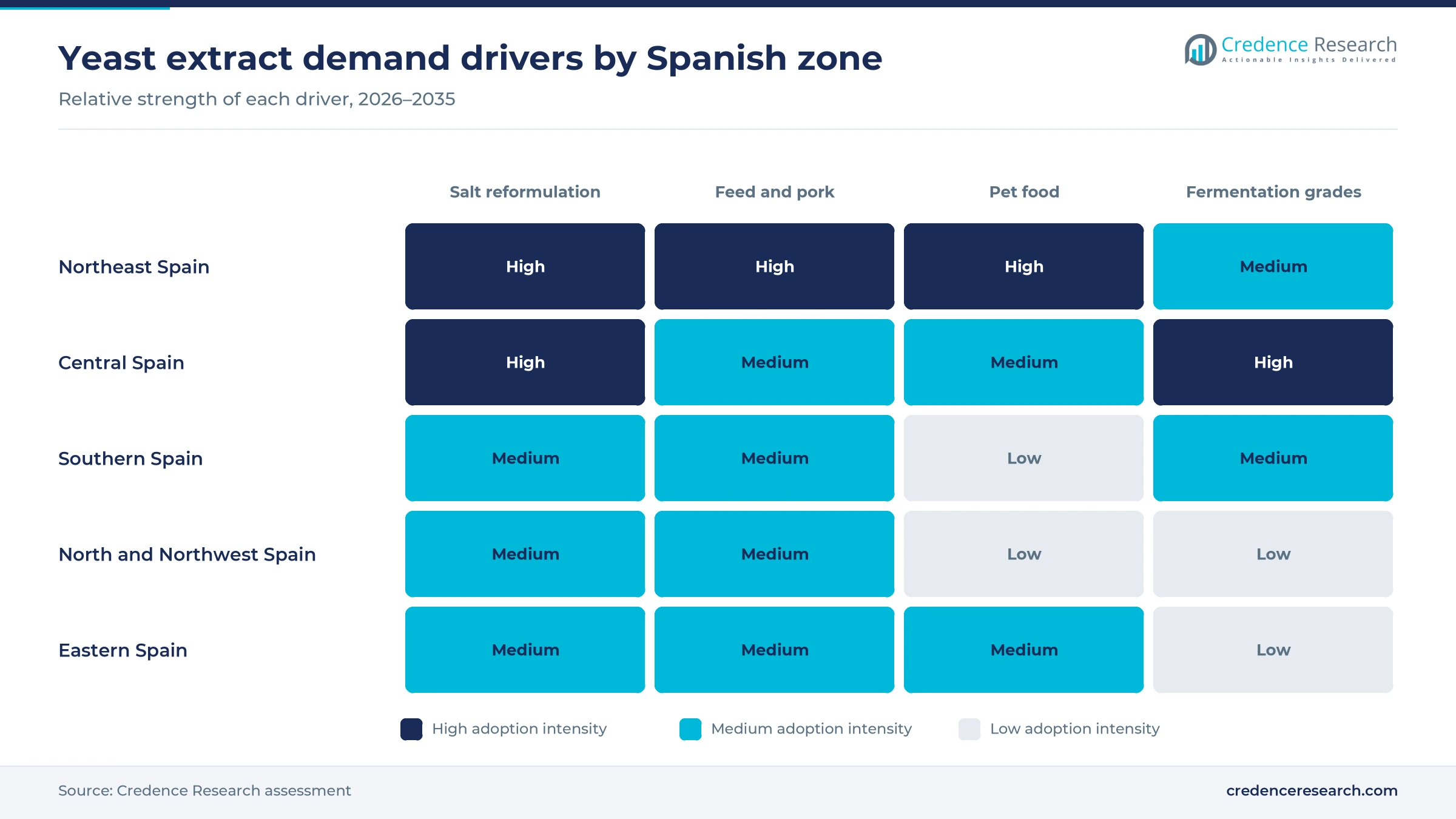
Spain regulates and negotiates salt content more tightly than most European markets, and yeast extract lets manufacturers hold savory intensity while sodium falls. Plain bread has been capped at 1.31 grams of salt per 100 grams since April 1, 2022, the agriculture ministry announced, after a delay granted to bakers. Under the 2020 collaboration plan, 398 food and beverage companies agreed through 20 sector agreements to cut sugar, saturated fat and salt by an average of 10%, the Ministry of Health said in January 2019. AESAN later reported that industry met 99% of the plan's objectives across more than 3,500 products. Sauce, broth and cured meat makers that reformulated under the plan are the suppliers' core customer base.
Broth and ready meal makers rely on savory bases
Broth, soup and ready meal producers use the most yeast extract per kilogram of product, because liquid and granulated stocks need a dense savory base that salt alone cannot supply. Spanish food and drink exports reached EUR 51.1 billion in 2024, up 7.2%, FIAB data reported by Interempresas show, which extends the reach of domestic recipes into export lines. GB Foods, owner of Gallina Blanca, plans a EUR 50 million investment, reported in March 2025, to add two lines at its Alcañiz plant in Teruel, mainly for Yatekomo noodle dishes, La Comarca reported. As the type analysis shows, the brand already doses yeast extract in both granules and carton broths. Suppliers with low-dose, clean-tasting grades gain when these brands extend ranges.
Pork and compound feed output widen nutrient demand
Feed mills buy yeast extract for nucleotides, peptides and palatability, so Spain's livestock scale creates a second demand base beside food. Spain produced 38.8 million metric tons of compound feed in 2024, up 1.5%, a volume that anchors feed-grade demand for yeast nutrients, the agriculture ministry said in September 2025. Spain also produced 5.0 million metric tons of pig meat in 2024, 23.5% of the EU total, according to Eurostat figures cited by The Pig Site. Phileo by Lesaffre opened a selenium-yeast plant in Valladolid in June 2023 for this animal nutrition demand. Suppliers of feed additives with piglet and broiler trial data gain most from this base.
Pet food growth adds demand for palatant grades
Pet food makers use yeast extract as a palatant, because cats and dogs respond to the same savory peptides and nucleotides that food makers buy. Spanish pet food sales rose 6.1% to about EUR 2.18 billion in 2025, PetfoodIndustry reported from ANFAAC data. Cat food sales rose 12.2%, far faster than dog food at 1.1%, which lifts demand in the wet and premium formats where palatants matter most. Spanish plants also export part of this output, so palatant contracts follow factory volume rather than household spending alone. Palatant suppliers that already serve European pet food plants are best placed for these contracts.
Supplier consolidation and spent-yeast reuse reshape supply
Supplier consolidation is narrowing the Western field
Western yeast groups are shifting toward fewer, larger extract businesses to address cost and scale pressure, which leaves Spanish buyers with fewer independent sources across savory and fermentation applications. Lesaffre announced on June 12, 2024, that it would buy dsm-firmenich's yeast extract business and completed the deal on Oct. 2, 2024, its press release states. The 46 employees, processing technologies and products moved into Biospringer, which promised access to its global manufacturing network and local supply. Lesaffre already operates a Valladolid site through Lesaffre Ibérica. Buyers that held two of the merged suppliers on one approved list now need a second qualified source, which strengthens the position of Ohly, Leiber and Angel Yeast in tenders.
Brewers' spent yeast is moving into ingredient uses
Brewers and yeast processors are shifting spent yeast from feed and disposal toward higher-value extracts to address circular economy targets, creating openings for brewer's yeast grades across seasonings and feed. Three large groups produced about 83% of national beer volume, the Mercasa review shows, which concentrates the spent yeast from Spain's 4.0 billion liters of annual beer output at a few large breweries. Spain's Aplicaciones Biológicas a la Nutrición, a family firm of about 50 staff that processes brewers' yeast, has joined forces with Germany's Leiber, now part of Asahi Group, to sell brewer's yeast food and feed products across Europe, Aquafeed reported. Neither company has published volumes, so the scale of new local supply remains an evidence gap.
Fermentation buyers open demand for nutrient grades
Pharmaceutical and biotech fermentation is an opening for nutrient-grade yeast extract, because microbes producing probiotics, enzymes and biologics need steady nitrogen, peptides and vitamins with full documentation. Angel Yeast showed its ultrafiltered extract FM888 and a yeast peptone at the CPHI exhibition in Barcelona on Oct. 24-26, 2023, hosting distributors and major users from Spain. Kerry bought the Spanish probiotics maker Biosearch Life for EUR 126.9 million, FoodNavigator reported, which adds a local fermentation buyer. A 454-gram laboratory pack lists at EUR 144.00 in Spain, which shows the value of documented demand. Suppliers that also serve cell culture media makers can cross-sell documented grades into this base.
Plant-based and clean-label recipes open savory demand
Clean-label and plant-based recipes are an opening for yeast extract, because it is declared as a food ingredient rather than an additive with an E-number, while monosodium glutamate is an additive declared as E621, as Spanish broth labels show. ABF Ingredients says Ohly dark yeast extracts add roasted, meaty notes and color to plant-based meat alternatives. Kerry's Barcelona innovation center, opened in March 2023 within an Iberian investment above EUR 200 million over four years, lists taste and plant-based foods among its focus areas. Gallina Blanca already puts yeast extract at under 2% of a carton broth recipe, a dose that plant-based brands can copy. No Spanish brand publishes its total use, so this opening is a Credence Research estimate. Makers of natural flavors are the likeliest partners, because they blend extracts into finished taste systems.
MSG pricing, falling beer volumes and imports weigh
Monosodium glutamate caps savory grade prices
Monosodium glutamate caps what price-sensitive buyers will pay for yeast extract, because both deliver glutamate-driven savory taste and broth makers already blend them. Avecrem chicken granules carry 59.75 grams of salt per 100 grams and list monosodium glutamate (E621) beside yeast extract, Open Food Facts records show. Granule and cube makers on tight shelf prices are most exposed, so extract suppliers must sell on dose efficiency and label benefits.
Falling beer volumes limit brewer's yeast feedstock
Brewer's yeast extract depends on beer output, and Spanish volumes are drifting lower. Beer sales fell 0.2% to 38.6 million hectoliters in 2024 and per capita consumption dropped 4.9% to 52.8 liters, Forbes España reported from Cerveceros de España data in June 2025. The number of registered brewing companies fell by 24 in 2024, to 432. Processors that plan extract lines around spent yeast carry the most exposure if volumes keep slipping, because feedstock cost rises as collection points thin out.
No successor salt plan slows the policy pull
Policy pull weakens when reformulation targets expire, and AESAN's plan page names no successor to the 2020 collaboration plan, whose goals ran to the end of 2020. Spain already holds the top Sodium Country Score of 4 in the WHO's March 2023 sodium report, so further gains depend on voluntary brand action outside bread. Suppliers that sized capacity around steady policy-driven reformulation are most exposed, because new briefs now depend on each brand's own health and labeling strategy.
Import reliance exposes buyers to freight and supply shifts
Spain has no publicly documented commercial yeast extract plant, so buyers rely on grades made in France, Germany and Asia. The local yeast sites make other products, as AB Mauri's Córdoba plant produces compressed, cream and crumbled yeast, and the Valladolid plant opened in June 2023 makes selenium-enriched feed yeast. Seasoning and meat processors without annual contracts are most exposed when freight costs or supplier allocation change after the 2024 consolidation.
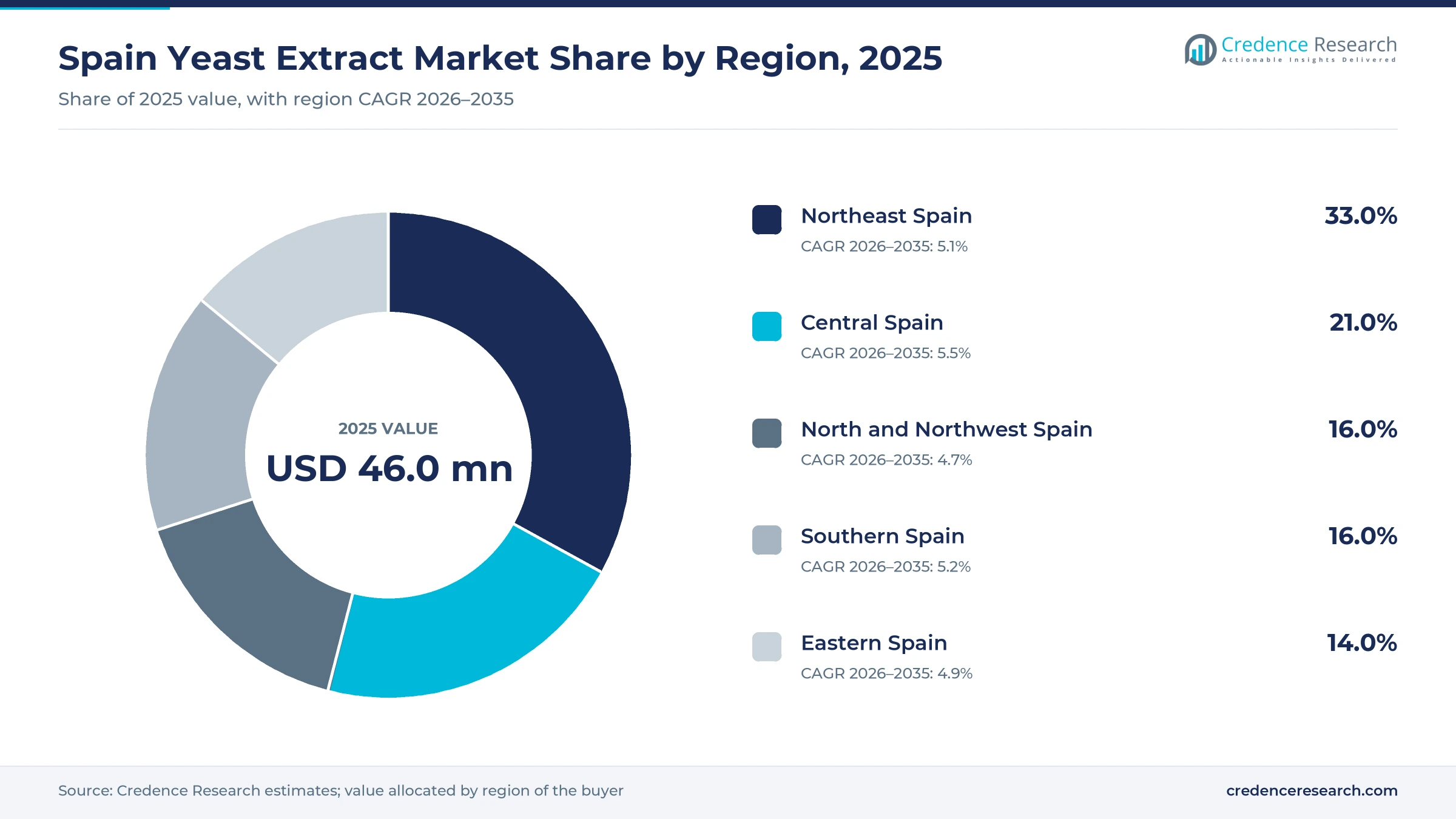
Northeast Spain leads while Central Spain grows fastest
| Region | Value, 2025 (USD million) | Share, 2025 | CAGR, 2026–2035 |
|---|---|---|---|
| Northeast Spain | 15.2 | 33.0% | 5.1% |
| Central Spain | 9.7 | 21.0% | 5.5% |
| North and Northwest Spain | 7.4 | 16.0% | 4.7% |
| Southern Spain | 7.4 | 16.0% | 5.2% |
| Eastern Spain | 6.4 | 14.0% | 4.9% |
Northeast Spain leads on pork, feed and broth plants
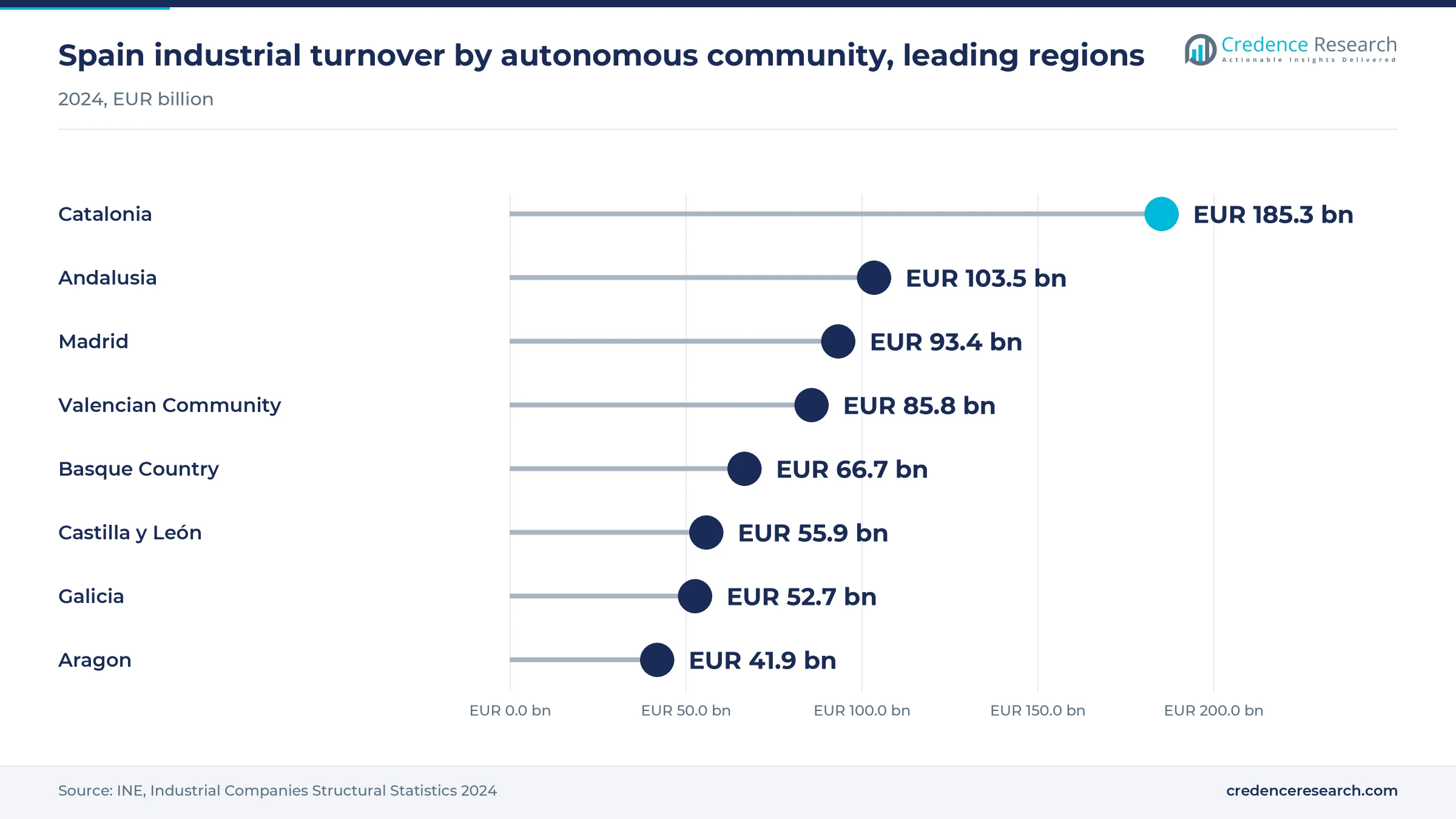
Northeast Spain, covering Catalonia, Aragon, Navarre, La Rioja and the Balearic Islands, held 33.0% of 2025 value and grows at 5.1% a year. Pork processors, compound feed mills and broth makers cluster here, and GB Foods is expanding its Alcañiz plant in Aragon for noodle dishes. Catalonia alone generated EUR 185.3 billion of industrial turnover in 2024, according to INE industrial statistics, and Kerry's Barcelona labs serve brand owners nearby. These buyers place the largest savory and feed-grade contracts in the country.
Central Spain grows fastest on feed plants and distribution
Central Spain, covering Madrid, Castilla y León and Castilla-La Mancha, held 21.0% of 2025 value and grows fastest at 5.5% a year. Madrid and Castilla y León together produced EUR 149.3 billion of industrial turnover in 2024, INE data show, which gives Madrid distributors a dense base of food and feed plants within a day's delivery. Lesaffre's Valladolid site added the Phileo feed yeast plant in 2023, which puts yeast application staff close to the region's feed mills, although the plant does not make extract.
Southern Spain builds on olive, vegetable and meat processors
Southern Spain, covering Andalusia, Extremadura, the Canary Islands, Ceuta and Melilla, held 16.0% of 2025 value and grows at 5.2% a year. Andalusia ranks second among Spanish regions by industrial turnover, INE data show and its olive, vegetable and meat processors give it a broad savory base. AB Mauri's Córdoba yeast plant supplies bakers, and Kerry's Granada technology center supports local brand owners. Zone-level ingredient data are thin, so the share is a Credence Research estimate.
North and Northwest Spain rests on Basque and Galician food
North and Northwest Spain, covering the Basque Country, Galicia, Asturias and Cantabria, held 16.0% of 2025 value and grows at 4.7% a year, the slowest pace. Fish, dairy and canned food processors buy most volume here, mainly for broths and seafood seasonings, and Kerry runs a technology center in Vigo close to Galician plants. Heavy industry dominates Basque turnover of EUR 66.7 billion in 2024, INE data show, so the food share is a Credence Research estimate.
Eastern Spain buys for ready meals and food exports
Eastern Spain, covering the Valencian Community and Murcia, held 14.0% of 2025 value and grows at 4.9% a year. Valencia and Murcia host a dense cluster of ready meal, sauce and processed vegetable plants that ship to export customers, with combined industrial turnover of EUR 118.2 billion in 2024, INE data show. These buyers order mostly through distributors based in Barcelona and Madrid. No zone purchase data are published, so the share rests on industrial output and plant locations.
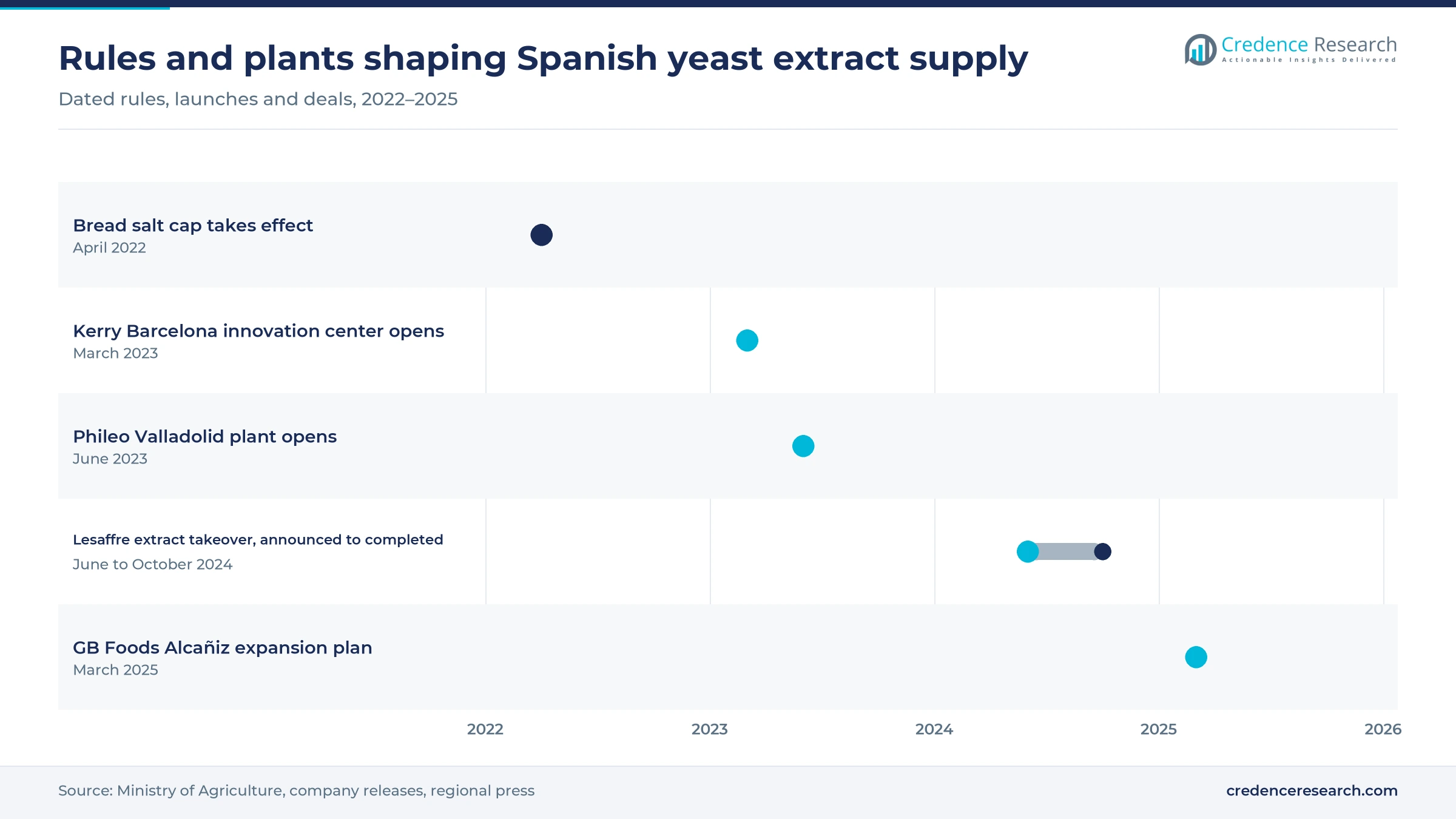
Plant openings and a supplier takeover mark 2022 to 2025
| Development | Status and market relevance |
|---|---|
| In April 2022, Spain's salt cap of 1.31 grams per 100 grams for plain bread took effect under Royal Decree 308/2019. | Regulation in force; it is the clearest binding salt limit and keeps bakery and savory reformulation on supplier agendas. |
| In March 2023, Kerry opened its Southern Europe innovation center in Barcelona with a customer suite and applications labs. | Operational launch; it puts taste and plant-based application teams close to Spanish and Portuguese brand owners. |
| In June 2023, Phileo by Lesaffre opened its selenium-enriched yeast plant at Valladolid for the animal nutrition sector. | Completed investment; it adds yeast processing capacity in Spain, although the line makes feed yeast rather than extract. |
| In October 2024, Lesaffre completed its purchase of dsm-firmenich's yeast extract business and merged it into Biospringer. | Completed acquisition, announced in June 2024; it reduces the number of independent Western extract suppliers. |
| In March 2025, GB Foods received the building permit for a EUR 50 million expansion of its Alcañiz plant with two new lines. | Plan with building permit; start-up was targeted for the end of 2025 and has not been confirmed publicly. |
Autolysis, filtration and drying set taste and cost
- Autolysis lets the yeast's own enzymes break down proteins at controlled heat, which keeps costs low and gives a rounded broth taste.
- Enzymatic hydrolysis adds proteases and nucleases to raise free amino acids and nucleotides, which suppliers use for low-dose, high-umami grades.
- Ultrafiltration removes larger molecules and color to produce clear, low-ash grades, which fermentation and pharmaceutical buyers require.
- Debittering strips hop compounds from spent brewer's yeast before extraction, which decides whether brewery feedstock can reach food grades.
Need a Custom Version of This Report?
Tailor the scope, geography, or segments to your exact requirements.
- Custom geography or segment scope
- Direct access to our analyst team
Application labs and grade breadth decide position
Competition turns on grade breadth, application support for broth and meat makers and the ability to deliver documented grades through Spanish distributors. Lesaffre now sells the widest Western savory range through Biospringer, after the 2024 takeover described above, and runs Lesaffre Ibérica in Valladolid. Associated British Foods competes through AB Mauri, which makes baker's yeast at Córdoba, and through Ohly extracts. Leiber supplies brewer's yeast extracts and works with the Spanish processor ABN on spent-yeast products. Angel Yeast sells savory and fermentation grades through Spanish distributors. Kerry competes on finished taste systems from its Barcelona labs, Lallemand serves food, feed and fermentation users from Barcelona, and Alltech sells yeast-based feed nutrition through its Spanish unit. Broth makers such as GB Foods are large buyers and, through their own enhancer blends, also decide how much extract each recipe uses.
A few European and Asian groups supply most volume
The supply side is concentrated in a handful of fermentation groups that sell into Spain through subsidiaries and ingredient distributors. Lesaffre through Biospringer, Associated British Foods through Ohly, Leiber, Lallemand and Angel Yeast make extracts abroad, while the Spanish yeast plants at Córdoba and Valladolid make baker's and feed yeast. Entry barriers are high, because an extract plant needs fermenters, separators, effluent treatment and steady molasses or spent yeast. Margins sit with producers that hold specialty grades and with distributors that run application support for meat and broth makers.
Eight suppliers that Spanish buyers shortlist
| Company | Type | Role in the market |
|---|---|---|
| Lesaffre Group (Biospringer) | Full-line supplier | Biospringer savory and fermentation yeast extracts; Lesaffre Ibérica site in Valladolid |
| Associated British Foods plc (AB Mauri, Ohly) | Yeast maker and specialist | AB Mauri yeast from Córdoba; Ohly yeast extracts and dark grades |
| Angel Yeast Co., Ltd. | Full-line supplier | Savory, ultrafiltered and peptone yeast products sold through Spanish distributors |
| Leiber GmbH (Asahi Group Foods) | Specialist | Brewer's yeast extracts for seasonings, feed and fermentation media |
| Aplicaciones Biológicas a la Nutrición S.L. (ABN) | Local processor | Spanish brewer's yeast food and feed products, partnered with Leiber |
| Kerry Group plc | Taste and ingredient supplier | Yeast-based umami ingredients and taste systems from Barcelona application labs |
| Lallemand Inc. (Lallemand Bio-Ingredients) | Specialist | Yeast extracts and nutrients; Lallemand Bio SL serves Spain from Barcelona |
| Alltech, Inc. | Feed specialist | Yeast-based feed nutrition products sold through Alltech Spain |
Value shifts toward low-sodium and fermentation grades
Credence Research's view is that value in Spain is moving from basic savory powders toward low-sodium broth grades, palatants and documented fermentation nutrients, where consistency earns higher prices. The market stays import-led, so distributor reach and application labs matter more than local plant capacity. Monosodium glutamate keeps a firm ceiling on prices for granule and cube grades. Buyers should qualify a second source for critical grades, because the 2024 consolidation narrowed the Western supplier field and no Spanish extract plant offers a domestic fallback.
Salt policy, feed, brewing and plant data anchor it
The report uses 2025 as the base year and 2026 to 2035 as the forecast period. Market values come from the Credence Research model, checked against salt policy records, compound feed and pork statistics, brewing data, pet food sales, retail ingredient lists, price listings and company disclosures. Zone, type, application and source splits are Credence Research estimates built from these public sources and from INE industrial turnover by region. The estimates do not rely on interviews or surveys conducted by Credence Research, and no domestic yeast extract production or trade data were available.
Reformulation and animal nutrition carry growth to 2035
Value rises from USD 48.3 million in 2026 to USD 75.6 million by 2035, with broth reformulation, animal feed and pet food adding most new volume. Northeast Spain keeps the largest base, while Central Spain adds share as feed and food plants in Castilla y León and Madrid widen use. The fate of national reformulation policy, beer volumes and the price gap to monosodium glutamate will decide where growth lands within the scenario range. Suppliers with low-sodium grades, palatant data and local application support are best placed to 2035.
Reformulation pace and feed volumes decide the range
The base case assumes steady brand-led reformulation, stable pork and feed output and continued pet food growth. The downside follows if no successor salt plan emerges, beer volumes keep falling and broth makers lean harder on cheaper monosodium glutamate. The upside requires a new national reformulation agreement with sodium targets for broths, sauces and cured meats, plus faster growth in fermentation and pet food demand.
| Scenario | CAGR, 2026–2035 | Value, 2035 | What has to hold |
|---|---|---|---|
| Downside | 3.7% | USD 67.0 million | No new salt plan, weaker beer output and a shift back to cheaper enhancers |
| Base | 5.10% | USD 75.6 million | Brand-led salt cuts continue while feed and pet food volumes grow steadily |
| Upside | 6.3% | USD 83.8 million | A new reformulation agreement sets sodium targets and fermentation demand scales up |
Frequently Asked Questions
How big is the Spain yeast extract market?
Why do Spanish food makers use yeast extract?
Is there a yeast extract plant in Spain?
Which yeast suppliers are active in Spain?
Which type and source lead the market?
Which region of Spain buys the most yeast extract?
How does pet food affect yeast extract demand in Spain?
What limits growth in Spanish yeast extract demand?
Table of Content
Chapter 1 Market Segmentation
- 1.1 Segmentation Framework
- 1.1.1 Product and Service Classification
- 1.1.2 Application and End-Use Classification
- 1.1.3 Technology and Solution Classification
- 1.1.4 Customer and Distribution Channel Classification
- 1.1.5 Geographic Segmentation
- 1.1.6 Market Segment Definitions and Boundaries
- 1.2 By Type
- 1.2.1 Powder
- 1.2.2 Paste
- 1.3 By Application
- 1.3.1 Food & Beverages
- 1.3.2 Pharmaceuticals
- 1.3.3 Animal Feed
- 1.3.4 Others
- 1.4 By Source
- 1.4.1 Baker's Yeast
- 1.4.2 Brewer's Yeast
Chapter 2 Introduction
- 2.1 Report Objectives and Scope
- 2.2 Product Definition and Industry Terminology
- 2.3 Market Inclusions and Exclusions
- 2.4 Research Process
- 2.4.1 Primary Research and Expert Interviews
- 2.4.2 Secondary Research and Source Review
- 2.4.3 Top-Down and Bottom-Up Estimation
- 2.4.4 Data Triangulation and Verification
- 2.5 Market Size Measurement Basis
- 2.5.1 2025: USD 46.0 million → 2035: USD 75.6 million
- 2.6 Historical and Forecast Reference Periods
- 2.6.1 Historical Period: 2018-2025
- 2.6.2 Base Year: 2025
- 2.6.3 Forecast Period: 2025-2035
- 2.7 Research Assumptions and Limitations
Chapter 3 Executive Summary
- 3.1 Market Snapshot and Key Findings
- 3.2 Base-Year Market Size, 2025
- 3.3 Forecast Market Size, 2035
- 3.4 Revenue and Volume Growth Outlook
- 3.5 Key Demand and Supply Indicators
- 3.6 Leading Market Segments
- 3.7 Fastest-Growing Market Opportunities
- 3.8 Regional Performance Highlights
- 3.9 Technology and Industry Transformation
- 3.10 Competitive Landscape Summary
- 3.11 Analyst View and Strategic Implications
Chapter 4 Spain Yeast Extract Market Trends and Developments
- 4.1 Historical Industry Development, 2018-2025
- 4.2 Recent Market Trends and Developments
- 4.3 Demand and Customer Behavior Trends
- 4.4 Technology and Product Innovation
- 4.5 Artificial Intelligence, Automation and Digitalization
- 4.6 Local Manufacturing and Supply Chain Realignment
- 4.7 Industry Partnerships, Mergers and Acquisitions
- 4.8 Sustainability and Circular Economy Developments
- 4.9 Government and Private Sector Investment Trends
- 4.10 Emerging Business Models and Commercialization
- 4.11 Industry Developments and Announcements
Chapter 5 Spain Yeast Extract Market Production, Supply and Demand Analysis
- 5.1 Demand Trend and Consumption Analysis, 2018-2025
- 5.2 Demand Forecast, 2025-2035
- 5.3 Production and Output Trend, 2018-2025
- 5.4 Production and Output Forecast, 2025-2035
- 5.5 Installed Capacity and Capacity Utilization
- 5.6 Company-Wise Production Plants and Statistics
- 5.6.1 Installed Production Capacity
- 5.6.2 Actual Production
- 5.6.3 Planned Capacity and Expansion Targets
- 5.7 Supply Chain Structure and Procurement Trends
- 5.8 Supply-Demand Gap and Bottlenecks
- 5.9 Import Dependence and Sourcing Structure
- 5.10 Contract Manufacturing and Outsourcing
- 5.11 Regional Supply and Demand Concentration
Chapter 6 Spain Yeast Extract Market Pricing Analysis
- 6.1 Pricing Structure and Measurement
- 6.2 Historical Pricing Trends, 2018-2025
- 6.3 Pricing Outlook, 2025-2035
- 6.4 Average Selling Price and Unit Economics
- 6.5 Pricing by Product and Market Segment
- 6.6 Geographic Pricing Differences
- 6.7 Key Input, Energy, Labor and Logistics Costs
- 6.8 Contract Pricing and Purchasing Models
- 6.9 Pricing Sensitivity and Competitive Positioning
- 6.10 Price, Margin and Profitability Implications
Chapter 7 Spain Yeast Extract Market Dynamics
- 7.1 Market Growth Drivers
- 7.1.1 Demand-Side Drivers
- 7.1.2 Technology and Innovation Drivers
- 7.1.3 Infrastructure and Investment Drivers
- 7.1.4 Regulatory and Policy Drivers
- 7.2 Market Restraints
- 7.2.1 Cost and Affordability Constraints
- 7.2.2 Technology and Adoption Barriers
- 7.2.3 Supply Chain and Operational Constraints
- 7.3 Market Challenges
- 7.3.1 Competitive Pressure and Margin Erosion
- 7.3.2 Skills, Infrastructure and Implementation Gaps
- 7.4 Emerging Market Opportunities
- 7.5 Market Dynamics Impact and Time-Horizon Assessment
Chapter 8 Spain Yeast Extract Value Chain Analysis
- 8.1 Industry Value Chain Overview
- 8.2 Upstream Suppliers and Critical Inputs
- 8.3 Technology and Component Providers
- 8.4 Manufacturing or Service Delivery
- 8.5 Distribution, Channel Partners and Integrators
- 8.6 Downstream Applications and End Users
- 8.7 Value Addition and Profit Pools
- 8.8 Vertical Integration and Outsourcing
- 8.9 Supplier Concentration and Risk
- 8.10 Supply Chain Localization and Resilience
Chapter 9 Spain Yeast Extract Market Regulations and Policies
- 9.1 Relevant Laws, Standards and Compliance Frameworks
- 9.2 Product, Service, Safety and Quality Requirements
- 9.3 Government Policies, Incentives and Subsidies
- 9.4 Imports, Exports and Trade Barriers
- 9.5 Public Procurement and Local Content Requirements
- 9.6 Environmental and Sustainability Compliance
- 9.7 Upcoming Policy Changes and Market Implications
Chapter 10 Spain Yeast Extract Market Hotspots and Opportunities
- 10.1 Market Opportunity Mapping and Growth Hotspots
- 10.2 High-Growth Applications and Customer Groups
- 10.3 Underserved Markets and White-Space Opportunities
- 10.4 Emerging Technology and Product Opportunities
- 10.5 New Capacity and Investment Hotspots
- 10.6 Market Entry and Expansion Opportunities
- 10.7 Distribution and Partnership Opportunities
- 10.8 Near-Term and Long-Term Commercial Potential
- 10.9 Opportunity Attractiveness and Execution Risks
Chapter 11 Spain Yeast Extract Market Outlook, 2025-2035
- 11.1 Market Size and Analysis
- 11.1.1 Revenue (Market Measurement: 2025: USD 46.0 million → 2035: USD 75.6 million)
- 11.1.2 Market Volume and Quantity Sold
- 11.1.3 Historical Market Size, 2018-2025
- 11.1.4 Base-Year Market Size, 2025
- 11.2 Market Forecast, 2025-2035
- 11.2.1 Revenue Forecast to 2035
- 11.2.2 Volume Forecast to 2035
- 11.2.3 CAGR and Year-on-Year Growth
- 11.2.4 Incremental Revenue Opportunity
- 11.3 Forecast Assumptions and Scenario Analysis
- 11.3.1 Base-Case Forecast
- 11.3.2 Optimistic and Conservative Scenarios
- 11.3.3 Technology, Pricing and Policy Sensitivities
- 11.4 Market Attractiveness and Growth Outlook
Chapter 12 Spain Yeast Extract Market Segmentation and Outlook
- 12.1 Segmentation Summary and Market Shares, 2025
- 12.2 Largest and Fastest-Growing Segments
- 12.3 By Type - Market Size and Forecast, 2025-2035
- 12.3.1 Segment Definition and Scope
- 12.3.2 Historical Market Size, 2018-2025
- 12.3.3 Revenue Forecast, 2025-2035
- 12.3.4 Volume Forecast, 2025-2035
- 12.3.5 Base-Year Market Share, 2025
- 12.3.6 Segment CAGR and Growth Drivers
- 12.3.7 Subsegment Market Size and Forecast
- 12.3.7.1 Powder
- 12.3.7.2 Paste
- 12.3.8 Subsegment Pricing and Adoption Trends
- 12.3.9 Leading Suppliers and Competition
- 12.3.10 Regional Demand and Opportunities
- 12.4 By Application - Market Size and Forecast, 2025-2035
- 12.4.1 Segment Definition and Scope
- 12.4.2 Historical Market Size, 2018-2025
- 12.4.3 Revenue Forecast, 2025-2035
- 12.4.4 Volume Forecast, 2025-2035
- 12.4.5 Base-Year Market Share, 2025
- 12.4.6 Segment CAGR and Growth Drivers
- 12.4.7 Subsegment Market Size and Forecast
- 12.4.7.1 Food & Beverages
- 12.4.7.2 Pharmaceuticals
- 12.4.7.3 Animal Feed
- 12.4.7.4 Others
- 12.4.8 Subsegment Pricing and Adoption Trends
- 12.4.9 Leading Suppliers and Competition
- 12.4.10 Regional Demand and Opportunities
- 12.5 By Source - Market Size and Forecast, 2025-2035
- 12.5.1 Segment Definition and Scope
- 12.5.2 Historical Market Size, 2018-2025
- 12.5.3 Revenue Forecast, 2025-2035
- 12.5.4 Volume Forecast, 2025-2035
- 12.5.5 Base-Year Market Share, 2025
- 12.5.6 Segment CAGR and Growth Drivers
- 12.5.7 Subsegment Market Size and Forecast
- 12.5.7.1 Baker's Yeast
- 12.5.7.2 Brewer's Yeast
- 12.5.8 Subsegment Pricing and Adoption Trends
- 12.5.9 Leading Suppliers and Competition
- 12.5.10 Regional Demand and Opportunities
- 12.6 Segment Growth Comparison
- 12.7 Segment Attractiveness and Priority Matrix
Chapter 13 Spain Yeast Extract End-Use and Application Market Outlook
- 13.1 End-Use Industry and Customer Demand Structure
- 13.2 Leading Applications and Customer Groups
- 13.3 End-Use Market Size, Share and Forecast
- 13.4 Major End-Use Industry Deep Dives
- 13.4.1 Customer Requirements and Use Cases
- 13.4.2 Demand and Replacement Cycles
- 13.4.3 Technical and Regulatory Considerations
- 13.4.4 Purchasing and Procurement Models
- 13.4.5 Leading Vendors and Distribution Channels
- 13.4.6 Forecast and Commercial Opportunities
- 13.5 Emerging Applications and Cross-Segment Demand
- 13.6 End-Use Industry Investment Priorities
Chapter 14 Spain Yeast Extract Geographic Market Outlook, 2025-2035
- 14.1 Domestic Market Distribution and Demand Clusters
- 14.2 State- or Province-Wise Market Size and Forecast, 2025-2035
- 14.3 City and Metropolitan Market Outlook
- 14.4 Industrial, Manufacturing and Commercial Clusters
- 14.5 Geographic Concentration of Key End Users
- 14.6 Local Pricing and Purchasing Differences
- 14.7 Domestic Production Facilities and Capacity Map
- 14.8 Local Infrastructure and Project Pipeline
- 14.9 State-Level Policy and Incentive Differences
- 14.10 Subnational Investment Hotspots and Opportunities
- 14.11 Distribution and Logistics Networks
- 14.12 Domestic Competitive Footprint
Chapter 15 Spain Yeast Extract Technology, Innovation and Sustainability Outlook
- 15.1 Technology Landscape and Maturity
- 15.2 Product, Process and Service Innovation
- 15.3 AI, Automation and Digital Tools in the Industry
- 15.4 Technology Adoption and Performance Benchmarking
- 15.5 Innovation Pipeline and R&D Investment
- 15.6 Patent and Intellectual Property Trends
- 15.7 Energy Efficiency and Resource Management
- 15.8 Sustainability, Recycling and Circularity
- 15.9 Technology Roadmap, 2025-2035
- 15.10 Risks of Obsolescence and Technology Substitution
Chapter 16 Spain Yeast Extract Market Key Strategic Imperatives
- 16.1 Growth and Market Entry Priorities
- 16.2 High-Return Products and Segments
- 16.3 Pricing, Profitability and Cost Optimization
- 16.4 Technology Investment and Product Differentiation
- 16.5 Supply Chain Localization and Resilience
- 16.6 Distribution and Customer Acquisition
- 16.7 Partnership, Acquisition and Capacity Strategy
- 16.8 Regional Expansion Priorities
- 16.9 Short-, Medium- and Long-Term Actions
Chapter 17 Competition Outlook
- 17.1 Industry Competition Characteristics
- 17.2 Market Structure and Concentration
- 17.3 Market Share and Competitive Positioning, 2025
- 17.4 Company-Wise Revenue and Product Benchmarking
- 17.5 Production and Service Capacity Benchmarking
- 17.6 Technology, Pricing and Differentiation
- 17.7 Regional Footprint and Distribution Strength
- 17.8 Mergers, Acquisitions and Strategic Alliances
- 17.9 New Entrants and Competitive Threats
- 17.10 Porter's Five Forces and Industry Attractiveness
- 17.11 Competitive Outlook, 2025-2035
Chapter 18 Company Profiles
- 18.1 Company Coverage and Selection Criteria
- 18.2 Lesaffre Group (Biospringer)
- 18.2.1 Business Description
- 18.2.2 Company Ownership and Geographic Presence
- 18.2.3 Product and Service Portfolio
- 18.2.4 Manufacturing and Operating Footprint
- 18.2.5 Production Capacity and Expansion Plans
- 18.2.6 Financial Performance and Investment
- 18.2.7 Market Share and Competitive Position
- 18.2.8 Technology and Innovation Capabilities
- 18.2.9 Strategic Alliances or Partnerships
- 18.2.10 Recent Developments
- 18.2.11 Growth Strategy and Outlook
- 18.3 Associated British Foods plc (AB Mauri, Ohly)
- 18.4 Angel Yeast Co., Ltd.
- 18.5 Leiber GmbH (Asahi Group Foods)
- 18.6 Aplicaciones Biológicas a la Nutrición S.L. (ABN)
- 18.7 Kerry Group plc
- 18.8 Lallemand Inc. (Lallemand Bio-Ingredients)
- 18.9 Alltech, Inc.
- 18.10 Other Relevant Market Participants
Note: Every listed company is profiled on the structure shown under the first company. The company list is preliminary and may change based on research findings, market developments, data availability and client requirements.
Chapter 19 Disclaimer
- 19.1 Research and Forecast Disclaimer
- 19.2 Data Source and Estimation Limitations
Note: The depth of individual sections depends on data availability for this market. Volume, capacity, trade and other unit-based metrics are included where applicable.