
Market Overview
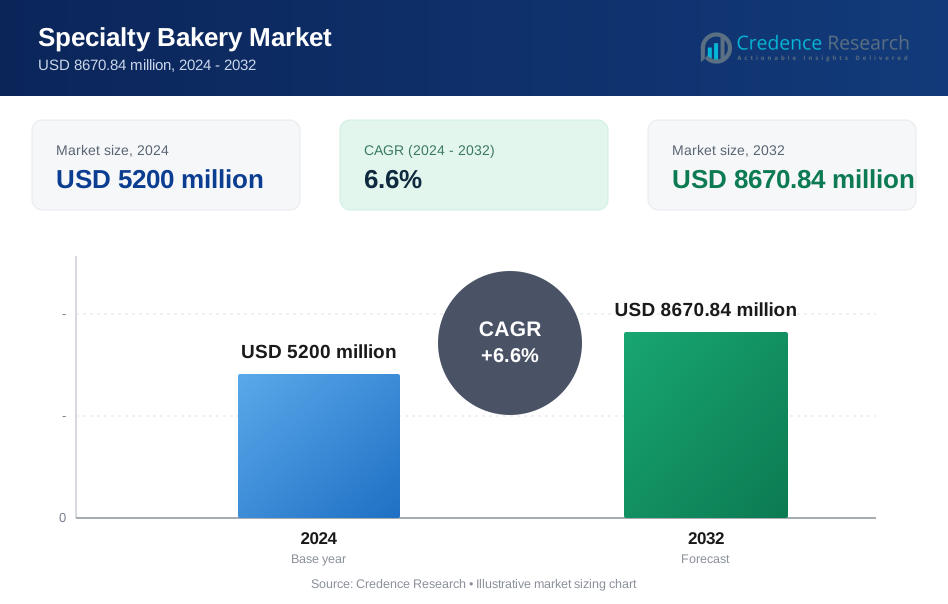
Specialty Bakery Market was valued at USD 5200 million in 2024 and is anticipated to reach USD 8670.84 million by 2032, growing at a CAGR of 6.6 % during the forecast period.
| REPORT ATTRIBUTE | DETAILS |
|---|---|
| Historical Period | 2020-2023 |
| Base Year | 2024 |
| Forecast Period | 2025-2032 |
| Specialty Bakery Market Size 2024 | USD 5200 Million |
| Specialty Bakery Market, CAGR | 6.6% |
| Specialty Bakery Market Size 2032 | USD 8670.84 Million |
The specialty bakery market is shaped by leading players such as EUROPASTRY SA, Conagra Brands Inc., Harry Brot GmbH, Britannia Industries Ltd., Corporativo Bimbo SA de CV, IL GERMOGLIO FOOD Spa, Associated British Foods Plc, Dawn Food Products Inc., ARYZTA AG, and Flowers Foods Inc. These companies strengthen their position through artisan product lines, gluten-free ranges, and strong retail partnerships. Many also expand online delivery reach to serve rising demand for premium and customized bakery items. North America remained the leading region in 2024 with about 37% share, driven by high spending on specialty bread, pastries, and allergen-free offerings across urban markets.
Market Insights
- The Specialty Bakery Market reached USD 5200 million in 2024 and is projected to grow at a 6.6 % CAGR, driven by rising demand for premium, gluten-free, vegan, and allergen-free products.
- Growth accelerated as health-focused buyers increased consumption of specialty bread and pastries, with specialty cakes and pastries holding about 39% share due to strong event-driven demand.
- Key trends include rapid product innovation using clean-label ingredients, expansion of artisan formats, and rising online customization, which boosts premium orders and repeat buying.
- Competitive activity intensified among EUROPASTRY SA, ARYZTA AG, Britannia Industries Ltd., Conagra Brands Inc., and Flowers Foods Inc., each investing in premium recipes, advanced baking tech, and wider distribution.
- North America led with roughly 37% share, supported by high spending on gourmet and allergen-free bakery products, while Europe followed with strong artisan traditions and growing vegan adoption.
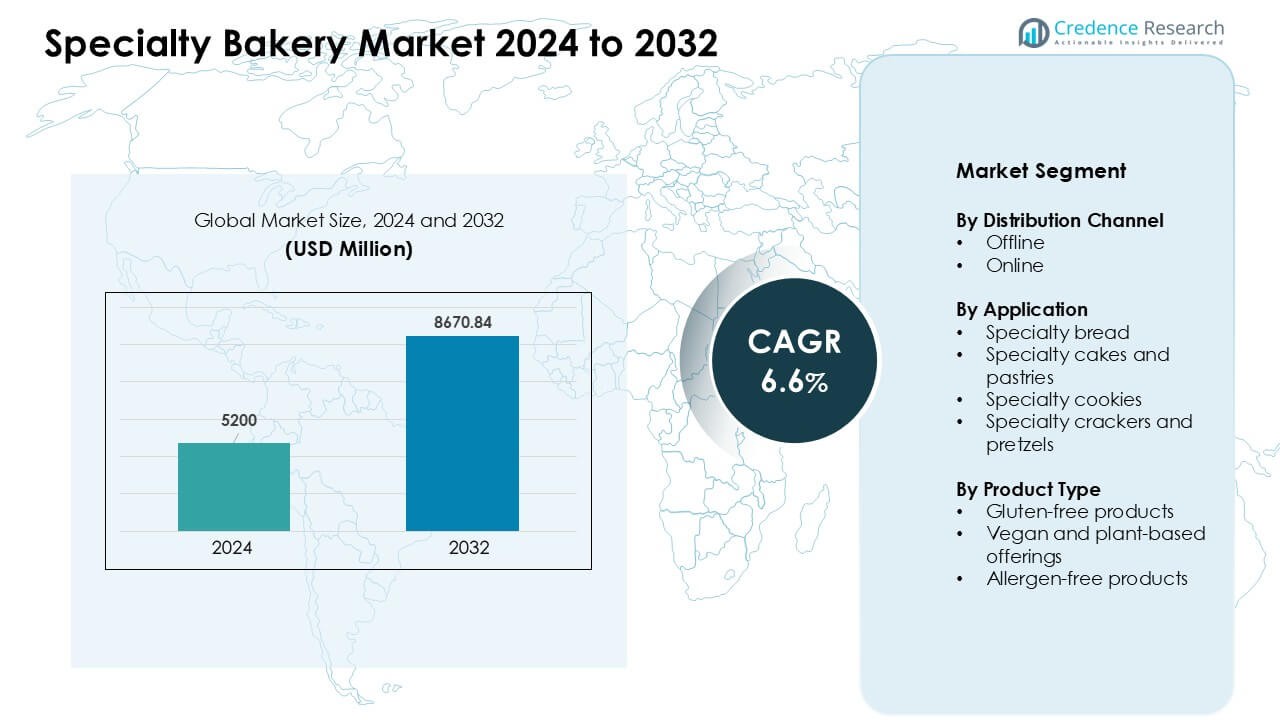 Market Segmentation Analysis:
By Distribution Channel
Offline retail dominated the specialty bakery market in 2024 with about 68% share. Supermarkets, artisan bakeries, and gourmet stores drove this lead through strong footfall and wide product displays. Buyers valued fresh inventory, quick service, and the ability to compare flavor and texture before purchase. Growth in offline channels also came from rising demand for premium bread and cakes in urban areas. Online channels grew fast as digital platforms expanded same-day delivery, subscription boxes, and personalized bakery bundles that appealed to younger consumers.
- For instance, Grupo Bimbo the world’s largest bakery company operates over 249 industrial bakeries and plants globally, supported by more than 54,000 distribution routes, which enables massive offline distribution reach.
By Application
Specialty cakes and pastries held the dominant position in 2024 with roughly 39% share. Demand stayed high due to rising interest in custom cakes, festive orders, and premium dessert menus. Cafés and boutique bakeries pushed this segment with new flavors, healthier formulations, and visually rich designs. Specialty bread followed due to higher focus on nutrition, sourdough options, and artisanal textures. Cookies, crackers, and pretzels saw steady growth as snack buyers looked for clean labels, portion-controlled packs, and unique flavor blends.
- For instance, in its 2023 Annual Report, Grupo Bimbo announced that it achieved 95% positive nutrition in our daily bread, pastries and breakfast portfolio. This was confirmed by CEO Rafael Pamias in a press release.
By Product Type
Gluten-free products led the product type segment in 2024 with nearly 41% share. Many buyers chose gluten-free options due to growing awareness of celiac issues and rising preference for low-gluten diets. Bakers improved texture and taste using alternative flours like almond, millet, and rice, which supported wider acceptance. Vegan and plant-based items expanded quickly as consumers shifted toward ethical and dairy-free choices. Allergen-free products also gained traction as parents demanded safer snacks free from nuts, soy, and common triggers.
Key Growth Drivers
Rising Demand for Health-Focused Bakery Products
Health-oriented buying habits now shape specialty bakery growth. Many consumers choose gluten-free, vegan, and allergen-free items due to rising awareness of diet-related issues and lifestyle choices. Bakeries respond with clean labels, low-sugar recipes, and natural ingredients that attract both young adults and families. Strong demand for functional bread with high fiber or protein adds further momentum. Retailers also highlight healthier bakery lines through premium shelf space and strong marketing. This push increases overall visibility and builds trust among buyers who seek quality and safety. The trend supports sustained expansion across urban and suburban markets.
- For instance, La Americana Gourmet (part of Bonn Group of Industries) recently launched a “Protein Bread” that delivers 40 g of protein per loaf, aimed at fitness‑conscious consumers avoiding refined flour or additives.
Expansion of Premium and Artisan Offerings
Premium and artisan bakery products gain steady traction as buyers seek unique flavors, fresh textures, and gourmet designs. Demand rises for slow-fermented bread, custom cakes, filled pastries, and handcrafted cookies that offer a richer experience than mass-market options. Specialty bakeries invest in skilled chefs, advanced ovens, and creative formats to meet this need. Events, celebrations, and gifting trends also support growth, as customers look for personalized and visually appealing creations. Higher willingness to pay for quality strengthens margins and encourages product innovation. This shift helps specialty players build strong brand identity and repeat demand.
- For instance, global ingredient supplier Puratos India introduced in 2023 a set of millets‑based bakery and patisserie mixes including a “Millet Bread Mix” and a “Millet Cake Mix” enabling artisanal bakeries and cafes to bake healthier, millet‑rich loaves and cakes on‑site.
Growing Influence of E-Commerce and On-Demand Delivery
Digital platforms transform the specialty bakery market by offering convenience, customization, and wider access. Buyers enjoy pre-orders, same-day delivery, curated dessert boxes, and subscription plans that suit busy lifestyles. Many bakeries partner with delivery apps to expand reach without heavy infrastructure investment. Online menus highlight exclusive flavors and seasonal offers, which drive impulse purchases. Social media also boosts visibility through photo-driven marketing and influencer engagement. Personalization tools let customers design cakes or choose dietary preferences with ease. This digital shift accelerates sales and supports strong growth in both metropolitan and tier-two cities.
Key Trend & Opportunity
Product Innovation Through Alternative Ingredients
The market sees strong innovation as bakers replace traditional ingredients with healthier or more sustainable options. Growing use of almond, coconut, quinoa, and sorghum flours improves texture and nutrition. Plant-based fats, natural sweeteners, and organic inclusions support clean eating preferences. This innovation creates room for premium pricing and strengthens consumer loyalty. Bakers can expand portfolios to target fitness-focused users, children needing allergen-safe snacks, and older buyers seeking low-glycemic options. The opportunity lies in merging taste with health benefits, allowing brands to differentiate and compete in crowded retail environments.
- For instance, Bakers can expand portfolios to target fitness‑focused users, children needing allergen-safe snacks, and older buyers seeking low‑glycemic options. The opportunity lies in merging taste with health benefits, allowing brands to differentiate and compete in crowded retail environments.
Rising Popularity of Customization and Seasonal Themes
Customization becomes a major appeal across specialty bakeries as buyers look for personalized products for events, milestones, and gifts. Bakeries gain traction with themed cakes, seasonal pastries, and adjustable flavor options. Digital tools support this shift by allowing easy design uploads, flavor selection, and real-time previews. Seasonal menus such as festive cookies, holiday bread, and limited-edition pastries let brands boost traffic and generate higher margins. This trend encourages constant creativity and helps bakeries stand out in competitive markets. Strong consumer engagement builds repeat orders and strengthens brand presence.
- For instance, Seasonal menus such as festive cookies, holiday breads, and limited‑edition pastries let brands boost traffic and generate higher margins. This trend encourages constant creativity and helps bakeries stand out in competitive markets. Strong consumer engagement builds repeat orders and strengthens brand presence.
Key Challenge
High Production Costs and Raw Material Volatility
Specialty bakery production faces rising costs due to premium ingredients, skilled labor, and advanced equipment. Almond flour, plant-based fats, natural flavorings, and gluten-free blends often carry high price tags. Supply fluctuations in dairy, nuts, and grains increase uncertainty and squeeze margins. Small bakeries struggle to absorb these costs without raising prices, which can impact demand. Logistics and packaging expenses further add pressure. Maintaining consistent quality while managing cost swings becomes a daily challenge. This issue limits scalability for many players and forces bakeries to refine sourcing strategies or adopt lean operations.
Short Shelf Life and Complex Quality Control
Specialty bakery products typically avoid heavy preservatives, which reduces shelf life and raises operational risk. Fresh bread, pastries, and allergen-free items require strict handling to maintain taste and safety. Temperature control, hygiene standards, and cross-contamination prevention demand strong monitoring. Failures in these areas can cause waste, financial loss, or customer dissatisfaction. Online delivery adds extra complexity due to travel time and varying storage conditions. Maintaining consistent freshness across both offline and online channels becomes difficult. This challenge pushes bakeries to invest in improved packaging, training, and real-time quality checks.
Regional Analysis
North America
North America led the specialty bakery market in 2024 with roughly 37% share. Buyers favored premium bread, gluten-free products, and custom cakes as health awareness and event-driven demand increased. Large retail chains expanded fresh bakery sections, while local artisan shops gained traction through unique flavors and clean-label claims. Strong adoption of e-commerce boosted personalized orders and subscription bakery boxes. The U.S. drove most revenue due to high spending on gourmet pastries and allergen-free snacks. Canada followed with steady growth linked to rising plant-based and organic bakery preferences across urban markets.
Europe
Europe accounted for about 31% share in 2024 and remained a mature yet innovative region. Demand rose for artisanal bread, vegan pastries, and low-sugar snacks supported by strong bakery traditions and strict quality standards. Germany, France, and the U.K. drove momentum with steady uptake of premium and seasonal bakery lines. Retailers expanded specialty counters featuring sourdough, heritage grains, and handcrafted desserts. Growth also came from rising foodservice activity and café culture. Sustainability and clean ingredients shaped product upgrades, while allergen-free and plant-based offerings gained wider acceptance.
Asia-Pacific
Asia-Pacific held nearly 22% share in 2024 and expanded rapidly as urban consumers shifted toward premium and Western-style bakery items. Demand grew for specialty cakes, filled pastries, and healthier bread formats that blend local flavors with global trends. China and Japan drove adoption through strong café networks and rising gifting culture. India saw fast growth due to rising income levels and wider acceptance of vegan and gluten-free offerings. Online delivery platforms boosted visibility for boutique bakeries. The region’s young population and interest in new flavors support long-term expansion.
Latin America
Latin America captured around 6% share in 2024 with steady demand for artisanal bread, festive cakes, and regional pastries. Brazil and Mexico led growth through rising café culture and increased interest in premium desserts. Specialty bakeries introduced vegan and allergen-free items for health-conscious buyers. Economic shifts kept price sensitivity high, but consumers still sought premium items for celebrations and weekend treats. Online bakery delivery expanded reach in major cities. Product innovation using local ingredients strengthened brand appeal and supported gradual market expansion across the region.
Middle East & Africa
The Middle East & Africa region held close to 4% share in 2024 and showed rising interest in premium bakery formats. Urban centers in the UAE and Saudi Arabia drove demand for gluten-free pastries, luxury cakes, and Western-style bread. Growth came from expanding retail chains, specialty cafés, and tourism-driven bakery consumption. Buyers valued customized desserts for events and gifting. Africa saw gradual adoption of specialty bread and cookies, supported by rising middle-class spending. Limited cold-chain infrastructure and price sensitivity slowed broader penetration, but premium bakery demand continues to rise.
Market Segmentations:
By Distribution Channel
- Offline
- Online
By Application
- Specialty bread
- Specialty cakes and pastries
- Specialty cookies
- Specialty crackers and pretzels
By Product Type
- Gluten-free products
- Vegan and plant-based offerings
- Allergen-free products
By Geography
- North America
- U.S.
- Canada
- Mexico
- Europe
- Germany
- France
- U.K.
- Italy
- Spain
- Rest of Europe
- Asia Pacific
- China
- Japan
- India
- South Korea
- South-east Asia
- Rest of Asia Pacific
- Latin America
- Brazil
- Argentina
- Rest of Latin America
- Middle East & Africa
- GCC Countries
- South Africa
- Rest of the Middle East and Africa
Competitive Landscape
The competitive landscape of the specialty bakery market includes major players such as EUROPASTRY SA, Conagra Brands Inc., Harry Brot GmbH, Britannia Industries Ltd., Corporativo Bimbo SA de CV, IL GERMOGLIO FOOD Spa, Associated British Foods Plc, Dawn Food Products Inc., ARYZTA AG, and Flowers Foods Inc. These companies expand their portfolios with gluten-free bread, vegan pastries, artisan cakes, and allergen-free snacks to meet changing consumer needs. Many invest in advanced baking technology, clean-label recipes, and premium ingredients to strengthen brand loyalty. Partnerships with supermarkets, cafés, and online delivery platforms widen reach. Boutique bakeries also add pressure with unique flavors and seasonal creations, making innovation and digital engagement essential for long-term competitiveness.
Key Player Analysis
- EUROPASTRY SA
- Conagra Brands Inc.
- Harry Brot GmbH
- Britannia Industries Ltd.
- Corporativo Bimbo SA de CV
- IL GERMOGLIO FOOD Spa
- Associated British Foods Plc
- Dawn Food Products Inc.
- ARYZTA AG
- Flowers Foods Inc.
Recent Developments
- In 2025, Associated British Foods plc agreed to acquire Hovis Group, expanding its UK bread and bakery portfolio and strengthening the Allied Bakeries business with a larger branded sliced-bread platform.
- In 2025, Flowers Foods Inc. announced its 2025 innovation lineup, adding new breads and sweet baked goods and extending flavors in existing brands to capture demand for premium and specialty bakery products across U.S. retail channels.
- In April 2025, Relaunched “Britannia Gobbles” cakes with a refreshed recipe and packaging (softer/tastier positioning), a product action within Britannia’s cakes/bakery portfolio.
Report Coverage
The research report offers an in-depth analysis based on Distribution Channel, Application, Product Type and Geography. It details leading market players, providing an overview of their business, product offerings, investments, revenue streams, and key applications. Additionally, the report includes insights into the competitive environment, SWOT analysis, current market trends, as well as the primary drivers and constraints. Furthermore, it discusses various factors that have driven market expansion in recent years. The report also explores market dynamics, regulatory scenarios, and technological advancements that are shaping the industry. It assesses the impact of external factors and global economic changes on market growth. Lastly, it provides strategic recommendations for new entrants and established companies to navigate the complexities of the market.
Future Outlook
- The market will expand as consumers continue shifting toward healthier and cleaner bakery options.
- Demand for gluten-free, vegan, and allergen-free lines will grow across mass and premium segments.
- Artisan and handcrafted bakery formats will gain wider retail presence in urban areas.
- Online delivery and customization platforms will strengthen long-term sales momentum.
- Seasonal and themed bakery offerings will drive repeat buying and higher premium pricing.
- Technology adoption in baking, packaging, and quality control will improve efficiency and consistency.
- Sustainability efforts will rise, with brands focusing on eco-friendly ingredients and reduced waste.
- Emerging markets will see faster adoption of Western-style specialty bakery products.
- Partnerships between bakeries, cafés, and retail chains will increase product visibility and reach.
- Innovation in alternative flours and plant-based ingredients will shape new product development.
Request a Free Sample
Fill in your details and we'll send you a free sample report.
- Sample data tables & charts
- Research methodology
Need a Custom Version of This Report?
Tailor the scope, geography, or segments to your exact requirements.
- Custom geography or segment scope
- Direct access to our analyst team
Frequently Asked Questions
What is the current market size for the Specialty Bakery Market, and what is its projected size in 2032?
At what Compound Annual Growth Rate is the Specialty Bakery Market projected to grow between 2024 and 2032?
Which Specialty Bakery Market segment held the largest share in 2024?
What are the primary factors fueling the growth of the Specialty Bakery Market?
Who are the leading companies in the Specialty Bakery Market?
Which region commanded the largest share of the Specialty Bakery Market?
Table of Content
Chapter 1. Report Introduction
- 1.1 Report Description & Purpose
- 1.1.1 Report Title & Market Definition
- 1.1.2 Unique Selling Propositions (USP) & Key Differentiators
- 1.1.3 Value Proposition for Stakeholders
- 1.2 Research Objectives
- 1.2.1 Market Sizing Objectives (Volume & Revenue)
- 1.2.2 Segmentation Objectives
- 1.2.3 Competitive Intelligence Objectives
- 1.2.4 Forecast & Scenario Objectives
- 1.3 Report Scope
- 1.3.1 Specialty Bakery Scope – Types & Subtypes Covered
- 1.3.2 Geographic Scope – Regions & Countries Covered
- 1.3.3 Historical Period, Base Year & Forecast Period (2024; forecast to 2032)
- 1.3.4 Inclusions & Exclusions
- 1.4 HS Code & Classification Framework
- 1.5 Currency, Units & Pricing Basis
- 1.6 Target Stakeholders
- 1.7 Limitations & Assumptions
Chapter 2. Executive Summary
- 2.1 Global Specialty Bakery Market Snapshot
- 2.1.1 Market Size – Historical (2024) & Forecast (2024-2032) (2024: USD 5200 million → 2032: USD 8670.84 million)
- 2.1.2 Volume & Revenue – Global Totals
- 2.1.3 Key Market Highlights – Top Five Facts
- 2.2 Specialty Bakery Market Segmentation Snapshot
- 2.2.1 Market Split by Region – 2024 vs. 2032
- 2.3 Competitive Snapshot
- 2.3.1 Top 10 Players by Revenue Share – 2024
- 2.3.2 Top 10 Players by Volume Share – 2024
- 2.3.3 Recent Strategic Developments (18-Month Summary)
- 2.4 Key Investment Highlights & Strategic Conclusions
Chapter 3. Specialty Bakery Market Dynamics & Industry Analysis
- 3.1 Market Overview & Context
- 3.1.1 Specialty Bakery Market Position in the Broader Automotive Value Chain
- 3.1.2 OEM vs. Replacement Market Dynamics
- 3.1.3 Market Maturity & Development Stage by Region
- 3.2 Specialty Bakery Market Drivers
- 3.3 Specialty Bakery Market Restraints & Challenges
- 3.4 Specialty Bakery Market Opportunities
- 3.5 Porter's Five Forces Analysis
- 3.5.1 Threat of New Entrants
- 3.5.2 Bargaining Power of Suppliers
- 3.5.3 Bargaining Power of Buyers
- 3.5.4 Threat of Substitutes
- 3.5.5 Competitive Rivalry – Intensity Assessment
- 3.6 Specialty Bakery Value Chain Analysis
- 3.6.1 Upstream – Raw Material/Input Suppliers
- 3.6.1.1 Raw Material/Input 1
- 3.6.1.2 Raw Material/Input 2
- 3.6.1.3 Raw Material/Input 3
- 3.6.2 Midstream – Production/Manufacturing/Service Delivery
- 3.6.2.1 Production/Process Overview
- 3.6.2.2 Key Facility Locations & Capacity by Manufacturer
- 3.6.3 Downstream – Distribution & End Consumer
- 3.6.3.1 Primary Channel – B2B/OEM
- 3.6.3.2 Secondary Channels – Dealer, Retail, Online, Direct
- 3.6.4 Value Chain Profitability Analysis
- 3.6.1 Upstream – Raw Material/Input Suppliers
- 3.7 PESTEL Analysis
- 3.7.1 Political Factors
- 3.7.2 Economic Factors
- 3.7.3 Social Factors
- 3.7.4 Technological Factors
- 3.7.5 Environmental Factors
- 3.7.6 Legal Factors
- 3.8 Specialty Bakery Supply Chain Analysis
- 3.8.1 Raw Material/Input Supply Risk Assessment
- 3.8.2 Manufacturing Concentration Risk (Geographic Exposure)
- 3.8.3 Trade Disruption Impact Analysis
- 3.9 Regulatory & Policy Landscape
Note: The regulatory and policy landscape section covers regulations based on their applicability to the market, Specialty Bakery category, geography, and scope of the study. Only regulatory frameworks with a material impact on operations, compliance, trade, sustainability, or market access are analyzed in detail.
Chapter 4. Key Investment Pockets & Opportunity Analysis
- 4.1 Specialty Bakery Market Attractiveness Analysis
- 4.1.1 By Region – Investment Attractiveness Matrix (Volume × CAGR)
- 4.2 Absolute Revenue Growth Opportunity
- 4.2.1 By Region – Absolute USD Growth Through 2032
- 4.3 Incremental Volume Opportunity
- 4.3.1 By Region – Incremental Volume Through 2032
- 4.3.2 Segment – Incremental Volume
- 4.4 Emerging Submarket Opportunity Deep Dive (Subject to Applicability)
- 4.5 Emerging Market Opportunity Scorecards
- 4.5.1 United States
- 4.5.2 Europe
- 4.5.3 Asia
- 4.5.4 Middle East & Africa
Note: Emerging Market Opportunity Scorecards will be included based on relevance and strategic importance. Regions listed are indicative and may vary depending on data availability and market dynamics.
Chapter 5. Specialty Bakery Import-Export Analysis & Trade Flows
- 5.1 Global Trade Overview
- 5.1.1 Global Export Value by Country (2024)
- 5.1.2 Global Export Volume by Country (2024)
- 5.1.3 Global Import Value by Country (2024)
- 5.1.4 Global Import Volume by Country (2024)
- 5.1.5 Net Trade Balance by Country (2024)
- 5.2 Export Analysis – Segment
- 5.2.1 Type 1 (HS Code)
- 5.2.2 Type 2 (HS Code)
- 5.2.3 Type 3 (HS Code)
- 5.2.4 Type 4 (HS Code)
- 5.2.5 Type 5 (HS Code)
- 5.3 Import Analysis – Segment
- 5.3.1 Type 1 (HS Code)
- 5.3.2 Type 2 (HS Code)
- 5.3.3 Type 3 (HS Code)
- 5.3.4 Type 4 (HS Code)
- 5.3.5 Type 5 (HS Code)
- 5.4 Average Unit Trade Prices
- 5.4.1 Average Export Price – Segment & Country
- 5.4.2 Average Import Price – Segment & Source Country
- 5.4.3 Price Trends (2024)
- 5.5 Key Trade Route Analysis
- 5.5.1 Trade Route 1
- 5.5.2 Trade Route 2
- 5.5.3 Trade Route 3
- 5.5.4 Trade Route 4
- 5.5.5 Trade Route 5
- 5.6 Trade Policy Impact Assessment
- 5.6.1 US Anti-Dumping & Section 301 Tariffs
- 5.6.2 EU Customs Union Impact
- 5.6.3 Major Free Trade Agreements
- 5.6.4 USMCA Rules of Origin
Note: Trade policy analysis will be included only where relevant to the Specialty Bakery market.
Chapter 6. Competitive Landscape & Company Benchmarking
- 6.1 Specialty Bakery Market Concentration & Structure
- 6.1.1 Herfindahl-Hirschman Index (HHI) – vs. 2024
- 6.1.2 Tier 1, Tier 2 & Tier 3 Market Structure
- 6.1.3 Global, Regional & Local Player Dynamics
- 6.2 Specialty Bakery Market Share Analysis – 2024
- 6.2.1 Global Revenue Share by Company
- 6.2.2 Global Volume Share by Company
- 6.2.3 Regional Revenue Share
- 6.2.4 Market Share Evolution ( vs. 2024)
- 6.2.5 OEM Segment Share by Company
- 6.2.6 Replacement Segment Share by Company
- 6.3 Production/Delivery Capacity & Facility Analysis
- 6.3.1 Global Installed Capacity
- 6.3.2 Capacity Utilization Rates
- 6.3.3 Production/Output Volume
- 6.3.4 Facility Locations & Capacity Map
- 6.3.5 Planned Capacity Additions
- 6.4 Specialty Bakery Competitive Benchmarking Matrix
- 6.4.1 Revenue, Volume, CAGR & Profitability Comparison
- 6.4.2 Channel Revenue Mix
- 6.4.3 Geographic Revenue Exposure
- 6.4.4 R&D Intensity
- 6.4.5 Sustainability Maturity
- 6.5 Strategic Developments in Specialty Bakery (Last 24 Months)
- 6.5.1 Mergers, Acquisitions & Divestments
- 6.5.2 New Specialty Bakery Launches
- 6.5.3 Facility Expansions
- 6.5.4 Strategic Alliances, Joint Ventures & Partnerships
- 6.5.5 Distribution Expansion & Market Entry
- 6.5.6 Sustainability & ESG Initiatives
- 6.6 Competitive Strategy Mapping
- 6.6.1 Leader, Challenger, Follower & Niche Classification
- 6.6.2 Pricing Strategy Comparison
- 6.6.3 Channel Strategy Matrix
Note: Strategic developments are included based on their materiality and the availability of reliable information.
Chapter 7. Global Specialty Bakery Market – By Distribution Channel
- 7.1 Segment Overview
- 7.1.1 Volume & Revenue Split by Channel (2024 & 2032)
- 7.1.2 Channel Mix Evolution (2024-2032)
Chapter 8. Regional Market Analysis – Global Overview
- 8.1 Global Regional Overview
- 8.1.1 Regional Volume Share
- 8.1.2 Regional Revenue Share
- 8.1.3 Regional Volume by Region
- 8.1.4 Regional Revenue by Region
- 8.1.5 Regional Forecast Through 2032
- 8.2 Cross-Regional Segment Analysis
- 8.2.1 By Distribution Channel
- 8.2.2 By Brand/Price Tier
Chapter 9. North America Specialty Bakery Market
- 9.1 United States
- 9.2 Canada
- 9.3 Mexico
Chapter 10. Europe Specialty Bakery Market
- 10.1 Germany
- 10.2 France
- 10.3 Italy
- 10.4 United Kingdom
- 10.5 Spain
- 10.6 Poland
- 10.7 Russia
- 10.8 Netherlands
- 10.9 Belgium
- 10.10 Sweden
- 10.11 Denmark
- 10.12 Norway
- 10.13 Rest of Europe
Chapter 11. Asia Pacific Specialty Bakery Market
- 11.1 China
- 11.2 India
- 11.3 Japan
- 11.4 South Korea
- 11.5 Thailand
- 11.6 Indonesia
- 11.7 Vietnam
- 11.8 Malaysia
- 11.9 Australia
- 11.10 Rest of Asia Pacific
Chapter 12. Latin America Specialty Bakery Market
- 12.1 Brazil
- 12.2 Argentina
- 12.3 Colombia
- 12.4 Chile
- 12.5 Rest of Latin America
Chapter 13. Middle East Specialty Bakery Market
- 13.1 Saudi Arabia
- 13.2 United Arab Emirates
- 13.3 Turkey
- 13.4 Israel
- 13.5 Iran
- 13.6 Rest of the Middle East
Chapter 14. Africa Specialty Bakery Market
- 14.1 South Africa
- 14.2 Egypt
- 14.3 Nigeria
- 14.4 Morocco
- 14.5 Rest of Africa
Chapter 15. Specialty Bakery Company Profiles
- 15.1 [Company 01]
- 15.1.1 Company Overview
- 15.1.2 Key Management Personnel
- 15.1.3 Products & Services Portfolio
- 15.1.4 Financial Performance
- 15.1.5 Key Market Focus & Geographic Presence
- 15.1.6 Recent Developments & Strategic Initiatives
Note: The company profile list is preliminary and may change based on research findings, market developments, data availability, and client requirements.
Chapter 16. Appendices
- Appendix A – List of Abbreviations & Acronyms
- Appendix B – Industry Classification Code Reference – Full Series
- Appendix C – Production & Capacity Data Tables
- Appendix D – End-Use & Demand Base Tables
- Appendix E – Consumption & Replacement Rate Assumptions
- Appendix F – ASP Reference Tables
- Appendix G – Manufacturing & Facility Database
- Appendix H – Import-Export Data Tables
- Appendix I – Regulatory Summary Tables
- Appendix J – Primary Research Participant List (Anonymized)
- Appendix K – Primary Research Questionnaire Framework
- Appendix L – Data Sources & Bibliography
- Appendix M – Market Size Divergence & Source Comparison
Chapter 17. Research Methodology
- 17.1 Research Framework & Philosophy
- 17.2 Secondary Research – Sources, Hierarchy & Data Extraction
- 17.3 Data Modeling – Bottom-Up & Top-Down Market Sizing
- 17.4 Primary Research – Stakeholder Framework, LOI & Sample Sizes
- 17.5 Forecast Methodology – Regression, Scenario & Sensitivity Analysis
- 17.6 Quality Control – Four-Layer Validation Framework
- 17.7 Limitations & Standard Assumptions
- 17.8 Disclaimer
