| REPORT ATTRIBUTE | DETAILS |
|---|---|
| Historical Period | 2020-2023 |
| Base Year | 2024 |
| Forecast Period | 2025-2032 |
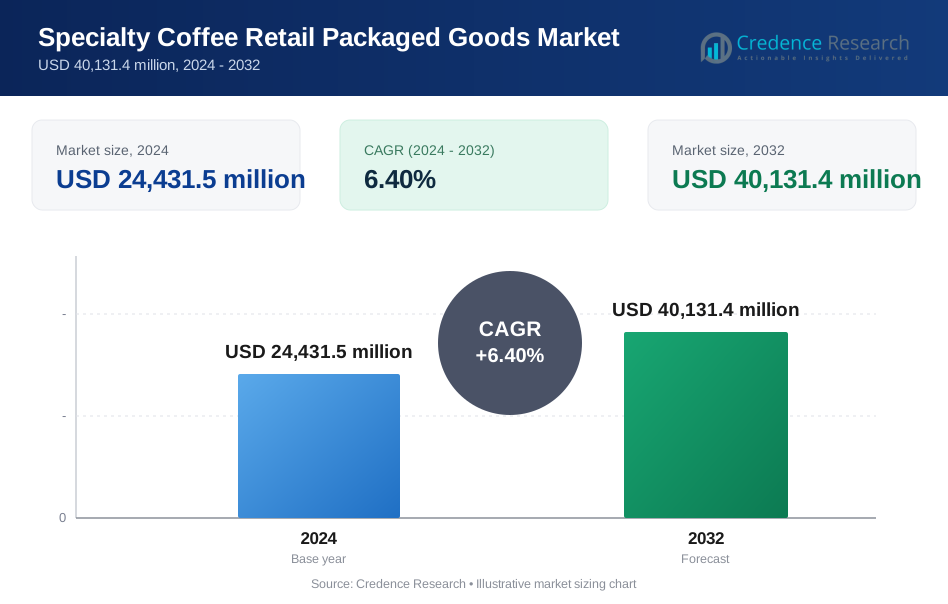
| Specialty Coffee Retail Packaged Goods Market Size 2024 | USD 24,431.5 million |
| Specialty Coffee Retail Packaged Goods Market, CAGR | 6.40% |
| Specialty Coffee Retail Packaged Goods Market Size 2032 | USD 40,131.4 million |
Market Overview
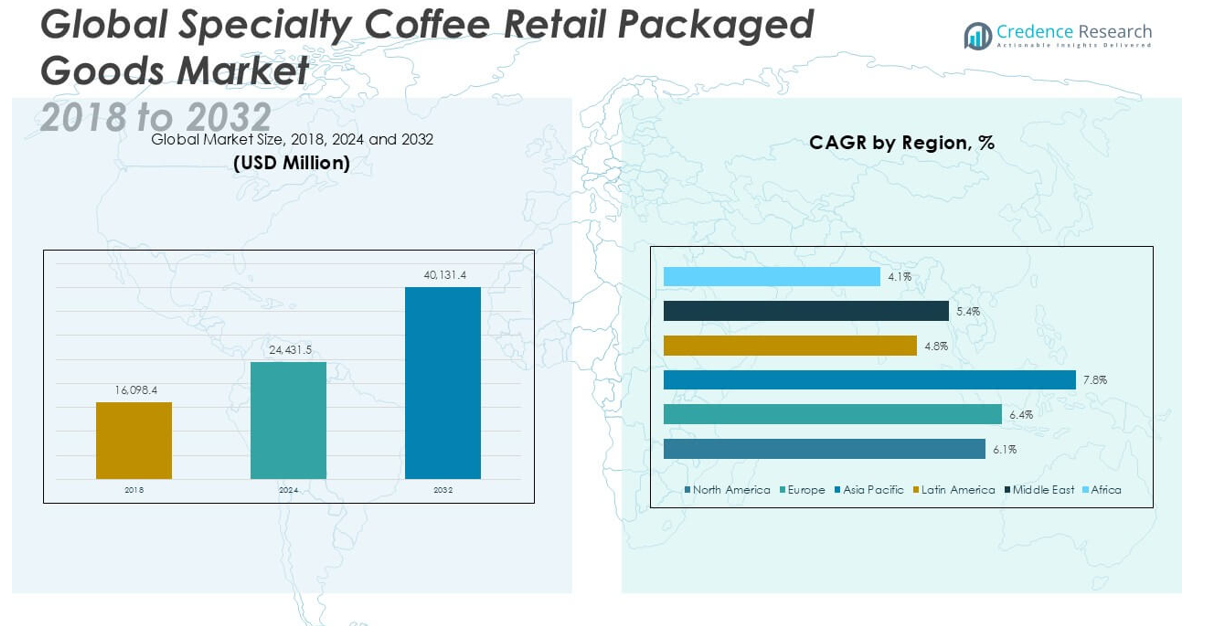
The Specialty Coffee Retail Packaged Goods market size was valued at USD 16,098.4 million in 2018, reached USD 24,431.5 million in 2024, and is anticipated to reach USD 40,131.4 million by 2032, at a CAGR of 6.40% during the forecast period.
The Specialty Coffee Retail Packaged Goods market is led by prominent players such as Nestlé S.A., Starbucks Corporation, Keurig Dr Pepper Inc., JDE Peet’s N.V., and Lavazza Group, which command significant global presence through robust product portfolios and expansive distribution channels. These companies consistently focus on innovation, sustainability, and premium offerings to capture evolving consumer preferences. North America stands as the leading region, accounting for approximately 35% of the global market share in 2024, driven by strong consumer demand for premium coffee, established retail infrastructure, and the growing home brewing trend. Europe follows closely, supported by its rich coffee culture and increasing demand for specialty blends. Both established brands and emerging specialty roasters continue to intensify competition across these key regions.
Market Insights
- The Specialty Coffee Retail Packaged Goods market was valued at USD 16,098.4 million in 2018, reached USD 24,431.5 million in 2024, and is projected to reach USD 40,131.4 million by 2032, growing at a CAGR of 6.40% during the forecast period.
- Increasing consumer demand for premium, ethically sourced coffee and the growing home brewing culture are driving the market's steady growth worldwide.
- Key trends include the rising popularity of sustainable coffee, expansion of online channels, and growing adoption of subscription-based specialty coffee services.
- The market is highly competitive with leading players such as Nestlé S.A., Starbucks Corporation, and JDE Peet’s N.V., along with emerging specialty roasters offering unique blends and focusing on direct-to-consumer models.
- North America holds the largest market share at approximately 35% in 2024, followed by Europe at 30%, while Fresh Coffee Beans dominate the product segment with over 40% market share.
Market Segmentation Analysis:
By Product Type:
In the Specialty Coffee Retail Packaged Goods market, Fresh Coffee Beans hold the dominant share, accounting for over 40% of the market in 2024. Consumers increasingly prefer freshly ground coffee from whole beans due to its superior aroma and flavor retention. This segment benefits from the rising trend of home brewing and the growing availability of premium single-origin beans. Fresh Ground Coffee Pods also show steady growth, driven by convenience and the expanding use of coffee machines at home and in offices. Standard Fresh Ground Coffee and other products maintain moderate demand among budget-conscious consumers.
- For instance, Starbucks offers over 20 distinct whole bean coffee varieties globally, with its Pike Place Roast and Espresso Roast among its top-selling products in retail packaged formats.
By Distribution Channel:
Hypermarkets & Supermarkets lead the distribution channels, capturing more than 45% market share in 2024, owing to their wide product assortment and consumer trust in these retail formats. They offer easy accessibility, competitive pricing, and a broad selection of specialty coffee brands, driving strong consumer footfall. Online Channels are rapidly gaining traction, supported by the convenience of home delivery, attractive discounts, and the growing popularity of subscription-based coffee services. Specialty Stores cater to niche buyers looking for exclusive blends and premium experiences, while other retail formats contribute a smaller yet stable market share.
- For instance, Walmart operates over 10,500 stores globally, providing extensive shelf space for specialty coffee brands, including Starbucks, Dunkin', and Peet’s Coffee, across its retail network.
Market Overview
Rising Consumer Preference for Premium Coffee
The increasing consumer shift toward high-quality, specialty coffee is a primary growth driver for the Specialty Coffee Retail Packaged Goods market. Consumers are becoming more discerning about coffee origins, roast profiles, and flavor complexity, fueling demand for premium products. This trend is particularly evident among millennials and urban populations who are willing to pay a premium for superior coffee experiences. The growing awareness about sustainable sourcing and single-origin beans further accelerates this demand, encouraging retailers and brands to expand their specialty coffee portfolios.
- For instance, Nestlé’s Nespresso offers over 30 permanent coffee blends sourced from 15 countries, and its single-origin “Ethiopia” capsule has become one of the highest-selling products in their specialty line, with over 400 million capsules sold to date.
Expansion of Home Brewing Culture
The rapid expansion of home brewing practices significantly contributes to market growth. Advancements in home coffee-making appliances, such as espresso machines and pour-over equipment, have made it easier for consumers to replicate café-style beverages at home. This shift is supported by the increase in remote working, which has led consumers to invest in quality coffee for home consumption. As a result, the market for fresh coffee beans and ground coffee pods is witnessing strong sales, with brands focusing on offering products that cater specifically to home baristas.
- For instance, Keurig Dr Pepper reported the sale of 13.3 million Keurig brewers in 2023, reflecting strong consumer adoption of home brewing machines compatible with their specialty coffee pods.
Growth of E-Commerce and Subscription Services
The rise of e-commerce platforms and coffee subscription services provides a strong growth avenue for the Specialty Coffee Retail Packaged Goods market. Online channels allow consumers to conveniently access a wider variety of specialty coffee, including rare blends and limited editions, often unavailable in physical stores. Subscription models offer curated coffee experiences and foster brand loyalty by delivering fresh products regularly. This digital shift enables brands to directly engage with customers, personalize offerings, and expand their market reach without the constraints of traditional retail.
Key Trends and Opportunities
Increasing Focus on Sustainable and Ethical Sourcing
Sustainability has become a critical trend in the Specialty Coffee Retail Packaged Goods market. Consumers are prioritizing ethically sourced coffee that supports fair trade, environmental stewardship, and farmer welfare. Brands that offer certified organic, Rainforest Alliance, or Fair Trade coffee are gaining consumer trust and market share. This focus presents an opportunity for companies to differentiate through transparent supply chains, sustainable packaging, and responsible sourcing practices that appeal to socially conscious buyers.
- For instance, JDE Peet’s reported sourcing 83,000 metric tons of certified coffee under sustainability programs in 2022, demonstrating its substantial commitment to ethical sourcing across its global operations.
Product Innovation and Diversification
Product innovation is shaping the future of the specialty coffee market. Brands are introducing unique flavor profiles, cold brews, ready-to-drink options, and functional coffees infused with vitamins or adaptogens to cater to evolving consumer preferences. Limited-edition releases and collaborations with specialty roasters also create excitement and exclusivity. This diversification helps companies capture new customer segments and respond to shifting taste trends, offering significant growth potential in both developed and emerging markets.
- For instance, La Colombe Coffee Roasters launched its Draft Latte ready-to-drink canned coffee line, selling over 10 million cans within its first two years, reflecting strong consumer demand for convenient specialty coffee formats.
Key Challenges
High Product Costs Limiting Mass Adoption
One of the major challenges for the Specialty Coffee Retail Packaged Goods market is the high price point of premium coffee products. Specialty coffee often involves small-batch roasting, traceable sourcing, and sustainable practices, which increase production and retail costs. These higher prices can limit accessibility for price-sensitive consumers and constrain market penetration in cost-driven regions. Balancing quality and affordability remains a critical hurdle for manufacturers aiming to broaden their consumer base.
Supply Chain Vulnerabilities and Price Volatility
The specialty coffee market faces persistent supply chain challenges, including fluctuating raw coffee bean prices, climate change impacts on coffee-producing regions, and geopolitical instability. These factors can disrupt supply continuity and lead to unpredictable pricing, affecting both producers and retailers. Additionally, specialty coffee’s reliance on specific origins increases exposure to regional disruptions. Brands must develop resilient sourcing strategies and diversify supply chains to mitigate these risks.
Competition from Conventional Coffee Brands
Specialty coffee brands encounter strong competition from established conventional coffee companies that are now entering the premium segment. Large players with extensive distribution networks and marketing budgets are launching specialty-style products at competitive prices, intensifying market rivalry. This competition challenges smaller specialty brands to maintain differentiation and customer loyalty while competing on both quality and price. Developing unique brand stories and focusing on customer experience will be essential to staying competitive.
Regional Analysis
North America
North America held the largest share in the Specialty Coffee Retail Packaged Goods market, accounting for approximately 35% of the global market in 2024. The market size grew from USD 5,875.9 million in 2018 to USD 8,551.0 million in 2024 and is projected to reach USD 13,163.1 million by 2032, expanding at a CAGR of 6.1%. Strong consumer demand for premium coffee, rising home brewing culture, and the proliferation of specialty coffee chains are driving growth in this region. Additionally, the United States and Canada remain key contributors to market expansion, supported by a well-established retail network.
Europe
Europe captured around 30% of the global Specialty Coffee Retail Packaged Goods market in 2024. The market size increased from USD 4,958.3 million in 2018 to USD 7,329.5 million in 2024 and is expected to reach USD 11,437.4 million by 2032, growing at a CAGR of 6.4%. The region’s strong coffee culture, coupled with increasing demand for ethically sourced and high-quality coffee, is fueling market growth. Countries such as Germany, France, and the UK are significant markets, with consumers showing preference for specialty blends and organic coffee. The expansion of e-commerce further supports market development.
Asia Pacific
Asia Pacific is the fastest-growing region in the Specialty Coffee Retail Packaged Goods market, holding about 22% of the global market share in 2024. The market expanded from USD 3,284.1 million in 2018 to USD 5,374.9 million in 2024 and is forecasted to reach USD 10,634.8 million by 2032, registering a CAGR of 7.8%. Rapid urbanization, increasing disposable income, and a growing young population are driving specialty coffee consumption in countries like China, Japan, and South Korea. The rising café culture and penetration of international brands significantly contribute to the region’s strong growth momentum.
Latin America
Latin America represented approximately 5% of the global Specialty Coffee Retail Packaged Goods market in 2024. The market size rose from USD 643.9 million in 2018 to USD 1,099.4 million in 2024 and is projected to reach USD 2,086.8 million by 2032, growing at a CAGR of 4.8%. As a major coffee-producing region, Latin America is seeing a rise in local consumption of specialty coffee, especially in Brazil, Colombia, and Mexico. Increased awareness of premium coffee products and the growing presence of specialty coffee shops are gradually enhancing the retail packaged goods segment.
Middle East
The Middle East accounted for about 6% of the global Specialty Coffee Retail Packaged Goods market in 2024. The market expanded from USD 965.9 million in 2018 to USD 1,343.7 million in 2024 and is expected to reach USD 2,006.6 million by 2032, growing at a CAGR of 5.4%. The region’s coffee culture is rapidly modernizing, with a noticeable shift toward specialty coffee consumption, especially in countries like the UAE and Saudi Arabia. The increasing number of specialty cafés and the rising appeal of Western-style coffee products are contributing to steady market growth.
Africa
Africa captured nearly 2% of the global Specialty Coffee Retail Packaged Goods market in 2024. The market size grew from USD 370.3 million in 2018 to USD 732.9 million in 2024 and is anticipated to reach USD 802.6 million by 2032, with a CAGR of 4.1%. Although Africa is a leading coffee producer, local specialty coffee consumption remains in the early growth phase. Urbanization, rising middle-class income, and the slow but growing influence of international coffee brands are encouraging market development. Increased exposure to premium coffee through tourism and global trade is also supporting this emerging segment.
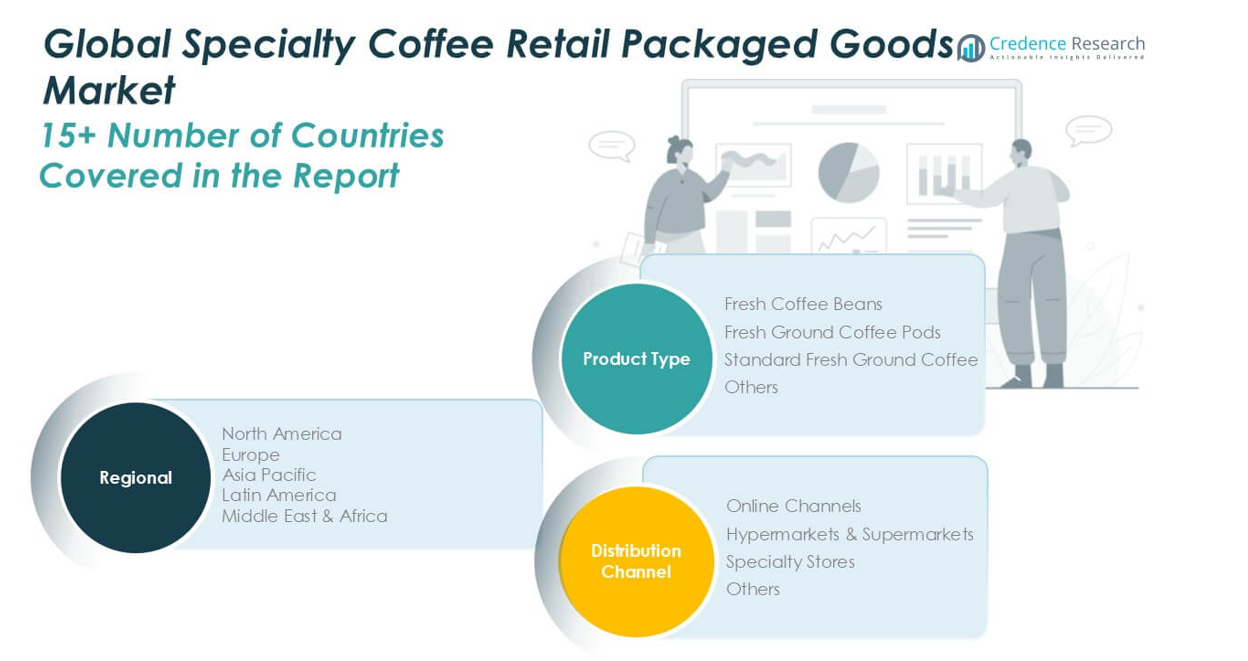
Market Segmentations:
By Product Type:
- Fresh Coffee Beans
- Fresh Ground Coffee Pods
- Standard Fresh Ground Coffee
- Others
By Distribution Channel:
- Online Channels
- Hypermarkets & Supermarkets
- Specialty Stores
- Others
By Geography:
- North America
- U.S.
- Canada
- Mexico
- Europe
- Germany
- France
- U.K.
- Italy
- Spain
- Rest of Europe
- Asia Pacific
- China
- Japan
- India
- South Korea
- South-east Asia
- Rest of Asia Pacific
- Latin America
- Brazil
- Argentina
- Rest of Latin America
- Middle East & Africa
- GCC Countries
- South Africa
- Rest of the Middle East and Africa
Competitive Landscape
The Specialty Coffee Retail Packaged Goods market is highly competitive, with both global corporations and niche specialty brands striving to expand their market presence. Key players such as Nestlé S.A., Starbucks Corporation, Keurig Dr Pepper Inc., and JDE Peet’s N.V. dominate through extensive product portfolios, strong distribution networks, and significant brand recognition. These companies continue to invest in product innovation, sustainable sourcing, and e-commerce expansion to maintain a competitive edge. Emerging specialty roasters like Stumptown Coffee Roasters, Death Wish Coffee Co., and Intelligentsia Coffee are gaining traction by offering unique blends, premium quality, and direct-to-consumer subscription models that appeal to younger, quality-conscious consumers. Strategic partnerships, acquisitions, and the launch of limited-edition products are commonly employed to strengthen market positioning. The increasing demand for ethically sourced and specialty-grade coffee is driving companies to differentiate through transparency and sustainability initiatives, intensifying competition across all regions.
Key Player Analysis
- Nestlé S.A.
- Starbucks Corporation
- Keurig Dr Pepper Inc.
- JDE Peet’s N.V.
- Lavazza Group
- The Kraft Heinz Company
- Illycaffè S.p.A.
- Peet’s Coffee
- Stumptown Coffee Roasters
- Death Wish Coffee Co.
- La Colombe Coffee Roasters
- Intelligentsia Coffee
- Tikkurila
- Sirca S.p.A.
Recent Developments
- In June 2025, Nestle, the world's largest food and beverage company, entered into a strategic partnership with Blue Bottle Coffee, a leading specialty coffee roaster, to expand its Nespresso business into the U.S. Premium coffee market (Nestle Press Release). This collaboration represents a significant shift in Nestle's focus on offering high-end, specialty coffee products to consumers.
- In August 2024, specialty coffee brand AbCoffee partnered with Shoppers Stop to establish coffee outlets within their stores nationwide. They have launched three new coffee decks in key cities: Delhi, Bengaluru, and Mumbai. This strategic collaboration enhances AbCoffee's brand visibility and customer reach, leveraging Shoppers Stop's strong footfall. It also enriches the retail experience for Shoppers Stop's customers, adding value through in-store dining options.
- In December 2023, Bellwether Coffee expanded into the European market by installing its first roaster in partnership with Hagen, a premium specialty coffee company in London. This strategic move allows Bellwether to tap into the growing European specialty coffee market, enhance brand visibility, and strengthen its global presence. Partnering with Hagen positions Bellwether to cater to sustainability-focused consumers and capitalize on the demand for eco-friendly coffee roasting solutions.
- In March 2023, Blue Bottle Coffee raised USD 700 million in funding. This funding will be used to expand Blue Bottle's retail and wholesale operations, as well as to invest in new product development.
- In February 2023, Peet's Coffee acquired Stumptown Coffee Roasters for USD 1.1 billion. This acquisition is a major consolidation in the specialty coffee industry, and it is expected to lead to increased competition and innovation in the market.
- In January 2023, Starbucks announced plans to open 3,000 new stores in China over the next five years. This is a significant investment in the Chinese market, which is expected to be one of the fastest-growing markets for specialty coffee in the coming years.
Market Concentration & Characteristics
The Specialty Coffee Retail Packaged Goods Market is moderately concentrated, with a mix of global corporations and emerging specialty brands competing for consumer attention. It features well-established players with extensive supply chains, such as Nestlé S.A., Starbucks Corporation, and JDE Peet’s N.V., who leverage their scale and strong retail presence to maintain a competitive edge. It also includes smaller, premium roasters like Stumptown Coffee Roasters and Death Wish Coffee Co. that differentiate through unique blends and direct consumer engagement. The market is characterized by rising consumer demand for high-quality, sustainably sourced coffee, encouraging brands to focus on ethical sourcing and transparent supply chains. Fresh coffee beans dominate the product mix, supported by the growing home brewing culture. It benefits from strong e-commerce growth, enabling smaller players to access wider markets without heavy reliance on traditional retail. Intense competition and shifting consumer preferences continue to shape its pricing strategies, product offerings, and innovation cycles.
Report Coverage
The research report offers an in-depth analysis based on Product Type, Distribution Channel and Geography. It details leading market players, providing an overview of their business, product offerings, investments, revenue streams, and key applications. Additionally, the report includes insights into the competitive environment, SWOT analysis, current market trends, as well as the primary drivers and constraints. Furthermore, it discusses various factors that have driven market expansion in recent years. The report also explores market dynamics, regulatory scenarios, and technological advancements that are shaping the industry. It assesses the impact of external factors and global economic changes on market growth. Lastly, it provides strategic recommendations for new entrants and established companies to navigate the complexities of the market.
Future Outlook
- The Specialty Coffee Retail Packaged Goods market is expected to experience steady growth driven by increasing consumer demand for premium coffee products.
- Home brewing will continue to rise, encouraging greater sales of fresh coffee beans and ground coffee pods.
- E-commerce and subscription-based models will expand, offering consumers convenient access to specialty coffee varieties.
- Sustainability and ethical sourcing will remain key factors influencing consumer purchasing decisions in the market.
- Companies will increasingly invest in product innovation, introducing unique flavors, limited editions, and functional coffee options.
- Emerging markets in Asia Pacific and Latin America will offer significant growth opportunities due to rising disposable income and changing coffee consumption habits.
- Competition will intensify as conventional coffee brands enter the specialty segment with competitive pricing and wide distribution.
- Direct-to-consumer strategies and personalized marketing will become critical for building brand loyalty and consumer engagement.
- Climate change and supply chain disruptions may continue to impact coffee availability and pricing stability.
- Specialty coffee brands will focus on enhancing packaging sustainability to meet growing environmental concerns among consumers.
Request a Free Sample
Fill in your details and we'll send you a free sample report.
- Sample data tables & charts
- Research methodology
Market Dynamics
Rising Consumer Preference for Premium Coffee
Consumers are increasingly seeking high-quality, specialty coffee with unique origins and flavor profiles, driving demand for premium retail packaged goods. This trend is especially strong among millennials and urban populations willing to pay more for superior coffee experiences.
Expansion of Home Brewing Culture
The proliferation of home coffee-making appliances and the rise in remote working have led more consumers to brew specialty coffee at home, boosting sales of fresh coffee beans and ground coffee pods tailored for home use.
Growth of E-Commerce and Subscription Services
Online channels and subscription-based models are making specialty coffee more accessible, allowing consumers to discover and regularly receive a wider variety of premium blends, which supports market expansion beyond traditional retail.
Increasing Focus on Sustainable and Ethical Sourcing
Consumers are prioritizing ethically sourced and environmentally friendly coffee, prompting brands to offer certified products and transparent supply chains, which enhances brand loyalty and attracts socially conscious buyers.
Product Innovation and Diversification
Brands are introducing new flavor profiles, ready-to-drink options, and functional coffees, as well as limited-edition collaborations, to capture evolving consumer preferences and differentiate themselves in a competitive market.
Need a Custom Version of This Report?
Tailor the scope, geography, or segments to your exact requirements.
- Custom geography or segment scope
- Direct access to our analyst team
Frequently Asked Questions
What is the current size of the Specialty Coffee Retail Packaged Goods Market?
What are the key segments within the Specialty Coffee Retail Packaged Goods Market?
What are some challenges faced by the Specialty Coffee Retail Packaged Goods Market?
Who are the major players in the Specialty Coffee Retail Packaged Goods Market?
Table of Content
Chapter 1 Market Segmentation
- 1.1 Segmentation Framework
- 1.1.1 Product and Service Classification
- 1.1.2 Application and End-Use Classification
- 1.1.3 Technology and Solution Classification
- 1.1.4 Customer and Distribution Channel Classification
- 1.1.5 Geographic Segmentation
- 1.1.6 Market Segment Definitions and Boundaries
- 1.2 By Product Type
- 1.2.1 Fresh Coffee Beans
- 1.2.2 Fresh Ground Coffee Pods
- 1.2.3 Standard Fresh Ground Coffee
- 1.2.4 Others
Chapter 2 Introduction
- 2.1 Report Objectives and Scope
- 2.2 Product Definition and Industry Terminology
- 2.3 Market Inclusions and Exclusions
- 2.4 Research Process
- 2.4.1 Primary Research and Expert Interviews
- 2.4.2 Secondary Research and Source Review
- 2.4.3 Top-Down and Bottom-Up Estimation
- 2.4.4 Data Triangulation and Verification
- 2.5 Market Size Measurement Basis
- 2.5.1 2024: USD 24,431.5 million → 2032: USD 40,131.4 million
- 2.6 Historical and Forecast Reference Periods
- 2.6.1 Base Year: 2024
- 2.6.2 Forecast Period: 2024-2032
- 2.7 Research Assumptions and Limitations
Chapter 3 Executive Summary
- 3.1 Market Snapshot and Key Findings
- 3.2 Base-Year Market Size, 2024
- 3.3 Forecast Market Size, 2032
- 3.4 Revenue and Volume Growth Outlook
- 3.5 Key Demand and Supply Indicators
- 3.6 Leading Market Segments
- 3.7 Fastest-Growing Market Opportunities
- 3.8 Regional Performance Highlights
- 3.9 Technology and Industry Transformation
- 3.10 Competitive Landscape Summary
- 3.11 Analyst View and Strategic Implications
Chapter 4 Global Specialty Coffee Retail Packaged Goods Market Trends and Developments
- 4.1 Historical Industry Development
- 4.2 Recent Market Trends and Developments
- 4.3 Demand and Customer Behavior Trends
- 4.4 Technology and Product Innovation
- 4.5 Artificial Intelligence, Automation and Digitalization
- 4.6 Local Manufacturing and Supply Chain Realignment
- 4.7 Industry Partnerships, Mergers and Acquisitions
- 4.8 Sustainability and Circular Economy Developments
- 4.9 Government and Private Sector Investment Trends
- 4.10 Emerging Business Models and Commercialization
- 4.11 Industry Developments and Announcements
Chapter 5 Global Specialty Coffee Retail Packaged Goods Market Production, Supply and Demand Analysis
- 5.1 Demand Trend and Consumption Analysis
- 5.2 Demand Forecast, 2024-2032
- 5.3 Production and Output Trend
- 5.4 Production and Output Forecast, 2024-2032
- 5.5 Installed Capacity and Capacity Utilization
- 5.6 Company-Wise Production Plants and Statistics
- 5.6.1 Installed Production Capacity
- 5.6.2 Actual Production
- 5.6.3 Planned Capacity and Expansion Targets
- 5.7 Supply Chain Structure and Procurement Trends
- 5.8 Supply-Demand Gap and Bottlenecks
- 5.9 Import Dependence and Sourcing Structure
- 5.10 Contract Manufacturing and Outsourcing
- 5.11 Regional Supply and Demand Concentration
Chapter 6 Global Specialty Coffee Retail Packaged Goods Market Pricing Analysis
- 6.1 Pricing Structure and Measurement
- 6.2 Historical Pricing Trends
- 6.3 Pricing Outlook, 2024-2032
- 6.4 Average Selling Price and Unit Economics
- 6.5 Pricing by Product and Market Segment
- 6.6 Geographic Pricing Differences
- 6.7 Key Input, Energy, Labor and Logistics Costs
- 6.8 Contract Pricing and Purchasing Models
- 6.9 Pricing Sensitivity and Competitive Positioning
- 6.10 Price, Margin and Profitability Implications
Chapter 7 Global Specialty Coffee Retail Packaged Goods Market Dynamics
- 7.1 Market Growth Drivers
- 7.1.1 Demand-Side Drivers
- 7.1.2 Technology and Innovation Drivers
- 7.1.3 Infrastructure and Investment Drivers
- 7.1.4 Regulatory and Policy Drivers
- 7.2 Market Restraints
- 7.2.1 Cost and Affordability Constraints
- 7.2.2 Technology and Adoption Barriers
- 7.2.3 Supply Chain and Operational Constraints
- 7.3 Market Challenges
- 7.3.1 Competitive Pressure and Margin Erosion
- 7.3.2 Skills, Infrastructure and Implementation Gaps
- 7.4 Emerging Market Opportunities
- 7.5 Market Dynamics Impact and Time-Horizon Assessment
Chapter 8 Global Specialty Coffee Retail Packaged Goods Value Chain Analysis
- 8.1 Industry Value Chain Overview
- 8.2 Upstream Suppliers and Critical Inputs
- 8.3 Technology and Component Providers
- 8.4 Manufacturing or Service Delivery
- 8.5 Distribution, Channel Partners and Integrators
- 8.6 Downstream Applications and End Users
- 8.7 Value Addition and Profit Pools
- 8.8 Vertical Integration and Outsourcing
- 8.9 Supplier Concentration and Risk
- 8.10 Supply Chain Localization and Resilience
Chapter 9 Global Specialty Coffee Retail Packaged Goods Market Regulations and Policies
- 9.1 Relevant Laws, Standards and Compliance Frameworks
- 9.2 Product, Service, Safety and Quality Requirements
- 9.3 Government Policies, Incentives and Subsidies
- 9.4 Imports, Exports and Trade Barriers
- 9.5 Public Procurement and Local Content Requirements
- 9.6 Environmental and Sustainability Compliance
- 9.7 Upcoming Policy Changes and Market Implications
Chapter 10 Global Specialty Coffee Retail Packaged Goods Market Hotspots and Opportunities
- 10.1 Market Opportunity Mapping and Growth Hotspots
- 10.2 High-Growth Applications and Customer Groups
- 10.3 Underserved Markets and White-Space Opportunities
- 10.4 Emerging Technology and Product Opportunities
- 10.5 New Capacity and Investment Hotspots
- 10.6 Market Entry and Expansion Opportunities
- 10.7 Distribution and Partnership Opportunities
- 10.8 Near-Term and Long-Term Commercial Potential
- 10.9 Opportunity Attractiveness and Execution Risks
Chapter 11 Global Specialty Coffee Retail Packaged Goods Market Outlook, 2024-2032
- 11.1 Market Size and Analysis
- 11.1.1 Revenue (Market Measurement: 2024: USD 24,431.5 million → 2032: USD 40,131.4 million)
- 11.1.2 Market Volume and Quantity Sold
- 11.1.3 Historical Market Size
- 11.1.4 Base-Year Market Size, 2024
- 11.2 Market Forecast, 2024-2032
- 11.2.1 Revenue Forecast to 2032
- 11.2.2 Volume Forecast to 2032
- 11.2.3 CAGR and Year-on-Year Growth
- 11.2.4 Incremental Revenue Opportunity
- 11.3 Forecast Assumptions and Scenario Analysis
- 11.3.1 Base-Case Forecast
- 11.3.2 Optimistic and Conservative Scenarios
- 11.3.3 Technology, Pricing and Policy Sensitivities
- 11.4 Market Attractiveness and Growth Outlook
Chapter 12 Global Specialty Coffee Retail Packaged Goods Market Segmentation and Outlook
- 12.1 Segmentation Summary and Market Shares, 2024
- 12.2 Largest and Fastest-Growing Segments
- 12.3 By Product Type - Market Size and Forecast, 2024-2032
- 12.3.1 Segment Definition and Scope
- 12.3.2 Historical Market Size
- 12.3.3 Revenue Forecast, 2024-2032
- 12.3.4 Volume Forecast, 2024-2032
- 12.3.5 Base-Year Market Share, 2024
- 12.3.6 Segment CAGR and Growth Drivers
- 12.3.7 Subsegment Market Size and Forecast
- 12.3.7.1 Fresh Coffee Beans
- 12.3.7.2 Fresh Ground Coffee Pods
- 12.3.7.3 Standard Fresh Ground Coffee
- 12.3.7.4 Others
- 12.3.8 Subsegment Pricing and Adoption Trends
- 12.3.9 Leading Suppliers and Competition
- 12.3.10 Regional Demand and Opportunities
- 12.4 Segment Growth Comparison
- 12.5 Segment Attractiveness and Priority Matrix
Chapter 13 Global Specialty Coffee Retail Packaged Goods Geographic Market Outlook, 2024-2032
- 13.1 Regional Market Size and Share, 2024
- 13.2 Regional Market Forecast, 2024-2032
- 13.3 Regional Pricing, Production and Demand Differences
- 13.4 North America
- 13.4.1 United States
- 13.4.2 Canada
- 13.4.3 Mexico
- 13.5 Europe
- 13.5.1 Germany
- 13.5.2 France
- 13.5.3 Italy
- 13.5.4 United Kingdom
- 13.5.5 Spain
- 13.5.6 Poland
- 13.5.7 Russia
- 13.5.8 Netherlands
- 13.5.9 Belgium
- 13.5.10 Sweden
- 13.5.11 Denmark
- 13.5.12 Norway
- 13.5.13 Rest of Europe
- 13.6 Asia Pacific
- 13.6.1 China
- 13.6.2 India
- 13.6.3 Japan
- 13.6.4 South Korea
- 13.6.5 Thailand
- 13.6.6 Indonesia
- 13.6.7 Vietnam
- 13.6.8 Malaysia
- 13.6.9 Australia
- 13.6.10 Rest of Asia Pacific
- 13.7 Latin America
- 13.7.1 Brazil
- 13.7.2 Argentina
- 13.7.3 Colombia
- 13.7.4 Chile
- 13.7.5 Rest of Latin America
- 13.8 Middle East
- 13.8.1 Saudi Arabia
- 13.8.2 United Arab Emirates
- 13.8.3 Turkey
- 13.8.4 Israel
- 13.8.5 Iran
- 13.8.6 Rest of the Middle East
- 13.9 Africa
- 13.9.1 South Africa
- 13.9.2 Egypt
- 13.9.3 Nigeria
- 13.9.4 Morocco
- 13.9.5 Rest of Africa
- 13.10 Regional Investment, Policy and Supply Chain Differences
- 13.11 Regional Competitive Landscape
- 13.12 Geographic Growth Hotspots
Chapter 14 Global Specialty Coffee Retail Packaged Goods Technology, Innovation and Sustainability Outlook
- 14.1 Technology Landscape and Maturity
- 14.2 Product, Process and Service Innovation
- 14.3 AI, Automation and Digital Tools in the Industry
- 14.4 Technology Adoption and Performance Benchmarking
- 14.5 Innovation Pipeline and R&D Investment
- 14.6 Patent and Intellectual Property Trends
- 14.7 Energy Efficiency and Resource Management
- 14.8 Sustainability, Recycling and Circularity
- 14.9 Technology Roadmap, 2024-2032
- 14.10 Risks of Obsolescence and Technology Substitution
Chapter 15 Global Specialty Coffee Retail Packaged Goods Market Key Strategic Imperatives
- 15.1 Growth and Market Entry Priorities
- 15.2 High-Return Products and Segments
- 15.3 Pricing, Profitability and Cost Optimization
- 15.4 Technology Investment and Product Differentiation
- 15.5 Supply Chain Localization and Resilience
- 15.6 Distribution and Customer Acquisition
- 15.7 Partnership, Acquisition and Capacity Strategy
- 15.8 Regional Expansion Priorities
- 15.9 Short-, Medium- and Long-Term Actions
Chapter 16 Competition Outlook
- 16.1 Industry Competition Characteristics
- 16.2 Market Structure and Concentration
- 16.3 Market Share and Competitive Positioning, 2024
- 16.4 Company-Wise Revenue and Product Benchmarking
- 16.5 Production and Service Capacity Benchmarking
- 16.6 Technology, Pricing and Differentiation
- 16.7 Regional Footprint and Distribution Strength
- 16.8 Mergers, Acquisitions and Strategic Alliances
- 16.9 New Entrants and Competitive Threats
- 16.10 Porter's Five Forces and Industry Attractiveness
- 16.11 Competitive Outlook, 2024-2032
Chapter 17 Company Profiles
- 17.1 Company Coverage and Selection Criteria
- 17.2 Nestlé S.A.
- 17.2.1 Business Description
- 17.2.2 Company Ownership and Geographic Presence
- 17.2.3 Product and Service Portfolio
- 17.2.4 Manufacturing and Operating Footprint
- 17.2.5 Production Capacity and Expansion Plans
- 17.2.6 Financial Performance and Investment
- 17.2.7 Market Share and Competitive Position
- 17.2.8 Technology and Innovation Capabilities
- 17.2.9 Strategic Alliances or Partnerships
- 17.2.10 Recent Developments
- 17.2.11 Growth Strategy and Outlook
- 17.3 Starbucks Corporation
- 17.4 Keurig Dr Pepper Inc.
- 17.5 JDE Peet’s N.V.
- 17.6 Lavazza Group
- 17.7 The Kraft Heinz Company
- 17.8 Illycaffè S.p.A.
- 17.9 Peet’s Coffee
- 17.10 Stumptown Coffee Roasters
- 17.11 Death Wish Coffee Co.
- 17.12 Other Relevant Market Participants
Note: Every listed company is profiled on the structure shown under the first company. The company list is preliminary and may change based on research findings, market developments, data availability and client requirements.
Chapter 18 Disclaimer
- 18.1 Research and Forecast Disclaimer
- 18.2 Data Source and Estimation Limitations
Note: The depth of individual sections depends on data availability for this market. Volume, capacity, trade and other unit-based metrics are included where applicable.