
Market Overview:
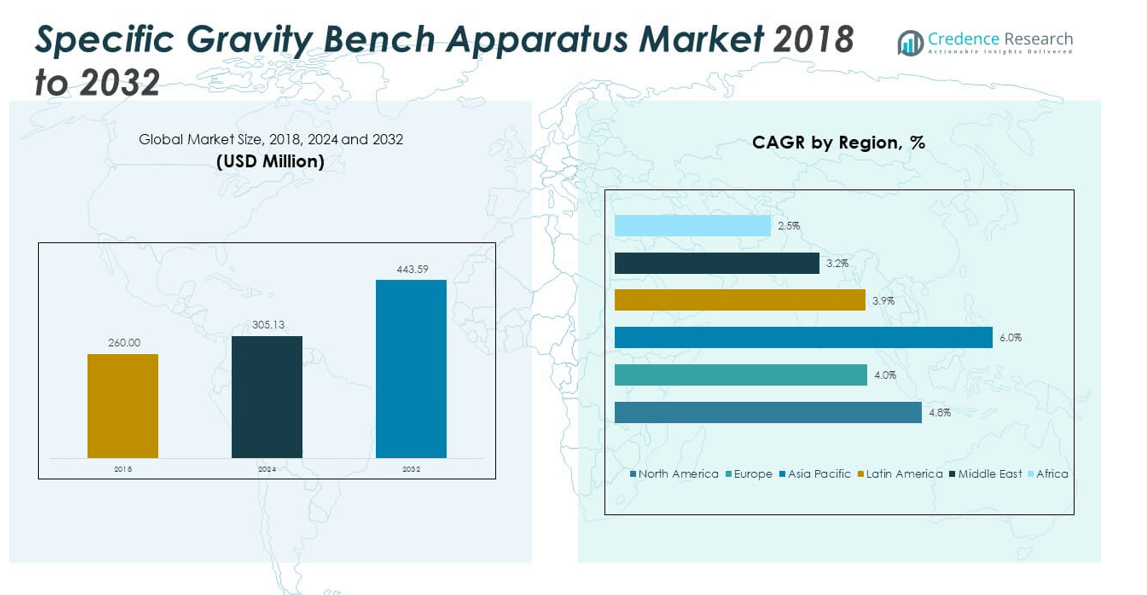
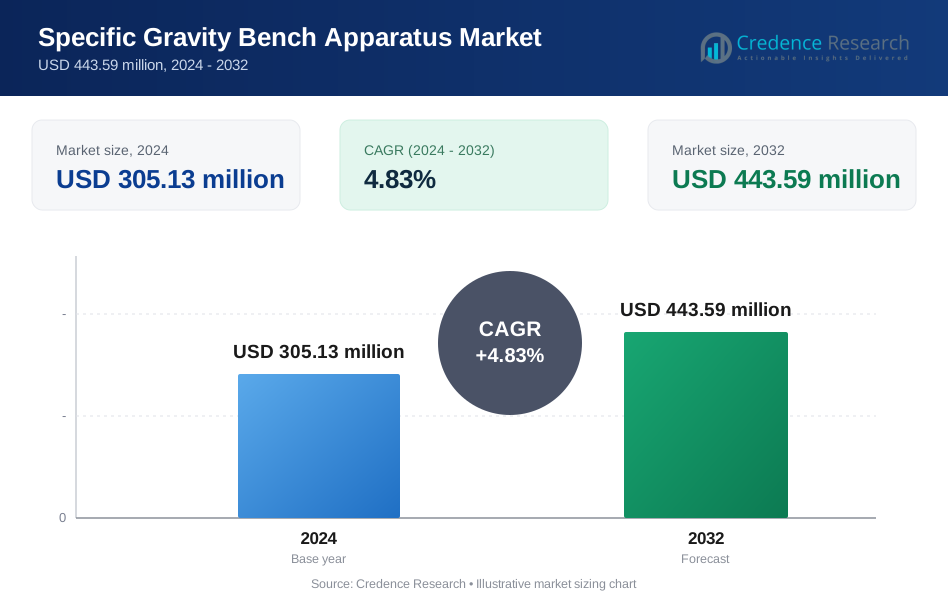
The Global Specific Gravity Bench Apparatus Market size was valued at USD 260.00 million in 2018. It reached USD 305.13 million in 2024. The market is anticipated to reach USD 443.59 million by 2032, at a CAGR of 4.83%.
| REPORT ATTRIBUTE | DETAILS |
|---|---|
| Historical Period | 2020-2023 |
| Base Year | 2024 |
| Forecast Period | 2025-2032 |
| Specific Gravity Bench Apparatus Market Size 2024 | USD 305.13 million |
| Specific Gravity Bench Apparatus Market, CAGR | 4.83% |
| Specific Gravity Bench Apparatus Market Size 2032 | USD 443.59 million |
The market grows due to rising demand for precise material testing. Construction labs require accurate density checks for aggregates and soils. Quality control teams rely on bench apparatus for repeatable results. Infrastructure projects increase routine testing needs across regions. Academic and research institutes expand laboratory capacity. Equipment upgrades improve ease of use and test consistency. Standard compliance drives steady replacement demand. Manufacturers focus on durable designs for long service life.
North America leads due to strong construction standards and advanced testing labs. Europe follows with strict material quality rules across infrastructure projects. Asia Pacific emerges fast with urban growth and new transport projects. China and India expand testing labs across public works. Southeast Asia shows rising adoption through industrial growth. Latin America gains traction via road and housing development. Middle East demand rises from large-scale infrastructure programs.
Market Insights:
- The Global Specific Gravity Bench Apparatus Market was valued at USD 260.00 million in 2018, reached USD 305.13 million in 2024, and is projected to reach USD 443.59 million by 2032, growing at a CAGR of 4.83%.
- North America leads with about 36.4% share due to strong standards, Asia Pacific follows with about 29.5% from infrastructure growth, and Europe holds nearly 21.6% driven by strict compliance norms.
- Asia Pacific is the fastest-growing region with about 29.5% share, supported by rapid urbanization, expanding education labs, and rising public infrastructure projects.
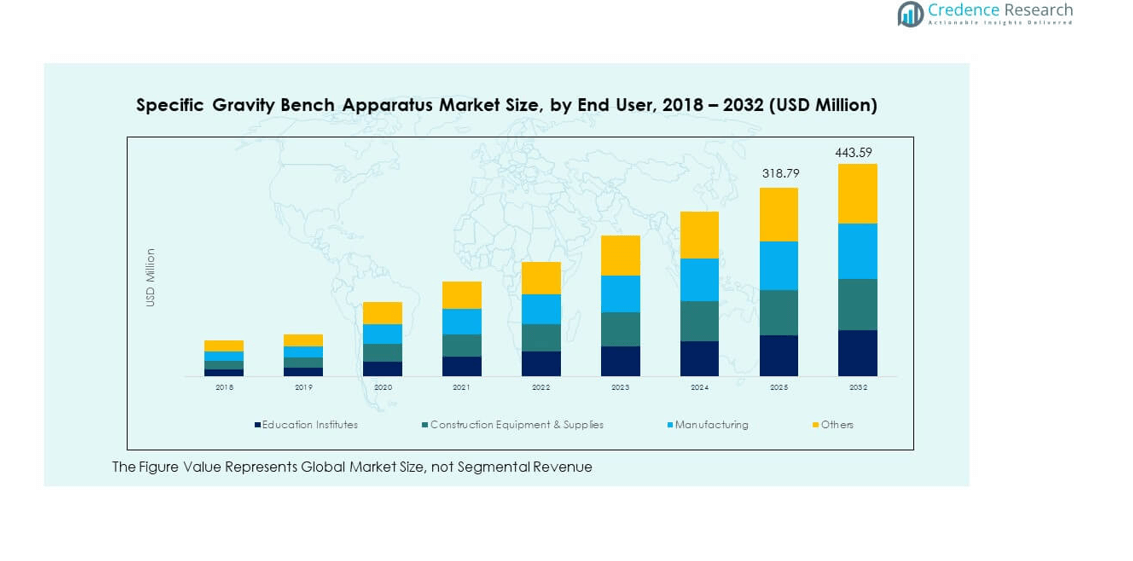
- By end user, construction equipment and supplies account for about 35% share, while manufacturing contributes nearly 30% due to routine material quality checks.
- Education institutes hold around 20% share and others account for about 15%, supported by academic training needs and third-party testing demand.
Market Drivers:
Rising Infrastructure Quality Control Requirements Across Public and Private Construction Projects
The Global Specific Gravity Bench Apparatus Market benefits from strict material quality norms across construction. Public agencies require verified density data for approval. Private developers enforce internal quality checks. Testing laboratories depend on accurate bench apparatus for compliance. Infrastructure audits increase routine sample validation. Contractors prefer reliable tools for dispute reduction. Standard test repeatability improves project confidence. This demand supports stable procurement cycles.
- For instance, Humboldt Mfg. Co. supplies specific gravity benches compliant with ASTM C127 and C128, supporting aggregate testing loads up to 25 kg with calibrated balance accuracy of 0.1 g.
Expansion Of Academic, Research, And Government Testing Laboratories Worldwide
Universities expand civil engineering and material science programs. Research institutes require precise density measurement for soil studies. Government labs support infrastructure planning and validation. Training centers use bench apparatus for practical instruction. Standard methods guide equipment specification decisions. Laboratory upgrades favor durable instruments. The Global Specific Gravity Bench Apparatus Market gains from institutional buying. Long equipment life ensures steady replacement demand.
- For instance, Controls S.p.A. thermostatic water baths used in academic labs feature corrosion-resistant stainless steel tanks and high-precision heating systems maintaining ±0.5 °C stability, ensuring compliance with EN and ASTM standards for specimen conditioning and materials testing.
Growth Of Road, Rail, And Urban Development Projects In Emerging Economies
Large transport projects require continuous material verification. Soil and aggregate density affects foundation stability. Urban expansion increases laboratory-backed approvals. Contractors adopt in-house testing facilities. Bench apparatus ensures controlled test conditions. Repeatable results support engineering decisions. Procurement rises with project scale. Equipment reliability supports frequent testing cycles.
Standardization Of Construction Testing Procedures Across Regions
International standards align testing practices across markets. Regulators enforce uniform density measurement methods. Contractors adopt compliant laboratory equipment. Testing consistency reduces project risk. Bench apparatus supports controlled environments. Calibration norms encourage periodic replacement. Compliance audits raise laboratory workload. Standard focus sustains long-term demand.
Market Trends:
Shift Toward Compact And Ergonomic Bench Apparatus For Modern Laboratories
Laboratories prefer space-efficient equipment layouts. Compact designs fit urban testing facilities. Ergonomic features reduce operator fatigue. Improved layouts enhance workflow efficiency. Manufacturers refine structural balance and stability. Labs value ease of setup and cleaning. The Global Specific Gravity Bench Apparatus Market reflects design-focused upgrades. User comfort influences purchase decisions.
- For instance, Gilson Company, Inc. offers the SG-20 Specific Gravity Bench, which features an adjustable shelf system for different tank sizes and a footprint width under one meter, improving operator access during repeated aggregate immersion tests.
Integration Of Improved Materials For Durability And Corrosion Resistance
Manufacturers adopt corrosion-resistant metals and coatings. Equipment durability supports long service life. Laboratories seek reduced maintenance needs. Material upgrades improve measurement stability. Harsh testing environments demand robust construction. Product reliability strengthens brand preference. Buyers favor proven build quality. This trend supports premium positioning.
- For instance, Forney LP uses powder-coated steel frames and corrosion-resistant stainless tanks rated for continuous water immersion, reducing surface degradation during high-frequency testing cycles.
Growing Preference For Standard-Compliant And Certified Equipment Models
Laboratories prioritize certified apparatus for audits. Compliance reduces approval delays. Buyers prefer models aligned with test standards. Certification simplifies procurement approvals. Equipment traceability gains importance. Manufacturers highlight compliance credentials. It strengthens buyer trust. Certification-driven selection shapes purchasing behavior.
Rising Demand For Low-Maintenance And Easy-To-Calibrate Instruments
Laboratories aim to reduce downtime. Easy calibration supports consistent accuracy. Low-maintenance designs lower operating costs. Testing schedules require dependable equipment. Simplified servicing improves lab efficiency. Manufacturers focus on user-friendly adjustments. The Global Specific Gravity Bench Apparatus Market reflects this shift. Reliability drives repeat purchases.
Market Challenges Analysis:
High Dependence On Skilled Laboratory Personnel And Proper Test Handling
Accurate testing requires trained technicians. Improper handling affects result reliability. Skill gaps limit effective equipment use. Training costs burden small laboratories. Manual procedures increase human error risk. Labs face staff turnover challenges. The Global Specific Gravity Bench Apparatus Market depends on user competence. Skill constraints slow adoption in some regions.
Limited Adoption In Cost-Sensitive And Low-Infrastructure Regions
Budget limits restrict laboratory investments. Small contractors delay equipment purchases. Manual testing methods persist in rural areas. Limited lab infrastructure slows market penetration. Import dependence raises acquisition costs. Maintenance access remains uneven. Procurement cycles stay long. These factors constrain market expansion.
Market Opportunities:
Expansion Of Construction Testing Infrastructure In Developing Economies
Emerging economies invest in material testing labs. Infrastructure programs require verified quality data. New laboratories need standard equipment. Contractors adopt formal testing practices. Public works demand compliance support. The Global Specific Gravity Bench Apparatus Market gains growth scope. Equipment suppliers target new installations. Long-term demand builds with infrastructure growth.
Increasing Private Laboratory Outsourcing And Third-Party Testing Demand
Developers outsource testing to certified labs. Independent laboratories expand service capacity. Third-party validation gains regulatory support. Bench apparatus demand rises with outsourcing growth. Private labs invest in standardized tools. Equipment upgrades support competitive positioning. It creates recurring sales opportunities. Market expansion aligns with service sector growth.
Market Segmentation Analysis:
Market By Type
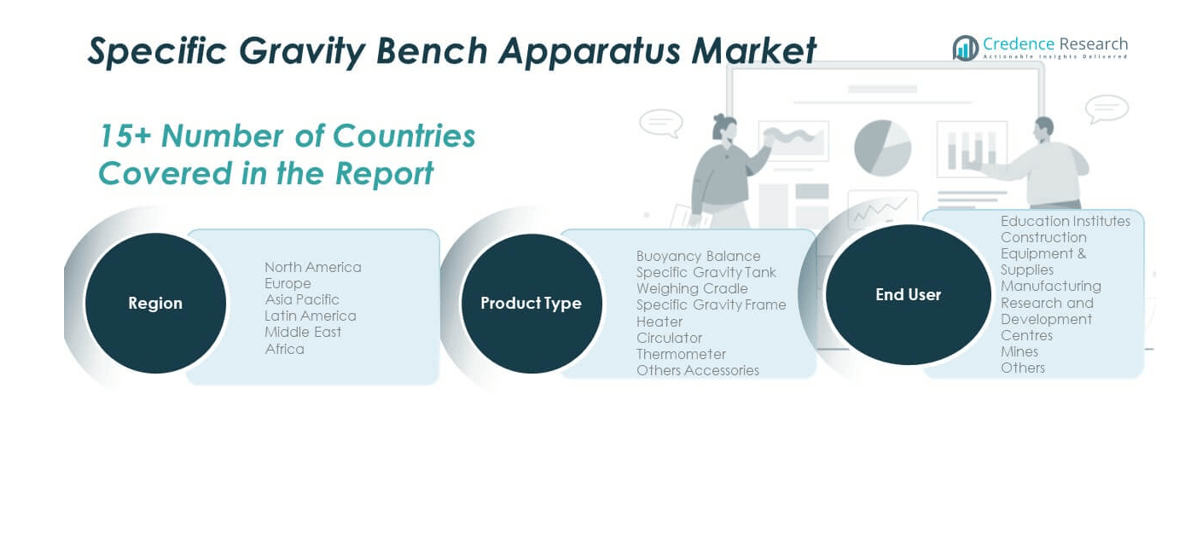
The Global Specific Gravity Bench Apparatus Market shows clear differentiation across equipment types. Buoyancy balance and specific gravity tanks hold strong demand due to core testing roles. Weighing cradles and frames support stable and repeatable measurements. Heaters and circulators ensure controlled test conditions in laboratories. Thermometers support accuracy through temperature monitoring. Other accessories improve setup flexibility and testing scope. Manufacturers focus on durability and precision across all components. Product selection depends on laboratory scale and test standards.
- For instance, Cooper Research Technology integrates digital thermometers with 0.1 °C resolution and circulation systems capable of maintaining uniform tank temperatures during prolonged aggregate testing.
Market By End User
The Global Specific Gravity Bench Apparatus Market serves a wide end user base with distinct needs. Education institutes rely on apparatus for teaching and practical training. Construction equipment and supplies users drive volume demand through routine quality checks. Manufacturing facilities use it for internal material validation. Research and development centres require high accuracy for experimental work. Mines depend on density testing for material classification. Other users include testing agencies and consultants. Usage frequency and compliance needs guide purchase decisions.
- For instance, Durham Geo-Enterprises supplies bench systems widely used by independent geotechnical labs, supporting daily multi-sample testing aligned with ASTM aggregate and soil density procedures.
Market By Region
The Global Specific Gravity Bench Apparatus Market shows varied regional adoption patterns. North America leads due to strong testing standards and lab infrastructure. Europe follows with strict compliance and quality norms. Asia Pacific grows fast with infrastructure expansion and academic investment. Latin America gains traction through road and housing projects. Middle East demand links to large construction programs. Africa shows gradual growth with rising testing capacity. Regional demand reflects development pace and regulatory focus.
Segmentation:
- Market By Type
- Buoyancy Balance
- Specific Gravity Tank
- Weighing Cradle
- Specific Gravity Frame
- Heater
- Circulator
- Thermometer
- Other Accessories
- Market By End User
- Education Institutes
- Construction Equipment & Supplies
- Manufacturing
- Research and Development Centres
- Mines
- Others
- Market By Region
- North America
- U.S.
- Canada
- Mexico
- Europe
- Germany
- France
- U.K.
- Italy
- Spain
- Rest of Europe
- Asia Pacific
- China
- Japan
- India
- South Korea
- South-east Asia
- Rest of Asia Pacific
- Latin America
- Brazil
- Argentina
- Rest of Latin America
- Middle East & Africa
- GCC Countries
- South Africa
- Rest of the Middle East and Africa
- North America
Regional Analysis:
North America
The North America Global Specific Gravity Bench Apparatus Market size was valued at USD 95.68 million in 2018 to USD 110.95 million in 2024 and is anticipated to reach USD 161.07 million by 2032, at a CAGR of 4.8 during the forecast period. The Global Specific Gravity Bench Apparatus Market holds the largest regional share in North America at about 36.4%. Strong testing standards support steady equipment demand. Construction quality control remains a key driver. Government-funded infrastructure projects sustain laboratory activity. Education institutes maintain stable procurement cycles. Manufacturing labs rely on precise density testing. Mining and material testing firms support repeat demand. The region benefits from mature laboratory infrastructure. Equipment replacement cycles remain predictable.
Europe
The Europe Global Specific Gravity Bench Apparatus Market size was valued at USD 58.89 million in 2018 to USD 65.99 million in 2024 and is anticipated to reach USD 89.72 million by 2032, at a CAGR of 4.0 during the forecast period. The Global Specific Gravity Bench Apparatus Market accounts for nearly 21.6% share in Europe. Strict regulatory standards shape equipment adoption. Public infrastructure maintenance supports testing demand. Academic research sustains laboratory investments. Industrial manufacturing relies on standardized material checks. Testing agencies focus on compliance-driven procurement. Western Europe leads regional demand. Eastern Europe shows gradual laboratory expansion. Market growth stays stable and compliance led.
Asia Pacific
The Asia Pacific Global Specific Gravity Bench Apparatus Market size was valued at USD 73.84 million in 2018 to USD 89.97 million in 2024 and is anticipated to reach USD 142.53 million by 2032, at a CAGR of 6.0 during the forecast period. The Global Specific Gravity Bench Apparatus Market captures around 29.5% share in Asia Pacific. Rapid infrastructure development drives testing needs. China and India lead regional consumption. Urban expansion supports laboratory growth. Education sector investments raise equipment demand. Manufacturing capacity expansion increases internal testing. Government projects enforce quality benchmarks. Southeast Asia shows rising adoption. This region records the fastest growth pace.
Latin America
The Latin America Global Specific Gravity Bench Apparatus Market size was valued at USD 17.68 million in 2018 to USD 20.56 million in 2024 and is anticipated to reach USD 27.89 million by 2032, at a CAGR of 3.9 during the forecast period. The Global Specific Gravity Bench Apparatus Market holds about 6.7% share in Latin America. Infrastructure development supports moderate demand. Road and housing projects drive testing activity. Brazil leads regional consumption. Mining operations support density testing needs. Public labs expand slowly across countries. Budget limits affect procurement cycles. Private testing labs show selective growth.
Middle East
The Middle East Global Specific Gravity Bench Apparatus Market size was valued at USD 8.32 million in 2018 to USD 9.03 million in 2024 and is anticipated to reach USD 11.58 million by 2032, at a CAGR of 3.2 during the forecast period. The Global Specific Gravity Bench Apparatus Market represents nearly 3.0% share in the Middle East. Large construction projects support demand. Government-led infrastructure drives testing needs. Gulf countries dominate regional activity. Academic and testing labs expand gradually. Quality compliance supports steady equipment use. Import reliance affects pricing trends. Market growth remains project driven.
Africa
The Africa Global Specific Gravity Bench Apparatus Market size was valued at USD 5.59 million in 2018 to USD 8.64 million in 2024 and is anticipated to reach USD 10.81 million by 2032, at a CAGR of 2.5 during the forecast period. The Global Specific Gravity Bench Apparatus Market accounts for about 2.8% share in Africa. Construction growth supports baseline demand. Mining activities drive material testing needs. South Africa leads regional adoption. Public infrastructure labs expand slowly. Budget constraints limit rapid upgrades. Training institutes create gradual demand. Market growth remains steady but modest.
Key Player Analysis:
- Durham Geo-Enterprises
- Controls S.p.A., Inc.
- Houghton Manufacturing Company
- Cooper Research Technology
- Gilson Company, Inc.
- Forney LP
- Humboldt Mfg. Co.
- Sun Labtek Equipments Manufacturing Private Limited
- Test Mark Industries
- M & L Testing Equipment (1995) Inc.
Competitive Analysis:
The Global Specific Gravity Bench Apparatus Market shows moderate competition with a mix of global and regional manufacturers. Established players focus on precision, durability, and compliance with testing standards. Product portfolios cover complete bench setups and individual components. Companies compete through quality consistency and brand reliability. Distribution networks play a key role in customer reach. After-sales support strengthens long-term relationships with laboratories. Pricing remains competitive in cost-sensitive regions. Smaller firms target niche academic and local testing labs. Market competition stays stable with limited technology disruption.
Recent Developments:
- On December 9, 2025, Cooper Research Technology announced a strategic partnership with Altronic LLC, a global provider of ignition, control, and instrumentation systems. This partnership marks an important expansion of Cooper's technical capabilities while creating new opportunities for Altronic to advance its technologies and accelerate growth. The collaboration aims to combine Cooper's deep field experience and broad aftermarket support network with Altronic's longstanding engineering innovation to improve product development and bolster operational reliability for customers who depend on critical infrastructure equipment. According to Cooper CEO Scott Buckhout, this partnership aligns with the company's ongoing commitment to being an engineering solutions-led organization, providing customers with dependable and forward-looking engine solutions.
- On June 16, 2025, Gilson announced the launch of PIPETMAN® M96, a 96-channel motorized pipette designed to bring efficient, semi-automated pipetting capabilities to laboratory benches. This product launch exemplifies Gilson's commitment to helping laboratories gradually transition from manual to automated processes. The PIPETMAN® M96 is designed to simplify and accelerate pipetting across 96- and 384-well microplates, enhancing productivity while reducing human error and operator fatigue. The device features advanced touchscreen control with customizable protocols and a compact, user-friendly design, making it ideal for labs looking to increase throughput without the complexity of full automation. Available globally starting June 2025, the PIPETMAN® M96 comes in two volume ranges 2–20 µL and 10–200 µL with both Bluetooth-connected and non-connected versions.
- In March 2025, Quaker Houghton announced a significant strategic acquisition aimed at strengthening its advanced solutions portfolio. The company entered into a purchase agreement to acquire Dipsol Chemicals Co., Ltd., a Japan-based supplier of surface treatment and plating solutions, for approximately $153 million (23 billion Japanese yen). The transaction was expected to close in the second quarter of 2025, subject to regulatory approvals and customary conditions. This acquisition demonstrates Quaker Houghton's ability to leverage its strong financial position to make strategic investments that accelerate growth. According to CEO Joseph Berquist, Dipsol provides Quaker Houghton with leading product technologies that complement its technical service model and expand the breadth of its differentiated advanced solutions portfolio, particularly strengthening its presence in the Asia Pacific region.
Report Coverage:
The research report offers an in-depth analysis based on type, end user, and region segments. It details leading market players, providing an overview of their business, product offerings, investments, revenue streams, and key applications. Additionally, the report includes insights into the competitive environment, SWOT analysis, current market trends, as well as the primary drivers and constraints. Furthermore, it discusses various factors that have driven market expansion in recent years. The report also explores market dynamics, regulatory scenarios, and technological advancements that are shaping the industry. It assesses the impact of external factors and global economic changes on market growth. Lastly, it provides strategic recommendations for new entrants and established companies to navigate the complexities of the market.
Future Outlook:
- Infrastructure quality standards will continue to drive consistent demand for testing equipment across public projects.
- Academic laboratory expansion will support stable baseline demand from universities and training institutes.
- Emerging markets will contribute incremental growth through new infrastructure and laboratory setups.
- Product durability will remain a key factor shaping long-term buyer preference and brand loyalty.
- Modular equipment designs will gain wider acceptance due to flexibility and ease of upgrades.
- Distribution reach will play a critical role in improving regional market penetration.
- Replacement demand will support recurring revenue for established manufacturers.
- Private testing laboratories will expand procurement to meet outsourced testing requirements.
- Compliance requirements will guide purchasing decisions across regulated construction markets.
- Regional infrastructure spending patterns will define the pace of market growth globally.
Request a Free Sample
Fill in your details and we'll send you a free sample report.
- Sample data tables & charts
- Research methodology
Need a Custom Version of This Report?
Tailor the scope, geography, or segments to your exact requirements.
- Custom geography or segment scope
- Direct access to our analyst team
Frequently Asked Questions
What is the projected growth of the Specific Gravity Bench Apparatus Market?
At what Compound Annual Growth Rate is the Global Specific Gravity Bench Apparatus Market projected to grow between 2025 and 2032?
What are the key drivers of market growth?
Which regions hold a dominant market share?
What challenges does the market face?
Who are the leading companies in the Global Specific Gravity Bench Apparatus Market?
Table of Content
Chapter 1. Report Introduction
- 1.1 Report Description & Purpose
- 1.1.1 Report Title & Market Definition
- 1.1.2 Unique Selling Propositions (USP) & Key Differentiators
- 1.1.3 Value Proposition for Stakeholders
- 1.2 Research Objectives
- 1.2.1 Market Sizing Objectives (Volume & Revenue)
- 1.2.2 Segmentation Objectives
- 1.2.3 Competitive Intelligence Objectives
- 1.2.4 Forecast & Scenario Objectives
- 1.3 Report Scope
- 1.3.1 Specific Gravity Bench Apparatus Scope – Types & Subtypes Covered
- 1.3.2 Geographic Scope – Regions & Countries Covered
- 1.3.3 Historical Period, Base Year & Forecast Period (2024; forecast to 2032)
- 1.3.4 Inclusions & Exclusions
- 1.4 HS Code & Classification Framework
- 1.5 Currency, Units & Pricing Basis
- 1.6 Target Stakeholders
- 1.7 Limitations & Assumptions
Chapter 2. Executive Summary
- 2.1 Global Specific Gravity Bench Apparatus Market Snapshot
- 2.1.1 Market Size – Historical (2024) & Forecast (2024-2032) (2024: USD 305.13 million → 2032: USD 443.59 million)
- 2.1.2 Volume & Revenue – Global Totals
- 2.1.3 Key Market Highlights – Top Five Facts
- 2.2 Specific Gravity Bench Apparatus Market Segmentation Snapshot
- 2.2.1 Market Split by Region – 2024 vs. 2032
- 2.3 Competitive Snapshot
- 2.3.1 Top 10 Players by Revenue Share – 2024
- 2.3.2 Top 10 Players by Volume Share – 2024
- 2.3.3 Recent Strategic Developments (18-Month Summary)
- 2.4 Key Investment Highlights & Strategic Conclusions
Chapter 3. Specific Gravity Bench Apparatus Market Dynamics & Industry Analysis
- 3.1 Market Overview & Context
- 3.1.1 Specific Gravity Bench Apparatus Market Position in the Broader Automotive Value Chain
- 3.1.2 OEM vs. Replacement Market Dynamics
- 3.1.3 Market Maturity & Development Stage by Region
- 3.2 Specific Gravity Bench Apparatus Market Drivers
- 3.3 Specific Gravity Bench Apparatus Market Restraints & Challenges
- 3.4 Specific Gravity Bench Apparatus Market Opportunities
- 3.5 Porter's Five Forces Analysis
- 3.5.1 Threat of New Entrants
- 3.5.2 Bargaining Power of Suppliers
- 3.5.3 Bargaining Power of Buyers
- 3.5.4 Threat of Substitutes
- 3.5.5 Competitive Rivalry – Intensity Assessment
- 3.6 Specific Gravity Bench Apparatus Value Chain Analysis
- 3.6.1 Upstream – Raw Material/Input Suppliers
- 3.6.1.1 Raw Material/Input 1
- 3.6.1.2 Raw Material/Input 2
- 3.6.1.3 Raw Material/Input 3
- 3.6.2 Midstream – Production/Manufacturing/Service Delivery
- 3.6.2.1 Production/Process Overview
- 3.6.2.2 Key Facility Locations & Capacity by Manufacturer
- 3.6.3 Downstream – Distribution & End Consumer
- 3.6.3.1 Primary Channel – B2B/OEM
- 3.6.3.2 Secondary Channels – Dealer, Retail, Online, Direct
- 3.6.4 Value Chain Profitability Analysis
- 3.6.1 Upstream – Raw Material/Input Suppliers
- 3.7 PESTEL Analysis
- 3.7.1 Political Factors
- 3.7.2 Economic Factors
- 3.7.3 Social Factors
- 3.7.4 Technological Factors
- 3.7.5 Environmental Factors
- 3.7.6 Legal Factors
- 3.8 Specific Gravity Bench Apparatus Supply Chain Analysis
- 3.8.1 Raw Material/Input Supply Risk Assessment
- 3.8.2 Manufacturing Concentration Risk (Geographic Exposure)
- 3.8.3 Trade Disruption Impact Analysis
- 3.9 Regulatory & Policy Landscape
Note: The regulatory and policy landscape section covers regulations based on their applicability to the market, Specific Gravity Bench Apparatus category, geography, and scope of the study. Only regulatory frameworks with a material impact on operations, compliance, trade, sustainability, or market access are analyzed in detail.
Chapter 4. Key Investment Pockets & Opportunity Analysis
- 4.1 Specific Gravity Bench Apparatus Market Attractiveness Analysis
- 4.1.1 By Region – Investment Attractiveness Matrix (Volume × CAGR)
- 4.2 Absolute Revenue Growth Opportunity
- 4.2.1 By Region – Absolute USD Growth Through 2032
- 4.3 Incremental Volume Opportunity
- 4.3.1 By Region – Incremental Volume Through 2032
- 4.3.2 Segment – Incremental Volume
- 4.4 Emerging Submarket Opportunity Deep Dive (Subject to Applicability)
- 4.5 Emerging Market Opportunity Scorecards
- 4.5.1 United States
- 4.5.2 Europe
- 4.5.3 Asia
- 4.5.4 Middle East & Africa
Note: Emerging Market Opportunity Scorecards will be included based on relevance and strategic importance. Regions listed are indicative and may vary depending on data availability and market dynamics.
Chapter 5. Specific Gravity Bench Apparatus Import-Export Analysis & Trade Flows
- 5.1 Global Trade Overview
- 5.1.1 Global Export Value by Country (2024)
- 5.1.2 Global Export Volume by Country (2024)
- 5.1.3 Global Import Value by Country (2024)
- 5.1.4 Global Import Volume by Country (2024)
- 5.1.5 Net Trade Balance by Country (2024)
- 5.2 Export Analysis – Segment
- 5.2.1 Type 1 (HS Code)
- 5.2.2 Type 2 (HS Code)
- 5.2.3 Type 3 (HS Code)
- 5.2.4 Type 4 (HS Code)
- 5.2.5 Type 5 (HS Code)
- 5.3 Import Analysis – Segment
- 5.3.1 Type 1 (HS Code)
- 5.3.2 Type 2 (HS Code)
- 5.3.3 Type 3 (HS Code)
- 5.3.4 Type 4 (HS Code)
- 5.3.5 Type 5 (HS Code)
- 5.4 Average Unit Trade Prices
- 5.4.1 Average Export Price – Segment & Country
- 5.4.2 Average Import Price – Segment & Source Country
- 5.4.3 Price Trends (2024)
- 5.5 Key Trade Route Analysis
- 5.5.1 Trade Route 1
- 5.5.2 Trade Route 2
- 5.5.3 Trade Route 3
- 5.5.4 Trade Route 4
- 5.5.5 Trade Route 5
- 5.6 Trade Policy Impact Assessment
- 5.6.1 US Anti-Dumping & Section 301 Tariffs
- 5.6.2 EU Customs Union Impact
- 5.6.3 Major Free Trade Agreements
- 5.6.4 USMCA Rules of Origin
Note: Trade policy analysis will be included only where relevant to the Specific Gravity Bench Apparatus market.
Chapter 6. Competitive Landscape & Company Benchmarking
- 6.1 Specific Gravity Bench Apparatus Market Concentration & Structure
- 6.1.1 Herfindahl-Hirschman Index (HHI) – vs. 2024
- 6.1.2 Tier 1, Tier 2 & Tier 3 Market Structure
- 6.1.3 Global, Regional & Local Player Dynamics
- 6.2 Specific Gravity Bench Apparatus Market Share Analysis – 2024
- 6.2.1 Global Revenue Share by Company
- 6.2.2 Global Volume Share by Company
- 6.2.3 Regional Revenue Share
- 6.2.4 Market Share Evolution ( vs. 2024)
- 6.2.5 OEM Segment Share by Company
- 6.2.6 Replacement Segment Share by Company
- 6.3 Production/Delivery Capacity & Facility Analysis
- 6.3.1 Global Installed Capacity
- 6.3.2 Capacity Utilization Rates
- 6.3.3 Production/Output Volume
- 6.3.4 Facility Locations & Capacity Map
- 6.3.5 Planned Capacity Additions
- 6.4 Specific Gravity Bench Apparatus Competitive Benchmarking Matrix
- 6.4.1 Revenue, Volume, CAGR & Profitability Comparison
- 6.4.2 Channel Revenue Mix
- 6.4.3 Geographic Revenue Exposure
- 6.4.4 R&D Intensity
- 6.4.5 Sustainability Maturity
- 6.5 Strategic Developments in Specific Gravity Bench Apparatus (Last 24 Months)
- 6.5.1 Mergers, Acquisitions & Divestments
- 6.5.2 New Specific Gravity Bench Apparatus Launches
- 6.5.3 Facility Expansions
- 6.5.4 Strategic Alliances, Joint Ventures & Partnerships
- 6.5.5 Distribution Expansion & Market Entry
- 6.5.6 Sustainability & ESG Initiatives
- 6.6 Competitive Strategy Mapping
- 6.6.1 Leader, Challenger, Follower & Niche Classification
- 6.6.2 Pricing Strategy Comparison
- 6.6.3 Channel Strategy Matrix
Note: Strategic developments are included based on their materiality and the availability of reliable information.
Chapter 7. Global Specific Gravity Bench Apparatus Market – By Distribution Channel
- 7.1 Segment Overview
- 7.1.1 Volume & Revenue Split by Channel (2024 & 2032)
- 7.1.2 Channel Mix Evolution (2024-2032)
Chapter 8. Regional Market Analysis – Global Overview
- 8.1 Global Regional Overview
- 8.1.1 Regional Volume Share
- 8.1.2 Regional Revenue Share
- 8.1.3 Regional Volume by Region
- 8.1.4 Regional Revenue by Region
- 8.1.5 Regional Forecast Through 2032
- 8.2 Cross-Regional Segment Analysis
- 8.2.1 By Distribution Channel
- 8.2.2 By Brand/Price Tier
Chapter 9. North America Specific Gravity Bench Apparatus Market
- 9.1 United States
- 9.2 Canada
- 9.3 Mexico
Chapter 10. Europe Specific Gravity Bench Apparatus Market
- 10.1 Germany
- 10.2 France
- 10.3 Italy
- 10.4 United Kingdom
- 10.5 Spain
- 10.6 Poland
- 10.7 Russia
- 10.8 Netherlands
- 10.9 Belgium
- 10.10 Sweden
- 10.11 Denmark
- 10.12 Norway
- 10.13 Rest of Europe
Chapter 11. Asia Pacific Specific Gravity Bench Apparatus Market
- 11.1 China
- 11.2 India
- 11.3 Japan
- 11.4 South Korea
- 11.5 Thailand
- 11.6 Indonesia
- 11.7 Vietnam
- 11.8 Malaysia
- 11.9 Australia
- 11.10 Rest of Asia Pacific
Chapter 12. Latin America Specific Gravity Bench Apparatus Market
- 12.1 Brazil
- 12.2 Argentina
- 12.3 Colombia
- 12.4 Chile
- 12.5 Rest of Latin America
Chapter 13. Middle East Specific Gravity Bench Apparatus Market
- 13.1 Saudi Arabia
- 13.2 United Arab Emirates
- 13.3 Turkey
- 13.4 Israel
- 13.5 Iran
- 13.6 Rest of the Middle East
Chapter 14. Africa Specific Gravity Bench Apparatus Market
- 14.1 South Africa
- 14.2 Egypt
- 14.3 Nigeria
- 14.4 Morocco
- 14.5 Rest of Africa
Chapter 15. Specific Gravity Bench Apparatus Company Profiles
- 15.1 [Company 01]
- 15.1.1 Company Overview
- 15.1.2 Key Management Personnel
- 15.1.3 Products & Services Portfolio
- 15.1.4 Financial Performance
- 15.1.5 Key Market Focus & Geographic Presence
- 15.1.6 Recent Developments & Strategic Initiatives
Note: The company profile list is preliminary and may change based on research findings, market developments, data availability, and client requirements.
Chapter 16. Appendices
- Appendix A – List of Abbreviations & Acronyms
- Appendix B – Industry Classification Code Reference – Full Series
- Appendix C – Production & Capacity Data Tables
- Appendix D – End-Use & Demand Base Tables
- Appendix E – Consumption & Replacement Rate Assumptions
- Appendix F – ASP Reference Tables
- Appendix G – Manufacturing & Facility Database
- Appendix H – Import-Export Data Tables
- Appendix I – Regulatory Summary Tables
- Appendix J – Primary Research Participant List (Anonymized)
- Appendix K – Primary Research Questionnaire Framework
- Appendix L – Data Sources & Bibliography
- Appendix M – Market Size Divergence & Source Comparison
Chapter 17. Research Methodology
- 17.1 Research Framework & Philosophy
- 17.2 Secondary Research – Sources, Hierarchy & Data Extraction
- 17.3 Data Modeling – Bottom-Up & Top-Down Market Sizing
- 17.4 Primary Research – Stakeholder Framework, LOI & Sample Sizes
- 17.5 Forecast Methodology – Regression, Scenario & Sensitivity Analysis
- 17.6 Quality Control – Four-Layer Validation Framework
- 17.7 Limitations & Standard Assumptions
- 17.8 Disclaimer
