
Market Overview
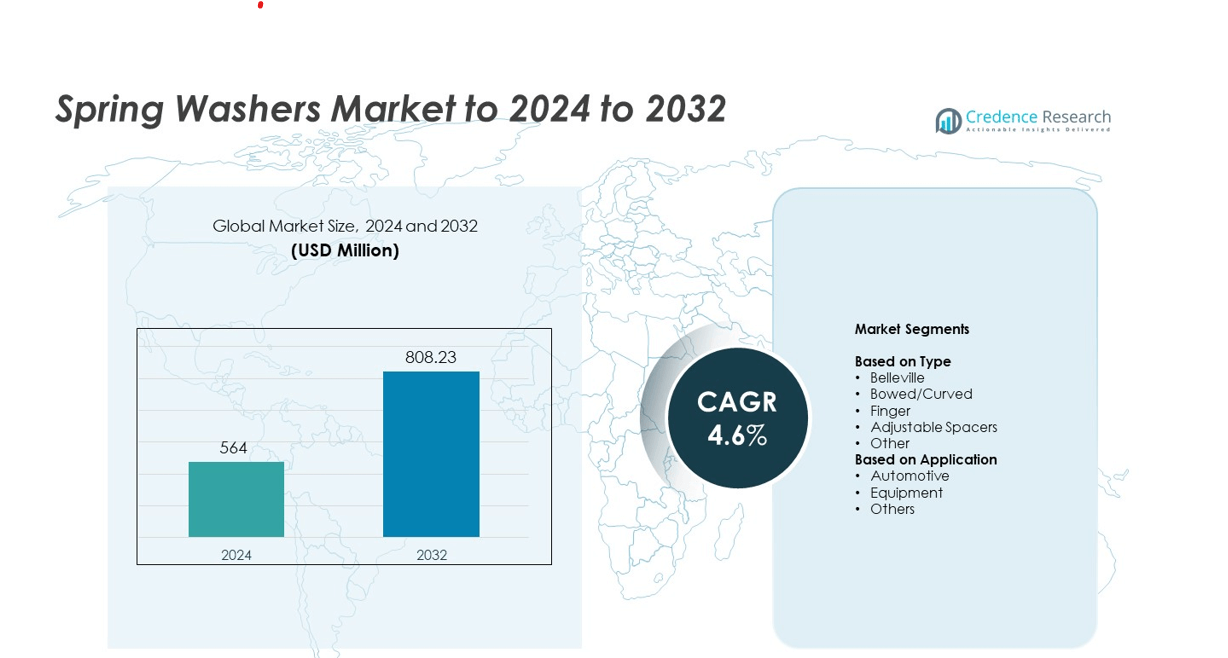
Spring Washers Market size was valued USD 564 Million in 2024 and is anticipated to reach USD 808.23 Million by 2032, at a CAGR of 4.6% during the forecast period.
| REPORT ATTRIBUTE | DETAILS |
|---|---|
| Historical Period | 2020-2023 |
| Base Year | 2024 |
| Forecast Period | 2025-2032 |
| Spring Washers Market Size 2024 | USD 564 Million |
| Spring Washers Market, CAGR | 4.6% |
| Spring Washers Market Size 2032 | USD 808.23 Million |
The Spring Washers Market includes key players such as Bombardier Recreational Products, Accurate Mfd Products, Yamaha, Nord-Lock, Polaris, Foreverbolt, Alpina, Rotor Clip, Crazy Mountain, BRP, Arctic Cat, and Micro Plastics, each contributing to product innovation and wider industry adoption. North America leads the market with about 32% share, driven by strong automotive and equipment manufacturing activity. Europe follows with roughly 28% share supported by strict engineering standards and advanced machinery production. Asia Pacific holds about 30% share due to large-scale industrial growth and expanding automotive output, while Latin America and the Middle East and Africa account for smaller but steady shares as machinery upgrades and construction activities rise.
Market Insights
- The Spring Washers Market was valued at USD 564 Million in 2024 and is projected to reach USD 808.23 Million by 2032, growing at a CAGR of 4.6%.
- Market growth is driven by rising use in automotive fastening systems, wider adoption in industrial machinery, and increasing demand for durable and high-tension assembly components.
- Key trends include the shift toward lightweight and high-strength washer designs, rising precision manufacturing needs, and growing use of spring washers in automated assembly lines.
- Competition intensifies as manufacturers improve material quality, expand customized washer portfolios, and strengthen global distribution to serve automotive, equipment, and construction applications.
- North America leads with about 32% share, followed by Europe at nearly 28% and Asia Pacific at about 30%, while automotive holds around 48% share and Belleville types lead the product segment with about 42% share.
Market Segmentation Analysis:
By Type
Belleville washers lead this segment with about 42% share in 2024. Demand stays strong because these conical washers deliver high load capacity, compact design, and precise tension control for heavy-duty assemblies. Industries rely on Belleville designs to maintain joint integrity under vibration, thermal shifts, and dynamic loads. Bowed or curved washers grow as manufacturers use them for flexible preload support in light machinery. Finger types see adoption in rotating systems where smooth torque transmission matters, while adjustable spacers and other forms serve niche uses that require fine height correction or layered stacking.
- For instance, SPIROL International produces Series DS Belleville-style (disc) springs following the DIN EN 16983 (formerly DIN 2093) standard, which offers a wide range of load/deflection characteristics
By Application
Automotive dominates this segment with nearly 48% share in 2024. Automakers adopt spring washers to secure fasteners exposed to shock, heat, and constant vibration in chassis, braking, and powertrain systems. The rising use of lightweight components and high-performance assemblies pushes demand for reliable tension-maintaining washers. Equipment applications expand in industrial machinery and construction tools where stable load distribution supports longer service life. Other uses include electronics and small devices that need compact fastener stability without adding excess mass.
- For instance, Schnorr GmbH notes in its product literature that its DIN 6796 load washers conform to the standard, which specifies they are designed for high-strength bolts (grades 8.8-12.9) and offer optimum compensation for setting in the joint.
Key Growth Drivers
Rising Use in Automotive Fastening Systems
Automotive makers rely on spring washers to keep joints stable under heat, shock, and vibration. Demand rises as new vehicles use more compact parts that need steady tension to avoid loosening. Growth also comes from electric vehicles, which place higher stress on mounting points due to battery weight and torque. This wider use in fasteners makes automotive adoption a major growth driver across global production lines.
- For instance, the Würth Group, which includes specialized companies like Arnold Umformtechnik focusing on connecting technology for the automotive industry, achieved total sales of over €20.4 billion in the 2023 fiscal year, a 2.4 % increase over the previous year.
Expansion of Industrial Machinery and Equipment
Industrial machines need fasteners that stay secure during long duty cycles and heavy loads. Spring washers support this need by offering strong preload control and better load distribution. As industries expand automation and upgrade older systems, buyers pick washers that reduce downtime and lower maintenance risk. This strong industrial push makes machinery growth a key driver for the market.
- For instance, Springmasters supplies DIN 2093 disc springs with outside diameters ranging from 6.0 mm to 250.0 mm, allowing engineers to match washer sizes to both small and very large industrial machinery connections.
Increasing Focus on Durable Assembly Solutions
Manufacturers seek components that support longer product life and reduce field failures. Spring washers help maintain tight joints in harsh settings such as pressure changes, vibration, and repeated motion. Rising quality standards and global safety rules also push companies to use tension-holding hardware. This rising focus on durability and performance stands as a key market driver.
Key Trends and Opportunities
Shift Toward Lightweight and High-Strength Designs
Producers explore new alloys and refined shapes to create lighter washers with higher load ratings. Growing demand for compact assemblies in automotive, equipment, and electronics encourages suppliers to design thin yet strong variants. These upgraded materials help improve energy efficiency and reduce part fatigue. This shift toward advanced lightweight designs forms a major trend and opportunity.
- For instance, the SPIROL Disc Spring Design Guideprovides charts and formulas for engineers to calculate the estimated fatigue life of specific springs, such as the DIN EN 16983 Series B 50 x 25.4 x 2 disc spring operating between a 15% and 75% deflection range.
Growth of Precision Manufacturing and Customized Washers
Buyers now request washers that match exact preload, thickness, and deflection needs. Precision machining and automated forming systems help suppliers deliver consistent, high-tolerance parts. Demand grows in sectors where accurate tension control improves system reliability. The expansion of custom and application-specific washers creates a strong opportunity for specialized manufacturers.
- For instance, Keller + Kalmbachsupplies a wide range of DIN 2093 disc springs with precisely defined dimensions that conform to tight-tolerance engineered assembly requirements.
Adoption of Automated Assembly Lines
Automated lines need fasteners that fit smoothly into high-speed processes. Spring washers designed for clean feeding and stable stacking gain traction. As more factories automate production, these optimized washers reduce rejection rates and improve throughput. Automation growth creates a clear opportunity for suppliers offering assembly-friendly designs.
Key Challenges
Fluctuating Raw Material Prices
Spring washer production depends on steel grades and specialty alloys that face constant price swings. These shifts raise production costs and squeeze margins for small suppliers. Companies struggle to balance quality and cost during volatile periods. This ongoing material instability stands as a major challenge for the market.
Competition from Alternative Fastening Solutions
Some systems now use locking nuts, thread adhesives, or integrated fastening designs that reduce the need for washers. These alternatives gain attention in sectors focused on fewer parts and faster assembly. As designs evolve, spring washers must prove higher value to remain standard in critical joints. This rise of competing solutions remains a key market challenge.
Regional Analysis
North America
North America holds about 32% share in the Spring Washers Market in 2024. The region benefits from strong automotive production, advanced equipment manufacturing, and strict quality standards that support steady demand. Industries such as construction machinery, aerospace components, and energy infrastructure rely on washers that maintain tension under vibration and thermal stress. The United States leads due to large-scale industrial activity and high adoption of precision fastening systems. Canada adds demand through machinery exports and mining equipment needs. Ongoing upgrades in production facilities and higher reliability requirements strengthen long-term growth across the region.
Europe
Europe accounts for nearly 28% share in the Spring Washers Market in 2024. The region maintains strong demand driven by large automotive fleets, advanced engineering standards, and strong industrial machinery production. Germany, France, and Italy support steady growth due to high reliance on durable fastening components in transport systems and heavy equipment. Strict safety rules encourage the use of tension-maintaining washers in high-load assemblies. The region’s strong focus on lightweight components further increases demand for precision-formed washers. Continued innovation in manufacturing lines and growth in electric mobility support stable long-term expansion.
Asia Pacific
Asia Pacific leads many production activities but holds about 30% share in the Spring Washers Market in 2024. Rapid industrial expansion, large automotive manufacturing hubs, and rising machinery exports support strong washer consumption. China drives demand with large equipment factories and wider use of automated assembly lines. India and Southeast Asia add growth due to infrastructure development and expansion of light machinery sectors. Manufacturers in this region focus on affordable but durable fastening components. Rising investment in electric vehicles and consumer electronics further enhances adoption of high-strength spring washer designs.
Latin America
Latin America represents around 6% share in the Spring Washers Market in 2024. Demand grows steadily due to the expansion of automotive servicing networks, mining equipment use, and moderate industrial development. Brazil leads with strong machinery manufacturing and wider application of tension-maintaining fasteners in heavy equipment. Mexico adds demand through automotive component production and assembly operations. Growth remains moderate but stable as industries upgrade older machines to improve reliability and reduce downtime. Expanding construction activity and transport equipment markets contribute to ongoing washer consumption across the region.
Middle East and Africa
Middle East and Africa hold about 4% share in the Spring Washers Market in 2024. The region sees demand from oil and gas operations, mining machinery, and heavy construction equipment that rely on stable fastening under high vibration and pressure. Gulf countries support washer use in industrial projects and large-scale infrastructure. Africa adds growth through mining machinery and transport equipment upgrades. Adoption remains gradual but increases as industries improve maintenance standards and depend more on reliable fastening solutions. Rising investment in manufacturing and logistics equipment contributes to steady long-term market development.
Market Segmentations:
By Type
- Belleville
- Bowed/Curved
- Finger
- Adjustable Spacers
- Other
By Application
- Automotive
- Equipment
- Others
By Geography
- North America
- U.S.
- Canada
- Mexico
- Europe
- Germany
- France
- U.K.
- Italy
- Spain
- Rest of Europe
- Asia Pacific
- China
- Japan
- India
- South Korea
- South-east Asia
- Rest of Asia Pacific
- Latin America
- Brazil
- Argentina
- Rest of Latin America
- Middle East & Africa
- GCC Countries
- South Africa
- Rest of the Middle East and Africa
Competitive Landscape
The Spring Washers Market features leading companies such as Bombardier Recreational Products, Accurate Mfd Products, Yamaha, Nord-Lock, Polaris, Foreverbolt, Alpina, Rotor Clip, Crazy Mountain, BRP, Arctic Cat, and Micro Plastics in a highly competitive environment. The market includes global manufacturers focusing on durable fastening solutions supported by strong engineering capabilities, wide product portfolios, and consistent material quality. Many firms invest in advanced forming technologies to improve load retention, fatigue strength, and dimensional accuracy. Competition intensifies as suppliers expand distribution networks and adopt automated production lines to meet rising precision requirements. Companies strengthen market presence by offering customized washers designed for specific load, tension, and vibration conditions across automotive, machinery, construction, and equipment sectors. Producers also broaden their reach in emerging markets where industrial expansion drives new demand. Rising focus on performance reliability, lightweight engineering, and high-strength alloys continues to shape competitive strategies across the sector.
Key Player Analysis
- Bombardier Recreational Products
- Accurate Mfd Products
- YAMAHA
- Nord-Lock
- Polaris
- Foreverbolt
- Alpina
- Rotor Clip
- Crazy Mountain
- BRP
- Arctic Cat
- Micro Plastics
Recent Developments
- In 2025, Arctic Cat resumed production of snowmobiles and side-by-side vehicles, indicating a focus on advanced component manufacturing including spring washers in their production lines.
- In 2025, Polaris introduced improved suspension systems featuring longer torsion springs with redesigned mounting points for enhanced performance on their 2026 RMK and INDY XCR models.
- In 2025, Rotor Clip continued to innovate with nested wave springs for high static load applications and introduced customized wave spring solutions tailored to exact specifications, improving force accuracy and simplifying assembly processes.
Report Coverage
The research report offers an in-depth analysis based on Type, Application and Geography. It details leading market players, providing an overview of their business, product offerings, investments, revenue streams, and key applications. Additionally, the report includes insights into the competitive environment, SWOT analysis, current market trends, as well as the primary drivers and constraints. Furthermore, it discusses various factors that have driven market expansion in recent years. The report also explores market dynamics, regulatory scenarios, and technological advancements that are shaping the industry. It assesses the impact of external factors and global economic changes on market growth. Lastly, it provides strategic recommendations for new entrants and established companies to navigate the complexities of the market.
Future Outlook
- The market will grow steadily as industries use more durable fastening solutions.
- Automotive production and electric vehicle expansion will raise long-term washer demand.
- Industrial machinery upgrades will increase the need for preload-stable washer designs.
- Adoption of lightweight and high-strength materials will support advanced washer development.
- Automation in factories will boost demand for washers suited for high-speed assembly lines.
- Precision manufacturing will push suppliers to offer tighter tolerances and custom designs.
- Construction and infrastructure projects will increase washer use in heavy-load applications.
- Global safety standards will drive the adoption of reliable tension-holding assemblies.
- Emerging markets will see faster growth as machinery and transport systems expand.
- Competition will shift toward improved performance washers that replace older designs.

Request a Free Sample
Fill in your details and we'll send you a free sample report.
- Sample data tables & charts
- Research methodology
Market Dynamics
Rising Use in Automotive Fastening Systems
Automotive manufacturers increasingly rely on spring washers to maintain joint stability under conditions of heat, shock, and vibration, especially as vehicles incorporate more compact and lightweight components. The growth of electric vehicles, which place higher stress on mounting points, further accelerates demand for reliable tension-maintaining washers.
Expansion of Industrial Machinery and Equipment
Industrial sectors are upgrading machinery and automating production lines, requiring fasteners that provide strong preload control and stable load distribution. Spring washers are favored for their ability to reduce downtime and maintenance risks in heavy-duty and high-cycle applications.
Increasing Focus on Durable Assembly Solutions
Manufacturers are prioritizing components that extend product life and reduce field failures, especially in harsh environments with vibration, pressure changes, and repeated motion. Spring washers help maintain tight joints, supporting higher quality standards and compliance with global safety regulations.
Shift Toward Lightweight and High-Strength Designs
There is a growing trend toward using advanced alloys and refined washer geometries to achieve lighter, stronger, and more fatigue-resistant products. This supports the demand for compact assemblies in automotive, equipment, and electronics sectors, improving energy efficiency and reducing part fatigue.
Adoption of Automated Assembly Lines
As factories automate, there is increased demand for spring washers that are compatible with high-speed, automated assembly processes. Washers designed for clean feeding and stable stacking help reduce rejection rates and improve throughput in modern manufacturing environments.
Need a Custom Version of This Report?
Tailor the scope, geography, or segments to your exact requirements.
- Custom geography or segment scope
- Direct access to our analyst team
Frequently Asked Questions
What is the current market size for Spring Washers Market, and what is its projected size in 2032?
At what Compound Annual Growth Rate is the Spring Washers Market projected to grow between 2025 and 2032?
Which segment is expected to post the highest CAGR during the forecast period?
Who are the major players in the global spring washers market?
What are the major market drivers of the spring washers industry?
What are the major market restraints of the spring washers industry?
What are the major market opportunities of the spring washers industry?
Who are the leading companies in the Spring Washers Market?
Table of Content
Chapter 1 Market Segmentation
- 1.1 Segmentation Framework
- 1.1.1 Product and Service Classification
- 1.1.2 Application and End-Use Classification
- 1.1.3 Technology and Solution Classification
- 1.1.4 Customer and Distribution Channel Classification
- 1.1.5 Geographic Segmentation
- 1.1.6 Market Segment Definitions and Boundaries
- 1.2 By Type
- 1.2.1 Belleville
- 1.2.2 Bowed/Curved
- 1.2.3 Finger
- 1.2.4 Adjustable Spacers
- 1.2.5 Other
- 1.3 By Application
- 1.3.1 Automotive
- 1.3.2 Equipment
- 1.3.3 Others
Chapter 2 Introduction
- 2.1 Report Objectives and Scope
- 2.2 Product Definition and Industry Terminology
- 2.3 Market Inclusions and Exclusions
- 2.4 Research Process
- 2.4.1 Primary Research and Expert Interviews
- 2.4.2 Secondary Research and Source Review
- 2.4.3 Top-Down and Bottom-Up Estimation
- 2.4.4 Data Triangulation and Verification
- 2.5 Market Size Measurement Basis
- 2.5.1 2024: USD 564 Million → 2032: USD 808.23 Million
- 2.6 Historical and Forecast Reference Periods
- 2.6.1 Base Year: 2024
- 2.6.2 Forecast Period: 2024-2032
- 2.7 Research Assumptions and Limitations
Chapter 3 Executive Summary
- 3.1 Market Snapshot and Key Findings
- 3.2 Base-Year Market Size, 2024
- 3.3 Forecast Market Size, 2032
- 3.4 Revenue and Volume Growth Outlook
- 3.5 Key Demand and Supply Indicators
- 3.6 Leading Market Segments
- 3.7 Fastest-Growing Market Opportunities
- 3.8 Regional Performance Highlights
- 3.9 Technology and Industry Transformation
- 3.10 Competitive Landscape Summary
- 3.11 Analyst View and Strategic Implications
Chapter 4 Global Spring Washers Market Trends and Developments
- 4.1 Historical Industry Development
- 4.2 Recent Market Trends and Developments
- 4.3 Demand and Customer Behavior Trends
- 4.4 Technology and Product Innovation
- 4.5 Artificial Intelligence, Automation and Digitalization
- 4.6 Local Manufacturing and Supply Chain Realignment
- 4.7 Industry Partnerships, Mergers and Acquisitions
- 4.8 Sustainability and Circular Economy Developments
- 4.9 Government and Private Sector Investment Trends
- 4.10 Emerging Business Models and Commercialization
- 4.11 Industry Developments and Announcements
Chapter 5 Global Spring Washers Market Production, Supply and Demand Analysis
- 5.1 Demand Trend and Consumption Analysis
- 5.2 Demand Forecast, 2024-2032
- 5.3 Production and Output Trend
- 5.4 Production and Output Forecast, 2024-2032
- 5.5 Installed Capacity and Capacity Utilization
- 5.6 Company-Wise Production Plants and Statistics
- 5.6.1 Installed Production Capacity
- 5.6.2 Actual Production
- 5.6.3 Planned Capacity and Expansion Targets
- 5.7 Supply Chain Structure and Procurement Trends
- 5.8 Supply-Demand Gap and Bottlenecks
- 5.9 Import Dependence and Sourcing Structure
- 5.10 Contract Manufacturing and Outsourcing
- 5.11 Regional Supply and Demand Concentration
Chapter 6 Global Spring Washers Market Pricing Analysis
- 6.1 Pricing Structure and Measurement
- 6.2 Historical Pricing Trends
- 6.3 Pricing Outlook, 2024-2032
- 6.4 Average Selling Price and Unit Economics
- 6.5 Pricing by Product and Market Segment
- 6.6 Geographic Pricing Differences
- 6.7 Key Input, Energy, Labor and Logistics Costs
- 6.8 Contract Pricing and Purchasing Models
- 6.9 Pricing Sensitivity and Competitive Positioning
- 6.10 Price, Margin and Profitability Implications
Chapter 7 Global Spring Washers Market Dynamics
- 7.1 Market Growth Drivers
- 7.1.1 Demand-Side Drivers
- 7.1.2 Technology and Innovation Drivers
- 7.1.3 Infrastructure and Investment Drivers
- 7.1.4 Regulatory and Policy Drivers
- 7.2 Market Restraints
- 7.2.1 Cost and Affordability Constraints
- 7.2.2 Technology and Adoption Barriers
- 7.2.3 Supply Chain and Operational Constraints
- 7.3 Market Challenges
- 7.3.1 Competitive Pressure and Margin Erosion
- 7.3.2 Skills, Infrastructure and Implementation Gaps
- 7.4 Emerging Market Opportunities
- 7.5 Market Dynamics Impact and Time-Horizon Assessment
Chapter 8 Global Spring Washers Value Chain Analysis
- 8.1 Industry Value Chain Overview
- 8.2 Upstream Suppliers and Critical Inputs
- 8.3 Technology and Component Providers
- 8.4 Manufacturing or Service Delivery
- 8.5 Distribution, Channel Partners and Integrators
- 8.6 Downstream Applications and End Users
- 8.7 Value Addition and Profit Pools
- 8.8 Vertical Integration and Outsourcing
- 8.9 Supplier Concentration and Risk
- 8.10 Supply Chain Localization and Resilience
Chapter 9 Global Spring Washers Market Regulations and Policies
- 9.1 Relevant Laws, Standards and Compliance Frameworks
- 9.2 Product, Service, Safety and Quality Requirements
- 9.3 Government Policies, Incentives and Subsidies
- 9.4 Imports, Exports and Trade Barriers
- 9.5 Public Procurement and Local Content Requirements
- 9.6 Environmental and Sustainability Compliance
- 9.7 Upcoming Policy Changes and Market Implications
Chapter 10 Global Spring Washers Market Hotspots and Opportunities
- 10.1 Market Opportunity Mapping and Growth Hotspots
- 10.2 High-Growth Applications and Customer Groups
- 10.3 Underserved Markets and White-Space Opportunities
- 10.4 Emerging Technology and Product Opportunities
- 10.5 New Capacity and Investment Hotspots
- 10.6 Market Entry and Expansion Opportunities
- 10.7 Distribution and Partnership Opportunities
- 10.8 Near-Term and Long-Term Commercial Potential
- 10.9 Opportunity Attractiveness and Execution Risks
Chapter 11 Global Spring Washers Market Outlook, 2024-2032
- 11.1 Market Size and Analysis
- 11.1.1 Revenue (Market Measurement: 2024: USD 564 Million → 2032: USD 808.23 Million)
- 11.1.2 Market Volume and Quantity Sold
- 11.1.3 Historical Market Size
- 11.1.4 Base-Year Market Size, 2024
- 11.2 Market Forecast, 2024-2032
- 11.2.1 Revenue Forecast to 2032
- 11.2.2 Volume Forecast to 2032
- 11.2.3 CAGR and Year-on-Year Growth
- 11.2.4 Incremental Revenue Opportunity
- 11.3 Forecast Assumptions and Scenario Analysis
- 11.3.1 Base-Case Forecast
- 11.3.2 Optimistic and Conservative Scenarios
- 11.3.3 Technology, Pricing and Policy Sensitivities
- 11.4 Market Attractiveness and Growth Outlook
Chapter 12 Global Spring Washers Market Segmentation and Outlook
- 12.1 Segmentation Summary and Market Shares, 2024
- 12.2 Largest and Fastest-Growing Segments
- 12.3 By Type - Market Size and Forecast, 2024-2032
- 12.3.1 Segment Definition and Scope
- 12.3.2 Historical Market Size
- 12.3.3 Revenue Forecast, 2024-2032
- 12.3.4 Volume Forecast, 2024-2032
- 12.3.5 Base-Year Market Share, 2024
- 12.3.6 Segment CAGR and Growth Drivers
- 12.3.7 Subsegment Market Size and Forecast
- 12.3.7.1 Belleville
- 12.3.7.2 Bowed/Curved
- 12.3.7.3 Finger
- 12.3.7.4 Adjustable Spacers
- 12.3.7.5 Other
- 12.3.8 Subsegment Pricing and Adoption Trends
- 12.3.9 Leading Suppliers and Competition
- 12.3.10 Regional Demand and Opportunities
- 12.4 By Application - Market Size and Forecast, 2024-2032
- 12.4.1 Segment Definition and Scope
- 12.4.2 Historical Market Size
- 12.4.3 Revenue Forecast, 2024-2032
- 12.4.4 Volume Forecast, 2024-2032
- 12.4.5 Base-Year Market Share, 2024
- 12.4.6 Segment CAGR and Growth Drivers
- 12.4.7 Subsegment Market Size and Forecast
- 12.4.7.1 Automotive
- 12.4.7.2 Equipment
- 12.4.7.3 Others
- 12.4.8 Subsegment Pricing and Adoption Trends
- 12.4.9 Leading Suppliers and Competition
- 12.4.10 Regional Demand and Opportunities
- 12.5 Segment Growth Comparison
- 12.6 Segment Attractiveness and Priority Matrix
Chapter 13 Global Spring Washers End-Use and Application Market Outlook
- 13.1 End-Use Industry and Customer Demand Structure
- 13.2 Leading Applications and Customer Groups
- 13.3 End-Use Market Size, Share and Forecast
- 13.4 Major End-Use Industry Deep Dives
- 13.4.1 Customer Requirements and Use Cases
- 13.4.2 Demand and Replacement Cycles
- 13.4.3 Technical and Regulatory Considerations
- 13.4.4 Purchasing and Procurement Models
- 13.4.5 Leading Vendors and Distribution Channels
- 13.4.6 Forecast and Commercial Opportunities
- 13.5 Emerging Applications and Cross-Segment Demand
- 13.6 End-Use Industry Investment Priorities
Chapter 14 Global Spring Washers Geographic Market Outlook, 2024-2032
- 14.1 Regional Market Size and Share, 2024
- 14.2 Regional Market Forecast, 2024-2032
- 14.3 Regional Pricing, Production and Demand Differences
- 14.4 North America
- 14.4.1 United States
- 14.4.2 Canada
- 14.4.3 Mexico
- 14.5 Europe
- 14.5.1 Germany
- 14.5.2 France
- 14.5.3 Italy
- 14.5.4 United Kingdom
- 14.5.5 Spain
- 14.5.6 Poland
- 14.5.7 Russia
- 14.5.8 Netherlands
- 14.5.9 Belgium
- 14.5.10 Sweden
- 14.5.11 Denmark
- 14.5.12 Norway
- 14.5.13 Rest of Europe
- 14.6 Asia Pacific
- 14.6.1 China
- 14.6.2 India
- 14.6.3 Japan
- 14.6.4 South Korea
- 14.6.5 Thailand
- 14.6.6 Indonesia
- 14.6.7 Vietnam
- 14.6.8 Malaysia
- 14.6.9 Australia
- 14.6.10 Rest of Asia Pacific
- 14.7 Latin America
- 14.7.1 Brazil
- 14.7.2 Argentina
- 14.7.3 Colombia
- 14.7.4 Chile
- 14.7.5 Rest of Latin America
- 14.8 Middle East
- 14.8.1 Saudi Arabia
- 14.8.2 United Arab Emirates
- 14.8.3 Turkey
- 14.8.4 Israel
- 14.8.5 Iran
- 14.8.6 Rest of the Middle East
- 14.9 Africa
- 14.9.1 South Africa
- 14.9.2 Egypt
- 14.9.3 Nigeria
- 14.9.4 Morocco
- 14.9.5 Rest of Africa
- 14.10 Regional Investment, Policy and Supply Chain Differences
- 14.11 Regional Competitive Landscape
- 14.12 Geographic Growth Hotspots
Chapter 15 Global Spring Washers Technology, Innovation and Sustainability Outlook
- 15.1 Technology Landscape and Maturity
- 15.2 Product, Process and Service Innovation
- 15.3 AI, Automation and Digital Tools in the Industry
- 15.4 Technology Adoption and Performance Benchmarking
- 15.5 Innovation Pipeline and R&D Investment
- 15.6 Patent and Intellectual Property Trends
- 15.7 Energy Efficiency and Resource Management
- 15.8 Sustainability, Recycling and Circularity
- 15.9 Technology Roadmap, 2024-2032
- 15.10 Risks of Obsolescence and Technology Substitution
Chapter 16 Global Spring Washers Market Key Strategic Imperatives
- 16.1 Growth and Market Entry Priorities
- 16.2 High-Return Products and Segments
- 16.3 Pricing, Profitability and Cost Optimization
- 16.4 Technology Investment and Product Differentiation
- 16.5 Supply Chain Localization and Resilience
- 16.6 Distribution and Customer Acquisition
- 16.7 Partnership, Acquisition and Capacity Strategy
- 16.8 Regional Expansion Priorities
- 16.9 Short-, Medium- and Long-Term Actions
Chapter 17 Competition Outlook
- 17.1 Industry Competition Characteristics
- 17.2 Market Structure and Concentration
- 17.3 Market Share and Competitive Positioning, 2024
- 17.4 Company-Wise Revenue and Product Benchmarking
- 17.5 Production and Service Capacity Benchmarking
- 17.6 Technology, Pricing and Differentiation
- 17.7 Regional Footprint and Distribution Strength
- 17.8 Mergers, Acquisitions and Strategic Alliances
- 17.9 New Entrants and Competitive Threats
- 17.10 Porter's Five Forces and Industry Attractiveness
- 17.11 Competitive Outlook, 2024-2032
Chapter 18 Company Profiles
- 18.1 Company Coverage and Selection Criteria
- 18.2 Bombardier Recreational Products
- 18.2.1 Business Description
- 18.2.2 Company Ownership and Geographic Presence
- 18.2.3 Product and Service Portfolio
- 18.2.4 Manufacturing and Operating Footprint
- 18.2.5 Production Capacity and Expansion Plans
- 18.2.6 Financial Performance and Investment
- 18.2.7 Market Share and Competitive Position
- 18.2.8 Technology and Innovation Capabilities
- 18.2.9 Strategic Alliances or Partnerships
- 18.2.10 Recent Developments
- 18.2.11 Growth Strategy and Outlook
- 18.3 Accurate Mfd Products
- 18.4 Yamaha
- 18.5 Nord-Lock
- 18.6 Polaris
- 18.7 Foreverbolt
- 18.8 Alpina
- 18.9 Rotor Clip
- 18.10 Arctic Cat
- 18.11 Micro Plastics
- 18.12 Other Relevant Market Participants
Note: Every listed company is profiled on the structure shown under the first company. The company list is preliminary and may change based on research findings, market developments, data availability and client requirements.
Chapter 19 Disclaimer
- 19.1 Research and Forecast Disclaimer
- 19.2 Data Source and Estimation Limitations
Note: The depth of individual sections depends on data availability for this market. Volume, capacity, trade and other unit-based metrics are included where applicable.

