
Market Insights
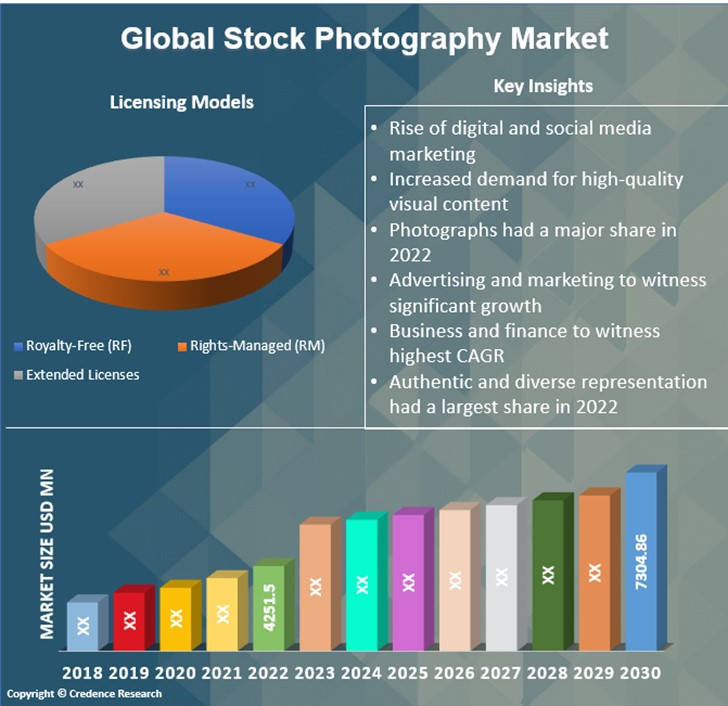
- The global demand for stock photography was valued at USD 4251.5 million in 2022 and is expected to reach USD 7304.86 million in 2030, growing at a CAGR of 7.00% between 2023 and 2030.
- Photographs are the leading segment by content type. On the other hand, illustrations and vector graphics are expected to grow at a strong CAGR.
- The leading licensing models segment is royalty-free (RF).
- The CAGR for creative professionals is expected to be the highest during the projection period.
- The advertising and marketing category will likely have the highest CAGR during the forecast time frame.
- During the forecast period, business and finance are estimated to have the greatest CAGR.
- Authentic and diverse representation is predicted to have the highest CAGR during the projections period.
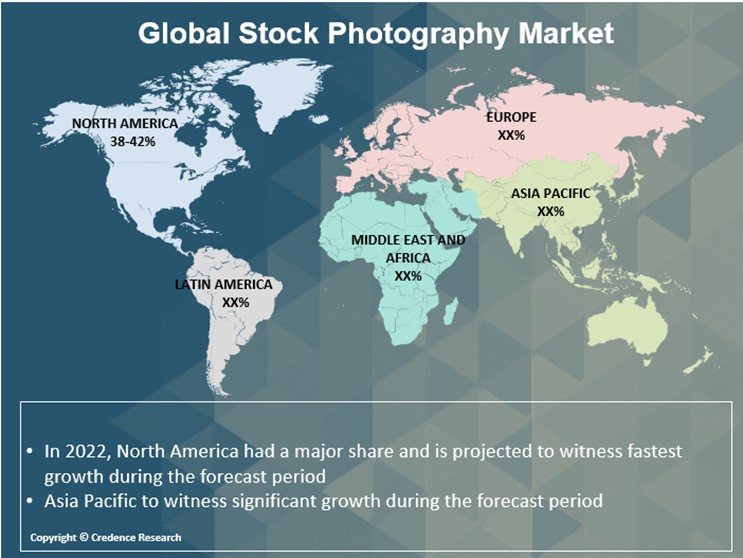
- North America is driving the stock photography market growth.
- Asia Pacific is predicted to be the second-largest region in the stock photography market.
- Europe is predicted to be the fastest-growing region in the stock photography market.
- Stock photography market growth is largely driven by the use of social media, content marketing, the need for advertising and marketing, digital transformation, and the growth of e-commerce.
- Real-time content updates, AI-enhanced search, specialized content specialization, 360-degree and VR imagery, mobile app development, and integrated editing tools are the key opportunities of the stock photography market.
Executive Summary
Market Definition
The industry that deals with licensing and distributing premium digital photos and photographs for use in commercial settings is known as the stock photography market. Photographers, graphic designers, companies, publishers, and other entities can access a large library of pre-made images in this market for web design, editorial content, advertising, marketing, and other creative projects. The market is governed by laws that control intellectual property rights protection, usage, and licensing. Users must comply with licensing agreements and copyright laws.
Market Overview
The market for stock photography has been growing rapidly in recent years, and it is predicted to grow at a CAGR of 7.00% between 2023 and 2030. The market is projected to be worth USD 7304.86 million in 2030, up from an estimated USD 4251.5 million in 2022.
AI algorithms are a major force behind the stock photography market, as they automatically analyze and tag images. This facilitates the effective classification and arrangement of massive stock photo collections. Automated tagging and categorization lets Users locate pertinent images more quickly in stock photo libraries. AI algorithms can improve image quality by adjusting colors, sharpening edges, and reducing noise. This guarantees that stock photos adhere to strict quality guidelines. Stock photo platforms can benefit greatly from automated quality enhancement to preserve a uniform degree of visual appeal throughout their collections.
AI systems can recognize new trends in photography by analyzing data from multiple sources. Stock photographers and platforms can use this information to predict what images will be in demand. Platforms for stock photography can make sure that their libraries are full of popular and relevant content by staying ahead of trends. AI can help automate the licensing process by confirming the permissions and usage rights related to stock photos. Artificial intelligence (AI) technologies can also protect intellectual property by identifying and preventing unauthorized use of images.
Companies are realizing they must target particular demographic groups with their marketing strategies. A wide selection of stock images enables marketers to develop campaigns for audiences from particular cultural or geographic backgrounds. Stock photography must adapt to changing cultural and social trends. New and pertinent imagery is needed to reflect these shifts as cultural movements and societal attitudes change. This demand can be satisfied by stock photo libraries that value cultural diversity.
Segmentation by Content Types
- In terms of content types, photographs are the top section. Photographs licensed for particular purposes are gathered and referred to as stock photography. Photographers created these images, which are not available for individual purchase but for licensing.
- The illustrations and vector graphics segment will display a significant CAGR during the forecast period. In the stock photo industry, illustrations can replace or enhance traditional photos. They are well-liked for expressing abstract ideas, producing eye-catching designs, or infusing a project with some originality. Many themes, such as business, technology, nature, and more, can be depicted through illustrations.
- Other content types, such as video footage, music, and audio, also contribute to the demand for stock photography.
Segmentation by Licensing Models
- According to model licensing, royalty-free (RF) is the top category. In stock photography, royalty-free (RF) refers to a licensing model that permits the buyer to use the image or media repeatedly without paying extra for each usage.
- During the forecast period, the rights-managed (RM) category is anticipated to rise at a significant CAGR. The stock photography industry uses the rights-managed (RM) licensing model to control the use of images. The license is granted for a specific period and purpose under the RM model, and the buyer pays a licensing fee based on the specific usage of the image.
- Other licensing models, such as extended licenses, also contribute to the demand for stock photography.
Segmentation by User Categories
- The creative professionals segment will experience the highest CAGR throughout the estimated period. Creative professionals create various visual content such as images, drawings, vector graphics, and other digital art. They frequently concentrate on producing photos that are adaptable and suitable for usage in a variety of contexts and subjects.
- Other user categories, such as small businesses, corporations, and individuals, also contribute to the demand for stock photography.
Segmentation by Industry Verticals
- During the forecast period, the advertising and marketing segment is anticipated to have the greatest CAGR. In stock photography, marketing, and advertising are essential tools for photographers and agencies to exhibit their work, draw in customers, and increase revenue.
- Other industry verticals, such as publishing, e-learning and education, e-commerce, travel and tourism, and healthcare and medical, also contribute to the demand for stock photography.
Segmentation by Content Themes
- Business and finance are predicted to have the highest CAGR during the forecast period. Businesses frequently use stock photos. Businesses use stock photos to depict professional settings or illustrate business concepts. Pictures of meetings, office spaces, and diverse teams are frequently used in business communications.
- Other content themes, such as nature and environment, technology and innovation, lifestyle and people, health and wellness, and travel and adventure, also contribute to the demand for stock photography.
Segmentation by Emerging Trends
- During the projected period, the CAGR for authentic and diverse representation is expected to be the greatest. Images accurately reflecting human experiences, backgrounds, and cultures are considered authentic and diverse representations in the stock photography market.
- Other emerging trends, such as sustainability, eco-friendly visuals, and mobile photography, also contribute to the demand for stock photography.
Segmentation by Region
- North America dominated the stock photography market. Robust intellectual property protection, a booming center for the creative industries, an entrepreneurial culture, and a rising demand for visual content contribute to this region's development.
- Asia Pacific is estimated to rank second in market size for stock photography.
- Europe will witness the most rapid growth in the stock photography market.
- The rest of the demand for stock photography is met by the rest of the world, which includes Latin America, the Middle East, and Africa.
Utilizing data analytics for influencer collaborations, user-generated content integration, video content integration, and image selection are some of the key drivers boosting the growth of the stock photography market.
During forecasting, North America is leading the stock photography market due to significant media and entertainment companies, advertising agencies, and a robust digital economy. Some of the world's biggest and most powerful media and entertainment corporations, such as ViacomCBS, AT&T (which owns Warner Media), Comcast, and Walt Disney Company, are based in North America. These multinational corporations create diverse media, encompassing motion pictures, television series, songs, and digital content. With a high internet penetration rate and extensive use of digital technologies, North America boasts a strong digital economy. Due to this, online advertising, digital streaming services, and other digital media platforms have all grown. Businesses like Netflix, Amazon Prime Video, and Hulu have become well-known worldwide, influencing digital entertainment.
The global connectivity of the North American region makes it easier to distribute stock photos to a large audience. Photographers can connect with global markets through online platforms, and buyers have access to an extensive global image collection. The need for visually appealing content has grown due to digital marketing and online content creation. The need for high-quality photographs for websites, social media, marketing collateral, and other digital platforms among individuals, businesses, and the media is driving the expansion of the stock photography industry.
The second-largest market for stock photography is Asia Pacific. There is increasing stock photos and video use due to digital transformation in e-commerce, marketing, and advertising. Asia Pacific is known for its varied languages, cultures, and topographies-the need for a wide variety of visual content that captures the local context results from this diversity. Using stock photography, businesses, and content producers can easily access images that appeal to target audiences.
Asia Pacific is turning into a center for international cooperation and commercial alliances. This has created a demand for images that can be utilized in various markets, and stock photography offers an easy way to create content that will appeal to people worldwide.
Key Highlights of the Report
The global stock photography market is segmented by content types, licensing models, user categories, industry verticals, content themes, emerging trends, and regions. By type of content, photographs are the most popular category. Royalty-Free (RF) is the foremost segment by licensing models. Over the projected period, creative professionals will have the highest CAGR. During the forecast period, the business and finance segment is anticipated to have the greatest CAGR. The market for stock photography is growing mostly in North America.
High-resolution images are now possible due to image processing and camera sensor advances. Because of this, stock photos are guaranteed to remain high caliber, making them suitable for a wide range of uses in print and web design, as well as marketing collateral. The shift from film to digital photography has made creating images more accessible. The proliferation of stock photos can be attributed to the ease with which a wider spectrum of photographers can now generate high-quality content due to digital cameras and smartphones with sophisticated sensors. Photographers can improve and refine their images with professional-grade tools like Adobe Photoshop and other advanced image editing software. This directly affects the caliber of stock images by enabling imaginative edits and personalization to match the particular user.
However, according to forecasts, North America will hold the largest stock photography market share globally. There is an abundance of gifted and varied creatives in North America. Through networking in these communities, photographers can exhibit their abilities and contribute to the stock photography industry. Additionally, the Asia Pacific region is assumed to have the sharpest growth in the market. The profusion of artistic talent guarantees a steady stream of inventive and high-quality content to stock platforms in the Asia Pacific. Professional development opportunities are provided by creative communities through workshops, seminars, and joint projects. These programs raise the standard of stock photography by assisting photographers in developing their abilities, keeping abreast of industry developments, and adjusting to changing consumer needs. Creative communities are frequently at the vanguard of new trends and artistic innovation. Stock photographers can ensure their work remains relevant and appealing to a wide audience by maintaining connections with these communities, which helps them anticipate and respond to changing preferences and demands.
What Are The Significant Factors Driving The Global Stock Photography Market?
The major variables boosting the global stock photography market include the real estate sector's increased usage of stock images for advertising and property listings and showcasing travel locations and experiences. The need for stock pictures for a range of commercial purposes is also increased by expanding economies. In the travel industry, stock photographs are crucial.
What Are The Key Challenges In The Global Market For Stock Photography?
Issues with the authenticity and quality of stock photos may arise for users, alternatives to paid stock photography platforms may decrease revenue if more free stock photo options become available, and copyright enforcement and protection can be difficult, which are the major difficulties in the global market for stock photography.
What Market Opportunities Exist For Stock Photography Globally?
The stock photography market presents a range of opportunities, such as providing users with on-platform editing tools for simple adjustments, cutting down on post-processing time and effort, researching blockchain technology to enhance copyright protection and ensure fair compensation for content creators, and satisfying consumers' desire for immersive experiences by offering 360-degree photos and virtual reality (VR) imagery for use in a variety of fields.
Market Drivers
Several factors influence the global market for stock photography. The following are the primary global market drivers for stock photography:
Expanding E-Learning Sector
The market for stock photography is significantly influenced by the expanding e-learning sector. The need for superior graphics to improve instructional materials, presentations, and course content has increased significantly as online education keeps growing. E-learning platforms cover many different subjects and topics. Teachers can easily find relevant and illustrative visuals for their courses with the help of stock photography platforms, which offer diverse content libraries catering to various educational fields. Making unique graphics for each e-learning module can be costly and time-consuming. Instead of hiring in-house graphic design or photography teams, educational institutions, instructors, and makers of e-learning content can access a wide variety of visuals by using stock photos, which offer a more affordable option.
Market Restraints
Several challenges could prevent the expansion of the global market for stock photography. Among them are the following:
Infringement of Copyright and License Violations
License and copyright violations are two major barriers to the growth of the stock photo industry. Photographers who create content and websites that make image licensing easier may suffer due to these problems. When someone uses a work protected by a copyright without the owner's consent, they infringe on their exclusive rights and are guilty of copyright infringement. Users of stock photos may be subject to fines and legal action from copyright holders if they violate licensing agreements or use the images without the required permission. Photographers and content creators may experience a direct financial impact from copyright and license violations. Photographers miss out on possible income if their photos are used without giving proper credit through licensing fees.
Opportunities
The global market for stock photography presents significant potential opportunities. The following is an example of these:
Growing AI and ML Inclusion in Stock Content
The stock photography market has a big potential when artificial intelligence (AI) and machine learning (ML) are integrated into stock content. AI and ML algorithms can greatly enhance the search and discovery experience on stock photo sites. Advanced algorithms can examine user behavior, preferences, and search patterns to provide more precise and pertinent search results. Image tagging and metadata creation can be automated using AI technologies. Contributors will save time by doing this, guaranteeing accurate categorization and easy searchability of images. It is possible to produce original and lifelike images using AI technologies, such as generative adversarial networks (GANs). This allows stock photo platforms to sell AI-generated content in addition to conventional stock photos.
Competitive Landscape
Key Players
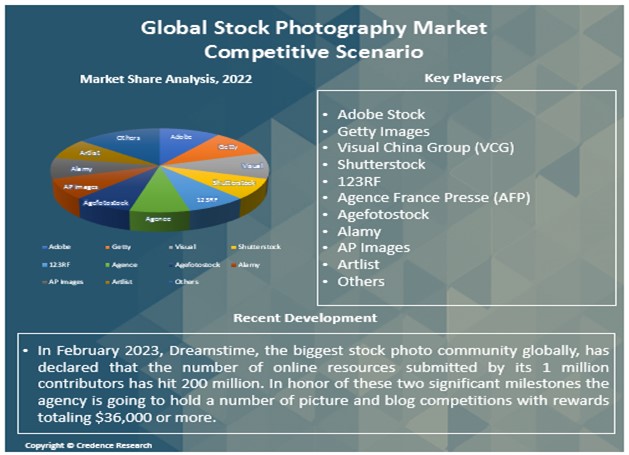
The global market for stock photography is very competitive, with many powerful players. Some of the leading market participants and their corresponding market shares are listed below:
- Adobe Stock
- Getty Images
- Visual China Group (VCG)
- Shutterstock
- 123RF
- Agence France Presse (AFP)
- Agefotostock
- Alamy
- AP Images
- Artlist
- Coinaphoto
- Depositphotos
- Dissolve
- Dreamstime
- East News
- Envato
- Fotosearch
- ImagineChina
- Masterfile
- The Mega Agency
- Newscom
- Photofolio
- Pixta
- Pond5
- PR Photos
- Redux Pictures
- Reuters Images
- SilverHub Media
- Stocksy
- SuStock Videotock
- Imagesbazaar
- Videvo
- PEXELS
- NHK Video Bank
- Nippon News
- Motion Array
- Storyblocks
- WENN
- ZUMA Press
- Others
To stay competitive, these businesses prioritize producing new products, growing their distribution network, and engaging in mergers and acquisitions.
The leading competitors in the global stock photography market are constantly looking for ways to get an advantage by releasing new items and advancements.
In November 2023, the largest stock photo community in the world, Dreamstime, released its newest app, Dreamstime Wallpapers, an amazing wallpaper collection with carefully chosen and personalized premium stock photos to brighten up smartphone screens. The software will soon be accessible on iOS and is now available for Android.
In April 2022, Dreamstime, a global leader in photo licensing and the largest community for stock photos, formally announced the release of LicenseGuard, a proprietary copyright tracking tool that uses artificial intelligence (AI) to scan, identify, and flag potentially unauthorized uses of the agency's visual content on the Internet. With features like post-usage options and cease-and-desist mechanisms, LicenseGuard enables contributors and recipients of copyright notices to settle disputes swiftly and equitably.
Summary of Key Findings
- Stock photography market growth is largely driven by government and non-profit organizations, photography equipment accessibility, the travel and tourism industry, social media, and influencer marketing and customization.
- The market is segmented by content types, licensing models, user categories, industry verticals, content themes, emerging trends, and regions.
- Regarding content types, photographs are the most prominent category.
- Based on model licensing, Royalty-Free (RF) is the top group.
- For the anticipated period, the segment of creative professionals will have the highest CAGR.
- During the forecast period, advertising and marketing are the categories with the most significant predicted CAGR.
- North America is leading market growth; the market is highly competitive with key players including Adobe Stock, Getty Images, Visual China Group (VCG), Shutterstock, 123RF, Agence France Presse (AFP), Agefotostock, Alamy, AP Images, Artlist, Coinaphoto, Depositphotos, Dissolve, Dreamstime, East News, Envato, Fotosearch, ImagineChina, Masterfile, The Mega Agency, Newscom, Photofolio, Pixta, Pond5, PR Photos, Redux Pictures, Reuters Images, SilverHub Media, Stocksy, SuStock Videotock, Imagesbazaar, Videvo, PEXELS, NHK Video Bank, Nippon News, Motion Array, Storyblocks, WENN, ZUMA Press, and others.
Future Outlook
- Optimistic viewpoint for the global stock photography market with noteworthy growth potential in the North American region.
- Advertising and marketing needs are major factors in expanding the stock photography market.
- The challenges limiting the growth of the stock photography market are fatigue with the subscription model, adapting to new media formats, and lack of diversity in content.
- Foremost companies must concentrate on product innovation, expanding their market reach, and maintaining competitive pricing to stay ahead.
How CXOs Can Benefit from the Credence Research Stock Photography Market Report
The Credence Research Stock Photography Market Report provides CXOs with a comprehensive overview of the market, including:
- Market size and growth forecast: The report provides detailed estimates of the global stock photography market size, segmented by content types, licensing models, user categories, industry verticals, content themes, emerging trends, and region. It also includes forecasts for the market through 2032 based on key trends and drivers.
- Market segmentation: The report segments the stock photography market by content types, licensing models, user categories, industry verticals, content themes, emerging trends, and region. This segmentation provides CXOs with a granular understanding of the market and the opportunities in each segment.
- Competitive landscape: The report profiles the key players in the stock photography market and provides insights into their strategies, product offerings, and financial performance. This information can help CXOs to identify and assess their competition.
- Key trends and drivers: The report identifies and analyses the key trends and drivers that are shaping the stock photography market. This information can help CXOs to make informed decisions about their investments and strategies.
CXOs can use the insights from the Credence Research Stock Photography Market Report to:
- Identify growth opportunities: The report can help CXOs to identify new growth opportunities in the stock photography market. For example, the report identifies the growing demand for stock photography from AI-enhanced search, e-learning, and education as a key opportunity.
- Make informed investment decisions: The report can help CXOs to make informed investment decisions about stock photography. For example, the report provides insights into the key factors to consider when evaluating stock photography providers and selecting solutions.
- Develop competitive strategies: The report can help CXOs to develop competitive strategies for their stock photography businesses. For example, the report identifies the key strategies that stock photography providers are using to differentiate themselves from their competitors.
- Track market developments: The report can help CXOs to track market developments and stay ahead of the curve. For example, the report provides insights into the latest trends and innovations in the stock photography market.
Overall, the Credence Research Stock Photography Market Report is a valuable resource for CXOs who are looking to gain a deeper understanding of the market and identify growth opportunities.
Segmentation
- By Content Types
- Photographs
- Illustrations and Vector Graphics
- Video Footage
- Music and Audio
- By Licensing Models
- Royalty-Free (RF)
- Rights-Managed (RM)
- Extended Licenses
- By User Categories
- Creative Professionals
- Small Businesses
- Corporations
- Individuals
- By Industry Verticals
- Advertising and Marketing
- Publishing
- E-learning and Education
- E-commerce
- Travel and Tourism
- Healthcare and Medical
- By Content Themes
- Business and Finance
- Nature and Environment
- Technology and Innovation
- Lifestyle and People
- Health and Wellness
- Travel and Adventure
- By Emerging Trends
- Authentic and Diverse Representation
- Sustainability and Eco-friendly Visuals
- Mobile Photography
- By Region
- North America
- The US.
- Canada
- Mexico
- Europe
- Germany
- France
- The U.K.
- Italy
- Spain
- Rest of Europe
- Asia Pacific
- China
- Japan
- India
- South Korea
- South-east Asia
- Rest of Asia Pacific
- Latin America
- Brazil
- Argentina
- Rest of Latin America
- Middle East & Africa
- GCC Countries
- South Africa
- Rest of the Middle East and Africa
- North America

Request a Free Sample
Fill in your details and we'll send you a free sample report.
- Sample data tables & charts
- Research methodology
Market Dynamics
Growth of Digital Marketing and Content Creation
The proliferation of digital marketing, social media, and content-driven strategies by businesses and influencers is fueling demand for high-quality, diverse stock images to enhance engagement and brand visibility.
Expansion of E-Learning and Online Education
The rapid growth of e-learning platforms and digital education has increased the need for illustrative and instructional visuals, making stock photography a cost-effective solution for educators and content creators.
AI-Enhanced Search and Content Curation
Advancements in AI and machine learning are improving image tagging, search accuracy, and trend prediction, making it easier for users to find relevant images and for platforms to offer in-demand content.
Diversity and Authentic Representation
Brands and publishers are increasingly seeking authentic and diverse imagery to connect with global audiences and reflect societal changes, driving demand for stock photos that represent a wide range of cultures, lifestyles, and experiences.
Growth of E-Commerce and Online Business
The expansion of e-commerce platforms and online businesses requires visually appealing product images and marketing visuals, boosting the need for stock photography across various industry verticals.
Need a Custom Version of This Report?
Tailor the scope, geography, or segments to your exact requirements.
- Custom geography or segment scope
- Direct access to our analyst team
Frequently Asked Questions
How big is the global market for stock photography right now?
What is the stock photography market's anticipated growth rate from 2023 to 2030?
Which segment is leading the market in terms of content types?
Which segment is leading the market in terms of licensing models?
Table of Content
Chapter 1 Market Segmentation
- 1.1 Segmentation Framework
- 1.1.1 Product and Service Classification
- 1.1.2 Application and End-Use Classification
- 1.1.3 Technology and Solution Classification
- 1.1.4 Customer and Distribution Channel Classification
- 1.1.5 Geographic Segmentation
- 1.1.6 Market Segment Definitions and Boundaries
- 1.2 By Content Types
- 1.2.1 Photographs
- 1.2.2 Illustrations and Vector Graphics
- 1.2.3 Video Footage
- 1.2.4 Music and Audio
- 1.3 By User Categories
- 1.3.1 Creative Professionals
- 1.3.2 Small Businesses
- 1.3.3 Corporations
- 1.3.4 Individuals
- 1.4 By Licensing Models
- 1.4.1 Royalty-Free (RF)
- 1.4.2 Rights-Managed (RM)
- 1.4.3 Extended Licenses
Chapter 2 Introduction
- 2.1 Report Objectives and Scope
- 2.2 Product Definition and Industry Terminology
- 2.3 Market Inclusions and Exclusions
- 2.4 Research Process
- 2.4.1 Primary Research and Expert Interviews
- 2.4.2 Secondary Research and Source Review
- 2.4.3 Top-Down and Bottom-Up Estimation
- 2.4.4 Data Triangulation and Verification
- 2.5 Market Size Measurement Basis
- 2.5.1 2022: USD 4,251.5 million → 2030: USD 7,304.86 million
- 2.6 Historical and Forecast Reference Periods
- 2.6.1 Base Year: 2022
- 2.6.2 Forecast Period: 2022-2030
- 2.7 Research Assumptions and Limitations
Chapter 3 Executive Summary
- 3.1 Market Snapshot and Key Findings
- 3.2 Base-Year Market Size, 2022
- 3.3 Forecast Market Size, 2030
- 3.4 Revenue and Volume Growth Outlook
- 3.5 Key Demand and Supply Indicators
- 3.6 Leading Market Segments
- 3.7 Fastest-Growing Market Opportunities
- 3.8 Regional Performance Highlights
- 3.9 Technology and Industry Transformation
- 3.10 Competitive Landscape Summary
- 3.11 Analyst View and Strategic Implications
Chapter 4 Global Stock Photography Market Trends and Developments
- 4.1 Historical Industry Development
- 4.2 Recent Market Trends and Developments
- 4.3 Demand and Customer Behavior Trends
- 4.4 Technology and Product Innovation
- 4.5 Artificial Intelligence, Automation and Digitalization
- 4.6 Local Manufacturing and Supply Chain Realignment
- 4.7 Industry Partnerships, Mergers and Acquisitions
- 4.8 Sustainability and Circular Economy Developments
- 4.9 Government and Private Sector Investment Trends
- 4.10 Emerging Business Models and Commercialization
- 4.11 Industry Developments and Announcements
Chapter 5 Global Stock Photography Market Production, Supply and Demand Analysis
- 5.1 Demand Trend and Consumption Analysis
- 5.2 Demand Forecast, 2022-2030
- 5.3 Production and Output Trend
- 5.4 Production and Output Forecast, 2022-2030
- 5.5 Installed Capacity and Capacity Utilization
- 5.6 Company-Wise Production Plants and Statistics
- 5.6.1 Installed Production Capacity
- 5.6.2 Actual Production
- 5.6.3 Planned Capacity and Expansion Targets
- 5.7 Supply Chain Structure and Procurement Trends
- 5.8 Supply-Demand Gap and Bottlenecks
- 5.9 Import Dependence and Sourcing Structure
- 5.10 Contract Manufacturing and Outsourcing
- 5.11 Regional Supply and Demand Concentration
Chapter 6 Global Stock Photography Market Pricing Analysis
- 6.1 Pricing Structure and Measurement
- 6.2 Historical Pricing Trends
- 6.3 Pricing Outlook, 2022-2030
- 6.4 Average Selling Price and Unit Economics
- 6.5 Pricing by Product and Market Segment
- 6.6 Geographic Pricing Differences
- 6.7 Key Input, Energy, Labor and Logistics Costs
- 6.8 Contract Pricing and Purchasing Models
- 6.9 Pricing Sensitivity and Competitive Positioning
- 6.10 Price, Margin and Profitability Implications
Chapter 7 Global Stock Photography Market Dynamics
- 7.1 Market Growth Drivers
- 7.1.1 Demand-Side Drivers
- 7.1.2 Technology and Innovation Drivers
- 7.1.3 Infrastructure and Investment Drivers
- 7.1.4 Regulatory and Policy Drivers
- 7.2 Market Restraints
- 7.2.1 Cost and Affordability Constraints
- 7.2.2 Technology and Adoption Barriers
- 7.2.3 Supply Chain and Operational Constraints
- 7.3 Market Challenges
- 7.3.1 Competitive Pressure and Margin Erosion
- 7.3.2 Skills, Infrastructure and Implementation Gaps
- 7.4 Emerging Market Opportunities
- 7.5 Market Dynamics Impact and Time-Horizon Assessment
Chapter 8 Global Stock Photography Value Chain Analysis
- 8.1 Industry Value Chain Overview
- 8.2 Upstream Suppliers and Critical Inputs
- 8.3 Technology and Component Providers
- 8.4 Manufacturing or Service Delivery
- 8.5 Distribution, Channel Partners and Integrators
- 8.6 Downstream Applications and End Users
- 8.7 Value Addition and Profit Pools
- 8.8 Vertical Integration and Outsourcing
- 8.9 Supplier Concentration and Risk
- 8.10 Supply Chain Localization and Resilience
Chapter 9 Global Stock Photography Market Regulations and Policies
- 9.1 Relevant Laws, Standards and Compliance Frameworks
- 9.2 Product, Service, Safety and Quality Requirements
- 9.3 Government Policies, Incentives and Subsidies
- 9.4 Imports, Exports and Trade Barriers
- 9.5 Public Procurement and Local Content Requirements
- 9.6 Environmental and Sustainability Compliance
- 9.7 Data Protection, AI and Cybersecurity Compliance
- 9.8 Upcoming Policy Changes and Market Implications
Chapter 10 Global Stock Photography Market Hotspots and Opportunities
- 10.1 Market Opportunity Mapping and Growth Hotspots
- 10.2 High-Growth Applications and Customer Groups
- 10.3 Underserved Markets and White-Space Opportunities
- 10.4 Emerging Technology and Product Opportunities
- 10.5 New Capacity and Investment Hotspots
- 10.6 Market Entry and Expansion Opportunities
- 10.7 Distribution and Partnership Opportunities
- 10.8 Near-Term and Long-Term Commercial Potential
- 10.9 Opportunity Attractiveness and Execution Risks
Chapter 11 Global Stock Photography Market Outlook, 2022-2030
- 11.1 Market Size and Analysis
- 11.1.1 Revenue (Market Measurement: 2022: USD 4,251.5 million → 2030: USD 7,304.86 million)
- 11.1.2 Market Volume and Quantity Sold
- 11.1.3 Historical Market Size
- 11.1.4 Base-Year Market Size, 2022
- 11.2 Market Forecast, 2022-2030
- 11.2.1 Revenue Forecast to 2030
- 11.2.2 Volume Forecast to 2030
- 11.2.3 CAGR and Year-on-Year Growth
- 11.2.4 Incremental Revenue Opportunity
- 11.3 Forecast Assumptions and Scenario Analysis
- 11.3.1 Base-Case Forecast
- 11.3.2 Optimistic and Conservative Scenarios
- 11.3.3 Technology, Pricing and Policy Sensitivities
- 11.4 Market Attractiveness and Growth Outlook
Chapter 12 Global Stock Photography Market Segmentation and Outlook
- 12.1 Segmentation Summary and Market Shares, 2022
- 12.2 Largest and Fastest-Growing Segments
- 12.3 By Content Types - Market Size and Forecast, 2022-2030
- 12.3.1 Segment Definition and Scope
- 12.3.2 Historical Market Size
- 12.3.3 Revenue Forecast, 2022-2030
- 12.3.4 Volume Forecast, 2022-2030
- 12.3.5 Base-Year Market Share, 2022
- 12.3.6 Segment CAGR and Growth Drivers
- 12.3.7 Subsegment Market Size and Forecast
- 12.3.7.1 Photographs
- 12.3.7.2 Illustrations and Vector Graphics
- 12.3.7.3 Video Footage
- 12.3.7.4 Music and Audio
- 12.3.8 Subsegment Pricing and Adoption Trends
- 12.3.9 Leading Suppliers and Competition
- 12.3.10 Regional Demand and Opportunities
- 12.4 By User Categories - Market Size and Forecast, 2022-2030
- 12.4.1 Segment Definition and Scope
- 12.4.2 Historical Market Size
- 12.4.3 Revenue Forecast, 2022-2030
- 12.4.4 Volume Forecast, 2022-2030
- 12.4.5 Base-Year Market Share, 2022
- 12.4.6 Segment CAGR and Growth Drivers
- 12.4.7 Subsegment Market Size and Forecast
- 12.4.7.1 Creative Professionals
- 12.4.7.2 Small Businesses
- 12.4.7.3 Corporations
- 12.4.7.4 Individuals
- 12.4.8 Subsegment Pricing and Adoption Trends
- 12.4.9 Leading Suppliers and Competition
- 12.4.10 Regional Demand and Opportunities
- 12.5 By Licensing Models - Market Size and Forecast, 2022-2030
- 12.5.1 Segment Definition and Scope
- 12.5.2 Historical Market Size
- 12.5.3 Revenue Forecast, 2022-2030
- 12.5.4 Volume Forecast, 2022-2030
- 12.5.5 Base-Year Market Share, 2022
- 12.5.6 Segment CAGR and Growth Drivers
- 12.5.7 Subsegment Market Size and Forecast
- 12.5.7.1 Royalty-Free (RF)
- 12.5.7.2 Rights-Managed (RM)
- 12.5.7.3 Extended Licenses
- 12.5.8 Subsegment Pricing and Adoption Trends
- 12.5.9 Leading Suppliers and Competition
- 12.5.10 Regional Demand and Opportunities
- 12.6 Segment Growth Comparison
- 12.7 Segment Attractiveness and Priority Matrix
Chapter 13 Global Stock Photography Geographic Market Outlook, 2022-2030
- 13.1 Regional Market Size and Share, 2022
- 13.2 Regional Market Forecast, 2022-2030
- 13.3 Regional Pricing, Production and Demand Differences
- 13.4 North America
- 13.4.1 United States
- 13.4.2 Canada
- 13.4.3 Mexico
- 13.5 Europe
- 13.5.1 Germany
- 13.5.2 France
- 13.5.3 Italy
- 13.5.4 United Kingdom
- 13.5.5 Spain
- 13.5.6 Poland
- 13.5.7 Russia
- 13.5.8 Netherlands
- 13.5.9 Belgium
- 13.5.10 Sweden
- 13.5.11 Denmark
- 13.5.12 Norway
- 13.5.13 Rest of Europe
- 13.6 Asia Pacific
- 13.6.1 China
- 13.6.2 India
- 13.6.3 Japan
- 13.6.4 South Korea
- 13.6.5 Thailand
- 13.6.6 Indonesia
- 13.6.7 Vietnam
- 13.6.8 Malaysia
- 13.6.9 Australia
- 13.6.10 Rest of Asia Pacific
- 13.7 Latin America
- 13.7.1 Brazil
- 13.7.2 Argentina
- 13.7.3 Colombia
- 13.7.4 Chile
- 13.7.5 Rest of Latin America
- 13.8 Middle East
- 13.8.1 Saudi Arabia
- 13.8.2 United Arab Emirates
- 13.8.3 Turkey
- 13.8.4 Israel
- 13.8.5 Iran
- 13.8.6 Rest of the Middle East
- 13.9 Africa
- 13.9.1 South Africa
- 13.9.2 Egypt
- 13.9.3 Nigeria
- 13.9.4 Morocco
- 13.9.5 Rest of Africa
- 13.10 Regional Investment, Policy and Supply Chain Differences
- 13.11 Regional Competitive Landscape
- 13.12 Geographic Growth Hotspots
Chapter 14 Global Stock Photography Technology, Innovation and Sustainability Outlook
- 14.1 Technology Landscape and Maturity
- 14.2 Product, Process and Service Innovation
- 14.3 AI, Automation and Digital Tools in the Industry
- 14.4 Technology Adoption and Performance Benchmarking
- 14.5 Innovation Pipeline and R&D Investment
- 14.6 Patent and Intellectual Property Trends
- 14.7 Energy Efficiency and Resource Management
- 14.8 Sustainability, Recycling and Circularity
- 14.9 Technology Roadmap, 2022-2030
- 14.10 Risks of Obsolescence and Technology Substitution
Chapter 15 Global Stock Photography Market Key Strategic Imperatives
- 15.1 Growth and Market Entry Priorities
- 15.2 High-Return Products and Segments
- 15.3 Pricing, Profitability and Cost Optimization
- 15.4 Technology Investment and Product Differentiation
- 15.5 Supply Chain Localization and Resilience
- 15.6 Distribution and Customer Acquisition
- 15.7 Partnership, Acquisition and Capacity Strategy
- 15.8 Regional Expansion Priorities
- 15.9 Short-, Medium- and Long-Term Actions
Chapter 16 Competition Outlook
- 16.1 Industry Competition Characteristics
- 16.2 Market Structure and Concentration
- 16.3 Market Share and Competitive Positioning, 2022
- 16.4 Company-Wise Revenue and Product Benchmarking
- 16.5 Production and Service Capacity Benchmarking
- 16.6 Technology, Pricing and Differentiation
- 16.7 Regional Footprint and Distribution Strength
- 16.8 Mergers, Acquisitions and Strategic Alliances
- 16.9 New Entrants and Competitive Threats
- 16.10 Porter's Five Forces and Industry Attractiveness
- 16.11 Competitive Outlook, 2022-2030
Chapter 17 Company Profiles
- 17.1 Company Coverage and Selection Criteria
- 17.2 Adobe Stock
- 17.2.1 Business Description
- 17.2.2 Company Ownership and Geographic Presence
- 17.2.3 Product and Service Portfolio
- 17.2.4 Manufacturing and Operating Footprint
- 17.2.5 Production Capacity and Expansion Plans
- 17.2.6 Financial Performance and Investment
- 17.2.7 Market Share and Competitive Position
- 17.2.8 Technology and Innovation Capabilities
- 17.2.9 Strategic Alliances or Partnerships
- 17.2.10 Recent Developments
- 17.2.11 Growth Strategy and Outlook
- 17.3 Getty Images
- 17.4 Shutterstock
- 17.5 Visual China Group (VCG)
- 17.6 123RF
- 17.7 Alamy
- 17.8 Dreamstime
- 17.9 Depositphotos
- 17.10 Envato
- 17.11 Pond5
- 17.12 Other Relevant Market Participants
Note: Every listed company is profiled on the structure shown under the first company. The company list is preliminary and may change based on research findings, market developments, data availability and client requirements.
Chapter 18 Disclaimer
- 18.1 Research and Forecast Disclaimer
- 18.2 Data Source and Estimation Limitations
Note: The depth of individual sections depends on data availability for this market. Volume, capacity, trade and other unit-based metrics are included where applicable.

