
Market Insights
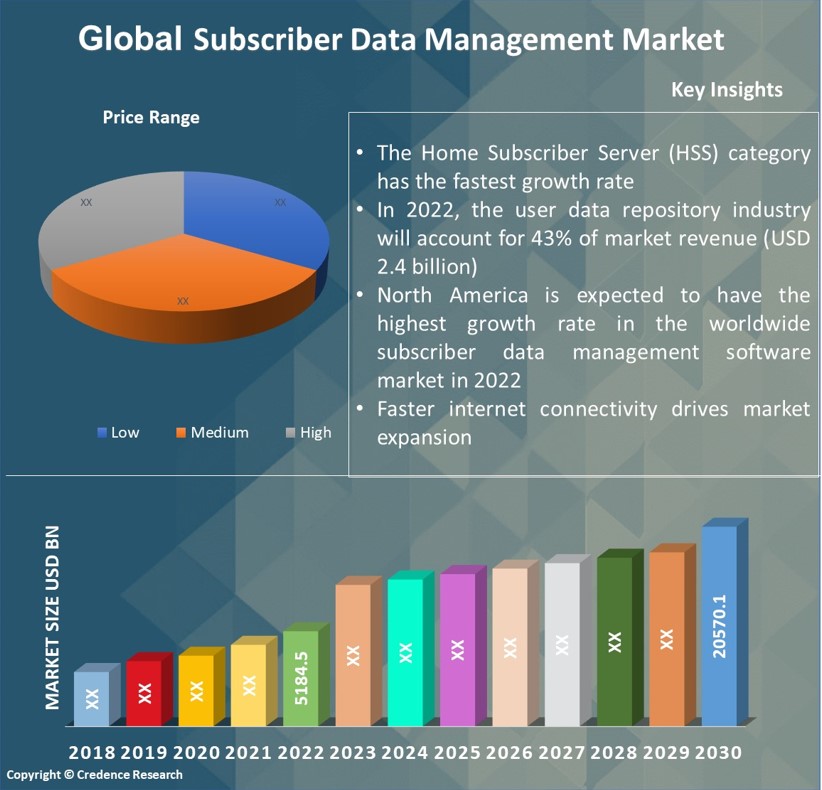
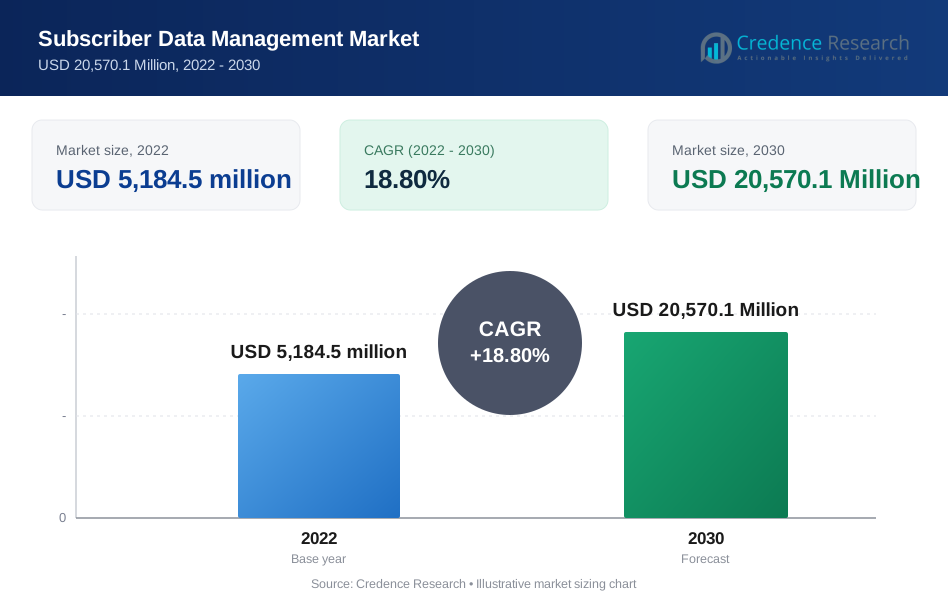
- The global demand for Subscriber Data Management was valued at USD 5184.5 million in 2022 and is expected to reach USD 20570.1 Million in 2030, growing at a CAGR of 18.80% between 2023 and 2030.
- In 2022, the on-premises segment would command 60% of total revenue (USD 3.30 billion). The cloud segment accounted for the largest revenue growth rate during the predicted period.
- The user data repository industry will generate 43% of market revenue (USD 2.4 billion) in 2022. while the revenue share of the policy management segment remained constant.
- The Subscriber Identity Module (SIM) is another important market sector in the SDM market, and the Home Subscriber Server (HSS) category has the highest growth rate.
- The largest segment in the SDM industry is telecom operators/service providers, with enterprises being another attractive area.
- North America is expected to have the highest growth rate in the worldwide subscriber data management software market in 2022, while Europe and Asia Pacific are expected to expand at a steady pace of revenue over the forecast period.
- Faster internet connectivity drives market expansion.
- Privacy worries over subscriber data management stifle market expansion.
Executive Summary
Market Definition
The Subscriber Data Management (SDM) market is concerned with the administration and organization of subscriber data within a telecommunications network. It entails gathering, storing, and utilizing subscriber data to improve network services and the user experience. SDM enables telecom operators to handle subscriber data such as profiles, preferences, and usage patterns more efficiently. It is critical for providing tailored services, targeted marketing efforts, and seamless connectivity across several devices.
Market Overview
It is anticipated that between 2023 and 2030, the worldwide Subscriber Data Management Market will expand at a compound annual growth rate (CAGR) of 18.80%. From USD 5184.5 million in 2022, the market is projected to be worth USD 20570.1 million by 2030.
The SDM market is expanding rapidly as a result of rising demand for tailored services and an increasing number of linked devices. SDM solutions assist telecom operators in successfully managing and utilizing subscriber data, allowing them to provide tailored services and improve the customer experience. Factors driving the market include the increasing deployment of 5G networks, the proliferation of IoT devices, and the necessity for effective data monetization. Key players in the SDM market include companies like Ericsson, Huawei, Nokia, and Oracle.
Segmentation by Deployment Models
- In 2022, the on-premises segment led the market, accounting for 60% of total revenue (USD 3.30 billion). This is due to the numerous advantages of on-premises installation, such as increased data security and safety.
- Over the forecast period, the cloud segment accounted for the highest revenue growth rate.
Segmentation by Components
- In 2022, the user data repository sector will account for 43% of market revenue (USD 2.4 billion). The increased number of cyberattacks utilizing subscription identity phishing will very certainly raise the need for this industry.
- In 2022, the policy management segment maintained its revenue share.
Segmentation by Types of SDM
- The Home Subscriber Server (HSS) category has the highest growth rate. In telecommunications networks, the HSS section is critical for handling subscriber data and delivering authentication and authorization services. The HSS market is experiencing considerable expansion due to the increased adoption of advanced network technologies and the growing need for seamless connectivity.
- The Subscriber Identity Module (SIM) is another key market sector in the SDM market. SIM cards are critical components that store subscriber information and provide network access.
Segmentation by End-Use Industries
- Telecom Operators/Service Providers are the dominant segment. Telecom operators play an important role in managing subscriber data, delivering network services, and maintaining their customers' flawless connectivity. Telecom operators have a substantial market share in the SDM market because to their extensive client base and infrastructure.
- Enterprises are another popular area in the SDM industry. SDM solutions are used by businesses across industries to manage subscriber data, improve customer experiences, and streamline operations.
Segmentation by Region
- North America will have the greatest growth rate in the global subscriber data management software market in 2022.
- The European and Asia Pacific markets are predicted to grow at a stable rate of revenue over the forecast period.
- The rest of the world, including Latin America, the Middle East, and Africa, supplies the remaining demand for Subscriber Data Management.
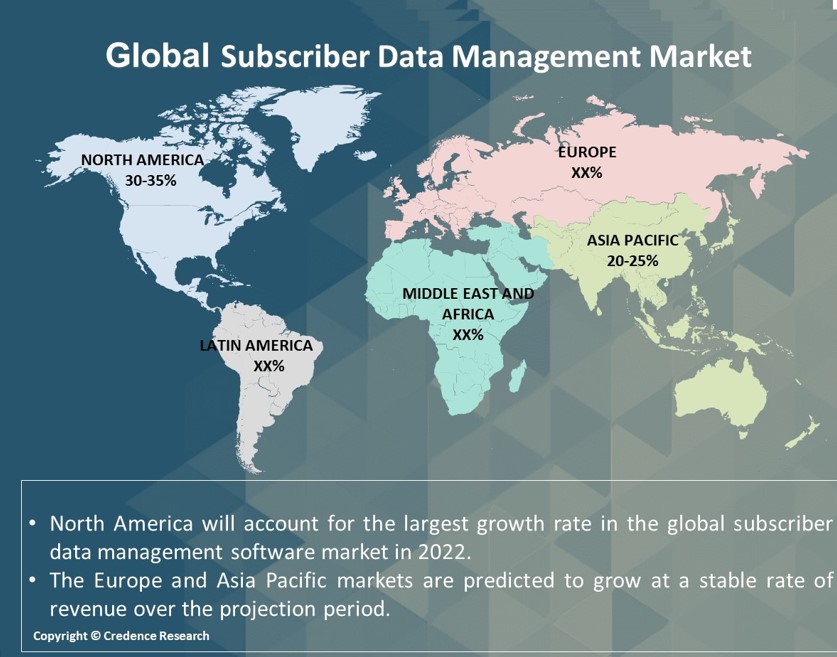
In 2022, North America will account for the highest growth rate in the global subscriber data management software market. Over the last two decades, the digital population and rapid innovation in telecom technology in the United States have expanded. According to the World Bank, by 2020, more than 92% of North Americans will have internet access. Rising enterprise demand for smartphones, smart TVs, and technological advancements in 5G Core (5GC) technology, IP Multimedia Subsystem (IMS), and cloud deployment tools, combined with rising service-based architecture (SBA), are driving revenue growth in the North American subscriber data management market.
Over the projection period, the European market is expected to increase at a steady pace of revenue. According to the World Bank, by 2020, more than 85% of Europeans will have internet connection. Rising investments in 5G infrastructure and internet architectures in new areas such as machine-to-machine (M2M) communication and the Internet of Things (IoT) across Europe are aiding revenue development in the region's subscriber data management industry.
In addition, Over the forecast period, the Asia Pacific market is expected to grow at a stable rate. According to the World Bank, by 2022, more than 69% of Asia Pacific residents would have access to the Internet. With widespread 5G wireless air interface deployment, this region has emerged as a full-fledged cloud native core network for business. Furthermore, advancements in radio communications, as well as widespread usage of smartphones and smart TVs, are boosting market revenue growth.
Key Highlights of the Report
The global Subscriber Data Management Market is segmented by Deployment Models, Components, Types of SDM, End-Use Industries, and region. The on-premises and user data repository segments dominated the market. In addition, the Home Subscriber Server (HSS) category has the fastest growth rate, and Enterprises are another prominent area in the SDM market, with North America leading the market growth.
The market's primary drivers include rising demand for personalized services and targeted marketing campaigns, rising adoption of 5G networks and the Internet of Things (IoT), and rising demand for effective data management and monetization in telecom networks. Moreover, concerns about data privacy and security, complex integration processes and interoperability issues, and regulatory compliance requirements and changing data protection legislation are the market's main limitations.
Nonetheless, North America will have the greatest growth rate in the global subscriber data management software market by 2022. The digital population and rapid innovation in telecom technology in the United States have grown over the previous two decades. Furthermore, the Asia Pacific market is predicted to increase at a steady rate over the forecast period.
What Elements Are Driving the Global Market for Subscriber Data Management?
Several main factors are driving the SDM industry. Personalized services and targeted marketing initiatives are becoming increasingly popular. Telecom companies are using subscriber data to provide specialized services and improve the overall consumer experience. Second, the increasing use of 5G networks and the Internet of Things (IoT) is increasing the demand for effective data management. SDM solutions assist operators in dealing with the huge amount of data generated by these networks.
What Are The Main Obstacles That The Global Subscriber Data Management Market Faces?
While the SDM market is expanding, there are several challenges that must be overcome. Data privacy and security are two major concerns. As subscriber data becomes more valuable, there is a greater need to guarantee that it is safeguarded and ethically handled. Furthermore, the extensive integration processes and interoperability issues are a constraint. Integrating SDM solutions into existing telecom networks can be a difficult undertaking that demands meticulous planning and coordination.
What Market Development Prospects Are There For Subscriber Data Management Globally?
The SDM market also offers numerous potential for expansion and innovation. With expanding communication infrastructure, emerging economies provide enormous opportunities for growth. As these regions' networks continue to evolve, so will the demand for SDM solutions. Furthermore, combining SDM with sophisticated technologies like as artificial intelligence and machine learning offers up new opportunities. These technologies can help operators obtain useful insights from subscriber data and improve their service offerings.
Market Drivers
The global Subscriber Data Management Market is driven by several factors. The following are the key drivers of the global Subscriber Data Management Market:
Improvements in Faster Internet Connectivity
The smart device revolution has boosted global innovation. After a rapid hybrid network deployment, subscriber data is managed unified by Unified Data Management (UDM), Authentication Server Function (AUSF), IP multimedia subsystem Home Subscriber Services (IMS-HSS), Severe Adverse Effect- Home Subscriber Services (SAE-HSS), Authentication, Authorization and Accounting (AAA), Engineering Numbering System (ENS), Home Location Register (HLR), and Equipment Identity Register (EIR). This form of implementation enables centralized management of 2G, 3G, 4G, 5G, VoLTE, and VoWiFi subscriber data, assures a consistent experience for subscribers when they access numerous types of networks, supports carriers in network simplification, and delivers high dependability and low latency. High-speed internet is also a key driver of revenue development in the subscriber data management market. The majority of mobile internet bandwidth consumed today is accounted for by real-time data transmission; upgraded 5G technology connectivity has unlocked bandwidths of over 1 GHz, and it is providing quality of service to accelerating the rollout of new services with a decrease in latency with real-time data transmission. With the deployment of network elements, high-speed connectivity that ensures a consistent experience for subscribers will open new possibilities for the subscriber data management sector.
Market Restraints
The global Subscriber Data Management Marketfaces some challenges that may hinder its growth. These include the following:
Privacy Concerns Over Subscriber Data Management
Data security issues continue to be a significant barrier for subscriber data management organizations. Piracy costs subscriber data management software vendors a big number of subscribers and revenue. Some pirates hack into accounts in order to obtain the login credentials of legitimate users. These credentials are then sold, and confidential user data is posted via peer-to-peer file sharing protocols or VPN to access video content, and these pirated files can be downloaded for free for a variety of devices. Some users gain endless free access by simply creating bogus accounts to take advantage of trials offered by data management services. Injection attacks, denial of service (DoS) assaults, and virus attacks all pose data security issues. These provide access to data management software breaches and the risk of data confidentiality. As a result, the server cannot handle legitimate user requests and frequently crashes or becomes unstable. These limitations are projected to limit the subscriber data management market's revenue growth.
Opportunities
The global Subscriber Data Management Marketoffers significant growth opportunities. These include the following:
Unleashing the Personalization Potential in the SDM Market
One important opportunity in the SDM market is to use subscriber data to provide personalized customer experiences. SDM systems can provide important insights into individual preferences, behaviours, and needs by properly maintaining and analyzing consumer data. This enables firms to personalize their products, services, and marketing efforts to each customer's specific needs.
Businesses can use SDM to generate detailed consumer profiles that include demographic information, purchase history, browsing tendencies, and social media activities. Companies can use this data to give targeted offers, recommendations, and tailored content, increasing customer engagement and loyalty.
Furthermore, SDM solutions can provide seamless integration across many channels, allowing businesses to deliver consistent and tailored experiences across multiple touchpoints. SDM enables organizations to deliver relevant and timely communications, eventually improving customer satisfaction and retention, whether through mobile apps, websites, social media, or customer service encounters.
Competitive Landscape
Key Players
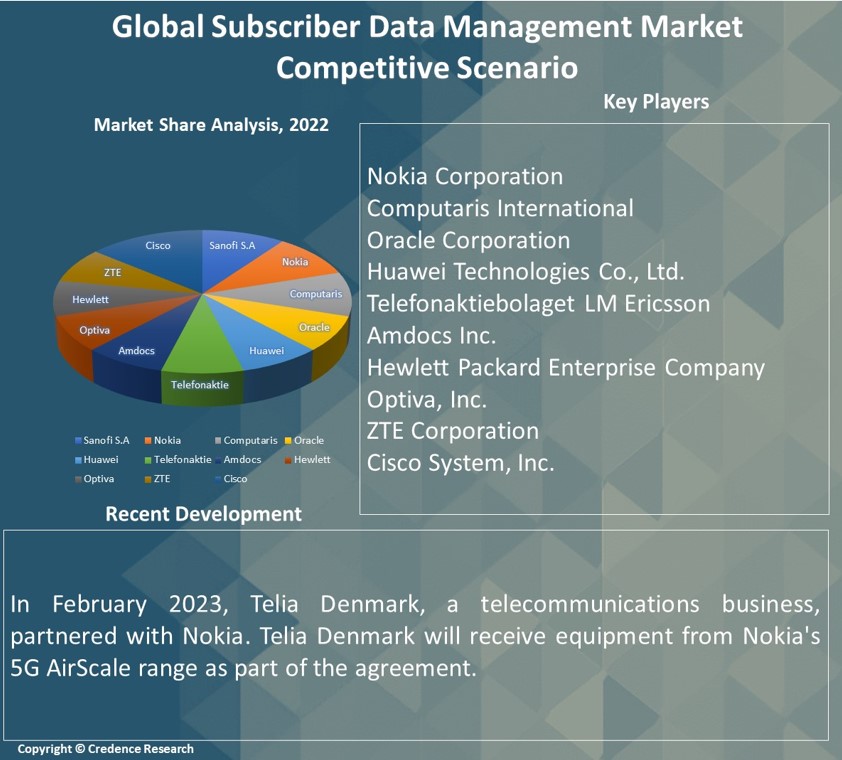
The global Subscriber Data Management Market is highly competitive, with several key players. Some of the major players in the market and their market share are as follows:
- Nokia Corporation
- Computaris International
- Oracle Corporation
- Huawei Technologies Co., Ltd.
- Telefonaktiebolaget LM Ericsson
- Amdocs Inc.
- Hewlett Packard Enterprise Company
- Optiva, Inc.
- ZTE Corporation
- Cisco System, Inc.
These organizations prioritize Application innovation, Disease Area expansion, and mergers and acquisitions to stay competitive.
The global Subscriber Data Management Market's key players continually seek to stay ahead by offering new Applications and developments.
In March 2023, ZTE Malaysia collaborated with Telekom Malaysia Berhad, a Malaysian triple-play communications firm. The collaboration entails the creation of a new hybrid cloud 5G core network. This collaboration also intends to accelerate the adoption of the 5G network in Malaysia.
In February 2023, Hewlett Packard Enterprise has expanded its collaboration with Nokia, a Finnish provider of telecom equipment and services. The collaboration entails providing open and competitive cloud RAN solutions to CSPs and companies worldwide.
In February 2022, Ericsson, a Swedish multinational networking and telecommunications corporation, worked with Saudi Telecommunication corporation (STC) on 5G subscriber data management, 5G resource controllers, 5G signalling solutions, and third-party application integration. This collaboration will also supply SAPC/PCF virtual charging access function (vCAF) technologies and enable agility and innovation to improve customer experience.
Summary of Key Findings
- Concerns about subscriber data handling stifle market expansion.
- Market segmented by Deployment Models, Components, Types of SDM, End-Use Industries, and region
- Over the forecast period, the cloud segment accounted for the highest revenue growth rate
- Telecom Operators/Service Providers are the dominant segment
- North America is leading market growth; the market is highly competitive with key players including Nokia Corporation, Computaris International, Oracle Corporation, Huawei Technologies Co., Ltd.
Future Outlook
- Expanding the use of 5G networks
- Increasing demand for customized services
- The spread of Internet of Things (IoT) devices
- Increasing demand for effective data monetization
- The emergence of advanced analytics and artificial intelligence (AI) technologies
- Concentrate on improving the client experience.
- Continuous network infrastructure developments
- Integration of SDM with other telecom solutions
- Market expansion of SDM in emerging economies
- Collaboration between telecom operators and providers of SDM solutions
Segmentation
- By Deployment Models:
- On-Premises
- Cloud-Based
- By Components:
- Policy Management
- Authentication
- User Data Repository (UDR
- By Types of SDM:
- Home Subscriber Server (HSS)
- Subscriber Identity Module (SIM)
- Authentication, Authorization, and Accounting (AAA)
- By End-Use Industries:
- Telecom Operators/Service Providers
- Enterprises
- By Region
- North America
- The U.S.
- Canada
- Mexico
- Europe
- Germany
- France
- The U.K.
- Italy
- Spain
- Rest of Europe
- Asia Pacific
- China
- Japan
- India
- South Korea
- South-east Asia
- Rest of Asia Pacific
- Latin America
- Brazil
- Argentina
- Rest of Latin America
- Middle East & Africa
- GCC Countries
- South Africa
- Rest of Middle East and Africa
- North America
Request a Free Sample
Fill in your details and we'll send you a free sample report.
- Sample data tables & charts
- Research methodology
Need a Custom Version of This Report?
Tailor the scope, geography, or segments to your exact requirements.
- Custom geography or segment scope
- Direct access to our analyst team
Frequently Asked Questions
What is the current Application of the worldwide Subscriber Data Management Market?
What is the predicted growth rate of the Subscriber Data Management Market between 2023 and 2030?
Which segment has the most market share in terms of Deployment Models?
Which End-Use Industries segment governs the market demand for Subscriber Data Management?
Which Types of SDM segment is predicted to grow at the highest rate over the forecast period?
Which region is driving the Subscriber Data Management industry forward?
Table of Content
Chapter 1. Report Introduction
- 1.1 Report Description & Purpose
- 1.1.1 Report Title & Market Definition
- 1.1.2 Unique Selling Propositions (USP) & Key Differentiators
- 1.1.3 Value Proposition for Stakeholders
- 1.2 Research Objectives
- 1.2.1 Market Sizing Objectives (Volume & Revenue) (Volume Where Applicable)
- 1.2.2 Segmentation Objectives
- 1.2.3 Competitive Intelligence Objectives
- 1.2.4 Forecast & Scenario Objectives
- 1.3 Report Scope
- 1.3.1 Subscriber Data Management Scope – Segments & Subsegments Covered
- 1.3.2 Geographic Scope – Regions & Countries Covered
- 1.3.3 Historical Period, Base Year & Forecast Period (2022; forecast to 2030)
- 1.3.4 Inclusions & Exclusions
- 1.4 Industry Classification & Applicable Codes
- 1.5 Currency, Measurement Units & Valuation Basis
- 1.6 Target Stakeholders
- 1.7 Limitations & Assumptions
Chapter 2. Executive Summary
- 2.1 Global Subscriber Data Management Market Snapshot
- 2.1.1 Market Size – Historical (2022) & Forecast (2022-2030) (2022: USD 5,184.5 million → 2030: USD 20,570.1 Million)
- 2.1.2 Volume & Revenue – Global Totals (Volume Where Applicable)
- 2.1.3 Key Market Highlights – Top Five Facts
- 2.2 Subscriber Data Management Market Segmentation Snapshot
- 2.2.1 Market Split by Region – 2022 vs. 2030
- 2.3 Competitive Snapshot
- 2.3.1 Top 10 Players by Revenue Share – 2022
- 2.3.2 Top 10 Players by Volume Share – 2022 (Volume Where Applicable)
- 2.3.3 Recent Strategic Developments (18-Month Summary)
- 2.4 Key Investment Highlights & Strategic Conclusions
Chapter 3. Subscriber Data Management Market Dynamics & Industry Analysis
- 3.1 Market Overview & Context
- 3.1.1 Subscriber Data Management Market Position in the Broader Industry Value Chain
- 3.1.2 Demand Structure & Purchasing Dynamics
- 3.1.3 Market Maturity & Development Stage by Region
- 3.2 Subscriber Data Management Market Drivers
- 3.3 Subscriber Data Management Market Restraints & Challenges
- 3.4 Subscriber Data Management Market Opportunities
- 3.5 Porter's Five Forces Analysis
- 3.5.1 Threat of New Entrants
- 3.5.2 Bargaining Power of Suppliers
- 3.5.3 Bargaining Power of Buyers
- 3.5.4 Threat of Substitutes
- 3.5.5 Competitive Rivalry – Intensity Assessment
- 3.6 Subscriber Data Management Value Chain Analysis
- 3.6.1 Upstream – Key Inputs, Resources & Suppliers
- 3.6.1.1 Key Input/Resource 1
- 3.6.1.2 Key Input/Resource 2
- 3.6.1.3 Key Input/Resource 3
- 3.6.2 Midstream – Core Operations & Value Creation
- 3.6.2.1 Operating Model & Process Overview
- 3.6.2.2 Key Operating Locations & Capabilities by Company
- 3.6.3 Downstream – Market Channels & End Users
- 3.6.3.1 Direct Sales & Customer Engagement Channels
- 3.6.3.2 Indirect Sales, Intermediaries & Partner Channels
- 3.6.4 Value Chain Profitability Analysis
- 3.6.1 Upstream – Key Inputs, Resources & Suppliers
- 3.7 PESTEL Analysis
- 3.7.1 Political Factors
- 3.7.2 Economic Factors
- 3.7.3 Social Factors
- 3.7.4 Technological Factors
- 3.7.5 Environmental Factors
- 3.7.6 Legal Factors
- 3.8 Subscriber Data Management Supply Chain Analysis
- 3.8.1 Critical Input & Resource Availability Risk Assessment
- 3.8.2 Supplier & Operational Concentration Risk (Geographic Exposure)
- 3.8.3 Supply & Service Disruption Impact Analysis
- 3.9 Regulatory & Policy Landscape
Note: The regulatory and policy landscape section covers regulations based on their applicability to the market, Subscriber Data Management category, geography, and scope of the study. Only regulatory frameworks with a material impact on operations, compliance, trade, sustainability, or market access are analyzed in detail.
Chapter 4. Key Investment Pockets & Opportunity Analysis
- 4.1 Subscriber Data Management Market Attractiveness Analysis
- 4.1.1 By Region – Investment Attractiveness Matrix (Market Size × CAGR)
- 4.2 Absolute Revenue Growth Opportunity
- 4.2.1 By Region – Absolute Revenue Growth Through 2030
- 4.3 Incremental Demand Opportunity
- 4.3.1 By Region – Incremental Demand Through 2030
- 4.3.2 Segment – Incremental Demand
- 4.4 Emerging Submarket Opportunity Deep Dive (Subject to Applicability)
- 4.5 Priority Market Opportunity Scorecards
- 4.5.1 United States
- 4.5.2 Europe
- 4.5.3 Asia
- 4.5.4 Middle East & Africa
Note: Priority market opportunity scorecards reflect the geographic scope and strategic relevance of the study. Listed markets are indicative and may be adapted to the industry.
Chapter 5. Subscriber Data Management Cross-Border Trade & Market Access Analysis
- 5.1 International Trade & Cross-Border Activity Overview
- 5.1.1 Global Export Value by Country (2022)
- 5.1.2 Global Export Volume by Country (2022) (Volume Where Applicable)
- 5.1.3 Global Import Value by Country (2022)
- 5.1.4 Global Import Volume by Country (2022) (Volume Where Applicable)
- 5.1.5 Net Trade Balance by Country (2022)
- 5.2 Export Analysis – Segment
- 5.2.1 Category 1 (Applicable Classification Code)
- 5.2.2 Category 2 (Applicable Classification Code)
- 5.2.3 Category 3 (Applicable Classification Code)
- 5.2.4 Category 4 (Applicable Classification Code)
- 5.2.5 Category 5 (Applicable Classification Code)
- 5.3 Import Analysis – Segment
- 5.3.1 Category 1 (Applicable Classification Code)
- 5.3.2 Category 2 (Applicable Classification Code)
- 5.3.3 Category 3 (Applicable Classification Code)
- 5.3.4 Category 4 (Applicable Classification Code)
- 5.3.5 Category 5 (Applicable Classification Code)
- 5.4 Cross-Border Pricing & Transaction Benchmarks
- 5.4.1 Export Pricing – Segment & Country
- 5.4.2 Import Pricing – Segment & Source Country
- 5.4.3 Price Trends (2022)
- 5.5 Key Cross-Border Trade & Delivery Routes
- 5.5.1 Cross-Border Trade/Delivery Route 1
- 5.5.2 Cross-Border Trade/Delivery Route 2
- 5.5.3 Cross-Border Trade/Delivery Route 3
- 5.5.4 Cross-Border Trade/Delivery Route 4
- 5.5.5 Cross-Border Trade/Delivery Route 5
- 5.6 Trade Policy & Market Access Impact Assessment
- 5.6.1 Tariff & Non-Tariff Barriers
- 5.6.2 Regional Trade & Economic Integration Frameworks
- 5.6.3 Bilateral & Multilateral Trade Agreements
- 5.6.4 Cross-Border Operating, Licensing & Localization Requirements
Note: This chapter applies where cross-border trade or delivery is relevant to Subscriber Data Management. Goods, services, and digital offerings are assessed using applicable classifications and transaction measures. Import-export volumes, trade balances, and route analyses are included only where meaningful to the market.
Chapter 6. Competitive Landscape & Company Benchmarking
- 6.1 Subscriber Data Management Market Concentration & Structure
- 6.1.1 Herfindahl-Hirschman Index (HHI) – vs. 2022
- 6.1.2 Leading, Mid-Sized & Emerging Player Structure
- 6.1.3 Global, Regional & Local Player Dynamics
- 6.2 Subscriber Data Management Market Share Analysis – 2022
- 6.2.1 Global Revenue Share by Company
- 6.2.2 Global Volume Share by Company (Volume Where Applicable)
- 6.2.3 Regional Revenue Share
- 6.2.4 Market Share Evolution ( vs. 2022)
- 6.2.5 Company Market Share by Key Segment
- 6.2.6 Company Market Share by Customer Group
- 6.3 Operating Scale, Capacity & Infrastructure Analysis
- 6.3.1 Global Operating Scale & Supply Capacity
- 6.3.2 Resource Utilization & Operating Efficiency
- 6.3.3 Output, Service Delivery & Activity Metrics
- 6.3.4 Operating Footprint & Infrastructure Map
- 6.3.5 Planned Operational & Capacity Expansion
- 6.4 Subscriber Data Management Competitive Benchmarking Matrix
- 6.4.1 Revenue, Growth, Profitability & Operating Metric Comparison
- 6.4.2 Channel Revenue Mix
- 6.4.3 Geographic Revenue Exposure
- 6.4.4 R&D Intensity
- 6.4.5 Sustainability Maturity
- 6.5 Strategic Developments in Subscriber Data Management (Last 24 Months)
- 6.5.1 Mergers, Acquisitions & Divestments
- 6.5.2 New Products, Services & Solutions in Subscriber Data Management
- 6.5.3 Operational & Infrastructure Expansions
- 6.5.4 Strategic Alliances, Joint Ventures & Partnerships
- 6.5.5 Distribution Expansion & Market Entry
- 6.5.6 Sustainability & ESG Initiatives
- 6.6 Competitive Strategy Mapping
- 6.6.1 Leader, Challenger, Follower & Niche Classification
- 6.6.2 Pricing Strategy Comparison
- 6.6.3 Channel Strategy Matrix
Note: Strategic developments are included based on their materiality and the availability of reliable information.
Chapter 7. Global Subscriber Data Management Market – By Sales & Delivery Channel
- 7.1 Segment Overview
- 7.1.1 Volume & Revenue Split by Channel (2022 & 2030) (Volume Where Applicable)
- 7.1.2 Channel Mix Evolution (2022-2030)
Chapter 8. Regional Market Analysis – Global Overview
- 8.1 Global Regional Overview
- 8.1.1 Regional Volume Share (Volume Where Applicable)
- 8.1.2 Regional Revenue Share
- 8.1.3 Regional Volume by Region (Volume Where Applicable)
- 8.1.4 Regional Revenue by Region
- 8.1.5 Regional Forecast Through 2030
- 8.2 Cross-Regional Segment Analysis
- 8.2.1 By Sales & Delivery Channel
- 8.2.2 By Competitive Positioning & Price Tier
Chapter 9. North America Subscriber Data Management Market
- 9.1 United States
- 9.2 Canada
- 9.3 Mexico
Chapter 10. Europe Subscriber Data Management Market
- 10.1 Germany
- 10.2 France
- 10.3 Italy
- 10.4 United Kingdom
- 10.5 Spain
- 10.6 Poland
- 10.7 Russia
- 10.8 Netherlands
- 10.9 Belgium
- 10.10 Sweden
- 10.11 Denmark
- 10.12 Norway
- 10.13 Rest of Europe
Chapter 11. Asia Pacific Subscriber Data Management Market
- 11.1 China
- 11.2 India
- 11.3 Japan
- 11.4 South Korea
- 11.5 Thailand
- 11.6 Indonesia
- 11.7 Vietnam
- 11.8 Malaysia
- 11.9 Australia
- 11.10 Rest of Asia Pacific
Chapter 12. Latin America Subscriber Data Management Market
- 12.1 Brazil
- 12.2 Argentina
- 12.3 Colombia
- 12.4 Chile
- 12.5 Rest of Latin America
Chapter 13. Middle East Subscriber Data Management Market
- 13.1 Saudi Arabia
- 13.2 United Arab Emirates
- 13.3 Turkey
- 13.4 Israel
- 13.5 Iran
- 13.6 Rest of the Middle East
Chapter 14. Africa Subscriber Data Management Market
- 14.1 South Africa
- 14.2 Egypt
- 14.3 Nigeria
- 14.4 Morocco
- 14.5 Rest of Africa
Chapter 15. Subscriber Data Management Company Profiles
- 15.1 [Company 01]
- 15.1.1 Company Overview
- 15.1.2 Key Management Personnel
- 15.1.3 Products & Services Portfolio
- 15.1.4 Financial Performance
- 15.1.5 Key Market Focus & Geographic Presence
- 15.1.6 Recent Developments & Strategic Initiatives
Note: The company profile list is preliminary and may change based on research findings, market developments, data availability, and client requirements.
Chapter 16. Appendices
- Appendix A – List of Abbreviations & Acronyms
- Appendix B – Industry Classification Code Reference – Full Series
- Appendix C – Supply, Output & Operating Capacity Data Tables
- Appendix D – End-Use & Demand Base Tables
- Appendix E – Demand, Adoption & Usage Assumptions
- Appendix F – Pricing & Revenue Metric Reference Tables
- Appendix G – Company Operations & Infrastructure Database
- Appendix H – Cross-Border Trade & Activity Data Tables (Where Applicable)
- Appendix I – Regulatory Summary Tables
- Appendix J – Primary Research Participant List (Anonymized)
- Appendix K – Primary Research Questionnaire Framework
- Appendix L – Data Sources & Bibliography
- Appendix M – Market Size Divergence & Source Comparison
Chapter 17. Research Methodology
- 17.1 Research Framework & Philosophy
- 17.2 Secondary Research – Sources, Hierarchy & Data Extraction
- 17.3 Data Modeling – Bottom-Up & Top-Down Market Sizing
- 17.4 Primary Research – Stakeholder Framework, LOI & Sample Sizes
- 17.5 Forecast Methodology – Regression, Scenario & Sensitivity Analysis
- 17.6 Quality Control – Four-Layer Validation Framework
- 17.7 Limitations & Standard Assumptions
- 17.8 Disclaimer
