
Market Overview
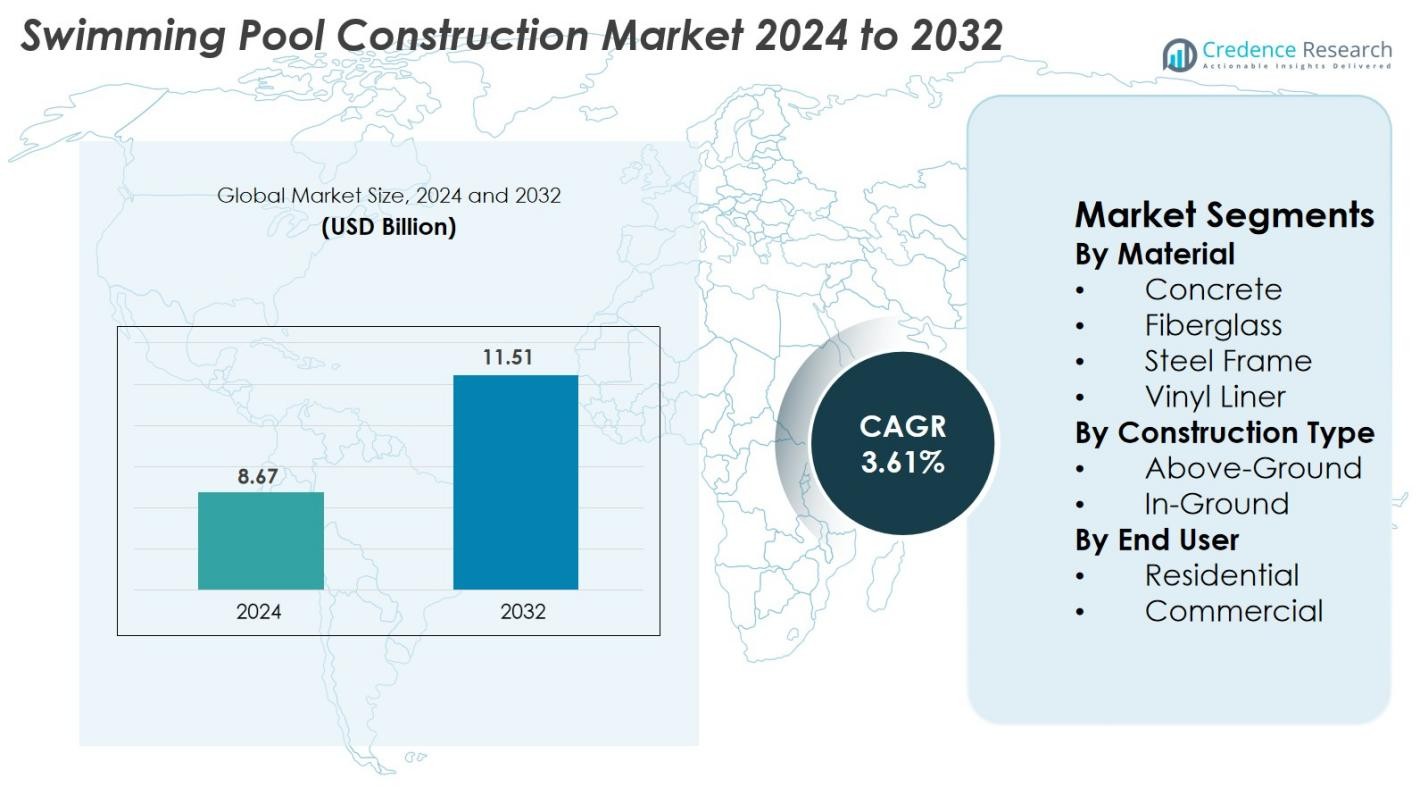
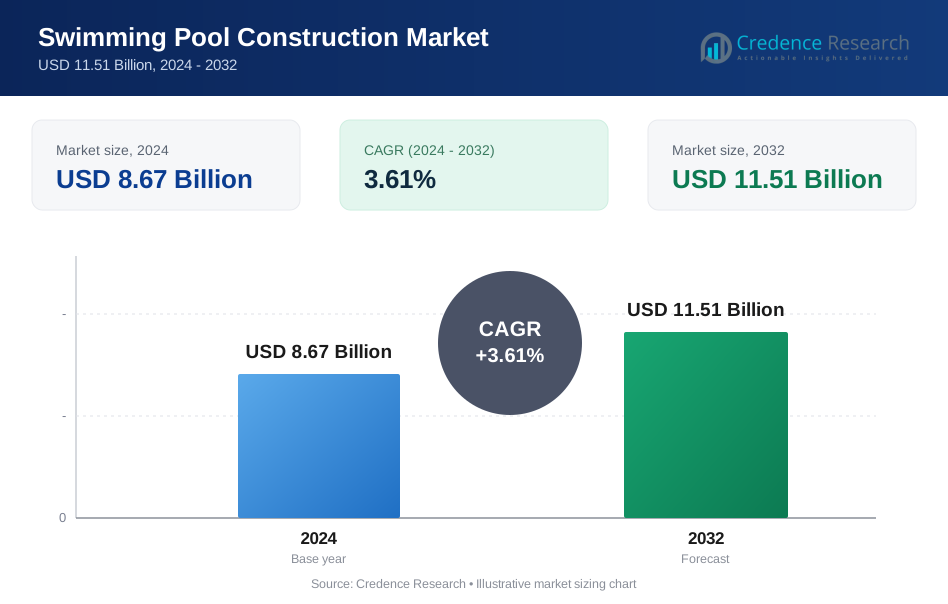
Swimming Pool Construction Market size was valued at USD 8.67 Billion in 2024 and is anticipated to reach USD 11.51 Billion by 2032, at a CAGR of 3.61% during the forecast period.
| REPORT ATTRIBUTE | DETAILS |
|---|---|
| Historical Period | 2020-2023 |
| Base Year | 2024 |
| Forecast Period | 2025-2032 |
| Swimming Pool Construction Market Size 2024 | USD 8.67 Billion |
| Swimming Pool Construction Market, CAGR | 3.61% |
| Swimming Pool Construction Market Size 2032 | USD 11.51 Billion |
The Swimming Pool Construction Market features a strong mix of global and regional players, including Aloha Pools Ltd, Aquamarine Pools, Concord Pools and Spas, Leisure Pools, Millennium Pools Pvt. Ltd, Myrtha Pools, Natare Corporation, Platinum Pools, and Presidential Pools, Spas & Patio, all competing through advanced designs, durable materials, and turnkey installation services. These companies focus on expanding their portfolios with smart automation, energy-efficient systems, and structural innovations to meet rising residential and commercial demand. North America leads the market with over 38% share in 2024, driven by high consumer spending, luxury housing developments, and widespread adoption of in-ground pool systems.
Market Insights
- The Swimming Pool Construction Market was valued at USD 8.67 billion in 2024 and is projected to reach USD 11.51 billion by 2032, expanding at a CAGR of 3.61% during the forecast period.
- Rising residential construction, lifestyle upgrades, and demand for home-based recreational amenities drive market growth, with the residential segment accounting for 72% share and concrete material leading with 42% share due to durability and design flexibility.
- Growing adoption of smart automation, energy-efficient systems, and eco-friendly filtration solutions shapes market trends as consumers increasingly prefer low-maintenance and sustainable pool systems.
- Key players including Aloha Pools Ltd, Leisure Pools, Myrtha Pools, Platinum Pools, Aquamarine Pools, and Natare Corporation compete through innovative designs, durable materials, and turnkey installation capabilities to strengthen their market presence.
- Regionally, North America leads with 38% share, followed by Europe at 27% and Asia-Pacific at 24%, while in-ground pools dominate globally with more than 68% share across new installations.
Market Segmentation Analysis
By Material
The Swimming Pool Construction Market is dominated by the concrete segment, capturing over 42% share in 2024, driven by its superior durability, design flexibility, and suitability for large custom pools. Concrete pools remain the top choice for high-end residential and commercial installations that demand premium aesthetics and long service life. Fiberglass follows due to its low maintenance and quick installation benefits, while vinyl liner pools hold demand in budget-focused residential projects. Steel-frame structures continue to gain traction, supported by growing adoption in modular and semi-permanent pool designs.
- For instance, Shotcrete Technologies has developed high-density shotcrete systems capable of achieving compressive strengths above 8,000 psi, allowing builders to create deeper and more structurally complex concrete pools.
By Construction Type
The in-ground segment leads the Swimming Pool Construction Market with more than 68% share in 2024, driven by increasing investments in luxury homes, landscaped outdoor spaces, and wellness-focused environments. In-ground pools offer long-term durability, structural strength, and extensive customization, making them the preferred option across residential and commercial settings. Above-ground pools sustain steady demand in cost-sensitive households due to lower installation costs and minimal site preparation. Rising urban density and DIY-friendly designs further support the adoption of above-ground pool solutions.
- For instance, Hayward’s AquaRite salt chlorination systems are installed on more than one million pools globally and are designed for in-ground basins up to 150,000 liters of water.
By End User
The residential segment dominated the Swimming Pool Construction Market with 72% share in 2024, driven by rising disposable incomes, lifestyle upgrades, and strong demand for home-based recreational amenities. Home renovation activities and the expansion of premium housing projects continue to fuel residential pool installations. The commercial segment, including hotels, resorts, sports clubs, and wellness centers, is expanding steadily due to growth in tourism, fitness culture, and modernization of hospitality facilities. Increasing construction of Olympic-standard and training pools further contributes to segment growth.
Key Growth Drivers
Rising Residential Construction and Lifestyle Upgrades
The Swimming Pool Construction Market benefits significantly from expanding residential construction and lifestyle modernization across urban and semi-urban areas. Rising disposable incomes and a shift toward premium home amenities have increased the demand for private pools, especially among mid- to high-income households. Homeowners increasingly view pools as value-adding assets that enhance property appeal and support wellness-centric living. Additionally, the trend of creating outdoor recreational spaces, including landscaped backyards, patios, and entertainment zones, drives higher adoption of in-ground and custom-designed pools. The surge in luxury housing communities, gated townships, and villa projects further accelerates swimming pool installations as developers position pools as essential amenities. The renovation market also contributes strongly, with homeowners upgrading older pools using modern materials, energy-efficient pumps, and smart automation. This broad-based residential demand continues to strengthen market growth globally.
· For instance, Hayward’s OmniLogic smart automation platform supports remote control of circulation, heating, and lighting systems, with each high-voltage relay managing individual loads up to 30 A to streamline pool operation in modern homes
Expansion of Hospitality, Leisure, and Wellness Infrastructure
Growth in the hospitality and leisure sectors plays a pivotal role in advancing the Swimming Pool Construction Market. Hotels, luxury resorts, water parks, fitness centers, and recreational clubs increasingly incorporate advanced pool designs to enhance guest experience and differentiate their facilities. The global rise in travel and tourism, including wellness tourism, has accelerated investments in infinity pools, rooftop pools, temperature-controlled pools, and thematic recreational pools. Sports complexes and academies are also constructing Olympic-standard pools to promote competitive swimming and fitness programs. Additionally, wellness centers and spa resorts integrate hydrotherapy pools, plunge pools, and relaxation pools into their service offerings, driving commercial demand. Public sector investments in community swimming facilities, especially in emerging economies, further broaden market expansion. As commercial establishments strive to elevate comfort, aesthetics, and functionality, demand for innovative materials, advanced filtration systems, and smart maintenance solutions continues to rise.
- For instance, Myrtha Pools has supplied over 1,500 competition-standard pools globally using stainless-steel modules engineered to maintain structural precision with sheet thicknesses down to 0.8 mm, making them suitable for Olympic-level facilities.
Technological Advancements and Smart Pool Integration
Rapid technological advancements significantly boost the Swimming Pool Construction Market by improving safety, durability, and operational efficiency. Smart pool systems equipped with IoT sensors, automated filtration, remote monitoring, and app-based controls have become increasingly popular among both residential and commercial users. These features enable real-time water quality monitoring, automated cleaning cycles, and optimized energy usage, reducing long-term operational costs. Advancements in construction materials such as corrosion-resistant steel frames, high-performance concrete, and prefabricated fiberglass shells make pool installation faster and more reliable. Additionally, environmentally friendly solutions like solar pool heaters, variable-speed pumps, and energy-efficient LED lighting support sustainability-focused buyers. Robotic pool cleaners and automated chemical dispensers are also transforming pool maintenance by enhancing convenience and safety. Collectively, these technological innovations are reshaping customer expectations and driving adoption of modern, low-maintenance, and energy-efficient pool systems.
Key Trends & Opportunities
Growing Preference for Sustainable and Eco-Friendly Pool Solutions
Sustainability has emerged as a major trend in the Swimming Pool Construction Market, opening multiple opportunities for eco-friendly designs and technologies. Consumers increasingly prefer solutions that reduce energy consumption, minimize water wastage, and lower environmental impact. Solar heating systems, energy-efficient pumps, regenerative media filters, and saltwater chlorination systems are gaining traction globally. Innovations such as permeable deck materials, rainwater harvesting integration, and recirculation optimization also support environmentally conscious pool operations. Manufacturers are developing low-VOC construction materials, recyclable liners, and long-lasting fiberglass composites to address sustainability concerns. With governments implementing stricter regulations on water usage and energy consumption, builders are adopting green construction practices and high-efficiency systems. This shift toward eco-friendly pool ecosystems is creating substantial opportunities for technology providers, filtration companies, and sustainable construction material manufacturers.
- For instance, Pentair’s variable-speed pumps, such as the IntelliFlo series, operate across a speed range from 450 to 3,450 rpm, enabling significant energy reduction compared to fixed-speed models in residential and commercial pools.
Rising Demand for Customized Designs and Luxury Pool Features
The trend toward customization and luxury pool features continues to reshape the market, particularly in premium residential and hospitality segments. Consumers increasingly demand tailor-made designs such as infinity edges, glass walls, integrated spas, underwater lighting, cascading water features, and advanced landscaping elements. The rise of aesthetic-oriented outdoor living spaces encourages the adoption of premium finishes, mosaic tiles, textured concrete, and decorative lighting. Smart design integrations such as swim-up seating, sun shelves, fire-and-water features, and automatic covers further elevate the value proposition. Architects and designers increasingly collaborate with pool specialists to create experiential spaces that merge relaxation and visual appeal. Luxury hospitality brands are also pushing creative boundaries with rooftop pools, suspended pools, and thematic water installations. These evolving design preferences present strong opportunities for specialized contractors, premium material suppliers, and technology integrators.
· For instance, AGC Glass Europe supplies laminated structural glass panels suitable to support loads required by engineering specifications for demanding applications, enabling safe construction of transparent pool walls in luxury villas and hotel rooftops.
Key Challenges
High Initial Investment and Rising Maintenance Costs
One of the most significant challenges in the Swimming Pool Construction Market is the high upfront cost of installation, which includes excavation, materials, filtration systems, and design features. In-ground pools, especially custom and large-scale builds, require substantial financial investment, limiting their adoption among cost-sensitive consumers. Moreover, ongoing maintenance expenses-such as water treatment, cleaning, chemical balancing, repairs, and energy consumption-add to the long-term cost burden. Economic fluctuations, high labor charges, and rising prices of raw materials like concrete, fiberglass, and steel further elevate project costs. In some markets, increasing utility bills and water scarcity concerns discourage consumers from installing or maintaining swimming pools. Collectively, these financial constraints slow residential adoption and delay upgrade or renovation decisions.
Regulatory Constraints and Water Scarcity Issues
Strict regulatory frameworks related to water usage, safety standards, chemical management, and construction permits present notable challenges for market expansion. Regions facing drought conditions or water shortages impose restrictions on pool construction, filling, and maintenance, significantly impacting demand. Compliance with local building codes, fencing requirements, and filtration standards increases project complexity and cost for both contractors and consumers. Additionally, environmental regulations governing wastewater discharge, chemical handling, and energy efficiency require investment in advanced systems to meet mandatory guidelines. Commercial facilities face even stricter requirements to ensure public health and safety, adding operational overhead. These regulatory limitations, combined with rising environmental concerns, create barriers for new installations and necessitate continuous adaptation by builders and equipment suppliers.
Regional Analysis
North America
North America dominates the Swimming Pool Construction Market with 38% share in 2024, supported by strong residential demand and a well-established culture of home-based recreational amenities. The U.S. leads the region due to high spending on luxury housing, backyard renovations, and smart pool installations. Growing adoption of fiberglass and concrete pools in suburban areas further strengthens market growth. Commercial demand from hotels, fitness clubs, and educational institutions also contributes significantly. Ongoing technological advancements in automation, sustainability-focused solutions, and energy-efficient heating systems continue to accelerate new installations and renovations across the region.
Europe
Europe accounts for 27% share of the Swimming Pool Construction Market in 2024, driven by increasing investments in residential wellness spaces and modernized hospitality infrastructure. Southern European countries such as Spain, Italy, and France dominate installations due to warmer climates and high tourism activity. Demand for eco-friendly pool systems, including energy-efficient pumps, solar heaters, and saltwater chlorination, is rising rapidly. Renovation of aging pool structures in hotels, resorts, and sports facilities also fuels market expansion. Strict environmental regulations encourage the adoption of advanced filtration and water-saving technologies, strengthening Europe’s premium and sustainable pool construction segment.
Asia-Pacific
Asia-Pacific is the fastest-growing region, holding 24% share in 2024, driven by rapid urbanization, increasing disposable incomes, and expanding real estate development. Countries such as China, Australia, India, and Southeast Asian markets are seeing a surge in luxury housing projects that incorporate in-ground swimming pools as standard amenities. The booming tourism and hospitality sector also fuels demand for resort-style pools, rooftop pools, and themed water attractions. Rising interest in health, fitness, and community recreation centers further boosts installations. Government-backed infrastructure development and foreign investments continue to accelerate commercial pool construction across emerging economies.
Latin America
Latin America captures 7% share of the Swimming Pool Construction Market in 2024, supported by growing residential adoption in Brazil, Mexico, Argentina, and Chile. Rising middle-class incomes and warm climatic conditions contribute to increasing demand for above-ground and in-ground pools. The hospitality and tourism sectors, especially in coastal and high-traffic vacation regions, drive installations of premium pools in hotels and resorts. However, economic volatility and varying construction spending limit rapid expansion. Nonetheless, adoption of modern materials, fiberglass shells, and cost-efficient filtration systems is helping the region steadily strengthen its market position.
Middle East & Africa (MEA)
The Middle East & Africa region holds 4% share of the Swimming Pool Construction Market in 2024, with growth concentrated in the UAE, Saudi Arabia, South Africa, and Egypt. High temperatures and expanding luxury real estate developments drive residential and commercial pool installations. Mega tourism projects, premium resorts, and gated communities increasingly incorporate modern pool designs, including infinity pools and temperature-controlled systems. Water scarcity and regulatory restrictions pose challenges, but advancements in recirculation technology and energy-efficient cleaning systems help mitigate limitations. Rising urbanization in Africa also supports gradual adoption across residential and hospitality sectors.
Market Segmentations
By Material
- Concrete
- Fiberglass
- Steel Frame
- Vinyl Liner
By Construction Type
- Above-Ground
- In-Ground
By End User
- Residential
- Commercial
By Geography
- North America
- Europe
- Asia Pacific
- Latin America
- Middle East
- Africa
Competitive Landscape
The competitive landscape of the Swimming Pool Construction Market is characterized by a mix of global manufacturers, regional specialists, and dedicated pool installation companies competing on design innovation, material quality, and turnkey service capabilities. Leading players such as Aloha Pools Ltd, Aquamarine Pools, Concord Pools and Spas, Leisure Pools, Millennium Pools Pvt. Ltd, Myrtha Pools, Natare Corporation, Platinum Pools, and Presidential Pools, Spas & Patio focus on expanding their portfolios with advanced in-ground, fiberglass, and concrete pool solutions. Companies are increasingly integrating smart automation, energy-efficient systems, and sustainable materials to differentiate offerings and address rising consumer demand for modern, low-maintenance pools. Strategic partnerships with real estate developers, resort chains, and fitness centers help strengthen commercial presence, while strong after-sales service, renovation expertise, and customizable design options remain key competitive levers. Continuous investment in technology, robotic cleaning, and high-performance filtration systems further enhances market competitiveness.
Key Player Analysis
- Presidential Pools, Spas & Patio
- Aquamarine Pools
- Myrtha Pools
- Leisure Pools
- Platinum Pools
- Aloha Pools Ltd
- Millennium Pools Pvt. Ltd
- Natare Corporation
- Concord Pools and Spas
- Spas & Patio
Recent Developments
- In October 2025, Easton Select Group acquired Jackson Pool Service, Inc. (Lexington, Massachusetts), enhancing its pool-construction, renovation & maintenance capabilities in the Greater Boston region.
- In July 2025, Lightview Capital announced a strategic majority investment in three affiliated commercial pool service & construction companies Vermana, Pulexa and nV Pools (all based in Florida).
- In April 2025, Azureon (via its parent O2 Investment Partners) made an investment in and partnership with Northern Pool & Spa of Eliot, Maine, to deepen its Northeast US presence.
Report Coverage
The research report offers an in-depth analysis based on Material, Construction Type, End-User and Geography. It details leading market players, providing an overview of their business, product offerings, investments, revenue streams, and key applications. Additionally, the report includes insights into the competitive environment, SWOT analysis, current market trends, as well as the primary drivers and constraints. Furthermore, it discusses various factors that have driven market expansion in recent years. The report also explores market dynamics, regulatory scenarios, and technological advancements that are shaping the industry. It assesses the impact of external factors and global economic changes on market growth. Lastly, it provides strategic recommendations for new entrants and established companies to navigate the complexities of the market.
Future Outlook
- The market will witness steady demand as residential construction and home renovation activity continue to rise globally.
- Adoption of smart pool technologies will accelerate, enhancing automation, energy efficiency, and remote monitoring.
- Eco-friendly pool solutions, including solar heating and low-chemical systems, will gain stronger preference among sustainability-focused consumers.
- Commercial installations in hotels, resorts, and sports complexes will expand with growing tourism and wellness infrastructure.
- Prefabricated fiberglass and modular pools will grow in popularity due to faster installation and lower maintenance needs.
- Custom-designed luxury pools with advanced aesthetics and integrated features will see rising adoption.
- Renovation and refurbishment of aging pools will increase as property owners upgrade to modern materials and efficient systems.
- Water-saving technologies and recirculation systems will become essential in regions facing regulatory and environmental pressures.
- Emerging markets in Asia-Pacific and Latin America will contribute significantly to new installations.
- Strategic partnerships between builders, real estate developers, and technology providers will reshape market competitiveness.
Request a Free Sample
Fill in your details and we'll send you a free sample report.
- Sample data tables & charts
- Research methodology
Need a Custom Version of This Report?
Tailor the scope, geography, or segments to your exact requirements.
- Custom geography or segment scope
- Direct access to our analyst team
Frequently Asked Questions
What is the current market size for Swimming Pool Construction market, and what is its projected size in 2032?
At what Compound Annual Growth Rate is the Swimming Pool Construction market projected to grow between 2025 and 2032?
Which Swimming Pool Construction market segment held the largest share in 2024?
What are the primary factors fueling the growth of the Swimming Pool Construction market?
Who are the leading companies in the Swimming Pool Construction market?
Which region commanded the largest share of the Swimming Pool Construction market in 2024?
Table of Content
Chapter 1. Report Introduction
- 1.1 Report Description & Purpose
- 1.1.1 Report Title & Market Definition
- 1.1.2 Unique Selling Propositions (USP) & Key Differentiators
- 1.1.3 Value Proposition for Stakeholders
- 1.2 Research Objectives
- 1.2.1 Market Sizing Objectives (Volume & Revenue)
- 1.2.2 Segmentation Objectives
- 1.2.3 Competitive Intelligence Objectives
- 1.2.4 Forecast & Scenario Objectives
- 1.3 Report Scope
- 1.3.1 Swimming Pool Construction Scope – Types & Subtypes Covered
- 1.3.2 Geographic Scope – Regions & Countries Covered
- 1.3.3 Historical Period, Base Year & Forecast Period (2024; forecast to 2032)
- 1.3.4 Inclusions & Exclusions
- 1.4 HS Code & Classification Framework
- 1.5 Currency, Units & Pricing Basis
- 1.6 Target Stakeholders
- 1.7 Limitations & Assumptions
Chapter 2. Executive Summary
- 2.1 Global Swimming Pool Construction Market Snapshot
- 2.1.1 Market Size – Historical (2024) & Forecast (2024-2032) (2024: USD 8.67 Billion → 2032: USD 11.51 Billion)
- 2.1.2 Volume & Revenue – Global Totals
- 2.1.3 Key Market Highlights – Top Five Facts
- 2.2 Swimming Pool Construction Market Segmentation Snapshot
- 2.2.1 Market Split by Region – 2024 vs. 2032
- 2.3 Competitive Snapshot
- 2.3.1 Top 10 Players by Revenue Share – 2024
- 2.3.2 Top 10 Players by Volume Share – 2024
- 2.3.3 Recent Strategic Developments (18-Month Summary)
- 2.4 Key Investment Highlights & Strategic Conclusions
Chapter 3. Swimming Pool Construction Market Dynamics & Industry Analysis
- 3.1 Market Overview & Context
- 3.1.1 Swimming Pool Construction Market Position in the Broader Automotive Value Chain
- 3.1.2 OEM vs. Replacement Market Dynamics
- 3.1.3 Market Maturity & Development Stage by Region
- 3.2 Swimming Pool Construction Market Drivers
- 3.3 Swimming Pool Construction Market Restraints & Challenges
- 3.4 Swimming Pool Construction Market Opportunities
- 3.5 Porter's Five Forces Analysis
- 3.5.1 Threat of New Entrants
- 3.5.2 Bargaining Power of Suppliers
- 3.5.3 Bargaining Power of Buyers
- 3.5.4 Threat of Substitutes
- 3.5.5 Competitive Rivalry – Intensity Assessment
- 3.6 Swimming Pool Construction Value Chain Analysis
- 3.6.1 Upstream – Raw Material/Input Suppliers
- 3.6.1.1 Raw Material/Input 1
- 3.6.1.2 Raw Material/Input 2
- 3.6.1.3 Raw Material/Input 3
- 3.6.2 Midstream – Production/Manufacturing/Service Delivery
- 3.6.2.1 Production/Process Overview
- 3.6.2.2 Key Facility Locations & Capacity by Manufacturer
- 3.6.3 Downstream – Distribution & End Consumer
- 3.6.3.1 Primary Channel – B2B/OEM
- 3.6.3.2 Secondary Channels – Dealer, Retail, Online, Direct
- 3.6.4 Value Chain Profitability Analysis
- 3.6.1 Upstream – Raw Material/Input Suppliers
- 3.7 PESTEL Analysis
- 3.7.1 Political Factors
- 3.7.2 Economic Factors
- 3.7.3 Social Factors
- 3.7.4 Technological Factors
- 3.7.5 Environmental Factors
- 3.7.6 Legal Factors
- 3.8 Swimming Pool Construction Supply Chain Analysis
- 3.8.1 Raw Material/Input Supply Risk Assessment
- 3.8.2 Manufacturing Concentration Risk (Geographic Exposure)
- 3.8.3 Trade Disruption Impact Analysis
- 3.9 Regulatory & Policy Landscape
Note: The regulatory and policy landscape section covers regulations based on their applicability to the market, Swimming Pool Construction category, geography, and scope of the study. Only regulatory frameworks with a material impact on operations, compliance, trade, sustainability, or market access are analyzed in detail.
Chapter 4. Key Investment Pockets & Opportunity Analysis
- 4.1 Swimming Pool Construction Market Attractiveness Analysis
- 4.1.1 By Region – Investment Attractiveness Matrix (Volume × CAGR)
- 4.2 Absolute Revenue Growth Opportunity
- 4.2.1 By Region – Absolute USD Growth Through 2032
- 4.3 Incremental Volume Opportunity
- 4.3.1 By Region – Incremental Volume Through 2032
- 4.3.2 Segment – Incremental Volume
- 4.4 Emerging Submarket Opportunity Deep Dive (Subject to Applicability)
- 4.5 Emerging Market Opportunity Scorecards
- 4.5.1 United States
- 4.5.2 Europe
- 4.5.3 Asia
- 4.5.4 Middle East & Africa
Note: Emerging Market Opportunity Scorecards will be included based on relevance and strategic importance. Regions listed are indicative and may vary depending on data availability and market dynamics.
Chapter 5. Swimming Pool Construction Import-Export Analysis & Trade Flows
- 5.1 Global Trade Overview
- 5.1.1 Global Export Value by Country (2024)
- 5.1.2 Global Export Volume by Country (2024)
- 5.1.3 Global Import Value by Country (2024)
- 5.1.4 Global Import Volume by Country (2024)
- 5.1.5 Net Trade Balance by Country (2024)
- 5.2 Export Analysis – Segment
- 5.2.1 Type 1 (HS Code)
- 5.2.2 Type 2 (HS Code)
- 5.2.3 Type 3 (HS Code)
- 5.2.4 Type 4 (HS Code)
- 5.2.5 Type 5 (HS Code)
- 5.3 Import Analysis – Segment
- 5.3.1 Type 1 (HS Code)
- 5.3.2 Type 2 (HS Code)
- 5.3.3 Type 3 (HS Code)
- 5.3.4 Type 4 (HS Code)
- 5.3.5 Type 5 (HS Code)
- 5.4 Average Unit Trade Prices
- 5.4.1 Average Export Price – Segment & Country
- 5.4.2 Average Import Price – Segment & Source Country
- 5.4.3 Price Trends (2024)
- 5.5 Key Trade Route Analysis
- 5.5.1 Trade Route 1
- 5.5.2 Trade Route 2
- 5.5.3 Trade Route 3
- 5.5.4 Trade Route 4
- 5.5.5 Trade Route 5
- 5.6 Trade Policy Impact Assessment
- 5.6.1 US Anti-Dumping & Section 301 Tariffs
- 5.6.2 EU Customs Union Impact
- 5.6.3 Major Free Trade Agreements
- 5.6.4 USMCA Rules of Origin
Note: Trade policy analysis will be included only where relevant to the Swimming Pool Construction market.
Chapter 6. Competitive Landscape & Company Benchmarking
- 6.1 Swimming Pool Construction Market Concentration & Structure
- 6.1.1 Herfindahl-Hirschman Index (HHI) – vs. 2024
- 6.1.2 Tier 1, Tier 2 & Tier 3 Market Structure
- 6.1.3 Global, Regional & Local Player Dynamics
- 6.2 Swimming Pool Construction Market Share Analysis – 2024
- 6.2.1 Global Revenue Share by Company
- 6.2.2 Global Volume Share by Company
- 6.2.3 Regional Revenue Share
- 6.2.4 Market Share Evolution ( vs. 2024)
- 6.2.5 OEM Segment Share by Company
- 6.2.6 Replacement Segment Share by Company
- 6.3 Production/Delivery Capacity & Facility Analysis
- 6.3.1 Global Installed Capacity
- 6.3.2 Capacity Utilization Rates
- 6.3.3 Production/Output Volume
- 6.3.4 Facility Locations & Capacity Map
- 6.3.5 Planned Capacity Additions
- 6.4 Swimming Pool Construction Competitive Benchmarking Matrix
- 6.4.1 Revenue, Volume, CAGR & Profitability Comparison
- 6.4.2 Channel Revenue Mix
- 6.4.3 Geographic Revenue Exposure
- 6.4.4 R&D Intensity
- 6.4.5 Sustainability Maturity
- 6.5 Strategic Developments in Swimming Pool Construction (Last 24 Months)
- 6.5.1 Mergers, Acquisitions & Divestments
- 6.5.2 New Swimming Pool Construction Launches
- 6.5.3 Facility Expansions
- 6.5.4 Strategic Alliances, Joint Ventures & Partnerships
- 6.5.5 Distribution Expansion & Market Entry
- 6.5.6 Sustainability & ESG Initiatives
- 6.6 Competitive Strategy Mapping
- 6.6.1 Leader, Challenger, Follower & Niche Classification
- 6.6.2 Pricing Strategy Comparison
- 6.6.3 Channel Strategy Matrix
Note: Strategic developments are included based on their materiality and the availability of reliable information.
Chapter 7. Global Swimming Pool Construction Market – By Distribution Channel
- 7.1 Segment Overview
- 7.1.1 Volume & Revenue Split by Channel (2024 & 2032)
- 7.1.2 Channel Mix Evolution (2024-2032)
Chapter 8. Regional Market Analysis – Global Overview
- 8.1 Global Regional Overview
- 8.1.1 Regional Volume Share
- 8.1.2 Regional Revenue Share
- 8.1.3 Regional Volume by Region
- 8.1.4 Regional Revenue by Region
- 8.1.5 Regional Forecast Through 2032
- 8.2 Cross-Regional Segment Analysis
- 8.2.1 By Distribution Channel
- 8.2.2 By Brand/Price Tier
Chapter 9. North America Swimming Pool Construction Market
- 9.1 United States
- 9.2 Canada
- 9.3 Mexico
Chapter 10. Europe Swimming Pool Construction Market
- 10.1 Germany
- 10.2 France
- 10.3 Italy
- 10.4 United Kingdom
- 10.5 Spain
- 10.6 Poland
- 10.7 Russia
- 10.8 Netherlands
- 10.9 Belgium
- 10.10 Sweden
- 10.11 Denmark
- 10.12 Norway
- 10.13 Rest of Europe
Chapter 11. Asia Pacific Swimming Pool Construction Market
- 11.1 China
- 11.2 India
- 11.3 Japan
- 11.4 South Korea
- 11.5 Thailand
- 11.6 Indonesia
- 11.7 Vietnam
- 11.8 Malaysia
- 11.9 Australia
- 11.10 Rest of Asia Pacific
Chapter 12. Latin America Swimming Pool Construction Market
- 12.1 Brazil
- 12.2 Argentina
- 12.3 Colombia
- 12.4 Chile
- 12.5 Rest of Latin America
Chapter 13. Middle East Swimming Pool Construction Market
- 13.1 Saudi Arabia
- 13.2 United Arab Emirates
- 13.3 Turkey
- 13.4 Israel
- 13.5 Iran
- 13.6 Rest of the Middle East
Chapter 14. Africa Swimming Pool Construction Market
- 14.1 South Africa
- 14.2 Egypt
- 14.3 Nigeria
- 14.4 Morocco
- 14.5 Rest of Africa
Chapter 15. Swimming Pool Construction Company Profiles
- 15.1 [Company 01]
- 15.1.1 Company Overview
- 15.1.2 Key Management Personnel
- 15.1.3 Products & Services Portfolio
- 15.1.4 Financial Performance
- 15.1.5 Key Market Focus & Geographic Presence
- 15.1.6 Recent Developments & Strategic Initiatives
Note: The company profile list is preliminary and may change based on research findings, market developments, data availability, and client requirements.
Chapter 16. Appendices
- Appendix A – List of Abbreviations & Acronyms
- Appendix B – Industry Classification Code Reference – Full Series
- Appendix C – Production & Capacity Data Tables
- Appendix D – End-Use & Demand Base Tables
- Appendix E – Consumption & Replacement Rate Assumptions
- Appendix F – ASP Reference Tables
- Appendix G – Manufacturing & Facility Database
- Appendix H – Import-Export Data Tables
- Appendix I – Regulatory Summary Tables
- Appendix J – Primary Research Participant List (Anonymized)
- Appendix K – Primary Research Questionnaire Framework
- Appendix L – Data Sources & Bibliography
- Appendix M – Market Size Divergence & Source Comparison
Chapter 17. Research Methodology
- 17.1 Research Framework & Philosophy
- 17.2 Secondary Research – Sources, Hierarchy & Data Extraction
- 17.3 Data Modeling – Bottom-Up & Top-Down Market Sizing
- 17.4 Primary Research – Stakeholder Framework, LOI & Sample Sizes
- 17.5 Forecast Methodology – Regression, Scenario & Sensitivity Analysis
- 17.6 Quality Control – Four-Layer Validation Framework
- 17.7 Limitations & Standard Assumptions
- 17.8 Disclaimer
