
Market Overview:
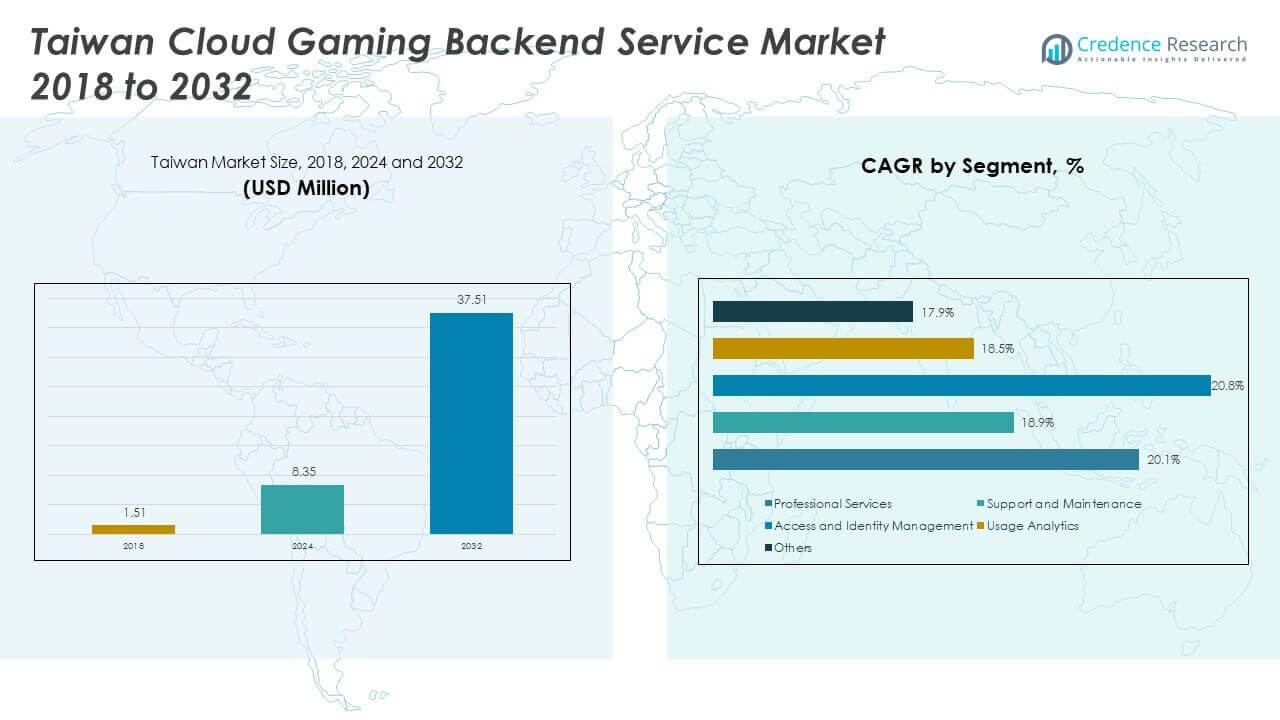
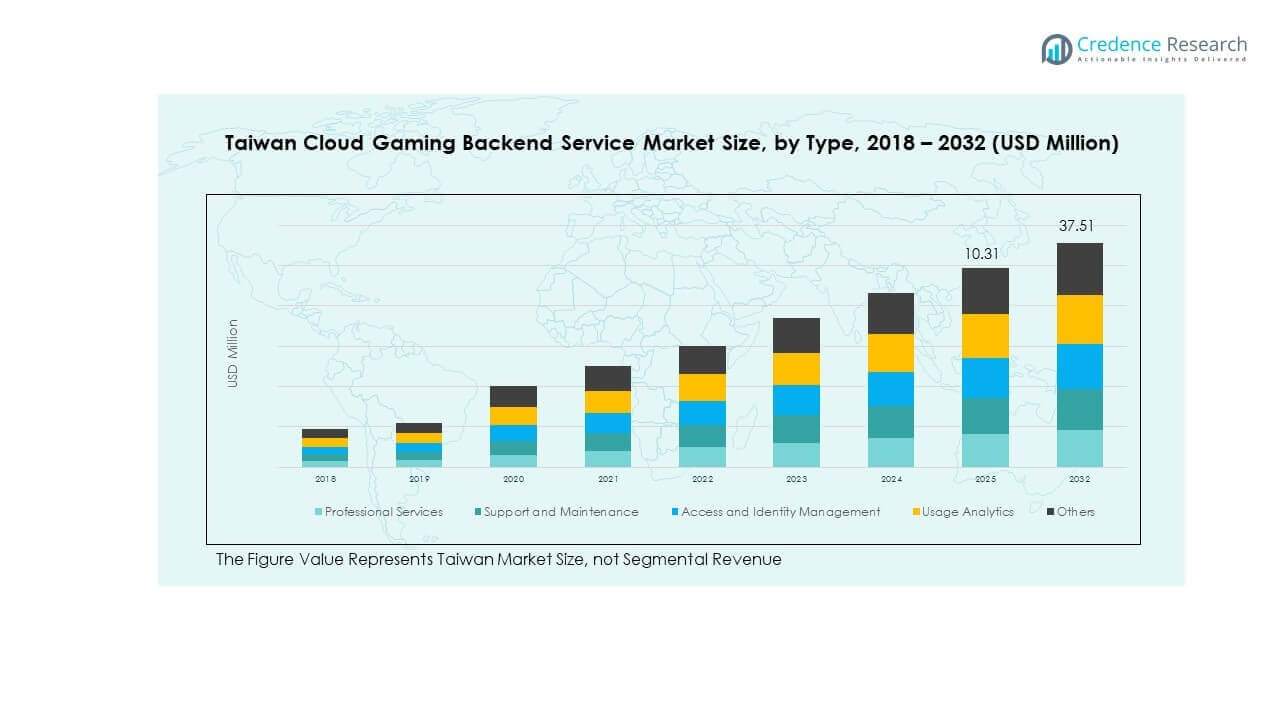
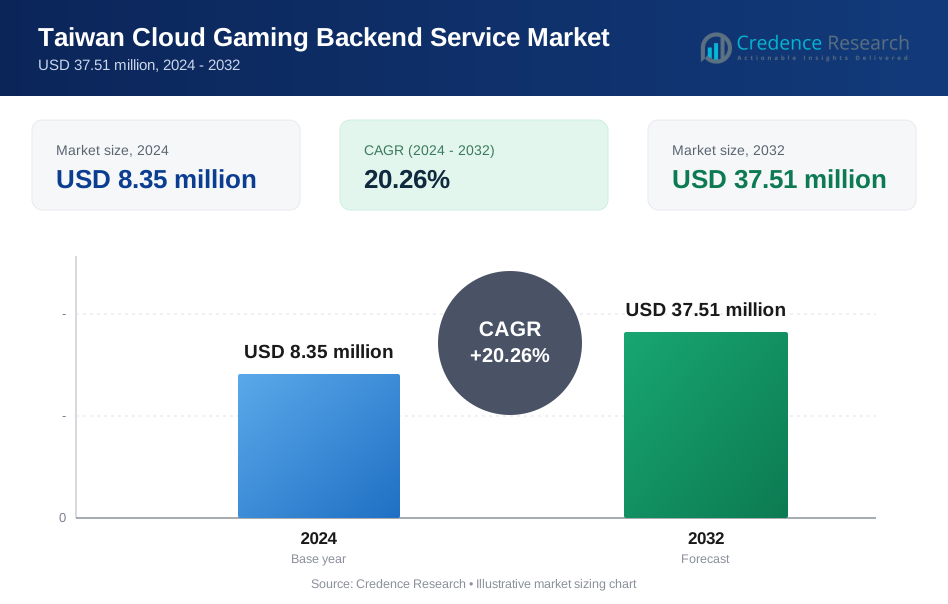
The Taiwan Cloud Gaming Backend Service Market size was valued at USD 1.51 million in 2018 to USD 8.35 million in 2024 and is anticipated to reach USD 37.51 million by 2032, at a CAGR of 20.26% during the forecast period.
| REPORT ATTRIBUTE | DETAILS |
|---|---|
| Historical Period | 2020-2023 |
| Base Year | 2024 |
| Forecast Period | 2025-2032 |
| Taiwan Cloud Gaming Backend Service Market Size 2024 | USD 8.35 Million |
| Taiwan Cloud Gaming Backend Service Market, CAGR | 20.26% |
| Taiwan Cloud Gaming Backend Service Market Size 2032 | USD 37.51 Million |
Market growth in Taiwan is driven by the surge in demand for immersive gaming experiences and the expansion of high-speed internet infrastructure. The rise of 5G networks has enabled faster connectivity, which supports low-latency cloud gaming. Increasing adoption of subscription-based gaming platforms, coupled with the growing number of smartphone and PC gamers, has further strengthened demand. Additionally, collaborations between telecom operators and gaming companies are fostering market expansion by ensuring accessibility and scalable backend support.
Regionally, Taiwan holds a strong position within Asia-Pacific due to its robust digital ecosystem and high internet penetration. Countries like Japan and South Korea lead in technological advancements and gaming culture, while emerging Southeast Asian nations are catching up with rising mobile adoption and improving infrastructure. Taiwan benefits from being a strategic hub, leveraging cross-border partnerships and innovation to enhance competitiveness in the regional cloud gaming landscape.
Market Insights
- The Taiwan Cloud Gaming Backend Service Market was valued at USD 1.51 million in 2018, reached USD 8.35 million in 2024, and is projected to hit USD 37.51 million by 2032, growing at a CAGR of 20.26%.
- Northern Taiwan accounted for 46% of the market in 2024 due to advanced digital infrastructure, Central Taiwan held 31% with expanding tech clusters, and Southern Taiwan secured 23% driven by mobile adoption and regional investments.
- Southern Taiwan is the fastest-growing subregion with 23% share, benefiting from expanding telecom coverage, rising young gamer participation, and the popularity of subscription-based cloud gaming services.
- By type, professional services held the largest share at 34% in 2024, driven by strong adoption of deployment expertise and backend integration support.
- Support and maintenance accounted for 22%, access and identity management captured 18%, usage analytics held 15%, while others represented 11%, showing balanced diversification across service categories.
Market Drivers
Rising Adoption of High-Speed Internet and Advanced Network Infrastructure
The widespread availability of high-speed internet and 5G networks is one of the strongest drivers for the Taiwan Cloud Gaming Backend Service Market. Faster connectivity ensures seamless and low-latency gameplay, which is vital for cloud gaming adoption. Telecom providers in Taiwan are expanding infrastructure, allowing more gamers to access reliable services. It helps cloud platforms deliver smooth performance across devices, including PCs, smartphones, and tablets. Government initiatives promoting digital transformation further support this momentum. The gaming ecosystem benefits from consistent connectivity improvements. Companies also see increased opportunities to offer bundled services with telecom partnerships. This foundation creates long-term growth prospects.
- For example, Chunghwa Telecom completed the deployment of over 7,000 5G base stations by July 2021, covering more than 75% of Taiwan’s population. This large-scale rollout significantly strengthened the country’s 5G infrastructure and supported advanced applications such as cloud gaming.
Growing Popularity of Subscription-Based Gaming Services and Diverse Platforms
The demand for subscription-based gaming services continues to rise, creating strong revenue streams for backend providers. Consumers prefer low upfront costs, diverse game libraries, and flexibility in access. The Taiwan Cloud Gaming Backend Service Market benefits from the trend, as more users shift from traditional ownership to access models. Gaming companies use backend services to manage scalability and traffic spikes during peak usage. It also helps providers analyze user data and personalize gaming experiences. Platforms now offer cloud access across multiple devices, enhancing convenience. This diversity in offerings strengthens user loyalty and adoption. Backend service providers gain a competitive edge by enabling such scalable features.
Expanding Role of Smartphones and PCs in Shaping Cloud Gaming Growth
Smartphones and PCs dominate the gaming landscape in Taiwan, acting as a major driver for backend services. These devices allow users to stream games without expensive hardware, fueling demand for scalable backend solutions. The Taiwan Cloud Gaming Backend Service Market leverages the large base of mobile users to expand reach. Telecom operators provide data packages optimized for gaming, making the service more accessible. It helps users play on-demand without delays or installation barriers. Game publishers benefit by attracting casual and serious gamers alike. This user shift creates strong opportunities for backend efficiency. Growth in device penetration directly supports the cloud gaming ecosystem.
- For example, in April 2023, ASUS launched the ROG Phone 7 series with a Snapdragon 8 Gen 2 processor and a 165 Hz AMOLED display. The devices were designed to deliver ultra-smooth, high-resolution gameplay, making them ideal for cloud gaming experiences.
Strategic Partnerships Between Telecom Operators and Gaming Companies
Telecom operators collaborate with gaming companies to build scalable backend ecosystems. These partnerships ensure reliability, bandwidth management, and enhanced service quality. The Taiwan Cloud Gaming Backend Service Market sees growth as major telecoms invest in joint ventures. It helps gaming companies reach more consumers while ensuring infrastructure stability. Backend solutions also benefit from cross-industry expertise in cloud delivery. Telecoms enable value-added services such as exclusive bundles, discounted subscriptions, and pre-installed applications. Partnerships strengthen customer loyalty and increase adoption rates. This collaboration creates a sustainable growth path for the industry in Taiwan.
Market Trends
Integration of Artificial Intelligence to Enhance Personalized Gaming Experiences
Artificial intelligence adoption is shaping backend services by enabling personalization and predictive performance improvements. AI helps in analyzing user behavior, optimizing resources, and recommending games. The Taiwan Cloud Gaming Backend Service Market incorporates AI-driven algorithms to enhance matchmaking and reduce latency. It creates engaging and tailored experiences for gamers across platforms. AI also supports adaptive graphics rendering to match device performance. It helps maintain user satisfaction and reduces churn in a competitive market. Gaming firms see AI as a tool to monetize through better recommendations. The trend is central to driving innovation in cloud gaming ecosystems.
Cloud-Native Architectures Supporting Scalable and Efficient Deployments
Backend providers are shifting toward cloud-native architectures for scalability and resilience. Microservices, containerization, and serverless frameworks allow flexible game deployment across regions. The Taiwan Cloud Gaming Backend Service Market benefits from these advanced architectures that reduce downtime and enhance efficiency. It enables seamless updates without disrupting users. Developers also achieve faster release cycles and easier maintenance. Cloud-native adoption reduces operational costs and improves overall system performance. This trend allows new entrants to compete with established providers. It strengthens the reliability of services while supporting rapid industry growth.
- For example, in August 2025, Microsoft released the Play History Sync feature for Xbox Cloud Gaming, enabling seamless progression across console, PC, and handheld devices. The update synchronizes recent gameplay across platforms, presenting all titles consistently in the player’s history.
Cross-Platform Accessibility Driving Seamless Gaming Across Devices
Users demand the flexibility to play games across devices, from consoles to mobiles. Cross-platform accessibility has become a defining trend, requiring robust backend services. The Taiwan Cloud Gaming Backend Service Market addresses this with scalable solutions that synchronize progress and save states. It ensures gamers continue sessions across devices without interruption. Backend systems manage authentication, data, and cloud saves effectively. This capability builds user loyalty and broadens audience reach. It helps reduce dependency on hardware limitations, making premium experiences accessible. The trend is transforming user expectations and market competition.
Integration of Cloud Gaming in Esports and Competitive Gaming Ecosystem
Esports growth has accelerated demand for robust cloud gaming solutions. Cloud platforms allow competitive gamers to participate seamlessly across regions. The Taiwan Cloud Gaming Backend Service Market supports esports integration by managing latency and delivering reliable infrastructure. It ensures high performance during live tournaments and streaming events. Organizers rely on backend scalability to manage large participant pools. It also provides analytics tools for player performance tracking and audience engagement. Esports platforms gain flexibility in offering hybrid gaming models. The trend connects competitive gaming with mainstream audiences, strengthening industry adoption.
- For example, Epic Games’ Fortnite allows millions of players on PC, console, and mobile to compete globally in real time. Its robust account synchronization supports seamless cross-platform progression, making it a benchmark in cross-platform gaming experiences.
Market Challenges Analysis
Concerns Over Latency and Performance in High-Demand Gaming Scenarios
Latency remains a key challenge for cloud gaming services. Even with 5G networks, maintaining consistent low-latency across diverse locations is difficult. The Taiwan Cloud Gaming Backend Service Market faces pressure to ensure uninterrupted experiences during peak hours. It is critical for backend providers to optimize traffic routing and server placement. High-demand games, such as action and multiplayer titles, require flawless execution. Performance drops create dissatisfaction, leading to user churn. Backend providers must invest heavily in infrastructure to mitigate these risks. This issue slows wider adoption despite growing demand.
High Infrastructure Costs and Complexities of Scalable Backend Management
Establishing scalable and efficient backend systems requires significant investment. Providers face cost pressures in building server farms, maintaining bandwidth, and ensuring cybersecurity. The Taiwan Cloud Gaming Backend Service Market must balance affordability with high-quality delivery. It becomes difficult for smaller providers to compete with large-scale operators. It also requires continuous upgrades to meet user expectations and evolving technologies. Managing cross-device compatibility adds further complexity. Backend providers must secure partnerships to share costs and resources. These challenges restrain market growth while demanding innovative solutions.
Market Opportunities
Expanding Demand for Mobile Gaming and Accessible Cloud Platforms
Mobile adoption is driving a surge in cloud gaming interest. Users prefer flexibility and affordability, leading to opportunities for backend providers. The Taiwan Cloud Gaming Backend Service Market gains by supporting mobile-first platforms with scalable services. It helps reach younger audiences who use smartphones as their primary gaming device. Cloud delivery reduces dependency on expensive hardware. Telecom providers also create tailored packages to boost adoption. Backend firms can expand by focusing on optimizing for mobile networks. This creates strong prospects for long-term revenue growth.
Growing Potential for International Collaboration and Regional Expansion
International collaboration offers backend providers the chance to scale services across borders. The Taiwan Cloud Gaming Backend Service Market benefits from its strategic location in Asia-Pacific. It helps providers form partnerships with Japanese, Korean, and Southeast Asian gaming companies. Regional expansion creates new consumer bases and revenue streams. Providers gain advantages by leveraging Taiwan’s digital infrastructure and innovation. It also positions Taiwan as a hub for cloud gaming technology. Strategic alliances strengthen industry presence globally. This opportunity drives greater competitiveness and market visibility.
Market Segmentation Analysis
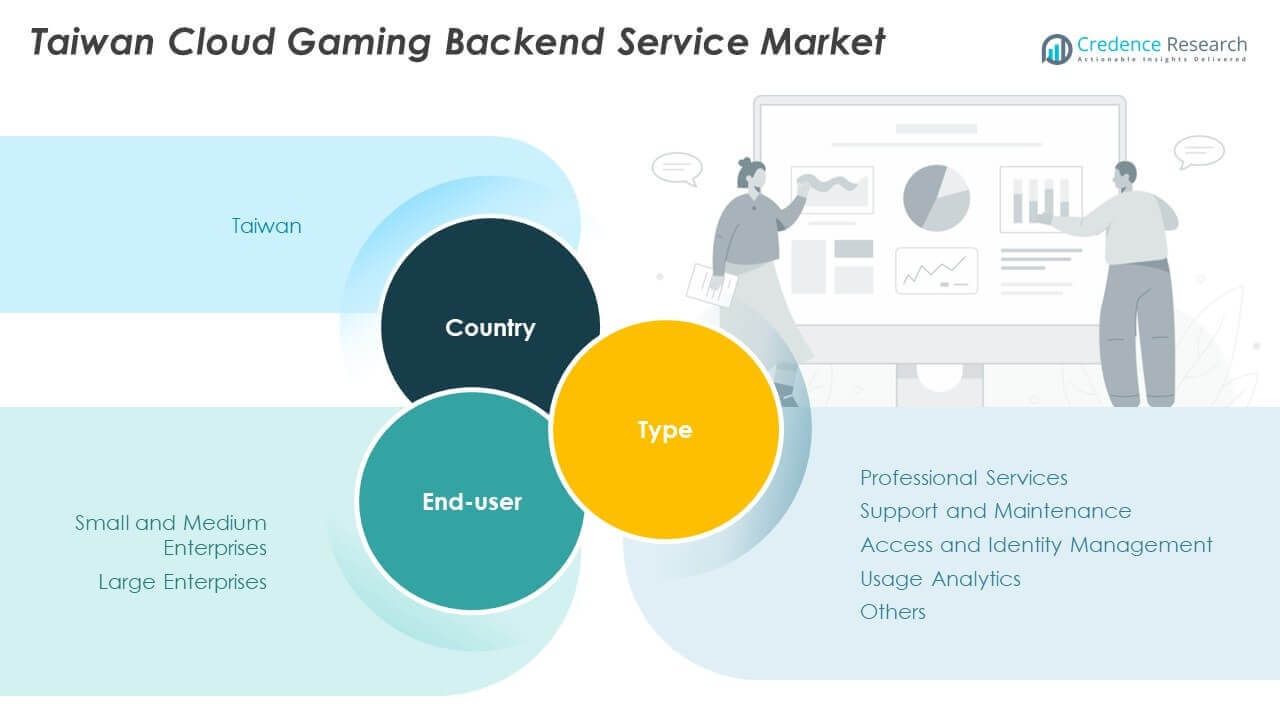
By type, professional services hold the largest share in the Taiwan Cloud Gaming Backend Service Market, driven by rising demand for deployment support, integration expertise, and scalable system management. Enterprises rely on professional services to implement backend frameworks efficiently and align with cloud-native architectures. Support and maintenance services follow closely, ensuring seamless operations and reducing downtime for gaming platforms. Access and identity management is gaining traction as security concerns grow, with firms prioritizing secure authentication and user data protection. Usage analytics represents another important segment, helping providers monitor player engagement and optimize performance. Others include specialized backend functions tailored for niche requirements, contributing to overall growth.
- For example, Tencent Cloud provides 24/7 technical support through its global service centers and enterprise-level plans. Its gaming solutions include stability optimization and infrastructure support designed to enhance platform reliability.
By end-user, large enterprises dominate the Taiwan Cloud Gaming Backend Service Market due to their ability to invest in robust backend solutions and advanced features. It benefits from strong adoption among global gaming firms and telecom operators that require high-scale operations. Small and medium enterprises also represent a growing segment, supported by cost-effective cloud solutions and demand for flexibility. SMEs leverage backend services to compete with larger providers by adopting subscription-based models and delivering cross-platform accessibility. Both segments together create balanced demand, with large enterprises sustaining volume and SMEs driving innovation. This dual adoption strengthens the market’s foundation and ensures steady growth across the forecast period.
- For instance, Chunghwa Telecom received Frost & Sullivan’s 2025 Taiwan Competitive Strategy Leadership Award, recognizing its launch of high-density, AI-ready data centers and plans for a new Taoyuan hyperscale facility supporting up to 12 megawatts of IT load specifically designed for large-scale enterprise and cloud gaming workloads.
Segmentation
By Type
- Professional Services
- Support and Maintenance
- Access and Identity Management
- Usage Analytics
- Others
By End-User
- Small and Medium Enterprises
- Large Enterprises
Regional Analysis
Northern Taiwan
Northern Taiwan dominates the Taiwan Cloud Gaming Backend Service Market with a 46% share. Taipei and New Taipei serve as the core hubs, supported by strong digital infrastructure and high internet penetration. The concentration of tech companies and advanced telecom services enables scalable backend delivery. It benefits from strong investments in 5G, driving low-latency gameplay for urban gamers. Educational institutions and research centers in this region also foster innovation in cloud solutions. Strong purchasing power supports premium gaming services, making Northern Taiwan the market leader.
Central Taiwan
Central Taiwan holds a 31% share of the market, supported by expanding connectivity and growing demand from mid-sized cities. Taichung is emerging as a center for both technology adoption and gaming culture. It benefits from regional telecom expansions that provide better access to reliable services. SMEs in this region increasingly adopt backend services to optimize platform delivery. The presence of rising tech clusters contributes to stable growth momentum. Central Taiwan is positioned as a competitive subregion with strong opportunities for scaling user adoption.
Southern Taiwan
Southern Taiwan accounts for a 23% share, driven by improving digital infrastructure and rising gamer participation. Kaohsiung and Tainan are strengthening their technology ecosystems with regional government support. It gains momentum from mobile-driven adoption, as younger populations embrace affordable subscription models. Local telecom providers are expanding coverage to reduce latency issues. Gaming cafes and community-driven platforms contribute to higher engagement levels. Southern Taiwan’s potential lies in its ability to transition from an emerging market into a competitive hub over the forecast period.
Key Player Analysis
- Tencent
- Naver
- NetEase
- Sony Interactive Entertainment
- Alibaba Cloud
- Blacknut
- Microsoft Azure
- NVIDIA GeForce Now
- Ubitus
- Garena
Competitive Analysis
The Taiwan Cloud Gaming Backend Service Market features a competitive landscape shaped by both global and regional players. Tencent, NetEase, and Sony Interactive Entertainment lead with established platforms and content libraries. Microsoft Azure and NVIDIA GeForce Now provide strong backend infrastructure, focusing on latency reduction and scalable deployment. It is also influenced by local companies such as Ubitus and Garena, which offer region-specific services that address consumer preferences. Alibaba Cloud and Naver are strengthening their positions through partnerships with telecom operators and service bundling strategies. Blacknut expands niche offerings by targeting subscription-driven casual gamers. Competition remains intense, with firms focusing on improving cross-platform accessibility and cloud-native architectures. Continuous innovation, regional alliances, and strategic mergers are expected to define market leadership across the forecast period.
Recent Developments
- In September 2025, Tencent Games announced a strategic partnership with Singtel to deploy large-scale cloud gaming using advanced 5G network slicing technology, enhancing the performance and scalability of cloud gaming in the Asia-Pacific region.
- In August 2025, NVIDIA made a significant update to its cloud gaming backend offering for the Taiwan market by introducing the NVIDIA Blackwell architecture to the GeForce NOW platform, representing the service's biggest technological leap to date. This upgrade delivers GeForce RTX 5080-class GPUs to the cloud, enabling streaming up to 5K resolution at 120 frames per second, enhanced by new AI-powered features and the latest DLSS 4 Multi-Frame Generation for ultra-smooth gameplay.
- In June 2025, NetEase announced an increased investment in cloud gaming infrastructure and AI-integrated titles as part of an internal restructuring of its mobile division. The company stated its ambition to enhance accessibility and performance for bandwidth-constrained regions and to deliver AAA-quality cloud-native games with adaptive AI, strengthening their backend service offerings in markets like Taiwan.
- In March 2025, Xsolla and AWS entered into a key partnership designed to empower game developers with the latest advancements in cloud gaming and LiveOps solutions. The collaboration leverages AWS’s cloud infrastructure and Xsolla’s developer platform to create scalable, flexible backend solutions, further strengthening their positions in the expanding global cloud gaming backend service sector.
Report Coverage
The research report offers an in-depth analysis based on type and end-user. It details leading market players, providing an overview of their business, product offerings, investments, revenue streams, and key applications. Additionally, the report includes insights into the competitive environment, SWOT analysis, current market trends, as well as the primary drivers and constraints. Furthermore, it discusses various factors that have driven market expansion in recent years. The report also explores market dynamics, regulatory scenarios, and technological advancements that are shaping the industry. It assesses the impact of external factors and global economic changes on market growth. Lastly, it provides strategic recommendations for new entrants and established companies to navigate the complexities of the market.
Future Outlook
- The Taiwan Cloud Gaming Backend Service Market will expand with rising 5G deployment across major cities.
- Strategic collaborations between telecom operators and gaming providers will strengthen competitive positioning.
- Increasing demand for subscription-based models will create steady recurring revenue opportunities.
- The integration of AI and machine learning in backend platforms will enhance personalization.
- Growth in mobile adoption will make smartphones the primary access point for cloud gaming.
- Esports integration with backend platforms will drive wider adoption among younger demographics.
- Cloud-native architectures will continue to improve scalability and operational efficiency for providers.
- Regional expansion by local players will help Taiwan act as a hub for Asia-Pacific markets.
- Continuous investment in latency reduction technologies will improve user experience significantly.
- Innovation in multi-device accessibility will define the next phase of market competition.
Request a Free Sample
Fill in your details and we'll send you a free sample report.
- Sample data tables & charts
- Research methodology
Need a Custom Version of This Report?
Tailor the scope, geography, or segments to your exact requirements.
- Custom geography or segment scope
- Direct access to our analyst team
Frequently Asked Questions
What is the current market size for Taiwan Cloud Gaming Backend Service Market, and what is its projected size in 2032?
At what Compound Annual Growth Rate is the Taiwan Cloud Gaming Backend Service Market projected to grow between 2024 and 2032?
Which Taiwan Cloud Gaming Backend Service Market segment held the largest share in 2024?
What are the primary factors fueling the growth of the Taiwan Cloud Gaming Backend Service Market?
Who are the leading companies in the Taiwan Cloud Gaming Backend Service Market?
Which region commanded the largest share of the Taiwan Cloud Gaming Backend Service Market in 2024?
Table of Content
Chapter 1. Report Introduction
- 1.1 Report Description & Purpose
- 1.1.1 Report Title & Market Definition
- 1.1.2 Unique Selling Propositions (USP) & Key Differentiators
- 1.1.3 Value Proposition for Stakeholders
- 1.2 Research Objectives
- 1.2.1 Market Sizing Objectives (Volume & Revenue)
- 1.2.2 Segmentation Objectives
- 1.2.3 Competitive Intelligence Objectives
- 1.2.4 Forecast & Scenario Objectives
- 1.3 Report Scope
- 1.3.1 Taiwan Cloud Gaming Backend Service Scope – Types & Subtypes Covered
- 1.3.2 Geographic Scope – Regions & Countries Covered
- 1.3.3 Historical Period, Base Year & Forecast Period (2024; forecast to 2032)
- 1.3.4 Inclusions & Exclusions
- 1.4 HS Code & Classification Framework
- 1.5 Currency, Units & Pricing Basis
- 1.6 Target Stakeholders
- 1.7 Limitations & Assumptions
Chapter 2. Executive Summary
- 2.1 Global Taiwan Cloud Gaming Backend Service Market Snapshot
- 2.1.1 Market Size – Historical (2024) & Forecast (2024-2032) (2024: USD 8.35 million → 2032: USD 37.51 million)
- 2.1.2 Volume & Revenue – Global Totals
- 2.1.3 Key Market Highlights – Top Five Facts
- 2.2 Taiwan Cloud Gaming Backend Service Market Segmentation Snapshot
- 2.2.1 Market Split by Region – 2024 vs. 2032
- 2.3 Competitive Snapshot
- 2.3.1 Top 10 Players by Revenue Share – 2024
- 2.3.2 Top 10 Players by Volume Share – 2024
- 2.3.3 Recent Strategic Developments (18-Month Summary)
- 2.4 Key Investment Highlights & Strategic Conclusions
Chapter 3. Taiwan Cloud Gaming Backend Service Market Dynamics & Industry Analysis
- 3.1 Market Overview & Context
- 3.1.1 Taiwan Cloud Gaming Backend Service Market Position in the Broader Automotive Value Chain
- 3.1.2 OEM vs. Replacement Market Dynamics
- 3.1.3 Market Maturity & Development Stage by Region
- 3.2 Taiwan Cloud Gaming Backend Service Market Drivers
- 3.3 Taiwan Cloud Gaming Backend Service Market Restraints & Challenges
- 3.4 Taiwan Cloud Gaming Backend Service Market Opportunities
- 3.5 Porter's Five Forces Analysis
- 3.5.1 Threat of New Entrants
- 3.5.2 Bargaining Power of Suppliers
- 3.5.3 Bargaining Power of Buyers
- 3.5.4 Threat of Substitutes
- 3.5.5 Competitive Rivalry – Intensity Assessment
- 3.6 Taiwan Cloud Gaming Backend Service Value Chain Analysis
- 3.6.1 Upstream – Raw Material/Input Suppliers
- 3.6.1.1 Raw Material/Input 1
- 3.6.1.2 Raw Material/Input 2
- 3.6.1.3 Raw Material/Input 3
- 3.6.2 Midstream – Production/Manufacturing/Service Delivery
- 3.6.2.1 Production/Process Overview
- 3.6.2.2 Key Facility Locations & Capacity by Manufacturer
- 3.6.3 Downstream – Distribution & End Consumer
- 3.6.3.1 Primary Channel – B2B/OEM
- 3.6.3.2 Secondary Channels – Dealer, Retail, Online, Direct
- 3.6.4 Value Chain Profitability Analysis
- 3.6.1 Upstream – Raw Material/Input Suppliers
- 3.7 PESTEL Analysis
- 3.7.1 Political Factors
- 3.7.2 Economic Factors
- 3.7.3 Social Factors
- 3.7.4 Technological Factors
- 3.7.5 Environmental Factors
- 3.7.6 Legal Factors
- 3.8 Taiwan Cloud Gaming Backend Service Supply Chain Analysis
- 3.8.1 Raw Material/Input Supply Risk Assessment
- 3.8.2 Manufacturing Concentration Risk (Geographic Exposure)
- 3.8.3 Trade Disruption Impact Analysis
- 3.9 Regulatory & Policy Landscape
Note: The regulatory and policy landscape section covers regulations based on their applicability to the market, Taiwan Cloud Gaming Backend Service category, geography, and scope of the study. Only regulatory frameworks with a material impact on operations, compliance, trade, sustainability, or market access are analyzed in detail.
Chapter 4. Key Investment Pockets & Opportunity Analysis
- 4.1 Taiwan Cloud Gaming Backend Service Market Attractiveness Analysis
- 4.1.1 By Region – Investment Attractiveness Matrix (Volume × CAGR)
- 4.2 Absolute Revenue Growth Opportunity
- 4.2.1 By Region – Absolute USD Growth Through 2032
- 4.3 Incremental Volume Opportunity
- 4.3.1 By Region – Incremental Volume Through 2032
- 4.3.2 Segment – Incremental Volume
- 4.4 Emerging Submarket Opportunity Deep Dive (Subject to Applicability)
- 4.5 Emerging Market Opportunity Scorecards
- 4.5.1 United States
- 4.5.2 Europe
- 4.5.3 Asia
- 4.5.4 Middle East & Africa
Note: Emerging Market Opportunity Scorecards will be included based on relevance and strategic importance. Regions listed are indicative and may vary depending on data availability and market dynamics.
Chapter 5. Taiwan Cloud Gaming Backend Service Import-Export Analysis & Trade Flows
- 5.1 Global Trade Overview
- 5.1.1 Global Export Value by Country (2024)
- 5.1.2 Global Export Volume by Country (2024)
- 5.1.3 Global Import Value by Country (2024)
- 5.1.4 Global Import Volume by Country (2024)
- 5.1.5 Net Trade Balance by Country (2024)
- 5.2 Export Analysis – Segment
- 5.2.1 Type 1 (HS Code)
- 5.2.2 Type 2 (HS Code)
- 5.2.3 Type 3 (HS Code)
- 5.2.4 Type 4 (HS Code)
- 5.2.5 Type 5 (HS Code)
- 5.3 Import Analysis – Segment
- 5.3.1 Type 1 (HS Code)
- 5.3.2 Type 2 (HS Code)
- 5.3.3 Type 3 (HS Code)
- 5.3.4 Type 4 (HS Code)
- 5.3.5 Type 5 (HS Code)
- 5.4 Average Unit Trade Prices
- 5.4.1 Average Export Price – Segment & Country
- 5.4.2 Average Import Price – Segment & Source Country
- 5.4.3 Price Trends (2024)
- 5.5 Key Trade Route Analysis
- 5.5.1 Trade Route 1
- 5.5.2 Trade Route 2
- 5.5.3 Trade Route 3
- 5.5.4 Trade Route 4
- 5.5.5 Trade Route 5
- 5.6 Trade Policy Impact Assessment
- 5.6.1 US Anti-Dumping & Section 301 Tariffs
- 5.6.2 EU Customs Union Impact
- 5.6.3 Major Free Trade Agreements
- 5.6.4 USMCA Rules of Origin
Note: Trade policy analysis will be included only where relevant to the Taiwan Cloud Gaming Backend Service market.
Chapter 6. Competitive Landscape & Company Benchmarking
- 6.1 Taiwan Cloud Gaming Backend Service Market Concentration & Structure
- 6.1.1 Herfindahl-Hirschman Index (HHI) – vs. 2024
- 6.1.2 Tier 1, Tier 2 & Tier 3 Market Structure
- 6.1.3 Global, Regional & Local Player Dynamics
- 6.2 Taiwan Cloud Gaming Backend Service Market Share Analysis – 2024
- 6.2.1 Global Revenue Share by Company
- 6.2.2 Global Volume Share by Company
- 6.2.3 Regional Revenue Share
- 6.2.4 Market Share Evolution ( vs. 2024)
- 6.2.5 OEM Segment Share by Company
- 6.2.6 Replacement Segment Share by Company
- 6.3 Production/Delivery Capacity & Facility Analysis
- 6.3.1 Global Installed Capacity
- 6.3.2 Capacity Utilization Rates
- 6.3.3 Production/Output Volume
- 6.3.4 Facility Locations & Capacity Map
- 6.3.5 Planned Capacity Additions
- 6.4 Taiwan Cloud Gaming Backend Service Competitive Benchmarking Matrix
- 6.4.1 Revenue, Volume, CAGR & Profitability Comparison
- 6.4.2 Channel Revenue Mix
- 6.4.3 Geographic Revenue Exposure
- 6.4.4 R&D Intensity
- 6.4.5 Sustainability Maturity
- 6.5 Strategic Developments in Taiwan Cloud Gaming Backend Service (Last 24 Months)
- 6.5.1 Mergers, Acquisitions & Divestments
- 6.5.2 New Taiwan Cloud Gaming Backend Service Launches
- 6.5.3 Facility Expansions
- 6.5.4 Strategic Alliances, Joint Ventures & Partnerships
- 6.5.5 Distribution Expansion & Market Entry
- 6.5.6 Sustainability & ESG Initiatives
- 6.6 Competitive Strategy Mapping
- 6.6.1 Leader, Challenger, Follower & Niche Classification
- 6.6.2 Pricing Strategy Comparison
- 6.6.3 Channel Strategy Matrix
Note: Strategic developments are included based on their materiality and the availability of reliable information.
Chapter 7. Global Taiwan Cloud Gaming Backend Service Market – By Distribution Channel
- 7.1 Segment Overview
- 7.1.1 Volume & Revenue Split by Channel (2024 & 2032)
- 7.1.2 Channel Mix Evolution (2024-2032)
Chapter 8. Regional Market Analysis – Global Overview
- 8.1 Global Regional Overview
- 8.1.1 Regional Volume Share
- 8.1.2 Regional Revenue Share
- 8.1.3 Regional Volume by Region
- 8.1.4 Regional Revenue by Region
- 8.1.5 Regional Forecast Through 2032
- 8.2 Cross-Regional Segment Analysis
- 8.2.1 By Distribution Channel
- 8.2.2 By Brand/Price Tier
Chapter 9. North America Taiwan Cloud Gaming Backend Service Market
- 9.1 United States
- 9.2 Canada
- 9.3 Mexico
Chapter 10. Europe Taiwan Cloud Gaming Backend Service Market
- 10.1 Germany
- 10.2 France
- 10.3 Italy
- 10.4 United Kingdom
- 10.5 Spain
- 10.6 Poland
- 10.7 Russia
- 10.8 Netherlands
- 10.9 Belgium
- 10.10 Sweden
- 10.11 Denmark
- 10.12 Norway
- 10.13 Rest of Europe
Chapter 11. Asia Pacific Taiwan Cloud Gaming Backend Service Market
- 11.1 China
- 11.2 India
- 11.3 Japan
- 11.4 South Korea
- 11.5 Thailand
- 11.6 Indonesia
- 11.7 Vietnam
- 11.8 Malaysia
- 11.9 Australia
- 11.10 Rest of Asia Pacific
Chapter 12. Latin America Taiwan Cloud Gaming Backend Service Market
- 12.1 Brazil
- 12.2 Argentina
- 12.3 Colombia
- 12.4 Chile
- 12.5 Rest of Latin America
Chapter 13. Middle East Taiwan Cloud Gaming Backend Service Market
- 13.1 Saudi Arabia
- 13.2 United Arab Emirates
- 13.3 Turkey
- 13.4 Israel
- 13.5 Iran
- 13.6 Rest of the Middle East
Chapter 14. Africa Taiwan Cloud Gaming Backend Service Market
- 14.1 South Africa
- 14.2 Egypt
- 14.3 Nigeria
- 14.4 Morocco
- 14.5 Rest of Africa
Chapter 15. Taiwan Cloud Gaming Backend Service Company Profiles
- 15.1 [Company 01]
- 15.1.1 Company Overview
- 15.1.2 Key Management Personnel
- 15.1.3 Products & Services Portfolio
- 15.1.4 Financial Performance
- 15.1.5 Key Market Focus & Geographic Presence
- 15.1.6 Recent Developments & Strategic Initiatives
Note: The company profile list is preliminary and may change based on research findings, market developments, data availability, and client requirements.
Chapter 16. Appendices
- Appendix A – List of Abbreviations & Acronyms
- Appendix B – Industry Classification Code Reference – Full Series
- Appendix C – Production & Capacity Data Tables
- Appendix D – End-Use & Demand Base Tables
- Appendix E – Consumption & Replacement Rate Assumptions
- Appendix F – ASP Reference Tables
- Appendix G – Manufacturing & Facility Database
- Appendix H – Import-Export Data Tables
- Appendix I – Regulatory Summary Tables
- Appendix J – Primary Research Participant List (Anonymized)
- Appendix K – Primary Research Questionnaire Framework
- Appendix L – Data Sources & Bibliography
- Appendix M – Market Size Divergence & Source Comparison
Chapter 17. Research Methodology
- 17.1 Research Framework & Philosophy
- 17.2 Secondary Research – Sources, Hierarchy & Data Extraction
- 17.3 Data Modeling – Bottom-Up & Top-Down Market Sizing
- 17.4 Primary Research – Stakeholder Framework, LOI & Sample Sizes
- 17.5 Forecast Methodology – Regression, Scenario & Sensitivity Analysis
- 17.6 Quality Control – Four-Layer Validation Framework
- 17.7 Limitations & Standard Assumptions
- 17.8 Disclaimer
