Market Overview:
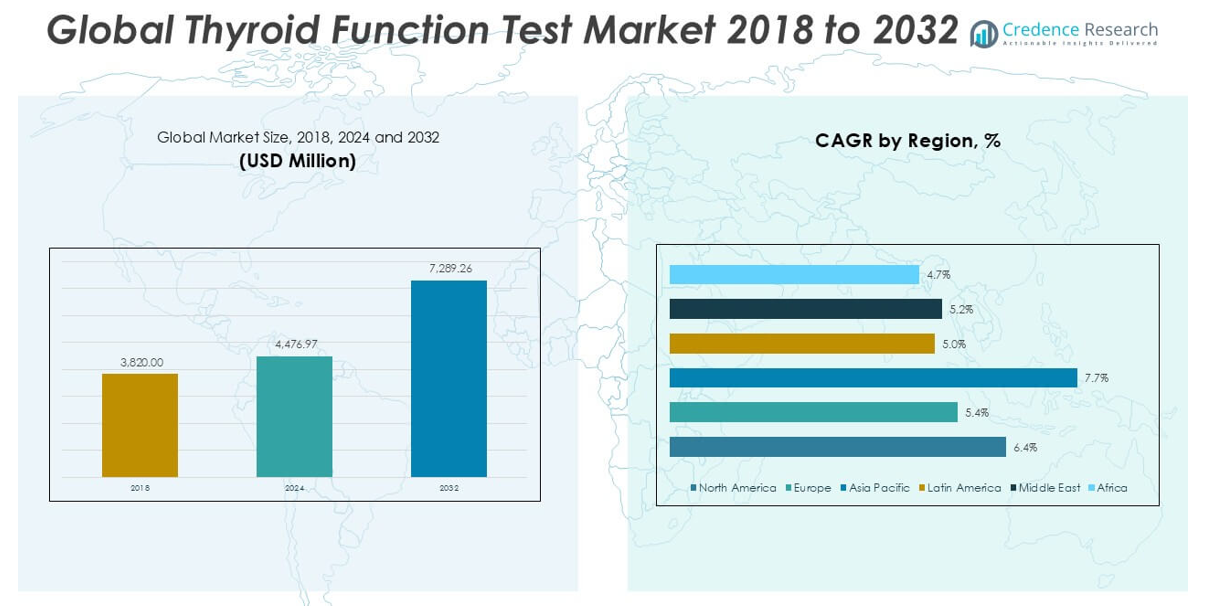
The Thyroid Function Test market size was valued at USD 3,820.00 million in 2018, reached USD 4,476.97 million in 2024, and is anticipated to reach USD 7,289.26 million by 2032, at a CAGR of 6.31% during the forecast period.
| REPORT ATTRIBUTE | DETAILS |
|---|---|
| Historical Period | 2020-2023 |
| Base Year | 2024 |
| Forecast Period | 2025-2032 |
| Thyroid Function Test Market Size 2024 | USD 4,476.97 million |
| Thyroid Function Test Market, CAGR | 6.31% |
| Thyroid Function Test Market Size 2032 | USD 7,289.26 million |
The Thyroid Function Test market is driven by prominent players such as Thermo Fisher, Abbott, Roche, DiaSorin, Danaher, Kronus, Merck, Cortez Diagnostics, bioMérieux, Qualigen, and Autobio Diagnostics. These companies actively invest in expanding their diagnostic portfolios, enhancing technological capabilities, and strengthening global distribution networks. North America leads the market with a dominant share of 43.6% in 2024, supported by advanced healthcare infrastructure, high patient awareness, and widespread diagnostic accessibility. Europe and Asia Pacific follow, with Asia Pacific emerging as the fastest-growing region due to increasing healthcare investments and rising thyroid disorder prevalence. The competitive landscape remains dynamic, with leading companies focusing on innovation, strategic partnerships, and regional expansion to secure their market positions.
Market Insights
- The Thyroid Function Test market was valued at USD 3,820.00 million in 2018, reached USD 4,476.97 million in 2024, and is projected to reach USD 7,289.26 million by 2032, growing at a CAGR of 6.31% during the forecast period.
- Rising prevalence of thyroid disorders and increasing awareness about early diagnosis are key drivers boosting the demand for thyroid function tests globally.
- The market is witnessing trends such as the growing adoption of point-of-care testing and automation in laboratories to deliver faster and more accurate thyroid results.
- North America holds the largest regional share at 43.6% in 2024, while Asia Pacific is the fastest-growing region with a CAGR of 7.7%; TSH tests dominate the type segment due to their high clinical usage.
- Limited access to advanced diagnostics in low-income regions and variable test results across laboratories are key restraints affecting consistent global market growth.
Market Segmentation Analysis:
By Type:
In the Thyroid Function Test market, TSH tests dominate the type segment, accounting for the largest market share in 2024. TSH tests are widely used as the primary screening tool for thyroid disorders, driving their high demand. The segment benefits from their superior accuracy and cost-effectiveness in detecting both hypothyroidism and hyperthyroidism. Increasing awareness of thyroid-related diseases and the growing global prevalence of thyroid dysfunction further support the dominance of this sub-segment. T4 and T3 tests hold moderate shares, mainly used as complementary diagnostics, while other tests contribute minimally to the overall market.
- For instance, Roche’s Elecsys TSH assay has a measuring range of 0.005 to 100 mIU/L, which provides laboratories with high sensitivity and reproducibility for thyroid diagnostics across a wide concentration spectrum.
By End-User
Hospitals lead the end-user segment in the Thyroid Function Test market, capturing the largest market share in 2024. Their dominance is supported by advanced diagnostic infrastructure, a high patient footfall, and the availability of skilled healthcare professionals. Hospitals typically perform a comprehensive range of thyroid function tests as part of routine health check-ups and critical care diagnostics. Diagnostic laboratories follow, driven by the rising demand for cost-efficient and quick testing services. Research laboratories and other end-users contribute a smaller portion, largely focused on clinical studies and specific research applications rather than large-scale patient diagnostics.
- For instance, Abbott’s ARCHITECT i1000SR analyzer processes up to 100 tests per hour, while its higher-end ARCHITECT i4000SR model reaches up to 400 tests per hour, supporting heavy test volumes in hospital labs.
Market Overview
Rising Prevalence of Thyroid Disorders
The increasing global burden of thyroid-related conditions, including hypothyroidism, hyperthyroidism, and thyroid cancer, significantly drives the demand for thyroid function tests. Sedentary lifestyles, poor dietary habits, and genetic predispositions contribute to a higher incidence of thyroid dysfunction. This growing patient base accelerates the adoption of regular thyroid screening and monitoring, particularly in developed and urban regions. The market benefits from heightened awareness among healthcare providers and patients, prompting timely diagnosis and boosting the volume of thyroid function tests performed across hospitals and diagnostic laboratories.
- For instance, DiaSorin’s LIAISON XL analyzer supports a throughput of up to 171 tests per hour, with first results available in as little as 17 minutes.
Expansion of Diagnostic Infrastructure
Continuous advancements in healthcare infrastructure, especially in emerging economies, strengthen the thyroid function test market. Investment in new diagnostic laboratories, the availability of modern testing equipment, and the expansion of point-of-care testing facilities improve patient access to thyroid diagnostics. Government healthcare initiatives and public-private partnerships further support market penetration. These developments enable faster, more accurate thyroid assessments, increasing testing volumes and supporting overall market growth. Improved diagnostic capabilities also encourage early detection, driving preventive healthcare trends in both urban and rural areas.
- For instance, bioMérieux’s VIDAS system is deployed in over 160 countries and used by 25,000 laboratories, bringing automated thyroid testing to a wide array of settings.
Growing Geriatric Population
The rising elderly population worldwide significantly contributes to the growth of the thyroid function test market. Older individuals are more prone to thyroid dysfunction due to age-related metabolic changes and a higher risk of comorbidities. The demand for regular thyroid monitoring among the aging demographic drives increased testing in both hospitals and diagnostic centers. This population segment often requires frequent thyroid assessments to manage chronic conditions, which enhances the demand for reliable and accessible thyroid function tests, further expanding the market size.
Key Trends & Opportunities
Rising Adoption of Point-of-Care Testing
Point-of-care testing (POCT) is emerging as a significant trend in the thyroid function test market. Healthcare providers increasingly prefer POCT due to its ability to deliver rapid, on-site results, improving diagnostic efficiency and patient management. The miniaturization of diagnostic devices and the growing availability of user-friendly test kits support this shift. POCT is particularly beneficial in remote and resource-limited settings, creating opportunities for market expansion. Manufacturers focusing on developing portable, cost-effective thyroid test solutions can capitalize on this growing demand.
- For instance, Qualigen’s FastPack IP System delivers quantitative TSH results in just 12 minutes with under one minute of hands-on time, ideal for point-of-care use.
Integration of Automation and Digital Platforms
Automation and digital diagnostic platforms are transforming thyroid function testing. Automated systems improve testing accuracy, reduce manual errors, and accelerate processing times, making them attractive for large diagnostic centers and hospitals. The integration of digital health records and laboratory information systems streamlines test result management and enhances patient tracking. This trend supports the growing demand for high-throughput testing, especially in regions with increasing thyroid disorder prevalence. Companies investing in automated analyzers and digital connectivity solutions are well-positioned to capture emerging market opportunities.
- For instance, Danaher’s Beckman Coulter Access 2 analyzer processes up to 100 tests per hour and offers onboard refrigerated storage for 24 assays with full integration into lab information systems.
Key Challenges
Limited Access in Low-Income Regions
One of the primary challenges facing the thyroid function test market is the limited accessibility to diagnostic services in low-income and rural areas. A shortage of well-equipped laboratories, insufficient healthcare funding, and low patient awareness restrict market growth in these regions. Delayed diagnosis and untreated thyroid conditions can lead to severe health complications, yet regular testing remains scarce. Addressing this gap requires targeted healthcare investments, mobile diagnostic solutions, and educational programs to improve thyroid disorder awareness and encourage timely testing.
Reimbursement Limitations and High Out-of-Pocket Costs
In several countries, thyroid function tests face reimbursement restrictions that limit their accessibility. Patients often bear the cost of testing out-of-pocket, especially in regions with underdeveloped insurance systems or stringent healthcare policies. This financial burden can discourage routine thyroid screening, particularly among lower-income groups. These cost-related barriers restrict the potential market expansion. Ensuring broader insurance coverage, simplifying reimbursement processes, and promoting affordable diagnostic solutions are essential to overcoming this challenge and enhancing testing uptake.
Variability in Test Results and Lack of Standardization
The thyroid function test market faces concerns related to variability in test results due to differences in laboratory protocols, assay sensitivity, and reference ranges. This inconsistency can lead to misdiagnosis or inappropriate treatment strategies, undermining patient trust and clinical outcomes. The absence of universally accepted testing standards contributes to this issue. Efforts to establish standardized testing procedures and harmonize reference intervals are crucial to ensuring result reliability. Addressing this challenge will improve diagnostic accuracy and support consistent thyroid disorder management worldwide.
Regional Analysis
North America
North America holds the largest share in the Thyroid Function Test market, accounting for 43.6% of the total market in 2024. The market was valued at USD 1,665.14 million in 2018 and is expected to reach USD 3,163.21 million by 2032, growing at a CAGR of 6.4%. The region’s dominance is driven by advanced healthcare infrastructure, high awareness levels, and the widespread availability of diagnostic services. Increased incidence of thyroid disorders and a well-established reimbursement framework further contribute to North America’s market leadership, positioning it as the key revenue generator in this industry.
Europe
Europe accounts for 25.5% of the global market share in 2024 in the Thyroid Function Test market. It was valued at USD 1,012.30 million in 2018 and is projected to reach USD 1,740.48 million by 2032, growing at a CAGR of 5.4%. The market’s growth is supported by a rising elderly population and a strong focus on preventive healthcare. The increasing adoption of advanced diagnostic equipment and the presence of well-regulated healthcare systems strengthen Europe’s market position. Consistent demand from Germany, France, and the UK continues to propel the market across the region.
Asia Pacific
Asia Pacific represents 21.2% of the global Thyroid Function Test market in 2024, with a valuation of USD 768.58 million in 2018, expected to reach USD 1,721.13 million by 2032 at a CAGR of 7.7%, the highest among all regions. Rapid urbanization, growing healthcare awareness, and a significant rise in thyroid disorder cases support the market’s strong growth. Countries like China, India, and Japan are key contributors due to expanding healthcare infrastructure and increasing investments in diagnostic services. The region presents considerable opportunities for market players seeking to expand in emerging economies.
Latin America
Latin America holds 4.1% of the global Thyroid Function Test market share in 2024. The regional market was valued at USD 160.82 million in 2018 and is projected to reach USD 273.13 million by 2032, growing at a CAGR of 5.0%. The market is driven by gradually improving healthcare access, rising awareness of thyroid-related conditions, and increasing government initiatives aimed at expanding diagnostic capabilities. Growth remains concentrated in countries like Brazil and Mexico, where private and public healthcare sectors are actively developing to meet diagnostic demands, particularly for chronic diseases.
Middle East
The Middle East captures 3.5% of the global Thyroid Function Test market share in 2024. It was valued at USD 141.34 million in 2018 and is forecasted to reach USD 230.29 million by 2032, growing at a CAGR of 5.2%. Market growth is supported by rising healthcare investments and the increasing prevalence of lifestyle-related disorders. Countries such as Saudi Arabia and the UAE are leading this growth due to their expanding hospital networks and improving diagnostic infrastructure. However, challenges related to healthcare accessibility in remote areas may slightly temper the overall growth rate.
Africa
Africa accounts for 2.5% of the Thyroid Function Test market share in 2024, with a market size of USD 71.82 million in 2018, expected to reach USD 161.02 million by 2032 at a CAGR of 4.7%. The market’s growth is driven by gradual improvements in healthcare access, rising awareness about thyroid diseases, and increased investment in primary care facilities. South Africa and Egypt contribute significantly to regional demand. However, limited diagnostic infrastructure and affordability issues still restrict wider market penetration, posing challenges for more rapid growth across the African continent.
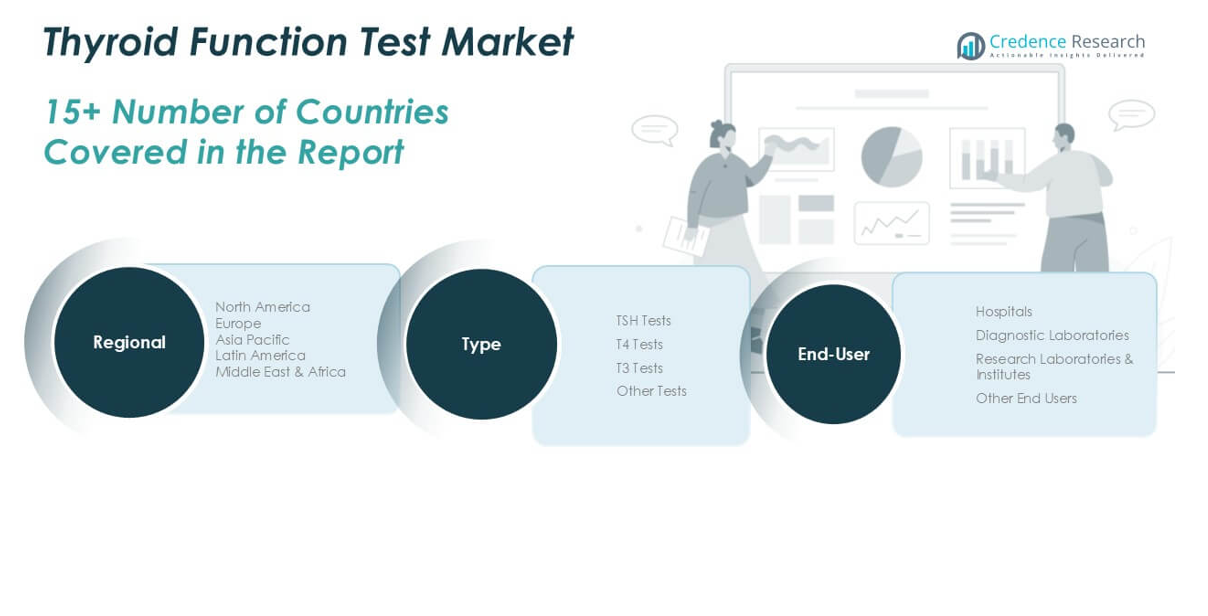
Market Segmentations:
By Type
- TSH Tests
- T4 Tests
- T3 Tests
- Other Tests
By End-User
- Hospitals
- Diagnostic Laboratories
- Research Laboratories & Institutes
- Other End Users
By Geography:
- North America
- U.S.
- Canada
- Mexico
- Europe
- Germany
- France
- U.K.
- Italy
- Spain
- Rest of Europe
- Asia Pacific
- China
- Japan
- India
- South Korea
- South-east Asia
- Rest of Asia Pacific
- Latin America
- Brazil
- Argentina
- Rest of Latin America
- Middle East & Africa
- GCC Countries
- South Africa
- Rest of the Middle East and Africa
Competitive Landscape
The Thyroid Function Test market is moderately competitive, with key players focusing on expanding their diagnostic portfolios and enhancing global reach. Companies such as Thermo Fisher, Abbott, Roche, DiaSorin, and Danaher lead the market, leveraging advanced technologies, strong distribution networks, and continuous product innovation to maintain their positions. Strategic collaborations, acquisitions, and investments in automated and point-of-care testing solutions are common among these players to strengthen their market presence. Emerging companies like Kronus, Cortez Diagnostics, and Qualigen contribute by offering specialized and cost-effective testing kits, adding to market diversity. Major players consistently invest in improving test accuracy, processing speed, and user-friendly platforms to meet growing clinical demands. The competitive environment is further shaped by regulatory approvals and the development of novel diagnostic assays that support early detection and precise thyroid management. Regional expansion and price competitiveness remain critical factors as companies aim to increase market penetration in both developed and emerging economies.
Key Player Analysis
- Thermo Fisher
- Abbott (US)
- Roche
- DiaSorin
- Danaher
- Kronus
- Merck
- Cortez Diagnostics
- bioMérieux
- Qualigen
- Autobio Diagnostics
Recent Developments
- In June 2025, Thermo Fisher launched the Orbitrap Astral Zoom and Orbitrap Excedion Pro mass spectrometers at the ASMS 2025 conference. While not explicitly branded as thyroid-specific, these next-generation mass spectrometry platforms are designed to deliver increased speed, sensitivity, and multiplexing capabilities for proteomics and biomarker discovery. These advances support more precise and high-throughput protein quantification, which is critical for developing and validating thyroid function biomarkers and assays, thus enabling earlier and more accurate detection of thyroid disorders.
- In January 2024, Abbott’s ARCHITECT family of analyzers and the Atellica Solution (developed by Siemens Healthineers but frequently referenced alongside Abbott in market analyses) are highlighted as leading platforms in the integration of advanced immunoassay technologies for thyroid function testing. These systems provide automated, high-throughput, and highly sensitive TSH, T3, and T4 assays, supporting both routine and specialized thyroid diagnostics in clinical labs.
- In October 2024, Siemens Healthineers completed verification of the Atellica DL IM1600 analyzer for anti-TPO and anti-TG detection, confirming precision standards for autoimmune thyroid diagnosis.
- In August 2024, Labcorp reported hospital thyroid test prices running 2-6 times higher than independent labs, driving payers toward lower-cost channels.
- In June 2024, HEI Therapeutics filed a patent on a home monitoring system aimed at personalized hypothyroidism management.
- In June 2024, Roche introduced the Elecsys Calcitonin assay for medullary thyroid cancer on the cobas platform.
- In March 2023, Everly Health introduced a new virtual care program that combines lab testing with telehealth consultations to assess various health conditions, such as COVID-19, flu, sexually transmitted infections (STIs), thyroid issues, weight management, and men's and women's health.
- In September 2023, Neuberg Diagnostics completed the merger of Supratech and Anand Reference Laboratory. This merger represents a major milestone in the quest to offer unmatched healthcare solutions. By combining these laboratories, the company strengthens its dedication to delivering exceptional diagnostics and patient care.
Market Concentration & Characteristics
The Thyroid Function Test Market demonstrates moderate market concentration with a mix of global leaders and regional players contributing to its growth. It is characterized by steady technological advancements, increasing demand for early and accurate thyroid diagnostics, and a growing preference for automated testing solutions. The market is driven by the rising global burden of thyroid disorders and the consistent need for routine screening across diverse healthcare settings. It shows strong penetration in developed regions with well-established healthcare systems, while emerging markets display expanding opportunities due to improving diagnostic infrastructure and rising health awareness. The Thyroid Function Test Market exhibits a structured competitive environment where key players focus on product innovation, automation, and expanding their geographic footprint to maintain their positions. It reflects a balanced demand from hospitals, diagnostic laboratories, and research institutions, supported by government health initiatives and the increasing availability of point-of-care testing. The market is highly responsive to improvements in test accuracy, speed, and affordability, making technological development a critical success factor. It faces challenges from limited accessibility in underdeveloped regions and variability in test results across different laboratories, which can hinder uniform diagnostic outcomes.
Report Coverage
The research report offers an in-depth analysis based on Facility Type, Activity Type, and Geography. It details leading market players, providing an overview of their business, product offerings, investments, revenue streams, and key applications. Additionally, the report includes insights into the competitive environment, SWOT analysis, current market trends, as well as the primary drivers and constraints. Furthermore, it discusses various factors that have driven market expansion in recent years. The report also explores market dynamics, regulatory scenarios, and technological advancements that are shaping the industry. It assesses the impact of external factors and global economic changes on market growth. Lastly, it provides strategic recommendations for new entrants and established companies to navigate the complexities of the market.
Future Outlook
- The Thyroid Function Test market is expected to grow steadily, driven by the increasing global prevalence of thyroid disorders.
- Demand for point-of-care thyroid testing is likely to rise due to the need for faster and more accessible diagnostic solutions.
- Automation in diagnostic laboratories will continue to expand, improving testing efficiency and accuracy.
- North America will maintain its market leadership, supported by advanced healthcare systems and high patient awareness.
- Asia Pacific is anticipated to grow at the fastest rate due to rising healthcare investments and increasing diagnostic capabilities.
- Continuous innovation in assay development is expected to improve test sensitivity and reliability across diverse settings.
- Market players will focus on strategic partnerships and geographic expansion to strengthen their competitive positions.
- Growing government support for preventive healthcare is likely to encourage routine thyroid screening programs.
- Reimbursement improvements and efforts to reduce out-of-pocket costs will support wider adoption of thyroid testing.
- Addressing the challenge of diagnostic variability across laboratories will remain a priority for improving clinical outcomes.

Request a Free Sample
Fill in your details and we'll send you a free sample report.
- Sample data tables & charts
- Research methodology
Market Dynamics
Rising Prevalence of Thyroid Disorders
The increasing global incidence of thyroid-related conditions such as hypothyroidism, hyperthyroidism, and thyroid cancer is driving demand for thyroid function tests, as more patients require regular screening and monitoring.
Expansion of Diagnostic Infrastructure
Continuous investments in healthcare infrastructure, especially in emerging economies, are improving access to advanced diagnostic laboratories and point-of-care testing, thereby increasing the volume of thyroid function tests performed.
Growing Geriatric Population
The aging global population is more susceptible to thyroid dysfunction, leading to higher demand for routine thyroid assessments and ongoing monitoring in both hospitals and diagnostic centers.
Adoption of Point-of-Care and Automated Testing
Healthcare providers are increasingly adopting point-of-care and automated testing solutions for thyroid function, which deliver faster, more accurate results and support higher testing throughput, especially in high-volume clinical settings.
Increasing Awareness and Preventive Healthcare Initiatives
Rising awareness among healthcare professionals and patients about the importance of early thyroid disorder detection, supported by government and private preventive healthcare programs, is boosting the uptake of thyroid function tests worldwide.
Need a Custom Version of This Report?
Tailor the scope, geography, or segments to your exact requirements.
- Custom geography or segment scope
- Direct access to our analyst team
Frequently Asked Questions
What is the current size of the Thyroid Function Test Market?
What are the key segments within the Thyroid Function Test Market?
What are some challenges faced by the Thyroid Function Test Market?
Who are the major players in the Thyroid Function Test Market?
Table of Content
Chapter 1 Market Segmentation
- 1.1 Segmentation Framework
- 1.1.1 Product and Service Classification
- 1.1.2 Application and End-Use Classification
- 1.1.3 Technology and Solution Classification
- 1.1.4 Customer and Distribution Channel Classification
- 1.1.5 Geographic Segmentation
- 1.1.6 Market Segment Definitions and Boundaries
- 1.2 By Type
- 1.2.1 TSH Tests
- 1.2.2 T4 Tests
- 1.2.3 T3 Tests
- 1.2.4 Other Tests
- 1.3 By End-User
- 1.3.1 Hospitals
- 1.3.2 Diagnostic Laboratories
- 1.3.3 Research Laboratories & Institutes
- 1.3.4 Other End Users
Chapter 2 Introduction
- 2.1 Report Objectives and Scope
- 2.2 Product Definition and Industry Terminology
- 2.3 Market Inclusions and Exclusions
- 2.4 Research Process
- 2.4.1 Primary Research and Expert Interviews
- 2.4.2 Secondary Research and Source Review
- 2.4.3 Top-Down and Bottom-Up Estimation
- 2.4.4 Data Triangulation and Verification
- 2.5 Market Size Measurement Basis
- 2.5.1 2018: USD 3,820.00 million → 2032: USD 7,289.26 million
- 2.6 Historical and Forecast Reference Periods
- 2.6.1 Base Year: 2018
- 2.6.2 Forecast Period: 2018-2032
- 2.7 Research Assumptions and Limitations
Chapter 3 Executive Summary
- 3.1 Market Snapshot and Key Findings
- 3.2 Base-Year Market Size, 2018
- 3.3 Forecast Market Size, 2032
- 3.4 Revenue and Volume Growth Outlook
- 3.5 Key Demand and Supply Indicators
- 3.6 Leading Market Segments
- 3.7 Fastest-Growing Market Opportunities
- 3.8 Regional Performance Highlights
- 3.9 Technology and Industry Transformation
- 3.10 Competitive Landscape Summary
- 3.11 Analyst View and Strategic Implications
Chapter 4 Global Thyroid Function Test Market Trends and Developments
- 4.1 Historical Industry Development
- 4.2 Recent Market Trends and Developments
- 4.3 Demand and Customer Behavior Trends
- 4.4 Technology and Product Innovation
- 4.5 Artificial Intelligence, Automation and Digitalization
- 4.6 Local Manufacturing and Supply Chain Realignment
- 4.7 Industry Partnerships, Mergers and Acquisitions
- 4.8 Sustainability and Circular Economy Developments
- 4.9 Government and Private Sector Investment Trends
- 4.10 Emerging Business Models and Commercialization
- 4.11 Industry Developments and Announcements
Chapter 5 Global Thyroid Function Test Market Production, Supply and Demand Analysis
- 5.1 Demand Trend and Consumption Analysis
- 5.2 Demand Forecast, 2018-2032
- 5.3 Production and Output Trend
- 5.4 Production and Output Forecast, 2018-2032
- 5.5 Installed Capacity and Capacity Utilization
- 5.6 Company-Wise Production Plants and Statistics
- 5.6.1 Installed Production Capacity
- 5.6.2 Actual Production
- 5.6.3 Planned Capacity and Expansion Targets
- 5.7 Supply Chain Structure and Procurement Trends
- 5.8 Supply-Demand Gap and Bottlenecks
- 5.9 Import Dependence and Sourcing Structure
- 5.10 Contract Manufacturing and Outsourcing
- 5.11 Regional Supply and Demand Concentration
Chapter 6 Global Thyroid Function Test Market Pricing Analysis
- 6.1 Pricing Structure and Measurement
- 6.2 Historical Pricing Trends
- 6.3 Pricing Outlook, 2018-2032
- 6.4 Average Selling Price and Unit Economics
- 6.5 Pricing by Product and Market Segment
- 6.6 Geographic Pricing Differences
- 6.7 Key Input, Energy, Labor and Logistics Costs
- 6.8 Contract Pricing and Purchasing Models
- 6.9 Pricing Sensitivity and Competitive Positioning
- 6.10 Price, Margin and Profitability Implications
Chapter 7 Global Thyroid Function Test Market Dynamics
- 7.1 Market Growth Drivers
- 7.1.1 Demand-Side Drivers
- 7.1.2 Technology and Innovation Drivers
- 7.1.3 Infrastructure and Investment Drivers
- 7.1.4 Regulatory and Policy Drivers
- 7.2 Market Restraints
- 7.2.1 Cost and Affordability Constraints
- 7.2.2 Technology and Adoption Barriers
- 7.2.3 Supply Chain and Operational Constraints
- 7.3 Market Challenges
- 7.3.1 Competitive Pressure and Margin Erosion
- 7.3.2 Skills, Infrastructure and Implementation Gaps
- 7.4 Emerging Market Opportunities
- 7.5 Market Dynamics Impact and Time-Horizon Assessment
Chapter 8 Global Thyroid Function Test Value Chain Analysis
- 8.1 Industry Value Chain Overview
- 8.2 Upstream Suppliers and Critical Inputs
- 8.3 Technology and Component Providers
- 8.4 Manufacturing or Service Delivery
- 8.5 Distribution, Channel Partners and Integrators
- 8.6 Downstream Applications and End Users
- 8.7 Value Addition and Profit Pools
- 8.8 Vertical Integration and Outsourcing
- 8.9 Supplier Concentration and Risk
- 8.10 Supply Chain Localization and Resilience
Chapter 9 Global Thyroid Function Test Market Regulations and Policies
- 9.1 Relevant Laws, Standards and Compliance Frameworks
- 9.2 Product, Service, Safety and Quality Requirements
- 9.3 Government Policies, Incentives and Subsidies
- 9.4 Imports, Exports and Trade Barriers
- 9.5 Public Procurement and Local Content Requirements
- 9.6 Environmental and Sustainability Compliance
- 9.7 Upcoming Policy Changes and Market Implications
Chapter 10 Global Thyroid Function Test Market Hotspots and Opportunities
- 10.1 Market Opportunity Mapping and Growth Hotspots
- 10.2 High-Growth Applications and Customer Groups
- 10.3 Underserved Markets and White-Space Opportunities
- 10.4 Emerging Technology and Product Opportunities
- 10.5 New Capacity and Investment Hotspots
- 10.6 Market Entry and Expansion Opportunities
- 10.7 Distribution and Partnership Opportunities
- 10.8 Near-Term and Long-Term Commercial Potential
- 10.9 Opportunity Attractiveness and Execution Risks
Chapter 11 Global Thyroid Function Test Market Outlook, 2018-2032
- 11.1 Market Size and Analysis
- 11.1.1 Revenue (Market Measurement: 2018: USD 3,820.00 million → 2032: USD 7,289.26 million)
- 11.1.2 Market Volume and Quantity Sold
- 11.1.3 Historical Market Size
- 11.1.4 Base-Year Market Size, 2018
- 11.2 Market Forecast, 2018-2032
- 11.2.1 Revenue Forecast to 2032
- 11.2.2 Volume Forecast to 2032
- 11.2.3 CAGR and Year-on-Year Growth
- 11.2.4 Incremental Revenue Opportunity
- 11.3 Forecast Assumptions and Scenario Analysis
- 11.3.1 Base-Case Forecast
- 11.3.2 Optimistic and Conservative Scenarios
- 11.3.3 Technology, Pricing and Policy Sensitivities
- 11.4 Market Attractiveness and Growth Outlook
Chapter 12 Global Thyroid Function Test Market Segmentation and Outlook
- 12.1 Segmentation Summary and Market Shares, 2018
- 12.2 Largest and Fastest-Growing Segments
- 12.3 By Type - Market Size and Forecast, 2018-2032
- 12.3.1 Segment Definition and Scope
- 12.3.2 Historical Market Size
- 12.3.3 Revenue Forecast, 2018-2032
- 12.3.4 Volume Forecast, 2018-2032
- 12.3.5 Base-Year Market Share, 2018
- 12.3.6 Segment CAGR and Growth Drivers
- 12.3.7 Subsegment Market Size and Forecast
- 12.3.7.1 TSH Tests
- 12.3.7.2 T4 Tests
- 12.3.7.3 T3 Tests
- 12.3.7.4 Other Tests
- 12.3.8 Subsegment Pricing and Adoption Trends
- 12.3.9 Leading Suppliers and Competition
- 12.3.10 Regional Demand and Opportunities
- 12.4 By End-User - Market Size and Forecast, 2018-2032
- 12.4.1 Segment Definition and Scope
- 12.4.2 Historical Market Size
- 12.4.3 Revenue Forecast, 2018-2032
- 12.4.4 Volume Forecast, 2018-2032
- 12.4.5 Base-Year Market Share, 2018
- 12.4.6 Segment CAGR and Growth Drivers
- 12.4.7 Subsegment Market Size and Forecast
- 12.4.7.1 Hospitals
- 12.4.7.2 Diagnostic Laboratories
- 12.4.7.3 Research Laboratories & Institutes
- 12.4.7.4 Other End Users
- 12.4.8 Subsegment Pricing and Adoption Trends
- 12.4.9 Leading Suppliers and Competition
- 12.4.10 Regional Demand and Opportunities
- 12.5 Segment Growth Comparison
- 12.6 Segment Attractiveness and Priority Matrix
Chapter 13 Global Thyroid Function Test End-Use and Application Market Outlook
- 13.1 End-Use Industry and Customer Demand Structure
- 13.2 Leading Applications and Customer Groups
- 13.3 End-Use Market Size, Share and Forecast
- 13.4 Major End-Use Industry Deep Dives
- 13.4.1 Customer Requirements and Use Cases
- 13.4.2 Demand and Replacement Cycles
- 13.4.3 Technical and Regulatory Considerations
- 13.4.4 Purchasing and Procurement Models
- 13.4.5 Leading Vendors and Distribution Channels
- 13.4.6 Forecast and Commercial Opportunities
- 13.5 Emerging Applications and Cross-Segment Demand
- 13.6 End-Use Industry Investment Priorities
Chapter 14 Global Thyroid Function Test Geographic Market Outlook, 2018-2032
- 14.1 Regional Market Size and Share, 2018
- 14.2 Regional Market Forecast, 2018-2032
- 14.3 Regional Pricing, Production and Demand Differences
- 14.4 North America
- 14.4.1 United States
- 14.4.2 Canada
- 14.4.3 Mexico
- 14.5 Europe
- 14.5.1 Germany
- 14.5.2 France
- 14.5.3 Italy
- 14.5.4 United Kingdom
- 14.5.5 Spain
- 14.5.6 Poland
- 14.5.7 Russia
- 14.5.8 Netherlands
- 14.5.9 Belgium
- 14.5.10 Sweden
- 14.5.11 Denmark
- 14.5.12 Norway
- 14.5.13 Rest of Europe
- 14.6 Asia Pacific
- 14.6.1 China
- 14.6.2 India
- 14.6.3 Japan
- 14.6.4 South Korea
- 14.6.5 Thailand
- 14.6.6 Indonesia
- 14.6.7 Vietnam
- 14.6.8 Malaysia
- 14.6.9 Australia
- 14.6.10 Rest of Asia Pacific
- 14.7 Latin America
- 14.7.1 Brazil
- 14.7.2 Argentina
- 14.7.3 Colombia
- 14.7.4 Chile
- 14.7.5 Rest of Latin America
- 14.8 Middle East
- 14.8.1 Saudi Arabia
- 14.8.2 United Arab Emirates
- 14.8.3 Turkey
- 14.8.4 Israel
- 14.8.5 Iran
- 14.8.6 Rest of the Middle East
- 14.9 Africa
- 14.9.1 South Africa
- 14.9.2 Egypt
- 14.9.3 Nigeria
- 14.9.4 Morocco
- 14.9.5 Rest of Africa
- 14.10 Regional Investment, Policy and Supply Chain Differences
- 14.11 Regional Competitive Landscape
- 14.12 Geographic Growth Hotspots
Chapter 15 Global Thyroid Function Test Technology, Innovation and Sustainability Outlook
- 15.1 Technology Landscape and Maturity
- 15.2 Product, Process and Service Innovation
- 15.3 AI, Automation and Digital Tools in the Industry
- 15.4 Technology Adoption and Performance Benchmarking
- 15.5 Innovation Pipeline and R&D Investment
- 15.6 Patent and Intellectual Property Trends
- 15.7 Energy Efficiency and Resource Management
- 15.8 Sustainability, Recycling and Circularity
- 15.9 Technology Roadmap, 2018-2032
- 15.10 Risks of Obsolescence and Technology Substitution
Chapter 16 Global Thyroid Function Test Market Key Strategic Imperatives
- 16.1 Growth and Market Entry Priorities
- 16.2 High-Return Products and Segments
- 16.3 Pricing, Profitability and Cost Optimization
- 16.4 Technology Investment and Product Differentiation
- 16.5 Supply Chain Localization and Resilience
- 16.6 Distribution and Customer Acquisition
- 16.7 Partnership, Acquisition and Capacity Strategy
- 16.8 Regional Expansion Priorities
- 16.9 Short-, Medium- and Long-Term Actions
Chapter 17 Competition Outlook
- 17.1 Industry Competition Characteristics
- 17.2 Market Structure and Concentration
- 17.3 Market Share and Competitive Positioning, 2018
- 17.4 Company-Wise Revenue and Product Benchmarking
- 17.5 Production and Service Capacity Benchmarking
- 17.6 Technology, Pricing and Differentiation
- 17.7 Regional Footprint and Distribution Strength
- 17.8 Mergers, Acquisitions and Strategic Alliances
- 17.9 New Entrants and Competitive Threats
- 17.10 Porter's Five Forces and Industry Attractiveness
- 17.11 Competitive Outlook, 2018-2032
Chapter 18 Company Profiles
- 18.1 Company Coverage and Selection Criteria
- 18.2 Thermo Fisher
- 18.2.1 Business Description
- 18.2.2 Company Ownership and Geographic Presence
- 18.2.3 Product and Service Portfolio
- 18.2.4 Manufacturing and Operating Footprint
- 18.2.5 Production Capacity and Expansion Plans
- 18.2.6 Financial Performance and Investment
- 18.2.7 Market Share and Competitive Position
- 18.2.8 Technology and Innovation Capabilities
- 18.2.9 Strategic Alliances or Partnerships
- 18.2.10 Recent Developments
- 18.2.11 Growth Strategy and Outlook
- 18.3 Abbott
- 18.4 Roche
- 18.5 DiaSorin
- 18.6 Danaher
- 18.7 Kronus
- 18.8 Merck
- 18.9 Cortez Diagnostics
- 18.10 bioMérieux
- 18.11 Qualigen
- 18.12 Other Relevant Market Participants
Note: Every listed company is profiled on the structure shown under the first company. The company list is preliminary and may change based on research findings, market developments, data availability and client requirements.
Chapter 19 Disclaimer
- 19.1 Research and Forecast Disclaimer
- 19.2 Data Source and Estimation Limitations
Note: The depth of individual sections depends on data availability for this market. Volume, capacity, trade and other unit-based metrics are included where applicable.