
Market Insights
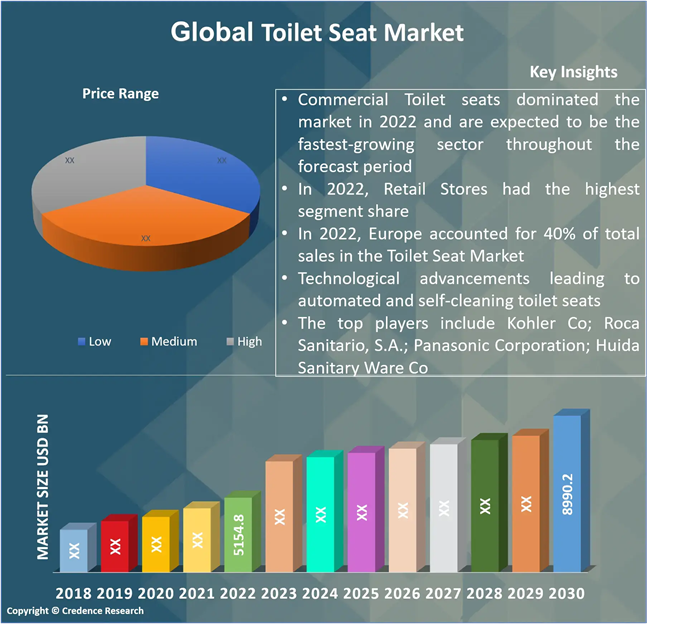
- The global demand for Toilet Seat was valued at USD 5154.8 Million in 2022 and is expected to reach USD 8990.2 Million in 2030, growing at a CAGR of 7.20% between 2023 and 2030.
- Plastic toilet seats are the market leader, with soft-shut toilet seats a close second.
- Commercial toilet seats dominated the market in 2022 and are predicted to be the fastest-growing sector throughout the forecast period, 2022-2030, with Residential Toilet seats being the fastest rising segment.
- Child and Family Toilet Seats are the toilet seat market's fastest growing category, and Elongated Toilet Seats are another important component of the toilet seat market.
- Standard toilet seats are in high demand, and Smart Toilet Seats are another market area that accounts for a sizable share of the toilet seat market.
- Residential consumers have a larger need for toilet seats, and commercial and institutional buyers have a higher CAGR.
- Retail Stores had the biggest segment share in 2022, while online retail is the fastest growing segment of the toilet industry.
- In 2022, Europe will account for 40% of overall sales in the Toilet Seat Market, while Asia-Pacific will be the market's second-largest region.
- The rising use of antibacterial materials is propelling the global market forward.
- The high cost of smart toilets over ordinary toilets is projected to limit industry expansion.
Executive Summary
Market Definition
The toilet seat market refers to the manufacturing and sale of toilet seats. Toilet seats are hinged components attached to toilets that provide a comfortable and sanitary seating area. Standard, elongated, cushioned, and heated toilet seats are available on the market, catering to varied consumer tastes and demands. Factors such as rising hygiene awareness, technological developments, and design innovations in toilet seat items are driving the market.
Market Overview
It is anticipated that between 2023 and 2030, the worldwide Toilet Seat Market will expand at a compound annual growth rate (CAGR) of 7.20%. From USD 5154.8 million in 2022, the market is projected to be worth USD 8990.2 million by 2030.
The toilet seat market is an expanding industry that meets the demand for pleasant and sanitary toilet seating solutions. To fulfill the different desires of consumers, it offers a wide selection of toilet seat alternatives such as conventional, extended, cushioned, and heated seats. Factors such as rising hygiene and sanitation awareness, technological developments, and design innovations in toilet seat items are driving the market. The toilet seat market continues to change and offer many options to enhance the whole bathroom experience, with a rising emphasis on bathroom aesthetics and functionality.
Segmentation by Material Type
- Plastic toilet seats are the market leader. They are frequently used because of their longevity, low cost, and ease of maintenance. Plastic toilet seats account for a sizable section of the industry.
- Soft-close toilet seats are another prominent product category. These seats include a slow-closing mechanism that minimizes slamming, making them quieter and more convenient for users. consumers.
Segmentation by Toilet Type
- Commercial Toilet seats dominated the market in 2022 and are expected to be the fastest-growing sector throughout the forecast period, 2022-2030. A growing number of high-end restaurants, pubs, hotels, and shopping malls are installing smart toilers to provide hygienic services to their clients. Furthermore, the smart toilet is seen as a luxury item that can be installed in high-end business establishments.
- Residential Toilet seats were the fastest expanding category. The expanding importance of the smart home as a result of growing requirements for energy conservation, push-button control, and altering demographic preferences is predicted to have a positive impact on industry growth.
Segmentation by Toilet Shape and Size
- Child and Family Toilet Seats are the fastest-growing segment of the toilet seat market. With features such as built-in child seats, adjustable settings, and safety precautions, these seats are specifically designed to meet the needs of young children and families. The demand for these specialty toilet seats is increasing as families value convenience and child-friendly items.
- Elongated Toilet Seats are another key component of the toilet seat market. The extended form of these seats gives greater comfort and support.
Segmentation by Features and Technology
- Standard Toilet Seats are in increased demand on the market. These are the most popular and widely available options on the market. They provide consumers with simplicity, cost, and a standard design that fits their basic needs. Standard toilet seats have the biggest market share due to their extensive use and popularity.
- Smart Toilet Seats are another market sector that has a considerable portion of the toilet seat market.
Segmentation by End User
- Toilet seats are in higher demand among residential consumers. Individuals and households who buy toilet seats for their houses are classified as residential consumers. As the market's largest consumer group, they drive total demand for toilet seats.
- Commercial and Institutional Buyers are another category with a higher Compound Annual Growth Rate (CAGR) in the toilet seat industry. Businesses, offices, hotels, restaurants, educational institutions, and healthcare facilities that require toilet seats for commercial or institutional areas fall into this category.
Segmentation by Sales Channel
- In 2022, Retail Stores had the highest segment share. Many buyers prefer to buy smart items through these channels because they offer the option of physical verification before making a purchase decision.
- Online retail is the fastest expanding part of the toilet industry. These platforms offer a variety of appealing products, such as free cashback and membership, doorstep delivery services, and simple return choices, which are chosen by consumers, particularly millennials.
Segmentation by Region
- In 2022, Europe accounted for 40% of total sales in the Toilet Seat Market.
- Asia-Pacific is the market's second-largest region in the Toilet Seat Market.
- The rest of the world, including Latin America, the Middle East, and Africa, supplies the remaining demand for Toilet Seat.
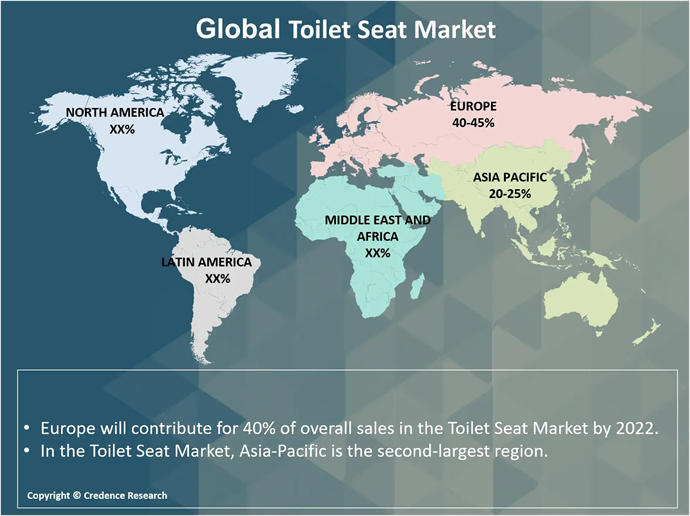
Europe is the largest shareholder in the worldwide toilet shower seat market, and it is predicted to rise at a CAGR of 4.4% during the forecast period. Europe is known for its technological advancements, which have allowed it to capture a substantial portion of the global toilet seat shower market. Many residents value health and hygiene, especially in the United Kingdom, France, and Germany. They choose to utilize a toilet seat developed with cutting-edge technology that can be used without touching. In recent years, customers in the United Kingdom, Italy, France, and Germany have spent more per person on healthy and clean items, propelling the worldwide toilet seat shower market.
During the forecast period, Asia-Pacific is the market's second-largest region. In Asia-Pacific, few individuals utilize toilet seats with advanced technology. In Asia and the Pacific, high-tech toilet seats are uncommon. However, the region has the fastest-growing construction sector, the largest rate of urbanization, the most rapidly evolving style of life, and the highest level of awareness of the importance of excellent hygiene. The region also contains the highest proportion of middle-class people, who spend a lot of money to improve their lives. The use of modern technologies has skyrocketed in countries such as China and India, boosting the worldwide toilet shower seat industry.
Key Highlights of the Report
The global Toilet Seat Market is segmented by Material Type, Toilet Type, Toilet Shape and Size, Features and Technology, End User, Sales Channel and region. In 2022, plastic toilet seats will be the market leader. Also, Child and Family Toilet Seats are the fastest-growing section of the toilet seat industry, while Commercial and Institutional Buyers have a higher Compound Annual Growth Rate (CAGR). Also, Standard Toilet Seats are in high demand on the market, with Europe leading the market growth.
Increasing awareness of hygiene and sanitation practices, Technological advancements leading to innovative and smart toilet seat solutions and Growing demand for eco-friendly and sustainable toilet seat materials are the key drivers of the market. Moreoevr, High initial costs associated with advanced toilet seat technologies, Limited adoption in certain regions due to cultural preferences and habits and Challenges in retrofitting existing toilets with new toilet seat designs are the key restraints of the market.
Nonetheless, Europe holds the greatest share of the global toilet shower seat market, during the projected period. Europe is known for its technological breakthroughs, which have enabled it to take a sizable share of the global toilet seat shower market. Furthermore, Asia-Pacific is the market's second-largest region during the forecast period. Few people in Asia-Pacific use high technology toilet seats. High-tech toilet seats are unusual in Asia and the Pacific.
What Elements Are Driving the Global Market for Toilet Seat?
A key driver in the Toilet Seat Market is increased awareness of cleanliness and sanitation practices. People are becoming more mindful of keeping their bathrooms clean, which is increasing demand for toilet seats with increased hygienic features and easy cleaning alternatives. Furthermore, technological improvements have paved the way for novel and smart toilet seat solutions like self-cleaning seats and touchless controls, which contribute to market growth. Furthermore, as consumers seek ecologically aware solutions for their bathroom fixtures, there is an increasing need for eco-friendly and sustainable toilet seat materials.
What Are The Main Obstacles That The Global Toilet Seat Market Faces?
While the Toilet Seat Market is expanding, there are some factors to consider. The high initial costs associated with new toilet seat technologies are one of the constraints. These novel features and smart functionalities are frequently more expensive, which limits their acceptance in specific market sectors. Furthermore, cultural preferences and behaviours in different countries can influence the acceptance and implementation of innovative toilet seat designs. Some regions may have distinct preferences or historic customs that make general adoption of certain toilet seat characteristics difficult. Furthermore, converting existing toilets with new toilet seat designs might be difficult due to compatibility and installation concerns.
What Market Development Prospects Are There For Toilet Seat Globally?
The Toilet Seat Market offers numerous chances for expansion and development. The growing desire for improved comfort and convenience in bathroom fixtures is an opportunity for manufacturers to provide new and ergonomic designs that prioritize user comfort. Furthermore, as developing economies' living standards improve, there is potential for market expansion in these regions. The increased emphasis on accessible and inclusive designs provides an opportunity for manufacturers to create toilet seats that meet the needs of individuals with disabilities, ensuring that everyone has equal access to restroom facilities.
Market Drivers
The global Toilet Seat Market is driven by several factors. The following are the key drivers of the global Toilet Seat Market:
Increased Usage Of Antimicrobial Materials
The increased usage of antimicrobial materials is driving the global market expansion for self-lifting toilet seats. Although commercial end users are the principal purchasers of these products, residential end users are projected to generate significant demand in the near future. These toilet seats include a hydraulic lift mechanism built into the base that allows the seat to rise automatically before use and fall automatically after use. This system uses spring-loaded hinges to gently raise and lower the seat on demand, and it is activated by just pressing down on the seat. During the forecast period, these attributes will contribute to market expansion.
Market Restraints
The global Toilet Seat Market faces some challenges that may hinder its growth. These include the following:
High Cost Of Smart Toilets Over Standard Toilets
Smart toilets are more expensive than ordinary toilets. This is because smart toilets need a variety of pricey components and incur significant implementation costs, raising the overall price of the device. These constraints significantly limit the industry's total growth. Additionally, the rate of expansion of the smart toilet seat market is projected to be restricted by consumers' preference for conventional toilet seats over smart toilet seats.
Furthermore, the vast number of hygienic ware product makers is expected to stymie the market's overall expansion.
High Costs of Advanced Sanitary Accessories
Consumers worldwide are price concerned and are hesitant to accept shower toilets that are much more expensive than the ordinary model. Furthermore, automatic toilets can raise their overall electricity use, increasing prices even further. As a result, most consumers opt for the conventional toilet seat, which allows them to save money.
Most consumers refuse to acquire this product, even if they can afford it, since they are terrified of being shocked by electricity and the damage that could ensue from such an incidence, which diminishes demand for the goods.
Opportunities
The global Toilet Seat Market offers significant growth opportunities. These include the following:
Increasing Research and Development Investments to Ensure Product Safety
The price of a conventional toilet is significantly lower than the price of a model with a shower. The biggest contributions to the product's high price are the materials and components utilized to produce these toilet seats. Despite the fact that technology advancements have allowed for some price reductions on these toilet seats, the bulk of people still cannot afford them.
To reduce this concern and increase acceptance, market participants could invest in research and development operations to build a cost-effective product within the price range of the target population. Many clients are concerned about their safety, as well as the cost. Because these toilet seats are powered by electricity, any malfunction or improper use could cause harm to both the device and the person using it.
Competitive Landscape
Key Players
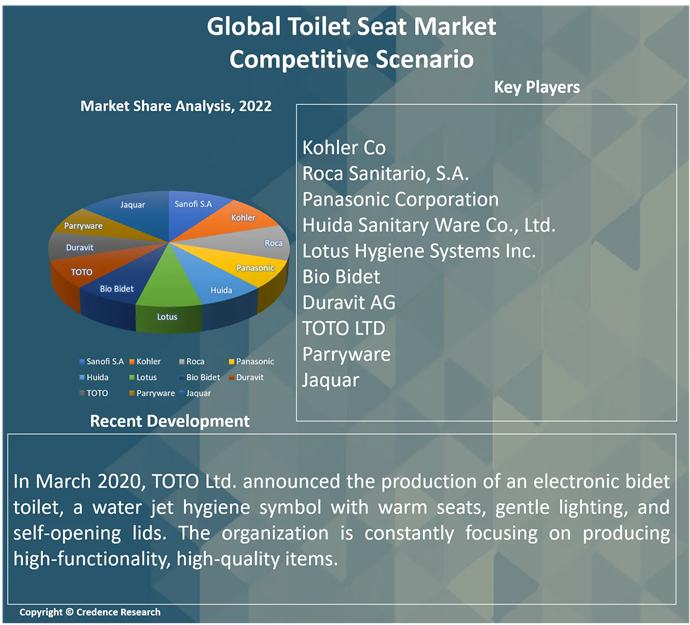
The global Toilet Seat Market is highly competitive, with several key players. Some of the major players in the market and their market share are as follows:
- Kohler Co
- Roca Sanitario, S.A.
- Panasonic Corporation
- Huida Sanitary Ware Co., Ltd.
- Lotus Hygiene Systems Inc.
- Bio Bidet
- Duravit AG
- TOTO LTD
- Parryware
- Jaquar.
These organizations prioritize product innovation, Disease Area expansion, and mergers and acquisitions to stay competitive.
The global Toilet Seat Market's key players continually seek to stay ahead by offering new Material Types and developments.
In January 2021, Kohler Co., an American maker of faucets, bathroom furnishings, bathroom sinks, bathing, toilets, and accessories, introduced four new products at virtual CES. Among the new additions to the company's smart home portfolio that focus on personal well-being are the Stillness bath, inherent intelligent toilet, touchless bathroom faucet collection, Kohler entire home water monitor, and Pro version..
In January 20221, At CES, Toto, a Japanese manufacturer of high-end bathroom items and smart toilets, displayed its high-tech smart toilet commode. Its technology will be accessible in more cheap models this year. Toto's new smart toilets are less likely to create sticker shock. At CES 2021, Toto also debuted the Toto Wellness Toilet, a smart toilet that analyzes waste to determine its health state.
In July 2023, Bemis Manufacturing Company intends to debut their new Assist premium toilet seat at the KBIS Show in Las Vegas in 2023. The standard height plastic seat has two built-in support arms, which eliminates the need for wall-mounted brackets. It is designed to accommodate both round and elongated toilet bowls and includes Bemis' Commercial STAY TITE Installation Svstem for a secure fit.
Summary of Key Findings
- The growing use of antimicrobial materials is propelling the global market forward.
- Market segmented by Material Type, Toilet Type, Toilet Shape and Size, Features and Technology, End User, Sales Channel and region
- Residential consumers have a larger need for toilet seats
- Plastic toilet seats are the market leader
- Europe is leading market growth; the market is highly competitive with key players including Kohler Co; Roca Sanitario, S.A.; Panasonic Corporation; Huida Sanitary Ware Co., Ltd.; Lotus Hygiene Systems Inc.; Bio Bidet; Duravit AG; TOTO LTD, Parryware; Jaquar
Future Outlook
- Increasing demand for smart toilet seats with advanced features
- Growing focus on eco-friendly and sustainable toilet seat materials
- Rising adoption of bidet toilet seats for enhanced hygiene
- Technological advancements leading to automated and self-cleaning toilet seats
- Expansion of the market in emerging economies with improving sanitation infrastructure.
Segmentation
By Material Type:
- Plastic Toilet Seats
- Wooden Toilet Seats
- Composite Toilet Seats
- Soft-Close Toilet Seats
- Padded Toilet Seats
- Bidet Toilet Seats
- Heated Toilet Seats
By Toilet Type:
- Residential Toilet Seats
- Commercial Toilet Seats
- Institutional Toilet Seats
- RV and Marine Toilet Seats
By Toilet Shape and Size:
- Round Toilet Seats
- Elongated Toilet Seats
- Compact Toilet Seats
- Child and Family Toilet Seats
By Features and Technology:
- Standard Toilet Seats
- Smart Toilet Seats
- Hygienic Toilet Seats
- DIY Toilet Seats
By End User:
- Residential Consumers
- Commercial and Institutional Buyers
- RV and Marine Owners
- Home Improvement and Construction
By Sales Channel:
- Retail Stores
- Online Retail
- Direct from Manufacturers
- Wholesale and B2B
- By Region
- North America
- U.S
- Canada
- Mexico
- Europe
- Germany
- France
- U.K.
- Italy
- Spain
- Rest of Europe
- Asia Pacific
- China
- Japan
- India
- South Korea
- South-east Asia
- Rest of Asia Pacific
- Latin America
- Brazil
- Argentina
- Rest of Latin America
- Middle East & Africa
- GCC Countries
- South Africa
- Rest of Middle East and Africa
- North America
Adjacent Markets
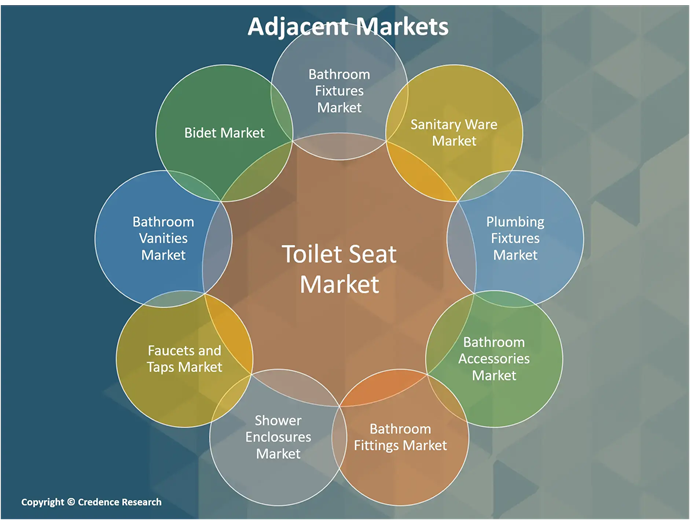
In the Toilet Seat Market, there are several adjacent markets which has high revenue growth opportunities. The key adjacent markets for Toilet Seat Market-
Request a Free Sample
Fill in your details and we'll send you a free sample report.
- Sample data tables & charts
- Research methodology
Need a Custom Version of This Report?
Tailor the scope, geography, or segments to your exact requirements.
- Custom geography or segment scope
- Direct access to our analyst team
Frequently Asked Questions
What is the current Material Type of the worldwide Toilet Seat Market?
What is the predicted growth rate of the Toilet Seat Market between 2023 and 2030?
Which segment has the most market share in terms of material type?
Which end-user segment governs the market demand for Toilet Seat?
Which Toilet shape and size segment is predicted to grow at the fastest growing segment over the forecast period?
Which region is driving the Toilet Seat industry forward?
Who are the major players in the global Toilet Seat Market?
What are the major market drivers of the Toilet Seat industry?
What are the major market restraints of the Toilet Seat industry?
What are the major market opportunities of the Toilet Seat industry?
Table of Content
Chapter 1. Report Introduction
- 1.1 Report Description & Purpose
- 1.1.1 Report Title & Market Definition
- 1.1.2 Unique Selling Propositions (USP) & Key Differentiators
- 1.1.3 Value Proposition for Stakeholders
- 1.2 Research Objectives
- 1.2.1 Market Sizing Objectives (Volume & Revenue) (Volume Where Applicable)
- 1.2.2 Segmentation Objectives
- 1.2.3 Competitive Intelligence Objectives
- 1.2.4 Forecast & Scenario Objectives
- 1.3 Report Scope
- 1.3.1 Toilet Seat Scope – Segments & Subsegments Covered
- 1.3.2 Geographic Scope – Regions & Countries Covered
- 1.3.3 Historical Period, Base Year & Forecast Period (the historical period; forecast to the forecast period)
- 1.3.4 Inclusions & Exclusions
- 1.4 Industry Classification & Applicable Codes
- 1.5 Currency, Measurement Units & Valuation Basis
- 1.6 Target Stakeholders
- 1.7 Limitations & Assumptions
Chapter 2. Executive Summary
- 2.1 Global Toilet Seat Market Snapshot
- 2.1.1 Market Size – Historical (the historical period) & Forecast (the forecast period) (base year: NULL → forecast year: NULL)
- 2.1.2 Volume & Revenue – Global Totals (Volume Where Applicable)
- 2.1.3 Key Market Highlights – Top Five Facts
- 2.2 Toilet Seat Market Segmentation Snapshot
- 2.2.1 Market Split by Region – vs.
- 2.3 Competitive Snapshot
- 2.3.1 Top 10 Players by Revenue Share –
- 2.3.2 Top 10 Players by Volume Share – (Volume Where Applicable)
- 2.3.3 Recent Strategic Developments (18-Month Summary)
- 2.4 Key Investment Highlights & Strategic Conclusions
Chapter 3. Toilet Seat Market Dynamics & Industry Analysis
- 3.1 Market Overview & Context
- 3.1.1 Toilet Seat Market Position in the Broader Industry Value Chain
- 3.1.2 Demand Structure & Purchasing Dynamics
- 3.1.3 Market Maturity & Development Stage by Region
- 3.2 Toilet Seat Market Drivers
- 3.3 Toilet Seat Market Restraints & Challenges
- 3.4 Toilet Seat Market Opportunities
- 3.5 Porter's Five Forces Analysis
- 3.5.1 Threat of New Entrants
- 3.5.2 Bargaining Power of Suppliers
- 3.5.3 Bargaining Power of Buyers
- 3.5.4 Threat of Substitutes
- 3.5.5 Competitive Rivalry – Intensity Assessment
- 3.6 Toilet Seat Value Chain Analysis
- 3.6.1 Upstream – Key Inputs, Resources & Suppliers
- 3.6.1.1 Key Input/Resource 1
- 3.6.1.2 Key Input/Resource 2
- 3.6.1.3 Key Input/Resource 3
- 3.6.2 Midstream – Core Operations & Value Creation
- 3.6.2.1 Operating Model & Process Overview
- 3.6.2.2 Key Operating Locations & Capabilities by Company
- 3.6.3 Downstream – Market Channels & End Users
- 3.6.3.1 Direct Sales & Customer Engagement Channels
- 3.6.3.2 Indirect Sales, Intermediaries & Partner Channels
- 3.6.4 Value Chain Profitability Analysis
- 3.6.1 Upstream – Key Inputs, Resources & Suppliers
- 3.7 PESTEL Analysis
- 3.7.1 Political Factors
- 3.7.2 Economic Factors
- 3.7.3 Social Factors
- 3.7.4 Technological Factors
- 3.7.5 Environmental Factors
- 3.7.6 Legal Factors
- 3.8 Toilet Seat Supply Chain Analysis
- 3.8.1 Critical Input & Resource Availability Risk Assessment
- 3.8.2 Supplier & Operational Concentration Risk (Geographic Exposure)
- 3.8.3 Supply & Service Disruption Impact Analysis
- 3.9 Regulatory & Policy Landscape
Note: The regulatory and policy landscape section covers regulations based on their applicability to the market, Toilet Seat category, geography, and scope of the study. Only regulatory frameworks with a material impact on operations, compliance, trade, sustainability, or market access are analyzed in detail.
Chapter 4. Key Investment Pockets & Opportunity Analysis
- 4.1 Toilet Seat Market Attractiveness Analysis
- 4.1.1 By Region – Investment Attractiveness Matrix (Market Size × CAGR)
- 4.2 Absolute Revenue Growth Opportunity
- 4.2.1 By Region – Absolute Revenue Growth Through the forecast period
- 4.3 Incremental Demand Opportunity
- 4.3.1 By Region – Incremental Demand Through the forecast period
- 4.3.2 Segment – Incremental Demand
- 4.4 Emerging Submarket Opportunity Deep Dive (Subject to Applicability)
- 4.5 Priority Market Opportunity Scorecards
- 4.5.1 United States
- 4.5.2 Europe
- 4.5.3 Asia
- 4.5.4 Middle East & Africa
Note: Priority market opportunity scorecards reflect the geographic scope and strategic relevance of the study. Listed markets are indicative and may be adapted to the industry.
Chapter 5. Toilet Seat Cross-Border Trade & Market Access Analysis
- 5.1 International Trade & Cross-Border Activity Overview
- 5.1.1 Global Export Value by Country (the historical period)
- 5.1.2 Global Export Volume by Country (the historical period) (Volume Where Applicable)
- 5.1.3 Global Import Value by Country (the historical period)
- 5.1.4 Global Import Volume by Country (the historical period) (Volume Where Applicable)
- 5.1.5 Net Trade Balance by Country (the historical period)
- 5.2 Export Analysis – Segment
- 5.2.1 Category 1 (Applicable Classification Code)
- 5.2.2 Category 2 (Applicable Classification Code)
- 5.2.3 Category 3 (Applicable Classification Code)
- 5.2.4 Category 4 (Applicable Classification Code)
- 5.2.5 Category 5 (Applicable Classification Code)
- 5.3 Import Analysis – Segment
- 5.3.1 Category 1 (Applicable Classification Code)
- 5.3.2 Category 2 (Applicable Classification Code)
- 5.3.3 Category 3 (Applicable Classification Code)
- 5.3.4 Category 4 (Applicable Classification Code)
- 5.3.5 Category 5 (Applicable Classification Code)
- 5.4 Cross-Border Pricing & Transaction Benchmarks
- 5.4.1 Export Pricing – Segment & Country
- 5.4.2 Import Pricing – Segment & Source Country
- 5.4.3 Price Trends (the historical period)
- 5.5 Key Cross-Border Trade & Delivery Routes
- 5.5.1 Cross-Border Trade/Delivery Route 1
- 5.5.2 Cross-Border Trade/Delivery Route 2
- 5.5.3 Cross-Border Trade/Delivery Route 3
- 5.5.4 Cross-Border Trade/Delivery Route 4
- 5.5.5 Cross-Border Trade/Delivery Route 5
- 5.6 Trade Policy & Market Access Impact Assessment
- 5.6.1 Tariff & Non-Tariff Barriers
- 5.6.2 Regional Trade & Economic Integration Frameworks
- 5.6.3 Bilateral & Multilateral Trade Agreements
- 5.6.4 Cross-Border Operating, Licensing & Localization Requirements
Note: This chapter applies where cross-border trade or delivery is relevant to Toilet Seat. Goods, services, and digital offerings are assessed using applicable classifications and transaction measures. Import-export volumes, trade balances, and route analyses are included only where meaningful to the market.
Chapter 6. Competitive Landscape & Company Benchmarking
- 6.1 Toilet Seat Market Concentration & Structure
- 6.1.1 Herfindahl-Hirschman Index (HHI) – vs.
- 6.1.2 Leading, Mid-Sized & Emerging Player Structure
- 6.1.3 Global, Regional & Local Player Dynamics
- 6.2 Toilet Seat Market Share Analysis –
- 6.2.1 Global Revenue Share by Company
- 6.2.2 Global Volume Share by Company (Volume Where Applicable)
- 6.2.3 Regional Revenue Share
- 6.2.4 Market Share Evolution ( vs. )
- 6.2.5 Company Market Share by Key Segment
- 6.2.6 Company Market Share by Customer Group
- 6.3 Operating Scale, Capacity & Infrastructure Analysis
- 6.3.1 Global Operating Scale & Supply Capacity
- 6.3.2 Resource Utilization & Operating Efficiency
- 6.3.3 Output, Service Delivery & Activity Metrics
- 6.3.4 Operating Footprint & Infrastructure Map
- 6.3.5 Planned Operational & Capacity Expansion
- 6.4 Toilet Seat Competitive Benchmarking Matrix
- 6.4.1 Revenue, Growth, Profitability & Operating Metric Comparison
- 6.4.2 Channel Revenue Mix
- 6.4.3 Geographic Revenue Exposure
- 6.4.4 R&D Intensity
- 6.4.5 Sustainability Maturity
- 6.5 Strategic Developments in Toilet Seat (Last 24 Months)
- 6.5.1 Mergers, Acquisitions & Divestments
- 6.5.2 New Products, Services & Solutions in Toilet Seat
- 6.5.3 Operational & Infrastructure Expansions
- 6.5.4 Strategic Alliances, Joint Ventures & Partnerships
- 6.5.5 Distribution Expansion & Market Entry
- 6.5.6 Sustainability & ESG Initiatives
- 6.6 Competitive Strategy Mapping
- 6.6.1 Leader, Challenger, Follower & Niche Classification
- 6.6.2 Pricing Strategy Comparison
- 6.6.3 Channel Strategy Matrix
Note: Strategic developments are included based on their materiality and the availability of reliable information.
Chapter 7. Global Toilet Seat Market – By Sales & Delivery Channel
- 7.1 Segment Overview
- 7.1.1 Volume & Revenue Split by Channel ( & ) (Volume Where Applicable)
- 7.1.2 Channel Mix Evolution (the forecast period)
Chapter 8. Regional Market Analysis – Global Overview
- 8.1 Global Regional Overview
- 8.1.1 Regional Volume Share (Volume Where Applicable)
- 8.1.2 Regional Revenue Share
- 8.1.3 Regional Volume by Region (Volume Where Applicable)
- 8.1.4 Regional Revenue by Region
- 8.1.5 Regional Forecast Through the forecast period
- 8.2 Cross-Regional Segment Analysis
- 8.2.1 By Sales & Delivery Channel
- 8.2.2 By Competitive Positioning & Price Tier
Chapter 9. North America Toilet Seat Market
- 9.1 United States
- 9.2 Canada
- 9.3 Mexico
Chapter 10. Europe Toilet Seat Market
- 10.1 Germany
- 10.2 France
- 10.3 Italy
- 10.4 United Kingdom
- 10.5 Spain
- 10.6 Poland
- 10.7 Russia
- 10.8 Netherlands
- 10.9 Belgium
- 10.10 Sweden
- 10.11 Denmark
- 10.12 Norway
- 10.13 Rest of Europe
Chapter 11. Asia Pacific Toilet Seat Market
- 11.1 China
- 11.2 India
- 11.3 Japan
- 11.4 South Korea
- 11.5 Thailand
- 11.6 Indonesia
- 11.7 Vietnam
- 11.8 Malaysia
- 11.9 Australia
- 11.10 Rest of Asia Pacific
Chapter 12. Latin America Toilet Seat Market
- 12.1 Brazil
- 12.2 Argentina
- 12.3 Colombia
- 12.4 Chile
- 12.5 Rest of Latin America
Chapter 13. Middle East Toilet Seat Market
- 13.1 Saudi Arabia
- 13.2 United Arab Emirates
- 13.3 Turkey
- 13.4 Israel
- 13.5 Iran
- 13.6 Rest of the Middle East
Chapter 14. Africa Toilet Seat Market
- 14.1 South Africa
- 14.2 Egypt
- 14.3 Nigeria
- 14.4 Morocco
- 14.5 Rest of Africa
Chapter 15. Toilet Seat Company Profiles
- 15.1 [Company 01]
- 15.1.1 Company Overview
- 15.1.2 Key Management Personnel
- 15.1.3 Products & Services Portfolio
- 15.1.4 Financial Performance
- 15.1.5 Key Market Focus & Geographic Presence
- 15.1.6 Recent Developments & Strategic Initiatives
Note: The company profile list is preliminary and may change based on research findings, market developments, data availability, and client requirements.
Chapter 16. Appendices
- Appendix A – List of Abbreviations & Acronyms
- Appendix B – Industry Classification Code Reference – Full Series
- Appendix C – Supply, Output & Operating Capacity Data Tables
- Appendix D – End-Use & Demand Base Tables
- Appendix E – Demand, Adoption & Usage Assumptions
- Appendix F – Pricing & Revenue Metric Reference Tables
- Appendix G – Company Operations & Infrastructure Database
- Appendix H – Cross-Border Trade & Activity Data Tables (Where Applicable)
- Appendix I – Regulatory Summary Tables
- Appendix J – Primary Research Participant List (Anonymized)
- Appendix K – Primary Research Questionnaire Framework
- Appendix L – Data Sources & Bibliography
- Appendix M – Market Size Divergence & Source Comparison
Chapter 17. Research Methodology
- 17.1 Research Framework & Philosophy
- 17.2 Secondary Research – Sources, Hierarchy & Data Extraction
- 17.3 Data Modeling – Bottom-Up & Top-Down Market Sizing
- 17.4 Primary Research – Stakeholder Framework, LOI & Sample Sizes
- 17.5 Forecast Methodology – Regression, Scenario & Sensitivity Analysis
- 17.6 Quality Control – Four-Layer Validation Framework
- 17.7 Limitations & Standard Assumptions
- 17.8 Disclaimer
