
Market Overview
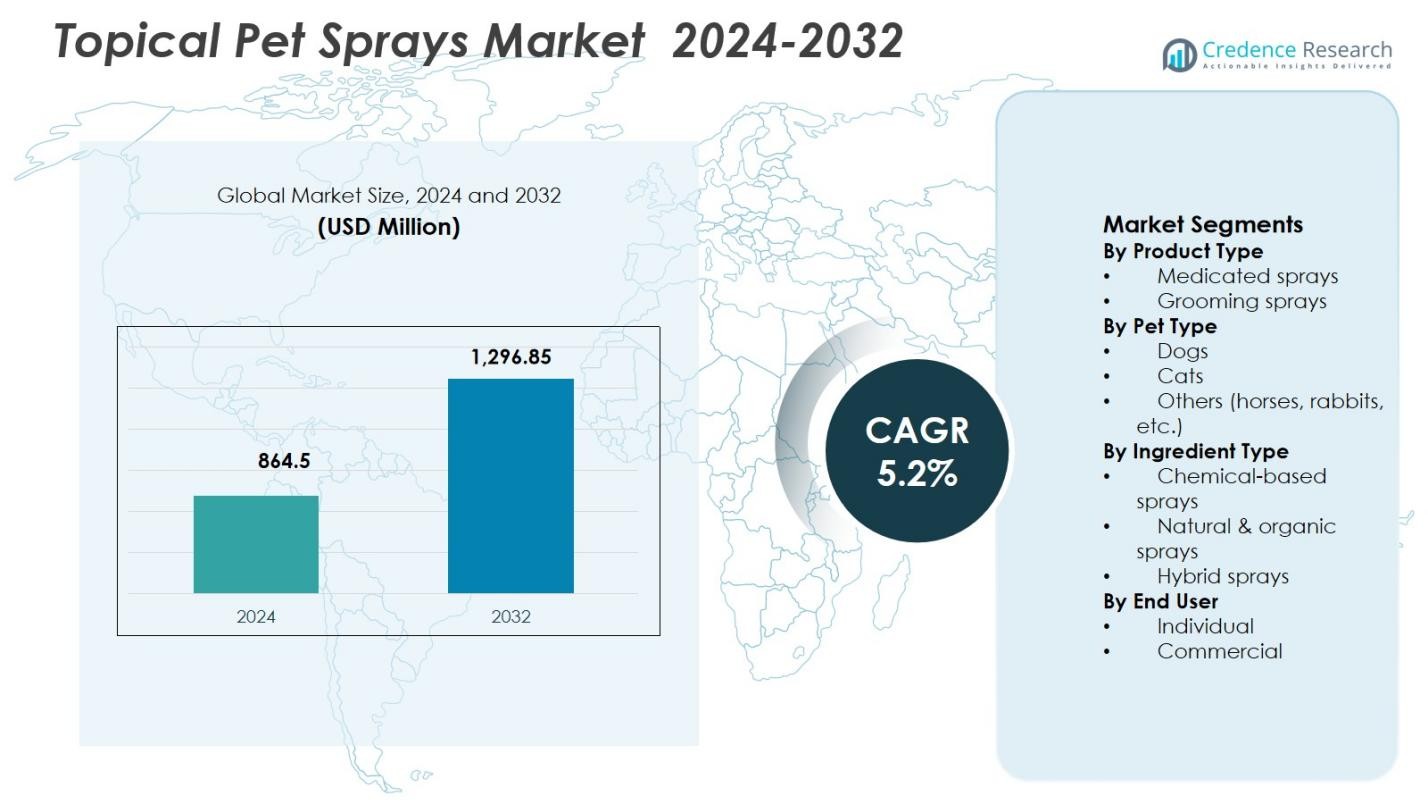
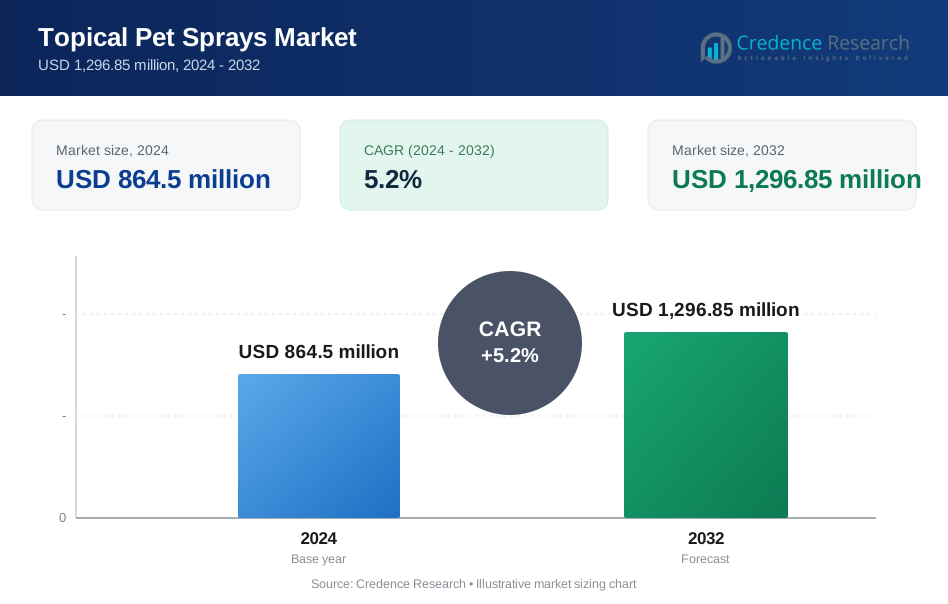
Topical Pet Sprays Market size was valued at USD 864.5 million in 2024 and is anticipated to reach USD 1,296.85 million by 2032, growing at a CAGR of 5.2% during the forecast period.
| REPORT ATTRIBUTE | DETAILS |
|---|---|
| Historical Period | 2020-2023 |
| Base Year | 2024 |
| Forecast Period | 2025-2032 |
| Topical Pet Sprays Market Size 2024 | USD 864.5 Million |
| Topical Pet Sprays Market, CAGR | 5.2% |
| Topical Pet Sprays Market Size 2032 | USD 1,296.85 Million |
Topical Pet Sprays Market is shaped by the strong presence of established pet care and animal health companies such as Bayer, Elanco Animal Health, Mars, Nestlé Purina PetCare, Hill’s Pet Nutrition, Cardinal Pet Care, Davis Manufacturing, Earthbath, Pet King, and PetArmor. These players focus on diversified product portfolios covering medicated, grooming, and preventive spray solutions, supported by veterinary endorsements and expanding omnichannel distribution networks. Continuous innovation in natural, hypoallergenic, and multi-functional formulations strengthens brand positioning and consumer trust. North America led the market with a 38.2% share in 2024, driven by high pet ownership, advanced veterinary infrastructure, and strong spending on premium pet healthcare products, followed by Europe and Asia Pacific, which benefit from rising preventive care awareness and expanding pet care ecosystems.
Market Insights
- The Topical Pet Sprays Market was valued at USD 864.5 million in 2024 and is projected to grow at a CAGR of 5.2% through the forecast period, supported by steady demand across medicated and grooming applications.
- Rising incidence of pet skin disorders and increasing pet humanization are driving higher adoption, with medicated sprays leading the market at 48.6% segment share due to strong veterinary recommendation.
- Growing preference for natural and organic formulations represents a key trend, with this segment holding 37.5% share as consumers seek safer, hypoallergenic pet care solutions.
- Product differentiation and brand strength define market dynamics, while regulatory compliance requirements and price sensitivity in emerging economies act as key restraints.
- North America dominated with 38.2% regional share, followed by Europe at 27.4% and Asia Pacific at 22.6%, reflecting advanced veterinary infrastructure and rising pet care awareness across regions.
Market Segmentation Analysis:
By Product Type:
The Topical Pet Sprays Market by product type shows clear dominance of medicated sprays, which accounted for 48.6% market share in 2024, driven by rising incidence of skin infections, allergies, flea infestations, and dermatitis among companion animals. Veterinarians widely recommend medicated sprays for targeted treatment, quick relief, and ease of topical application, supporting higher adoption. Grooming sprays followed with 34.1% share, supported by growing pet hygiene awareness and premium grooming trends, while functional grooming products addressing odor control and coat conditioning sustained demand across urban pet owners.
- For instance, Vetoquinol's Dermichlor Spray treats bacterial skin infections and fungal issues like ringworm in dogs and cats through targeted application, reducing itching and promoting healing.
By Pet Type:
By pet type, dogs dominated the market with a 62.4% share in 2024, reflecting higher global dog ownership, frequent outdoor exposure, and greater susceptibility to ticks, fleas, and skin disorders. Regular grooming routines and preventive care practices among dog owners significantly supported spray usage. Cats accounted for 28.7% share, driven by increasing indoor pet adoption and demand for stress-free, non-invasive care solutions. Other pets, including horses and rabbits, represented 8.9% share, supported by niche veterinary applications and expanding awareness of topical care in specialty animal segments.
- For instance, Zoetis's Revolution, approved for rabbits, treats fleas across life stages plus mites and lice in a monthly top-spot application that's waterproof after two hours.
By Ingredient Type:
In terms of ingredient type, chemical-based sprays led with a 44.8% market share in 2024, supported by their proven efficacy, fast action, and strong veterinary acceptance for therapeutic treatments. However, natural & organic sprays captured 37.5% share, driven by rising consumer preference for plant-based, toxin-free, and hypoallergenic formulations aligned with premium pet care trends. Hybrid sprays held 17.7% share, benefiting from balanced formulations that combine clinical effectiveness with perceived safety, appealing to pet owners seeking both performance and reduced chemical exposure in routine applications.
Key Growth Drivers
Rising Incidence of Pet Skin Disorders
The growing prevalence of skin-related conditions such as allergies, flea infestations, dermatitis, and fungal infections among companion animals is a primary growth driver for the Topical Pet Sprays Market. Environmental allergens, climate changes, and increased outdoor exposure have heightened dermatological issues, particularly in dogs and cats. Pet owners increasingly prefer topical sprays for their targeted application, fast relief, and non-invasive nature. Strong veterinary recommendations further support routine use of medicated and preventive sprays, reinforcing consistent demand across therapeutic and grooming applications.
- For instance, Zoetis Pet Derm Spray treats seborrheic dermatitis, dermatophyte infections, and ringworm in dogs and cats with miconazole nitrate and chlorhexidine gluconate.
Increasing Pet Humanization and Preventive Care Focus
Pet humanization continues to influence purchasing behavior, with owners prioritizing comfort, hygiene, and long-term wellness. This shift has elevated spending on advanced grooming and healthcare products, including topical pet sprays. Preventive care awareness has increased the adoption of anti-itch, deodorizing, and coat-conditioning sprays as part of regular pet care routines. Educational campaigns by veterinarians and pet care brands have strengthened understanding of skin health maintenance, encouraging proactive use of sprays to prevent infections and improve overall pet well-being.
- For instance, Petvit's Anti-Itch Oil Spray delivers fast relief from itching and redness via pH-balanced, lick-safe elements including Vitamin E, Lavender Oil, and Castor Oil for all dog and cat breeds. Its vegan, toxin-free blend soothes irritation on contact, enabling safe repeated use.
Expansion of Veterinary and Specialty Pet Care Infrastructure
The expanding network of veterinary clinics, pet hospitals, and specialty pet care retail outlets significantly supports market growth. These professional channels actively recommend clinically validated topical sprays as part of standard treatment and grooming protocols. Improved access to veterinary guidance has increased consumer trust in branded products. Additionally, the growth of organized pet retail chains has enhanced product visibility and availability, supporting higher adoption rates in urban and semi-urban regions.
Key Trends & Opportunities
Shift Toward Natural and Organic Pet Care Solutions
Rising concerns over chemical exposure have accelerated the shift toward natural and organic topical pet sprays. Consumers increasingly favor formulations free from harsh chemicals, parabens, and synthetic fragrances. Manufacturers are responding with plant-based, essential-oil-infused, and hypoallergenic products that align with wellness-oriented pet care trends. This shift creates opportunities for premium product positioning, brand differentiation, and expansion into high-margin segments driven by safety-conscious and environmentally aware pet owners.
- For instance, Coco Crush provides a natural Flea & Tick Repellent Spray using neem oil, lemongrass oil, and tea tree oil as key ingredients. This 100% natural, vegan formula creates a gentle barrier against pests without artificial colors or flavors.
Rapid Growth of E-commerce and Direct-to-Consumer Channels
- commerce platforms are transforming product accessibility and purchasing behavior in the topical pet sprays market. Online channels enable wider reach, subscription-based sales, and personalized product recommendations. Digital platforms also support consumer education through reviews, tutorials, and condition-specific guidance. This trend presents strong opportunities for manufacturers to engage directly with customers, improve brand loyalty, and penetrate underserved regions with lower distribution costs.
- For instance, VetBox offers monthly subscriptions for flea and tick spot-on treatments containing Fipronil and S-Methoprene, delivered automatically with treats included.
Key Challenges
Stringent Regulatory and Compliance Requirements
The topical pet sprays market faces challenges related to strict regulatory standards governing animal health products. Compliance with ingredient safety, efficacy testing, and labeling regulations increases development timelines and costs. Heightened scrutiny of chemical formulations further complicates product innovation. Manufacturers must continuously adapt formulations to meet evolving regulations, which can delay product launches and limit flexibility, particularly for smaller or emerging players.
Price Sensitivity and Limited Adoption in Emerging Economies
Price sensitivity among pet owners in emerging markets restricts the adoption of premium topical pet sprays. While awareness of pet healthcare is improving, cost remains a key purchasing factor. Branded medicated and natural sprays often face competition from low-cost alternatives and home remedies. This challenge requires manufacturers to balance affordability with quality, optimize pricing strategies, and develop value-oriented offerings to expand market penetration.
Regional Analysis
North America
North America held 38.2% market share in 2024, driven by high pet ownership rates, advanced veterinary infrastructure, and strong spending on premium pet healthcare products. The region benefits from widespread adoption of preventive grooming and medicated sprays, supported by strong veterinarian recommendations. Rising awareness of skin health, allergies, and parasite control has increased routine usage among dog and cat owners. Well-established pet specialty retail chains and e-commerce platforms further enhance product accessibility. The growing preference for natural and organic formulations also supports premium product penetration across the United States and Canada.
Europe
Europe accounted for 27.4% market share in 2024, supported by strict animal welfare standards and growing emphasis on preventive pet healthcare. Increasing demand for dermatologically tested and regulated topical sprays has driven adoption across key markets such as Germany, the United Kingdom, and France. High awareness of pet hygiene, along with rising preference for natural and eco-friendly formulations, supports market growth. Strong veterinary networks and expanding specialty pet stores enhance product availability. Regulatory compliance and ingredient transparency remain key factors influencing product development and purchasing decisions across the region.
Asia Pacific
Asia Pacific captured 22.6% market share in 2024, driven by rapidly increasing pet adoption, urbanization, and rising disposable income in countries such as China, Japan, and India. Growing awareness of pet grooming and skin care has accelerated demand for topical sprays, particularly for dogs. Expansion of organized pet retail, veterinary clinics, and online platforms has improved product accessibility. The region shows strong growth potential due to rising pet humanization trends and increasing demand for affordable yet effective grooming and medicated spray solutions across emerging markets.
Latin America
Latin America held 7.1% market share in 2024, supported by growing pet ownership and increasing focus on basic pet hygiene and healthcare. Countries such as Brazil and Mexico are witnessing higher adoption of topical pet sprays, driven by expanding veterinary services and improved awareness of flea and tick control. The market favors cost-effective and multifunctional products, with medicated and grooming sprays gaining steady traction. Growth of pet specialty retail stores and gradual expansion of e-commerce channels further support market development across urban centers.
Middle East & Africa
The Middle East & Africa region accounted for 4.7% market share in 2024, driven by rising pet adoption in urban areas and increasing awareness of pet grooming and skin health. Demand is primarily concentrated in countries such as the UAE and South Africa, where veterinary services and specialty pet retail infrastructure are expanding. Topical sprays are increasingly adopted for parasite control and basic grooming needs. Limited access to premium products and price sensitivity remain challenges, though growing investment in pet care services supports gradual market expansion.
Market Segmentations:
By Product Type
- Medicated sprays
- Grooming sprays
By Pet Type
- Dogs
- Cats
- Others (horses, rabbits, etc.)
By Ingredient Type
- Chemical-based sprays
- Natural & organic sprays
- Hybrid sprays
By End User
- Individual
- Commercial
By Geography
- North America
- U.S.
- Canada
- Mexico
- Europe
- Germany
- France
- U.K.
- Italy
- Spain
- Rest of Europe
- Asia Pacific
- China
- Japan
- India
- South Korea
- South-east Asia
- Rest of Asia Pacific
- Latin America
- Brazil
- Argentina
- Rest of Latin America
- Middle East & Africa
- GCC Countries
- South Africa
- Rest of the Middle East and Africa
Competitive Landscape
Competitive Landscape Analysis: The Topical Pet Sprays Market features the presence of key players including Bayer, Elanco Animal Health, Mars, Nestlé Purina PetCare, Hill’s Pet Nutrition, Cardinal Pet Care, Davis Manufacturing, Earthbath, Pet King, and PetArmor. The market is characterized by strong brand positioning, broad product portfolios, and a focus on differentiated formulations addressing medicated, grooming, and preventive care needs. Leading companies leverage veterinary endorsements, clinical validation, and established distribution networks across pet specialty stores, veterinary clinics, and online channels. Strategic emphasis on natural and organic ingredients, hypoallergenic formulations, and multi-functional sprays enhances product appeal among health-conscious pet owners. Companies actively pursue product line extensions, packaging innovations, and region-specific offerings to strengthen market presence. Competitive intensity remains moderate to high, driven by brand loyalty, regulatory compliance capabilities, and continuous investment in research, marketing, and omnichannel distribution strategies.
Key Player Analysis
- PetArmor
- Hill's Pet Nutrition
- Earthbath
- Mars
- Davis Manufacturing
- Nestlé Purina PetCare
- Pet King
- Elanco Animal Health
- Cardinal Pet Care
- Bayer
Recent Developments
- In September 2025, Nutravet launched Nutramed®, a hypochlorous gel and spray for animal skin care, targeting irritation and infections in pets.
- In May 2025, FurLife introduced FurLife™ Flea & Tick Spray, a plant-based topical solution safe for dogs and cats over 8 weeks old, forming a protective barrier against pests.
- In February 2025, Elanco Animal Health launched its new line of veterinarian-formulated pet supplements under the Pet Protect brand, enhancing its overall pet health portfolio.
- In October 2025, Mars Petcare, in collaboration with Big Idea Ventures, selected three startups for the 2025 Next Generation Pet Food Program, signaling broader innovation engagement in pet health.
Report Coverage
The research report offers an in-depth analysis based on Product Type, Pet Type, Ingredient Type, End User and Geography. It details leading market players, providing an overview of their business, product offerings, investments, revenue streams, and key applications. Additionally, the report includes insights into the competitive environment, SWOT analysis, current market trends, as well as the primary drivers and constraints. Furthermore, it discusses various factors that have driven market expansion in recent years. The report also explores market dynamics, regulatory scenarios, and technological advancements that are shaping the industry. It assesses the impact of external factors and global economic changes on market growth. Lastly, it provides strategic recommendations for new entrants and established companies to navigate the complexities of the market.
Future Outlook
- The market will continue to benefit from rising global pet ownership and increasing focus on companion animal skin health.
- Preventive care adoption will strengthen demand for daily-use grooming and protective topical sprays.
- Natural and organic formulations will gain stronger traction as safety and ingredient transparency influence purchasing decisions.
- Medicated sprays will remain essential for managing allergies, infections, and parasite-related skin conditions.
- Veterinary recommendation and clinical validation will play a critical role in shaping brand preference.
- E-commerce and direct-to-consumer channels will expand product reach and improve consumer engagement.
- Product innovation will focus on multi-functional sprays offering treatment, grooming, and odor control benefits.
- Emerging markets will experience faster adoption as awareness of pet hygiene and healthcare improves.
- Manufacturers will invest in sustainable packaging and eco-friendly formulations to align with evolving consumer expectations.
- Strategic partnerships and product line extensions will support long-term market expansion and competitiveness.
Request a Free Sample
Fill in your details and we'll send you a free sample report.
- Sample data tables & charts
- Research methodology
Need a Custom Version of This Report?
Tailor the scope, geography, or segments to your exact requirements.
- Custom geography or segment scope
- Direct access to our analyst team
Frequently Asked Questions
What is the current market size for Topical Pet Sprays Market, and what is its projected size in 2032?
At what Compound Annual Growth Rate is the Topical Pet Sprays Market projected to grow between 2024 and 2032?
Which Topical Pet Sprays Market segment held the largest share in 2024?
What are the primary factors fueling the growth of the Topical Pet Sprays Market?
Who are the leading companies in the Topical Pet Sprays Market?
Which region commanded the largest share of the Topical Pet Sprays Market in 2024?
Table of Content
Chapter 1. Report Introduction
- 1.1 Report Description & Purpose
- 1.1.1 Report Title & Market Definition
- 1.1.2 Unique Selling Propositions (USP) & Key Differentiators
- 1.1.3 Value Proposition for Stakeholders
- 1.2 Research Objectives
- 1.2.1 Market Sizing Objectives (Volume & Revenue)
- 1.2.2 Segmentation Objectives
- 1.2.3 Competitive Intelligence Objectives
- 1.2.4 Forecast & Scenario Objectives
- 1.3 Report Scope
- 1.3.1 Topical Pet Sprays Scope – Types & Subtypes Covered
- 1.3.2 Geographic Scope – Regions & Countries Covered
- 1.3.3 Historical Period, Base Year & Forecast Period (2024; forecast to 2032)
- 1.3.4 Inclusions & Exclusions
- 1.4 HS Code & Classification Framework
- 1.5 Currency, Units & Pricing Basis
- 1.6 Target Stakeholders
- 1.7 Limitations & Assumptions
Chapter 2. Executive Summary
- 2.1 Global Topical Pet Sprays Market Snapshot
- 2.1.1 Market Size – Historical (2024) & Forecast (2024-2032) (2024: USD 864.5 million → 2032: USD 1,296.85 million)
- 2.1.2 Volume & Revenue – Global Totals
- 2.1.3 Key Market Highlights – Top Five Facts
- 2.2 Topical Pet Sprays Market Segmentation Snapshot
- 2.2.1 Market Split by Region – 2024 vs. 2032
- 2.3 Competitive Snapshot
- 2.3.1 Top 10 Players by Revenue Share – 2024
- 2.3.2 Top 10 Players by Volume Share – 2024
- 2.3.3 Recent Strategic Developments (18-Month Summary)
- 2.4 Key Investment Highlights & Strategic Conclusions
Chapter 3. Topical Pet Sprays Market Dynamics & Industry Analysis
- 3.1 Market Overview & Context
- 3.1.1 Topical Pet Sprays Market Position in the Broader Automotive Value Chain
- 3.1.2 OEM vs. Replacement Market Dynamics
- 3.1.3 Market Maturity & Development Stage by Region
- 3.2 Topical Pet Sprays Market Drivers
- 3.3 Topical Pet Sprays Market Restraints & Challenges
- 3.4 Topical Pet Sprays Market Opportunities
- 3.5 Porter's Five Forces Analysis
- 3.5.1 Threat of New Entrants
- 3.5.2 Bargaining Power of Suppliers
- 3.5.3 Bargaining Power of Buyers
- 3.5.4 Threat of Substitutes
- 3.5.5 Competitive Rivalry – Intensity Assessment
- 3.6 Topical Pet Sprays Value Chain Analysis
- 3.6.1 Upstream – Raw Material/Input Suppliers
- 3.6.1.1 Raw Material/Input 1
- 3.6.1.2 Raw Material/Input 2
- 3.6.1.3 Raw Material/Input 3
- 3.6.2 Midstream – Production/Manufacturing/Service Delivery
- 3.6.2.1 Production/Process Overview
- 3.6.2.2 Key Facility Locations & Capacity by Manufacturer
- 3.6.3 Downstream – Distribution & End Consumer
- 3.6.3.1 Primary Channel – B2B/OEM
- 3.6.3.2 Secondary Channels – Dealer, Retail, Online, Direct
- 3.6.4 Value Chain Profitability Analysis
- 3.6.1 Upstream – Raw Material/Input Suppliers
- 3.7 PESTEL Analysis
- 3.7.1 Political Factors
- 3.7.2 Economic Factors
- 3.7.3 Social Factors
- 3.7.4 Technological Factors
- 3.7.5 Environmental Factors
- 3.7.6 Legal Factors
- 3.8 Topical Pet Sprays Supply Chain Analysis
- 3.8.1 Raw Material/Input Supply Risk Assessment
- 3.8.2 Manufacturing Concentration Risk (Geographic Exposure)
- 3.8.3 Trade Disruption Impact Analysis
- 3.9 Regulatory & Policy Landscape
Note: The regulatory and policy landscape section covers regulations based on their applicability to the market, Topical Pet Sprays category, geography, and scope of the study. Only regulatory frameworks with a material impact on operations, compliance, trade, sustainability, or market access are analyzed in detail.
Chapter 4. Key Investment Pockets & Opportunity Analysis
- 4.1 Topical Pet Sprays Market Attractiveness Analysis
- 4.1.1 By Region – Investment Attractiveness Matrix (Volume × CAGR)
- 4.2 Absolute Revenue Growth Opportunity
- 4.2.1 By Region – Absolute USD Growth Through 2032
- 4.3 Incremental Volume Opportunity
- 4.3.1 By Region – Incremental Volume Through 2032
- 4.3.2 Segment – Incremental Volume
- 4.4 Emerging Submarket Opportunity Deep Dive (Subject to Applicability)
- 4.5 Emerging Market Opportunity Scorecards
- 4.5.1 United States
- 4.5.2 Europe
- 4.5.3 Asia
- 4.5.4 Middle East & Africa
Note: Emerging Market Opportunity Scorecards will be included based on relevance and strategic importance. Regions listed are indicative and may vary depending on data availability and market dynamics.
Chapter 5. Topical Pet Sprays Import-Export Analysis & Trade Flows
- 5.1 Global Trade Overview
- 5.1.1 Global Export Value by Country (2024)
- 5.1.2 Global Export Volume by Country (2024)
- 5.1.3 Global Import Value by Country (2024)
- 5.1.4 Global Import Volume by Country (2024)
- 5.1.5 Net Trade Balance by Country (2024)
- 5.2 Export Analysis – Segment
- 5.2.1 Type 1 (HS Code)
- 5.2.2 Type 2 (HS Code)
- 5.2.3 Type 3 (HS Code)
- 5.2.4 Type 4 (HS Code)
- 5.2.5 Type 5 (HS Code)
- 5.3 Import Analysis – Segment
- 5.3.1 Type 1 (HS Code)
- 5.3.2 Type 2 (HS Code)
- 5.3.3 Type 3 (HS Code)
- 5.3.4 Type 4 (HS Code)
- 5.3.5 Type 5 (HS Code)
- 5.4 Average Unit Trade Prices
- 5.4.1 Average Export Price – Segment & Country
- 5.4.2 Average Import Price – Segment & Source Country
- 5.4.3 Price Trends (2024)
- 5.5 Key Trade Route Analysis
- 5.5.1 Trade Route 1
- 5.5.2 Trade Route 2
- 5.5.3 Trade Route 3
- 5.5.4 Trade Route 4
- 5.5.5 Trade Route 5
- 5.6 Trade Policy Impact Assessment
- 5.6.1 US Anti-Dumping & Section 301 Tariffs
- 5.6.2 EU Customs Union Impact
- 5.6.3 Major Free Trade Agreements
- 5.6.4 USMCA Rules of Origin
Note: Trade policy analysis will be included only where relevant to the Topical Pet Sprays market.
Chapter 6. Competitive Landscape & Company Benchmarking
- 6.1 Topical Pet Sprays Market Concentration & Structure
- 6.1.1 Herfindahl-Hirschman Index (HHI) – vs. 2024
- 6.1.2 Tier 1, Tier 2 & Tier 3 Market Structure
- 6.1.3 Global, Regional & Local Player Dynamics
- 6.2 Topical Pet Sprays Market Share Analysis – 2024
- 6.2.1 Global Revenue Share by Company
- 6.2.2 Global Volume Share by Company
- 6.2.3 Regional Revenue Share
- 6.2.4 Market Share Evolution ( vs. 2024)
- 6.2.5 OEM Segment Share by Company
- 6.2.6 Replacement Segment Share by Company
- 6.3 Production/Delivery Capacity & Facility Analysis
- 6.3.1 Global Installed Capacity
- 6.3.2 Capacity Utilization Rates
- 6.3.3 Production/Output Volume
- 6.3.4 Facility Locations & Capacity Map
- 6.3.5 Planned Capacity Additions
- 6.4 Topical Pet Sprays Competitive Benchmarking Matrix
- 6.4.1 Revenue, Volume, CAGR & Profitability Comparison
- 6.4.2 Channel Revenue Mix
- 6.4.3 Geographic Revenue Exposure
- 6.4.4 R&D Intensity
- 6.4.5 Sustainability Maturity
- 6.5 Strategic Developments in Topical Pet Sprays (Last 24 Months)
- 6.5.1 Mergers, Acquisitions & Divestments
- 6.5.2 New Topical Pet Sprays Launches
- 6.5.3 Facility Expansions
- 6.5.4 Strategic Alliances, Joint Ventures & Partnerships
- 6.5.5 Distribution Expansion & Market Entry
- 6.5.6 Sustainability & ESG Initiatives
- 6.6 Competitive Strategy Mapping
- 6.6.1 Leader, Challenger, Follower & Niche Classification
- 6.6.2 Pricing Strategy Comparison
- 6.6.3 Channel Strategy Matrix
Note: Strategic developments are included based on their materiality and the availability of reliable information.
Chapter 7. Global Topical Pet Sprays Market – By Distribution Channel
- 7.1 Segment Overview
- 7.1.1 Volume & Revenue Split by Channel (2024 & 2032)
- 7.1.2 Channel Mix Evolution (2024-2032)
Chapter 8. Regional Market Analysis – Global Overview
- 8.1 Global Regional Overview
- 8.1.1 Regional Volume Share
- 8.1.2 Regional Revenue Share
- 8.1.3 Regional Volume by Region
- 8.1.4 Regional Revenue by Region
- 8.1.5 Regional Forecast Through 2032
- 8.2 Cross-Regional Segment Analysis
- 8.2.1 By Distribution Channel
- 8.2.2 By Brand/Price Tier
Chapter 9. North America Topical Pet Sprays Market
- 9.1 United States
- 9.2 Canada
- 9.3 Mexico
Chapter 10. Europe Topical Pet Sprays Market
- 10.1 Germany
- 10.2 France
- 10.3 Italy
- 10.4 United Kingdom
- 10.5 Spain
- 10.6 Poland
- 10.7 Russia
- 10.8 Netherlands
- 10.9 Belgium
- 10.10 Sweden
- 10.11 Denmark
- 10.12 Norway
- 10.13 Rest of Europe
Chapter 11. Asia Pacific Topical Pet Sprays Market
- 11.1 China
- 11.2 India
- 11.3 Japan
- 11.4 South Korea
- 11.5 Thailand
- 11.6 Indonesia
- 11.7 Vietnam
- 11.8 Malaysia
- 11.9 Australia
- 11.10 Rest of Asia Pacific
Chapter 12. Latin America Topical Pet Sprays Market
- 12.1 Brazil
- 12.2 Argentina
- 12.3 Colombia
- 12.4 Chile
- 12.5 Rest of Latin America
Chapter 13. Middle East Topical Pet Sprays Market
- 13.1 Saudi Arabia
- 13.2 United Arab Emirates
- 13.3 Turkey
- 13.4 Israel
- 13.5 Iran
- 13.6 Rest of the Middle East
Chapter 14. Africa Topical Pet Sprays Market
- 14.1 South Africa
- 14.2 Egypt
- 14.3 Nigeria
- 14.4 Morocco
- 14.5 Rest of Africa
Chapter 15. Topical Pet Sprays Company Profiles
- 15.1 [Company 01]
- 15.1.1 Company Overview
- 15.1.2 Key Management Personnel
- 15.1.3 Products & Services Portfolio
- 15.1.4 Financial Performance
- 15.1.5 Key Market Focus & Geographic Presence
- 15.1.6 Recent Developments & Strategic Initiatives
Note: The company profile list is preliminary and may change based on research findings, market developments, data availability, and client requirements.
Chapter 16. Appendices
- Appendix A – List of Abbreviations & Acronyms
- Appendix B – Industry Classification Code Reference – Full Series
- Appendix C – Production & Capacity Data Tables
- Appendix D – End-Use & Demand Base Tables
- Appendix E – Consumption & Replacement Rate Assumptions
- Appendix F – ASP Reference Tables
- Appendix G – Manufacturing & Facility Database
- Appendix H – Import-Export Data Tables
- Appendix I – Regulatory Summary Tables
- Appendix J – Primary Research Participant List (Anonymized)
- Appendix K – Primary Research Questionnaire Framework
- Appendix L – Data Sources & Bibliography
- Appendix M – Market Size Divergence & Source Comparison
Chapter 17. Research Methodology
- 17.1 Research Framework & Philosophy
- 17.2 Secondary Research – Sources, Hierarchy & Data Extraction
- 17.3 Data Modeling – Bottom-Up & Top-Down Market Sizing
- 17.4 Primary Research – Stakeholder Framework, LOI & Sample Sizes
- 17.5 Forecast Methodology – Regression, Scenario & Sensitivity Analysis
- 17.6 Quality Control – Four-Layer Validation Framework
- 17.7 Limitations & Standard Assumptions
- 17.8 Disclaimer
