
| REPORT ATTRIBUTE | DETAILS |
|---|---|
| Historical Period | 2019-2022 |
| Base Year | 2023 |
| Forecast Period | 2024-2032 |
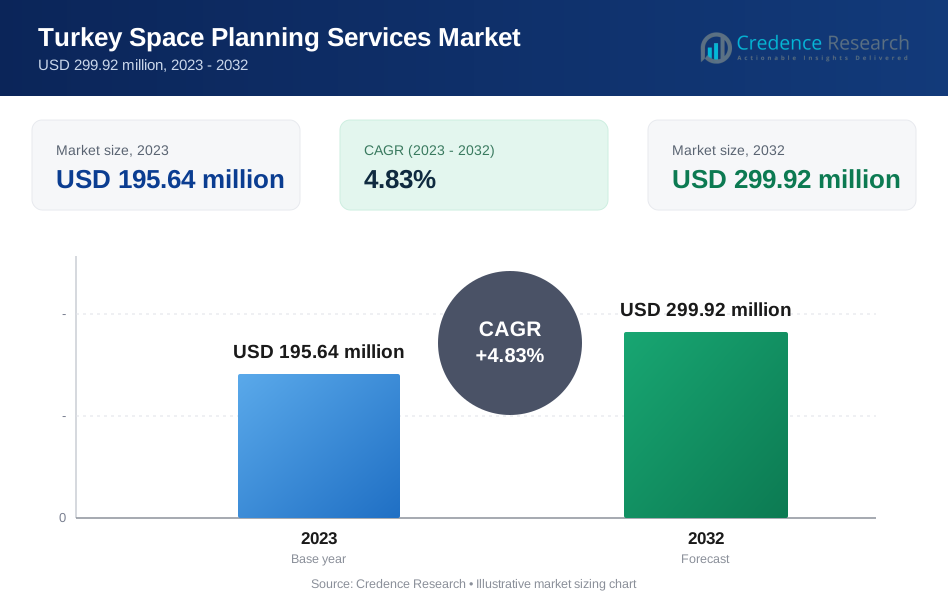
| Turkey Space Planning Services Market Size 2023 | USD 195.64 million |
| Turkey Space Planning Services Market, CAGR | 4.83% |
| Turkey Space Planning Services Market Size 2032 | USD 299.92 million |
Market Overview
The Turkey Space Planning Services Market is projected to grow from USD 195.64 million in 2023 to an estimated USD 299.92 million by 2032, registering a compound annual growth rate (CAGR) of 4.83% from 2024 to 2032. This growth reflects increasing demand for efficient and innovative spatial optimization solutions across various sectors, including commercial, residential, and industrial projects.
Key drivers fueling market growth include rapid urbanization, increasing real estate investments, and the rising importance of sustainable design practices. The adoption of advanced technologies such as 3D modeling, virtual reality (VR), and augmented reality (AR) for space visualization is a notable trend in the market. Additionally, government initiatives to enhance urban infrastructure and encourage eco-friendly building practices are expected to drive demand for space planning services.
Geographically, Istanbul dominates the Turkey Space Planning Services Market due to its dense urban development and large-scale commercial projects. Other significant regions contributing to market growth include Ankara and Izmir, where investments in infrastructure and urban renewal projects are prominent. The competitive landscape features key players such as Arcadis, Perkins & Will, and Space Matrix, who leverage technology and expertise to deliver tailored solutions. These companies are actively expanding their service portfolios to address the diverse needs of Turkey’s evolving market.
Market Insights
- The Turkey Space Planning Services Market is projected to grow from USD 195.64 million in 2023 to USD 299.92 million by 2032, registering a CAGR of 4.83% from 2024 to 2032.
- Rapid urbanization and rising real estate investments drive demand for efficient spatial optimization across commercial, residential, and industrial sectors.
- Integration of technologies like 3D modeling, virtual reality (VR), and augmented reality (AR) enhances project visualization and collaboration, boosting market growth.
- Increasing emphasis on eco-friendly design and green building certifications propels demand for sustainable space planning solutions.
- Limited awareness of advanced planning technologies and budget constraints among smaller firms and rural developers hinder market expansion.
- Istanbul dominates the market with a 42% share due to high urbanization and large-scale projects, followed by Ankara and Izmir.
- Expanding smart city initiatives and growing demand for flexible, customized designs create significant opportunities for market players to innovate and grow.
Market Drivers
Growing Urbanization and Real Estate Investments
Urbanization is a key factor driving the growth of the Turkey Space Planning Services Market. As the population in urban areas increases, there is a rising demand for efficient utilization of space in residential, commercial, and industrial sectors. Urban areas like Istanbul, Ankara, and Izmir are witnessing an influx of people due to better job opportunities and infrastructure, leading to heightened real estate activity. For instance, as of 2022, approximately 67.9% of Turkey's population resides in urban areas, amounting to over 57 million people living in cities that cover only 1.6% of the country's total surface area. This rapid urbanization has led to a substantial increase in real estate activities as developers seek to optimize limited space while catering to the functional and aesthetic needs of modern consumers.Moreover, from 2000 to 2010, Turkey experienced a remarkable growth in urban footprints, with 45 out of 47 cities analyzed showing positive area growth. The average increase in built-up area during this period was around 51 km². Developers are increasingly seeking professional space planning services to optimize available areas while meeting the demands of modern consumers. Government initiatives aimed at boosting urban infrastructure through smart city projects have further intensified the adoption of advanced space planning services.
Shift Toward Sustainable and Eco-Friendly Design Practices
The growing emphasis on sustainability in Turkey’s construction and real estate sectors is significantly influencing the demand for space planning services. With increasing environmental concerns and global commitments to reduce carbon footprints, developers and organizations are prioritizing eco-friendly designs. For example, many new buildings are now designed with energy-efficient layouts and sustainable materials as part of their compliance with international green building standards like LEED. Space planners are integrating sustainable materials, energy-efficient layouts, and natural lighting solutions into their projects to align with environmental regulations and client expectations.Additionally, Turkey’s adherence to global green building standards underscores the importance of sustainable space planning in driving market growth. This shift towards sustainability reflects a broader trend where developers aim to create spaces that not only meet client needs but also contribute positively to the environment. As such, the demand for space planning services that incorporate eco-friendly practices continues to rise, shaping the future of Turkey's real estate landscape.
Integration of Advanced Technologies
The adoption of advanced technologies such as 3D modeling, virtual reality (VR), and augmented reality (AR) has revolutionized the Turkey Space Planning Services Market. These tools enable precise space visualization, allowing stakeholders to review and modify designs in real time, thus ensuring optimal utilization of resources. For instance, VR and AR technologies are being used to create immersive experiences for clients, helping them visualize layouts before actual implementation.Moreover, Building Information Modeling (BIM) tools facilitate collaboration among architects, engineers, and planners, reducing errors and enhancing project efficiency. The integration of these technologies is becoming a critical factor for success in the market. As developers increasingly rely on these advanced tools for design and planning processes, they gain a competitive edge by delivering innovative solutions that meet client expectations while optimizing project outcomes.
Rising Demand for Customized and Flexible Space Solutions
The evolving needs of businesses and residents are driving demand for customized and flexible space solutions. Companies are increasingly focusing on creating work environments that enhance employee productivity and well-being. Similarly, residential consumers are seeking homes that maximize utility while maintaining aesthetic appeal. Space planning services cater to these preferences by offering tailored solutions that consider specific requirements such as open office layouts, multipurpose rooms, or modular designs.The post-pandemic shift toward remote and hybrid work models has further heightened the need for flexible space planning as businesses reimagine office spaces to accommodate changing work dynamics. This trend emphasizes the importance of adaptability in design and functionality within both commercial and residential spaces. As a result, space planning services that provide customized solutions are becoming essential in meeting the diverse needs of today’s urban populations in Turkey's dynamic real estate market.
Market Trends
Adoption of Smart and Digital Tools in Space Planning
The integration of smart and digital tools is fundamentally reshaping the space planning landscape in Turkey. For instance, technologies such as 3D modeling, augmented reality (AR), virtual reality (VR), and building information modeling (BIM) are increasingly utilized to enhance design precision and elevate client satisfaction. These tools empower architects and planners to create detailed visualizations, allowing clients to make informed decisions and significantly reducing the likelihood of errors. Virtual reality, in particular, has gained traction by enabling immersive walkthroughs, where clients can experience the functionality and aesthetics of a space before any construction begins. This not only enhances client engagement but also ensures that their expectations are met from the outset. Furthermore, BIM promotes collaboration among all stakeholders involved in a project, streamlining workflows and enhancing project management efficiency. The widespread adoption of these advanced tools marks a pivotal shift towards innovation and quality within the Turkish space planning market, setting new benchmarks for excellence.
Rising Focus on Sustainability and Eco-Friendly Design
The increasing focus on sustainability is a defining characteristic of the space planning services market in Turkey. For example, there has been a notable surge in demand for eco-friendly designs and green building certifications like LEED and BREEAM. As environmental awareness grows among developers and clients alike, space planning firms are responding by integrating energy-efficient layouts, natural lighting solutions, and sustainable materials into their projects.Urban planners are prioritizing designs that not only reduce energy consumption but also promote the integration of renewable energy sources. This trend aligns with Turkey's national sustainability goals, reflecting a broader shift towards responsible urban development practices. As a result, space planning firms are not just meeting regulatory requirements; they are actively contributing to a greener future while enhancing the overall quality of life in urban environments. Through these initiatives, the Turkish market is establishing itself as a leader in sustainable design practices that resonate with contemporary values and consumer expectations.
Tailored Solutions for Evolving Consumer Needs
The Turkey Space Planning Services Market is witnessing a growing demand for customized and adaptable solutions. Consumers now seek spaces that cater to their unique requirements, whether for residential, commercial, or industrial purposes. In the residential sector, there is a rising preference for multipurpose areas and modular designs that maximize utility and flexibility. In the commercial sector, businesses are focusing on layouts that enhance productivity and employee well-being, such as open-plan offices, biophilic designs, and wellness-oriented environments. This trend has been amplified by the post-pandemic shift toward hybrid work models, which require versatile spaces that accommodate remote and on-site work seamlessly.
Urbanization and Smart City Development
Urbanization and the rise of smart cities are shaping the space planning market in Turkey. Rapid urban migration has created a need for efficient land use and well-organized urban infrastructure. Cities like Istanbul, Ankara, and Izmir are investing heavily in smart city projects, which incorporate advanced technology and sustainable design principles. Space planning services play a crucial role in optimizing layouts for residential, commercial, and public spaces within these developments. Moreover, the use of data-driven approaches in smart city projects enables planners to create environments that are not only functional but also responsive to changing urban dynamics.
Market Challenges
Limited Awareness and Adoption of Advanced Planning Technologies
One of the significant challenges facing the Turkey Space Planning Services Market is the limited awareness and adoption of advanced planning technologies among smaller firms and local developers. For instance, a study focusing on the integration of augmented reality (AR) with building information modeling (BIM) in Turkey indicates that while AR has immense potential to enhance project execution, its adoption remains limited. Many construction stakeholders in smaller cities are unaware of the benefits that AR-BIM integration can offer, resulting in a reliance on traditional planning methods. This lack of awareness is compounded by insufficient training and infrastructure, which creates a technological gap that hinders efficiency and restricts market expansion. Moreover, a survey conducted across several countries, including Turkey, revealed that while professionals express confidence in handling AR-BIM implementations, they face significant barriers such as inadequate knowledge and resources. Consequently, this technological gap limits firms' ability to meet the growing demand for innovative planning solutions, ultimately affecting their competitiveness in an increasingly digital global market.
Economic Uncertainty and Budget Constraints
Economic fluctuations and budgetary constraints pose another challenge for the Turkey Space Planning Services Market. For instance, following last year's devastating earthquakes, the construction sector has been heavily impacted by rising material costs and borrowing expenses. The Turkish Statistical Institute reported that construction material prices surged significantly year-on-year, driven by increased demand for rebuilding efforts. This economic pressure has forced many small and medium-sized enterprises (SMEs) to opt for cost-saving alternatives like in-house planning or standard templates instead of investing in professional services that offer customized solutions. Additionally, a report highlighted that micro and small enterprises often struggle to secure financing due to high rejection rates for loan applications compared to larger firms. This financial barrier limits their ability to adopt advanced technologies necessary for efficient space planning. As a result, firms find it increasingly challenging to expand their client base and maintain profitability amid ongoing economic uncertainty and competitive pressures within the market.
Market Opportunities
Limited Awareness and Adoption of Advanced Planning Technologies
Limited awareness and adoption of advanced planning technologies pose significant challenges to the Turkey Space Planning Services Market. For instance, a comparative study on the integration of augmented reality (AR) and building information modeling (BIM) in construction revealed that stakeholders in Turkey often lack the necessary training and infrastructure to implement these technologies effectively. Despite the potential benefits of AR-BIM integration, such as enhanced project execution and improved communication among architects, engineers, and contractors, many firms in smaller cities still rely on traditional methods. This reliance stems from insufficient knowledge about modern technologies, which restricts their ability to innovate and respond to market demands. Furthermore, the study indicates that while Turkish firms express confidence in adopting AR-BIM methodologies, they face significant barriers such as inadequate support systems and limited access to training resources. Consequently, this technological gap not only hinders operational efficiency but also limits the overall growth of the space planning sector in Turkey.
Economic Uncertainty and Budget Constraints
Economic uncertainty and budget constraints significantly impact the Turkey Space Planning Services Market. For example, a recent analysis highlighted that small and medium-sized enterprises (SMEs) in the construction sector are particularly vulnerable to financial fluctuations. The rising costs of materials and labor, coupled with economic instability, have made it increasingly difficult for these firms to invest in advanced planning technologies. A report indicated that SMEs often resort to cost-saving alternatives like in-house planning or standard templates due to budgetary limitations, which compromises the quality and customization of their services. Additionally, the aftermath of recent natural disasters has intensified demand for rebuilding efforts while simultaneously straining financial resources. With many construction projects requiring substantial investment upfront, high-interest rates further deter SMEs from securing necessary funding. This situation creates a challenging environment for firms aiming to expand their client base and maintain profitability amidst rising operational costs and economic volatility.
Market Segmentation Analysis
By Type
The market is categorized into Conceptual Space Planning, Detailed Space Planning, Furniture and Equipment Planning, and Space Management and Optimization. Conceptual space planning involves initial layouts and broad designs to optimize functionality and aesthetics, appealing to early-stage projects in real estate and renovations. Detailed space planning, critical for later project stages, focuses on precise layouts and measurements. Furniture and equipment planning is particularly prominent in retail and commercial spaces, ensuring optimal placement for utility and design harmony. Space management and optimization are in demand for projects requiring real-time space utilization monitoring, especially in large commercial offices and industrial setups.
By Vertical
The market serves various verticals, including Retail and Hospitality, Commercial Office, Healthcare, Education, and Government and Non-Profit. Retail and hospitality sectors are major contributors due to their need for customer-centric, appealing layouts. The commercial office segment is driven by increasing demand for collaborative and productivity-enhancing environments. Healthcare facilities require precise planning to accommodate equipment and improve patient flow. Education and government sectors emphasize space optimization for multipurpose usage, while non-profits focus on cost-effective, functional designs.
Segments
Based on Type
- Conceptual Space Planning
- Detailed Space Planning
- Furniture and Equipment Planning
- Space Management and Optimization
Based on Vertical
- Retail and Hospitality
- Commercial Office
- Healthcare
- Education
- Government and Non-Profit
Based on Deployment Method
- On-Premise
- Cloud-Based
- Hybrid
Based on Collaboration & Communication Technology
- Virtual Reality (VR)
- Augmented Reality (AR)
- 3D Modelling
Based on Region
- Istanbul
- Ankara
- Izmir
Regional Analysis
Istanbul (42%):
Istanbul holds the largest market share, contributing approximately 42% to the Turkey Space Planning Services Market in 2023. As Turkey’s largest metropolitan area and financial hub, Istanbul is home to extensive commercial, residential, and industrial activities, which fuel the demand for professional space planning services. High levels of urbanization and real estate investment, combined with large-scale infrastructure projects such as Istanbul Airport and urban renewal initiatives, make the city a focal point for space planners. The retail and hospitality sectors are particularly active in this region, emphasizing innovative and customer-centric designs.
Ankara (22%):
Ankara, the capital city, accounts for about 22% of the market share. The city’s prominence as the administrative and political center drives demand for space planning in government and institutional projects. Additionally, Ankara’s growing commercial real estate market and urban development initiatives contribute significantly to its market share. Projects involving healthcare, education, and public infrastructure are key contributors to the demand for specialized space planning services in this region.
Key players
- BVN
- Studios Architecture
- Perkins and Will
- CallisonRTKL
- RTKL
- OP
- NBBJ
- IA Interior Architects
- Mainrock
- Blue Line Design
- Orbyte Aerospace Technologies
- Cervos Aerospace
- Space
Competitive Analysis
The Turkey Space Planning Services Market is characterized by a mix of international and local players offering diverse solutions to meet the growing demand for innovative and efficient space utilization. Companies like Perkins and Will, CallisonRTKL, and NBBJ leverage their global expertise and advanced technologies, such as 3D modeling and building information modeling (BIM), to deliver tailored solutions for high-profile commercial and residential projects. Meanwhile, local players such as Blue Line Design and Mainrock focus on cost-effective, region-specific services that cater to mid-sized and smaller projects. The competitive landscape is further shaped by firms like Studios Architecture and IA Interior Architects, which emphasize sustainable designs and customized layouts. As technological integration and sustainability trends dominate the market, companies investing in innovation and adaptability are better positioned to capture market share and strengthen their competitive edge.
Recent Developments
- In December 2024, BVN Architecture announced its participation in a significant project aimed at enhancing sustainable urban environments in Turkey. The firm is collaborating with local authorities to design a series of green spaces that integrate nature into urban planning, promoting biodiversity and community well-being. This initiative aligns with the global trend towards eco-friendly architecture and aims to set a benchmark for future developments in Turkey's urban landscape.
- As of January 2025, Studios Architecture has been awarded a contract to design a new cultural center in Istanbul. This project focuses on creating multifunctional spaces that foster community engagement and cultural exchange. The design incorporates advanced planning technologies, including Building Information Modeling (BIM), to optimize space utilization and enhance user experience. This development is part of Turkey's broader strategy to modernize its architectural landscape and improve public amenities.
- In January 2025, Perkins and Will launched its new initiative aimed at integrating smart technologies into public spaces in Turkey. The firm is working on several projects that utilize data analytics to enhance user interaction within urban environments. This approach not only aims to improve the efficiency of space usage but also seeks to create more responsive and adaptable public areas that cater to the evolving needs of the community.
- In January 2025, CallisonRTKL announced its collaboration with Turkish developers on a mixed-use development project in Ankara. The project emphasizes sustainable design principles and aims to create vibrant community spaces that blend residential, commercial, and recreational areas. The firm is leveraging its global expertise to introduce innovative planning solutions that address local needs while promoting economic growth.
- In December 2024, NBBJ revealed plans for a new office complex in Istanbul designed to prioritize employee well-being and productivity. The project incorporates biophilic design elements and advanced workplace strategies that reflect the latest trends in office space planning. This development is expected to set new standards for workplace environments in Turkey, aligning with global best practices.
- In January 2025, IA Interior Architects has recently completed the redesign of an office space for a major tech company in Istanbul, announced. The project focuses on creating flexible workspaces that encourage collaboration while incorporating wellness features such as natural lighting and greenery. This initiative reflects the growing demand for innovative interior solutions that enhance employee satisfaction and productivity.
- In January 2025, Blue Line Design launched a new initiative focused on integrating smart technology into public infrastructure projects across Turkey. The firm aims to enhance urban planning processes by utilizing data-driven approaches that improve efficiency and sustainability in design implementation.
- In January 2025, Orbyte Aerospace Technologies has introduced a high-fidelity space simulation software called Orbiter, which was announced. This software is designed for use by aerospace professionals engaged in mission engineering, providing tools for flight simulations and orbital calculations. This innovation positions Orbyte as a key player in advancing aerospace technology within Turkey.
- In January 2025, Space announced its plans to expand its operations within Turkey by establishing partnerships with local firms focused on satellite technology development. This initiative aims to bolster Turkey's capabilities in satellite communications and Earth observation, contributing to the country's growing ambitions in the space sector
Market Concentration and Characteristics
The Turkey Space Planning Services Market is moderately fragmented, with a mix of international and local players competing to address the growing demand for efficient space utilization solutions. While global firms such as Perkins and Will, CallisonRTKL, and NBBJ dominate high-profile commercial and residential projects with their advanced technologies and global expertise, local companies like Blue Line Design and Mainrock focus on cost-effective, customized services tailored to regional needs. The market is characterized by increasing adoption of digital tools like 3D modeling, virtual reality (VR), and building information modeling (BIM), which enhance project precision and client engagement. Additionally, the emphasis on sustainability and flexible design solutions reflects the evolving preferences of clients across sectors such as retail, healthcare, and government. This dynamic landscape underscores the importance of innovation, collaboration, and adaptability as key differentiators among market players.
Report Coverage
The research report offers an in-depth analysis based on Type, Vertical, Deployment Method, Collaboration & Communication Technology and Region. It details leading market players, providing an overview of their business, product offerings, investments, revenue streams, and key applications. Additionally, the report includes insights into the competitive environment, SWOT analysis, current market trends, as well as the primary drivers and constraints. Furthermore, it discusses various factors that have driven market expansion in recent years. The report also explores market dynamics, regulatory scenarios, and technological advancements that are shaping the industry. It assesses the impact of external factors and global economic changes on market growth. Lastly, it provides strategic recommendations for new entrants and established companies to navigate the complexities of the market.
Future Outlook
- The Turkey Space Planning Services Market is poised for steady growth, with a projected CAGR of 4.83% from 2024 to 2032, driven by increasing urbanization and real estate developments in major cities like Istanbul, Ankara, and Izmir.
- The adoption of advanced technologies such as 3D modeling, augmented reality (AR), and building information modeling (BIM) will significantly enhance project accuracy and client engagement, creating competitive advantages for service providers.
- Growing emphasis on sustainability and eco-friendly designs will drive demand for energy-efficient layouts and green building certifications, aligning with global environmental standards and local regulations.
- Expanding smart city initiatives and infrastructure projects in Turkey will provide lucrative opportunities for space planning services, particularly in optimizing urban layouts and public spaces.
- Increasing investments in the commercial office sector will fuel demand for productivity-enhancing layouts, as businesses seek to create flexible and employee-friendly work environments.
- The shift toward hybrid work models and multipurpose spaces will encourage the adoption of customizable planning solutions across residential and commercial sectors.
- Local players will likely focus on cost-effective and region-specific solutions to cater to mid-sized and small-scale projects, contributing to increased competition and innovation in the market.
- The healthcare and education sectors will drive demand for specialized planning services to accommodate advancements in medical technology and modern educational facilities.
- Integration of collaboration tools like virtual reality (VR) and cloud-based platforms will streamline workflows and foster seamless communication between architects, planners, and clients.
- As smaller cities and regions in Turkey witness increasing urbanization and infrastructure investments, the market will expand beyond major metropolitan areas, creating new growth avenues for service providers.
Request a Free Sample
Fill in your details and we'll send you a free sample report.
- Sample data tables & charts
- Research methodology
Need a Custom Version of This Report?
Tailor the scope, geography, or segments to your exact requirements.
- Custom geography or segment scope
- Direct access to our analyst team
Frequently Asked Questions
What is the market size of the Turkey Space Planning Services Market in 2023 and 2032, and what is its CAGR?
What are the key factors driving the growth of the Turkey Space Planning Services Market?
How is technology influencing the Turkey Space Planning Services Market?
Which regions dominate the Turkey Space Planning Services Market?
Who are the prominent players in the Turkey Space Planning Services Market?
Table of Content
Chapter 1. Report Introduction
- 1.1 Report Description & Purpose
- 1.1.1 Report Title & Market Definition
- 1.1.2 Unique Selling Propositions (USP) & Key Differentiators
- 1.1.3 Value Proposition for Stakeholders
- 1.2 Research Objectives
- 1.2.1 Market Sizing Objectives (Volume & Revenue)
- 1.2.2 Segmentation Objectives
- 1.2.3 Competitive Intelligence Objectives
- 1.2.4 Forecast & Scenario Objectives
- 1.3 Report Scope
- 1.3.1 Turkey Space Planning Services Scope – Types & Subtypes Covered
- 1.3.2 Geographic Scope – Regions & Countries Covered
- 1.3.3 Historical Period, Base Year & Forecast Period (2023; forecast to 2032)
- 1.3.4 Inclusions & Exclusions
- 1.4 HS Code & Classification Framework
- 1.5 Currency, Units & Pricing Basis
- 1.6 Target Stakeholders
- 1.7 Limitations & Assumptions
Chapter 2. Executive Summary
- 2.1 Global Turkey Space Planning Services Market Snapshot
- 2.1.1 Market Size – Historical (2023) & Forecast (2023-2032) (2023: USD 195.64 million → 2032: USD 299.92 million)
- 2.1.2 Volume & Revenue – Global Totals
- 2.1.3 Key Market Highlights – Top Five Facts
- 2.2 Turkey Space Planning Services Market Segmentation Snapshot
- 2.2.1 Market Split by Region – 2023 vs. 2032
- 2.3 Competitive Snapshot
- 2.3.1 Top 10 Players by Revenue Share – 2023
- 2.3.2 Top 10 Players by Volume Share – 2023
- 2.3.3 Recent Strategic Developments (18-Month Summary)
- 2.4 Key Investment Highlights & Strategic Conclusions
Chapter 3. Turkey Space Planning Services Market Dynamics & Industry Analysis
- 3.1 Market Overview & Context
- 3.1.1 Turkey Space Planning Services Market Position in the Broader Automotive Value Chain
- 3.1.2 OEM vs. Replacement Market Dynamics
- 3.1.3 Market Maturity & Development Stage by Region
- 3.2 Turkey Space Planning Services Market Drivers
- 3.3 Turkey Space Planning Services Market Restraints & Challenges
- 3.4 Turkey Space Planning Services Market Opportunities
- 3.5 Porter's Five Forces Analysis
- 3.5.1 Threat of New Entrants
- 3.5.2 Bargaining Power of Suppliers
- 3.5.3 Bargaining Power of Buyers
- 3.5.4 Threat of Substitutes
- 3.5.5 Competitive Rivalry – Intensity Assessment
- 3.6 Turkey Space Planning Services Value Chain Analysis
- 3.6.1 Upstream – Raw Material/Input Suppliers
- 3.6.1.1 Raw Material/Input 1
- 3.6.1.2 Raw Material/Input 2
- 3.6.1.3 Raw Material/Input 3
- 3.6.2 Midstream – Production/Manufacturing/Service Delivery
- 3.6.2.1 Production/Process Overview
- 3.6.2.2 Key Facility Locations & Capacity by Manufacturer
- 3.6.3 Downstream – Distribution & End Consumer
- 3.6.3.1 Primary Channel – B2B/OEM
- 3.6.3.2 Secondary Channels – Dealer, Retail, Online, Direct
- 3.6.4 Value Chain Profitability Analysis
- 3.6.1 Upstream – Raw Material/Input Suppliers
- 3.7 PESTEL Analysis
- 3.7.1 Political Factors
- 3.7.2 Economic Factors
- 3.7.3 Social Factors
- 3.7.4 Technological Factors
- 3.7.5 Environmental Factors
- 3.7.6 Legal Factors
- 3.8 Turkey Space Planning Services Supply Chain Analysis
- 3.8.1 Raw Material/Input Supply Risk Assessment
- 3.8.2 Manufacturing Concentration Risk (Geographic Exposure)
- 3.8.3 Trade Disruption Impact Analysis
- 3.9 Regulatory & Policy Landscape
Note: The regulatory and policy landscape section covers regulations based on their applicability to the market, Turkey Space Planning Services category, geography, and scope of the study. Only regulatory frameworks with a material impact on operations, compliance, trade, sustainability, or market access are analyzed in detail.
Chapter 4. Key Investment Pockets & Opportunity Analysis
- 4.1 Turkey Space Planning Services Market Attractiveness Analysis
- 4.1.1 By Region – Investment Attractiveness Matrix (Volume × CAGR)
- 4.2 Absolute Revenue Growth Opportunity
- 4.2.1 By Region – Absolute USD Growth Through 2032
- 4.3 Incremental Volume Opportunity
- 4.3.1 By Region – Incremental Volume Through 2032
- 4.3.2 Segment – Incremental Volume
- 4.4 Emerging Submarket Opportunity Deep Dive (Subject to Applicability)
- 4.5 Emerging Market Opportunity Scorecards
- 4.5.1 United States
- 4.5.2 Europe
- 4.5.3 Asia
- 4.5.4 Middle East & Africa
Note: Emerging Market Opportunity Scorecards will be included based on relevance and strategic importance. Regions listed are indicative and may vary depending on data availability and market dynamics.
Chapter 5. Turkey Space Planning Services Import-Export Analysis & Trade Flows
- 5.1 Global Trade Overview
- 5.1.1 Global Export Value by Country (2023)
- 5.1.2 Global Export Volume by Country (2023)
- 5.1.3 Global Import Value by Country (2023)
- 5.1.4 Global Import Volume by Country (2023)
- 5.1.5 Net Trade Balance by Country (2023)
- 5.2 Export Analysis – Segment
- 5.2.1 Type 1 (HS Code)
- 5.2.2 Type 2 (HS Code)
- 5.2.3 Type 3 (HS Code)
- 5.2.4 Type 4 (HS Code)
- 5.2.5 Type 5 (HS Code)
- 5.3 Import Analysis – Segment
- 5.3.1 Type 1 (HS Code)
- 5.3.2 Type 2 (HS Code)
- 5.3.3 Type 3 (HS Code)
- 5.3.4 Type 4 (HS Code)
- 5.3.5 Type 5 (HS Code)
- 5.4 Average Unit Trade Prices
- 5.4.1 Average Export Price – Segment & Country
- 5.4.2 Average Import Price – Segment & Source Country
- 5.4.3 Price Trends (2023)
- 5.5 Key Trade Route Analysis
- 5.5.1 Trade Route 1
- 5.5.2 Trade Route 2
- 5.5.3 Trade Route 3
- 5.5.4 Trade Route 4
- 5.5.5 Trade Route 5
- 5.6 Trade Policy Impact Assessment
- 5.6.1 US Anti-Dumping & Section 301 Tariffs
- 5.6.2 EU Customs Union Impact
- 5.6.3 Major Free Trade Agreements
- 5.6.4 USMCA Rules of Origin
Note: Trade policy analysis will be included only where relevant to the Turkey Space Planning Services market.
Chapter 6. Competitive Landscape & Company Benchmarking
- 6.1 Turkey Space Planning Services Market Concentration & Structure
- 6.1.1 Herfindahl-Hirschman Index (HHI) – vs. 2023
- 6.1.2 Tier 1, Tier 2 & Tier 3 Market Structure
- 6.1.3 Global, Regional & Local Player Dynamics
- 6.2 Turkey Space Planning Services Market Share Analysis – 2023
- 6.2.1 Global Revenue Share by Company
- 6.2.2 Global Volume Share by Company
- 6.2.3 Regional Revenue Share
- 6.2.4 Market Share Evolution ( vs. 2023)
- 6.2.5 OEM Segment Share by Company
- 6.2.6 Replacement Segment Share by Company
- 6.3 Production/Delivery Capacity & Facility Analysis
- 6.3.1 Global Installed Capacity
- 6.3.2 Capacity Utilization Rates
- 6.3.3 Production/Output Volume
- 6.3.4 Facility Locations & Capacity Map
- 6.3.5 Planned Capacity Additions
- 6.4 Turkey Space Planning Services Competitive Benchmarking Matrix
- 6.4.1 Revenue, Volume, CAGR & Profitability Comparison
- 6.4.2 Channel Revenue Mix
- 6.4.3 Geographic Revenue Exposure
- 6.4.4 R&D Intensity
- 6.4.5 Sustainability Maturity
- 6.5 Strategic Developments in Turkey Space Planning Services (Last 24 Months)
- 6.5.1 Mergers, Acquisitions & Divestments
- 6.5.2 New Turkey Space Planning Services Launches
- 6.5.3 Facility Expansions
- 6.5.4 Strategic Alliances, Joint Ventures & Partnerships
- 6.5.5 Distribution Expansion & Market Entry
- 6.5.6 Sustainability & ESG Initiatives
- 6.6 Competitive Strategy Mapping
- 6.6.1 Leader, Challenger, Follower & Niche Classification
- 6.6.2 Pricing Strategy Comparison
- 6.6.3 Channel Strategy Matrix
Note: Strategic developments are included based on their materiality and the availability of reliable information.
Chapter 7. Global Turkey Space Planning Services Market – By Distribution Channel
- 7.1 Segment Overview
- 7.1.1 Volume & Revenue Split by Channel (2023 & 2032)
- 7.1.2 Channel Mix Evolution (2023-2032)
Chapter 8. Regional Market Analysis – Global Overview
- 8.1 Global Regional Overview
- 8.1.1 Regional Volume Share
- 8.1.2 Regional Revenue Share
- 8.1.3 Regional Volume by Region
- 8.1.4 Regional Revenue by Region
- 8.1.5 Regional Forecast Through 2032
- 8.2 Cross-Regional Segment Analysis
- 8.2.1 By Distribution Channel
- 8.2.2 By Brand/Price Tier
Chapter 9. North America Turkey Space Planning Services Market
- 9.1 United States
- 9.2 Canada
- 9.3 Mexico
Chapter 10. Europe Turkey Space Planning Services Market
- 10.1 Germany
- 10.2 France
- 10.3 Italy
- 10.4 United Kingdom
- 10.5 Spain
- 10.6 Poland
- 10.7 Russia
- 10.8 Netherlands
- 10.9 Belgium
- 10.10 Sweden
- 10.11 Denmark
- 10.12 Norway
- 10.13 Rest of Europe
Chapter 11. Asia Pacific Turkey Space Planning Services Market
- 11.1 China
- 11.2 India
- 11.3 Japan
- 11.4 South Korea
- 11.5 Thailand
- 11.6 Indonesia
- 11.7 Vietnam
- 11.8 Malaysia
- 11.9 Australia
- 11.10 Rest of Asia Pacific
Chapter 12. Latin America Turkey Space Planning Services Market
- 12.1 Brazil
- 12.2 Argentina
- 12.3 Colombia
- 12.4 Chile
- 12.5 Rest of Latin America
Chapter 13. Middle East Turkey Space Planning Services Market
- 13.1 Saudi Arabia
- 13.2 United Arab Emirates
- 13.3 Turkey
- 13.4 Israel
- 13.5 Iran
- 13.6 Rest of the Middle East
Chapter 14. Africa Turkey Space Planning Services Market
- 14.1 South Africa
- 14.2 Egypt
- 14.3 Nigeria
- 14.4 Morocco
- 14.5 Rest of Africa
Chapter 15. Turkey Space Planning Services Company Profiles
- 15.1 [Company 01]
- 15.1.1 Company Overview
- 15.1.2 Key Management Personnel
- 15.1.3 Products & Services Portfolio
- 15.1.4 Financial Performance
- 15.1.5 Key Market Focus & Geographic Presence
- 15.1.6 Recent Developments & Strategic Initiatives
Note: The company profile list is preliminary and may change based on research findings, market developments, data availability, and client requirements.
Chapter 16. Appendices
- Appendix A – List of Abbreviations & Acronyms
- Appendix B – Industry Classification Code Reference – Full Series
- Appendix C – Production & Capacity Data Tables
- Appendix D – End-Use & Demand Base Tables
- Appendix E – Consumption & Replacement Rate Assumptions
- Appendix F – ASP Reference Tables
- Appendix G – Manufacturing & Facility Database
- Appendix H – Import-Export Data Tables
- Appendix I – Regulatory Summary Tables
- Appendix J – Primary Research Participant List (Anonymized)
- Appendix K – Primary Research Questionnaire Framework
- Appendix L – Data Sources & Bibliography
- Appendix M – Market Size Divergence & Source Comparison
Chapter 17. Research Methodology
- 17.1 Research Framework & Philosophy
- 17.2 Secondary Research – Sources, Hierarchy & Data Extraction
- 17.3 Data Modeling – Bottom-Up & Top-Down Market Sizing
- 17.4 Primary Research – Stakeholder Framework, LOI & Sample Sizes
- 17.5 Forecast Methodology – Regression, Scenario & Sensitivity Analysis
- 17.6 Quality Control – Four-Layer Validation Framework
- 17.7 Limitations & Standard Assumptions
- 17.8 Disclaimer
