
Market Overview:
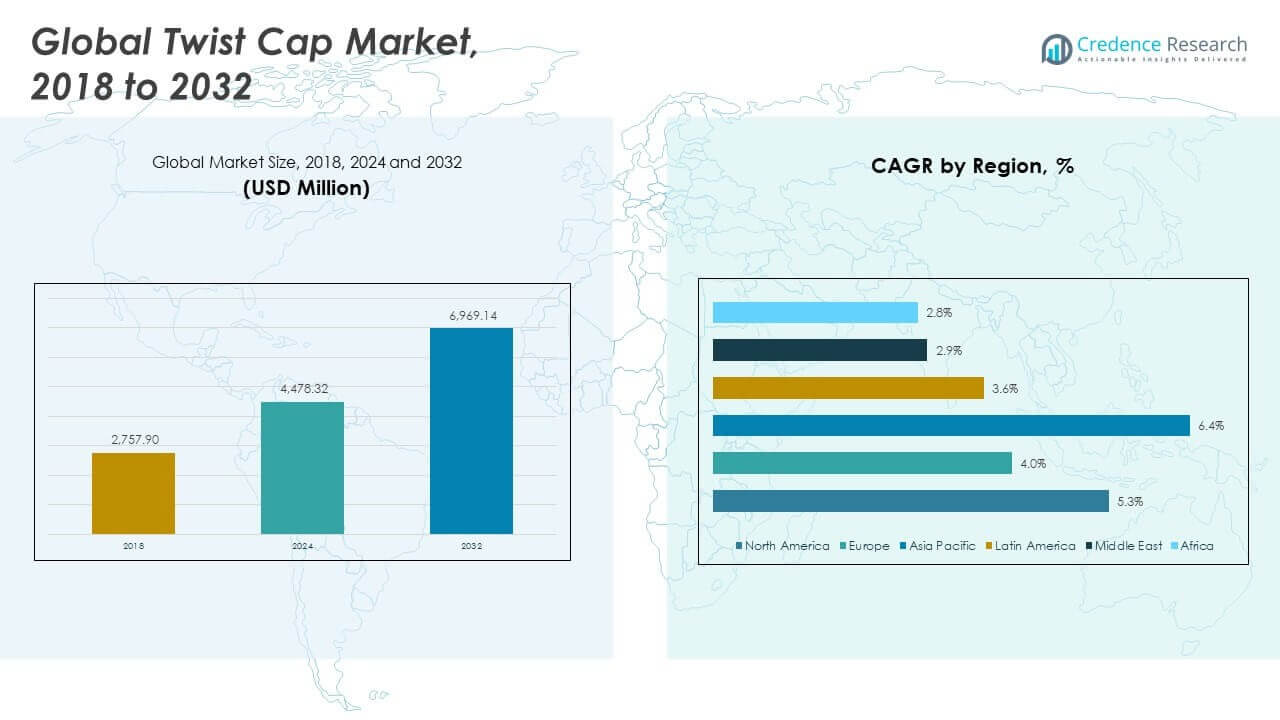
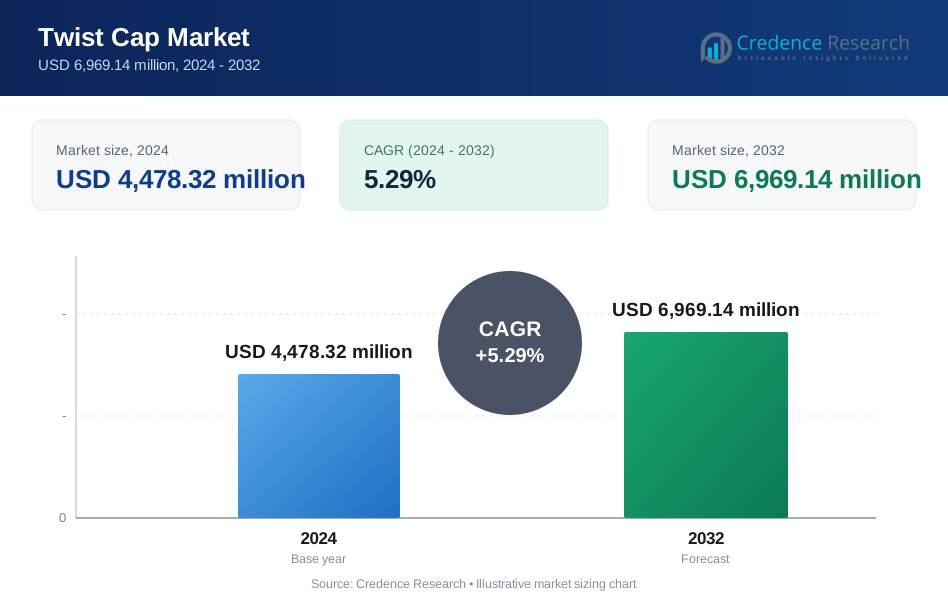
The Global Twist Cap Market size was valued at USD 2,757.90 million in 2018 to USD 4,478.32 million in 2024 and is anticipated to reach USD 6,969.14 million by 2032, at a CAGR of 5.29% during the forecast period.
| REPORT ATTRIBUTE | DETAILS |
|---|---|
| Historical Period | 2020-2023 |
| Base Year | 2024 |
| Forecast Period | 2025-2032 |
| Twist Cap Market Size 2024 | USD 4,478.32 million |
| Twist Cap Market, CAGR | 5.29% |
| Twist Cap Market Size 2032 | USD 6,969.14 million |
Growth in packaged food, beverages, and pharmaceuticals continues to support demand for twist caps. Manufacturers prefer twist caps for secure sealing, ease of opening, and reseal functionality. Rising focus on product safety increases adoption of tamper-evident and child-resistant designs. Sustainability targets push companies toward lightweight and recyclable cap materials. Automation in filling and capping lines improves efficiency and consistency. Brand owners also value twist caps for customization and visual differentiation. Expanding private-label production strengthens volume demand. These factors collectively reinforce steady market expansion.
North America and Europe lead the market due to strong packaging standards and mature food and pharmaceutical sectors. These regions show high adoption of advanced and compliant closure solutions. Asia Pacific is the fastest-growing region, driven by urbanization, rising packaged food consumption, and expanding healthcare access. Countries such as China and India contribute large volumes due to manufacturing scale. Latin America shows steady growth supported by FMCG expansion. Middle East and Africa remain emerging regions, benefiting from bottled water demand and improving retail infrastructure.
Market Insights:
- The Global Twist Cap Market was valued at USD 2,757.90 million in 2018, reached USD 4,478.32 million in 2024, and is projected to hit USD 6,969.14 million by 2032, growing at a CAGR of 5.29%.
- The top three regions by 2024 market share are North America (42.8%), Asia Pacific (30.8%), and Europe (17.4%), driven by strong demand in food, beverage, and pharmaceutical packaging and a shift toward safe and recyclable closures.
- Asia Pacific is the fastest-growing region with a 4% CAGR, supported by rising urbanization, growing FMCG penetration, and rapid expansion in healthcare and convenience food sectors.
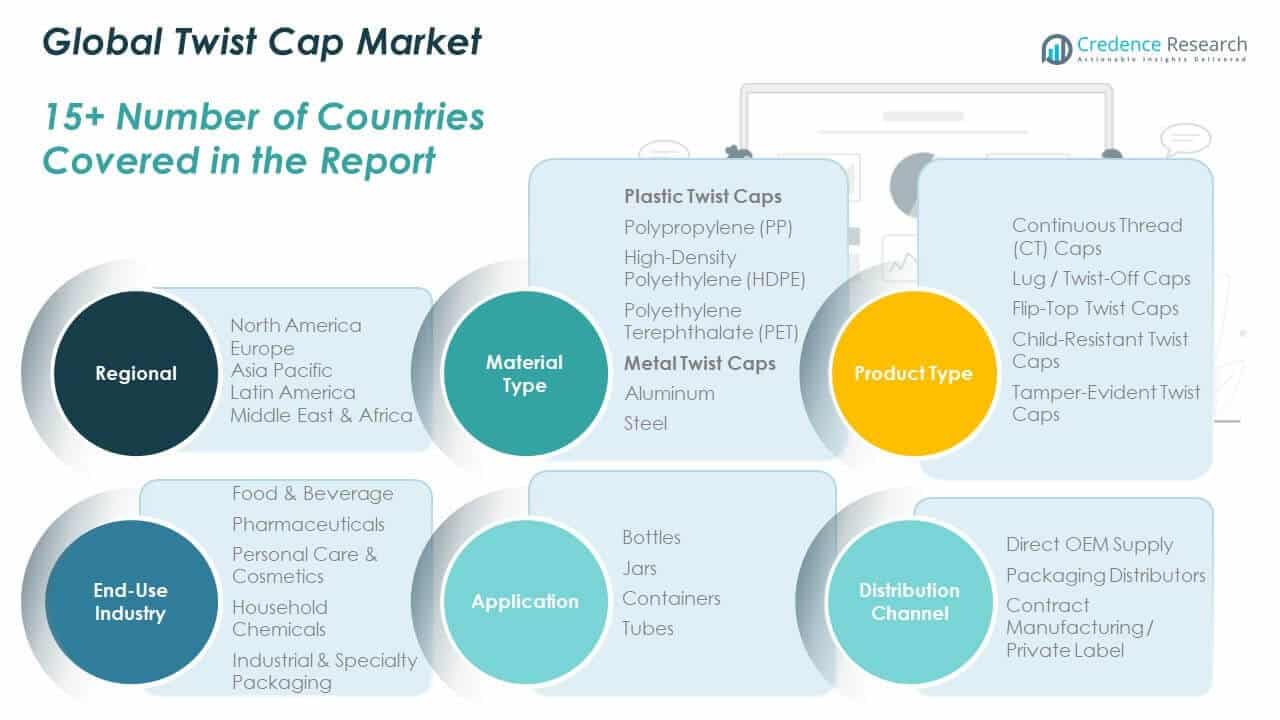
- Plastic Twist Caps account for the dominant segment, contributing over 70% of the total market value in 2024, with polypropylene leading due to cost and application flexibility.
- Metal Twist Caps make up the remaining sub-30% share, favored in premium food and export packaging segments requiring stronger barrier and visual appeal.
Market Drivers
Rising Demand for Safe and Tamper-Evident Packaging in Food and Beverage Sector
Food and beverage companies continue to adopt twist caps to ensure hygiene and safety compliance. Demand grows for packaging that provides strong seals and shows clear evidence of tampering. Twist caps offer reliable resealability, supporting longer shelf life and product freshness. The Global Twist Cap Market benefits from this rising demand across sauces, spreads, and bottled drinks. Brand owners invest in tamper-proof designs to meet regulatory norms and consumer expectations. Product integrity concerns in exports also drive twist cap adoption. Manufacturers improve performance with better sealing materials and thread precision. Foodservice and retail packaging both contribute to volume growth.
- For instance, Amcor launched tamper‑evident closures with integrated break‑away bands for bottled water and beverage applications to meet global safety standards and reduce contamination risk in transit.
Expansion of Pharmaceutical and Healthcare Packaging Requirements
Pharmaceutical and healthcare packaging requires strict sealing and child-resistant features. Twist caps address safety standards for over-the-counter and prescription products. The Global Twist Cap Market sees strong adoption in syrup bottles, ointment jars, and health supplements. These caps help companies meet dosage accuracy and hygiene expectations. Manufacturers customize torque and thread features for easy opening and leak prevention. The rise in generic drugs and self-care products further drives demand. Government healthcare schemes increase product availability across markets. It supports both large-scale and specialty drug packaging requirements.
- For instance, West Pharmaceutical Services introduced Daikyo PLASCAP® RUV closures in 2025, a metal‑free polypropylene vial closure with integrated stopper available in validated formats for 13 mm and 20 mm vial necks, streamlining sterile pharmaceutical packaging.
Shift Toward Convenience-Focused, On-the-Go Packaging Formats
Changing consumer lifestyles raise demand for convenient, resealable packaging. Twist caps meet expectations for easy opening, secure closure, and portable use. The Global Twist Cap Market benefits from high uptake in ready-to-drink, dairy, and single-serve food packs. Convenience stores and e-commerce packaging formats drive bulk demand. Product developers use twist caps to reduce spills and improve customer handling. Brands enhance visual appeal with ergonomic cap shapes and embossing. Portable packaging improves brand engagement in busy urban markets. Cap formats evolve to meet varying dispensing and usage patterns.
Brand Preference for Customizable and Aesthetically Appealing Closure Solutions
Brand differentiation drives the adoption of customized twist cap designs. Twist caps support embossing, color coding, and logo printing. The Global Twist Cap Market supports brand-building across premium and mass-market segments. Cap styling helps reinforce brand recall and perceived value. Multinational and regional brands invest in tooling for exclusive formats. Customized closures create visual identity on retail shelves. Product lines extend with consistent cap design across SKUs. It enables higher pricing leverage and packaging consistency in competitive categories.
Market Trends
Integration of Recyclable and Lightweight Material Compositions in Cap Production
Sustainability targets shape the use of recyclable plastics and lightweight resins. Twist cap makers adopt PP, HDPE, and bio-based polymers to lower environmental impact. The Global Twist Cap Market sees demand for caps that align with circular economy goals. Lightweight caps reduce transport costs and material usage. Brands seek certification-friendly materials that pass recycling guidelines. Regulatory mandates in Europe and North America favor recyclable closures. Supply chain players collaborate on closed-loop systems and sorting compatibility. It supports lifecycle accountability and brand credibility.
- For instance, Blue Ocean Closures partnered with consumer goods brands to produce fiber‑based caps that use 10% of the production energy of injection‑molded plastics, cutting CO₂ emissions by up to 80% versus traditional plastic closures.
Adoption of High-Speed, Automated Capping Equipment Across Filling Lines
Automation reshapes production throughput and consistency across filling operations. Twist caps must align with rapid, high-volume capping machines. The Global Twist Cap Market aligns with the growth of automated packaging lines in beverages, pharma, and FMCG. Machine-compatible caps improve torque control and reduce error rates. Vendors optimize thread profile and wall thickness for automation compatibility. Packaging firms invest in multi-head capper systems for speed. It lowers labor costs while raising consistency in closure application. Seamless integration reduces downtime and material waste.
- For instance, SACMI’s CCM64MD compression molding press can manufacture up to 2,850 caps per minute with 64 molds and process recycled high‑density polyethylene (rHDPE) at industry fairs like K 2025.
Growth in Smart Packaging and Embedded Closure Technologies
Smart packaging adoption drives innovation in cap functionality and information display. Twist caps integrate NFC tags, QR codes, and tamper sensors. The Global Twist Cap Market benefits from value-added features for product traceability and anti-counterfeiting. Brands use interactive caps to link consumers with digital content. Healthcare products use embedded caps to track dosage and expiration. Embedded sensors enable condition-based alerts in transit. Consumer engagement improves through tech-enabled packaging. It creates differentiation in saturated product categories.
Emergence of Twist Caps in Alcoholic Beverage and Personal Care Applications
Twist caps find increasing use beyond food and pharma in emerging segments. Alcoholic drinks, skin creams, and grooming products adopt twist closures. The Global Twist Cap Market expands as these products demand resealability and aesthetics. Premium liquors and oils use decorative caps with tamper evidence. Personal care items use twist caps for controlled dispensing and hygiene. Brand owners shift from pumps to caps for portability. Cap manufacturers develop fragrance-sealing and oil-resistant formats. It supports high-margin niche product expansion.
Market Challenges Analysis
Fluctuation in Polymer Raw Material Prices and Supply Chain Constraints
Raw material cost volatility impacts cap production economics and pricing. Petroleum-based resin prices affect PP and HDPE availability. The Global Twist Cap Market faces margin pressures when supply chains experience shocks or shortages. Global logistics disruptions delay imports of virgin or recycled plastics. Producers struggle to maintain stable cap costs during demand spikes. Small manufacturers face higher procurement risk. Procurement teams diversify sourcing to stabilize inputs. Price fluctuations hinder long-term supply contracts and affect customer pricing models.
Standardization Pressure and Rising Compliance Across Global Packaging Laws
Global packaging norms demand tighter compliance with safety and recyclability rules. Twist caps must meet torque, barrier, and recyclability standards across regions. The Global Twist Cap Market responds to stricter EU and U.S. packaging compliance. Cap designs must align with food contact, pharmaceutical sealing, and waste recovery laws. Variation in regional rules increases testing and redesign costs. Multinational brands require unified standards, which can slow innovation. Certification processes delay product launches. It affects time-to-market and adds regulatory overhead for exporters.
Market Opportunities
Expansion into Emerging Regions with Rising Packaged Food and Pharma Demand
Emerging regions present strong growth potential for twist caps in retail and healthcare sectors. The Global Twist Cap Market stands to gain from rising packaged food and pharmaceutical penetration in Asia, Africa, and Latin America. Urbanization and income growth support product diversification. Local manufacturing expansion enables regional supply chains. Twist caps suit small-format packaging used in rural and semi-urban markets. Multinationals localize designs to match regional preferences. It supports long-term market penetration and competitive differentiation.
Development of Bio-Based Twist Cap Materials and Smart Closure Solutions
Sustainability and innovation drive demand for alternative materials and tech-enabled caps. The Global Twist Cap Market sees new opportunities in bio-polymer cap formats and embedded smart closures. Startups and established players develop compostable and biodegradable cap designs. Tech integrations such as temperature sensors and authentication chips gain traction. Brands seek low-footprint materials without sacrificing performance. It creates opportunities across premium and regulated segments.
Market Segmentation Analysis:
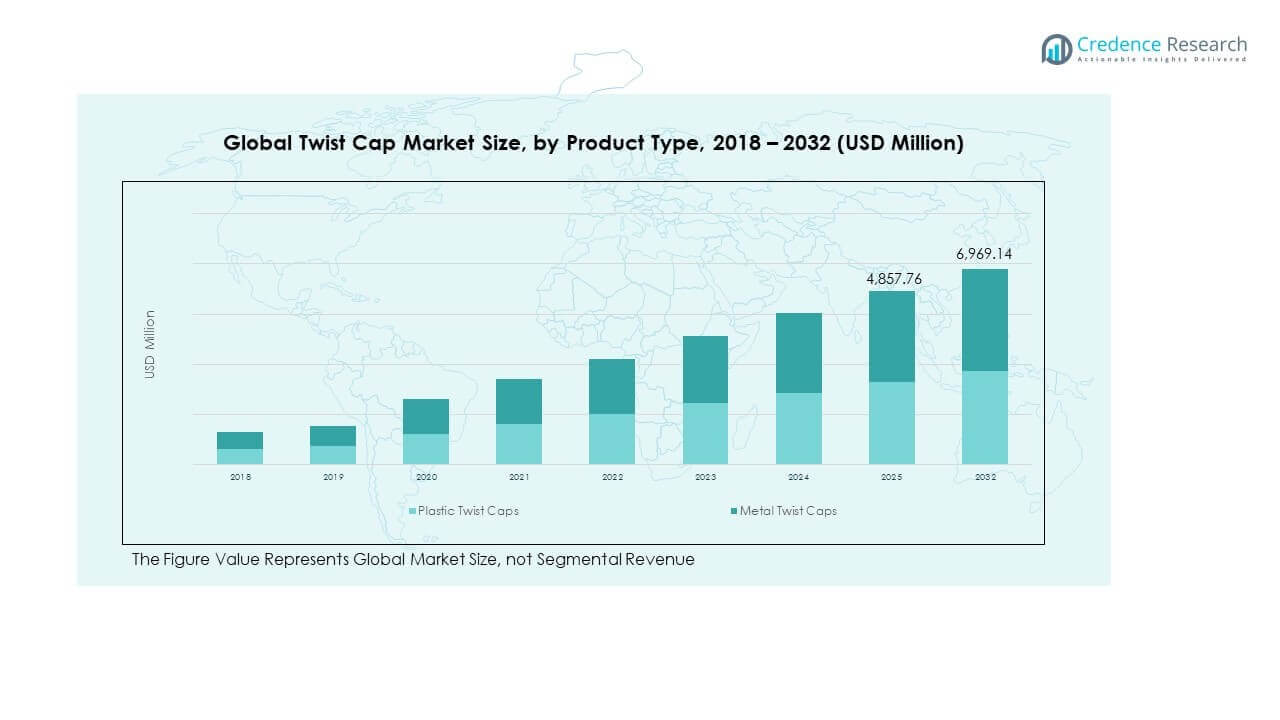
By Material Type: Plastic and Metal Segment Performance
The Global Twist Cap Market is segmented by material into plastic and metal categories. Plastic twist caps lead in volume, driven by polypropylene (PP) due to its durability, flexibility, and affordability. High-Density Polyethylene (HDPE) supports applications requiring impact resistance, while Polyethylene Terephthalate (PET) offers clarity for transparent packaging. Metal caps, such as aluminum and steel, serve premium food, beverage, and export-grade segments. They offer better sealing and aesthetics but come at a higher material cost. Plastic caps continue to dominate everyday consumer goods packaging. Metal caps retain strength in high-margin retail packaging. It reflects a balance between functionality and brand value.
- For instance, Guala Closures agreed to acquire Metal Crowns Group, a leading East African manufacturer of crown corks and plastic closures, with the deal confirmed in October 2025, strengthening its regional footprint and product portfolio in closures.
By Product Type: Functional Variety for Application Needs
The Global Twist Cap Market includes various product types, each aligned with specific packaging needs. Continuous Thread (CT) caps are widely used due to compatibility with standard neck finishes. Lug or Twist-Off caps serve processed food jars, offering ease of use. Flip-Top caps cater to personal care, allowing single-hand dispensing. Child-resistant caps meet safety norms in pharma, while tamper-evident formats assure product integrity. Growth in safety-focused and resealable closures drives innovation. Cap types evolve with retail and e-commerce packaging needs. It encourages tailored design for application-specific performance.
- For instance, Berry Global introduced a range of specialized plastic closures and caps for nutraceutical and consumer packaging applications in 2024, enhancing its product portfolio across multiple twist and snap closure formats.
By End-User and Application: Diverse Industry Penetration
The Global Twist Cap Market serves key industries including food and beverage, pharmaceuticals, personal care, household chemicals, and industrial packaging. Food and beverage lead in adoption, followed by regulated categories like pharmaceuticals. Personal care and cosmetics use flip-top and tamper-evident caps for brand differentiation. Bottles dominate application use, while jars support viscous products like sauces and creams. Containers and tubes serve specialty or travel-sized packs. It enables format flexibility across high and low viscosity contents. Cap formats respond to handling ease and shelf-life requirements.
By Distribution Channel: Strategic Sourcing and Market Reach
Distribution in the Global Twist Cap Market spans direct OEM supply, packaging distributors, and contract/private-label manufacturing. OEM supply remains dominant for large brands seeking volume reliability and price control. Packaging distributors enable access to diverse SKUs for SMEs and regional fillers. Contract manufacturers support customization and fast turnaround for private-label brands. It allows scale and design agility in regional markets. Distribution flexibility strengthens supplier reach across developed and emerging regions.
Segmentation:
By Material Type:
- Plastic Twist Caps
- Polypropylene (PP)
- High-Density Polyethylene (HDPE)
- Polyethylene Terephthalate (PET
- Metal Twist Caps
- Aluminum
- Steel
By Product Type:
- Continuous Thread (CT) Caps
- Lug / Twist-Off Caps
- Flip-Top Twist Caps
- Child-Resistant Twist Caps
- Tamper-Evident Twist Caps
By End-User Industry:
- Food & Beverage
- Pharmaceuticals
- Personal Care & Cosmetics
- Household Chemicals
- Industrial & Specialty Packaging
By Application:
- Bottles
- Jars
- Containers
- Tubes
By Distribution Channel:
- Direct OEM Supply
- Packaging Distributors
- Contract Manufacturing / Private Label
- North America
- U.S.
- Canada
- Mexico
- Europe
- Germany
- France
- U.K.
- Italy
- Spain
- Rest of Europe
- Asia Pacific
- China
- Japan
- India
- South Korea
- South-east Asia
- Rest of Asia Pacific
- Latin America
- Brazil
- Argentina
- Rest of Latin America
- Middle East & Africa
- GCC Countries
- South Africa
- Rest of the Middle East and Africa
Regional Analysis:
North America
The North America Global Twist Cap Market size was valued at USD 1,192.36 million in 2018 to USD 1,915.87 million in 2024 and is anticipated to reach USD 2,989.83 million by 2032, at a CAGR of 5.3% during the forecast period. North America held approximately 42.8% of the Global Twist Cap Market share in 2024. The region leads in adoption of tamper-evident and child-resistant twist caps, driven by strong regulatory frameworks. Food, beverage, and pharmaceutical industries account for major cap consumption. Growth in health supplements and OTC medicines supports demand for safety-compliant closures. Manufacturers prioritize recyclable materials and ergonomic designs. Twist caps serve across both mass-market and premium product lines. The U.S. dominates with high per-capita packaging consumption. It benefits from advanced capping machinery and integrated supply chains.
Europe
The Europe Global Twist Cap Market size was valued at USD 508.83 million in 2018 to USD 780.45 million in 2024 and is anticipated to reach USD 1,103.02 million by 2032, at a CAGR of 4.0% during the forecast period. Europe contributed 17.4% to the Global Twist Cap Market in 2024. The region emphasizes packaging sustainability, favoring lightweight and recyclable twist caps. Regulatory pressure drives demand for mono-material closures. Food jars, sauces, and cosmetic products are major application areas. Germany, France, and Italy remain key demand centers. Metal twist caps gain preference in premium food exports. Private-label goods use cost-effective plastic variants. It supports steady product innovation and custom branding in closures.
Asia Pacific
The Asia Pacific Global Twist Cap Market size was valued at USD 806.24 million in 2018 to USD 1,381.45 million in 2024 and is anticipated to reach USD 2,342.43 million by 2032, at a CAGR of 6.4% during the forecast period. Asia Pacific accounted for 30.8% of the Global Twist Cap Market in 2024. Rapid urbanization and expanding middle-class consumption drive demand for safe and affordable packaging. China and India lead in production and usage volume. Local manufacturers offer high-capacity output with cost efficiency. Twist caps are widely used in dairy, condiments, and health supplements. E-commerce and retail growth increase demand for tamper-evident packaging. Japan and South Korea drive adoption in personal care and pharma. It supports regional and export-focused packaging ecosystems.
Latin America
The Latin America Global Twist Cap Market size was valued at USD 127.51 million in 2018 to USD 204.42 million in 2024 and is anticipated to reach USD 280.77 million by 2032, at a CAGR of 3.6% during the forecast period. Latin America held 4.6% of the Global Twist Cap Market share in 2024. The region experiences gradual growth in packaged food and beverage consumption. Brazil and Mexico dominate cap demand with large FMCG sectors. Imports supplement local cap production, especially in pharma and personal care. Refillable bottle use in beverages drives reusable cap demand. Smaller brands adopt twist caps to meet safety and branding needs. Contract manufacturing supports local private label expansion. It offers growth potential through regional customization and cost-effective formats.
Middle East
The Middle East Global Twist Cap Market size was valued at USD 72.66 million in 2018 to USD 107.20 million in 2024 and is anticipated to reach USD 138.95 million by 2032, at a CAGR of 2.9% during the forecast period. The Middle East contributed 2.4% to the Global Twist Cap Market in 2024. Bottled water, condiments, and pharmaceutical products drive regional cap consumption. UAE and Saudi Arabia lead in packaging demand. Demand focuses on tamper-proof and hygienic closures for export and domestic use. Import reliance remains high for specialized cap types. Sustainability awareness begins influencing cap material selection. Brands explore lightweight plastic caps for high-volume goods. It supports premium branding in food and cosmetic categories.
Africa
The Africa Global Twist Cap Market size was valued at USD 50.29 million in 2018 to USD 88.92 million in 2024 and is anticipated to reach USD 114.13 million by 2032, at a CAGR of 2.8% during the forecast period. Africa accounted for 2.0% of the Global Twist Cap Market in 2024. Growth remains steady across packaged water, sauces, and over-the-counter health products. South Africa, Nigeria, and Kenya lead consumption in urban retail zones. Local cap manufacturing is limited, leading to imports of basic plastic variants. Cost sensitivity drives demand for standardized closures. Informal retail channels create demand for resealable and secure packaging. Brand owners adopt caps for shelf stability and leakage control. It presents long-term growth through infrastructure expansion and FMCG penetration.
Key Player Analysis:
- Berry Global Group
- Silgan Holdings
- AptarGroup
- Closure Systems International (CSI)
- Guala Closures
Competitive Analysis:
The Global Twist Cap Market features a competitive mix of global packaging giants and regional manufacturers. Leading players include Berry Global, Silgan Holdings, AptarGroup, Closure Systems International, and Guala Closures. These companies invest in cap innovation, sustainable materials, and high-speed manufacturing systems. It remains highly cost-sensitive, pushing suppliers to optimize production efficiency and supply chain integration. Product differentiation focuses on tamper-evidence, child resistance, ergonomic design, and recyclability. Regional firms serve local FMCG and healthcare sectors with customizable solutions and flexible volumes. Strategic partnerships with food, beverage, and pharma brands secure recurring contracts. Private label growth boosts demand for contract manufacturing, favoring players with scalable operations. The market continues to shift toward automation, material circularity, and branding-focused closure formats. It offers steady competitive intensity across both mature and emerging regions.
Recent Developments:
- In November 2024, Berry Global Group announced an agreement to combine with Amcor in an all-stock transaction creating a global leader in consumer packaging solutions with enhanced capabilities in containers and closures, a key segment of the Global Twist Cap Market; the deal completed on April 30, 2025.
Report Coverage:
The research report offers an in-depth analysis based on Material Type, Product Type, End-User Industry, Application and Distribution Channel. It details leading market players, providing an overview of their business, product offerings, investments, revenue streams, and key applications. Additionally, the report includes insights into the competitive environment, SWOT analysis, current market trends, as well as the primary drivers and constraints. Furthermore, it discusses various factors that have driven market expansion in recent years. The report also explores market dynamics, regulatory scenarios, and technological advancements that are shaping the industry. It assesses the impact of external factors and global economic changes on market growth. Lastly, it provides strategic recommendations for new entrants and established companies to navigate the complexities of the market.
Future Outlook:
- Growing demand for tamper-evident and child-resistant closures will strengthen regulatory-compliant packaging across sectors.
- Innovation in recyclable and lightweight materials will drive product development aligned with circular economy goals.
- Rapid growth in single-use and on-the-go food and beverage packaging will increase demand for resealable cap formats.
- Automated capping lines in pharma and FMCG sectors will favor precision-engineered twist cap designs.
- Market expansion in Asia-Pacific and Africa will be fueled by rising consumption and retail infrastructure growth.
- Premium personal care and health supplement products will adopt flip-top and customized twist caps for differentiation.
- Private-label brand expansion will support demand for contract manufacturing and design-flexible cap suppliers.
- Digital printing, embossing, and brand integration on caps will grow with increased focus on packaging aesthetics.
- Government mandates on mono-material and recyclable caps will reshape supply chains and product portfolios.
- Strategic partnerships and acquisitions among cap manufacturers and filler lines will define competitive leadership.
Request a Free Sample
Fill in your details and we'll send you a free sample report.
- Sample data tables & charts
- Research methodology
Need a Custom Version of This Report?
Tailor the scope, geography, or segments to your exact requirements.
- Custom geography or segment scope
- Direct access to our analyst team
Frequently Asked Questions
What is the current market size for Global Twist Cap Market, and what is its projected size in 2032?
At what Compound Annual Growth Rate is the Global Twist Cap Market projected to grow between 2024 and 2032?
Which Global Twist Cap Market segment held the largest share in 2024?
What are the primary factors fueling the growth of the Global Twist Cap Market?
Who are the leading companies in the Global Twist Cap Market?
Which region commanded the largest share of the Global Twist Cap Market in 2024?
Table of Content
Chapter 1. Report Introduction
- 1.1 Report Description & Purpose
- 1.1.1 Report Title & Market Definition
- 1.1.2 Unique Selling Propositions (USP) & Key Differentiators
- 1.1.3 Value Proposition for Stakeholders
- 1.2 Research Objectives
- 1.2.1 Market Sizing Objectives (Volume & Revenue)
- 1.2.2 Segmentation Objectives
- 1.2.3 Competitive Intelligence Objectives
- 1.2.4 Forecast & Scenario Objectives
- 1.3 Report Scope
- 1.3.1 Twist Cap Scope – Types & Subtypes Covered
- 1.3.2 Geographic Scope – Regions & Countries Covered
- 1.3.3 Historical Period, Base Year & Forecast Period (2024; forecast to 2032)
- 1.3.4 Inclusions & Exclusions
- 1.4 HS Code & Classification Framework
- 1.5 Currency, Units & Pricing Basis
- 1.6 Target Stakeholders
- 1.7 Limitations & Assumptions
Chapter 2. Executive Summary
- 2.1 Global Twist Cap Market Snapshot
- 2.1.1 Market Size – Historical (2024) & Forecast (2024-2032) (2024: USD 4,478.32 million → 2032: USD 6,969.14 million)
- 2.1.2 Volume & Revenue – Global Totals
- 2.1.3 Key Market Highlights – Top Five Facts
- 2.2 Twist Cap Market Segmentation Snapshot
- 2.2.1 Market Split by Region – 2024 vs. 2032
- 2.3 Competitive Snapshot
- 2.3.1 Top 10 Players by Revenue Share – 2024
- 2.3.2 Top 10 Players by Volume Share – 2024
- 2.3.3 Recent Strategic Developments (18-Month Summary)
- 2.4 Key Investment Highlights & Strategic Conclusions
Chapter 3. Twist Cap Market Dynamics & Industry Analysis
- 3.1 Market Overview & Context
- 3.1.1 Twist Cap Market Position in the Broader Automotive Value Chain
- 3.1.2 OEM vs. Replacement Market Dynamics
- 3.1.3 Market Maturity & Development Stage by Region
- 3.2 Twist Cap Market Drivers
- 3.3 Twist Cap Market Restraints & Challenges
- 3.4 Twist Cap Market Opportunities
- 3.5 Porter's Five Forces Analysis
- 3.5.1 Threat of New Entrants
- 3.5.2 Bargaining Power of Suppliers
- 3.5.3 Bargaining Power of Buyers
- 3.5.4 Threat of Substitutes
- 3.5.5 Competitive Rivalry – Intensity Assessment
- 3.6 Twist Cap Value Chain Analysis
- 3.6.1 Upstream – Raw Material/Input Suppliers
- 3.6.1.1 Raw Material/Input 1
- 3.6.1.2 Raw Material/Input 2
- 3.6.1.3 Raw Material/Input 3
- 3.6.2 Midstream – Production/Manufacturing/Service Delivery
- 3.6.2.1 Production/Process Overview
- 3.6.2.2 Key Facility Locations & Capacity by Manufacturer
- 3.6.3 Downstream – Distribution & End Consumer
- 3.6.3.1 Primary Channel – B2B/OEM
- 3.6.3.2 Secondary Channels – Dealer, Retail, Online, Direct
- 3.6.4 Value Chain Profitability Analysis
- 3.6.1 Upstream – Raw Material/Input Suppliers
- 3.7 PESTEL Analysis
- 3.7.1 Political Factors
- 3.7.2 Economic Factors
- 3.7.3 Social Factors
- 3.7.4 Technological Factors
- 3.7.5 Environmental Factors
- 3.7.6 Legal Factors
- 3.8 Twist Cap Supply Chain Analysis
- 3.8.1 Raw Material/Input Supply Risk Assessment
- 3.8.2 Manufacturing Concentration Risk (Geographic Exposure)
- 3.8.3 Trade Disruption Impact Analysis
- 3.9 Regulatory & Policy Landscape
Note: The regulatory and policy landscape section covers regulations based on their applicability to the market, Twist Cap category, geography, and scope of the study. Only regulatory frameworks with a material impact on operations, compliance, trade, sustainability, or market access are analyzed in detail.
Chapter 4. Key Investment Pockets & Opportunity Analysis
- 4.1 Twist Cap Market Attractiveness Analysis
- 4.1.1 By Region – Investment Attractiveness Matrix (Volume × CAGR)
- 4.2 Absolute Revenue Growth Opportunity
- 4.2.1 By Region – Absolute USD Growth Through 2032
- 4.3 Incremental Volume Opportunity
- 4.3.1 By Region – Incremental Volume Through 2032
- 4.3.2 Segment – Incremental Volume
- 4.4 Emerging Submarket Opportunity Deep Dive (Subject to Applicability)
- 4.5 Emerging Market Opportunity Scorecards
- 4.5.1 United States
- 4.5.2 Europe
- 4.5.3 Asia
- 4.5.4 Middle East & Africa
Note: Emerging Market Opportunity Scorecards will be included based on relevance and strategic importance. Regions listed are indicative and may vary depending on data availability and market dynamics.
Chapter 5. Twist Cap Import-Export Analysis & Trade Flows
- 5.1 Global Trade Overview
- 5.1.1 Global Export Value by Country (2024)
- 5.1.2 Global Export Volume by Country (2024)
- 5.1.3 Global Import Value by Country (2024)
- 5.1.4 Global Import Volume by Country (2024)
- 5.1.5 Net Trade Balance by Country (2024)
- 5.2 Export Analysis – Segment
- 5.2.1 Type 1 (HS Code)
- 5.2.2 Type 2 (HS Code)
- 5.2.3 Type 3 (HS Code)
- 5.2.4 Type 4 (HS Code)
- 5.2.5 Type 5 (HS Code)
- 5.3 Import Analysis – Segment
- 5.3.1 Type 1 (HS Code)
- 5.3.2 Type 2 (HS Code)
- 5.3.3 Type 3 (HS Code)
- 5.3.4 Type 4 (HS Code)
- 5.3.5 Type 5 (HS Code)
- 5.4 Average Unit Trade Prices
- 5.4.1 Average Export Price – Segment & Country
- 5.4.2 Average Import Price – Segment & Source Country
- 5.4.3 Price Trends (2024)
- 5.5 Key Trade Route Analysis
- 5.5.1 Trade Route 1
- 5.5.2 Trade Route 2
- 5.5.3 Trade Route 3
- 5.5.4 Trade Route 4
- 5.5.5 Trade Route 5
- 5.6 Trade Policy Impact Assessment
- 5.6.1 US Anti-Dumping & Section 301 Tariffs
- 5.6.2 EU Customs Union Impact
- 5.6.3 Major Free Trade Agreements
- 5.6.4 USMCA Rules of Origin
Note: Trade policy analysis will be included only where relevant to the Twist Cap market.
Chapter 6. Competitive Landscape & Company Benchmarking
- 6.1 Twist Cap Market Concentration & Structure
- 6.1.1 Herfindahl-Hirschman Index (HHI) – vs. 2024
- 6.1.2 Tier 1, Tier 2 & Tier 3 Market Structure
- 6.1.3 Global, Regional & Local Player Dynamics
- 6.2 Twist Cap Market Share Analysis – 2024
- 6.2.1 Global Revenue Share by Company
- 6.2.2 Global Volume Share by Company
- 6.2.3 Regional Revenue Share
- 6.2.4 Market Share Evolution ( vs. 2024)
- 6.2.5 OEM Segment Share by Company
- 6.2.6 Replacement Segment Share by Company
- 6.3 Production/Delivery Capacity & Facility Analysis
- 6.3.1 Global Installed Capacity
- 6.3.2 Capacity Utilization Rates
- 6.3.3 Production/Output Volume
- 6.3.4 Facility Locations & Capacity Map
- 6.3.5 Planned Capacity Additions
- 6.4 Twist Cap Competitive Benchmarking Matrix
- 6.4.1 Revenue, Volume, CAGR & Profitability Comparison
- 6.4.2 Channel Revenue Mix
- 6.4.3 Geographic Revenue Exposure
- 6.4.4 R&D Intensity
- 6.4.5 Sustainability Maturity
- 6.5 Strategic Developments in Twist Cap (Last 24 Months)
- 6.5.1 Mergers, Acquisitions & Divestments
- 6.5.2 New Twist Cap Launches
- 6.5.3 Facility Expansions
- 6.5.4 Strategic Alliances, Joint Ventures & Partnerships
- 6.5.5 Distribution Expansion & Market Entry
- 6.5.6 Sustainability & ESG Initiatives
- 6.6 Competitive Strategy Mapping
- 6.6.1 Leader, Challenger, Follower & Niche Classification
- 6.6.2 Pricing Strategy Comparison
- 6.6.3 Channel Strategy Matrix
Note: Strategic developments are included based on their materiality and the availability of reliable information.
Chapter 7. Global Twist Cap Market – By Distribution Channel
- 7.1 Segment Overview
- 7.1.1 Volume & Revenue Split by Channel (2024 & 2032)
- 7.1.2 Channel Mix Evolution (2024-2032)
Chapter 8. Regional Market Analysis – Global Overview
- 8.1 Global Regional Overview
- 8.1.1 Regional Volume Share
- 8.1.2 Regional Revenue Share
- 8.1.3 Regional Volume by Region
- 8.1.4 Regional Revenue by Region
- 8.1.5 Regional Forecast Through 2032
- 8.2 Cross-Regional Segment Analysis
- 8.2.1 By Distribution Channel
- 8.2.2 By Brand/Price Tier
Chapter 9. North America Twist Cap Market
- 9.1 United States
- 9.2 Canada
- 9.3 Mexico
Chapter 10. Europe Twist Cap Market
- 10.1 Germany
- 10.2 France
- 10.3 Italy
- 10.4 United Kingdom
- 10.5 Spain
- 10.6 Poland
- 10.7 Russia
- 10.8 Netherlands
- 10.9 Belgium
- 10.10 Sweden
- 10.11 Denmark
- 10.12 Norway
- 10.13 Rest of Europe
Chapter 11. Asia Pacific Twist Cap Market
- 11.1 China
- 11.2 India
- 11.3 Japan
- 11.4 South Korea
- 11.5 Thailand
- 11.6 Indonesia
- 11.7 Vietnam
- 11.8 Malaysia
- 11.9 Australia
- 11.10 Rest of Asia Pacific
Chapter 12. Latin America Twist Cap Market
- 12.1 Brazil
- 12.2 Argentina
- 12.3 Colombia
- 12.4 Chile
- 12.5 Rest of Latin America
Chapter 13. Middle East Twist Cap Market
- 13.1 Saudi Arabia
- 13.2 United Arab Emirates
- 13.3 Turkey
- 13.4 Israel
- 13.5 Iran
- 13.6 Rest of the Middle East
Chapter 14. Africa Twist Cap Market
- 14.1 South Africa
- 14.2 Egypt
- 14.3 Nigeria
- 14.4 Morocco
- 14.5 Rest of Africa
Chapter 15. Twist Cap Company Profiles
- 15.1 [Company 01]
- 15.1.1 Company Overview
- 15.1.2 Key Management Personnel
- 15.1.3 Products & Services Portfolio
- 15.1.4 Financial Performance
- 15.1.5 Key Market Focus & Geographic Presence
- 15.1.6 Recent Developments & Strategic Initiatives
Note: The company profile list is preliminary and may change based on research findings, market developments, data availability, and client requirements.
Chapter 16. Appendices
- Appendix A – List of Abbreviations & Acronyms
- Appendix B – Industry Classification Code Reference – Full Series
- Appendix C – Production & Capacity Data Tables
- Appendix D – End-Use & Demand Base Tables
- Appendix E – Consumption & Replacement Rate Assumptions
- Appendix F – ASP Reference Tables
- Appendix G – Manufacturing & Facility Database
- Appendix H – Import-Export Data Tables
- Appendix I – Regulatory Summary Tables
- Appendix J – Primary Research Participant List (Anonymized)
- Appendix K – Primary Research Questionnaire Framework
- Appendix L – Data Sources & Bibliography
- Appendix M – Market Size Divergence & Source Comparison
Chapter 17. Research Methodology
- 17.1 Research Framework & Philosophy
- 17.2 Secondary Research – Sources, Hierarchy & Data Extraction
- 17.3 Data Modeling – Bottom-Up & Top-Down Market Sizing
- 17.4 Primary Research – Stakeholder Framework, LOI & Sample Sizes
- 17.5 Forecast Methodology – Regression, Scenario & Sensitivity Analysis
- 17.6 Quality Control – Four-Layer Validation Framework
- 17.7 Limitations & Standard Assumptions
- 17.8 Disclaimer
