
Market Overview:
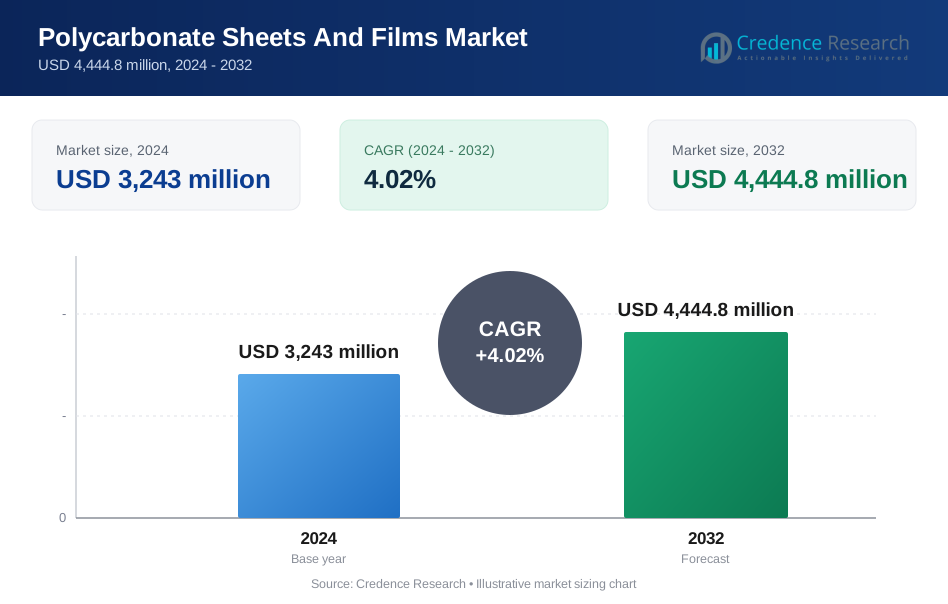
The Polycarbonate Sheets and Films Market is projected to grow from USD 3,243 million in 2024 to an estimated USD 4,444.8 million by 2032, with a compound annual growth rate (CAGR) of 4.02% from 2024 to 2032.
| REPORT ATTRIBUTE | DETAILS |
|---|---|
| Historical Period | 2020-2023 |
| Base Year | 2024 |
| Forecast Period | 2025-2032 |
| Polycarbonate Sheets And Films Market Size 2024 | USD 3,243 million |
| Polycarbonate Sheets And Films Market, CAGR | 4.02% |
| Polycarbonate Sheets And Films Market Size 2032 | USD 4,444.8 million |
Growth in the Polycarbonate Sheets and Films Market is fueled by increasing infrastructure modernization and lightweight material adoption in automotive manufacturing. The electronics sector favors polycarbonate films for durable displays and optical components, while industrial construction benefits from energy-efficient sheet solutions. Manufacturers focus on UV-resistant and recyclable grades, improving sustainability and lifecycle performance. Technological advancements, such as improved extrusion and coating techniques, further optimize product quality and application diversity across industries.
Regionally, Asia Pacific dominates the Polycarbonate Sheets and Films Market due to strong industrialization, construction expansion, and electronics production in China, Japan, and South Korea. North America follows, supported by growing use in green buildings and electric vehicle components. Europe remains a significant contributor due to its stringent environmental standards and advanced manufacturing capabilities. Emerging regions like Latin America and the Middle East show rising demand with ongoing infrastructure projects and investments in energy-efficient building materials.

Market Insights:
- The Polycarbonate sheets and films market stood at USD 3,243 million in 2024 and is projected to reach USD 4,444.8 million by 2032, registering a CAGR of 4.02% during the forecast period.
- Asia-Pacific leads with about 45% share due to strong construction and electronics output, followed by North America at 25% driven by renovation and automotive demand, and Europe at 20% supported by advanced manufacturing and safety standards.
- Asia-Pacific is also the fastest-growing region, holding nearly 45% share, supported by urbanization, infrastructure spending, and expanding automotive production bases.
- By end-user industry, construction accounts for around 40% share due to roofing and glazing demand, while automotive contributes nearly 20% driven by lightweight material adoption.
- By type, solid sheets and films dominate with about 50% share owing to impact strength and optical clarity, while multi-walled sheets hold close to 30% due to insulation benefits.
Market Drivers:
Rising Demand From Construction And Infrastructure Applications
The Polycarbonate sheets and films market gains momentum from steady construction activity worldwide. Builders prefer polycarbonate due to high impact strength and light weight. Roofing, glazing, and skylight projects rely on durable transparent materials. The material supports energy-efficient building designs across climates. Urban housing growth sustains long-term material demand. Commercial spaces adopt polycarbonate for safety and design flexibility. Renovation projects also increase replacement demand. It supports faster installation and lower structural load.
- For instance, Palram Industries Ltd. reports that solid polycarbonate sheets deliver impact resistance up to 250 times stronger than glass, supporting safety glazing in large commercial roofs.
Growing Adoption In Automotive And Transportation Manufacturing
The Polycarbonate sheets and films market benefits from lightweight material adoption in vehicles. Automakers use polycarbonate to reduce vehicle weight. Lower weight supports fuel efficiency and emission targets. Interior trims and exterior glazing favor impact-resistant sheets. Electric vehicle platforms increase material substitution trends. Safety regulations push demand for shatter-resistant materials. Polycarbonate supports complex shapes with design freedom. It enhances durability across harsh operating conditions.
- For instance, Covestro AG supplies Makrolon® polycarbonate used in panoramic automotive glazing, which weighs around 50% less than conventional glass while meeting automotive safety standards.
Expanding Use In Electrical And Electronics Manufacturing
The Polycarbonate sheets and films market sees strong demand from electronics manufacturing. Consumer devices require durable and heat-resistant films. Display panels use polycarbonate for optical clarity. Electrical insulation applications rely on stable dielectric properties. Miniaturized devices favor thin and flexible films. Industrial electronics require consistent thermal performance. Manufacturers trust polycarbonate for long service life. It supports reliable performance in compact assemblies.
Preference For Impact Resistance And Design Versatility
The Polycarbonate sheets and films market grows due to performance-driven material selection. Industries seek alternatives to glass and acrylic. High impact resistance improves safety in public spaces. Designers value ease of fabrication and forming. Polycarbonate allows cold bending without fracture risk. Surface coatings improve scratch and UV resistance. End users benefit from long product lifespan. It supports both functional and aesthetic requirements.
Market Trends:
Shift Toward Multi-Layer And Coated Sheet Technologies
The Polycarbonate sheets and films market trends toward advanced layered products. Manufacturers develop multi-wall and hollow structures. These designs improve insulation and load capacity. Coatings enhance UV protection and surface hardness. Optical clarity improves with refined extrusion processes. Product differentiation supports premium pricing strategies. Industrial buyers prefer high-performance variants. It strengthens value-added product portfolios.
- For instance, SABIC offers LEXAN™ multiwall sheets with UV-protected surfaces that retain clarity for over 10 years in outdoor construction applications, supporting long service life.
Rising Focus On Recyclable And Circular Material Solutions
The Polycarbonate sheets and films market aligns with sustainability-focused production. Producers invest in recyclable polycarbonate grades. Circular material use gains attention across industries. Closed-loop manufacturing reduces waste output. Customers demand environmentally responsible materials. Regulatory pressure supports sustainable product adoption. Material recovery technologies continue to improve. It aligns supply chains with green objectives.
- For instance, Teijin Limited operates chemical recycling processes that recover polycarbonate feedstock at near-virgin quality, supporting reuse in electronics and automotive components.
Customization And Application-Specific Product Development
The Polycarbonate sheets and films market moves toward customized solutions. End users demand application-specific thickness and finishes. Industrial buyers seek tailored thermal and optical properties. Color-tinted and textured sheets gain acceptance. Custom sizes reduce installation waste. Rapid prototyping supports faster product adaptation. Suppliers enhance technical support services. It improves customer retention and margins.
Increased Automation In Manufacturing And Processing
The Polycarbonate sheets and films market reflects higher automation levels. Producers adopt precision extrusion and cutting systems. Automation improves consistency and surface quality. Production efficiency reduces defect rates. Digital monitoring enhances process control. Automation supports large-scale output stability. Labor dependency declines across facilities. It improves long-term cost competitiveness.
Market Challenges Analysis:
Volatility In Raw Material Prices And Supply Chains
The Polycarbonate sheets and films market faces raw material price instability. Polycarbonate resin depends on petrochemical feedstocks. Price swings affect cost planning and margins. Supply chain disruptions impact production schedules. Import dependence increases exposure to global risks. Smaller producers struggle with cost absorption. Contract pricing limits flexibility in volatile periods. It pressures profitability across the value chain.
Competition From Alternative Transparent Materials
The Polycarbonate sheets and films market encounters competition from substitutes. Acrylic and tempered glass compete in key applications. Cost-sensitive buyers prefer lower-priced alternatives. Some sectors favor traditional materials for familiarity. Performance trade-offs influence material choice decisions. Awareness gaps limit polycarbonate adoption in some regions. Market education requires sustained investment. It slows penetration in conservative industries.
Market Opportunities:
Expansion In Emerging Infrastructure And Industrial Economies
The Polycarbonate sheets and films market holds strong growth potential in emerging regions. Infrastructure expansion supports material demand. Industrial parks increase consumption of durable sheets. Urban transit projects require impact-resistant glazing. Governments invest in public safety materials. Rising income levels support modern building materials. Local manufacturing capacity continues to improve. It unlocks new regional revenue streams.
Innovation In High-Performance And Specialty Applications
The Polycarbonate sheets and films market offers opportunities through innovation. High-temperature and flame-retardant grades gain relevance. Medical and security applications demand certified materials. Smart building integration supports advanced glazing solutions. Lightweight protection systems expand defense usage. Research focuses on enhanced optical performance. Specialty products command higher margins. It strengthens long-term competitive positioning.
Market Segmentation Analysis:
By Type
The Polycarbonate sheets and films market shows clear differentiation across type segments. Solid sheets and films lead due to high impact strength, optical clarity, and wide industrial use. Construction and automotive sectors prefer these products for safety glazing and protective panels. Corrugated sheets and films gain traction in roofing and agricultural structures. These products offer light weight and easy installation. Multi-walled sheets and films support thermal insulation needs. Green buildings and industrial sheds favor such structures. It benefits applications that demand energy efficiency and load reduction.
- For instance, Palram Industries Ltd. produces multiwall sheets with thermal insulation values that reduce heat transfer compared to single-layer plastics.
By End-User Industry
The Polycarbonate sheets and films market reflects diverse demand across end-user industries. Construction remains the largest consumer due to roofing, cladding, and glazing needs. Automotive manufacturers adopt polycarbonate for lightweight interiors and exterior components. Electrical and electronics use films for insulation and durable displays. Agriculture applies sheets in greenhouses and protective coverings. Aerospace adopts polycarbonate for interior panels and transparent components. Other industries include signage and safety equipment. It supports performance, durability, and design flexibility across sectors.
- For instance, 3M Company supplies polycarbonate-based films for electronic displays that meet UL flame-retardant standards, supporting reliability across industrial and consumer electronics.
Segmentation:
By Type- Solid sheets and films
- Corrugated sheets and films
- Multi-walled sheets and films
- Aerospace
- Agriculture
- Automotive
- Construction
- Electrical & Electronics
- Others
- North America
- U.S.
- Canada
- Mexico
- Europe
- Germany
- France
- U.K.
- Italy
- Spain
- Rest of Europe
- Asia Pacific
- China
- Japan
- India
- South Korea
- South-east Asia
- Rest of Asia Pacific
- Latin America
- Brazil
- Argentina
- Rest of Latin America
- Middle East & Africa
- GCC Countries
- South Africa
- Rest of the Middle East and Africa
Regional Analysis:
Asia-Pacific
The Polycarbonate sheets and films market holds the largest share in Asia-Pacific, accounting for about 45% of global demand. China leads regional consumption due to strong construction and electronics manufacturing activity. Japan and South Korea support growth through advanced automotive and electrical applications. Rapid urbanization increases demand for roofing and glazing materials. Agricultural greenhouse adoption also supports volume growth. India emerges as a key growth market due to infrastructure expansion. It benefits from cost-competitive manufacturing and rising domestic consumption.
North America
The Polycarbonate sheets and films market in North America represents nearly 25% of global share. The United States dominates regional demand due to construction renovation and automotive lightweighting trends. Strong demand for impact-resistant glazing supports steady consumption. Electrical and electronics applications sustain film demand across industries. Regulatory focus on building safety favors polycarbonate adoption. Innovation in coated and high-performance sheets strengthens supplier positioning. It maintains stable demand across mature end-user sectors.
Europe, South America, And Middle East & Africa
The Polycarbonate sheets and films market in Europe accounts for around 20% of global share. Germany, France, and the UK lead due to advanced construction standards and automotive manufacturing. Sustainability policies support adoption of durable and recyclable materials. South America contributes nearly 6% share, driven by Brazil’s construction and agriculture sectors. Middle East & Africa holds about 4% share with demand from commercial buildings and infrastructure projects. Climate-resistant materials gain preference in this region. It supports gradual expansion through long-term development projects.
Key Player Analysis:
- Covestro AG
- SABIC
- Teijin Limited
- LG Chem
- Trinseo
- Mitsubishi Gas Chemical Company
- Palram Industries Ltd.
- 3M Company
Competitive Analysis:
The Polycarbonate sheets and films market features strong competition among global and regional manufacturers. Large players focus on product quality, capacity expansion, and technical support. Companies invest in advanced extrusion and coating capabilities to strengthen portfolios. Product differentiation centers on durability, UV resistance, and optical clarity. Strategic pricing and long-term supply contracts shape buyer relationships. Regional manufacturers compete through cost efficiency and local distribution strength. Innovation and customization improve customer retention across end-use industries. It remains moderately consolidated with clear leaders and several niche suppliers.
Recent Developments:
- Covestro AG demonstrated substantial innovation across multiple applications in the polycarbonate sheets and films sector. In February 2024, the company showcased smart film solutions tailored for printed electronics at LOPEC 2024, featuring its Makrolon® AG polycarbonate resin and Makrofol® PC film technology with integrated heaters for LiDAR cover lenses designed with Canatu for automotive applications. The company expanded its production capacity for polycarbonate films in Thailand in March 2023, with an investment in the higher double-digit million euro range scheduled for completion in 2025. Covestro continued strengthening its position by presenting high-performance polycarbonate solutions at Computex 2025 in May 2025, emphasizing materials for consumer electronics and automotive smart surfaces featuring In-Mold Structural Electronics (IMSE®) technology that enables integration of lighting, haptics, displays, and electronic circuits. Most recently, in November 2025, Covestro showcased its Certevo® polymeric substrate at TRUSTECH 2025 in Paris, demonstrating how this innovative material is being integrated into real-world security printing applications including certificates, diplomas, vehicle registration papers, and fiscal documents, with capabilities for laser personalization and secure color personalization of polycarbonate documents.
- Trinseo made a strategic exit from virgin polycarbonate production while establishing a technology partnership with an emerging Indian manufacturer. In October 2024, the company announced its decision to exit virgin polycarbonate production at its facility in Stade, Germany, with production expected to end in January 2025, as part of a broader business reorganization combining its Engineered Materials, Plastic Solutions, and Polystyrene businesses. In November 2024, Trinseo signed agreements with Deepak Nitrite Limited (through its subsidiary Deepak Chem Tech) to supply a polycarbonate technology license as well as all proprietary polycarbonate production equipment located in Stade, Germany for use in India, with a total transaction value of USD 52.5 million, expected to receive approximately USD 9 million by the end of 2024 and an additional USD 21 million in the first half of 2025. This strategic partnership represents Trinseo's initial steps in a collaborative arrangement with Deepak as both companies explore additional opportunities to leverage technology portfolios and expand in higher-growth markets such as India.
- LG Chem expanded its polycarbonate and film portfolio through strategic partnerships and innovative product development. In April 2024, the company announced a strategic partnership with Webasto, a global leader in automotive sunroof systems, to supply switchable glazing film (SGF) for advanced automotive sunroof systems designed for European vehicles, with mass production planned for later in 2024 and full-scale sales beginning in the second half of 2025, with annual capacity for 3 million vehicles. The company further expanded its sustainability initiatives in August 2024 by developing world-first cosmetics containers made from polyethylene carbonate (PEC), a plastic derived from carbon dioxide, offering flexibility, transparency, and excellent oxygen barrier properties. In September 2025, LG Chem completed development of both liquid and film-type photopolymer materials (PID) optimized for advanced IC substrates, with the liquid PID delivering high-resolution patterning with low-temperature curing while being free of PFAS and organic solvents. Most significantly, in October 2025, LG Chem and ZEISS established a strategic alliance for industrial-scale photopolymer film supply in advanced optics, with co-development of photopolymer solutions for next-generation automotive holographic windshield displays targeting OEM production by 2029.
Report Coverage:
The research report offers an in-depth analysis based on By Type and By End-User Industry segments. It details leading market players, providing an overview of their business, product offerings, investments, revenue streams, and key applications. Additionally, the report includes insights into the competitive environment, SWOT analysis, current market trends, as well as the primary drivers and constraints. Furthermore, it discusses various factors that have driven market expansion in recent years. The report also explores market dynamics, regulatory scenarios, and technological advancements that are shaping the industry. It assesses the impact of external factors and global economic changes on market growth. Lastly, it provides strategic recommendations for new entrants and established companies to navigate the complexities of the market.
Future Outlook:
- Construction activity across residential and commercial projects will continue to support steady material demand.
- Automotive manufacturers will increase use of lightweight polycarbonate components to improve efficiency and safety.
- Electronics production will expand application of durable and heat-resistant films.
- Sustainable and recyclable polycarbonate grades will gain stronger market acceptance.
- Emerging economies will create new demand through infrastructure and industrial growth.
- Automation in manufacturing will enhance product consistency and cost control.
- Coated and multi-layer sheet technologies will see wider adoption across end users.
- Strategic partnerships will support development of application-specific solutions.
- Supply chain optimization will remain a priority for leading manufacturers.
- Product customization will strengthen long-term customer relationships and competitiveness.
Request a Free Sample
Fill in your details and we'll send you a free sample report.
- Sample data tables & charts
- Research methodology
Need a Custom Version of This Report?
Tailor the scope, geography, or segments to your exact requirements.
- Custom geography or segment scope
- Direct access to our analyst team
Frequently Asked Questions
What is the current market size for Polycarbonate sheets and films market, and what is its projected size in 2032?
At what Compound Annual Growth Rate is the Polycarbonate sheets and films market projected to grow between 2025 and 2032?
Which Polycarbonate sheets and films market segment held the largest share in 2024?
What are the primary factors fueling the growth of the Polycarbonate sheets and films market?
Who are the leading companies in the Polycarbonate sheets and films market?
Which region commanded the largest share of the Polycarbonate sheets and films market in 2024?
Table of Content
Chapter 1 Market Segmentation
- 1.1 Segmentation Framework
- 1.1.1 Product and Service Classification
- 1.1.2 Application and End-Use Classification
- 1.1.3 Technology and Solution Classification
- 1.1.4 Customer and Distribution Channel Classification
- 1.1.5 Geographic Segmentation
- 1.1.6 Market Segment Definitions and Boundaries
Chapter 2 Introduction
- 2.1 Report Objectives and Scope
- 2.2 Product Definition and Industry Terminology
- 2.3 Market Inclusions and Exclusions
- 2.4 Research Process
- 2.4.1 Primary Research and Expert Interviews
- 2.4.2 Secondary Research and Source Review
- 2.4.3 Top-Down and Bottom-Up Estimation
- 2.4.4 Data Triangulation and Verification
- 2.5 Market Size Measurement Basis
- 2.5.1 2024: USD 3,243 million → 2032: USD 4,444.8 million
- 2.6 Historical and Forecast Reference Periods
- 2.6.1 Base Year: 2024
- 2.6.2 Forecast Period: 2024-2032
- 2.7 Research Assumptions and Limitations
Chapter 3 Executive Summary
- 3.1 Market Snapshot and Key Findings
- 3.2 Base-Year Market Size, 2024
- 3.3 Forecast Market Size, 2032
- 3.4 Revenue and Volume Growth Outlook
- 3.5 Key Demand and Supply Indicators
- 3.6 Leading Market Segments
- 3.7 Fastest-Growing Market Opportunities
- 3.8 Regional Performance Highlights
- 3.9 Technology and Industry Transformation
- 3.10 Competitive Landscape Summary
- 3.11 Analyst View and Strategic Implications
Chapter 4 Global Polycarbonate Sheets And Films Market Trends and Developments
- 4.1 Historical Industry Development
- 4.2 Recent Market Trends and Developments
- 4.3 Demand and Customer Behavior Trends
- 4.4 Technology and Product Innovation
- 4.5 Artificial Intelligence, Automation and Digitalization
- 4.6 Local Manufacturing and Supply Chain Realignment
- 4.7 Industry Partnerships, Mergers and Acquisitions
- 4.8 Sustainability and Circular Economy Developments
- 4.9 Government and Private Sector Investment Trends
- 4.10 Emerging Business Models and Commercialization
- 4.11 Industry Developments and Announcements
Chapter 5 Global Polycarbonate Sheets And Films Market Production, Supply and Demand Analysis
- 5.1 Demand Trend and Consumption Analysis
- 5.2 Demand Forecast, 2024-2032
- 5.3 Production and Output Trend
- 5.4 Production and Output Forecast, 2024-2032
- 5.5 Installed Capacity and Capacity Utilization
- 5.6 Company-Wise Production Plants and Statistics
- 5.6.1 Installed Production Capacity
- 5.6.2 Actual Production
- 5.6.3 Planned Capacity and Expansion Targets
- 5.7 Supply Chain Structure and Procurement Trends
- 5.8 Supply-Demand Gap and Bottlenecks
- 5.9 Import Dependence and Sourcing Structure
- 5.10 Contract Manufacturing and Outsourcing
- 5.11 Regional Supply and Demand Concentration
Chapter 6 Global Polycarbonate Sheets And Films Market Pricing Analysis
- 6.1 Pricing Structure and Measurement
- 6.2 Historical Pricing Trends
- 6.3 Pricing Outlook, 2024-2032
- 6.4 Average Selling Price and Unit Economics
- 6.5 Pricing by Product and Market Segment
- 6.6 Geographic Pricing Differences
- 6.7 Key Input, Energy, Labor and Logistics Costs
- 6.8 Contract Pricing and Purchasing Models
- 6.9 Pricing Sensitivity and Competitive Positioning
- 6.10 Price, Margin and Profitability Implications
Chapter 7 Global Polycarbonate Sheets And Films Market Dynamics
- 7.1 Market Growth Drivers
- 7.1.1 Demand-Side Drivers
- 7.1.2 Technology and Innovation Drivers
- 7.1.3 Infrastructure and Investment Drivers
- 7.1.4 Regulatory and Policy Drivers
- 7.2 Market Restraints
- 7.2.1 Cost and Affordability Constraints
- 7.2.2 Technology and Adoption Barriers
- 7.2.3 Supply Chain and Operational Constraints
- 7.3 Market Challenges
- 7.3.1 Competitive Pressure and Margin Erosion
- 7.3.2 Skills, Infrastructure and Implementation Gaps
- 7.4 Emerging Market Opportunities
- 7.5 Market Dynamics Impact and Time-Horizon Assessment
Chapter 8 Global Polycarbonate Sheets And Films Value Chain Analysis
- 8.1 Industry Value Chain Overview
- 8.2 Upstream Suppliers and Critical Inputs
- 8.3 Technology and Component Providers
- 8.4 Manufacturing or Service Delivery
- 8.5 Distribution, Channel Partners and Integrators
- 8.6 Downstream Applications and End Users
- 8.7 Value Addition and Profit Pools
- 8.8 Vertical Integration and Outsourcing
- 8.9 Supplier Concentration and Risk
- 8.10 Supply Chain Localization and Resilience
Chapter 9 Global Polycarbonate Sheets And Films Market Regulations and Policies
- 9.1 Relevant Laws, Standards and Compliance Frameworks
- 9.2 Product, Service, Safety and Quality Requirements
- 9.3 Government Policies, Incentives and Subsidies
- 9.4 Imports, Exports and Trade Barriers
- 9.5 Public Procurement and Local Content Requirements
- 9.6 Environmental and Sustainability Compliance
- 9.7 Upcoming Policy Changes and Market Implications
Chapter 10 Global Polycarbonate Sheets And Films Market Hotspots and Opportunities
- 10.1 Market Opportunity Mapping and Growth Hotspots
- 10.2 High-Growth Applications and Customer Groups
- 10.3 Underserved Markets and White-Space Opportunities
- 10.4 Emerging Technology and Product Opportunities
- 10.5 New Capacity and Investment Hotspots
- 10.6 Market Entry and Expansion Opportunities
- 10.7 Distribution and Partnership Opportunities
- 10.8 Near-Term and Long-Term Commercial Potential
- 10.9 Opportunity Attractiveness and Execution Risks
Chapter 11 Global Polycarbonate Sheets And Films Market Outlook, 2024-2032
- 11.1 Market Size and Analysis
- 11.1.1 Revenue (Market Measurement: 2024: USD 3,243 million → 2032: USD 4,444.8 million)
- 11.1.2 Market Volume and Quantity Sold
- 11.1.3 Historical Market Size
- 11.1.4 Base-Year Market Size, 2024
- 11.2 Market Forecast, 2024-2032
- 11.2.1 Revenue Forecast to 2032
- 11.2.2 Volume Forecast to 2032
- 11.2.3 CAGR and Year-on-Year Growth
- 11.2.4 Incremental Revenue Opportunity
- 11.3 Forecast Assumptions and Scenario Analysis
- 11.3.1 Base-Case Forecast
- 11.3.2 Optimistic and Conservative Scenarios
- 11.3.3 Technology, Pricing and Policy Sensitivities
- 11.4 Market Attractiveness and Growth Outlook
Chapter 12 Global Polycarbonate Sheets And Films Market Segmentation and Outlook
- 12.1 Segmentation Summary and Market Shares, 2024
- 12.2 Largest and Fastest-Growing Segments
- 12.3 Segment Growth Comparison
- 12.4 Segment Attractiveness and Priority Matrix
Chapter 13 Global Polycarbonate Sheets And Films Geographic Market Outlook, 2024-2032
- 13.1 Regional Market Size and Share, 2024
- 13.2 Regional Market Forecast, 2024-2032
- 13.3 Regional Pricing, Production and Demand Differences
- 13.4 North America
- 13.4.1 United States
- 13.4.2 Canada
- 13.4.3 Mexico
- 13.5 Europe
- 13.5.1 Germany
- 13.5.2 France
- 13.5.3 Italy
- 13.5.4 United Kingdom
- 13.5.5 Spain
- 13.5.6 Poland
- 13.5.7 Russia
- 13.5.8 Netherlands
- 13.5.9 Belgium
- 13.5.10 Sweden
- 13.5.11 Denmark
- 13.5.12 Norway
- 13.5.13 Rest of Europe
- 13.6 Asia Pacific
- 13.6.1 China
- 13.6.2 India
- 13.6.3 Japan
- 13.6.4 South Korea
- 13.6.5 Thailand
- 13.6.6 Indonesia
- 13.6.7 Vietnam
- 13.6.8 Malaysia
- 13.6.9 Australia
- 13.6.10 Rest of Asia Pacific
- 13.7 Latin America
- 13.7.1 Brazil
- 13.7.2 Argentina
- 13.7.3 Colombia
- 13.7.4 Chile
- 13.7.5 Rest of Latin America
- 13.8 Middle East
- 13.8.1 Saudi Arabia
- 13.8.2 United Arab Emirates
- 13.8.3 Turkey
- 13.8.4 Israel
- 13.8.5 Iran
- 13.8.6 Rest of the Middle East
- 13.9 Africa
- 13.9.1 South Africa
- 13.9.2 Egypt
- 13.9.3 Nigeria
- 13.9.4 Morocco
- 13.9.5 Rest of Africa
- 13.10 Regional Investment, Policy and Supply Chain Differences
- 13.11 Regional Competitive Landscape
- 13.12 Geographic Growth Hotspots
Chapter 14 Global Polycarbonate Sheets And Films Technology, Innovation and Sustainability Outlook
- 14.1 Technology Landscape and Maturity
- 14.2 Product, Process and Service Innovation
- 14.3 AI, Automation and Digital Tools in the Industry
- 14.4 Technology Adoption and Performance Benchmarking
- 14.5 Innovation Pipeline and R&D Investment
- 14.6 Patent and Intellectual Property Trends
- 14.7 Energy Efficiency and Resource Management
- 14.8 Sustainability, Recycling and Circularity
- 14.9 Technology Roadmap, 2024-2032
- 14.10 Risks of Obsolescence and Technology Substitution
Chapter 15 Global Polycarbonate Sheets And Films Market Key Strategic Imperatives
- 15.1 Growth and Market Entry Priorities
- 15.2 High-Return Products and Segments
- 15.3 Pricing, Profitability and Cost Optimization
- 15.4 Technology Investment and Product Differentiation
- 15.5 Supply Chain Localization and Resilience
- 15.6 Distribution and Customer Acquisition
- 15.7 Partnership, Acquisition and Capacity Strategy
- 15.8 Regional Expansion Priorities
- 15.9 Short-, Medium- and Long-Term Actions
Chapter 16 Competition Outlook
- 16.1 Industry Competition Characteristics
- 16.2 Market Structure and Concentration
- 16.3 Market Share and Competitive Positioning, 2024
- 16.4 Company-Wise Revenue and Product Benchmarking
- 16.5 Production and Service Capacity Benchmarking
- 16.6 Technology, Pricing and Differentiation
- 16.7 Regional Footprint and Distribution Strength
- 16.8 Mergers, Acquisitions and Strategic Alliances
- 16.9 New Entrants and Competitive Threats
- 16.10 Porter's Five Forces and Industry Attractiveness
- 16.11 Competitive Outlook, 2024-2032
Chapter 17 Company Profiles
- 17.1 Company Coverage and Selection Criteria
- 17.2 Leading Market Participants – Standard Profile Structure
- 17.2.1 Business Description
- 17.2.2 Company Ownership and Geographic Presence
- 17.2.3 Product and Service Portfolio
- 17.2.4 Manufacturing and Operating Footprint
- 17.2.5 Production Capacity and Expansion Plans
- 17.2.6 Financial Performance and Investment
- 17.2.7 Market Share and Competitive Position
- 17.2.8 Technology and Innovation Capabilities
- 17.2.9 Strategic Alliances or Partnerships
- 17.2.10 Recent Developments
- 17.2.11 Growth Strategy and Outlook
- 17.3 Other Relevant Market Participants
Note: Every listed company is profiled on the structure shown under the first company. The company list is preliminary and may change based on research findings, market developments, data availability and client requirements.
Chapter 18 Disclaimer
- 18.1 Research and Forecast Disclaimer
- 18.2 Data Source and Estimation Limitations
Note: The depth of individual sections depends on data availability for this market. Volume, capacity, trade and other unit-based metrics are included where applicable.

