
Market Overview:
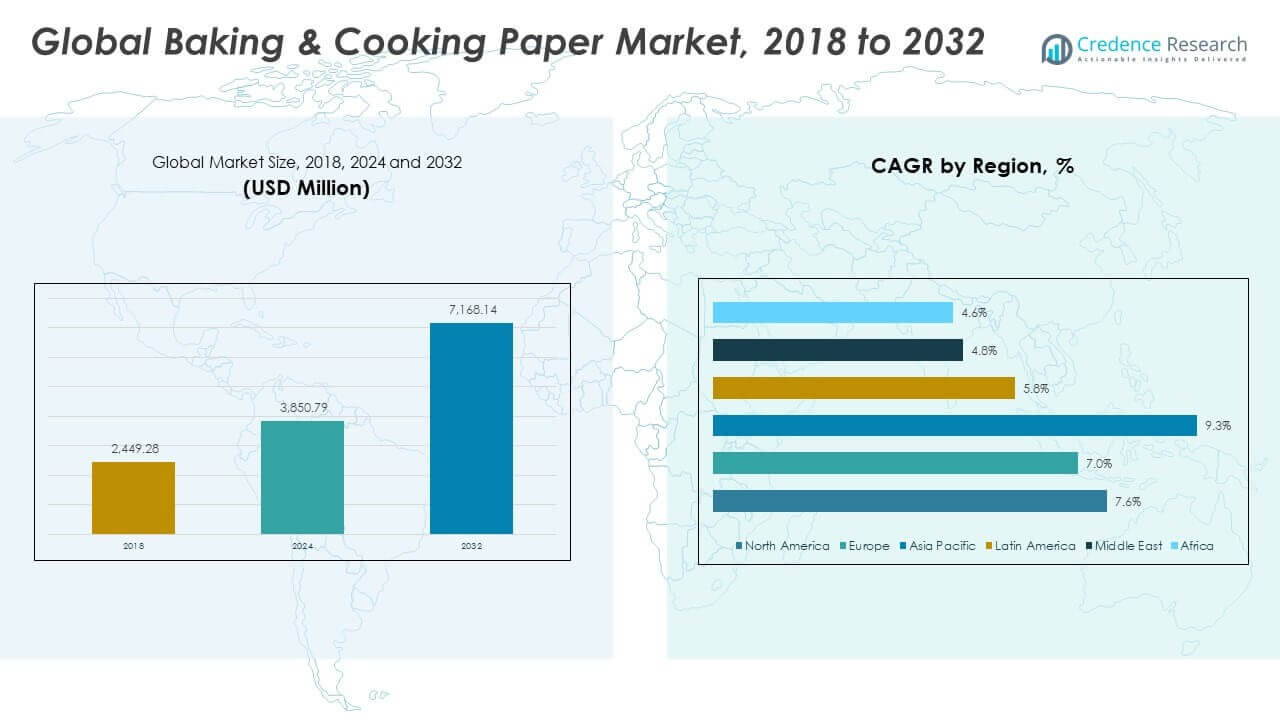
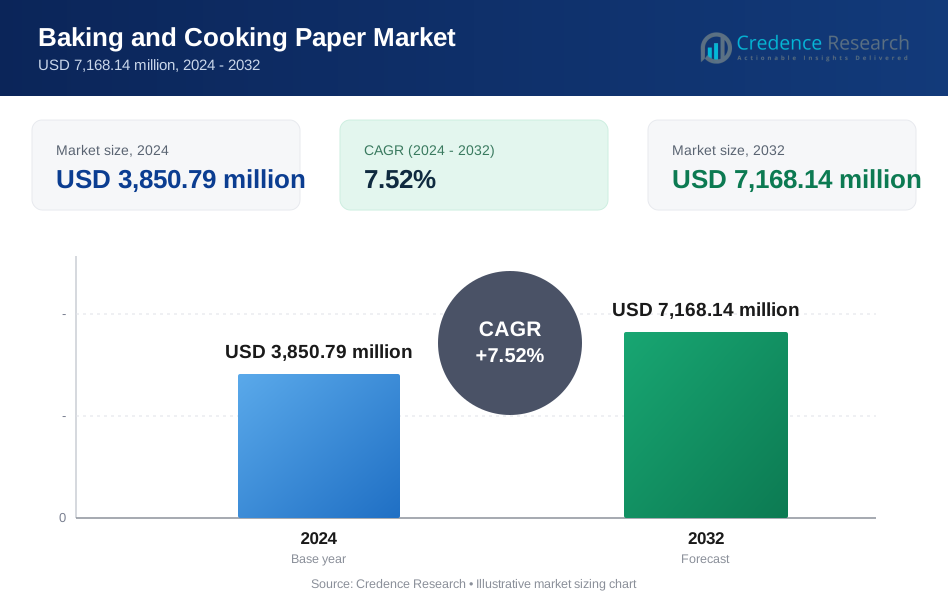
The Global Baking & Cooking Paper Market size was valued at USD 2,449.28 million in 2018 to USD 3,850.79 million in 2024 and is anticipated to reach USD 7,168.14 million by 2032, at a CAGR of 7.52% during the forecast period.
| REPORT ATTRIBUTE | DETAILS |
|---|---|
| Historical Period | 2020-2023 |
| Base Year | 2024 |
| Forecast Period | 2025-2032 |
| Baking and Cooking Paper Market Size 2024 | USD 3,850.79 million |
| Baking and Cooking Paper Market, CAGR | 7.52% |
| Baking and Cooking Paper Market Size 2032 | USD 7,168.14 million |
Rising demand for non-stick, food-safe, and grease-resistant solutions continues to drive market growth. Consumers seek convenient options for baking and cooking that reduce mess, improve hygiene, and support healthy eating. The foodservice sector including bakeries, quick-service restaurants, and ready-to-eat producers relies heavily on baking paper for speed, efficiency, and presentation. Sustainability trends push the adoption of compostable and unbleached paper variants, while digital meal-kit services and home baking fuel retail demand. Manufacturers invest in PFAS-free coatings, heat resistance, and recyclable formats to meet food safety and environmental standards.
Europe leads the market due to strong bakery culture, regulatory support for eco-friendly materials, and high institutional demand. North America follows, driven by retail and industrial baking applications. Asia Pacific is emerging as the fastest-growing region with rising urbanization, expanding foodservice infrastructure, and growing home-baking interest in China, India, and Southeast Asia. Latin America and the Middle East are gaining traction, supported by QSR expansion and evolving food packaging standards. Africa sees gradual growth led by urban cafes and low-cost cooking solutions.
Market Insights:
- The Global Baking & Cooking Paper Market was valued at USD 2,449.28 million in 2018, USD 3,850.79 million in 2024, and is projected to reach USD 7,168.14 million by 2032, growing at a CAGR of 7.52%.
- Europe led the market with a 43.2% share in 2024 due to strict eco-regulations and strong bakery culture, followed by North America with 28.9% driven by institutional baking, and Asia Pacific at 19.4% fueled by expanding foodservice.
- Asia Pacific is the fastest-growing region with a 9.3% CAGR, supported by urbanization, home-baking trends, and rising demand for clean food preparation formats in China, India, and Southeast Asia.
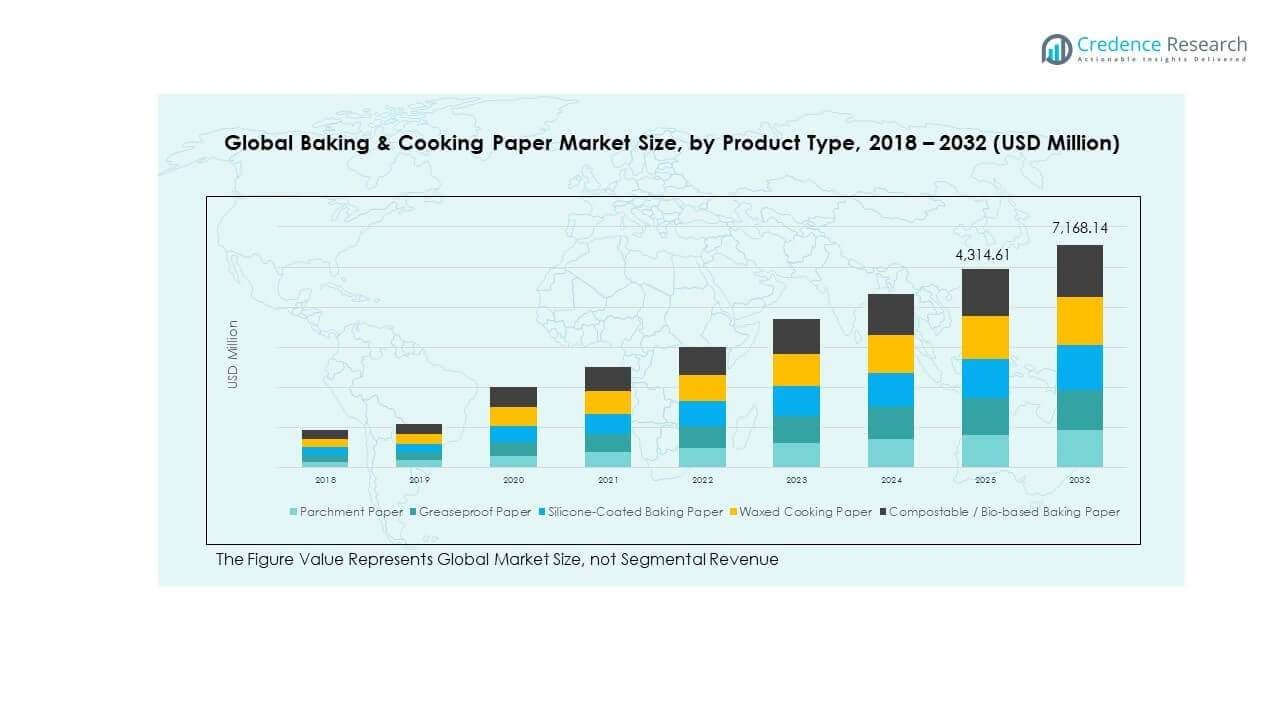
- In 2024, parchment paper accounted for the highest share among product types, followed by greaseproof and silicone-coated papers, supported by visual evidence from the product-wise market chart.
- Compostable and bio-based paper showed the strongest growth curve in volume between 2018 and 2024, reflecting the segment’s rising importance in eco-conscious consumer and institutional markets.
Market Drivers
Rising Consumer Preference for Convenient, Hygienic, and Non-Stick Cooking Solutions
Consumers across households and food services now demand baking papers that simplify meal preparation. These papers offer non-stick surfaces, reduce cleanup time, and support healthier cooking by minimizing oil use. It supports growth in domestic kitchens and commercial bakeries alike. Busy lifestyles and smaller kitchen staff in restaurants accelerate adoption. Ready-to-eat and takeout food chains also rely on grease-resistant liners. The Global Baking & Cooking Paper Market benefits from these user-centric needs. Manufacturers are developing advanced coatings for temperature resistance and food-grade safety. Greaseproof and silicone-based options now dominate high-demand categories.
- For instance, Reynolds Kitchens parchment paper features a silicone coating on both sides, is oven‑safe up to 425°F, and can be reused up to three times with reliable non‑stick performance according to its product specifications.
Expanding Home Baking and Meal-Kit Subscription Services Worldwide
Home baking trends, fueled by digital content and cooking shows, drive paper usage across age groups. Social media promotes DIY baking, creating regular demand for parchment sheets and rolls. It aligns with increasing meal-kit deliveries that often include pre-cut paper for baking. Meal-prep businesses use it for portion control and packaging. Commercial kitchens use it to maintain speed and cleanliness in bulk orders. The Global Baking & Cooking Paper Market sees direct growth from these evolving preparation formats. Growing interest in healthier lifestyles also aligns with non-toxic, reusable options. These trends reinforce baking paper's essential role in modern kitchens.
Institutional Adoption Across QSR Chains, Cafes, and Industrial Kitchens
Large-format users like pizzerias, bakeries, and QSR outlets standardize paper types for consistent food output. Paper liners ensure easy release of dough, pastries, and pizzas without added grease. It reduces downtime spent scrubbing trays and improves kitchen hygiene. Industrial-scale baking requires paper that holds shape and resists tearing at high temperatures. Many chains adopt silicone-coated papers with high reuse cycles to manage operating costs. The Global Baking & Cooking Paper Market gains strength from this institutional dependence. Bulk orders from foodservice players stabilize long-term supplier contracts. Reliability and performance shape purchase decisions in this segment.
Sustainability Push Favoring Compostable and Unbleached Paper Alternatives
Sustainability goals in food packaging impact the baking paper value chain directly. Eco-conscious buyers seek chlorine-free, compostable papers over waxed or plastic-based wraps. It aligns with growing bans on single-use plastics in food handling. Major brands now label their papers as biodegradable or recyclable to attract health-focused consumers. The Global Baking & Cooking Paper Market experiences structural demand from this sustainability shift. Food processors and bakeries increasingly specify FSC-certified paper sources. Regulations in Europe and North America further support demand for unbleached and recyclable options. Suppliers leverage greener branding to secure contracts with global food retailers.
- For instance, Reynolds Kitchens parchment paper is made from 100% chlorine‑free fibers, is FSC‑certified for sustainable sourcing, and offers compostable options certified to industry standards, supporting eco‑friendly baking applications.
Market Trends
Growing Demand for Specialty Formats Like Pre-Cut Sheets and Printed Liners
Pre-cut baking papers offer convenience, portion accuracy, and speed in commercial kitchens. These formats remove the need for manual sizing, reducing waste and labor. It appeals strongly to cafes, QSRs, and cloud kitchens with rapid throughput needs. Custom-printed liners with logos or cooking guides add branding value for meal delivery services. Premium packaging formats increasingly use wax-patterned or heat-sealed paper for presentation. The Global Baking & Cooking Paper Market evolves toward more customized and ready-to-use paper forms. Folded, die-cut, and compartmentalized papers address niche food applications. Demand for these innovations grows in both retail and foodservice segments.
Adoption of Heat-Resistant and Multi-Use Paper in Industrial Bakery Operations
Industrial-scale baking demands paper that can withstand prolonged exposure to high temperatures. Heat-resistant baking paper with multiple-use cycles supports cost savings in large facilities. It helps maintain uniform baking, color, and texture across production batches. It also prevents cross-contamination during high-volume processing. The Global Baking & Cooking Paper Market benefits from product development focused on durability and high-capacity usage. Manufacturers now supply oven-safe, double-sided silicone-coated papers to industrial users. Food chains seek papers that survive freezing, baking, and reheating in one cycle. Demand rises for versatile grades compatible with various heat sources.
Rise of E-Commerce Platforms for Direct-to-Consumer Baking Paper Sales
E-commerce platforms allow small and large brands to offer baking papers directly to households. Bundled packs, multi-size rolls, and seasonal print variants gain visibility online. It allows manufacturers to test new formats without traditional retail constraints. Online reviews and ratings influence product choices and repeat purchases. The Global Baking & Cooking Paper Market now includes strong digital storefronts from both global and niche players. Subscription models for regular household supplies grow across developed markets. Digital distribution supports personalization, flexible packaging, and faster innovation cycles. It creates a level playing field for new entrants with focused offerings.
- For instance, King Arthur Baking sells parchment paper rolls on Amazon, where the product has received over 10,000 customer reviews with an average rating of 4.8 stars, supporting broad household access through multi-size online bundles.
Integration of Natural Additives and Biopolymer Coatings for Health-Conscious Users
Manufacturers experiment with coatings derived from biopolymers or vegetable oils. These reduce synthetic chemical use while maintaining non-stick properties. Health-conscious buyers prefer uncoated or naturally coated baking paper variants. It supports cleaner labels in food preparation and packaging. The Global Baking & Cooking Paper Market expands to include options compatible with organic certification requirements. These papers avoid artificial resins or silicone-based layers. Consumer awareness about coating composition influences product demand. Suppliers promote transparency through certifications, additive-free claims, and traceable sourcing.
- For instance, If You Care offers unbleached, chlorine-free parchment paper that is FSC-certified, PFAS-free, and uses a natural silicone coating derived from sand, making it suitable for organic baking and home composting.
Market Challenges Analysis
Raw Material Price Volatility and Supply Chain Disruptions Impact Profit Margins
The baking paper industry depends heavily on paper pulp, silicone, and specialty coating materials. Price fluctuations in pulp, energy, and chemical additives affect overall manufacturing costs. It creates instability in supplier pricing, especially for bulk contracts with narrow margins. Import dependence for silicone coatings exposes manufacturers to currency and freight cost risks. The Global Baking & Cooking Paper Market faces procurement challenges during global shortages or trade restrictions. It disrupts production timelines and affects lead times for distributors. Smaller players struggle to absorb sudden cost hikes, leading to reduced competitiveness. These issues create pricing pressure across both premium and mass-market segments.
Environmental Compliance and Disposal Regulations Raise Production Complexity Governments worldwide introduce stricter norms on recyclable content, compostability, and emissions. Manufacturers must adapt product formulations to meet compostable standards while maintaining performance. It requires R&D investment in alternative coatings and substrates. The Global Baking & Cooking Paper Market must comply with varying disposal mandates across regions. Certification processes increase costs and extend time-to-market. Achieving both heat resistance and full biodegradability remains technically challenging. These evolving regulatory requirements create operational strain, especially for export-focused companies. Failure to comply may limit access to high-margin institutional buyers.
Market Opportunities
Emerging Demand in Foodservice Sectors Across Asia, Latin America, and Africa
Expanding foodservice ecosystems in emerging markets generate new paper consumption across formats. Urbanization, bakery chain expansion, and delivery platforms create steady demand for greaseproof and oven-safe solutions. The Global Baking & Cooking Paper Market can scale through targeted distributor partnerships in these regions. Suppliers focusing on cost-effective, compostable paper gain traction where food hygiene laws evolve. Packaging localization and private label manufacturing offer further entry points.
Product Innovation with Smart Features, Multi-Use Layers, and Sustainability Labels
New product formats with QR codes, temperature indicators, or structured folding improve use cases. Layered baking paper enables dual functionality in baking and serving. It supports reduced SKUs for institutional users. The Global Baking & Cooking Paper Market sees opportunity in merging performance with eco-branding. Innovations that combine aesthetics, sustainability, and user ease help suppliers move up the value chain.
Market Segmentation Analysis:
By Product Type
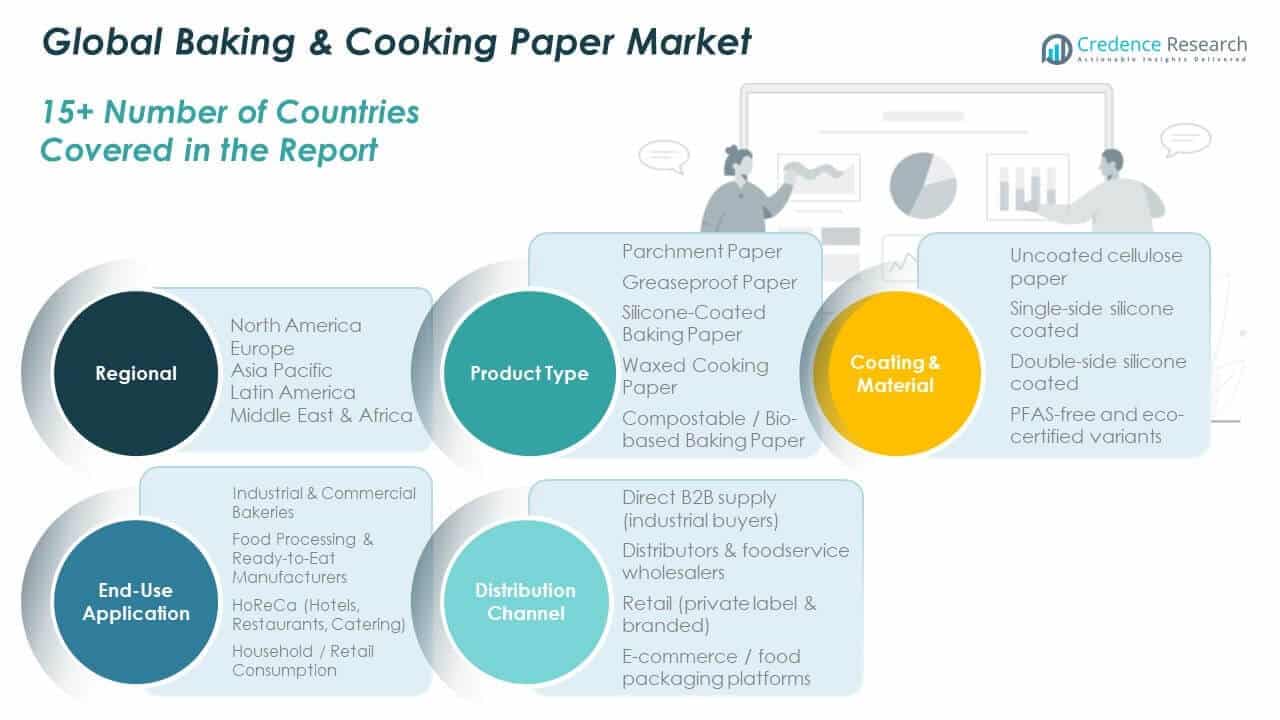
The Global Baking & Cooking Paper Market includes parchment paper, greaseproof paper, silicone-coated baking paper, waxed cooking paper, and compostable or bio-based variants. Parchment and silicone-coated types lead due to durability and non-stick performance. Greaseproof formats appeal to low-fat baking and eco-conscious segments. Waxed variants support cold storage and wrapping, though less common in baking. Compostable papers gain traction with foodservice brands focusing on sustainability. Each product type serves distinct baking, cooking, or packaging functions across regions and applications.
- For instance, Reynolds Kitchens parchment paper is oven-safe up to 425°F and FDA-compliant for direct food contact in standard baking. Greaseproof formats appeal to low-fat baking.
By Coating & Material
Key material segments include uncoated cellulose, single-side silicone coated, double-side silicone coated, and PFAS-free eco-certified variants. Silicone-coated formats dominate due to heat resistance and reuse potential in industrial ovens. Uncoated cellulose papers support lower-cost retail packaging needs. PFAS-free and certified options align with global regulatory trends and green-label demands. It supports increased specification by institutional buyers, especially in Europe and North America.
- For instance, Ahlstrom offers PFAS‑free baking paper grades that comply with EU Regulation 2022/1254 and are designed for oven use at temperatures up to 220°C, supporting regulatory and sustainability requirements.
By End-Use Application
The Global Baking & Cooking Paper Market serves industrial bakeries, food processing units, HoReCa establishments, and household consumers. Industrial and commercial bakeries lead demand due to high-volume batch baking. Food processors use paper for lining and moisture control in ready-to-eat meals. HoReCa channels value greaseproof and easy-release formats for efficiency. Household consumption rises with growing home-baking interest and availability of pre-cut rolls.
By Distribution Channel
Sales channels include direct B2B supply, foodservice distributors, retail outlets, and e-commerce platforms. Industrial buyers source bulk rolls through direct supply chains. Wholesalers and foodservice distributors serve bakeries and caterers. Retail channels offer both branded and private-label formats across supermarkets. It sees rising online purchases, especially for sustainable and premium paper types through packaging-focused platforms.
Segmentation:
By Product Type:
- Parchment Paper
- Greaseproof Paper
- Silicone-Coated Baking Paper
- Waxed Cooking Paper
- Compostable / Bio-based Baking Paper
By Coating & Material:
- Uncoated Cellulose Paper
- Single-Side Silicone Coated
- Double-Side Silicone Coated
- PFAS-Free and Eco-Certified Variants
By End-Use Application:
- Industrial & Commercial Bakeries
- Food Processing & Ready-to-Eat Manufacturers
- HoReCa (Hotels, Restaurants, Catering)
- Household / Retail Consumption
By Distribution Channel:
- Direct B2B Supply (Industrial Buyers)
- Distributors & Foodservice Wholesalers
- Retail (Private Label & Branded)
- E-commerce / Food Packaging Platforms
By Region:
- North America
- U.S.
- Canada
- Mexico
- Europe
- Germany
- France
- U.K.
- Italy
- Spain
- Rest of Europe
- Asia Pacific
- China
- Japan
- India
- South Korea
- South-east Asia
- Rest of Asia Pacific
- Latin America
- Brazil
- Argentina
- Rest of Latin America
- Middle East & Africa
- GCC Countries
- South Africa
- Rest of the Middle East and Africa
Regional Analysis:
North America
The North America Global Baking & Cooking Paper Market size was valued at USD 718.74 million in 2018 to USD 1,112.55 million in 2024 and is anticipated to reach USD 2,079.59 million by 2032, at a CAGR of 7.6% during the forecast period. North America accounted for approximately 28.9% of the global market share in 2024. The market benefits from widespread home baking habits, established retail channels, and large-scale foodservice operations. Demand for silicone-coated and compostable papers is strong across the U.S. and Canada. Commercial bakeries and meal-prep businesses support high-volume adoption. Sustainability regulations in several U.S. states push growth of PFAS-free and recyclable formats. Manufacturers cater to private-label demand in supermarkets and e-commerce. It gains from consistent industrial use and growing preference for clean-label food packaging.
Europe
The Europe Global Baking & Cooking Paper Market size was valued at USD 1,083.41 million in 2018 to USD 1,663.97 million in 2024 and is anticipated to reach USD 2,982.76 million by 2032, at a CAGR of 7.0% during the forecast period. Europe contributed about 43.2% of the global market share in 2024, making it the largest regional segment. Strong baking traditions and stringent sustainability policies drive demand for unbleached, compostable paper. France, Germany, and the UK lead consumption, supported by premium bakery chains and organic food retailers. Eco-certifications and FSC sourcing influence institutional procurement. Foodservice brands integrate printed liners and custom-cut formats. High demand from artisanal bakeries, cafés, and hotel kitchens ensures consistent product use. It sees innovation in coatings, design, and performance to meet European safety and recycling norms.
Asia Pacific
The Asia Pacific Global Baking & Cooking Paper Market size was valued at USD 436.82 million in 2018 to USD 748.90 million in 2024 and is anticipated to reach USD 1,592.19 million by 2032, at a CAGR of 9.3% during the forecast period. Asia Pacific held 19.4% of the global market share in 2024 and shows the fastest growth rate. Rising urbanization and Western food influence boost home baking and café culture. China, Japan, South Korea, and India lead demand due to expanding foodservice sectors. Packaging innovation and disposable hygiene needs drive demand for parchment and greaseproof paper. E-commerce channels improve access to specialty papers across urban households. Local manufacturers scale production to serve domestic QSR chains and regional exports. It benefits from investments in automated baking lines and printed paper formats.
Latin America
The Latin America Global Baking & Cooking Paper Market size was valued at USD 111.06 million in 2018 to USD 172.35 million in 2024 and is anticipated to reach USD 282.41 million by 2032, at a CAGR of 5.8% during the forecast period. Latin America represented 4.5% of the global market share in 2024. Brazil and Mexico anchor market demand, driven by growing urban food delivery and fast-food operations. Commercial bakeries and frozen food brands support consistent use of baking liners. Retail expansion into smaller cities boosts household consumption of pre-cut rolls. Demand for low-cost greaseproof and waxed papers remains high. It faces limited availability of high-performance coatings but sees growing interest in compostable options. Local brands focus on affordable, food-safe formats for mass-market penetration.
Middle East
The Middle East Global Baking & Cooking Paper Market size was valued at USD 59.36 million in 2018 to USD 84.06 million in 2024 and is anticipated to reach USD 127.79 million by 2032, at a CAGR of 4.8% during the forecast period. The region accounted for 2.2% of the global market share in 2024. The market is shaped by strong growth in bakery chains, hospitality, and ready-to-eat food production. UAE and Saudi Arabia lead consumption due to rapid food retail development. Institutional kitchens and foodservice brands rely on silicone-coated and greaseproof paper formats. Sustainability remains a growing concern with interest in biodegradable papers. Import reliance remains high, though regional converters are emerging. It grows steadily with demand for convenience and hygienic food-handling solutions.
Africa
The Africa Global Baking & Cooking Paper Market size was valued at USD 39.89 million in 2018 to USD 68.95 million in 2024 and is anticipated to reach USD 103.41 million by 2032, at a CAGR of 4.6% during the forecast period. Africa held 1.8% of the global market share in 2024. South Africa, Nigeria, and Egypt are key contributors with rising foodservice and bakery activity. The market sees adoption in urban cafés, QSRs, and frozen food segments. Waxed and uncoated cellulose formats dominate low-cost applications. Infrastructure gaps limit full-scale industrial use but small bakeries continue to expand paper usage. Import dependence challenges local availability of coated or compostable variants. It remains price-sensitive but has room for private-label growth and retail expansion.
Key Player Analysis:
- Nordic Paper
- Ahlstrom
- Delfort Group
- Metsä Group
- KRPA Holding
Competitive Analysis:
The Global Baking & Cooking Paper Market features a concentrated competitive landscape led by vertically integrated manufacturers with strong regional footprints. Key players include Ahlstrom, Delfort Group, Nordic Paper, Metsä Group, and KRPA Holding. These companies invest in coating innovations, sustainability certifications, and food safety compliance to maintain market position. It sees high competition in silicone-coated and compostable paper categories, where differentiation depends on heat resistance, release properties, and recyclability. Private-label production supports revenue growth for mid-sized suppliers serving retail chains. E-commerce expansion enables smaller firms to reach niche consumer segments. Strategic partnerships with food processors and packaging converters influence long-term contract wins. Companies also compete on pricing, sheet customizations, and eco-label alignment. It favors players with diversified distribution, strong B2B networks, and local production capabilities. Competitors prioritize operational efficiency to manage raw material volatility and meet region-specific regulatory requirements.
Recent Developments:
- In June 2025, Metsä Tissue signed a licensing agreement with Fredman Group Oy for its SAGA greaseproof paper consumer business. Under this deal, Fredman will handle sales, marketing, and distribution in Finland and the Baltics while Metsä Tissue continues production at its mill.
- In March 2025, Ahlstrom launched LamiBak™ Flex, a new base paper designed for flexible food packaging applications that supports high-barrier performance and sustainable, recyclable food contact solutions. This innovation extends the company’s portfolio into adaptable paper formats suitable for various food packaging needs.
Report Coverage:
The research report offers an in-depth analysis based on Product Type, Coating & Material, End-Use Application and Distribution Channel. It details leading market players, providing an overview of their business, product offerings, investments, revenue streams, and key applications. Additionally, the report includes insights into the competitive environment, SWOT analysis, current market trends, as well as the primary drivers and constraints. Furthermore, it discusses various factors that have driven market expansion in recent years. The report also explores market dynamics, regulatory scenarios, and technological advancements that are shaping the industry. It assesses the impact of external factors and global economic changes on market growth. Lastly, it provides strategic recommendations for new entrants and established companies to navigate the complexities of the market.
Future Outlook:
- Rising health and hygiene awareness will drive continued demand for non-stick and food-safe paper formats.
- Strong growth in home baking and digital meal-kit services will support household segment expansion.
- Product innovation will focus on compostable, PFAS-free, and heat-resistant coatings aligned with regulations.
- Automation in industrial bakeries will increase demand for high-durability silicone-coated papers.
- E-commerce platforms will enhance accessibility for niche and premium product variants.
- Europe will maintain leadership due to strict sustainability norms and developed foodservice sectors.
- Asia Pacific will register the fastest growth, driven by expanding middle-class and food delivery trends.
- Private-label and branded retail categories will gain traction through customization and eco-labeling.
- Manufacturers will invest in regional production and local sourcing to reduce supply chain volatility.
- Strategic partnerships between paper converters and food packaging firms will shape long-term market direction.
Request a Free Sample
Fill in your details and we'll send you a free sample report.
- Sample data tables & charts
- Research methodology
Need a Custom Version of This Report?
Tailor the scope, geography, or segments to your exact requirements.
- Custom geography or segment scope
- Direct access to our analyst team
Frequently Asked Questions
What is the current market size for Global Baking & Cooking Paper Market, and what is its projected size in 2032?
At what Compound Annual Growth Rate is the Global Baking & Cooking Paper Market projected to grow between 2024 and 2032?
Which Global Baking & Cooking Paper Market segment held the largest share in 2024?
What are the primary factors fueling the growth of the Global Baking & Cooking Paper Market?
Who are the leading companies in the Global Baking & Cooking Paper Market?
Which region commanded the largest share of the Global Baking & Cooking Paper Market in 2024?
Table of Content
Chapter 1. Report Introduction
- 1.1 Report Description & Purpose
- 1.1.1 Report Title & Market Definition
- 1.1.2 Unique Selling Propositions (USP) & Key Differentiators
- 1.1.3 Value Proposition for Stakeholders
- 1.2 Research Objectives
- 1.2.1 Market Sizing Objectives (Volume & Revenue)
- 1.2.2 Segmentation Objectives
- 1.2.3 Competitive Intelligence Objectives
- 1.2.4 Forecast & Scenario Objectives
- 1.3 Report Scope
- 1.3.1 Baking and Cooking Paper Scope – Types & Subtypes Covered
- 1.3.2 Geographic Scope – Regions & Countries Covered
- 1.3.3 Historical Period, Base Year & Forecast Period (2024; forecast to 2032)
- 1.3.4 Inclusions & Exclusions
- 1.4 HS Code & Classification Framework
- 1.5 Currency, Units & Pricing Basis
- 1.6 Target Stakeholders
- 1.7 Limitations & Assumptions
Chapter 2. Executive Summary
- 2.1 Global Baking and Cooking Paper Market Snapshot
- 2.1.1 Market Size – Historical (2024) & Forecast (2024-2032) (2024: USD 3,850.79 million → 2032: USD 7,168.14 million)
- 2.1.2 Volume & Revenue – Global Totals
- 2.1.3 Key Market Highlights – Top Five Facts
- 2.2 Baking and Cooking Paper Market Segmentation Snapshot
- 2.2.1 Market Split by Region – 2024 vs. 2032
- 2.3 Competitive Snapshot
- 2.3.1 Top 10 Players by Revenue Share – 2024
- 2.3.2 Top 10 Players by Volume Share – 2024
- 2.3.3 Recent Strategic Developments (18-Month Summary)
- 2.4 Key Investment Highlights & Strategic Conclusions
Chapter 3. Baking and Cooking Paper Market Dynamics & Industry Analysis
- 3.1 Market Overview & Context
- 3.1.1 Baking and Cooking Paper Market Position in the Broader Automotive Value Chain
- 3.1.2 OEM vs. Replacement Market Dynamics
- 3.1.3 Market Maturity & Development Stage by Region
- 3.2 Baking and Cooking Paper Market Drivers
- 3.3 Baking and Cooking Paper Market Restraints & Challenges
- 3.4 Baking and Cooking Paper Market Opportunities
- 3.5 Porter's Five Forces Analysis
- 3.5.1 Threat of New Entrants
- 3.5.2 Bargaining Power of Suppliers
- 3.5.3 Bargaining Power of Buyers
- 3.5.4 Threat of Substitutes
- 3.5.5 Competitive Rivalry – Intensity Assessment
- 3.6 Baking and Cooking Paper Value Chain Analysis
- 3.6.1 Upstream – Raw Material/Input Suppliers
- 3.6.1.1 Raw Material/Input 1
- 3.6.1.2 Raw Material/Input 2
- 3.6.1.3 Raw Material/Input 3
- 3.6.2 Midstream – Production/Manufacturing/Service Delivery
- 3.6.2.1 Production/Process Overview
- 3.6.2.2 Key Facility Locations & Capacity by Manufacturer
- 3.6.3 Downstream – Distribution & End Consumer
- 3.6.3.1 Primary Channel – B2B/OEM
- 3.6.3.2 Secondary Channels – Dealer, Retail, Online, Direct
- 3.6.4 Value Chain Profitability Analysis
- 3.6.1 Upstream – Raw Material/Input Suppliers
- 3.7 PESTEL Analysis
- 3.7.1 Political Factors
- 3.7.2 Economic Factors
- 3.7.3 Social Factors
- 3.7.4 Technological Factors
- 3.7.5 Environmental Factors
- 3.7.6 Legal Factors
- 3.8 Baking and Cooking Paper Supply Chain Analysis
- 3.8.1 Raw Material/Input Supply Risk Assessment
- 3.8.2 Manufacturing Concentration Risk (Geographic Exposure)
- 3.8.3 Trade Disruption Impact Analysis
- 3.9 Regulatory & Policy Landscape
Note: The regulatory and policy landscape section covers regulations based on their applicability to the market, Baking and Cooking Paper category, geography, and scope of the study. Only regulatory frameworks with a material impact on operations, compliance, trade, sustainability, or market access are analyzed in detail.
Chapter 4. Key Investment Pockets & Opportunity Analysis
- 4.1 Baking and Cooking Paper Market Attractiveness Analysis
- 4.1.1 By Region – Investment Attractiveness Matrix (Volume × CAGR)
- 4.2 Absolute Revenue Growth Opportunity
- 4.2.1 By Region – Absolute USD Growth Through 2032
- 4.3 Incremental Volume Opportunity
- 4.3.1 By Region – Incremental Volume Through 2032
- 4.3.2 Segment – Incremental Volume
- 4.4 Emerging Submarket Opportunity Deep Dive (Subject to Applicability)
- 4.5 Emerging Market Opportunity Scorecards
- 4.5.1 United States
- 4.5.2 Europe
- 4.5.3 Asia
- 4.5.4 Middle East & Africa
Note: Emerging Market Opportunity Scorecards will be included based on relevance and strategic importance. Regions listed are indicative and may vary depending on data availability and market dynamics.
Chapter 5. Baking and Cooking Paper Import-Export Analysis & Trade Flows
- 5.1 Global Trade Overview
- 5.1.1 Global Export Value by Country (2024)
- 5.1.2 Global Export Volume by Country (2024)
- 5.1.3 Global Import Value by Country (2024)
- 5.1.4 Global Import Volume by Country (2024)
- 5.1.5 Net Trade Balance by Country (2024)
- 5.2 Export Analysis – Segment
- 5.2.1 Type 1 (HS Code)
- 5.2.2 Type 2 (HS Code)
- 5.2.3 Type 3 (HS Code)
- 5.2.4 Type 4 (HS Code)
- 5.2.5 Type 5 (HS Code)
- 5.3 Import Analysis – Segment
- 5.3.1 Type 1 (HS Code)
- 5.3.2 Type 2 (HS Code)
- 5.3.3 Type 3 (HS Code)
- 5.3.4 Type 4 (HS Code)
- 5.3.5 Type 5 (HS Code)
- 5.4 Average Unit Trade Prices
- 5.4.1 Average Export Price – Segment & Country
- 5.4.2 Average Import Price – Segment & Source Country
- 5.4.3 Price Trends (2024)
- 5.5 Key Trade Route Analysis
- 5.5.1 Trade Route 1
- 5.5.2 Trade Route 2
- 5.5.3 Trade Route 3
- 5.5.4 Trade Route 4
- 5.5.5 Trade Route 5
- 5.6 Trade Policy Impact Assessment
- 5.6.1 US Anti-Dumping & Section 301 Tariffs
- 5.6.2 EU Customs Union Impact
- 5.6.3 Major Free Trade Agreements
- 5.6.4 USMCA Rules of Origin
Note: Trade policy analysis will be included only where relevant to the Baking and Cooking Paper market.
Chapter 6. Competitive Landscape & Company Benchmarking
- 6.1 Baking and Cooking Paper Market Concentration & Structure
- 6.1.1 Herfindahl-Hirschman Index (HHI) – vs. 2024
- 6.1.2 Tier 1, Tier 2 & Tier 3 Market Structure
- 6.1.3 Global, Regional & Local Player Dynamics
- 6.2 Baking and Cooking Paper Market Share Analysis – 2024
- 6.2.1 Global Revenue Share by Company
- 6.2.2 Global Volume Share by Company
- 6.2.3 Regional Revenue Share
- 6.2.4 Market Share Evolution ( vs. 2024)
- 6.2.5 OEM Segment Share by Company
- 6.2.6 Replacement Segment Share by Company
- 6.3 Production/Delivery Capacity & Facility Analysis
- 6.3.1 Global Installed Capacity
- 6.3.2 Capacity Utilization Rates
- 6.3.3 Production/Output Volume
- 6.3.4 Facility Locations & Capacity Map
- 6.3.5 Planned Capacity Additions
- 6.4 Baking and Cooking Paper Competitive Benchmarking Matrix
- 6.4.1 Revenue, Volume, CAGR & Profitability Comparison
- 6.4.2 Channel Revenue Mix
- 6.4.3 Geographic Revenue Exposure
- 6.4.4 R&D Intensity
- 6.4.5 Sustainability Maturity
- 6.5 Strategic Developments in Baking and Cooking Paper (Last 24 Months)
- 6.5.1 Mergers, Acquisitions & Divestments
- 6.5.2 New Baking and Cooking Paper Launches
- 6.5.3 Facility Expansions
- 6.5.4 Strategic Alliances, Joint Ventures & Partnerships
- 6.5.5 Distribution Expansion & Market Entry
- 6.5.6 Sustainability & ESG Initiatives
- 6.6 Competitive Strategy Mapping
- 6.6.1 Leader, Challenger, Follower & Niche Classification
- 6.6.2 Pricing Strategy Comparison
- 6.6.3 Channel Strategy Matrix
Note: Strategic developments are included based on their materiality and the availability of reliable information.
Chapter 7. Global Baking and Cooking Paper Market – By Distribution Channel
- 7.1 Segment Overview
- 7.1.1 Volume & Revenue Split by Channel (2024 & 2032)
- 7.1.2 Channel Mix Evolution (2024-2032)
Chapter 8. Regional Market Analysis – Global Overview
- 8.1 Global Regional Overview
- 8.1.1 Regional Volume Share
- 8.1.2 Regional Revenue Share
- 8.1.3 Regional Volume by Region
- 8.1.4 Regional Revenue by Region
- 8.1.5 Regional Forecast Through 2032
- 8.2 Cross-Regional Segment Analysis
- 8.2.1 By Distribution Channel
- 8.2.2 By Brand/Price Tier
Chapter 9. North America Baking and Cooking Paper Market
- 9.1 United States
- 9.2 Canada
- 9.3 Mexico
Chapter 10. Europe Baking and Cooking Paper Market
- 10.1 Germany
- 10.2 France
- 10.3 Italy
- 10.4 United Kingdom
- 10.5 Spain
- 10.6 Poland
- 10.7 Russia
- 10.8 Netherlands
- 10.9 Belgium
- 10.10 Sweden
- 10.11 Denmark
- 10.12 Norway
- 10.13 Rest of Europe
Chapter 11. Asia Pacific Baking and Cooking Paper Market
- 11.1 China
- 11.2 India
- 11.3 Japan
- 11.4 South Korea
- 11.5 Thailand
- 11.6 Indonesia
- 11.7 Vietnam
- 11.8 Malaysia
- 11.9 Australia
- 11.10 Rest of Asia Pacific
Chapter 12. Latin America Baking and Cooking Paper Market
- 12.1 Brazil
- 12.2 Argentina
- 12.3 Colombia
- 12.4 Chile
- 12.5 Rest of Latin America
Chapter 13. Middle East Baking and Cooking Paper Market
- 13.1 Saudi Arabia
- 13.2 United Arab Emirates
- 13.3 Turkey
- 13.4 Israel
- 13.5 Iran
- 13.6 Rest of the Middle East
Chapter 14. Africa Baking and Cooking Paper Market
- 14.1 South Africa
- 14.2 Egypt
- 14.3 Nigeria
- 14.4 Morocco
- 14.5 Rest of Africa
Chapter 15. Baking and Cooking Paper Company Profiles
- 15.1 [Company 01]
- 15.1.1 Company Overview
- 15.1.2 Key Management Personnel
- 15.1.3 Products & Services Portfolio
- 15.1.4 Financial Performance
- 15.1.5 Key Market Focus & Geographic Presence
- 15.1.6 Recent Developments & Strategic Initiatives
Note: The company profile list is preliminary and may change based on research findings, market developments, data availability, and client requirements.
Chapter 16. Appendices
- Appendix A – List of Abbreviations & Acronyms
- Appendix B – Industry Classification Code Reference – Full Series
- Appendix C – Production & Capacity Data Tables
- Appendix D – End-Use & Demand Base Tables
- Appendix E – Consumption & Replacement Rate Assumptions
- Appendix F – ASP Reference Tables
- Appendix G – Manufacturing & Facility Database
- Appendix H – Import-Export Data Tables
- Appendix I – Regulatory Summary Tables
- Appendix J – Primary Research Participant List (Anonymized)
- Appendix K – Primary Research Questionnaire Framework
- Appendix L – Data Sources & Bibliography
- Appendix M – Market Size Divergence & Source Comparison
Chapter 17. Research Methodology
- 17.1 Research Framework & Philosophy
- 17.2 Secondary Research – Sources, Hierarchy & Data Extraction
- 17.3 Data Modeling – Bottom-Up & Top-Down Market Sizing
- 17.4 Primary Research – Stakeholder Framework, LOI & Sample Sizes
- 17.5 Forecast Methodology – Regression, Scenario & Sensitivity Analysis
- 17.6 Quality Control – Four-Layer Validation Framework
- 17.7 Limitations & Standard Assumptions
- 17.8 Disclaimer
