
Market Overview:
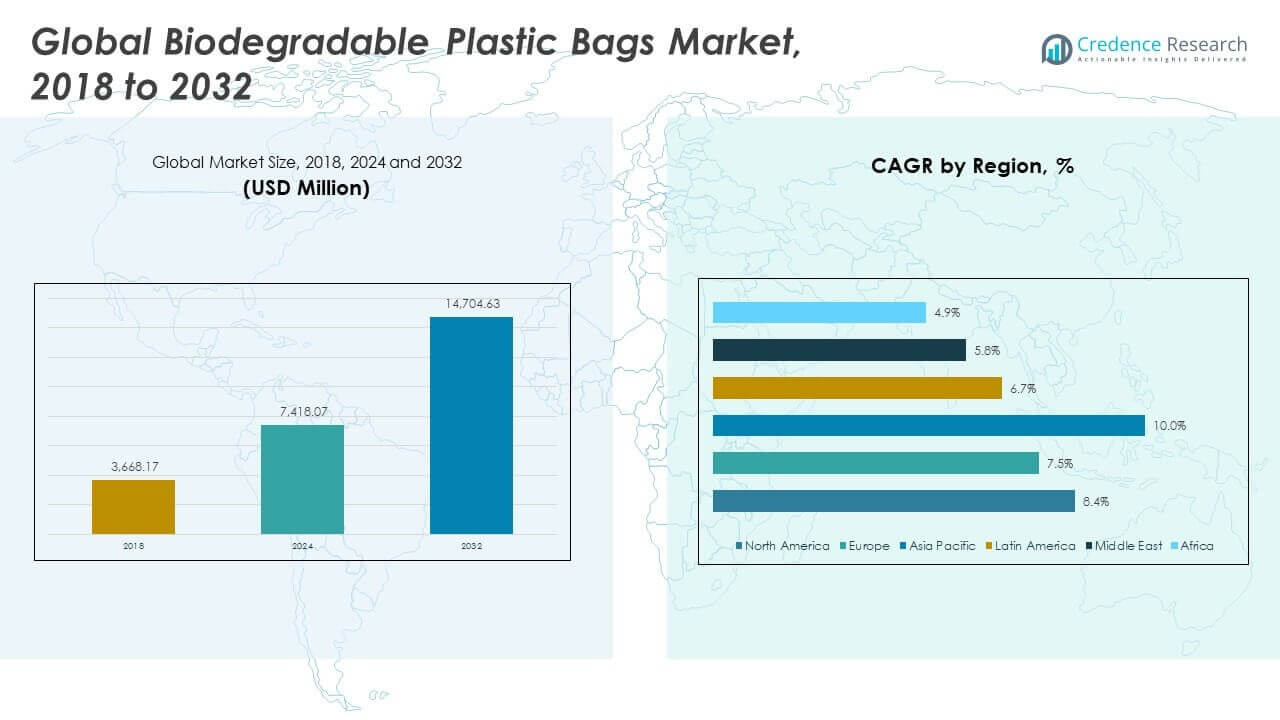
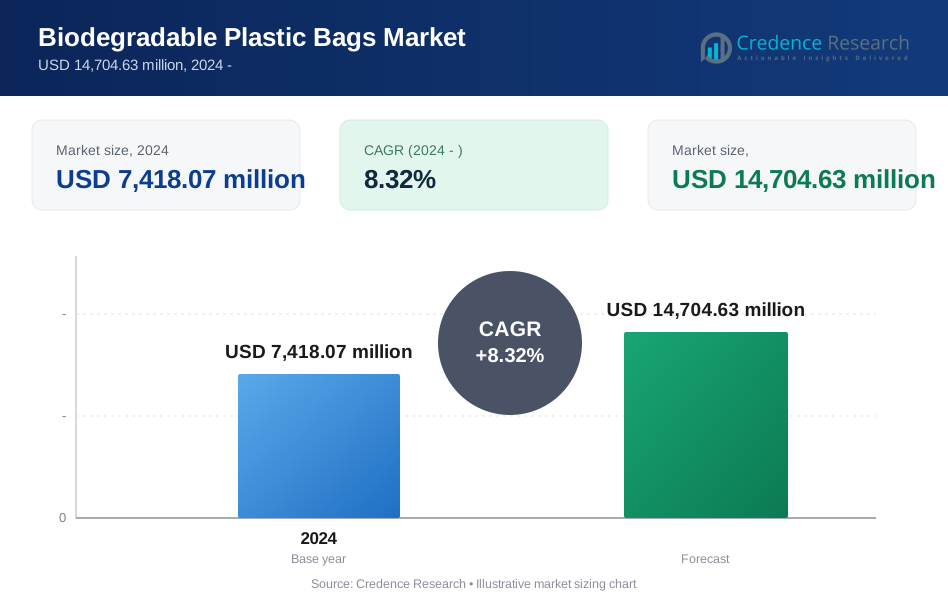
The Global Biodegradable Plastic Bags Market size was valued at USD 3,668.17 million in 2018 to USD 7,418.07 million in 2024 and is anticipated to reach USD 14,704.63 million by 2032, at a CAGR of 8.32% during the forecast period.
| REPORT ATTRIBUTE | DETAILS |
|---|---|
| Historical Period | 2020-2023 |
| Base Year | 2024 |
| Forecast Period | 2025-2032 |
| Biodegradable Plastic Bags Market Size 2024 | USD 7,418.07 million |
| Biodegradable Plastic Bags Market, CAGR | 8.32% |
| Biodegradable Plastic Bags Market Size 2032 | USD 14,704.63 million |
The Global Biodegradable Plastic Bags Market grows due to strict plastic bans worldwide. Retailers replace conventional bags with certified alternatives. Brands adopt sustainable packaging to meet ESG goals. Food delivery and takeaway services raise single-use bag demand. Grocery chains expand private-label biodegradable bags. Material advances improve strength and moisture resistance. Buyers value clear compostability claims and labeling. Institutional procurement favors eco-friendly options. Cost gaps narrow with scale and process efficiency.
The Global Biodegradable Plastic Bags Market shows strong regional variation. North America leads due to firm regulations and retailer commitments. Europe follows with strict directives and advanced composting systems. Asia Pacific emerges fast from urban waste pressure and e-commerce growth. China and India expand adoption through phased bans. Latin America grows steadily via city-level policies. The Middle East and Africa remain early-stage markets. Sustainability agendas guide pilot adoption. Infrastructure gaps shape regional growth pace.
Market Insights:
- The Global Biodegradable Plastic Bags Market was valued at USD 3,668.17 million in 2018, reached USD 7,418.07 million in 2024, and is projected to hit USD 14,704.63 million by 2032, growing at a CAGR of 8.32% during the forecast period.
- North America leads with about 42.3% share, followed by Europe at 27.8% and Asia Pacific at 21.3%, supported by strict plastic bans, strong retail compliance, and established composting infrastructure.
- Asia Pacific is the fastest-growing region, holding around 21.3% share, driven by rapid urbanization, expanding e-commerce, and phased plastic bans across China, India, and Southeast Asia.
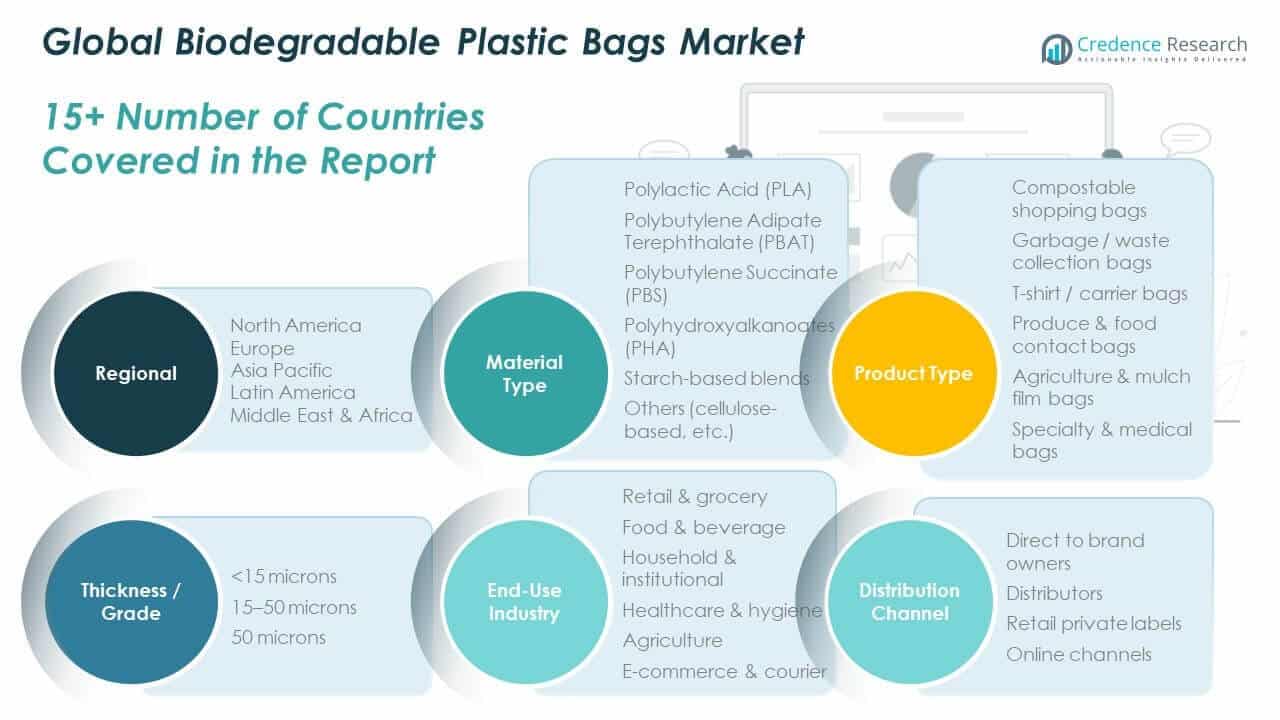
- Compostable shopping bags account for the largest product share at roughly 35%, reflecting dominant retail and grocery demand for certified biodegradable carry bags.
- Garbage and waste collection bags hold about 25% share, while T-shirt and carrier bags contribute nearly 20%, supported by municipal waste programs and high-volume grocery usage.
Market Drivers:
Rising Regulatory Pressure On Single-Use Plastics Across Economies
Governments enforce strict limits on conventional plastic bags worldwide. These rules push retailers toward certified biodegradable options. Municipal bans expand across urban and semi-urban markets. Compliance deadlines force faster material substitution decisions. Retail chains adjust sourcing policies to avoid penalties. The Global Biodegradable Plastic Bags Market gains steady policy-driven demand. Public procurement also favors eco-friendly packaging formats. Policy clarity improves supplier planning and capacity use.
- For instance, BASF SE reports ecoVio® films meeting EN 13432 standards and supporting compostable bag production across multiple EU states. Policy clarity improves supplier planning and capacity use.
Growing Sustainability Commitments From Retailers And Consumer Brands
Large retailers set packaging reduction and sustainability targets. Consumer brands align bag choices with ESG goals. Corporate reporting links packaging materials to climate metrics. Procurement teams prioritize compostable and bio-based bags. Brand reputation depends on visible sustainability actions. The Global Biodegradable Plastic Bags Market benefits from long-term supply contracts. Private-label products adopt greener carry bag formats. Sustainability audits reinforce repeat demand cycles.
- For instance, Walmart requires suppliers to meet packaging sustainability criteria under Project Gigaton, covering thousands of private-label SKUs. Sustainability audits reinforce repeat demand cycles.
Expansion Of Food Delivery, Takeaway, And Grocery Packaging Needs
Urban lifestyles raise reliance on food delivery services. Takeaway packaging needs lightweight carry solutions. Grocery retail expands home delivery models. These channels require high volumes of single-use bags. Operators seek materials with lower environmental impact. The Global Biodegradable Plastic Bags Market addresses this scale demand. Strength and leak resistance improvements support food use. Service platforms standardize biodegradable bag adoption.
Advancements In Biopolymer Blends And Manufacturing Capabilities
Producers improve mechanical strength and tear resistance. New blends handle moisture and varied load weights better. Manufacturing lines reach higher output consistency. Cost efficiency improves through scale and process control. Certification standards guide product quality benchmarks. The Global Biodegradable Plastic Bags Market gains trust from buyers. Improved shelf life supports broader retail use. Technology progress reduces performance gaps versus plastic.
Market Trends:
Shift Toward Compostable And Home-Degradable Bag Certifications
Buyers seek bags with clear compostability claims. Home-compostable labels gain interest in residential markets. Certification bodies influence procurement requirements. Retailers prefer standardized labeling for consumer clarity. Waste handlers align collection streams with certified materials. The Global Biodegradable Plastic Bags Market reflects this labeling focus. Producers invest in testing and compliance systems. Certification becomes a sales differentiator. Clear labeling reduces misuse and contamination risks. Standard logos improve consumer trust at point of sale.
- For instance, Novamont supplies Mater-Bi® bags certified for both industrial and home composting under OK Compost HOME standards. Certification becomes a sales differentiator.
Growth Of Customized And Branded Biodegradable Carry Bags
Retailers demand printed and branded biodegradable bags. Brand visibility matters even for sustainable packaging. Ink compatibility improves with bio-based films. Short-run digital printing supports regional branding. Fashion stores adopt premium designs. The Global Biodegradable Plastic Bags Market supports customization demand. Aesthetic appeal aids consumer acceptance. Packaging becomes a brand communication tool. Seasonal campaigns drive short production runs. Custom bags reinforce brand identity in physical stores.
- For instance, TIPA Corp Ltd offers compostable films compatible with high-resolution flexographic printing used by apparel and grocery brands. Packaging becomes a brand communication tool.
Rising Use Of Biodegradable Bags In Institutional And Public Sectors
Hospitals and schools adopt eco-friendly waste bags. Public offices align packaging with sustainability mandates. Events reduce plastic bag distribution. Municipal programs promote biodegradable alternatives. Procurement policies favor certified suppliers. The Global Biodegradable Plastic Bags Market gains stable institutional volumes. Demand cycles follow public budget planning. Long contracts support production stability. Centralized tenders create predictable order flows. Compliance audits strengthen supplier retention.
Integration Of Lifecycle And Carbon Impact Metrics In Purchasing
Buyers assess lifecycle impact beyond disposal claims. Carbon footprint data shapes material selection. Suppliers disclose sourcing and processing details. Retailers compare emissions across packaging options. Transparency influences supplier rankings. The Global Biodegradable Plastic Bags Market adapts to data-driven buying. Lifecycle tools support premium positioning. Sustainability teams guide final purchase decisions. Digital dashboards track packaging emissions. Data-backed claims reduce greenwashing concerns.
Market Challenges Analysis:
Higher Production Costs Compared To Conventional Plastic Bags
Biopolymer raw materials cost more than fossil plastics. Price volatility affects contract stability. Small retailers resist premium pricing pressure. Cost sensitivity remains high in emerging economies. Scale limits short-term margin flexibility. The Global Biodegradable Plastic Bags Market faces pricing resistance. Producers balance quality and affordability targets. Cost parity remains a long-term hurdle.
Limited Composting Infrastructure And Disposal Awareness
Many regions lack industrial composting facilities. Improper disposal reduces environmental benefits. Consumers remain unclear on correct waste streams. Municipal systems struggle with material sorting. Contamination affects compost quality outcomes. The Global Biodegradable Plastic Bags Market faces adoption friction. Education gaps slow impact realization. Infrastructure growth lags product availability.
Market Opportunities:
Expansion In Emerging Economies With New Plastic Restrictions
Emerging markets announce phased plastic bans. Urban centers adopt waste reduction policies first. Retail modernization supports packaging upgrades. Local producers seek technology partnerships. Import substitution opens regional supply opportunities. The Global Biodegradable Plastic Bags Market can scale early entry. Cost-optimized products suit volume demand. Policy rollout creates predictable growth paths.
Innovation In Multi-Use And High-Strength Biodegradable Bag Formats
Consumers prefer bags with reuse capability. Thicker biodegradable bags meet durability needs. Multi-use designs reduce total bag consumption. Retailers value lower replacement frequency. Product innovation supports premium pricing strategies. The Global Biodegradable Plastic Bags Market benefits from value-added formats. Performance parity boosts buyer confidence. Innovation widens addressable applications.
Market Segmentation Analysis:
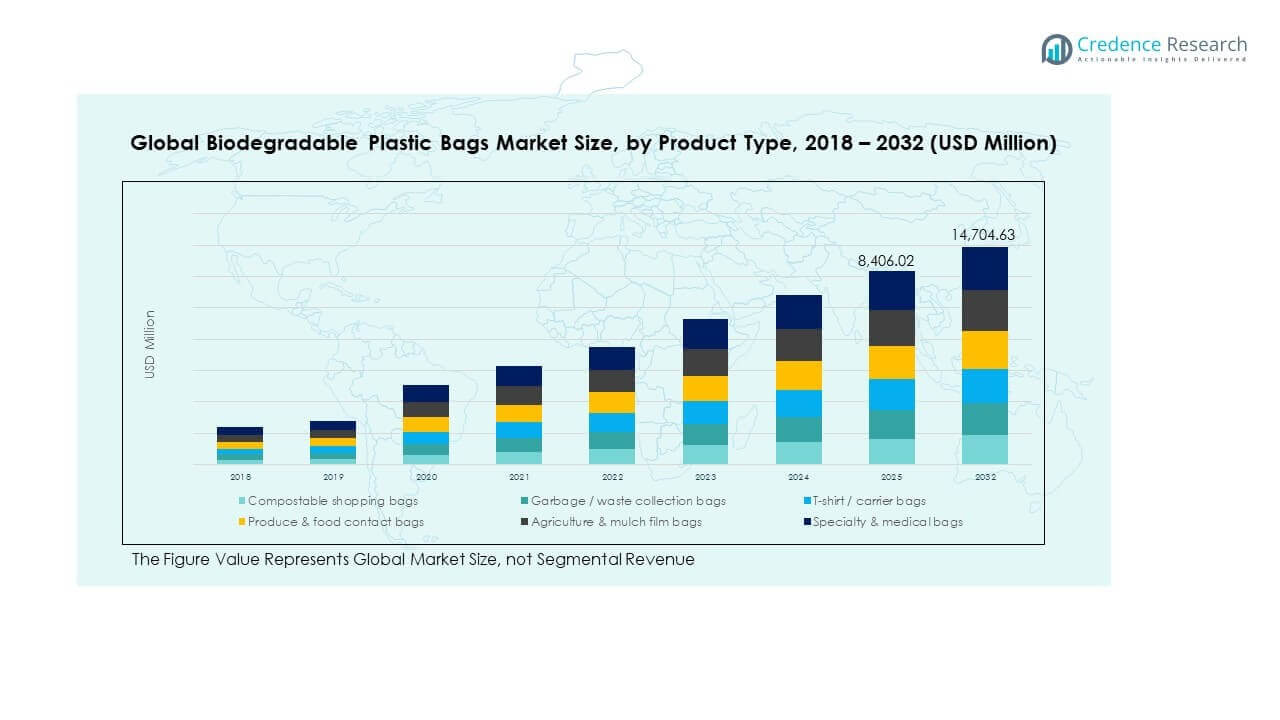
By Material Type
Polylactic Acid and PBAT lead due to balance of strength and compostability. PBS supports durability needs in heavier applications. PHA gains interest for marine and soil biodegradation traits. Starch-based blends offer cost control for mass retail use. Other cellulose options serve niche and premium formats. The Global Biodegradable Plastic Bags Market benefits from diversified material choices. Material selection aligns with regulation and end-use needs.
- For instance, NatureWorks LLC supplies Ingeo™ PLA grades used in certified compostable retail and food-contact bags globally.
By Product Type
Compostable shopping bags hold strong retail demand. Garbage and waste collection bags grow with municipal programs. T-shirt and carrier bags remain volume drivers in grocery. Produce and food contact bags gain traction from hygiene focus. Agriculture and mulch film bags support farm waste goals. Specialty and medical bags address regulated environments. The Global Biodegradable Plastic Bags Market reflects varied use cases.
- For instance, Novolex produces Eco-Products® and Duro® compostable waste and shopping bags supplied to municipal and retail programs across North America.
By Thickness / Grade
Thin grades below 15 microns suit lightweight carry needs. Mid-range 15–50 microns dominate daily retail use. Fifty-micron bags support reuse and durability goals. Buyers select grades based on load and reuse cycles. Regulations often set minimum thickness rules. The Global Biodegradable Plastic Bags Market aligns grades with compliance.
By End-Use Industry
Retail and grocery lead adoption volumes. Food and beverage demand rises from delivery growth. Household and institutional use expands via public programs. Healthcare and hygiene require certified materials. Agriculture adopts biodegradable disposal solutions. E-commerce needs durable shipping bags. The Global Biodegradable Plastic Bags Market serves broad sectors.
By Distribution Channel
Direct sales to brand owners secure long contracts. Distributors expand regional reach. Retail private labels grow shelf presence. Online channels support SMEs and customization. The Global Biodegradable Plastic Bags Market balances channels for scale.
Segmentation:
By Material Type
- Polylactic Acid (PLA)
- Polybutylene Adipate Terephthalate (PBAT)
- Polybutylene Succinate (PBS)
- Polyhydroxyalkanoates (PHA)
- Starch-based blends
- Others
By Product Type
- Compostable shopping bags
- Garbage / waste collection bags
- T-shirt / carrier bags
- Produce & food contact bags
- Agriculture & mulch film bags
- Specialty & medical bags
By Thickness / Grade
- <15 microns
- 15–50 microns
- 50 microns
By End-Use Industry
- Retail & grocery
- Food & beverage
- Household & institutional
- Healthcare & hygiene
- Agriculture
- E-commerce & courier
By Distribution Channel
- Direct to brand owners
- Distributors
- Retail private labels
- Online channels
By Region
- North America
- U.S.
- Canada
- Mexico
- Europe
- Germany
- France
- U.K.
- Italy
- Spain
- Rest of Europe
- Asia Pacific
- China
- Japan
- India
- South Korea
- South-east Asia
- Rest of Asia Pacific
- Latin America
- Brazil
- Argentina
- Rest of Latin America
- Middle East & Africa
- GCC Countries
- South Africa
- Rest of the Middle East and Africa
Regional Analysis:
North America
The North America Biodegradable Plastic Bags Market size was valued at USD 1,567.57 million in 2018 to USD 3,136.43 million in 2024 and is anticipated to reach USD 6,234.91 million by 2032, at a CAGR of 8.4% during the forecast period. North America accounted for about 42.3% market share in 2024. Federal and state bans push retailers toward certified alternatives. Major grocery chains commit to compostable packaging targets. Food delivery and takeaway services raise single-use demand. Private labels expand sustainable bag portfolios. Industrial composting access supports disposal compliance. The Global Biodegradable Plastic Bags Market benefits from strong policy enforcement in this region. Supplier capacity expansion aligns with long-term contracts.
Europe
The Europe Biodegradable Plastic Bags Market size was valued at USD 1,058.10 million in 2018 to USD 2,063.92 million in 2024 and is anticipated to reach USD 3,855.98 million by 2032, at a CAGR of 7.5% during the forecast period. Europe held nearly 27.8% market share in 2024. EU directives restrict conventional plastic usage across retail. Mandatory bag charges influence consumer behavior. Advanced composting systems enable effective waste handling. Brands integrate biodegradable bags into ESG strategies. Certification standards guide supplier selection. The Global Biodegradable Plastic Bags Market remains regulation driven in Europe. Innovation targets strength and reuse features.
Asia Pacific
The Asia Pacific Biodegradable Plastic Bags Market size was valued at USD 720.59 million in 2018 to USD 1,576.93 million in 2024 and is anticipated to reach USD 3,532.35 million by 2032, at a CAGR of 10.0% during the forecast period. Asia Pacific captured about 21.3% market share in 2024. Rapid urbanization increases waste management pressure. National plastic bans expand across major economies. E-commerce growth fuels packaging demand. Cost sensitivity influences material choices. Local producers invest in scale and partnerships. The Global Biodegradable Plastic Bags Market grows fastest in this region. Volume expansion supports gradual cost reduction.
Latin America
The Latin America Biodegradable Plastic Bags Market size was valued at USD 173.67 million in 2018 to USD 346.85 million in 2024 and is anticipated to reach USD 608.74 million by 2032, at a CAGR of 6.7% during the forecast period. Latin America represented around 4.7% market share in 2024. City-level plastic bans lead adoption efforts. Retail modernization supports sustainable packaging uptake. Import dependence affects pricing stability. Local production capacity remains limited. Consumer awareness improves steadily. The Global Biodegradable Plastic Bags Market shows early but consistent momentum. Policy expansion supports future demand.
Middle East
The Middle East Biodegradable Plastic Bags Market size was valued at USD 96.64 million in 2018 to USD 177.58 million in 2024 and is anticipated to reach USD 293.19 million by 2032, at a CAGR of 5.8% during the forecast period. The Middle East held about 2.4% market share in 2024. National sustainability agendas influence packaging choices. Retail pilots test biodegradable bag adoption. Composting infrastructure remains limited. Tourism-driven markets increase visibility of alternatives. Cost sensitivity slows mass adoption. The Global Biodegradable Plastic Bags Market expands selectively here. Regulatory pace varies across countries.
Africa
The Africa Biodegradable Plastic Bags Market size was valued at USD 51.59 million in 2018 to USD 116.35 million in 2024 and is anticipated to reach USD 179.47 million by 2032, at a CAGR of 4.9% during the forecast period. Africa accounted for nearly 1.6% market share in 2024. Several countries enforce strict plastic bans. Enforcement consistency differs by nation. Affordability remains a key concern. Local manufacturing stays at an early stage. NGO programs raise environmental awareness. The Global Biodegradable Plastic Bags Market remains nascent in Africa. Infrastructure gaps limit rapid scale.
Key Player Analysis:
Competitive Analysis:
The Global Biodegradable Plastic Bags Market shows moderate consolidation with global material suppliers and regional converters. Large players compete on material science, certifications, and supply reliability. Product portfolios cover compostable shopping, waste, and food-contact bags. Companies focus on long-term retail and brand-owner contracts. Private labels increase competitive pressure on pricing and margins. Innovation centers on strength, print quality, and compostability claims. Strategic partnerships support regional scale and compliance. Entry barriers remain moderate due to capital and certification needs. Competition favors firms with integrated material access and distribution reach. Sustainability reporting and audit readiness influence supplier selection. Regional manufacturing footprints help reduce logistics risk and lead times.
Recent Developments:
- In October 2025, BASF SE announced a strategic collaboration with International Flavors & Fragrances Inc. (IFF) to accelerate the development of next-generation enzyme technologies and biobased polymers for sustainable applications, including those relevant to biodegradable plastics.
- In May 2025, BASF SE expanded its partnership with a major European food-packaging group to scale production of ecovio compostable materials, compliant with EN 13432 standards, for single-use cups and flexible wraps in the biodegradable plastics sector.
Report Coverage:
The research report offers an in-depth analysis based on material type, product type, thickness or grade, end-use industry, and distribution channel. It details leading market players, providing an overview of their business, product offerings, investments, revenue streams, and key applications. Additionally, the report includes insights into the competitive environment, SWOT analysis, current market trends, as well as the primary drivers and constraints. Furthermore, it discusses various factors that have driven market expansion in recent years. The report also explores market dynamics, regulatory scenarios, and technological advancements that are shaping the industry. It assesses the impact of external factors and global economic changes on market growth. Lastly, it provides strategic recommendations for new entrants and established companies to navigate the complexities of the market.
Future Outlook:
- Retail bans across developed and developing economies will continue to support long-term demand for biodegradable plastic bags in retail and grocery applications.
- Ongoing material innovation will enhance mechanical strength, moisture resistance, and processing efficiency while gradually reducing production costs.
- Compostable and home-compostable certifications will increasingly shape procurement decisions for retailers, municipalities, and institutional buyers.
- Private-label brands will expand sustainable packaging portfolios to strengthen compliance, improve margins, and reinforce brand sustainability positioning.
- Rapid growth in food delivery, takeaway, and online grocery services will support higher volume consumption of biodegradable single-use bags.
- Emerging markets will adopt phased plastic restrictions, creating steady demand growth as enforcement expands from urban to semi-urban areas.
- Strategic distribution partnerships will improve regional market access, shorten lead times, and strengthen supplier responsiveness to local demand.
- Lifecycle and carbon impact data will play a larger role in buyer evaluation, influencing material choice and supplier ranking processes.
- Institutional adoption will increase through government programs, healthcare systems, and educational facilities seeking compliant waste solutions.
- Competitive dynamics will favor companies with large-scale production capacity, certified product portfolios, and strong regulatory compliance frameworks.
Request a Free Sample
Fill in your details and we'll send you a free sample report.
- Sample data tables & charts
- Research methodology
Need a Custom Version of This Report?
Tailor the scope, geography, or segments to your exact requirements.
- Custom geography or segment scope
- Direct access to our analyst team
Frequently Asked Questions
What is the current market size for the Global Biodegradable Plastic Bags Market, and what is its projected size in 2032?
At what Compound Annual Growth Rate is the Global Biodegradable Plastic Bags Market projected to grow between 2025 and 2032?
Which segment held the largest share in the Global Biodegradable Plastic Bags Market in 2024?
What are the primary factors fueling the growth of the Global Biodegradable Plastic Bags Market?
Which region commanded the largest share of the Global Biodegradable Plastic Bags Market in 2024?
Table of Content
Chapter 1. Report Introduction
- 1.1 Report Description & Purpose
- 1.1.1 Report Title & Market Definition
- 1.1.2 Unique Selling Propositions (USP) & Key Differentiators
- 1.1.3 Value Proposition for Stakeholders
- 1.2 Research Objectives
- 1.2.1 Market Sizing Objectives (Volume & Revenue)
- 1.2.2 Segmentation Objectives
- 1.2.3 Competitive Intelligence Objectives
- 1.2.4 Forecast & Scenario Objectives
- 1.3 Report Scope
- 1.3.1 Biodegradable Plastic Bags Scope – Types & Subtypes Covered
- 1.3.2 Geographic Scope – Regions & Countries Covered
- 1.3.3 Historical Period, Base Year & Forecast Period (2024; forecast to the forecast period)
- 1.3.4 Inclusions & Exclusions
- 1.4 HS Code & Classification Framework
- 1.5 Currency, Units & Pricing Basis
- 1.6 Target Stakeholders
- 1.7 Limitations & Assumptions
Chapter 2. Executive Summary
- 2.1 Global Biodegradable Plastic Bags Market Snapshot
- 2.1.1 Market Size – Historical (2024) & Forecast (the forecast period) (2024: USD 7,418.07 million → forecast year: USD 14,704.63 million)
- 2.1.2 Volume & Revenue – Global Totals
- 2.1.3 Key Market Highlights – Top Five Facts
- 2.2 Biodegradable Plastic Bags Market Segmentation Snapshot
- 2.2.1 Market Split by Region – 2024 vs.
- 2.3 Competitive Snapshot
- 2.3.1 Top 10 Players by Revenue Share – 2024
- 2.3.2 Top 10 Players by Volume Share – 2024
- 2.3.3 Recent Strategic Developments (18-Month Summary)
- 2.4 Key Investment Highlights & Strategic Conclusions
Chapter 3. Biodegradable Plastic Bags Market Dynamics & Industry Analysis
- 3.1 Market Overview & Context
- 3.1.1 Biodegradable Plastic Bags Market Position in the Broader Automotive Value Chain
- 3.1.2 OEM vs. Replacement Market Dynamics
- 3.1.3 Market Maturity & Development Stage by Region
- 3.2 Biodegradable Plastic Bags Market Drivers
- 3.3 Biodegradable Plastic Bags Market Restraints & Challenges
- 3.4 Biodegradable Plastic Bags Market Opportunities
- 3.5 Porter's Five Forces Analysis
- 3.5.1 Threat of New Entrants
- 3.5.2 Bargaining Power of Suppliers
- 3.5.3 Bargaining Power of Buyers
- 3.5.4 Threat of Substitutes
- 3.5.5 Competitive Rivalry – Intensity Assessment
- 3.6 Biodegradable Plastic Bags Value Chain Analysis
- 3.6.1 Upstream – Raw Material/Input Suppliers
- 3.6.1.1 Raw Material/Input 1
- 3.6.1.2 Raw Material/Input 2
- 3.6.1.3 Raw Material/Input 3
- 3.6.2 Midstream – Production/Manufacturing/Service Delivery
- 3.6.2.1 Production/Process Overview
- 3.6.2.2 Key Facility Locations & Capacity by Manufacturer
- 3.6.3 Downstream – Distribution & End Consumer
- 3.6.3.1 Primary Channel – B2B/OEM
- 3.6.3.2 Secondary Channels – Dealer, Retail, Online, Direct
- 3.6.4 Value Chain Profitability Analysis
- 3.6.1 Upstream – Raw Material/Input Suppliers
- 3.7 PESTEL Analysis
- 3.7.1 Political Factors
- 3.7.2 Economic Factors
- 3.7.3 Social Factors
- 3.7.4 Technological Factors
- 3.7.5 Environmental Factors
- 3.7.6 Legal Factors
- 3.8 Biodegradable Plastic Bags Supply Chain Analysis
- 3.8.1 Raw Material/Input Supply Risk Assessment
- 3.8.2 Manufacturing Concentration Risk (Geographic Exposure)
- 3.8.3 Trade Disruption Impact Analysis
- 3.9 Regulatory & Policy Landscape
Note: The regulatory and policy landscape section covers regulations based on their applicability to the market, Biodegradable Plastic Bags category, geography, and scope of the study. Only regulatory frameworks with a material impact on operations, compliance, trade, sustainability, or market access are analyzed in detail.
Chapter 4. Key Investment Pockets & Opportunity Analysis
- 4.1 Biodegradable Plastic Bags Market Attractiveness Analysis
- 4.1.1 By Region – Investment Attractiveness Matrix (Volume × CAGR)
- 4.2 Absolute Revenue Growth Opportunity
- 4.2.1 By Region – Absolute USD Growth Through the forecast period
- 4.3 Incremental Volume Opportunity
- 4.3.1 By Region – Incremental Volume Through the forecast period
- 4.3.2 Segment – Incremental Volume
- 4.4 Emerging Submarket Opportunity Deep Dive (Subject to Applicability)
- 4.5 Emerging Market Opportunity Scorecards
- 4.5.1 United States
- 4.5.2 Europe
- 4.5.3 Asia
- 4.5.4 Middle East & Africa
Note: Emerging Market Opportunity Scorecards will be included based on relevance and strategic importance. Regions listed are indicative and may vary depending on data availability and market dynamics.
Chapter 5. Biodegradable Plastic Bags Import-Export Analysis & Trade Flows
- 5.1 Global Trade Overview
- 5.1.1 Global Export Value by Country (2024)
- 5.1.2 Global Export Volume by Country (2024)
- 5.1.3 Global Import Value by Country (2024)
- 5.1.4 Global Import Volume by Country (2024)
- 5.1.5 Net Trade Balance by Country (2024)
- 5.2 Export Analysis – Segment
- 5.2.1 Type 1 (HS Code)
- 5.2.2 Type 2 (HS Code)
- 5.2.3 Type 3 (HS Code)
- 5.2.4 Type 4 (HS Code)
- 5.2.5 Type 5 (HS Code)
- 5.3 Import Analysis – Segment
- 5.3.1 Type 1 (HS Code)
- 5.3.2 Type 2 (HS Code)
- 5.3.3 Type 3 (HS Code)
- 5.3.4 Type 4 (HS Code)
- 5.3.5 Type 5 (HS Code)
- 5.4 Average Unit Trade Prices
- 5.4.1 Average Export Price – Segment & Country
- 5.4.2 Average Import Price – Segment & Source Country
- 5.4.3 Price Trends (2024)
- 5.5 Key Trade Route Analysis
- 5.5.1 Trade Route 1
- 5.5.2 Trade Route 2
- 5.5.3 Trade Route 3
- 5.5.4 Trade Route 4
- 5.5.5 Trade Route 5
- 5.6 Trade Policy Impact Assessment
- 5.6.1 US Anti-Dumping & Section 301 Tariffs
- 5.6.2 EU Customs Union Impact
- 5.6.3 Major Free Trade Agreements
- 5.6.4 USMCA Rules of Origin
Note: Trade policy analysis will be included only where relevant to the Biodegradable Plastic Bags market.
Chapter 6. Competitive Landscape & Company Benchmarking
- 6.1 Biodegradable Plastic Bags Market Concentration & Structure
- 6.1.1 Herfindahl-Hirschman Index (HHI) – vs. 2024
- 6.1.2 Tier 1, Tier 2 & Tier 3 Market Structure
- 6.1.3 Global, Regional & Local Player Dynamics
- 6.2 Biodegradable Plastic Bags Market Share Analysis – 2024
- 6.2.1 Global Revenue Share by Company
- 6.2.2 Global Volume Share by Company
- 6.2.3 Regional Revenue Share
- 6.2.4 Market Share Evolution ( vs. 2024)
- 6.2.5 OEM Segment Share by Company
- 6.2.6 Replacement Segment Share by Company
- 6.3 Production/Delivery Capacity & Facility Analysis
- 6.3.1 Global Installed Capacity
- 6.3.2 Capacity Utilization Rates
- 6.3.3 Production/Output Volume
- 6.3.4 Facility Locations & Capacity Map
- 6.3.5 Planned Capacity Additions
- 6.4 Biodegradable Plastic Bags Competitive Benchmarking Matrix
- 6.4.1 Revenue, Volume, CAGR & Profitability Comparison
- 6.4.2 Channel Revenue Mix
- 6.4.3 Geographic Revenue Exposure
- 6.4.4 R&D Intensity
- 6.4.5 Sustainability Maturity
- 6.5 Strategic Developments in Biodegradable Plastic Bags (Last 24 Months)
- 6.5.1 Mergers, Acquisitions & Divestments
- 6.5.2 New Biodegradable Plastic Bags Launches
- 6.5.3 Facility Expansions
- 6.5.4 Strategic Alliances, Joint Ventures & Partnerships
- 6.5.5 Distribution Expansion & Market Entry
- 6.5.6 Sustainability & ESG Initiatives
- 6.6 Competitive Strategy Mapping
- 6.6.1 Leader, Challenger, Follower & Niche Classification
- 6.6.2 Pricing Strategy Comparison
- 6.6.3 Channel Strategy Matrix
Note: Strategic developments are included based on their materiality and the availability of reliable information.
Chapter 7. Global Biodegradable Plastic Bags Market – By Distribution Channel
- 7.1 Segment Overview
- 7.1.1 Volume & Revenue Split by Channel (2024 & )
- 7.1.2 Channel Mix Evolution (the forecast period)
Chapter 8. Regional Market Analysis – Global Overview
- 8.1 Global Regional Overview
- 8.1.1 Regional Volume Share
- 8.1.2 Regional Revenue Share
- 8.1.3 Regional Volume by Region
- 8.1.4 Regional Revenue by Region
- 8.1.5 Regional Forecast Through the forecast period
- 8.2 Cross-Regional Segment Analysis
- 8.2.1 By Distribution Channel
- 8.2.2 By Brand/Price Tier
Chapter 9. North America Biodegradable Plastic Bags Market
- 9.1 United States
- 9.2 Canada
- 9.3 Mexico
Chapter 10. Europe Biodegradable Plastic Bags Market
- 10.1 Germany
- 10.2 France
- 10.3 Italy
- 10.4 United Kingdom
- 10.5 Spain
- 10.6 Poland
- 10.7 Russia
- 10.8 Netherlands
- 10.9 Belgium
- 10.10 Sweden
- 10.11 Denmark
- 10.12 Norway
- 10.13 Rest of Europe
Chapter 11. Asia Pacific Biodegradable Plastic Bags Market
- 11.1 China
- 11.2 India
- 11.3 Japan
- 11.4 South Korea
- 11.5 Thailand
- 11.6 Indonesia
- 11.7 Vietnam
- 11.8 Malaysia
- 11.9 Australia
- 11.10 Rest of Asia Pacific
Chapter 12. Latin America Biodegradable Plastic Bags Market
- 12.1 Brazil
- 12.2 Argentina
- 12.3 Colombia
- 12.4 Chile
- 12.5 Rest of Latin America
Chapter 13. Middle East Biodegradable Plastic Bags Market
- 13.1 Saudi Arabia
- 13.2 United Arab Emirates
- 13.3 Turkey
- 13.4 Israel
- 13.5 Iran
- 13.6 Rest of the Middle East
Chapter 14. Africa Biodegradable Plastic Bags Market
- 14.1 South Africa
- 14.2 Egypt
- 14.3 Nigeria
- 14.4 Morocco
- 14.5 Rest of Africa
Chapter 15. Biodegradable Plastic Bags Company Profiles
- 15.1 [Company 01]
- 15.1.1 Company Overview
- 15.1.2 Key Management Personnel
- 15.1.3 Products & Services Portfolio
- 15.1.4 Financial Performance
- 15.1.5 Key Market Focus & Geographic Presence
- 15.1.6 Recent Developments & Strategic Initiatives
Note: The company profile list is preliminary and may change based on research findings, market developments, data availability, and client requirements.
Chapter 16. Appendices
- Appendix A – List of Abbreviations & Acronyms
- Appendix B – Industry Classification Code Reference – Full Series
- Appendix C – Production & Capacity Data Tables
- Appendix D – End-Use & Demand Base Tables
- Appendix E – Consumption & Replacement Rate Assumptions
- Appendix F – ASP Reference Tables
- Appendix G – Manufacturing & Facility Database
- Appendix H – Import-Export Data Tables
- Appendix I – Regulatory Summary Tables
- Appendix J – Primary Research Participant List (Anonymized)
- Appendix K – Primary Research Questionnaire Framework
- Appendix L – Data Sources & Bibliography
- Appendix M – Market Size Divergence & Source Comparison
Chapter 17. Research Methodology
- 17.1 Research Framework & Philosophy
- 17.2 Secondary Research – Sources, Hierarchy & Data Extraction
- 17.3 Data Modeling – Bottom-Up & Top-Down Market Sizing
- 17.4 Primary Research – Stakeholder Framework, LOI & Sample Sizes
- 17.5 Forecast Methodology – Regression, Scenario & Sensitivity Analysis
- 17.6 Quality Control – Four-Layer Validation Framework
- 17.7 Limitations & Standard Assumptions
- 17.8 Disclaimer
