
Market Overview:
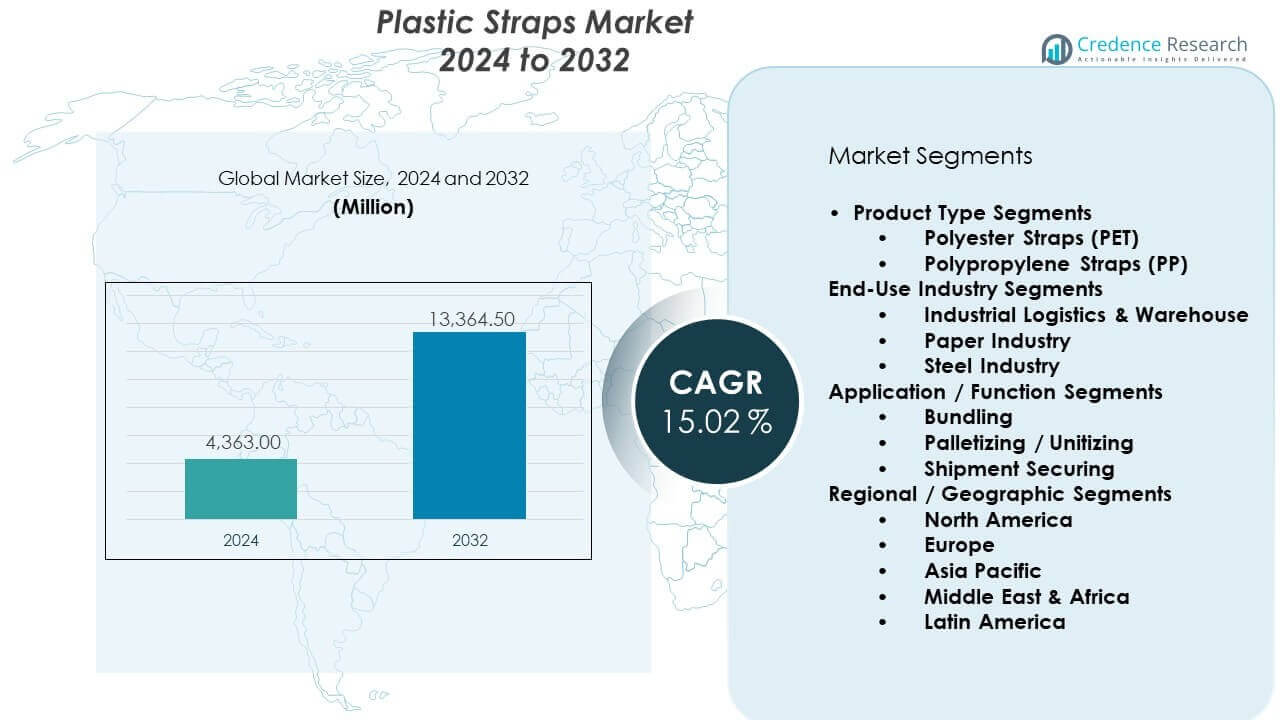
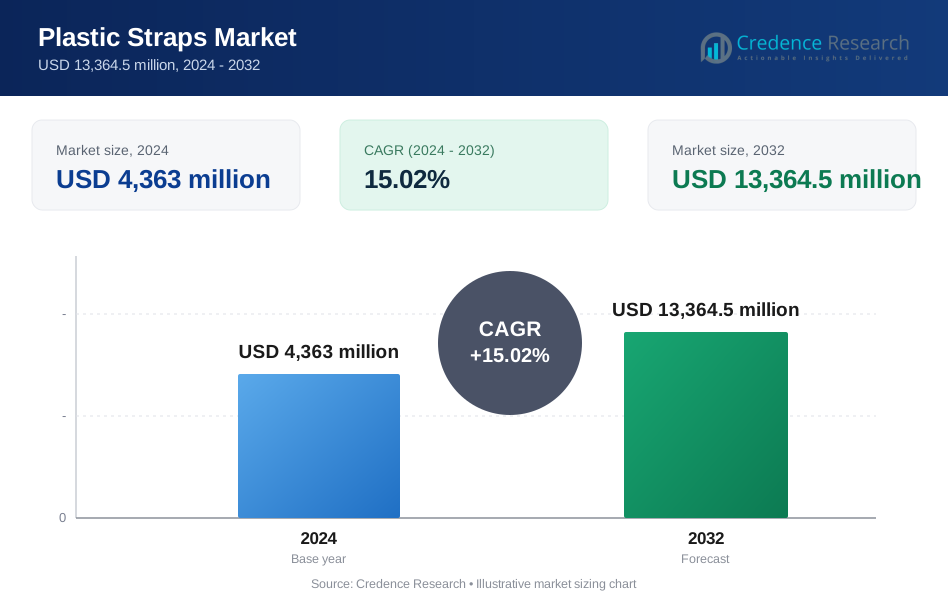
The Plastic straps market is projected to grow from USD 4,363 million in 2024 to USD 13,364.5 million by 2032. The market is expected to register a CAGR of 15.02% from 2024 to 2032.
| REPORT ATTRIBUTE | DETAILS |
|---|---|
| Historical Period | 2020-2023 |
| Base Year | 2024 |
| Forecast Period | 2025-2032 |
| Plastic Straps Market Size 2024 | USD 4,363 million |
| Plastic Straps Market , CAGR | 15.2% |
| Plastic Straps Market Size 2032 | USD 13,364.5 million |
Market growth is driven by rising global trade and expanding logistics networks. Manufacturers increase the use of plastic straps to secure goods during storage and transit. Growth in e-commerce raises demand for lightweight and reliable packaging materials. Industrial sectors prefer plastic straps due to corrosion resistance and consistent tensile strength. Automation in packaging lines also supports higher adoption. Recyclable and PET-based straps gain attention as companies focus on sustainability goals.
Asia Pacific leads the Plastic straps market due to strong manufacturing output and export activity. China and India benefit from expanding logistics, construction, and industrial sectors. North America remains a mature market with steady demand from warehousing and retail distribution. Europe shows stable growth driven by recycling initiatives and efficient packaging standards. Latin America and the Middle East emerge as growth regions, supported by infrastructure development and rising industrialization.
Market Insights:
- The Plastic straps market reached USD 4,363 million in 2024 and is projected to reach USD 13,364.5 million by 2032, registering a CAGR of 15.02% due to strong industrial and logistics demand.
- Asia Pacific leads with about 45% share driven by manufacturing and exports, followed by North America at 25% due to warehousing scale, and Europe at 20% supported by regulated packaging standards.
- Asia Pacific also remains the fastest-growing region, holding 45% share, supported by expanding factories, export trade, and rapid logistics infrastructure development.
- By product type, Polyester (PET) straps account for nearly 60% share due to high strength and steel replacement use, while Polypropylene (PP) straps hold around 30% driven by light-duty packaging needs.
- By end use, industrial logistics and warehouse applications contribute about 40% share, reflecting high pallet movement, automation adoption, and continuous material handling demand.
Market Drivers:
Expansion Of Global Packaging And Logistics Operations
The Plastic straps market benefits from expanding packaging and logistics operations worldwide. Manufacturers rely on strapping to secure goods during handling. Warehousing growth increases the need for stable unit loads. Transport firms prefer plastic straps for lightweight strength. Export volumes push demand for standardized strapping solutions. Retail distribution centers require fast bundling methods. Plastic strapping supports consistent load integrity. It reduces damage risks across supply chains.
- For instance, Signode Industrial Group LLC supplies PET straps rated above 1,000 kg break strength for automated logistics hubs. Plastic strapping supports consistent load integrity and reduces damage risks.
Rising Industrial Production Across Manufacturing Sectors
The Plastic straps market gains support from rising industrial production. Manufacturing plants bundle raw materials and finished goods daily. Metal, paper, and textile industries depend on strapping efficiency. Plastic straps provide uniform tension across packaged items. Factories value predictable performance under repetitive use. Automation lines require compatible strapping materials. Plastic options suit machine-based applications. It improves throughput across high-volume facilities.
- For instance, Samuel Strapping Systems deploys machine-grade polypropylene (PP) straps in high-speed systems like the P702, which support continuous cycles of up to 65 straps per minute. For heavy-duty applications, their PET options provide high-tension stability that improves throughput by replacing manual steel strapping with automated machine-based processes.
Cost Efficiency And Material Performance Advantages
The Plastic straps market advances due to cost and performance benefits. Producers favor plastic over steel for lower total costs. Plastic straps reduce injury risks during manual handling. Corrosion resistance supports storage in varied environments. Tensile strength meets most industrial needs. Consistent width supports automated sealing. Maintenance needs remain minimal across operations. It helps control long-term packaging expenses.
Growth Of E-Commerce And Retail Fulfillment Networks
The Plastic straps market grows with expanding e-commerce fulfillment networks. Online retailers manage high parcel movement daily. Distribution hubs require fast and secure bundling. Plastic straps suit mixed product loads. Lightweight properties reduce shipping weight concerns. Fulfillment centers prefer clean handling materials. Plastic strapping aligns with rapid order cycles. It supports efficient last-mile logistics.
Market Trends:
Shift Toward PET-Based And Recyclable Strapping Materials
The Plastic straps market shows a shift toward PET-based materials. Companies aim to reduce packaging waste. PET straps support recycling targets across industries. Brands align strapping choices with sustainability policies. Regulators push for responsible material use. PET options match steel strength in many cases. Lifecycle assessments favor recycled inputs. It supports environmental compliance goals.
- For instance, FROMM Packaging produces PET straps with up to 90% recycled content for industrial use. Lifecycle assessments favor recycled inputs and support compliance goals.
Rising Adoption Of Automated And Semi-Automated Strapping Systems
The Plastic straps market reflects higher automation adoption. Packaging lines integrate strapping machines for speed. Automated systems require uniform strap quality. Plastic straps meet precision feeding needs. Machine compatibility improves operational consistency. Labor dependence declines in large facilities. Automation supports continuous packaging flows. It improves output predictability.
- For instance, Mosca develops strapping systems capable of over 50 bundles per minute using PET straps. Automation supports continuous packaging flows and improves output predictability.
Customization Of Strap Widths And Tensile Specifications
The Plastic straps market trends toward product customization. End users demand application-specific strap sizes. Load type influences width and strength selection. Suppliers offer tailored tensile ranges. Customized straps reduce material waste. Precision specifications enhance load safety. Industrial buyers value application fit. It strengthens supplier differentiation.
Growing Preference For Colored And Printed Plastic Straps
The Plastic straps market sees demand for visual identification features. Colored straps support warehouse sorting. Printed straps improve brand visibility. Logistics firms use color coding for tracking. Retailers apply printed straps for compliance tags. Visual cues reduce handling errors. Custom colors support operational clarity. It enhances packaging control systems.
Market Challenges Analysis:
Environmental Regulations And Plastic Usage Restrictions
The Plastic straps market faces pressure from environmental regulations. Governments restrict single-use plastic materials. Compliance raises material sourcing challenges. Recycling infrastructure varies by region. End users face scrutiny over packaging choices. Substitute materials gain regulatory support. Plastic strapping must meet evolving standards. It creates compliance complexity for suppliers.
Volatility In Raw Material Prices And Supply Chains
The Plastic straps market encounters raw material price volatility. Resin costs fluctuate with oil markets. Supply chain disruptions affect availability. Producers manage uncertain procurement cycles. Price swings impact profit margins. Long-term contracts limit flexibility. Smaller firms face sourcing disadvantages. It complicates cost planning strategies.
Market Opportunities:
Expansion In Emerging Industrial And Infrastructure Markets
The Plastic straps market finds opportunity in emerging economies. Industrialization drives packaging demand. Infrastructure projects increase material movement. Manufacturing clusters expand across new regions. Local logistics networks require secure bundling. Plastic strapping suits cost-sensitive markets. Distribution hubs grow alongside urbanization. It supports scalable deployment.
Innovation In Bio-Based And Low-Carbon Plastic Straps
The Plastic straps market opens opportunities through material innovation. Bio-based polymers attract brand interest. Low-carbon straps align with climate goals. Research improves strength and durability profiles. Early adopters gain sustainability advantages. Regulatory incentives support material shifts. Product innovation enhances market positioning. It drives future differentiation.
Market Segmentation Analysis:
Product Type Segments
The Plastic straps market shows clear preference for Polyester Straps (PET) and Polypropylene Straps (PP). PET straps lead due to high tensile strength and suitability for heavy loads. Industrial users select PET as a replacement for steel strapping. PP straps support light to medium duty packaging needs. Cost efficiency drives PP adoption in high-volume operations. Both materials offer consistent performance in automated systems. It supports wide use across industries.
- For instance, Polychem Corporation supplies PET straps exceeding 1,200 kg tensile strength for heavy pallet loads. It supports wide use across industries.
End-Use Industry Segments
The Plastic straps market gains strong demand from industrial logistics and warehouse operations. These facilities require secure unit loads for storage and transport. The paper industry uses plastic straps for bundling reels and cartons. Steel producers rely on high-strength straps for coils and profiles. Each sector values reliability and worker safety. Plastic strapping reduces handling risks. It improves operational efficiency.
- For instance, Cordstrap provides PET and composite straps certified for steel coil securing above 8 tons per load. It improves operational efficiency across sectors.
Application / Function Segments
The Plastic straps market serves diverse packaging functions. Bundling supports organized handling of loose items. Palletizing and unitizing ensure stable loads during movement. Shipment securing protects goods from shifting damage. Plastic straps meet varied tension requirements. Automation compatibility strengthens adoption. It supports high-throughput environments.
Segmentation:
Product Type Segments
- Polyester Straps (PET)
- Polypropylene Straps (PP)
End-Use Industry Segments
- Industrial Logistics & Warehouse
- Paper Industry
- Steel Industry
Application / Function Segments
- Bundling
- Palletizing / Unitizing
- Shipment Securing
Regional / Geographic Segments
- North America
- U.S.
- Canada
- Mexico
- Europe
- Germany
- France
- U.K.
- Italy
- Spain
- Rest of Europe
- Asia Pacific
- China
- Japan
- India
- South Korea
- South-east Asia
- Rest of Asia Pacific
- Latin America
- Brazil
- Argentina
- Rest of Latin America
- Middle East & Africa
- GCC Countries
- South Africa
- Rest of the Middle East and Africa
Regional Analysis:
Asia Pacific Dominates With Strong Manufacturing And Export Activity
The Plastic straps market is led by Asia Pacific, which accounts for nearly 45% of global demand. China remains the largest contributor due to its strong manufacturing base. India supports growth through expanding logistics and industrial output. Export-driven economies rely on plastic straps for load stability. Cost-sensitive industries prefer plastic over metal alternatives. Rapid warehouse development supports steady volume demand. It benefits from scalable production capacity across the region.
North America And Europe Show Stable Demand With Process Efficiency Focus
The Plastic straps market records about 25% share in North America and close to 20% in Europe. The United States leads regional demand through warehousing and retail distribution. Automated packaging systems drive consistent strap consumption. Europe benefits from regulated packaging standards and recycling focus. Germany and France support demand from industrial and export sectors. PET strap adoption rises across European logistics hubs. It maintains stable growth through operational efficiency.
Latin America And Middle East & Africa Emerge As Growth Regions
The Plastic straps market holds a combined share of around 10% across Latin America and the Middle East & Africa. Brazil and Mexico lead Latin America through industrial packaging demand. Infrastructure development supports logistics expansion in the region. The Middle East gains traction from construction and trade activity. Africa shows gradual uptake through manufacturing growth. Import reliance shapes regional supply patterns. It reflects early-stage but improving market penetration.
Key Player Analysis:
- Signode Industrial Group LLC
- Crown Holdings Inc.
- FROMM Packaging
- Mosca
- Samuel Strapping Systems
- Cordstrap
- Polychem Corporation
- J. Maillis Group
Competitive Analysis:
The Plastic straps market features strong competition among global and regional manufacturers with broad product portfolios. Leading players compete on tensile strength, automation compatibility, and supply reliability. Global firms leverage scale to serve logistics, paper, and steel industries. Regional players focus on cost efficiency and local distribution strength. Product consistency supports long-term contracts with industrial buyers. Innovation centers on PET strapping and machine-grade solutions. Mergers and partnerships strengthen geographic reach. It remains moderately consolidated with clear leaders.
Recent Developments:
- In August 28 2025, Crown Holdings achieved a major sustainability milestone when the Science Based Targets initiative (SBTi) officially validated the company's new net-zero emissions target, reinforcing Crown's position as a climate leadership advocate in the packaging industry. The company received approval for its updated near-term environmental goals, committing to reduce Scope 1 and 2 emissions by 50% and Scope 3 emissions by 27.5% by 2030, with a net-zero achievement target set for 2050. These ambitious sustainability targets represent Crown's comprehensive strategy across environmental, social, and governance (ESG) dimensions through its Twentyby30™ program. The approval demonstrates Crown's commitment to measurable impact across its entire value chain, from production to distribution, and positions the company as an industry leader in sustainable packaging solutions.
- In July 2025, Crown Holdings announced a significant raise to its 2025 financial guidance, reflecting exceptionally strong Q2 performance across its key market segments. The company reported that North American food demand increased by 9% during the second quarter, with particularly strong performance in vegetable volumes, demonstrating resilience across diverse product categories. Crown raised its adjusted free cash flow expectations to approximately $900 million for 2025, up from the previous estimate of $800 million, following planned capital expenditures of $450 million. The company's positive outlook extends beyond 2025, with management expressing confidence in "very strong 2026" ahead. Crown also revealed its strategy to build can inventory through year-end, currently operating several hundred million cans below desired inventory levels. Despite economic pressures and higher prices passed to consumers, Crown observed that consumers have not reduced their beverage can purchases, regardless of product type, indicating sustained demand strength.
- On January 30, 2025, Mosca and Reisopack formalized a transformative strategic merger with the creation of MoRe Packaging Group SL, headquartered in Barcelona, Spain. This landmark collaboration represents an important evolution in the industrial packaging sector, combining two industry leaders with complementary strengths and market expertise. The new entity operates as a holding company structure for Reisopack SL and Mosca Direct SL (the Spanish division), with both companies maintaining their individual legal independence while functioning under the unified MoRe Packaging Group framework.
Report Coverage:
The research report offers an in-depth analysis based on Product Type Segments, End-Use Industry Segments, Application Segments, and Regional Segments. It details leading market players, providing an overview of their business, product offerings, investments, revenue streams, and key applications. Additionally, the report includes insights into the competitive environment, SWOT analysis, current market trends, as well as the primary drivers and constraints. Furthermore, it discusses various factors that have driven market expansion in recent years. The report also explores market dynamics, regulatory scenarios, and technological advancements that are shaping the industry. It assesses the impact of external factors and global economic changes on market growth. Lastly, it provides strategic recommendations for new entrants and established companies to navigate the complexities of the market.
Future Outlook:
- Automation adoption will increase demand for machine-grade plastic straps.
- PET straps will gain wider acceptance as steel replacements.
- Sustainability goals will encourage recycled material usage.
- Warehousing expansion will support steady volume growth.
- Custom strap specifications will grow across industries.
- Emerging markets will attract new manufacturing capacity.
- Digital quality monitoring will improve product consistency.
- Regional sourcing strategies will reduce supply risk.
- Partnerships will expand distribution reach.
- Product innovation will remain a key differentiation lever.
Request a Free Sample
Fill in your details and we'll send you a free sample report.
- Sample data tables & charts
- Research methodology
Need a Custom Version of This Report?
Tailor the scope, geography, or segments to your exact requirements.
- Custom geography or segment scope
- Direct access to our analyst team
Frequently Asked Questions
What is the current market size for Plastic straps market, and what is its projected size in 2032?
At what Compound Annual Growth Rate is the Plastic straps market projected to grow between 2025 and 2032?
Which Plastic straps market segment held the largest share in 2024?
What are the primary factors fueling the growth of the Plastic straps market?
Who are the leading companies in the Plastic straps market?
Which region commanded the largest share of the Plastic straps market in 2024?
Table of Content
Chapter 1. Report Introduction
- 1.1 Report Description & Purpose
- 1.1.1 Report Title & Market Definition
- 1.1.2 Unique Selling Propositions (USP) & Key Differentiators
- 1.1.3 Value Proposition for Stakeholders
- 1.2 Research Objectives
- 1.2.1 Market Sizing Objectives (Volume & Revenue)
- 1.2.2 Segmentation Objectives
- 1.2.3 Competitive Intelligence Objectives
- 1.2.4 Forecast & Scenario Objectives
- 1.3 Report Scope
- 1.3.1 Plastic Straps Scope – Types & Subtypes Covered
- 1.3.2 Geographic Scope – Regions & Countries Covered
- 1.3.3 Historical Period, Base Year & Forecast Period (2024; forecast to 2032)
- 1.3.4 Inclusions & Exclusions
- 1.4 HS Code & Classification Framework
- 1.5 Currency, Units & Pricing Basis
- 1.6 Target Stakeholders
- 1.7 Limitations & Assumptions
Chapter 2. Executive Summary
- 2.1 Global Plastic Straps Market Snapshot
- 2.1.1 Market Size – Historical (2024) & Forecast (2024-2032) (2024: USD 4,363 million → 2032: USD 13,364.5 million)
- 2.1.2 Volume & Revenue – Global Totals
- 2.1.3 Key Market Highlights – Top Five Facts
- 2.2 Plastic Straps Market Segmentation Snapshot
- 2.2.1 Market Split by Region – 2024 vs. 2032
- 2.3 Competitive Snapshot
- 2.3.1 Top 10 Players by Revenue Share – 2024
- 2.3.2 Top 10 Players by Volume Share – 2024
- 2.3.3 Recent Strategic Developments (18-Month Summary)
- 2.4 Key Investment Highlights & Strategic Conclusions
Chapter 3. Plastic Straps Market Dynamics & Industry Analysis
- 3.1 Market Overview & Context
- 3.1.1 Plastic Straps Market Position in the Broader Automotive Value Chain
- 3.1.2 OEM vs. Replacement Market Dynamics
- 3.1.3 Market Maturity & Development Stage by Region
- 3.2 Plastic Straps Market Drivers
- 3.3 Plastic Straps Market Restraints & Challenges
- 3.4 Plastic Straps Market Opportunities
- 3.5 Porter's Five Forces Analysis
- 3.5.1 Threat of New Entrants
- 3.5.2 Bargaining Power of Suppliers
- 3.5.3 Bargaining Power of Buyers
- 3.5.4 Threat of Substitutes
- 3.5.5 Competitive Rivalry – Intensity Assessment
- 3.6 Plastic Straps Value Chain Analysis
- 3.6.1 Upstream – Raw Material/Input Suppliers
- 3.6.1.1 Raw Material/Input 1
- 3.6.1.2 Raw Material/Input 2
- 3.6.1.3 Raw Material/Input 3
- 3.6.2 Midstream – Production/Manufacturing/Service Delivery
- 3.6.2.1 Production/Process Overview
- 3.6.2.2 Key Facility Locations & Capacity by Manufacturer
- 3.6.3 Downstream – Distribution & End Consumer
- 3.6.3.1 Primary Channel – B2B/OEM
- 3.6.3.2 Secondary Channels – Dealer, Retail, Online, Direct
- 3.6.4 Value Chain Profitability Analysis
- 3.6.1 Upstream – Raw Material/Input Suppliers
- 3.7 PESTEL Analysis
- 3.7.1 Political Factors
- 3.7.2 Economic Factors
- 3.7.3 Social Factors
- 3.7.4 Technological Factors
- 3.7.5 Environmental Factors
- 3.7.6 Legal Factors
- 3.8 Plastic Straps Supply Chain Analysis
- 3.8.1 Raw Material/Input Supply Risk Assessment
- 3.8.2 Manufacturing Concentration Risk (Geographic Exposure)
- 3.8.3 Trade Disruption Impact Analysis
- 3.9 Regulatory & Policy Landscape
Note: The regulatory and policy landscape section covers regulations based on their applicability to the market, Plastic Straps category, geography, and scope of the study. Only regulatory frameworks with a material impact on operations, compliance, trade, sustainability, or market access are analyzed in detail.
Chapter 4. Key Investment Pockets & Opportunity Analysis
- 4.1 Plastic Straps Market Attractiveness Analysis
- 4.1.1 By Region – Investment Attractiveness Matrix (Volume × CAGR)
- 4.2 Absolute Revenue Growth Opportunity
- 4.2.1 By Region – Absolute USD Growth Through 2032
- 4.3 Incremental Volume Opportunity
- 4.3.1 By Region – Incremental Volume Through 2032
- 4.3.2 Segment – Incremental Volume
- 4.4 Emerging Submarket Opportunity Deep Dive (Subject to Applicability)
- 4.5 Emerging Market Opportunity Scorecards
- 4.5.1 United States
- 4.5.2 Europe
- 4.5.3 Asia
- 4.5.4 Middle East & Africa
Note: Emerging Market Opportunity Scorecards will be included based on relevance and strategic importance. Regions listed are indicative and may vary depending on data availability and market dynamics.
Chapter 5. Plastic Straps Import-Export Analysis & Trade Flows
- 5.1 Global Trade Overview
- 5.1.1 Global Export Value by Country (2024)
- 5.1.2 Global Export Volume by Country (2024)
- 5.1.3 Global Import Value by Country (2024)
- 5.1.4 Global Import Volume by Country (2024)
- 5.1.5 Net Trade Balance by Country (2024)
- 5.2 Export Analysis – Segment
- 5.2.1 Type 1 (HS Code)
- 5.2.2 Type 2 (HS Code)
- 5.2.3 Type 3 (HS Code)
- 5.2.4 Type 4 (HS Code)
- 5.2.5 Type 5 (HS Code)
- 5.3 Import Analysis – Segment
- 5.3.1 Type 1 (HS Code)
- 5.3.2 Type 2 (HS Code)
- 5.3.3 Type 3 (HS Code)
- 5.3.4 Type 4 (HS Code)
- 5.3.5 Type 5 (HS Code)
- 5.4 Average Unit Trade Prices
- 5.4.1 Average Export Price – Segment & Country
- 5.4.2 Average Import Price – Segment & Source Country
- 5.4.3 Price Trends (2024)
- 5.5 Key Trade Route Analysis
- 5.5.1 Trade Route 1
- 5.5.2 Trade Route 2
- 5.5.3 Trade Route 3
- 5.5.4 Trade Route 4
- 5.5.5 Trade Route 5
- 5.6 Trade Policy Impact Assessment
- 5.6.1 US Anti-Dumping & Section 301 Tariffs
- 5.6.2 EU Customs Union Impact
- 5.6.3 Major Free Trade Agreements
- 5.6.4 USMCA Rules of Origin
Note: Trade policy analysis will be included only where relevant to the Plastic Straps market.
Chapter 6. Competitive Landscape & Company Benchmarking
- 6.1 Plastic Straps Market Concentration & Structure
- 6.1.1 Herfindahl-Hirschman Index (HHI) – vs. 2024
- 6.1.2 Tier 1, Tier 2 & Tier 3 Market Structure
- 6.1.3 Global, Regional & Local Player Dynamics
- 6.2 Plastic Straps Market Share Analysis – 2024
- 6.2.1 Global Revenue Share by Company
- 6.2.2 Global Volume Share by Company
- 6.2.3 Regional Revenue Share
- 6.2.4 Market Share Evolution ( vs. 2024)
- 6.2.5 OEM Segment Share by Company
- 6.2.6 Replacement Segment Share by Company
- 6.3 Production/Delivery Capacity & Facility Analysis
- 6.3.1 Global Installed Capacity
- 6.3.2 Capacity Utilization Rates
- 6.3.3 Production/Output Volume
- 6.3.4 Facility Locations & Capacity Map
- 6.3.5 Planned Capacity Additions
- 6.4 Plastic Straps Competitive Benchmarking Matrix
- 6.4.1 Revenue, Volume, CAGR & Profitability Comparison
- 6.4.2 Channel Revenue Mix
- 6.4.3 Geographic Revenue Exposure
- 6.4.4 R&D Intensity
- 6.4.5 Sustainability Maturity
- 6.5 Strategic Developments in Plastic Straps (Last 24 Months)
- 6.5.1 Mergers, Acquisitions & Divestments
- 6.5.2 New Plastic Straps Launches
- 6.5.3 Facility Expansions
- 6.5.4 Strategic Alliances, Joint Ventures & Partnerships
- 6.5.5 Distribution Expansion & Market Entry
- 6.5.6 Sustainability & ESG Initiatives
- 6.6 Competitive Strategy Mapping
- 6.6.1 Leader, Challenger, Follower & Niche Classification
- 6.6.2 Pricing Strategy Comparison
- 6.6.3 Channel Strategy Matrix
Note: Strategic developments are included based on their materiality and the availability of reliable information.
Chapter 7. Global Plastic Straps Market – By Distribution Channel
- 7.1 Segment Overview
- 7.1.1 Volume & Revenue Split by Channel (2024 & 2032)
- 7.1.2 Channel Mix Evolution (2024-2032)
Chapter 8. Regional Market Analysis – Global Overview
- 8.1 Global Regional Overview
- 8.1.1 Regional Volume Share
- 8.1.2 Regional Revenue Share
- 8.1.3 Regional Volume by Region
- 8.1.4 Regional Revenue by Region
- 8.1.5 Regional Forecast Through 2032
- 8.2 Cross-Regional Segment Analysis
- 8.2.1 By Distribution Channel
- 8.2.2 By Brand/Price Tier
Chapter 9. North America Plastic Straps Market
- 9.1 United States
- 9.2 Canada
- 9.3 Mexico
Chapter 10. Europe Plastic Straps Market
- 10.1 Germany
- 10.2 France
- 10.3 Italy
- 10.4 United Kingdom
- 10.5 Spain
- 10.6 Poland
- 10.7 Russia
- 10.8 Netherlands
- 10.9 Belgium
- 10.10 Sweden
- 10.11 Denmark
- 10.12 Norway
- 10.13 Rest of Europe
Chapter 11. Asia Pacific Plastic Straps Market
- 11.1 China
- 11.2 India
- 11.3 Japan
- 11.4 South Korea
- 11.5 Thailand
- 11.6 Indonesia
- 11.7 Vietnam
- 11.8 Malaysia
- 11.9 Australia
- 11.10 Rest of Asia Pacific
Chapter 12. Latin America Plastic Straps Market
- 12.1 Brazil
- 12.2 Argentina
- 12.3 Colombia
- 12.4 Chile
- 12.5 Rest of Latin America
Chapter 13. Middle East Plastic Straps Market
- 13.1 Saudi Arabia
- 13.2 United Arab Emirates
- 13.3 Turkey
- 13.4 Israel
- 13.5 Iran
- 13.6 Rest of the Middle East
Chapter 14. Africa Plastic Straps Market
- 14.1 South Africa
- 14.2 Egypt
- 14.3 Nigeria
- 14.4 Morocco
- 14.5 Rest of Africa
Chapter 15. Plastic Straps Company Profiles
- 15.1 [Company 01]
- 15.1.1 Company Overview
- 15.1.2 Key Management Personnel
- 15.1.3 Products & Services Portfolio
- 15.1.4 Financial Performance
- 15.1.5 Key Market Focus & Geographic Presence
- 15.1.6 Recent Developments & Strategic Initiatives
Note: The company profile list is preliminary and may change based on research findings, market developments, data availability, and client requirements.
Chapter 16. Appendices
- Appendix A – List of Abbreviations & Acronyms
- Appendix B – Industry Classification Code Reference – Full Series
- Appendix C – Production & Capacity Data Tables
- Appendix D – End-Use & Demand Base Tables
- Appendix E – Consumption & Replacement Rate Assumptions
- Appendix F – ASP Reference Tables
- Appendix G – Manufacturing & Facility Database
- Appendix H – Import-Export Data Tables
- Appendix I – Regulatory Summary Tables
- Appendix J – Primary Research Participant List (Anonymized)
- Appendix K – Primary Research Questionnaire Framework
- Appendix L – Data Sources & Bibliography
- Appendix M – Market Size Divergence & Source Comparison
Chapter 17. Research Methodology
- 17.1 Research Framework & Philosophy
- 17.2 Secondary Research – Sources, Hierarchy & Data Extraction
- 17.3 Data Modeling – Bottom-Up & Top-Down Market Sizing
- 17.4 Primary Research – Stakeholder Framework, LOI & Sample Sizes
- 17.5 Forecast Methodology – Regression, Scenario & Sensitivity Analysis
- 17.6 Quality Control – Four-Layer Validation Framework
- 17.7 Limitations & Standard Assumptions
- 17.8 Disclaimer
