
| REPORT ATTRIBUTE | DETAILS |
|---|---|
| Historical Period | 2020-2023 |
| Base Year | 2024 |
| Forecast Period | 2025-2032 |
| UAE Industrial Fasteners Market Size 2024 | USD 216.74 million |
| UAE Industrial Fasteners Market, CAGR | 3.71% |
| UAE Industrial Fasteners Market Size 2032 | USD 290.03 million |
Market Overview:
The UAE Industrial Fasteners Market is projected to grow from USD 216.74 million in 2024 to an estimated USD 290.03 million by 2032, with a compound annual growth rate (CAGR) of 3.71% from 2024 to 2032.
Several major factors are supporting the growth of the UAE Industrial Fasteners Market. Infrastructure development remains a dominant driver, with projects like rail networks, metro expansions, and residential and commercial complexes generating strong demand for reliable fastening systems. The government’s active efforts to diversify the economy under initiatives like Vision 2021 and the Dubai Industrial Strategy 2030 have bolstered the manufacturing and industrial sectors, further increasing the need for fasteners. The automotive and aerospace industries are emerging as significant consumers, requiring specialized fasteners to meet advanced engineering and safety standards. Additionally, substantial growth in petrochemical and energy projects is creating steady opportunities for fasteners used in critical and high-stress environments. These combined factors are strengthening the foundation for sustained market growth over the long term.
The UAE plays a central role in the industrial fasteners market across the Middle East and Africa region. Its strategic geographic location, advanced logistics infrastructure, and strong trade connectivity position it as a key distribution hub for fasteners. The country’s industrial zones and free trade areas support not only domestic consumption but also regional exports, with significant trade links to neighboring Gulf Cooperation Council countries. The UAE’s commitment to developing smart infrastructure, enhancing manufacturing capabilities, and fostering international trade partnerships continues to enhance its influence in the regional market. As industrial activity across the Middle East accelerates, the UAE remains a vital player, driving growth and innovation within the industrial fasteners sector.
Market Insights:
- The UAE Industrial Fasteners Market is projected to grow steadily from USD 216.74 million in 2024 to USD 290.03 million by 2032, at a CAGR of 3.71%.
- Expanding infrastructure projects, including metro systems, airports, and smart cities, are major drivers boosting fastener demand across the country.
- Economic diversification initiatives such as Vision 2021 and Dubai Industrial Strategy 2030 are strengthening manufacturing and industrial production, increasing fastener consumption.
- Automotive and aerospace sectors are emerging as high-growth areas, creating new demand for precision-engineered and safety-critical fasteners.
- The petrochemical and energy industries are fueling demand for corrosion-resistant fasteners used in critical and high-stress operational environments.
- Volatile raw material prices and heavy dependence on imported fasteners pose challenges to market stability and profitability for domestic suppliers.
- The UAE's strategic location and strong logistics infrastructure position it as a key hub for regional fastener distribution across the Middle East and Africa.
Report scope
This report segments the UAE Industrial Fasteners Market as follow: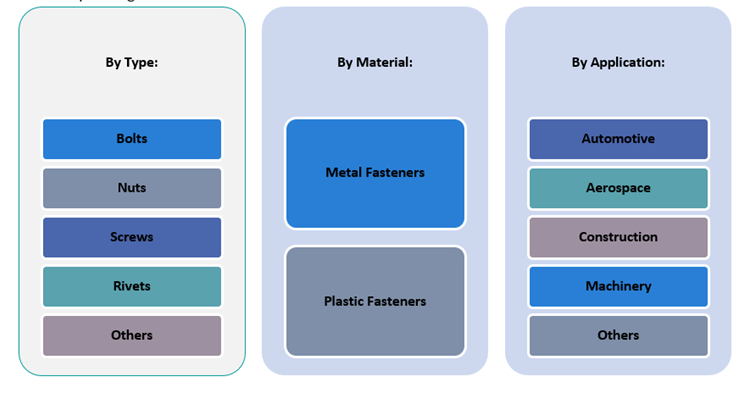
Market Drivers:
Infrastructure Development and Construction Boom
The UAE’s aggressive infrastructure development initiatives are significantly driving demand for industrial fasteners. Large-scale projects such as metro expansions, airport developments, residential complexes, and commercial hubs are steadily boosting the consumption of fastening solutions across diverse applications. The government's consistent investments in upgrading transportation networks, smart city projects like Dubai South, and major events like Expo 2020 have triggered extensive construction activities that require high-performance fastening products. As urbanization continues to reshape the nation's landscape, the need for durable and specialized fasteners remains crucial, reinforcing the market’s steady growth.
Economic Diversification and Industrial Expansion
The UAE’s strategic move toward economic diversification under Vision 2021 and the Dubai Industrial Strategy 2030 has fueled the growth of non-oil sectors, particularly manufacturing and industrial production. Expansion in industries such as machinery, equipment manufacturing, and industrial fabrication has considerably increased the demand for various types of fasteners. Government incentives encouraging local manufacturing and the establishment of industrial parks are further strengthening the domestic production ecosystem. This diversification not only minimizes reliance on oil revenues but also creates a sustainable environment for continuous demand across sectors where fastening components are integral.
Growth of Automotive and Aerospace Industries
The UAE’s automotive and aerospace sectors are emerging as significant consumers of advanced industrial fasteners. The rise in automobile imports, assembly units, and aerospace maintenance facilities across the country is stimulating demand for specialized fastening systems that meet stringent quality, durability, and safety standards. For instance, Emirates SkyCargo, the freight division of Emirates Airline, transported over 2.1 million tonnes of cargo in 2023, including high-value aerospace components that depend on certified fasteners for airworthiness. The focus on promoting electric vehicles, automotive parts manufacturing, and aviation services in hubs like Abu Dhabi and Dubai has amplified the requirement for precision-engineered fasteners. As these sectors grow in complexity and technological advancement, the necessity for high-performance fastening solutions becomes even more critical to ensure safety and operational efficiency.
Expansion of Petrochemical and Energy Sectors
The expansion of the UAE’s petrochemical and energy industries plays a vital role in accelerating the demand for industrial fasteners. Mega projects in oil and gas exploration, refinery expansions, and renewable energy developments require highly resilient and corrosion-resistant fastening solutions to withstand extreme environmental conditions. For instance, ADNOC is investing in new petrochemical plants, including facilities for paraxylene (1.4 million tpa) and benzene (400,000 tpa). Investments in offshore drilling, solar parks, and nuclear energy facilities have intensified the need for fasteners capable of performing reliably in critical and high-stress environments. As the UAE strengthens its position as a regional energy leader, the market for specialized fasteners continues to benefit from the sustained growth of energy-related infrastructure.
Market Trends:
Rise of Advanced Fastener Materials
The UAE industrial fasteners market is witnessing a clear shift towards the use of advanced materials such as titanium, stainless steel, and high-performance alloys. For instance, Asia Bolts Industries LLC manufactures fasteners using alloy steel, SS304, SS316, B7, L7, and B16, supplying over 40,000 types of products for demanding applications in petrochemical installations and oil refineries, where strength and corrosion resistance are critical. Industries across sectors such as aerospace, marine, and heavy machinery are increasingly opting for fasteners that offer superior strength, corrosion resistance, and longer service life. The demand for lightweight yet durable fasteners is particularly strong in aviation and defense projects, where weight reduction without compromising structural integrity is critical. This trend is encouraging manufacturers and suppliers to innovate in material science, leading to the broader adoption of specialized fasteners across complex industrial applications.
Growing Adoption of Smart Fasteners
Technological advancement is reshaping the UAE fasteners market with the growing introduction of smart fasteners equipped with sensors and real-time monitoring capabilities. These smart fastening systems are increasingly used in critical sectors like aerospace, oil and gas, and infrastructure projects, where real-time feedback on load, tension, and environmental conditions can prevent failures and enhance maintenance planning. For example, several UAE manufacturers have begun incorporating Industry 4.0 principles into their production facilities, enabling the development of intelligent fastening systems that can be integrated with IoT frameworks for predictive maintenance and operational efficiency. Integration with the Internet of Things (IoT) and Industry 4.0 frameworks is creating new opportunities for fastener manufacturers to offer value-added solutions. As industries move towards predictive maintenance and enhanced operational efficiency, the adoption of intelligent fastening technologies is becoming a notable trend.
Expansion of Green Construction Initiatives
The UAE’s strong push towards sustainable development is influencing the industrial fasteners market, especially in the construction sector. Green building standards such as Estidama and LEED certifications are promoting the use of environmentally friendly materials and construction practices. As a result, demand for eco-friendly fasteners, recyclable products, and fastening systems with lower environmental impact is steadily increasing. Construction companies are placing greater emphasis on sourcing fastening solutions that comply with green certification requirements. This trend is prompting manufacturers to invest in sustainable production methods and materials to cater to the evolving preferences of environmentally conscious clients.
Shift Towards Domestic Manufacturing and Localization
Amid changing global trade dynamics and supply chain uncertainties, there is a growing emphasis on domestic manufacturing and localization of industrial fasteners within the UAE. Government initiatives supporting local production and policies promoting industrial self-sufficiency are encouraging companies to invest in setting up manufacturing units within the country. Free zones like Jebel Ali Free Zone (JAFZA) and Khalifa Industrial Zone Abu Dhabi (KIZAD) are attracting investments for fastener production facilities. This shift not only reduces dependency on imports but also enables faster turnaround times, cost efficiencies, and customization according to the specific needs of regional industries, contributing to a more resilient supply chain ecosystem.
Market Challenges Analysis:
Volatility in Raw Material Prices
The UAE industrial fasteners market faces notable challenges due to fluctuations in the prices of raw materials such as steel, aluminum, and alloys. For instance, the Federal Reserve Bank of St. Louis reported that the Global Metal Price Index more than doubled compared to 2021, with prices declining between 2022 and 2023 but remaining volatile, creating an unstable pricing environment for manufacturers. Since fasteners are highly material-dependent products, any significant variation in the cost of raw inputs directly affects production costs and profit margins. Global supply chain disruptions, tariff changes, and geopolitical tensions further intensify the unpredictability of material availability and pricing. Manufacturers are often compelled to pass these costs on to end-users, which can affect demand, particularly in price-sensitive segments. Sustained volatility in raw material markets remains a critical restraint that limits long-term planning and stable growth for fastener producers in the UAE.
High Dependence on Imports and Supply Chain Risks
A substantial portion of industrial fasteners used in the UAE is sourced through imports, primarily from Asian and European countries. This dependence on external suppliers exposes the market to potential risks associated with logistical delays, shipping cost surges, regulatory changes, and trade restrictions. Recent global events have highlighted vulnerabilities in extended supply chains, emphasizing the impact of even minor disruptions on project timelines and inventory management. Although the UAE’s strategic location provides strong trade connectivity, reliance on imports creates uncertainty in consistent product availability and pricing stability. Building a more resilient domestic manufacturing base remains a critical challenge that must be addressed to ensure sustainable market development.
Market Opportunities:
The UAE Industrial Fasteners Market presents significant growth opportunities driven by the country's ambitious infrastructure development programs and increasing industrialization. The ongoing expansion of sectors such as construction, transportation, energy, and manufacturing is creating sustained demand for a wide variety of high-performance fastening solutions. With government initiatives like Operation 300bn aiming to boost the contribution of the industrial sector to the national economy, there is a clear pathway for fastener manufacturers and suppliers to tap into rising requirements for precision-engineered, durable, and application-specific fastening products. Furthermore, the rise of mega-projects including smart cities, renewable energy parks, and industrial free zones is generating strong demand for technologically advanced fasteners, offering lucrative prospects for companies willing to innovate and adapt to evolving customer needs.
Another major opportunity lies in the UAE’s strategic push for localized manufacturing and supply chain resilience. As businesses seek to reduce dependency on imports and enhance operational flexibility, there is growing encouragement for establishing domestic fastener manufacturing capabilities. Investments in industrial zones like Khalifa Industrial Zone Abu Dhabi (KIZAD) and Jebel Ali Free Zone (JAFZA) offer incentives for new production facilities, enabling manufacturers to meet regional demand more efficiently. Additionally, the increasing emphasis on sustainability and green building practices opens avenues for eco-friendly fasteners that align with environmental standards. Companies that can combine innovation, customization, and sustainable practices are well-positioned to capitalize on the dynamic opportunities emerging across the UAE’s fast-evolving industrial landscape.
Market Segmentation Analysis:
The UAE Industrial Fasteners Market is segmented by type, application, and material, each contributing distinctly to the industry’s overall development.
By type, bolts hold the largest market share due to their widespread usage across heavy construction, automotive manufacturing, and machinery assembly. Nuts and screws also capture a significant portion, driven by their critical role in providing structural integrity across multiple sectors. Rivets are gaining traction, particularly in aerospace and construction applications, where high-strength, permanent fastening solutions are essential. The ‘others’ category, including washers and pins, continues to support niche industrial requirements, contributing steadily to market growth.
By application, the construction segment dominates the market, fueled by the UAE’s continuous investment in infrastructure, residential, and commercial projects. The automotive sector follows, supported by growing vehicle imports, assembly facilities, and maintenance operations that require precision fastening solutions. Aerospace represents a high-value segment, with increasing demand for specialized fasteners designed to meet stringent safety and performance standards. The machinery sector also plays a crucial role, reflecting the expanding industrial base and manufacturing capabilities within the UAE. The 'others' segment, comprising sectors like marine and electrical applications, provides additional opportunities for specialized fastener use.
By material, metal fasteners account for the majority share, owing to their superior strength, durability, and ability to withstand harsh environmental conditions typical in construction and industrial operations. Plastic fasteners, while holding a smaller share, are witnessing growing demand due to their lightweight properties, corrosion resistance, and use in automotive and electronics industries. This diversified segmentation highlights the broad and evolving application landscape of the UAE Industrial Fasteners Market.
Segmentation:
By Type Segment:
- Bolts
- Nuts
- Screws
- Rivets
- Others
By Application Segment:
- Automotive
- Aerospace
- Construction
- Machinery
- Others
By Material Segment:
- Metal Fasteners
- Plastic Fasteners
Regional Analysis:
The UAE industrial fasteners market exhibits a regionally diverse landscape, with significant contributions from various emirates. Dubai leads the market, accounting for approximately 40% of the national demand, driven by its extensive construction projects, including commercial buildings, infrastructure developments, and its status as a major logistics hub. Abu Dhabi follows closely, contributing around 30% to the market, supported by large-scale industrial and energy projects, as well as government-led initiatives aimed at economic diversification. Sharjah and the Northern Emirates collectively represent about 20% of the market share, benefiting from growing manufacturing activities and small to medium-scale construction projects. The remaining 10% is distributed among other regions, where ongoing development projects continue to spur demand for industrial fasteners.
The UAE's strategic position as a trade and logistics center in the Middle East enhances its role in the regional industrial fasteners market. The country's well-developed infrastructure, including ports and free zones, facilitates the import and export of fasteners, not only serving domestic needs but also catering to neighboring countries. This regional integration is further strengthened by the UAE's participation in various economic partnerships and trade agreements, which promote the flow of goods and support the growth of the industrial fasteners market across the region.
Key Player Analysis:
- EJOT Middle East FZE
- Fischer Fixings Middle East
- Al Jazeera Bolts Industries LLC
- Dubai Bolt and Screw Company LLC
- Bolt Master Middle East
- Fast Trade Est.
- Al Maha Fasteners
- Al-Rajhi Industrial Group
- Petrofast Middle East LLC
- Saudi Fasteners Company
Competitive Analysis:
The UAE Industrial Fasteners Market is characterized by a competitive landscape featuring a blend of international manufacturers and regional suppliers striving to strengthen their market presence. Leading global players compete by offering advanced fastening solutions with high precision, superior material quality, and customized product ranges to meet diverse industrial needs. Regional companies leverage strong distribution networks, local manufacturing capabilities, and cost-effective solutions to cater to growing domestic demand. Strategic partnerships, technological innovation, and product differentiation remain critical strategies among key players to enhance their competitiveness. Additionally, firms are increasingly focusing on developing sustainable and corrosion-resistant fasteners to align with the UAE’s rising green building and infrastructure initiatives. The competition is further intensified by the growing demand for specialized fasteners across sectors such as construction, automotive, and aerospace, encouraging continuous investment in research, development, and localized production to maintain a competitive edge in the evolving market environment.
Recent Developments:
- Fischer Fixings Middle East has been highly active in 2025. In March, the company launched the C-Fiber Force Strengthening System, an ETA-certified solution using advanced carbon fiber technology for structural reinforcement in buildings and bridges. The system is developed and manufactured in Germany, emphasizing quality and performance. Additionally, Fischer expanded its operations by opening a new office in Abu Dhabi to better serve regional customers and announced plans to expand its fixing systems division following the sale of its automotive arm.
- On February 25, 2025, Miller Electric Mfg. LLC, a wholly-owned subsidiary of Illinois Tool Works (ITW), announced a strategic partnership with Novarc Technologies. This collaboration focuses on developing AI-powered welding solutions under the Miller® Copilot™ line, aiming to enhance productivity, address labor shortages, and improve precision in industries such as shipbuilding and heavy equipment manufacturing.
Market Concentration & Characteristics:
The UAE industrial fasteners market is characterized by a moderately fragmented structure, featuring a mix of global manufacturers and regional suppliers. While international players bring advanced technologies and extensive product portfolios, local companies leverage proximity to key industries and a deep understanding of regional requirements to maintain competitiveness. This dynamic fosters a competitive environment where innovation, quality, and customization are pivotal. The market benefits from the UAE's strategic position as a trade and logistics hub, facilitating efficient import and export activities. Additionally, the country's emphasis on infrastructure development and industrial diversification under initiatives like Vision 2021 and the Dubai Industrial Strategy 2030 stimulates demand across various sectors, including construction, automotive, and aerospace. However, the industry faces challenges such as fluctuating raw material prices and reliance on imports for certain components, prompting a gradual shift towards local manufacturing and supply chain optimization to enhance resilience and meet growing domestic demand.
Report Coverage:
The research report offers an in-depth analysis based on Type, Application and Material. It details leading market players, providing an overview of their business, product offerings, investments, revenue streams, and key applications. Additionally, the report includes insights into the competitive environment, SWOT analysis, current market trends, as well as the primary drivers and constraints. Furthermore, it discusses various factors that have driven market expansion in recent years. The report also explores market dynamics, regulatory scenarios, and technological advancements that are shaping the industry. It assesses the impact of external factors and global economic changes on market growth. Lastly, it provides strategic recommendations for new entrants and established companies to navigate the complexities of the market.
Future Outlook:
- Increasing infrastructure investments will continue to drive strong demand for high-performance fasteners.
- Expansion of local manufacturing facilities is expected to reduce dependence on imported fastening products.
- Rising adoption of advanced materials like composites and alloys will reshape product development strategies.
- Growth in the electric vehicle and green mobility sectors will create new requirements for lightweight fasteners.
- Technological integration with smart fasteners and IoT solutions will enhance maintenance and monitoring capabilities.
- Sustainability initiatives will drive demand for eco-friendly and recyclable fastening systems across industries.
- Strategic partnerships between global manufacturers and regional distributors will strengthen market accessibility.
- Surge in aerospace and defense projects will boost the need for precision-engineered fastening components.
- Development of free zones and industrial clusters will facilitate easier entry and expansion for new market players.
- Evolving regulatory standards will encourage quality enhancements and certification-driven competitive differentiation.

Request a Free Sample
Fill in your details and we'll send you a free sample report.
- Sample data tables & charts
- Research methodology
Market Dynamics
Infrastructure Development and Construction Boom
Large-scale infrastructure projects such as metro expansions, airports, and smart cities in the UAE are significantly increasing the demand for industrial fasteners, as these projects require high-performance and durable fastening solutions across a wide range of applications.
Economic Diversification and Industrial Expansion
Government initiatives like Vision 2021 and the Dubai Industrial Strategy 2030 are driving growth in non-oil sectors, particularly manufacturing and industrial production, which in turn boosts the consumption of fasteners for machinery, equipment, and fabrication.
Growth of Automotive and Aerospace Industries
The expansion of automotive assembly, imports, and aerospace maintenance facilities in the UAE is creating new demand for precision-engineered and safety-critical fasteners, as these sectors require advanced fastening systems to meet stringent quality and safety standards.
Expansion of Petrochemical and Energy Sectors
Ongoing investments in oil and gas, refinery expansions, and renewable energy projects are fueling the need for corrosion-resistant and high-strength fasteners that can perform reliably in critical and high-stress environments.
Shift Towards Domestic Manufacturing and Localization
Efforts to localize fastener production and reduce reliance on imports are strengthening the domestic supply chain, enabling faster turnaround, cost efficiencies, and customization to meet the specific needs of regional industries.
Need a Custom Version of This Report?
Tailor the scope, geography, or segments to your exact requirements.
- Custom geography or segment scope
- Direct access to our analyst team
Frequently Asked Questions
What is the current size of the UAE Industrial Fasteners Market?
What factors are driving the growth of the UAE Industrial Fasteners Market?
What are the key segments within the UAE Industrial Fasteners Market?
Who are the major players in the UAE Industrial Fasteners Market?
Table of Content
Chapter 1 Market Segmentation
- 1.1 Segmentation Framework
- 1.1.1 Product and Service Classification
- 1.1.2 Application and End-Use Classification
- 1.1.3 Technology and Solution Classification
- 1.1.4 Customer and Distribution Channel Classification
- 1.1.5 Geographic Segmentation
- 1.1.6 Market Segment Definitions and Boundaries
- 1.2 By Type
- 1.2.1 Bolts
- 1.2.2 Nuts
- 1.2.3 Screws
- 1.2.4 Rivets
- 1.2.5 Others
- 1.3 By Material
- 1.3.1 Metal Fasteners
- 1.3.2 Plastic Fasteners
- 1.4 By Application
- 1.4.1 Construction
- 1.4.2 Automotive
- 1.4.3 Aerospace
- 1.4.4 Machinery
- 1.4.5 Others
Chapter 2 Introduction
- 2.1 Report Objectives and Scope
- 2.2 Product Definition and Industry Terminology
- 2.3 Market Inclusions and Exclusions
- 2.4 Research Process
- 2.4.1 Primary Research and Expert Interviews
- 2.4.2 Secondary Research and Source Review
- 2.4.3 Top-Down and Bottom-Up Estimation
- 2.4.4 Data Triangulation and Verification
- 2.5 Market Size Measurement Basis
- 2.5.1 2024: USD 216.74 million → 2032: USD 290.03 million
- 2.6 Historical and Forecast Reference Periods
- 2.6.1 Base Year: 2024
- 2.6.2 Forecast Period: 2024-2032
- 2.7 Research Assumptions and Limitations
Chapter 3 Executive Summary
- 3.1 Market Snapshot and Key Findings
- 3.2 Base-Year Market Size, 2024
- 3.3 Forecast Market Size, 2032
- 3.4 Revenue and Volume Growth Outlook
- 3.5 Key Demand and Supply Indicators
- 3.6 Leading Market Segments
- 3.7 Fastest-Growing Market Opportunities
- 3.8 Regional Performance Highlights
- 3.9 Technology and Industry Transformation
- 3.10 Competitive Landscape Summary
- 3.11 Analyst View and Strategic Implications
Chapter 4 UAE Industrial Fasteners Market Trends and Developments
- 4.1 Historical Industry Development
- 4.2 Recent Market Trends and Developments
- 4.3 Demand and Customer Behavior Trends
- 4.4 Technology and Product Innovation
- 4.5 Artificial Intelligence, Automation and Digitalization
- 4.6 Local Manufacturing and Supply Chain Realignment
- 4.7 Industry Partnerships, Mergers and Acquisitions
- 4.8 Sustainability and Circular Economy Developments
- 4.9 Government and Private Sector Investment Trends
- 4.10 Emerging Business Models and Commercialization
- 4.11 Industry Developments and Announcements
Chapter 5 UAE Industrial Fasteners Market Production, Supply and Demand Analysis
- 5.1 Demand Trend and Consumption Analysis
- 5.2 Demand Forecast, 2024-2032
- 5.3 Production and Output Trend
- 5.4 Production and Output Forecast, 2024-2032
- 5.5 Installed Capacity and Capacity Utilization
- 5.6 Company-Wise Production Plants and Statistics
- 5.6.1 Installed Production Capacity
- 5.6.2 Actual Production
- 5.6.3 Planned Capacity and Expansion Targets
- 5.7 Supply Chain Structure and Procurement Trends
- 5.8 Supply-Demand Gap and Bottlenecks
- 5.9 Import Dependence and Sourcing Structure
- 5.10 Contract Manufacturing and Outsourcing
- 5.11 Regional Supply and Demand Concentration
Chapter 6 UAE Industrial Fasteners Market Pricing Analysis
- 6.1 Pricing Structure and Measurement
- 6.2 Historical Pricing Trends
- 6.3 Pricing Outlook, 2024-2032
- 6.4 Average Selling Price and Unit Economics
- 6.5 Pricing by Product and Market Segment
- 6.6 Geographic Pricing Differences
- 6.7 Key Input, Energy, Labor and Logistics Costs
- 6.8 Contract Pricing and Purchasing Models
- 6.9 Pricing Sensitivity and Competitive Positioning
- 6.10 Price, Margin and Profitability Implications
Chapter 7 UAE Industrial Fasteners Market Dynamics
- 7.1 Market Growth Drivers
- 7.1.1 Demand-Side Drivers
- 7.1.2 Technology and Innovation Drivers
- 7.1.3 Infrastructure and Investment Drivers
- 7.1.4 Regulatory and Policy Drivers
- 7.2 Market Restraints
- 7.2.1 Cost and Affordability Constraints
- 7.2.2 Technology and Adoption Barriers
- 7.2.3 Supply Chain and Operational Constraints
- 7.3 Market Challenges
- 7.3.1 Competitive Pressure and Margin Erosion
- 7.3.2 Skills, Infrastructure and Implementation Gaps
- 7.4 Emerging Market Opportunities
- 7.5 Market Dynamics Impact and Time-Horizon Assessment
Chapter 8 UAE Industrial Fasteners Value Chain Analysis
- 8.1 Industry Value Chain Overview
- 8.2 Upstream Suppliers and Critical Inputs
- 8.3 Technology and Component Providers
- 8.4 Manufacturing or Service Delivery
- 8.5 Distribution, Channel Partners and Integrators
- 8.6 Downstream Applications and End Users
- 8.7 Value Addition and Profit Pools
- 8.8 Vertical Integration and Outsourcing
- 8.9 Supplier Concentration and Risk
- 8.10 Supply Chain Localization and Resilience
Chapter 9 UAE Industrial Fasteners Market Regulations and Policies
- 9.1 Relevant Laws, Standards and Compliance Frameworks
- 9.2 Product, Service, Safety and Quality Requirements
- 9.3 Government Policies, Incentives and Subsidies
- 9.4 Imports, Exports and Trade Barriers
- 9.5 Public Procurement and Local Content Requirements
- 9.6 Environmental and Sustainability Compliance
- 9.7 Upcoming Policy Changes and Market Implications
Chapter 10 UAE Industrial Fasteners Market Hotspots and Opportunities
- 10.1 Market Opportunity Mapping and Growth Hotspots
- 10.2 High-Growth Applications and Customer Groups
- 10.3 Underserved Markets and White-Space Opportunities
- 10.4 Emerging Technology and Product Opportunities
- 10.5 New Capacity and Investment Hotspots
- 10.6 Market Entry and Expansion Opportunities
- 10.7 Distribution and Partnership Opportunities
- 10.8 Near-Term and Long-Term Commercial Potential
- 10.9 Opportunity Attractiveness and Execution Risks
Chapter 11 UAE Industrial Fasteners Market Outlook, 2024-2032
- 11.1 Market Size and Analysis
- 11.1.1 Revenue (Market Measurement: 2024: USD 216.74 million → 2032: USD 290.03 million)
- 11.1.2 Market Volume and Quantity Sold
- 11.1.3 Historical Market Size
- 11.1.4 Base-Year Market Size, 2024
- 11.2 Market Forecast, 2024-2032
- 11.2.1 Revenue Forecast to 2032
- 11.2.2 Volume Forecast to 2032
- 11.2.3 CAGR and Year-on-Year Growth
- 11.2.4 Incremental Revenue Opportunity
- 11.3 Forecast Assumptions and Scenario Analysis
- 11.3.1 Base-Case Forecast
- 11.3.2 Optimistic and Conservative Scenarios
- 11.3.3 Technology, Pricing and Policy Sensitivities
- 11.4 Market Attractiveness and Growth Outlook
Chapter 12 UAE Industrial Fasteners Market Segmentation and Outlook
- 12.1 Segmentation Summary and Market Shares, 2024
- 12.2 Largest and Fastest-Growing Segments
- 12.3 By Type - Market Size and Forecast, 2024-2032
- 12.3.1 Segment Definition and Scope
- 12.3.2 Historical Market Size
- 12.3.3 Revenue Forecast, 2024-2032
- 12.3.4 Volume Forecast, 2024-2032
- 12.3.5 Base-Year Market Share, 2024
- 12.3.6 Segment CAGR and Growth Drivers
- 12.3.7 Subsegment Market Size and Forecast
- 12.3.7.1 Bolts
- 12.3.7.2 Nuts
- 12.3.7.3 Screws
- 12.3.7.4 Rivets
- 12.3.7.5 Others
- 12.3.8 Subsegment Pricing and Adoption Trends
- 12.3.9 Leading Suppliers and Competition
- 12.3.10 Regional Demand and Opportunities
- 12.4 By Material - Market Size and Forecast, 2024-2032
- 12.4.1 Segment Definition and Scope
- 12.4.2 Historical Market Size
- 12.4.3 Revenue Forecast, 2024-2032
- 12.4.4 Volume Forecast, 2024-2032
- 12.4.5 Base-Year Market Share, 2024
- 12.4.6 Segment CAGR and Growth Drivers
- 12.4.7 Subsegment Market Size and Forecast
- 12.4.7.1 Metal Fasteners
- 12.4.7.2 Plastic Fasteners
- 12.4.8 Subsegment Pricing and Adoption Trends
- 12.4.9 Leading Suppliers and Competition
- 12.4.10 Regional Demand and Opportunities
- 12.5 By Application - Market Size and Forecast, 2024-2032
- 12.5.1 Segment Definition and Scope
- 12.5.2 Historical Market Size
- 12.5.3 Revenue Forecast, 2024-2032
- 12.5.4 Volume Forecast, 2024-2032
- 12.5.5 Base-Year Market Share, 2024
- 12.5.6 Segment CAGR and Growth Drivers
- 12.5.7 Subsegment Market Size and Forecast
- 12.5.7.1 Construction
- 12.5.7.2 Automotive
- 12.5.7.3 Aerospace
- 12.5.7.4 Machinery
- 12.5.7.5 Others
- 12.5.8 Subsegment Pricing and Adoption Trends
- 12.5.9 Leading Suppliers and Competition
- 12.5.10 Regional Demand and Opportunities
- 12.6 Segment Growth Comparison
- 12.7 Segment Attractiveness and Priority Matrix
Chapter 13 UAE Industrial Fasteners End-Use and Application Market Outlook
- 13.1 End-Use Industry and Customer Demand Structure
- 13.2 Leading Applications and Customer Groups
- 13.3 End-Use Market Size, Share and Forecast
- 13.4 Major End-Use Industry Deep Dives
- 13.4.1 Customer Requirements and Use Cases
- 13.4.2 Demand and Replacement Cycles
- 13.4.3 Technical and Regulatory Considerations
- 13.4.4 Purchasing and Procurement Models
- 13.4.5 Leading Vendors and Distribution Channels
- 13.4.6 Forecast and Commercial Opportunities
- 13.5 Emerging Applications and Cross-Segment Demand
- 13.6 End-Use Industry Investment Priorities
Chapter 14 UAE Industrial Fasteners Geographic Market Outlook, 2024-2032
- 14.1 Domestic Market Distribution and Demand Clusters
- 14.2 State- or Province-Wise Market Size and Forecast, 2024-2032
- 14.3 City and Metropolitan Market Outlook
- 14.4 Industrial, Manufacturing and Commercial Clusters
- 14.5 Geographic Concentration of Key End Users
- 14.6 Local Pricing and Purchasing Differences
- 14.7 Domestic Production Facilities and Capacity Map
- 14.8 Local Infrastructure and Project Pipeline
- 14.9 State-Level Policy and Incentive Differences
- 14.10 Subnational Investment Hotspots and Opportunities
- 14.11 Distribution and Logistics Networks
- 14.12 Domestic Competitive Footprint
Chapter 15 UAE Industrial Fasteners Technology, Innovation and Sustainability Outlook
- 15.1 Technology Landscape and Maturity
- 15.2 Product, Process and Service Innovation
- 15.3 AI, Automation and Digital Tools in the Industry
- 15.4 Technology Adoption and Performance Benchmarking
- 15.5 Innovation Pipeline and R&D Investment
- 15.6 Patent and Intellectual Property Trends
- 15.7 Energy Efficiency and Resource Management
- 15.8 Sustainability, Recycling and Circularity
- 15.9 Technology Roadmap, 2024-2032
- 15.10 Risks of Obsolescence and Technology Substitution
Chapter 16 UAE Industrial Fasteners Market Key Strategic Imperatives
- 16.1 Growth and Market Entry Priorities
- 16.2 High-Return Products and Segments
- 16.3 Pricing, Profitability and Cost Optimization
- 16.4 Technology Investment and Product Differentiation
- 16.5 Supply Chain Localization and Resilience
- 16.6 Distribution and Customer Acquisition
- 16.7 Partnership, Acquisition and Capacity Strategy
- 16.8 Regional Expansion Priorities
- 16.9 Short-, Medium- and Long-Term Actions
Chapter 17 Competition Outlook
- 17.1 Industry Competition Characteristics
- 17.2 Market Structure and Concentration
- 17.3 Market Share and Competitive Positioning, 2024
- 17.4 Company-Wise Revenue and Product Benchmarking
- 17.5 Production and Service Capacity Benchmarking
- 17.6 Technology, Pricing and Differentiation
- 17.7 Regional Footprint and Distribution Strength
- 17.8 Mergers, Acquisitions and Strategic Alliances
- 17.9 New Entrants and Competitive Threats
- 17.10 Porter's Five Forces and Industry Attractiveness
- 17.11 Competitive Outlook, 2024-2032
Chapter 18 Company Profiles
- 18.1 Company Coverage and Selection Criteria
- 18.2 EJOT Middle East FZE
- 18.2.1 Business Description
- 18.2.2 Company Ownership and Geographic Presence
- 18.2.3 Product and Service Portfolio
- 18.2.4 Manufacturing and Operating Footprint
- 18.2.5 Production Capacity and Expansion Plans
- 18.2.6 Financial Performance and Investment
- 18.2.7 Market Share and Competitive Position
- 18.2.8 Technology and Innovation Capabilities
- 18.2.9 Strategic Alliances or Partnerships
- 18.2.10 Recent Developments
- 18.2.11 Growth Strategy and Outlook
- 18.3 Fischer Fixings Middle East
- 18.4 Al Jazeera Bolts Industries LLC
- 18.5 Dubai Bolt and Screw Company LLC
- 18.6 Bolt Master Middle East
- 18.7 Fast Trade Est.
- 18.8 Al Maha Fasteners
- 18.9 Al-Rajhi Industrial Group
- 18.10 Petrofast Middle East LLC
- 18.11 Saudi Fasteners Company
- 18.12 Other Relevant Market Participants
Note: Every listed company is profiled on the structure shown under the first company. The company list is preliminary and may change based on research findings, market developments, data availability and client requirements.
Chapter 19 Disclaimer
- 19.1 Research and Forecast Disclaimer
- 19.2 Data Source and Estimation Limitations
Note: The depth of individual sections depends on data availability for this market. Volume, capacity, trade and other unit-based metrics are included where applicable.

