
Market Overview
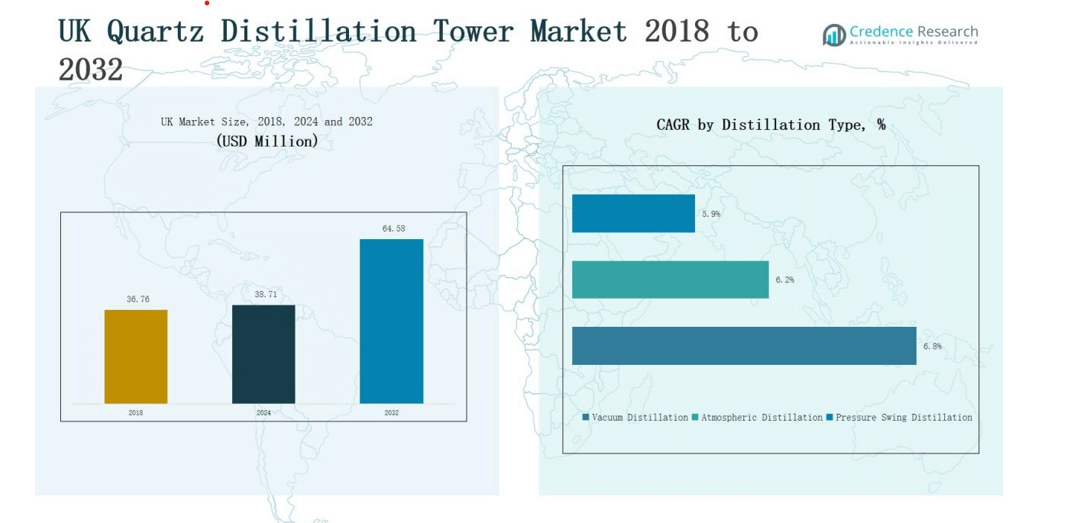
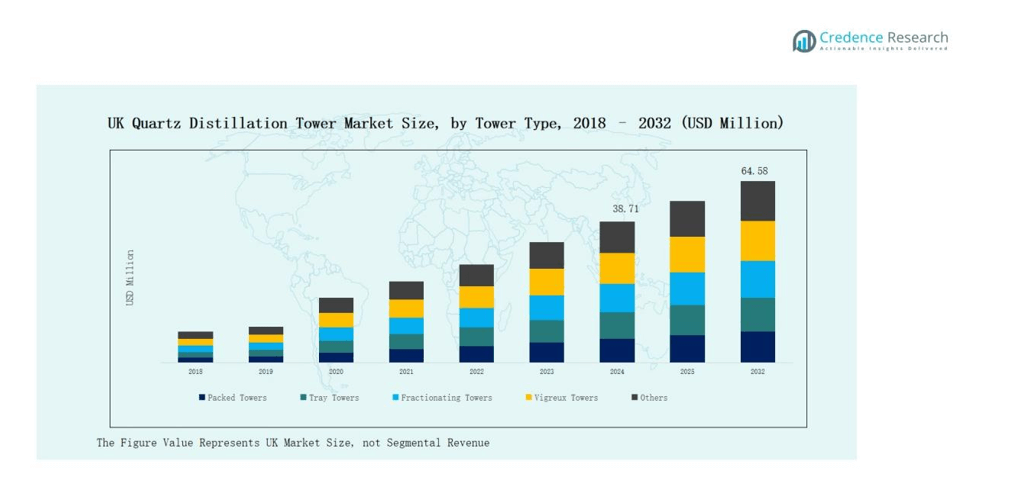
The UK Quartz Distillation Tower Market size was valued at USD 36.76 million in 2018, increased to USD 38.71 million in 2024, and is anticipated to reach USD 64.58 million by 2032, growing at a CAGR of 6.61% during the forecast period.
| REPORT ATTRIBUTE | DETAILS |
|---|---|
| Historical Period | 2020-2023 |
| Base Year | 2024 |
| Forecast Period | 2025-2032 |
| UK Quartz Distillation Tower Market Size 2024 | USD 38.71 million |
| UK Quartz Distillation Tower Market, CAGR | 6.61% |
| UK Quartz Distillation Tower Market Size 2032 | USD 64.58 million |
The UK Quartz Distillation Tower Market is shaped by prominent players such as Saint-Gobain, Pall Corporation, Fenix Process Technologies, HAT International Ltd., Montz GmbH, Nikon Corporation, Heraeus, Koch-Glitsch, and Sulzer Ltd. These companies focus on precision manufacturing, high-purity quartz engineering, and advanced automation to enhance process reliability and energy efficiency. Strategic collaborations with semiconductor and pharmaceutical manufacturers strengthen their market presence. Continuous investment in R&D and material innovation supports product performance and durability. England emerged as the leading region, commanding 58% of the total market share in 2024, driven by its strong semiconductor base, advanced research ecosystem, and concentration of high-tech manufacturing facilities.
Market Insights
- The UK Quartz Distillation Tower Market was valued at USD 36.76 million in 2018, increased to USD 38.71 million in 2024, and is projected to reach USD 64.58 million by 2032, growing at a CAGR of 6.61%.
- England dominated the market with a 58% share in 2024, supported by strong semiconductor, chemical, and pharmaceutical manufacturing clusters across London, Cambridge, and Manchester.
- The Packed Towers segment led by 41% share due to high efficiency, low pressure drop, and suitability for corrosive and high-purity applications in semiconductor and pharmaceutical industries.
- The Vacuum Distillation segment accounted for 46% share, driven by its superior energy efficiency and precision in temperature-sensitive material separation across advanced industrial operations.
- Stainless Steel material dominated with 52% share, offering superior corrosion resistance, structural durability, and long operational lifecycles for high-performance quartz distillation applications.
Market Segment Insights
By Tower Type
The Packed Towers segment dominated the UK Quartz Distillation Tower Market, accounting for 41% of the total share in 2024. Their high efficiency in mass transfer, low pressure drop, and suitability for corrosive environments drive strong adoption in semiconductor and pharmaceutical applications. The increasing focus on high-purity quartz structures enhances demand. Energy-efficient design improvements and material optimization further strengthen their preference over tray or fractionating systems in precision industrial processes.
- For instance, Heraeus Quartztech introduced a high-purity fused quartz packed tower system tailored for pharmaceutical solvent recovery, reducing operational pressure drops by 18% compared to conventional designs.
By Distillation Type
The Vacuum Distillation segment led the UK Quartz Distillation Tower Market, holding 46% of the share in 2024. It is widely used for temperature-sensitive materials requiring low thermal degradation during separation. The technology’s ability to operate at reduced pressures enhances product purity and energy savings. Growing semiconductor and specialty chemical production drives adoption, supported by rising R&D in low-contamination quartz towers designed for high-precision distillation and controlled manufacturing environments.
- For instance, QSIL advanced its R&D on high-purity quartz products for the semiconductor industry, integrating automated production technologies to enhance material consistency in controlled manufacturing environments
By Material
The Stainless Steel segment dominated the UK Quartz Distillation Tower Market, capturing 52% of the total share in 2024. Stainless steel’s superior corrosion resistance, structural durability, and compatibility with high-purity quartz assemblies make it ideal for long operational lifecycles. Industries prefer stainless steel towers for semiconductor, pharmaceutical, and fine chemical applications. Rising use of hybrid quartz-steel configurations improves thermal stability and mechanical strength, reinforcing the segment’s leadership across advanced industrial facilities.
Key Growth Drivers
Rising Semiconductor Manufacturing Demand
The growing semiconductor industry in the UK drives strong demand for high-purity quartz distillation towers. These systems enable contamination-free processing and precise temperature control essential for chip fabrication. The expansion of cleanroom facilities and local semiconductor R&D centers supports market growth. Manufacturers focus on developing energy-efficient and corrosion-resistant tower designs to meet process precision requirements, reinforcing the use of quartz-based systems across advanced manufacturing and electronic production environments.
- For example, UK-based startup Quantum Motion has created a full-stack quantum computer using standard silicon chips that are compatible with mass-manufacturing technologies, demonstrating a path toward scalable quantum technology
Technological Advancements in Quartz Engineering
Continuous innovation in quartz processing technologies enhances material strength, purity, and thermal resistance. UK-based manufacturers and European suppliers are investing in precision fabrication and automated assembly systems to improve tower efficiency and lifespan. Integration of digital control systems further enables performance optimization during distillation operations. These advancements reduce maintenance costs, increase output quality, and promote adoption across pharmaceutical, chemical, and microelectronics applications, strengthening the overall growth trajectory of the market.
- For instance, Momentive Technologies, a global leader in fused quartz, manufactures high-purity quartz tubes and other products for the semiconductor industry at its facilities, including a specialty quartz plant in Geesthacht, Germany.
Expanding Use in Chemical and Pharmaceutical Applications
The UK’s chemical and pharmaceutical sectors increasingly adopt quartz distillation towers for high-purity separation and solvent recovery processes. Their ability to maintain chemical stability under extreme thermal conditions ensures consistent output quality. Rising investments in drug formulation and specialty chemical manufacturing drive installation of customized quartz towers. The growing emphasis on sustainable production and material recyclability also boosts demand for corrosion-resistant and low-maintenance quartz equipment across these industrial domains.
Key Trends & Opportunities
Adoption of Automation and Smart Monitoring Systems
Automation and IoT-based monitoring are becoming key trends in UK quartz distillation tower operations. Smart sensors enable real-time pressure, temperature, and flow control, improving process reliability. Data-driven optimization enhances energy efficiency and predictive maintenance, reducing downtime. Manufacturers are integrating AI-enabled systems for performance analytics and fault detection. This trend supports the shift toward Industry 4.0 compliance, improving scalability and efficiency in high-precision manufacturing facilities across the country.
- For instance, Heraeus Comvance implemented an AI-driven automated quality control system that processes up to 15,000 images in 15 minutes to detect bubbles and cracks in quartz glass cylinders, enhancing defect detection accuracy and production consistency.
Sustainability and Energy Efficiency Focus
The UK market is witnessing rising interest in sustainable quartz tower designs with reduced energy footprints. Manufacturers emphasize lightweight structures and optimized heat transfer systems that minimize power consumption. The push for net-zero industrial operations encourages adoption of recyclable materials and eco-friendly production processes. Government sustainability initiatives and green manufacturing incentives further expand opportunities for energy-efficient quartz distillation towers tailored to environmentally responsible industrial standards.
- For instance, Heraeus Conamic captures waste heat from its quartz processes and repurposes it to heat adjacent facilities, cutting net energy demand.
Key Challenges
High Production and Material Costs
Manufacturing quartz distillation towers involves complex fabrication processes and costly raw materials. High-purity quartz and precision machining significantly elevate production expenses. Small and medium manufacturers face profitability pressures due to limited economies of scale. Moreover, volatile energy and material prices in Europe add cost uncertainty. These factors challenge widespread adoption, particularly among cost-sensitive sectors that rely on steel-based alternatives or refurbished tower systems to minimize capital expenditure.
Limited Domestic Quartz Supply Chain
The UK depends heavily on imported high-grade quartz materials from Europe and Asia, increasing vulnerability to supply chain disruptions. Transportation delays, geopolitical instability, and rising import costs affect consistent availability of raw materials. This dependence hinders timely production and customization capabilities for local manufacturers. Building domestic quartz purification and processing facilities remains essential to reduce external dependency and stabilize pricing structures in the long term.
Complex Installation and Maintenance Requirements
Quartz distillation towers demand specialized handling during installation and maintenance due to their fragile nature and high precision requirements. Skilled labor shortages in the UK engineering workforce amplify the challenge. Frequent calibration, cleaning, and inspection are required to maintain system integrity. Improper maintenance can lead to contamination or structural stress, reducing tower lifespan. These complexities increase operational costs and deter small-scale industries from adopting quartz-based systems.
Regional Analysis
England
England led the UK Quartz Distillation Tower Market, holding 58% of the total share in 2024. Strong semiconductor and chemical manufacturing clusters across London, Cambridge, and Manchester drive high demand for precision distillation systems. The region’s advanced research facilities and presence of global players such as Saint-Gobain and Pall Corporation support continuous innovation. It benefits from robust infrastructure and skilled engineering resources. The growing focus on sustainable production and automation technology enhances adoption across industries seeking efficiency and purity in operations.
Scotland
Scotland accounted for 19% of the UK Quartz Distillation Tower Market in 2024. The region’s growing pharmaceutical and specialty chemical industries rely on quartz towers for high-purity separation processes. Investments in biotech facilities across Glasgow and Edinburgh strengthen market prospects. Research partnerships between universities and industrial manufacturers promote technological adaptation in precision distillation. Government support for clean manufacturing practices encourages wider use of energy-efficient and corrosion-resistant quartz tower systems across industrial facilities.
Wales
Wales captured 13% of the total market share in 2024. The regional growth is supported by expanding electronics and materials engineering sectors that require advanced distillation systems. Local investments in process optimization and sustainable manufacturing enhance market penetration. The availability of industrial parks and skilled labor improves production capability. It continues to attract small and medium manufacturers focusing on cost-effective quartz-based solutions for laboratory and pilot-scale operations in the region.
Northern Ireland
Northern Ireland held 10% of the market share in 2024. The industrial base is expanding through increased activity in pharmaceutical research and microelectronic assembly. Manufacturers adopt quartz distillation towers to ensure chemical stability and high product purity. The region’s trade connectivity with the Republic of Ireland supports cross-border equipment supply and technological collaboration. It benefits from government incentives promoting industrial modernization and advanced material adoption, strengthening its position in high-purity process equipment manufacturing.
Market Segmentations:
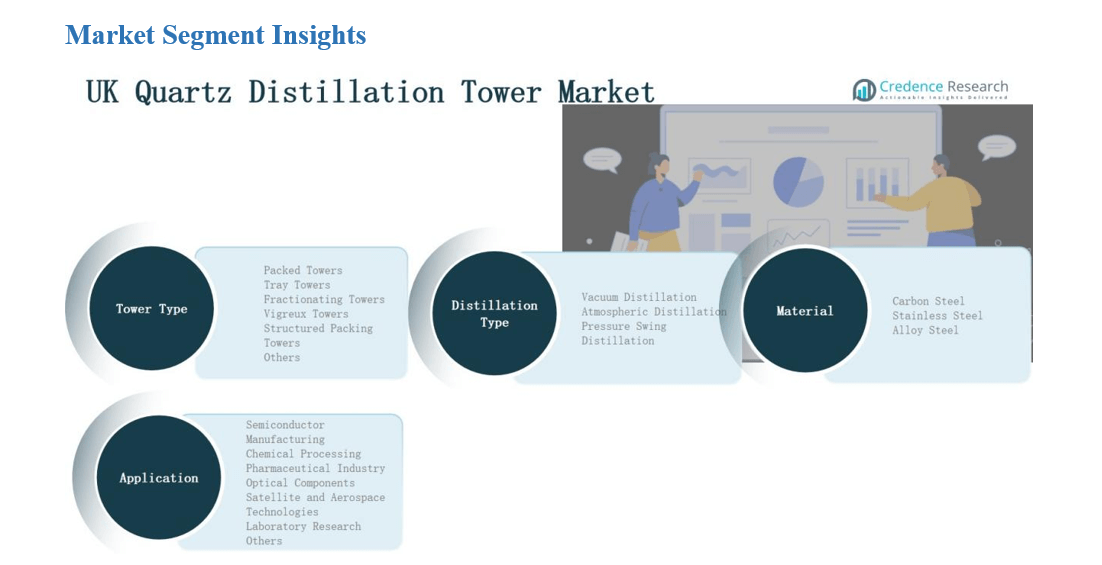
By Tower Type
- Packed Towers
- Tray Towers
- Fractionating Towers
- Vigreux Towers
- Structured Packing Towers
- Others
By Distillation Type
- Vacuum Distillation
- Atmospheric Distillation
- Pressure Swing Distillation
By Material
- Carbon Steel
- Stainless Steel
- Alloy Steel
By Application
- Semiconductor Manufacturing
- Chemical Processing
- Pharmaceutical Industry
- Optical Components
- Satellite and Aerospace Technologies
- Laboratory Research
- Others
By Region
- England
- Scotland
- Wales
- Northern Ireland
Competitive Landscape
The UK Quartz Distillation Tower Market features a moderately consolidated structure with several global and regional manufacturers competing through product quality, material innovation, and customization. Key players such as Saint-Gobain, Pall Corporation, Fenix Process Technologies, HAT International Ltd., and Montz GmbH emphasize precision engineering and automation to improve purity, corrosion resistance, and energy efficiency. Companies invest heavily in R&D to develop high-purity quartz assemblies suitable for semiconductor, pharmaceutical, and chemical industries. Local firms collaborate with research institutions to enhance process innovation and sustainability. Strategic partnerships, mergers, and expansion of production facilities strengthen market presence. The growing adoption of digital monitoring systems and modular tower designs intensifies competition in the high-performance equipment segment. Continuous technological advancement and emphasis on clean manufacturing standards support long-term competitiveness, while international suppliers expand distribution networks to meet increasing demand across the UK’s advanced manufacturing and research-driven industrial sectors.
Key Players
- Raschig GmbH
- Montz GmbH
- Saint-Gobain
- Fenix Process Technologies
- HAT International Ltd.
- Nikon Corporation
- Pall Corporation
- Heraeus
- Koch-Glitsch
- Sulzer Ltd.
- Shin-Etsu Quartz Products Co., Ltd.
- Wacom Quartz Corporation
- Helios Italquartz S.r.l.
- Terme Quartz Internazionale
- Hubei Feilihua Quartz Glass Co., Ltd.
Recent Developments
- In May 2024, KCC Corporation completed the acquisition of Momentive Performance Materials, expanding its capabilities in high-purity quartz and ceramic solutions used in distillation tower manufacturing.
- In January 2025, SCHOTT AG finalized the acquisition of QSIL GmbH Quarzschmelze Ilmenau, enhancing its capabilities in high-purity quartz glass production across.
- In April 2025, Glacier Energy successfully delivered a 50-meter distillation column manufactured in its UK facility.
Report Coverage
The research report offers an in-depth analysis based on Tower Type, Distillation Type, Material, Application and Region. It details leading market players, providing an overview of their business, product offerings, investments, revenue streams, and key applications. Additionally, the report includes insights into the competitive environment, SWOT analysis, current market trends, as well as the primary drivers and constraints. Furthermore, it discusses various factors that have driven market expansion in recent years. The report also explores market dynamics, regulatory scenarios, and technological advancements that are shaping the industry. It assesses the impact of external factors and global economic changes on market growth. Lastly, it provides strategic recommendations for new entrants and established companies to navigate the complexities of the market.
Future Outlook
- Demand for high-purity quartz distillation systems will rise with semiconductor expansion in the UK.
- Manufacturers will focus on automation and smart monitoring to improve process accuracy.
- Local production of quartz components will increase to reduce import dependency.
- Adoption of corrosion-resistant and energy-efficient tower designs will strengthen sustainability goals.
- Pharmaceutical and specialty chemical industries will continue driving precision distillation requirements.
- Partnerships between manufacturers and research institutions will promote technology advancement.
- Integration of digital twins and predictive maintenance tools will enhance operational reliability.
- Growing investment in clean manufacturing infrastructure will boost equipment modernization.
- New entrants will explore niche applications in optics and aerospace processing sectors.
- Government incentives for innovation and energy efficiency will support market competitiveness.

Request a Free Sample
Fill in your details and we'll send you a free sample report.
- Sample data tables & charts
- Research methodology
Need a Custom Version of This Report?
Tailor the scope, geography, or segments to your exact requirements.
- Custom geography or segment scope
- Direct access to our analyst team
Frequently Asked Questions
What is the current market size for the UK Quartz Distillation Tower Market, and what is its projected size in 2032?
At what Compound Annual Growth Rate is the UK Quartz Distillation Tower Market projected to grow between 2025 and 2032?
Which UK Quartz Distillation Tower Market segment held the largest share in 2024?
What are the primary factors fueling the growth of the UK Quartz Distillation Tower Market?
Who are the leading companies in the UK Quartz Distillation Tower Market?
Table of Content
Chapter 1. Report Introduction
- 1.1 Report Description & Purpose
- 1.1.1 Report Title & Market Definition
- 1.1.2 Unique Selling Propositions (USP) & Key Differentiators
- 1.1.3 Value Proposition for Stakeholders
- 1.2 Research Objectives
- 1.2.1 Market Sizing Objectives (Volume & Revenue) (Volume Where Applicable)
- 1.2.2 Segmentation Objectives
- 1.2.3 Competitive Intelligence Objectives
- 1.2.4 Forecast & Scenario Objectives
- 1.3 Report Scope
- 1.3.1 UK Quartz Distillation Tower Scope – Segments & Subsegments Covered
- 1.3.2 Geographic Scope – Selected Country & Subnational Markets Covered
- 1.3.3 Historical Period, Base Year & Forecast Period (2024; forecast to 2032)
- 1.3.4 Inclusions & Exclusions
- 1.4 Industry Classification & Applicable Codes
- 1.5 Currency, Measurement Units & Valuation Basis
- 1.6 Target Stakeholders
- 1.7 Limitations & Assumptions
Chapter 2. Executive Summary
- 2.1 UK Quartz Distillation Tower Snapshot
- 2.1.1 Market Size – Historical (2024) & Forecast (2024-2032) (2024: USD 38.71 million → 2032: USD 64.58 million)
- 2.1.2 Volume & Revenue – National Totals (Volume Where Applicable)
- 2.1.3 Key Market Highlights – Top Five Facts
- 2.2 UK Quartz Distillation Tower Segmentation Snapshot
- 2.2.1 Market Split by Subnational Area – 2024 vs. 2032
- 2.3 Competitive Snapshot
- 2.3.1 Top 10 Players by Revenue Share – 2024
- 2.3.2 Top 10 Players by Volume Share – 2024 (Volume Where Applicable)
- 2.3.3 Recent Strategic Developments (18-Month Summary)
- 2.4 Key Investment Highlights & Strategic Conclusions
Chapter 3. UK Quartz Distillation Tower Dynamics & Industry Analysis
- 3.1 Market Overview & Context
- 3.1.1 UK Quartz Distillation Tower Position in the Broader Industry Value Chain
- 3.1.2 Demand Structure & Purchasing Dynamics
- 3.1.3 Market Maturity & Development Stage Across Domestic Markets
- 3.2 UK Quartz Distillation Tower Drivers
- 3.3 UK Quartz Distillation Tower Restraints & Challenges
- 3.4 UK Quartz Distillation Tower Opportunities
- 3.5 Porter's Five Forces Analysis
- 3.5.1 Threat of New Entrants
- 3.5.2 Bargaining Power of Suppliers
- 3.5.3 Bargaining Power of Buyers
- 3.5.4 Threat of Substitutes
- 3.5.5 Competitive Rivalry – Intensity Assessment
- 3.6 UK Quartz Distillation Tower Value Chain Analysis
- 3.6.1 Upstream – Key Inputs, Resources & Suppliers
- 3.6.1.1 Key Input/Resource 1
- 3.6.1.2 Key Input/Resource 2
- 3.6.1.3 Key Input/Resource 3
- 3.6.2 Midstream – Core Operations & Value Creation
- 3.6.2.1 Operating Model & Process Overview
- 3.6.2.2 Key Operating Locations & Capabilities by Company
- 3.6.3 Downstream – Market Channels & End Users
- 3.6.3.1 Direct Sales & Customer Engagement Channels
- 3.6.3.2 Indirect Sales, Intermediaries & Partner Channels
- 3.6.4 Value Chain Profitability Analysis
- 3.6.1 Upstream – Key Inputs, Resources & Suppliers
- 3.7 PESTEL Analysis
- 3.7.1 Political Factors
- 3.7.2 Economic Factors
- 3.7.3 Social Factors
- 3.7.4 Technological Factors
- 3.7.5 Environmental Factors
- 3.7.6 Legal Factors
- 3.8 UK Quartz Distillation Tower Supply Chain Analysis
- 3.8.1 Critical Input & Resource Availability Risk Assessment
- 3.8.2 Supplier & Operational Concentration Risk (Geographic Exposure)
- 3.8.3 Supply & Service Disruption Impact Analysis
- 3.9 National & Subnational Regulatory Landscape
Note: The regulatory and policy landscape section covers regulations based on their applicability to the market, UK Quartz Distillation Tower category, geography, and scope of the study. Only regulatory frameworks with a material impact on operations, compliance, trade, sustainability, or market access are analyzed in detail.
Chapter 4. Key Investment Pockets & Opportunity Analysis
- 4.1 UK Quartz Distillation Tower Attractiveness Analysis
- 4.1.1 By Subnational Area – Investment Attractiveness Matrix (Market Size × CAGR)
- 4.2 Absolute Revenue Growth Opportunity
- 4.2.1 By Subnational Area – Absolute Revenue Growth Through 2032
- 4.3 Incremental Demand Opportunity
- 4.3.1 By Subnational Area – Incremental Demand Through 2032
- 4.3.2 Segment – Incremental Demand
- 4.4 Emerging Submarket Opportunity Deep Dive (Subject to Applicability)
- 4.5 Priority Domestic Market Opportunity Scorecards
- 4.5.1 Priority Domestic Market 1
- 4.5.2 Priority Domestic Market 2
- 4.5.3 Priority Domestic Market 3
- 4.5.4 Priority Domestic Market 4
Note: Domestic market scorecards cover relevant states, provinces, territories, cities, or economic zones within the selected country. Numbered entries are populated with market names suited to the national administrative structure and research scope. Geographic share tables use one consistent, nonoverlapping set of areas.
Chapter 5. UK Quartz Distillation Tower Cross-Border Trade & Market Access Analysis
- 5.1 National Trade & International Partner Overview
- 5.1.1 Export Value by Destination Country (2024)
- 5.1.2 Export Volume by Destination Country (2024) (Where Applicable)
- 5.1.3 Import Value by Source Country (2024)
- 5.1.4 Import Volume by Source Country (2024) (Where Applicable)
- 5.1.5 National & Partner-Country Trade Balances (2024)
- 5.2 Export Analysis – Segment
- 5.2.1 Category 1 (Applicable Classification Code)
- 5.2.2 Category 2 (Applicable Classification Code)
- 5.2.3 Category 3 (Applicable Classification Code)
- 5.2.4 Category 4 (Applicable Classification Code)
- 5.2.5 Category 5 (Applicable Classification Code)
- 5.3 Import Analysis – Segment
- 5.3.1 Category 1 (Applicable Classification Code)
- 5.3.2 Category 2 (Applicable Classification Code)
- 5.3.3 Category 3 (Applicable Classification Code)
- 5.3.4 Category 4 (Applicable Classification Code)
- 5.3.5 Category 5 (Applicable Classification Code)
- 5.4 Cross-Border Pricing & Transaction Benchmarks
- 5.4.1 Export Pricing – Segment & Destination Country
- 5.4.2 Import Pricing – Segment & Source Country
- 5.4.3 Price Trends (2024)
- 5.5 Key Cross-Border Trade & Delivery Routes
- 5.5.1 Cross-Border Trade/Delivery Route 1
- 5.5.2 Cross-Border Trade/Delivery Route 2
- 5.5.3 Cross-Border Trade/Delivery Route 3
- 5.5.4 Cross-Border Trade/Delivery Route 4
- 5.5.5 Cross-Border Trade/Delivery Route 5
- 5.6 Trade Policy & Market Access Impact Assessment
- 5.6.1 Tariff & Non-Tariff Barriers
- 5.6.2 National Participation in Regional Trade & Economic Frameworks
- 5.6.3 Bilateral & Multilateral Trade Agreements
- 5.6.4 Cross-Border Operating, Licensing & Localization Requirements
Note: This chapter covers international trade relevant to UK Quartz Distillation Tower in the selected country. Exports are analyzed by destination and imports by source. Domestic interregional flows are excluded from international trade totals. Goods, services, and digital offerings use applicable classifications; volume and route analyses apply only where meaningful.
Chapter 6. Competitive Landscape & Company Benchmarking
- 6.1 UK Quartz Distillation Tower Concentration & Structure
- 6.1.1 Herfindahl-Hirschman Index (HHI) – vs. 2024
- 6.1.2 Leading, Mid-Sized & Emerging Player Structure
- 6.1.3 Multinational, National & Local Player Dynamics
- 6.2 UK Quartz Distillation Tower Share Analysis – 2024
- 6.2.1 National Revenue Share by Company
- 6.2.2 National Volume Share by Company (Volume Where Applicable)
- 6.2.3 Company Revenue Share by Subnational Area
- 6.2.4 Market Share Evolution ( vs. 2024)
- 6.2.5 Company Market Share by Key Segment
- 6.2.6 Company Market Share by Customer Group
- 6.3 Operating Scale, Capacity & Infrastructure Analysis
- 6.3.1 National Operating Scale & Supply Capacity
- 6.3.2 Resource Utilization & Operating Efficiency
- 6.3.3 Output, Service Delivery & Activity Metrics
- 6.3.4 Operating Footprint & Infrastructure Map
- 6.3.5 Planned Operational & Capacity Expansion
- 6.4 UK Quartz Distillation Tower Competitive Benchmarking Matrix
- 6.4.1 Revenue, Growth, Profitability & Operating Metric Comparison
- 6.4.2 Channel Revenue Mix
- 6.4.3 Revenue Exposure Across Domestic Markets
- 6.4.4 R&D Intensity
- 6.4.5 Sustainability Maturity
- 6.5 Strategic Developments in UK Quartz Distillation Tower (Last 24 Months)
- 6.5.1 Mergers, Acquisitions & Divestments
- 6.5.2 New Products, Services & Solutions in UK Quartz Distillation Tower
- 6.5.3 Operational & Infrastructure Expansions
- 6.5.4 Strategic Alliances, Joint Ventures & Partnerships
- 6.5.5 Distribution Expansion & Market Entry
- 6.5.6 Sustainability & ESG Initiatives
- 6.6 Competitive Strategy Mapping
- 6.6.1 Leader, Challenger, Follower & Niche Classification
- 6.6.2 Pricing Strategy Comparison
- 6.6.3 Channel Strategy Matrix
Note: Strategic developments are included based on their materiality and the availability of reliable information.
Chapter 7. UK Quartz Distillation Tower – By Sales & Delivery Channel
- 7.1 Segment Overview
- 7.1.1 Volume & Revenue Split by Channel (2024 & 2032) (Volume Where Applicable)
- 7.1.2 Channel Mix Evolution (2024-2032)
Chapter 8. Subnational Market Analysis – Country Overview
- 8.1 Domestic Geographic Market Overview
- 8.1.1 Subnational Volume Share (Where Applicable)
- 8.1.2 Subnational Revenue Share
- 8.1.3 Market Volume by Subnational Area (Where Applicable)
- 8.1.4 Market Revenue by Subnational Area
- 8.1.5 Subnational Forecasts Through 2032
- 8.2 Cross-Area Segment Analysis Within the Country
- 8.2.1 By Sales & Delivery Channel
- 8.2.2 By Competitive Positioning & Price Tier
Chapter 9. UK Quartz Distillation Tower – Priority Domestic Market 1
Chapter 10. UK Quartz Distillation Tower – Priority Domestic Market 2
Chapter 11. UK Quartz Distillation Tower – Priority Domestic Market 3
Chapter 12. UK Quartz Distillation Tower – Priority Domestic Market 4
Chapter 13. UK Quartz Distillation Tower Company Profiles
- 13.1 [Company 01]
- 13.1.1 Company Overview
- 13.1.2 Key Management Personnel
- 13.1.3 Products & Services Portfolio
- 13.1.4 Financial Performance
- 13.1.5 Domestic Market Focus & Local Operating Presence
- 13.1.6 Recent Developments & Strategic Initiatives
Note: The company profile list is preliminary and may change based on research findings, market developments, data availability, and client requirements.
Chapter 14. Appendices
- Appendix A – List of Abbreviations & Acronyms
- Appendix B – Industry Classification Code Reference – Full Series
- Appendix C – Supply, Output & Operating Capacity Data Tables
- Appendix D – End-Use & Demand Base Tables
- Appendix E – Demand, Adoption & Usage Assumptions
- Appendix F – Pricing & Revenue Metric Reference Tables
- Appendix G – Company Operations & Infrastructure Database
- Appendix H – Cross-Border Trade & Activity Data Tables (Where Applicable)
- Appendix I – Regulatory Summary Tables
- Appendix J – Primary Research Participant List (Anonymized)
- Appendix K – Primary Research Questionnaire Framework
- Appendix L – Data Sources & Bibliography
- Appendix M – Market Size Divergence & Source Comparison
Chapter 15. Research Methodology
- 15.1 Research Framework & Philosophy
- 15.2 Secondary Research – Sources, Hierarchy & Data Extraction
- 15.3 Data Modeling – National Market Sizing & Subnational Allocation
- 15.4 Primary Research – Stakeholder Framework, LOI & Sample Sizes
- 15.5 Forecast Methodology – Regression, Scenario & Sensitivity Analysis
- 15.6 Quality Control – Four-Layer Validation Framework
- 15.7 Limitations & Standard Assumptions
- 15.8 Disclaimer
