
Market Overview
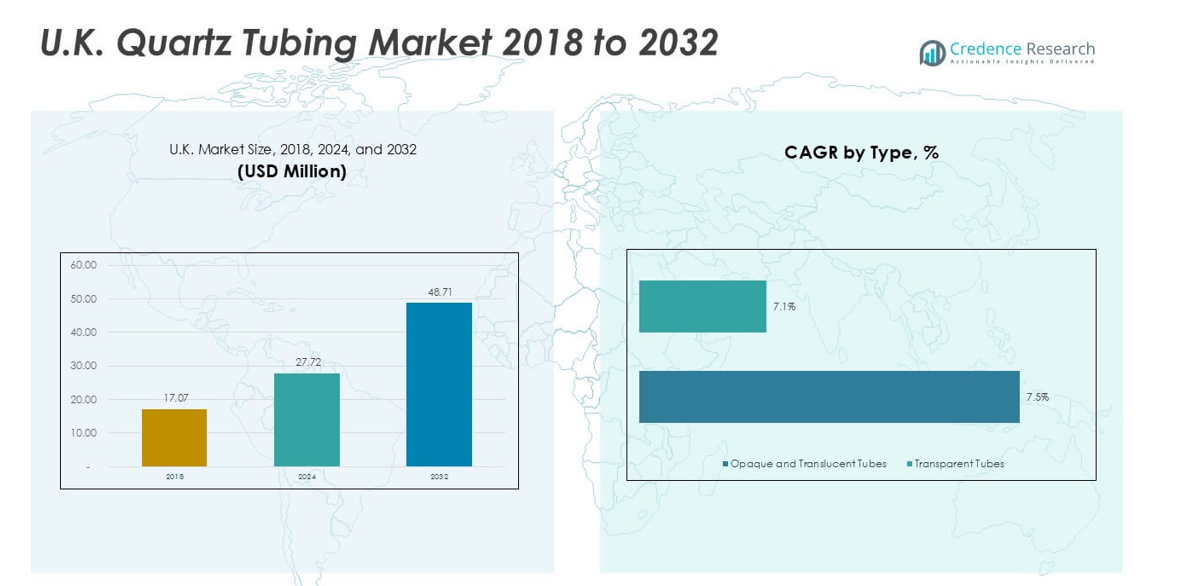
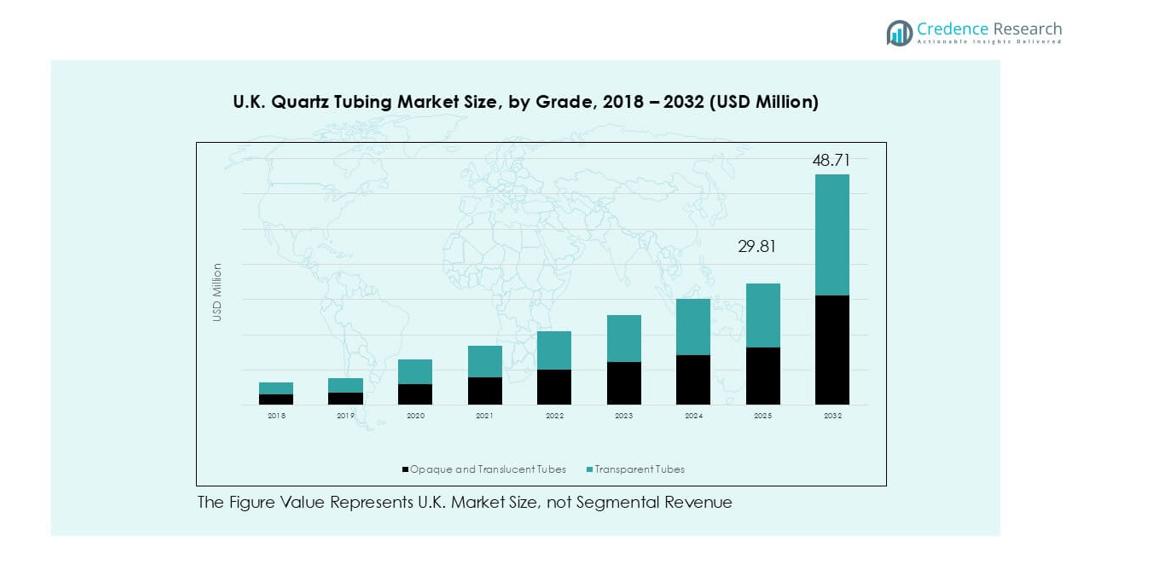
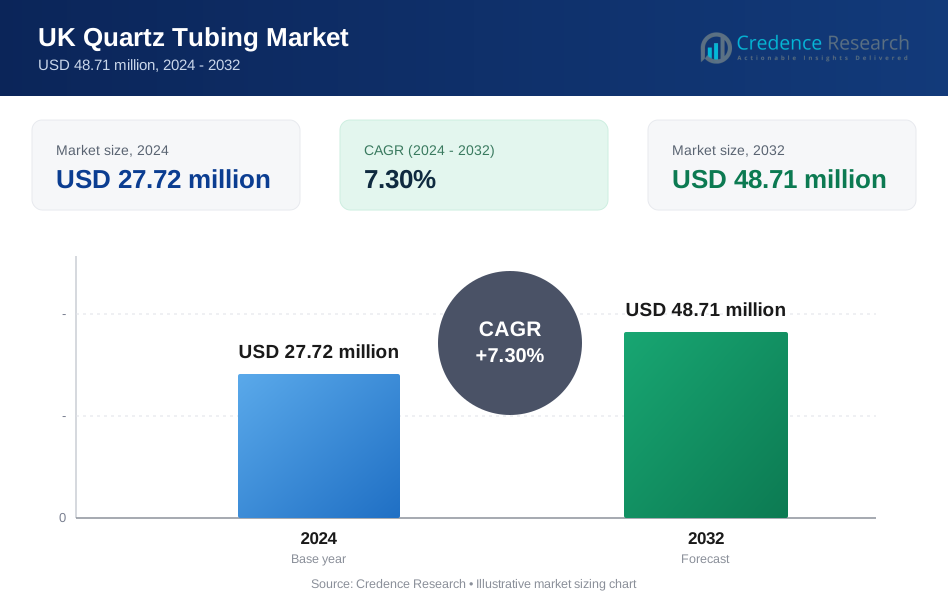
UK Quartz Tubing market size was valued at USD 17.07 million in 2018 to USD 27.72 million in 2024 and is anticipated to reach USD 48.71 million by 2032, at a CAGR of 7.30% during the forecast period.
| REPORT ATTRIBUTE | DETAILS |
|---|---|
| Historical Period | 2020-2023 |
| Base Year | 2024 |
| Forecast Period | 2025-2032 |
| UK Quartz Tubing Market Size 2024 | USD 27.72 million |
| UK Quartz Tubing Market, CAGR | 7.30% |
| UK Quartz Tubing Market Size 2032 | USD 48.71 million |
The UK quartz tubing market is led by a mix of global specialists and regional manufacturers. Key players include Heraeus, TOSOH, WONIK Quartz Europe, John Moncrieff Ltd, proQuarz GmbH, and Multi-Lab Ltd, which compete on purity, dimensional accuracy, and customization depth. Global suppliers dominate semiconductor-grade tubing, while UK firms focus on made-to-order industrial and laboratory applications. Regionally, England, including Greater London and the South East, leads the market with a 49% share, supported by semiconductor research, advanced manufacturing, and laboratory demand. Scotland and Northern England follow with a 23% share, driven by electronics and industrial processing. Wales, the West Midlands, and other regions account for the remaining share, supported by diversified industrial use.
Market Insights
- The UK quartz tubing market grew from USD 17.07 million in 2018 to USD 27.72 million in 2024 and is projected to reach USD 48.71 million by 2032, registering a CAGR of 7.30% during the forecast period, supported by steady industrial and semiconductor demand.
- Market growth is driven by rising use in high-temperature industrial furnaces and semiconductor diffusion processes, where quartz tubing offers superior thermal stability, chemical resistance, and purity, increasing replacement and upgrade cycles across manufacturing facilities.
- Key market trends include growing demand for transparent quartz tubing, which holds around 60–65% segment share, driven by semiconductor and laboratory use, alongside increasing customization for wall thickness, diameter, and purity grades.
- The competitive landscape features global players and regional specialists competing on quality, purity assurance, and lead times, with differentiation increasingly based on technical support, digital quality control, and application-specific engineering.
- Regionally, England leads with about 49% market share, followed by Scotland and Northern England at 23%, Wales and the West Midlands at 17%, and other regions accounting for the remaining share, supported by diversified industrial demand.
Market Segmentation Analysis:
By Type
The UK quartz tubing market shows clear dominance by transparent tubes, which account for an estimated 60–65% market share. Transparent tubes benefit from superior optical clarity, high thermal stability, and precise dimensional control. These properties support use in semiconductor processing, laboratory equipment, and high-temperature industrial systems. Demand rises from applications requiring visual process monitoring and ultra-high purity performance. Opaque and translucent tubes hold the remaining share, driven by furnace linings and insulation uses. However, transparent variants gain faster adoption due to advanced manufacturing, tighter tolerance needs, and premium pricing potential.
- For instance,QSIL supplies transparent fused-quartz tubes globally, including through distributors in the UK. These products typically feature a low hydroxyl content, often below 10 ppm for high-purity, electrically fused grades, and exhibit a low coefficient of thermal expansion near 0.55 × 10⁻⁶/K.
By Application
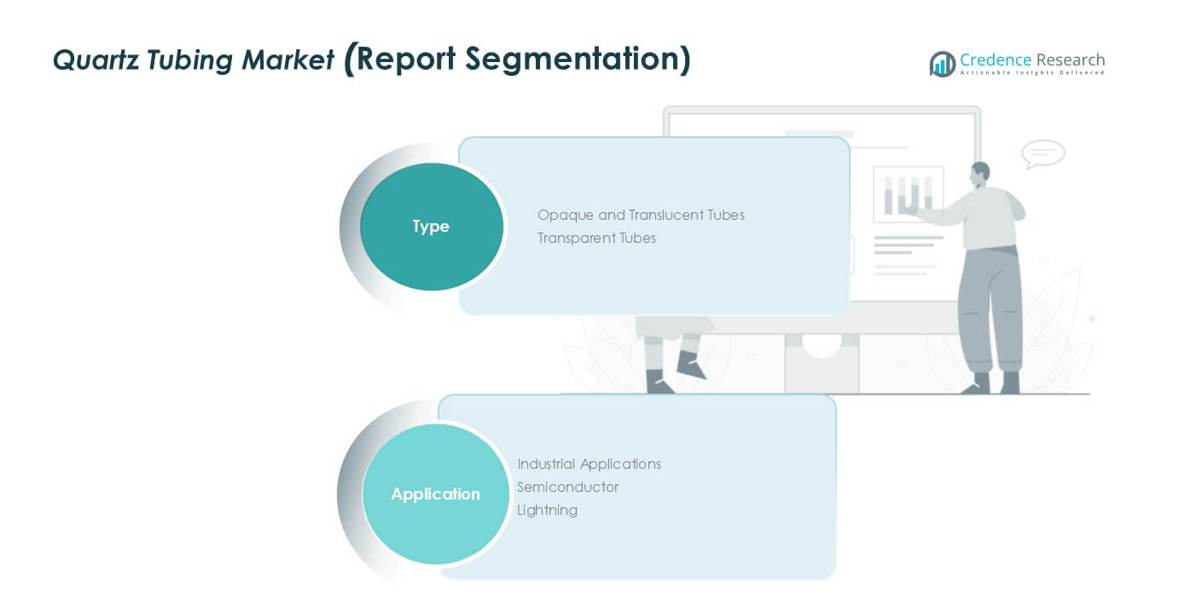
Industrial applications dominate the UK quartz tubing market, representing roughly 45–50% of total demand. This segment benefits from sustained use in high-temperature furnaces, chemical processing, and thermal equipment. The semiconductor segment follows closely, driven by wafer fabrication, diffusion, and oxidation processes requiring high-purity quartz tubing. Semiconductor growth outpaces other uses due to node scaling and fab upgrades. Lighting applications hold a smaller share, supported by specialty lamps and UV systems. Overall, industrial reliability needs and semiconductor purity requirements remain the strongest demand drivers.
- For instance, Heraeus supplies semiconductor-grade quartz tubes used in diffusion furnaces operating above 1,050 °C, with certified metallic impurities below 1 ppm, supporting clean wafer processing in UK-based research fabs and pilot lines.
Key Growth Drivers
Expansion of Semiconductor Manufacturing and Equipment Upgrades
The expansion of semiconductor manufacturing is a major growth driver for the UK quartz tubing market. Quartz tubing plays a critical role in diffusion, oxidation, and deposition processes. Chip fabrication requires ultra-high purity and thermal stability. Advanced nodes demand tighter impurity limits and dimensional precision. UK fabs continue investing in equipment upgrades and pilot production lines. These upgrades increase consumption of premium quartz tubing grades. Domestic and European semiconductor supply-chain resilience further supports demand. Government incentives and private investments encourage localized chip production. Process automation also raises tubing replacement rates. As semiconductor tools operate at higher temperatures, material reliability becomes essential. These dynamic supports sustained growth for high-performance quartz tubing suppliers.
- For instance, Heraeus supplies semiconductor-grade quartz tubes with metallic impurities below 1 ppm and continuous-use stability above 1,050 °C, supporting diffusion and LPCVD tools used in UK research fabs.
Rising Demand from High-Temperature Industrial Applications
High-temperature industrial operations strongly support quartz tubing demand in the UK. Industries rely on quartz tubing for furnaces, reactors, and thermal processing systems. Quartz withstands extreme heat without deformation or contamination. Chemical resistance also makes quartz suitable for corrosive environments. Growth in specialty chemicals, advanced ceramics, and materials processing increases usage. Industrial operators prioritize longer equipment lifecycles and process consistency. Quartz tubing supports stable thermal profiles and reduced downtime. Energy-efficient furnace designs also favor quartz components. Replacement demand remains steady due to harsh operating conditions. Industrial diversification across metallurgy, glass, and energy systems sustains long-term market growth.
- For instance, QSIL manufactures fused-silica industrial tubes with thermal expansion near 0.55 × 10⁻⁶/K and verified resistance to repeated heat-quench cycles above 1,000 °C, enabling reliable use in UK chemical and materials-processing furnaces.
Increasing Adoption of High-Purity and Customized Tubing
Demand for high-purity and customized quartz tubing continues to rise. End users increasingly require application-specific dimensions and purity grades. Semiconductor and laboratory users seek tighter tolerance control. Customized wall thickness improves thermal efficiency and process outcomes. Small-batch production capabilities create supplier differentiation. Engineering collaboration adds value beyond standard products. Customers prefer suppliers offering testing and metrology support. Premium customized tubing commands higher margins. Custom solutions also strengthen long-term client relationships. As UK manufacturers move toward precision processes, demand shifts from commodity products. This trend directly supports value growth in the quartz tubing market.
Key Trends & Opportunities
Adoption of Advanced Manufacturing and Digital Quality Control
Advanced manufacturing represents a key trend and opportunity in the UK quartz tubing market. Automation improves dimensional accuracy and yield rates. Inline inspection detects micro-defects earlier in production cycles. Digital quality control enhances traceability and compliance. Semiconductor customers favor suppliers with data-driven quality systems. Smart manufacturing also reduces scrap and energy use. Process analytics support consistent purity performance. These capabilities improve operational efficiency and pricing power. Suppliers investing in smart factories gain competitive advantage. Digital integration also supports faster customization cycles. This trend opens opportunities for premium positioning and export competitiveness.
- For instance, QSIL uses laser-based inline metrology in its European plants to control tube diameter within ±0.1 mm and detect surface defects down to 50 µm, supporting semiconductor-grade quartz production.
Growth in UV, Specialty Lighting, and Scientific Applications
Specialty lighting and scientific uses create incremental growth opportunities. Quartz tubing supports UV, infrared, and specialty lamp applications. Demand persists in medical, analytical, and environmental systems. UV sterilization and analytical instrumentation drive niche consumption. Research laboratories require consistent optical and thermal properties. Although LED adoption limits general lighting demand, specialty segments remain resilient. These applications favor high-quality transparent quartz tubing. Longer service life supports repeat orders. Custom geometries also create differentiation opportunities. This segment offers stable margins despite lower overall volume.
- For instance, Heraeus supplies UV-grade quartz tubes with transmission above 85% at 254 nm and verified thermal stability above 1,000 °C, enabling long-life performance in medical UV and analytical systems used across the UK.
Key Challenges
High Production Costs and Energy Intensity
High production costs present a major challenge for the UK quartz tubing market. Quartz processing requires extreme temperatures and energy input. Energy price volatility directly affects manufacturing margins. Raw material purity requirements increase processing complexity. Capital-intensive equipment limits rapid capacity expansion. Smaller producers face cost disadvantages against global suppliers. Environmental regulations add compliance expenses. Cost pressures restrict pricing flexibility in competitive segments. Producers must balance quality with cost efficiency. Without process optimization, profitability remains exposed. Managing energy consumption becomes critical for long-term sustainability.
Supply Chain Constraints and Import Dependence
Supply chain constraints pose another key challenge for the market. High-purity quartz raw materials often rely on imports. Global supply disruptions impact lead times and pricing stability. Transportation delays affect just-in-time delivery models. Semiconductor customers demand consistent and timely supply. Import dependence increases exposure to geopolitical risks. Currency fluctuations also influence procurement costs. Limited domestic raw material sources restrict flexibility. Building resilient supply chains requires long-term supplier agreements. Inventory buffering raises working capital needs. These factors create operational risks for UK quartz tubing manufacturers.
Regional Analysis
England (including Greater London & South East)
England dominates the UK quartz tubing market with an estimated 48–50% share. The region benefits from strong semiconductor research, advanced manufacturing, and laboratory clusters. Greater London supports demand from research institutes and medical technology firms. The South East hosts precision engineering and materials science users. High-purity and transparent tubing see strong adoption. Equipment upgrades drive replacement demand. Proximity to ports improves import logistics. Skilled labor supports customization services. Customers value tight tolerances and traceability. This region sustains premium pricing due to quality expectations and consistent demand.
Scotland & Northern England
Scotland and Northern England account for about 22–24% market share. The region benefits from electronics manufacturing and university-led research. Scotland supports semiconductor tooling and photonics activity. Northern England hosts furnace, glass, and materials processing users. Industrial applications drive volume demand. Cost-sensitive buyers favor durable tubing grades. Regional incentives support advanced manufacturing investment. Supply chains link closely with European partners. Replacement cycles remain steady. Growth remains stable, supported by industrial reliability needs and ongoing process modernization.
Wales & West Midlands
Wales and the West Midlands hold roughly 16–18% market share. The West Midlands anchors heavy industry and thermal processing demand. Automotive and materials engineering sustain industrial usage. Wales supports specialty manufacturing and research facilities. Quartz tubing serves furnaces, reactors, and testing systems. Opaque and translucent tubes see higher penetration. Energy-intensive operations drive replacement demand. Regional manufacturers value consistent supply. Infrastructure investment supports equipment upgrades. The region maintains steady growth through diversified industrial applications.
Northern Ireland, East Midlands & Other Regions
Northern Ireland, the East Midlands, and other regions represent about 10–12% market share. Demand remains fragmented across smaller industrial users. The East Midlands supports ceramics, chemicals, and laboratory applications. Northern Ireland shows niche demand from research and electronics assembly. Volumes remain lower than other regions. Buyers emphasize cost control and delivery reliability. Import dependence shapes purchasing decisions. Growth remains moderate but stable. Specialty and custom orders support margins. Regional demand benefits from gradual industrial modernization and research activity.
Market Segmentations:
By Type
- Opaque and Translucent Tubes
- Transparent Tubes
By Application
- Industrial Applications
- Semiconductor
- Lighting
By Geography
- England (including Greater London & South East)
- Scotland & Northern England
- Wales & West Midlands
- Northern Ireland, East Midlands & Other Regions
Competitive Landscape
The UK quartz tubing market shows moderate concentration, led by global suppliers and specialized European producers. International players such as Heraeus, TOSOH, and WONIK Quartz Europe leverage scale, high-purity production, and semiconductor-grade capabilities. UK-based and regional firms like John Moncrieff Ltd and Multi-Lab Ltd compete through customization, short lead times, and application-specific engineering. Asian suppliers, including Aoxin Quartz and Fudong Lighting, participate mainly through imports and price-competitive offerings. Competition centers on purity levels, dimensional accuracy, and thermal performance. Customers prioritize suppliers with strong quality control and traceability. Technical support and co-development capabilities influence supplier selection. Long-term contracts remain common in semiconductor and industrial segments. Energy efficiency and process reliability also shape purchasing decisions. Overall, differentiation relies more on technical performance and service depth than price alone.
Key Player Analysis
- John Moncrieff Ltd
- Heraeus
- Sung Rim Europe GmbH
- TOSOH
- Fudong Lighting
- Aoxin Quartz
- Sentro Tech
- proQuarz GmbH
- WONIK Quartz Europe
- Multi-Lab Ltd
Recent Developments
- In Jan 2025, Heraeus combined high-performance materials units into Heraeus Covantics to expand its technology leadership in high-purity quartz and fused silica products.
- In Nov 2024, Momentive Technologies promoted two long-serving executives into global quartz and ceramics leadership roles, strengthening its quartz business focus.
Report Coverage
The research report offers an in-depth analysis based on Type, Application and Geography. It details leading market players, providing an overview of their business, product offerings, investments, revenue streams, and key applications. Additionally, the report includes insights into the competitive environment, SWOT analysis, current market trends, as well as the primary drivers and constraints. Furthermore, it discusses various factors that have driven market expansion in recent years. The report also explores market dynamics, regulatory scenarios, and technological advancements that are shaping the industry. It assesses the impact of external factors and global economic changes on market growth. Lastly, it provides strategic recommendations for new entrants and established companies to navigate the complexities of the market.
Future Outlook
- The market will benefit from continued investment in semiconductor research and pilot fabrication lines.
- Demand for high-purity quartz tubing will increase as process tolerances tighten.
- Transparent tubing will retain dominance due to semiconductor and laboratory usage.
- Industrial furnace upgrades will support steady replacement demand.
- Custom-made tubing will gain importance across specialized applications.
- Suppliers will invest more in automated and digital quality control systems.
- Energy efficiency pressures will encourage process optimization in manufacturing.
- Import reliance will drive focus on supply chain resilience.
- Regional demand will remain strongest in England and the South East.
- Technical support and co-development will shape long-term supplier partnerships.
Request a Free Sample
Fill in your details and we'll send you a free sample report.
- Sample data tables & charts
- Research methodology
Need a Custom Version of This Report?
Tailor the scope, geography, or segments to your exact requirements.
- Custom geography or segment scope
- Direct access to our analyst team
Frequently Asked Questions
What is the current market size for the UK Quartz Tubing market, and what is its projected size in 2032?
At what Compound Annual Growth Rate is the UK Quartz Tubing market projected to grow between 2024 and 2032?
Which UK Quartz Tubing market segment held the largest share in 2024?
What are the primary factors fueling the growth of the UK Quartz Tubing market?
Who are the leading companies in the UK Quartz Tubing market?
Table of Content
Chapter 1. Report Introduction
- 1.1 Report Description & Purpose
- 1.1.1 Report Title & Market Definition
- 1.1.2 Unique Selling Propositions (USP) & Key Differentiators
- 1.1.3 Value Proposition for Stakeholders
- 1.2 Research Objectives
- 1.2.1 Market Sizing Objectives (Volume & Revenue)
- 1.2.2 Segmentation Objectives
- 1.2.3 Competitive Intelligence Objectives
- 1.2.4 Forecast & Scenario Objectives
- 1.3 Report Scope
- 1.3.1 UK Quartz Tubing Scope – Types & Subtypes Covered
- 1.3.2 Geographic Scope – Regions & Countries Covered
- 1.3.3 Historical Period, Base Year & Forecast Period (2024; forecast to 2032)
- 1.3.4 Inclusions & Exclusions
- 1.4 HS Code & Classification Framework
- 1.5 Currency, Units & Pricing Basis
- 1.6 Target Stakeholders
- 1.7 Limitations & Assumptions
Chapter 2. Executive Summary
- 2.1 Global UK Quartz Tubing Market Snapshot
- 2.1.1 Market Size – Historical (2024) & Forecast (2024-2032) (2024: USD 27.72 million → 2032: USD 48.71 million)
- 2.1.2 Volume & Revenue – Global Totals
- 2.1.3 Key Market Highlights – Top Five Facts
- 2.2 UK Quartz Tubing Market Segmentation Snapshot
- 2.2.1 Market Split by Region – 2024 vs. 2032
- 2.3 Competitive Snapshot
- 2.3.1 Top 10 Players by Revenue Share – 2024
- 2.3.2 Top 10 Players by Volume Share – 2024
- 2.3.3 Recent Strategic Developments (18-Month Summary)
- 2.4 Key Investment Highlights & Strategic Conclusions
Chapter 3. UK Quartz Tubing Market Dynamics & Industry Analysis
- 3.1 Market Overview & Context
- 3.1.1 UK Quartz Tubing Market Position in the Broader Automotive Value Chain
- 3.1.2 OEM vs. Replacement Market Dynamics
- 3.1.3 Market Maturity & Development Stage by Region
- 3.2 UK Quartz Tubing Market Drivers
- 3.3 UK Quartz Tubing Market Restraints & Challenges
- 3.4 UK Quartz Tubing Market Opportunities
- 3.5 Porter's Five Forces Analysis
- 3.5.1 Threat of New Entrants
- 3.5.2 Bargaining Power of Suppliers
- 3.5.3 Bargaining Power of Buyers
- 3.5.4 Threat of Substitutes
- 3.5.5 Competitive Rivalry – Intensity Assessment
- 3.6 UK Quartz Tubing Value Chain Analysis
- 3.6.1 Upstream – Raw Material/Input Suppliers
- 3.6.1.1 Raw Material/Input 1
- 3.6.1.2 Raw Material/Input 2
- 3.6.1.3 Raw Material/Input 3
- 3.6.2 Midstream – Production/Manufacturing/Service Delivery
- 3.6.2.1 Production/Process Overview
- 3.6.2.2 Key Facility Locations & Capacity by Manufacturer
- 3.6.3 Downstream – Distribution & End Consumer
- 3.6.3.1 Primary Channel – B2B/OEM
- 3.6.3.2 Secondary Channels – Dealer, Retail, Online, Direct
- 3.6.4 Value Chain Profitability Analysis
- 3.6.1 Upstream – Raw Material/Input Suppliers
- 3.7 PESTEL Analysis
- 3.7.1 Political Factors
- 3.7.2 Economic Factors
- 3.7.3 Social Factors
- 3.7.4 Technological Factors
- 3.7.5 Environmental Factors
- 3.7.6 Legal Factors
- 3.8 UK Quartz Tubing Supply Chain Analysis
- 3.8.1 Raw Material/Input Supply Risk Assessment
- 3.8.2 Manufacturing Concentration Risk (Geographic Exposure)
- 3.8.3 Trade Disruption Impact Analysis
- 3.9 Regulatory & Policy Landscape
Note: The regulatory and policy landscape section covers regulations based on their applicability to the market, UK Quartz Tubing category, geography, and scope of the study. Only regulatory frameworks with a material impact on operations, compliance, trade, sustainability, or market access are analyzed in detail.
Chapter 4. Key Investment Pockets & Opportunity Analysis
- 4.1 UK Quartz Tubing Market Attractiveness Analysis
- 4.1.1 By Region – Investment Attractiveness Matrix (Volume × CAGR)
- 4.2 Absolute Revenue Growth Opportunity
- 4.2.1 By Region – Absolute USD Growth Through 2032
- 4.3 Incremental Volume Opportunity
- 4.3.1 By Region – Incremental Volume Through 2032
- 4.3.2 Segment – Incremental Volume
- 4.4 Emerging Submarket Opportunity Deep Dive (Subject to Applicability)
- 4.5 Emerging Market Opportunity Scorecards
- 4.5.1 United States
- 4.5.2 Europe
- 4.5.3 Asia
- 4.5.4 Middle East & Africa
Note: Emerging Market Opportunity Scorecards will be included based on relevance and strategic importance. Regions listed are indicative and may vary depending on data availability and market dynamics.
Chapter 5. UK Quartz Tubing Import-Export Analysis & Trade Flows
- 5.1 Global Trade Overview
- 5.1.1 Global Export Value by Country (2024)
- 5.1.2 Global Export Volume by Country (2024)
- 5.1.3 Global Import Value by Country (2024)
- 5.1.4 Global Import Volume by Country (2024)
- 5.1.5 Net Trade Balance by Country (2024)
- 5.2 Export Analysis – Segment
- 5.2.1 Type 1 (HS Code)
- 5.2.2 Type 2 (HS Code)
- 5.2.3 Type 3 (HS Code)
- 5.2.4 Type 4 (HS Code)
- 5.2.5 Type 5 (HS Code)
- 5.3 Import Analysis – Segment
- 5.3.1 Type 1 (HS Code)
- 5.3.2 Type 2 (HS Code)
- 5.3.3 Type 3 (HS Code)
- 5.3.4 Type 4 (HS Code)
- 5.3.5 Type 5 (HS Code)
- 5.4 Average Unit Trade Prices
- 5.4.1 Average Export Price – Segment & Country
- 5.4.2 Average Import Price – Segment & Source Country
- 5.4.3 Price Trends (2024)
- 5.5 Key Trade Route Analysis
- 5.5.1 Trade Route 1
- 5.5.2 Trade Route 2
- 5.5.3 Trade Route 3
- 5.5.4 Trade Route 4
- 5.5.5 Trade Route 5
- 5.6 Trade Policy Impact Assessment
- 5.6.1 US Anti-Dumping & Section 301 Tariffs
- 5.6.2 EU Customs Union Impact
- 5.6.3 Major Free Trade Agreements
- 5.6.4 USMCA Rules of Origin
Note: Trade policy analysis will be included only where relevant to the UK Quartz Tubing market.
Chapter 6. Competitive Landscape & Company Benchmarking
- 6.1 UK Quartz Tubing Market Concentration & Structure
- 6.1.1 Herfindahl-Hirschman Index (HHI) – vs. 2024
- 6.1.2 Tier 1, Tier 2 & Tier 3 Market Structure
- 6.1.3 Global, Regional & Local Player Dynamics
- 6.2 UK Quartz Tubing Market Share Analysis – 2024
- 6.2.1 Global Revenue Share by Company
- 6.2.2 Global Volume Share by Company
- 6.2.3 Regional Revenue Share
- 6.2.4 Market Share Evolution ( vs. 2024)
- 6.2.5 OEM Segment Share by Company
- 6.2.6 Replacement Segment Share by Company
- 6.3 Production/Delivery Capacity & Facility Analysis
- 6.3.1 Global Installed Capacity
- 6.3.2 Capacity Utilization Rates
- 6.3.3 Production/Output Volume
- 6.3.4 Facility Locations & Capacity Map
- 6.3.5 Planned Capacity Additions
- 6.4 UK Quartz Tubing Competitive Benchmarking Matrix
- 6.4.1 Revenue, Volume, CAGR & Profitability Comparison
- 6.4.2 Channel Revenue Mix
- 6.4.3 Geographic Revenue Exposure
- 6.4.4 R&D Intensity
- 6.4.5 Sustainability Maturity
- 6.5 Strategic Developments in UK Quartz Tubing (Last 24 Months)
- 6.5.1 Mergers, Acquisitions & Divestments
- 6.5.2 New UK Quartz Tubing Launches
- 6.5.3 Facility Expansions
- 6.5.4 Strategic Alliances, Joint Ventures & Partnerships
- 6.5.5 Distribution Expansion & Market Entry
- 6.5.6 Sustainability & ESG Initiatives
- 6.6 Competitive Strategy Mapping
- 6.6.1 Leader, Challenger, Follower & Niche Classification
- 6.6.2 Pricing Strategy Comparison
- 6.6.3 Channel Strategy Matrix
Note: Strategic developments are included based on their materiality and the availability of reliable information.
Chapter 7. Global UK Quartz Tubing Market – By Distribution Channel
- 7.1 Segment Overview
- 7.1.1 Volume & Revenue Split by Channel (2024 & 2032)
- 7.1.2 Channel Mix Evolution (2024-2032)
Chapter 8. Regional Market Analysis – Global Overview
- 8.1 Global Regional Overview
- 8.1.1 Regional Volume Share
- 8.1.2 Regional Revenue Share
- 8.1.3 Regional Volume by Region
- 8.1.4 Regional Revenue by Region
- 8.1.5 Regional Forecast Through 2032
- 8.2 Cross-Regional Segment Analysis
- 8.2.1 By Distribution Channel
- 8.2.2 By Brand/Price Tier
Chapter 9. North America UK Quartz Tubing Market
- 9.1 United States
- 9.2 Canada
- 9.3 Mexico
Chapter 10. Europe UK Quartz Tubing Market
- 10.1 Germany
- 10.2 France
- 10.3 Italy
- 10.4 United Kingdom
- 10.5 Spain
- 10.6 Poland
- 10.7 Russia
- 10.8 Netherlands
- 10.9 Belgium
- 10.10 Sweden
- 10.11 Denmark
- 10.12 Norway
- 10.13 Rest of Europe
Chapter 11. Asia Pacific UK Quartz Tubing Market
- 11.1 China
- 11.2 India
- 11.3 Japan
- 11.4 South Korea
- 11.5 Thailand
- 11.6 Indonesia
- 11.7 Vietnam
- 11.8 Malaysia
- 11.9 Australia
- 11.10 Rest of Asia Pacific
Chapter 12. Latin America UK Quartz Tubing Market
- 12.1 Brazil
- 12.2 Argentina
- 12.3 Colombia
- 12.4 Chile
- 12.5 Rest of Latin America
Chapter 13. Middle East UK Quartz Tubing Market
- 13.1 Saudi Arabia
- 13.2 United Arab Emirates
- 13.3 Turkey
- 13.4 Israel
- 13.5 Iran
- 13.6 Rest of the Middle East
Chapter 14. Africa UK Quartz Tubing Market
- 14.1 South Africa
- 14.2 Egypt
- 14.3 Nigeria
- 14.4 Morocco
- 14.5 Rest of Africa
Chapter 15. UK Quartz Tubing Company Profiles
- 15.1 [Company 01]
- 15.1.1 Company Overview
- 15.1.2 Key Management Personnel
- 15.1.3 Products & Services Portfolio
- 15.1.4 Financial Performance
- 15.1.5 Key Market Focus & Geographic Presence
- 15.1.6 Recent Developments & Strategic Initiatives
Note: The company profile list is preliminary and may change based on research findings, market developments, data availability, and client requirements.
Chapter 16. Appendices
- Appendix A – List of Abbreviations & Acronyms
- Appendix B – Industry Classification Code Reference – Full Series
- Appendix C – Production & Capacity Data Tables
- Appendix D – End-Use & Demand Base Tables
- Appendix E – Consumption & Replacement Rate Assumptions
- Appendix F – ASP Reference Tables
- Appendix G – Manufacturing & Facility Database
- Appendix H – Import-Export Data Tables
- Appendix I – Regulatory Summary Tables
- Appendix J – Primary Research Participant List (Anonymized)
- Appendix K – Primary Research Questionnaire Framework
- Appendix L – Data Sources & Bibliography
- Appendix M – Market Size Divergence & Source Comparison
Chapter 17. Research Methodology
- 17.1 Research Framework & Philosophy
- 17.2 Secondary Research – Sources, Hierarchy & Data Extraction
- 17.3 Data Modeling – Bottom-Up & Top-Down Market Sizing
- 17.4 Primary Research – Stakeholder Framework, LOI & Sample Sizes
- 17.5 Forecast Methodology – Regression, Scenario & Sensitivity Analysis
- 17.6 Quality Control – Four-Layer Validation Framework
- 17.7 Limitations & Standard Assumptions
- 17.8 Disclaimer
