
| REPORT ATTRIBUTE | DETAILS |
|---|---|
| Historical Period | 2019-2022 |
| Base Year | 2023 |
| Forecast Period | 2024-2032 |
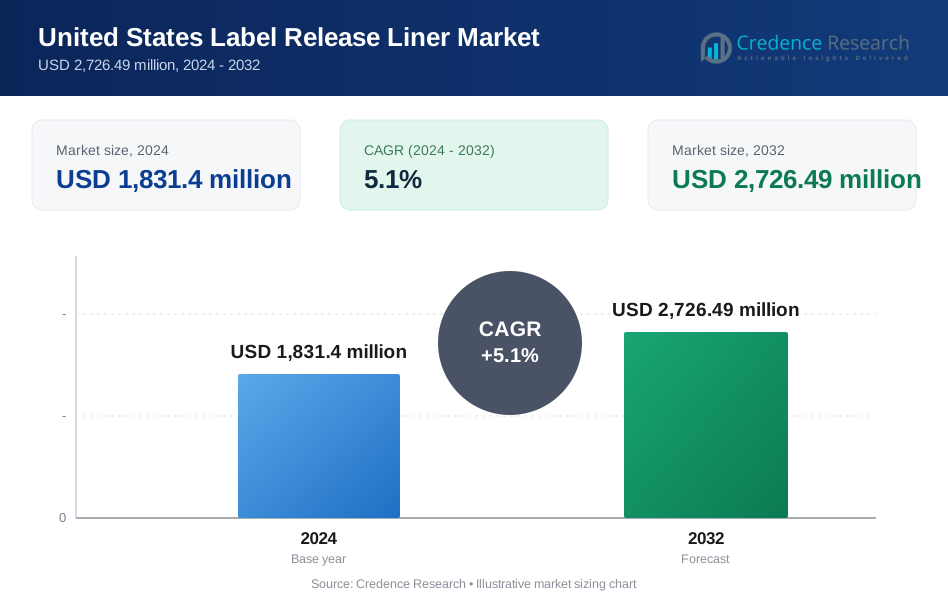
| United States Label Release Liner Market Size 2024 | USD 1,831.4 million |
| United States Label Release Liner Market, CAGR | 5.1% |
| United States Label Release Liner Market Size 2032 | USD 2,726.49 million |
Market Overview
The United States Label Release Liner market is projected to grow from USD 1,831.4 million in 2024 to USD 2,726.49 million by 2032, reflecting a compound annual growth rate (CAGR) of 5.1%.
The United States Label Release Liner market is driven by the growing demand for eco-friendly and sustainable labeling solutions across industries such as food, beverages, pharmaceuticals, and consumer goods. The shift towards more sustainable materials, including recyclable and biodegradable release liners, is a key factor boosting market growth. Additionally, advancements in technology, such as the development of innovative adhesive formulations and efficient manufacturing processes, are enhancing product performance and driving demand. The rise of e-commerce and the increasing need for packaging solutions that cater to both aesthetics and functionality also contribute to the market’s expansion. Furthermore, the increasing adoption of digital printing technologies and the trend toward personalized packaging are shaping the market's trajectory. As environmental regulations tighten and consumer preferences shift toward sustainability, manufacturers are focusing on eco-conscious product innovations, which is expected to further propel the growth of the United States Label Release Liner market in the coming years.
The United States Label Release Liner market is geographically diverse, with key regions such as the East Coast and West Coast driving significant market share. The East Coast, accounting for approximately 45% of the market, is a hub for industries like food and beverages, pharmaceuticals, and consumer goods. The West Coast, contributing around 40% of the market, is known for its focus on high-performance packaging solutions, particularly in electronics and technology. Leading players in the market, including Avery Dennison Corporation, UPM Raflatac, Mondi Group, 3M Company, and Loparex LLC, are pivotal in shaping market trends. These companies dominate the market by offering a range of high-quality and sustainable release liners, focusing on innovation and customization to meet the growing demand for eco-friendly and efficient labeling solutions across various industries.
Market Drivers
Growing Demand for Sustainable Solutions
The increasing focus on sustainability is a primary driver of the United States Label Release Liner market. Consumers and businesses alike are demanding eco-friendly packaging solutions, including biodegradable and recyclable release liners. For instance, the Tag and Label Manufacturers Institute (TLMI) has partnered with CELAB North America to launch the Liner Recycling Initiative (LRI). As businesses adopt more eco-conscious practices to align with regulatory requirements and consumer preferences, the demand for sustainable release liners continues to grow.
Advancements in Technology
Technological advancements in adhesive formulations and manufacturing processes are significantly boosting the United States Label Release Liner market. For example, companies like 3M (US) and Mondi (Austria) are leading players in the release liners market, focusing on innovation in materials and coatings that improve performance while reducing environmental impact. Additionally, advancements in digital printing and labeling technologies are driving demand for specialized release liners that offer better adhesion, print quality, and flexibility. These technological developments provide manufacturers with a competitive edge and are helping meet the evolving needs of various industries.
Growth of E-commerce and Packaging Demand
The rapid expansion of e-commerce has significantly contributed to the growth of the Label Release Liner market in the United States. For instance, the global release liners market is projected to reach USD 176.8 billion by 2033, driven by the escalating demand for pressure-sensitive labels and industrial tape, as well as the growing need for effective packaging in various end-use industries. Label release liners are essential for providing high-quality, functional labels for products sold online. As packaging becomes a key differentiator in consumer purchasing decisions, the demand for release liners that support customized, eye-catching packaging has surged.
Stringent Regulatory Environment
The growing stringency of environmental regulations in the United States is another key driver of the Label Release Liner market. For example, the collaboration between TLMI and CELAB North America on the Liner Recycling Initiative reflects the industry's response to increasing environmental regulations. Compliance with these regulations is essential for businesses looking to maintain a competitive edge in the market, driving the adoption of environmentally responsible release liner solutions.
Market Trends
Shift Towards Sustainable Packaging
The United States label release liner market is experiencing a notable shift towards sustainable packaging solutions. For example, the increasing consumer preference for eco-friendly products has led manufacturers to develop biodegradable and recyclable release liners. This trend aligns with the global push to reduce plastic waste and promote environmental sustainability.
Advancements in Release Liner Technology
Technological innovations are significantly enhancing the performance of release liners in the U.S. market. For instance, companies are investing in research and development to create liners with improved durability and functionality. These advancements cater to the evolving needs of industries such as food and beverage, pharmaceuticals, and cosmetics, which demand high-quality labelling solutions.
Growth in E-commerce Driving Packaging Demand
The rapid expansion of e-commerce has substantially increased the demand for effective packaging solutions, including label release liners. For example, the surge in online shopping requires robust labeling for product identification and branding, leading to a higher consumption of release liners. This trend is expected to continue as e-commerce platforms proliferate.
Regional Expansion and Capacity Building
Companies are expanding their capacities in the United States to meet the growing demand for release liners. For instance, the Felix Schoeller Group announced plans to invest more than $100 million by 2025 to expand its capacity in North America. This investment includes increasing the production capacity of their existing paper machine in Drummondville, Canada, to over 40,000 tons per year.
Market Challenges Analysis
Supply Chain and Raw Material Constraints
One of the significant challenges faced by the United States Label Release Liner market is the ongoing supply chain disruptions and raw material constraints. The availability and cost of key materials used in manufacturing release liners, such as paper, films, and adhesives, have been impacted by global supply chain issues. Shortages, price volatility, and transportation delays have made it difficult for manufacturers to maintain consistent production schedules. These challenges not only increase operational costs but also hinder the timely delivery of products, affecting both manufacturers and end-users. As demand for sustainable materials rises, sourcing eco-friendly alternatives can be particularly challenging, further complicating the supply chain dynamics for companies in this sector.
Regulatory Compliance and Environmental Concerns
Navigating the complex landscape of environmental regulations poses another challenge for the United States Label Release Liner market. Stringent regulations surrounding waste management, recycling, and the use of hazardous materials require manufacturers to adopt sustainable practices and eco-friendly materials. While this trend aligns with market demands, meeting the evolving regulatory requirements can be costly and resource-intensive. Companies must invest in research and development to ensure their products meet these standards while remaining competitive. Additionally, with increasing consumer awareness of environmental issues, any non-compliance or use of non-sustainable materials can lead to reputational damage, making it critical for manufacturers to stay ahead of regulatory changes.
Market Segmentation Analysis:
By Substrate
The United States Label Release Liner market can be segmented by substrate, which includes paper, film, and other materials. Among these, paper-based substrates dominate the market due to their versatility, cost-effectiveness, and widespread use in various industries such as food and beverage, pharmaceuticals, and consumer goods. Paper-based release liners are commonly used for applications requiring good printability, ease of handling, and strong adhesion properties. Film-based substrates, such as PET (Polyethylene Terephthalate) and PVC (Polyvinyl Chloride), are gaining traction due to their higher durability and resistance to moisture, chemicals, and temperature fluctuations. These materials are increasingly utilized in applications that demand high-performance and long-lasting labels, such as in electronics, automotive, and medical industries. The demand for each substrate is influenced by specific industry requirements, with paper substrates continuing to lead in general-purpose applications, while film-based substrates are rising in specialized sectors.
By Label Type
In terms of label type, the United States Label Release Liner market is segmented into pressure-sensitive labels, heat transfer labels, and others. Pressure-sensitive labels (PSLs) dominate the market due to their ease of application and versatility across various industries. PSLs do not require heat or solvent activation, making them suitable for a wide range of products and surfaces. These labels are commonly used in retail packaging, logistics, and consumer goods. Heat transfer labels, which require heat to activate, are used in specific applications such as textiles and high-end consumer products. This segment is growing due to the increasing demand for durable, high-quality labeling that provides a premium look and feel. As e-commerce continues to rise, the demand for innovative label types that support product differentiation and branding is also increasing, further driving growth in the market.
Segments:
Based on Label Type:
- Barcode Labels & QR Code Labels
- RFID, NFC & EAS Labels
- Decorative and Informative Labels
- Others (Holographic Labels, etc.)
Based on Substrate:
- Film Liner
- Paper Liner
Based on Liner Type:
- Single Side Coated
- Double Side Coated
Regional Analysis
East Coast
The United States Label Release Liner market is significantly driven by regional dynamics, with the East Coast holding a notable share of the market. This region accounts for 45% of the overall market, fueled by the high concentration of manufacturing industries such as food and beverages, pharmaceuticals, and consumer goods. These sectors heavily rely on efficient and high-quality labeling solutions, creating a consistent demand for label release liners. Major metropolitan hubs, including New York, Philadelphia, and Boston, act as critical centers for packaging and labeling activities, further contributing to the region’s dominance. Additionally, the East Coast benefits from an established distribution network, robust infrastructure, and proximity to key logistics and retail hubs, which ensures the timely delivery and widespread adoption of release liners. Moreover, the growing trend of sustainability in packaging, driven by increasing consumer and regulatory pressure for eco-friendly materials, is pushing manufacturers to innovate. As a result, the demand for biodegradable, recyclable, and sustainable release liners is on the rise, further propelling the growth of the market in this region.
West Coast
The West Coast holds a significant share in the United States Label Release Liner market, contributing 40% to the overall market. Regions like California are key players in the growth of this sector, with a strong emphasis on advanced technologies, innovation, and high-performance packaging. Industries such as electronics, automotive, and technology, which demand specialized, durable, and high-quality release liners, are major drivers of demand in this region. Additionally, the rise of e-commerce and the increasing need for customized and personalized packaging solutions are propelling market growth, as businesses seek unique and effective labeling solutions. The West Coast's strategic position near the Pacific Ocean offers a competitive advantage in global trade, enabling easy access to international markets and enhancing the export of label release liners. Furthermore, the region is experiencing a heightened focus on sustainability, with businesses increasingly adopting eco-friendly materials and practices in line with consumer preferences and environmental regulations. This trend is contributing to the demand for innovative, sustainable release liner solutions, reinforcing the West Coast's vital role in shaping the market’s future.
Key Player Analysis
- 3M Company
- LINTEC Corporation
- Toray Plastics (America), Inc.
- Loparex LLC
- UPM Raflatac
- Avery Dennison Corporation
- Polyplex Corporation Ltd.
- Gascogne Flexible
- Mondi Group
- Elkem Silicones USA Corp.
Competitive Analysis
The United States Label Release Liner market is highly competitive, with several industry leaders driving innovation and shaping the market. For instance, companies such as Avery Dennison Corporation, UPM Raflatac, Mondi Group, Elkem Silicones USA Corp., Mitsubishi Chemical America, Inc., Gascogne Flexible, 3M Company, Loparex LLC, Toray Plastics (America), Inc., Polyplex Corporation Ltd., and LINTEC Corporation are at the forefront of the market, offering a diverse range of products and solutions. These companies focus on enhancing product performance, sustainability, and customization to cater to the growing demand for eco-friendly, high-quality release liners. With advancements in adhesive technologies, digital printing, and eco-conscious materials, these players are investing heavily in research and development to maintain their competitive edge. Strategic partnerships, mergers, and acquisitions are also common strategies for expanding their market share and expanding product portfolios. As consumer preferences shift towards sustainable and innovative solutions, these players are well-positioned to lead the market.
Recent Developments
- In 2023, Sappi introduced a new and improved generation of its well-established Silco Glassine paper product line, now marketed under the name Silco. This enhanced version of Silco Glassine paper offers advanced performance features, reinforcing Sappi’s commitment to providing innovative solutions for various applications while maintaining sustainability and quality.
- In 2023, Ahlstrom unveiled a new line of sustainable release liners, further advancing its commitment to eco-friendly practices. These new release liners are designed to meet the growing demand for more sustainable products in the market while delivering the high performance and reliability that Ahlstrom’s customers have come to expect.
- In September 2022, UPM Raflatac expanded its capabilities and accelerated its growth by acquiring AMC AG (Advanced Methods of Coating). This strategic acquisition allows UPM Raflatac to enhance its product offerings and further strengthen its position in the market, driving innovation and expanding its reach in the field of coated solutions.
- In May 2022, Mondi made a significant shift in its product portfolio by switching its range of glassine-based release liners to base paper that is certified, aligning with its commitment to sustainability and environmental responsibility.
Market Concentration & Characteristics
The United States Label Release Liner market exhibits moderate concentration, with a mix of well-established global players and regional companies. Leading firms such as Avery Dennison Corporation, UPM Raflatac, Mondi Group, and 3M Company dominate the market, holding significant shares due to their extensive product portfolios, advanced technologies, and strong distribution networks. Despite this concentration, the market is also characterized by the presence of several smaller, niche players like Loparex LLC and Toray Plastics (America), Inc., which cater to specific customer needs and offer specialized products. The market is highly competitive, driven by innovation, especially in sustainable materials and high-performance release liners. Manufacturers are increasingly focusing on developing eco-friendly, recyclable, and cost-effective solutions to meet regulatory requirements and consumer demand for sustainability. Additionally, customization and the ability to cater to various industries such as food, pharmaceuticals, and e-commerce further contribute to the market’s dynamic nature.
Report Coverage
The research report offers an in-depth analysis based on Label-Type, Liner-Type and Substrate. It details leading market players, providing an overview of their business, product offerings, investments, revenue streams, and key applications. Additionally, the report includes insights into the competitive environment, SWOT analysis, current market trends, as well as the primary drivers and constraints. Furthermore, it discusses various factors that have driven market expansion in recent years. The report also explores market dynamics, regulatory scenarios, and technological advancements that are shaping the industry. It assesses the impact of external factors and global economic changes on market growth. Lastly, it provides strategic recommendations for new entrants and established companies to navigate the complexities of the market.
Future Outlook
- The United States Label Release Liner market is expected to experience steady growth due to rising demand for eco-friendly packaging solutions.
- Increasing adoption of sustainable and recyclable materials will drive innovation in release liner products.
- The shift toward digital printing technologies will continue to enhance customization and flexibility in labeling solutions.
- Growth in e-commerce and the need for attractive, functional packaging will further fuel market demand.
- Regulatory pressures around waste management and sustainability will push manufacturers to adopt environmentally responsible practices.
- The market will see continued advancements in adhesive technology to improve performance and efficiency.
- High-performance release liners will gain traction in sectors such as electronics, automotive, and medical packaging.
- Strategic partnerships, acquisitions, and mergers will increase among leading market players to expand product portfolios.
- Growing consumer preference for personalized and visually appealing packaging will drive innovation in label release liners.
- As sustainability becomes a top priority, demand for biodegradable and compostable release liners will rise significantly.
Request a Free Sample
Fill in your details and we'll send you a free sample report.
- Sample data tables & charts
- Research methodology
Need a Custom Version of This Report?
Tailor the scope, geography, or segments to your exact requirements.
- Custom geography or segment scope
- Direct access to our analyst team
Frequently Asked Questions
What is the current size of the United States Label Release Liner market?
What factors are driving the growth of the United States Label Release Liner market?
What are some challenges faced by the United States Label Release Liner market?
Who are the major players in the United States Label Release Liner market?
Table of Content
Chapter 1. Report Introduction
- 1.1 Report Description & Purpose
- 1.1.1 Report Title & Market Definition
- 1.1.2 Unique Selling Propositions (USP) & Key Differentiators
- 1.1.3 Value Proposition for Stakeholders
- 1.2 Research Objectives
- 1.2.1 Market Sizing Objectives (Volume & Revenue)
- 1.2.2 Segmentation Objectives
- 1.2.3 Competitive Intelligence Objectives
- 1.2.4 Forecast & Scenario Objectives
- 1.3 Report Scope
- 1.3.1 United States Label Release Liner Scope – Types & Subtypes Covered
- 1.3.2 Geographic Scope – Regions & Countries Covered
- 1.3.3 Historical Period, Base Year & Forecast Period (2024; forecast to 2032)
- 1.3.4 Inclusions & Exclusions
- 1.4 HS Code & Classification Framework
- 1.5 Currency, Units & Pricing Basis
- 1.6 Target Stakeholders
- 1.7 Limitations & Assumptions
Chapter 2. Executive Summary
- 2.1 Global United States Label Release Liner Market Snapshot
- 2.1.1 Market Size – Historical (2024) & Forecast (2024-2032) (2024: USD 1,831.4 million → 2032: USD 2,726.49 million)
- 2.1.2 Volume & Revenue – Global Totals
- 2.1.3 Key Market Highlights – Top Five Facts
- 2.2 United States Label Release Liner Market Segmentation Snapshot
- 2.2.1 Market Split by Region – 2024 vs. 2032
- 2.3 Competitive Snapshot
- 2.3.1 Top 10 Players by Revenue Share – 2024
- 2.3.2 Top 10 Players by Volume Share – 2024
- 2.3.3 Recent Strategic Developments (18-Month Summary)
- 2.4 Key Investment Highlights & Strategic Conclusions
Chapter 3. United States Label Release Liner Market Dynamics & Industry Analysis
- 3.1 Market Overview & Context
- 3.1.1 United States Label Release Liner Market Position in the Broader Automotive Value Chain
- 3.1.2 OEM vs. Replacement Market Dynamics
- 3.1.3 Market Maturity & Development Stage by Region
- 3.2 United States Label Release Liner Market Drivers
- 3.3 United States Label Release Liner Market Restraints & Challenges
- 3.4 United States Label Release Liner Market Opportunities
- 3.5 Porter's Five Forces Analysis
- 3.5.1 Threat of New Entrants
- 3.5.2 Bargaining Power of Suppliers
- 3.5.3 Bargaining Power of Buyers
- 3.5.4 Threat of Substitutes
- 3.5.5 Competitive Rivalry – Intensity Assessment
- 3.6 United States Label Release Liner Value Chain Analysis
- 3.6.1 Upstream – Raw Material/Input Suppliers
- 3.6.1.1 Raw Material/Input 1
- 3.6.1.2 Raw Material/Input 2
- 3.6.1.3 Raw Material/Input 3
- 3.6.2 Midstream – Production/Manufacturing/Service Delivery
- 3.6.2.1 Production/Process Overview
- 3.6.2.2 Key Facility Locations & Capacity by Manufacturer
- 3.6.3 Downstream – Distribution & End Consumer
- 3.6.3.1 Primary Channel – B2B/OEM
- 3.6.3.2 Secondary Channels – Dealer, Retail, Online, Direct
- 3.6.4 Value Chain Profitability Analysis
- 3.6.1 Upstream – Raw Material/Input Suppliers
- 3.7 PESTEL Analysis
- 3.7.1 Political Factors
- 3.7.2 Economic Factors
- 3.7.3 Social Factors
- 3.7.4 Technological Factors
- 3.7.5 Environmental Factors
- 3.7.6 Legal Factors
- 3.8 United States Label Release Liner Supply Chain Analysis
- 3.8.1 Raw Material/Input Supply Risk Assessment
- 3.8.2 Manufacturing Concentration Risk (Geographic Exposure)
- 3.8.3 Trade Disruption Impact Analysis
- 3.9 Regulatory & Policy Landscape
Note: The regulatory and policy landscape section covers regulations based on their applicability to the market, United States Label Release Liner category, geography, and scope of the study. Only regulatory frameworks with a material impact on operations, compliance, trade, sustainability, or market access are analyzed in detail.
Chapter 4. Key Investment Pockets & Opportunity Analysis
- 4.1 United States Label Release Liner Market Attractiveness Analysis
- 4.1.1 By Region – Investment Attractiveness Matrix (Volume × CAGR)
- 4.2 Absolute Revenue Growth Opportunity
- 4.2.1 By Region – Absolute USD Growth Through 2032
- 4.3 Incremental Volume Opportunity
- 4.3.1 By Region – Incremental Volume Through 2032
- 4.3.2 Segment – Incremental Volume
- 4.4 Emerging Submarket Opportunity Deep Dive (Subject to Applicability)
- 4.5 Emerging Market Opportunity Scorecards
- 4.5.1 United States
- 4.5.2 Europe
- 4.5.3 Asia
- 4.5.4 Middle East & Africa
Note: Emerging Market Opportunity Scorecards will be included based on relevance and strategic importance. Regions listed are indicative and may vary depending on data availability and market dynamics.
Chapter 5. United States Label Release Liner Import-Export Analysis & Trade Flows
- 5.1 Global Trade Overview
- 5.1.1 Global Export Value by Country (2024)
- 5.1.2 Global Export Volume by Country (2024)
- 5.1.3 Global Import Value by Country (2024)
- 5.1.4 Global Import Volume by Country (2024)
- 5.1.5 Net Trade Balance by Country (2024)
- 5.2 Export Analysis – Segment
- 5.2.1 Type 1 (HS Code)
- 5.2.2 Type 2 (HS Code)
- 5.2.3 Type 3 (HS Code)
- 5.2.4 Type 4 (HS Code)
- 5.2.5 Type 5 (HS Code)
- 5.3 Import Analysis – Segment
- 5.3.1 Type 1 (HS Code)
- 5.3.2 Type 2 (HS Code)
- 5.3.3 Type 3 (HS Code)
- 5.3.4 Type 4 (HS Code)
- 5.3.5 Type 5 (HS Code)
- 5.4 Average Unit Trade Prices
- 5.4.1 Average Export Price – Segment & Country
- 5.4.2 Average Import Price – Segment & Source Country
- 5.4.3 Price Trends (2024)
- 5.5 Key Trade Route Analysis
- 5.5.1 Trade Route 1
- 5.5.2 Trade Route 2
- 5.5.3 Trade Route 3
- 5.5.4 Trade Route 4
- 5.5.5 Trade Route 5
- 5.6 Trade Policy Impact Assessment
- 5.6.1 US Anti-Dumping & Section 301 Tariffs
- 5.6.2 EU Customs Union Impact
- 5.6.3 Major Free Trade Agreements
- 5.6.4 USMCA Rules of Origin
Note: Trade policy analysis will be included only where relevant to the United States Label Release Liner market.
Chapter 6. Competitive Landscape & Company Benchmarking
- 6.1 United States Label Release Liner Market Concentration & Structure
- 6.1.1 Herfindahl-Hirschman Index (HHI) – vs. 2024
- 6.1.2 Tier 1, Tier 2 & Tier 3 Market Structure
- 6.1.3 Global, Regional & Local Player Dynamics
- 6.2 United States Label Release Liner Market Share Analysis – 2024
- 6.2.1 Global Revenue Share by Company
- 6.2.2 Global Volume Share by Company
- 6.2.3 Regional Revenue Share
- 6.2.4 Market Share Evolution ( vs. 2024)
- 6.2.5 OEM Segment Share by Company
- 6.2.6 Replacement Segment Share by Company
- 6.3 Production/Delivery Capacity & Facility Analysis
- 6.3.1 Global Installed Capacity
- 6.3.2 Capacity Utilization Rates
- 6.3.3 Production/Output Volume
- 6.3.4 Facility Locations & Capacity Map
- 6.3.5 Planned Capacity Additions
- 6.4 United States Label Release Liner Competitive Benchmarking Matrix
- 6.4.1 Revenue, Volume, CAGR & Profitability Comparison
- 6.4.2 Channel Revenue Mix
- 6.4.3 Geographic Revenue Exposure
- 6.4.4 R&D Intensity
- 6.4.5 Sustainability Maturity
- 6.5 Strategic Developments in United States Label Release Liner (Last 24 Months)
- 6.5.1 Mergers, Acquisitions & Divestments
- 6.5.2 New United States Label Release Liner Launches
- 6.5.3 Facility Expansions
- 6.5.4 Strategic Alliances, Joint Ventures & Partnerships
- 6.5.5 Distribution Expansion & Market Entry
- 6.5.6 Sustainability & ESG Initiatives
- 6.6 Competitive Strategy Mapping
- 6.6.1 Leader, Challenger, Follower & Niche Classification
- 6.6.2 Pricing Strategy Comparison
- 6.6.3 Channel Strategy Matrix
Note: Strategic developments are included based on their materiality and the availability of reliable information.
Chapter 7. Global United States Label Release Liner Market – By Distribution Channel
- 7.1 Segment Overview
- 7.1.1 Volume & Revenue Split by Channel (2024 & 2032)
- 7.1.2 Channel Mix Evolution (2024-2032)
Chapter 8. Regional Market Analysis – Global Overview
- 8.1 Global Regional Overview
- 8.1.1 Regional Volume Share
- 8.1.2 Regional Revenue Share
- 8.1.3 Regional Volume by Region
- 8.1.4 Regional Revenue by Region
- 8.1.5 Regional Forecast Through 2032
- 8.2 Cross-Regional Segment Analysis
- 8.2.1 By Distribution Channel
- 8.2.2 By Brand/Price Tier
Chapter 9. North America United States Label Release Liner Market
- 9.1 United States
- 9.2 Canada
- 9.3 Mexico
Chapter 10. Europe United States Label Release Liner Market
- 10.1 Germany
- 10.2 France
- 10.3 Italy
- 10.4 United Kingdom
- 10.5 Spain
- 10.6 Poland
- 10.7 Russia
- 10.8 Netherlands
- 10.9 Belgium
- 10.10 Sweden
- 10.11 Denmark
- 10.12 Norway
- 10.13 Rest of Europe
Chapter 11. Asia Pacific United States Label Release Liner Market
- 11.1 China
- 11.2 India
- 11.3 Japan
- 11.4 South Korea
- 11.5 Thailand
- 11.6 Indonesia
- 11.7 Vietnam
- 11.8 Malaysia
- 11.9 Australia
- 11.10 Rest of Asia Pacific
Chapter 12. Latin America United States Label Release Liner Market
- 12.1 Brazil
- 12.2 Argentina
- 12.3 Colombia
- 12.4 Chile
- 12.5 Rest of Latin America
Chapter 13. Middle East United States Label Release Liner Market
- 13.1 Saudi Arabia
- 13.2 United Arab Emirates
- 13.3 Turkey
- 13.4 Israel
- 13.5 Iran
- 13.6 Rest of the Middle East
Chapter 14. Africa United States Label Release Liner Market
- 14.1 South Africa
- 14.2 Egypt
- 14.3 Nigeria
- 14.4 Morocco
- 14.5 Rest of Africa
Chapter 15. United States Label Release Liner Company Profiles
- 15.1 [Company 01]
- 15.1.1 Company Overview
- 15.1.2 Key Management Personnel
- 15.1.3 Products & Services Portfolio
- 15.1.4 Financial Performance
- 15.1.5 Key Market Focus & Geographic Presence
- 15.1.6 Recent Developments & Strategic Initiatives
Note: The company profile list is preliminary and may change based on research findings, market developments, data availability, and client requirements.
Chapter 16. Appendices
- Appendix A – List of Abbreviations & Acronyms
- Appendix B – Industry Classification Code Reference – Full Series
- Appendix C – Production & Capacity Data Tables
- Appendix D – End-Use & Demand Base Tables
- Appendix E – Consumption & Replacement Rate Assumptions
- Appendix F – ASP Reference Tables
- Appendix G – Manufacturing & Facility Database
- Appendix H – Import-Export Data Tables
- Appendix I – Regulatory Summary Tables
- Appendix J – Primary Research Participant List (Anonymized)
- Appendix K – Primary Research Questionnaire Framework
- Appendix L – Data Sources & Bibliography
- Appendix M – Market Size Divergence & Source Comparison
Chapter 17. Research Methodology
- 17.1 Research Framework & Philosophy
- 17.2 Secondary Research – Sources, Hierarchy & Data Extraction
- 17.3 Data Modeling – Bottom-Up & Top-Down Market Sizing
- 17.4 Primary Research – Stakeholder Framework, LOI & Sample Sizes
- 17.5 Forecast Methodology – Regression, Scenario & Sensitivity Analysis
- 17.6 Quality Control – Four-Layer Validation Framework
- 17.7 Limitations & Standard Assumptions
- 17.8 Disclaimer
