
Market Overview
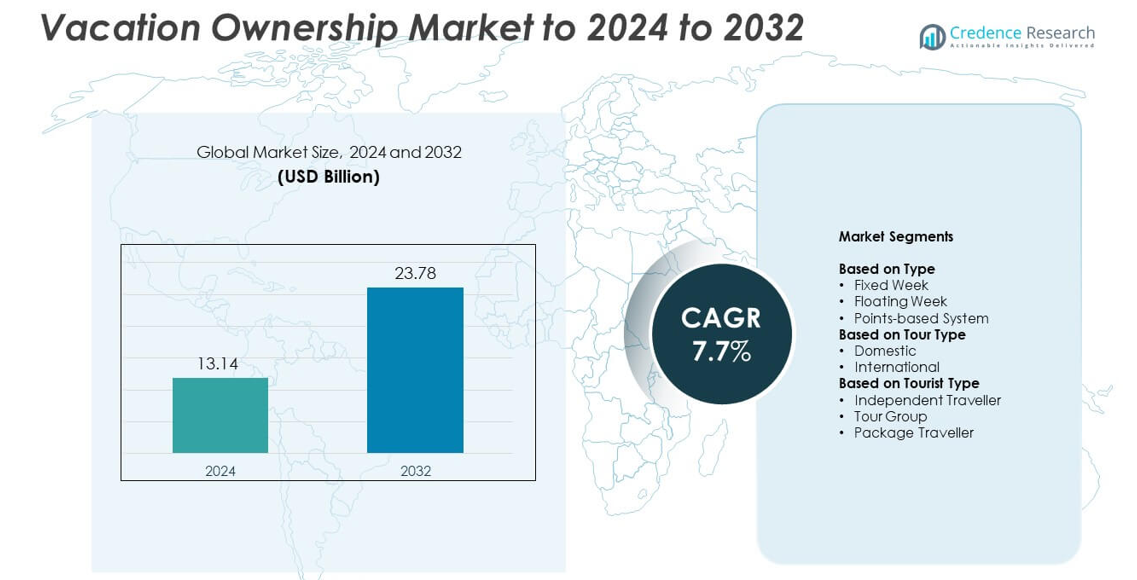
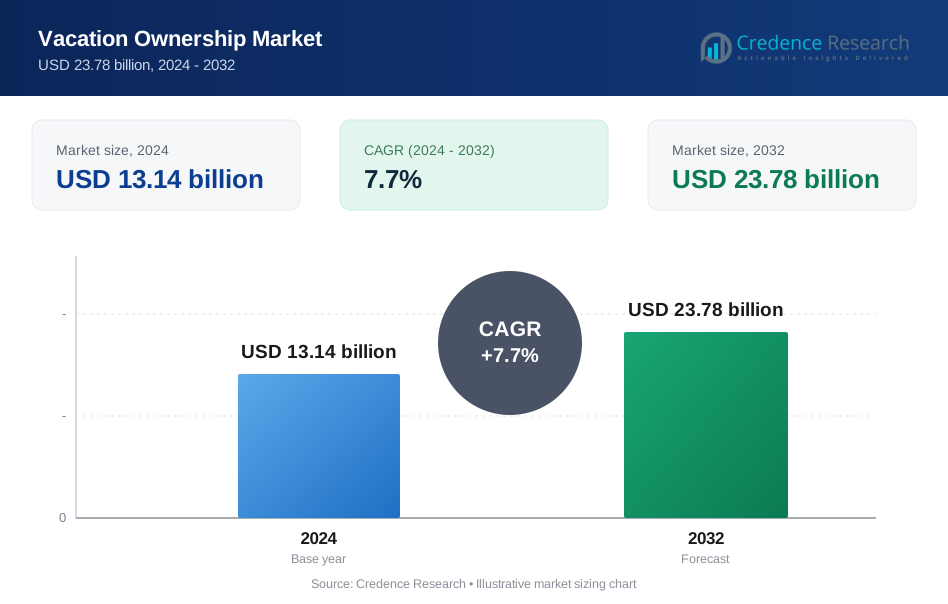
Vacation ownership market size was valued at USD 13.14 billion in 2024 and is anticipated to reach USD 23.78 billion by 2032, growing at a CAGR of 7.7% during the forecast period.
| REPORT ATTRIBUTE | DETAILS |
|---|---|
| Historical Period | 2020-2023 |
| Base Year | 2024 |
| Forecast Period | 2025-2032 |
| Vacation Ownership Market Size 2024 | USD 13.14 billion |
| Vacation Ownership Market, CAGR | 7.7% |
| Vacation Ownership Market Size 2032 | USD 23.78 billion |
The vacation ownership market features major players such as Marriott Vacations Worldwide, Hilton Grand Vacations, Disney Vacation Club, Bluegreen Vacations, Westgate Resorts, Hyatt Residence Club, Welk Resorts, Vidanta Resorts, and Holiday Inn Club Vacations (IHG), each expanding resort networks and flexible membership programs to strengthen customer retention. Their focus on premium amenities, curated experiences, and digital engagement supports steady global adoption. North America remained the leading region in 2024 with about 41% share, driven by strong domestic tourism, mature resort infrastructure, and high participation in structured vacation programs. Europe and Asia Pacific followed with rising interest in flexible and experience-driven ownership models.
Market Insights
- The vacation ownership market reached USD 13.14 billion in 2024 and is projected to hit USD 23.78 billion by 2032, growing at a 7.7% CAGR.
- Growth is driven by rising demand for planned family travel, strong adoption of fixed-week formats with a 42% share, and expanding branded hospitality networks offering predictable, high-value vacation options.
- Key trends include a shift toward flexible points-based systems, wellness-focused travel, and digital adoption through virtual tours and app-based member platforms that improve booking and engagement.
- Competition intensifies as major hospitality brands invest in premium resort upgrades, loyalty programs, and multi-destination exchange networks, strengthening long-term customer retention across domestic and international markets.
- North America led with a 41% share, followed by Europe at 28% and Asia Pacific at 23%, while Latin America and the Middle East & Africa held 5% and 3% respectively, supported by steady interest from independent travellers with a 48% segment share.
Market Segmentation Analysis:
By Type
Fixed week led the type segment in 2024 with about 42% share. Buyers preferred fixed week plans because they guarantee the same vacation period each year, which supports stable planning for families and repeat travellers. This format also offers clear cost expectations and stronger long-term value, making it attractive for middle-income households. Floating week products grew due to flexible date choices, while points-based systems expanded as younger travellers sought customizable stay lengths and multi-destination access across branded resort networks.
- For instance, RCI (Resorts Condominium International), a global leader in vacation exchange, gives members access to approximately 4,100 to 4,300affiliated resorts in around 100 to 110 countries worldwide, demonstrating their extensive global network for vacation ownership exchange.
By Tour Type
Domestic travel dominated the tour type segment in 2024 with nearly 63% share. Strong demand came from shorter booking cycles, lower travel expenses, and increased interest in in-country leisure destinations. Domestic packages also benefited from improved road and air connectivity and rising investment in resort infrastructure. International travel continued to recover as visa processing improved and outbound tourism increased among higher-income groups, but domestic ownership remained the preferred option due to convenience and predictable yearly costs.
- For instance, Mahindra Holidays & Resorts reported inventory of 4,940 keys across 102 resorts at the end of FY2023.
By Tourist Type
Independent traveller held the top position in the tourist type segment in 2024 with around 48% share. This group preferred vacation ownership because it allows flexible trip planning and offers access to multiple resort styles without strict group itineraries. Independent buyers also value privacy, self-guided experiences, and the ability to choose travel dates aligned with personal schedules. Tour groups and package travellers showed steady activity, but shifting preferences toward customized stays and experiential holidays strengthened the appeal of ownership among individual travellers.
Key Growth Drivers
Rising Demand for Family-Oriented Leisure Travel
Family travellers increased their spending on planned vacations, which strengthened interest in long-term ownership models. Buyers focused on predictable yearly stays, comfortable resort amenities, and multi-room units that support group travel. This shift encouraged households to secure guaranteed accommodation during peak seasons, reducing dependence on fluctuating hotel prices. Growing interest in repeat travel to familiar destinations further supported the appeal of structured ownership plans.
- For instance, the Disney Vacation Club (DVC) program has an estimated over 250,000 member families who hail from all 50 U.S. states and approximately 100 countries worldwide.
Expansion of Branded Hospitality Networks
Global hospitality brands expanded resort inventories, which boosted consumer confidence in ownership products. Stronger brand assurance, better maintenance standards, and access to loyalty programs attracted new buyers across mid- and premium-income groups. Resort developers also added integrated amenities such as spas, entertainment zones, and curated experience packages. These improvements strengthened long-term value perception and increased enrolment across major tourism regions.
- For instance, Hilton Grand Vacations’ acquisition of Bluegreen Vacations is expected to lift its membership base from 525,000 to more than 740,000 owners and expand its resort portfolio to nearly 200 properties.
Shift Toward Flexible Ownership Models
Flexible products such as points-based systems gained strong traction due to evolving traveller expectations. Modern buyers preferred the freedom to choose destinations, season types, and stay lengths without long-term commitment to a single week. Hospitality brands enhanced exchange networks, allowing members to access resorts across global portfolios. This adaptability supported higher adoption among younger travellers who prioritize customization and experience-based travel.
Key Trends and Opportunities
Growth of Experiential and Wellness Tourism
Travellers shifted toward wellness, adventure, and cultural experiences, increasing demand for resorts that offer curated on-site and destination activities. Developers introduced spa retreats, fitness programs, local cuisine journeys, and guided outdoor exploration to match evolving preferences. Ownership products integrated these features to boost engagement and repeat usage. This trend opened new opportunities for premium positioning and higher-value membership packages.
- For instance, Six Senses now offers dedicated sound-therapy wellness programs across 27 properties worldwide.
Digital Adoption in Sales and Member Engagement
Sales platforms moved toward virtual tours, AI-based recommendations, and digital contract management. These tools improved transparency and reduced the time needed for decision-making. Members benefited from mobile apps that manage bookings, track point usage, and access exclusive offers. This digital shift enhanced customer experience and created new cross-selling opportunities for resorts and tourism partners.
- For instance, Hyatt Vacation Club launched as a rebranded platform spanning 22 branded resorts, supporting digitally managed vacation ownership experiences.
Expansion into Emerging Tourism Destinations
Developers increased focus on emerging coastal, hill, and heritage locations with rising domestic tourism. These destinations offered lower development costs and strong long-term demand potential. Governments supported tourism infrastructure, improving accessibility and reducing operational barriers for new resorts. The expansion broadened ownership choices and strengthened the market’s future growth pipeline.
Key Challenges
High Upfront Investment and Maintenance Obligations
Many buyers hesitate due to significant upfront purchase requirements and recurring annual fees. These costs create long-term financial commitments that may not match income stability for some households. Market growth slows when economic uncertainty rises, prompting travellers to delay or reconsider ownership. Developers continue to refine financing options, but affordability remains a structural challenge.
Seasonal Demand Fluctuations and Inventory Pressure
Seasonal peaks restrict flexible booking options, leading to overcrowded resort calendars and member dissatisfaction during high-demand periods. Off-season underutilization reduces revenue efficiency and strains resort management. Maintaining fair access to popular weeks becomes difficult as membership volumes rise. Developers must balance inventory, expand available destinations, and optimize dynamic allocation systems to reduce pressure.
Regional Analysis
North America
North America held the leading position in 2024 with about 41% share. The region benefited from strong resort networks, high discretionary income, and rising demand for structured family vacations. Major hospitality brands expanded properties across coastal and mountain destinations, supporting steady ownership enrolment. Short-haul domestic travel also grew, helping buyers see long-term value in fixed and flexible ownership formats. Expanding loyalty programs and upgraded amenities kept retention high, while digital sales tools added transparency. Consistent tourism spending and mature exchange networks reinforced North America’s dominance.
Europe
Europe accounted for nearly 28% share in 2024, supported by strong tourism activity across Spain, Italy, France, and the UK. Buyers valued access to heritage locations, beach destinations, and wellness-focused resorts. Improved cross-country connectivity encouraged multi-destination ownership, strengthening the appeal of points-based plans. Economic stability in key markets helped maintain steady demand, while the rise of experiential travel encouraged developers to expand resort offerings. Growing interest from younger travellers and stronger adoption of digital booking tools contributed to healthy regional growth.
Asia Pacific
Asia Pacific captured around 23% share in 2024 and showed the fastest expansion. Rising middle-class income, growth in domestic tourism, and increasing resort development across Thailand, Indonesia, India, and Australia supported ownership uptake. Travellers sought predictable yearly stays and value-driven packages, making flexible plans attractive. Expanding hospitality chains widened access to new destinations, while governments invested heavily in roads, airports, and coastal tourism hubs. Younger travellers showed strong interest in flexible and points-based systems, helping Asia Pacific accelerate further.
Latin America
Latin America held about 5% share in 2024, supported by tourism growth in Mexico, Brazil, and the Caribbean belt. Buyers were drawn to beach resorts and all-inclusive packages that offered stable pricing and repeat travel benefits. Developers focused on improving resort quality and strengthening exchange partnerships to attract international interest. Currency fluctuations and economic uncertainty slowed adoption in some markets, but rising inbound tourism kept long-term prospects strong. Expanding air connectivity and investment in leisure infrastructure supported gradual growth.
Middle East and Africa
The Middle East and Africa accounted for roughly 3% share in 2024, with growth led by the UAE, Saudi Arabia, and South Africa. Travelers sought premium desert, beach, and safari experiences, prompting developers to add high-end resort offerings. Strong government-led tourism programs expanded market visibility and increased interest in structured ownership models. Limited supply and higher development costs slowed broad adoption, yet rising income levels and luxury travel demand created steady opportunities. Strengthening hospitality investments continued to support future expansion.
Market Segmentations:
By Type
- Fixed Week
- Floating Week
- Points-based System
By Tour Type
- Domestic
- International
By Tourist Type
- Independent Traveller
- Tour Group
- Package Traveller
By Geography
- North America
- U.S.
- Canada
- Mexico
- Europe
- Germany
- France
- U.K.
- Italy
- Spain
- Rest of Europe
- Asia Pacific
- China
- Japan
- India
- South Korea
- South-east Asia
- Rest of Asia Pacific
- Latin America
- Brazil
- Argentina
- Rest of Latin America
- Middle East & Africa
- GCC Countries
- South Africa
- Rest of the Middle East and Africa
Competitive Landscape
The vacation ownership market is shaped by major players such as Vidanta Resorts, Welk Resorts, Hilton Grand Vacations, Bluegreen Vacations, Westgate Resorts, Hyatt Residence Club, Marriott Vacations Worldwide, Disney Vacation Club, and Holiday Inn Club Vacations (IHG). These companies focus on expanding resort inventories, enhancing member experience, and strengthening loyalty ecosystems across top leisure destinations. Developers invest in premium amenities, digital booking platforms, and flexible ownership structures to attract both new and repeat buyers. Strong emphasis on experiential travel, curated activities, and multi-destination access continues to widen the appeal of ownership programs. Competitive strategies now prioritize personalization, value differentiation, and long-term service quality to increase retention. Rising interest in environmentally responsible resort development and wellness-focused stay options further shapes portfolio planning. Partnerships with travel platforms, hospitality groups, and exchange networks improve global accessibility, while ongoing innovation in financing and membership models supports broader consumer adoption
Key Player Analysis
- Vidanta Resorts
- Welk Resorts
- Hilton Grand Vacations
- Bluegreen Vacations
- Westgate Resorts
- Hyatt Residence Club
- Marriott Vacations Worldwide
- Disney Vacation Club
- Holiday Inn Club Vacations (IHG)
Recent Developments
- In 2024, Bluegreen Vacations was acquired by Hilton Grand Vacations, with the acquisition completed. This acquisition expanded Hilton Grand Vacations' offerings, customer reach, and sales locations, effectively broadening its vacation ownership and experiences portfolio.
- In 2024, Vidanta East Cape opened as a new paradise resort, enhancing their coastal luxury offerings.
- In 2023, Holiday Inn Club Vacations (partner of IHG) acquired four beachfront resorts in Mexico (Cancun, Playa del Carmen, Riviera Maya) from Royal Resorts, marking their first properties outside the U.S
Report Coverage
The research report offers an in-depth analysis based on Type, Tour Type, Tourist Type and Geography. It details leading market players, providing an overview of their business, product offerings, investments, revenue streams, and key applications. Additionally, the report includes insights into the competitive environment, SWOT analysis, current market trends, as well as the primary drivers and constraints. Furthermore, it discusses various factors that have driven market expansion in recent years. The report also explores market dynamics, regulatory scenarios, and technological advancements that are shaping the industry. It assesses the impact of external factors and global economic changes on market growth. Lastly, it provides strategic recommendations for new entrants and established companies to navigate the complexities of the market.
Future Outlook
- The market will expand as more families choose planned annual vacations.
- Flexible ownership models will attract younger travellers seeking customizable stays.
- Branded hospitality chains will grow resort portfolios to strengthen member confidence.
- Digital sales tools and virtual tours will improve buyer conversion rates.
- Wellness-focused and experiential resorts will gain higher adoption across segments.
- Domestic tourism growth will keep ownership demand strong in major regions.
- Exchange networks will widen, offering members access to more global destinations.
- Premium and luxury ownership tiers will grow as high-income travel spending rises.
- Emerging tourism destinations will see increased development activity and resort expansion.
- Improved financing options will help broaden ownership adoption among mid-income groups.
Request a Free Sample
Fill in your details and we'll send you a free sample report.
- Sample data tables & charts
- Research methodology
Need a Custom Version of This Report?
Tailor the scope, geography, or segments to your exact requirements.
- Custom geography or segment scope
- Direct access to our analyst team
Frequently Asked Questions
What is the current market size for Vacation Ownership Market, and what is its projected size in 2032?
At what Compound Annual Growth Rate is the Vacation Ownership Market projected to grow between 2025 and 2032?
Who are the key participants in the market for vacation ownership globally?
What are the main market factors driving the vacation ownership sector?
What main market challenges prevent the vacation ownership sector from growing?
What are the main market opportunities for the vacation ownership sector?
Who are the leading companies in the Vacation Ownership Market?
Table of Content
Chapter 1. Report Introduction
- 1.1 Report Description & Purpose
- 1.1.1 Report Title & Market Definition
- 1.1.2 Unique Selling Propositions (USP) & Key Differentiators
- 1.1.3 Value Proposition for Stakeholders
- 1.2 Research Objectives
- 1.2.1 Market Sizing Objectives (Volume & Revenue) (Volume Where Applicable)
- 1.2.2 Segmentation Objectives
- 1.2.3 Competitive Intelligence Objectives
- 1.2.4 Forecast & Scenario Objectives
- 1.3 Report Scope
- 1.3.1 Vacation Ownership Scope – Segments & Subsegments Covered
- 1.3.2 Geographic Scope – Regions & Countries Covered
- 1.3.3 Historical Period, Base Year & Forecast Period (2024; forecast to 2032)
- 1.3.4 Inclusions & Exclusions
- 1.4 Industry Classification & Applicable Codes
- 1.5 Currency, Measurement Units & Valuation Basis
- 1.6 Target Stakeholders
- 1.7 Limitations & Assumptions
Chapter 2. Executive Summary
- 2.1 Global Vacation Ownership Market Snapshot
- 2.1.1 Market Size – Historical (2024) & Forecast (2024-2032) (2024: USD 13.14 billion → 2032: USD 23.78 billion)
- 2.1.2 Volume & Revenue – Global Totals (Volume Where Applicable)
- 2.1.3 Key Market Highlights – Top Five Facts
- 2.2 Vacation Ownership Market Segmentation Snapshot
- 2.2.1 Market Split by Region – 2024 vs. 2032
- 2.3 Competitive Snapshot
- 2.3.1 Top 10 Players by Revenue Share – 2024
- 2.3.2 Top 10 Players by Volume Share – 2024 (Volume Where Applicable)
- 2.3.3 Recent Strategic Developments (18-Month Summary)
- 2.4 Key Investment Highlights & Strategic Conclusions
Chapter 3. Vacation Ownership Market Dynamics & Industry Analysis
- 3.1 Market Overview & Context
- 3.1.1 Vacation Ownership Market Position in the Broader Industry Value Chain
- 3.1.2 Demand Structure & Purchasing Dynamics
- 3.1.3 Market Maturity & Development Stage by Region
- 3.2 Vacation Ownership Market Drivers
- 3.3 Vacation Ownership Market Restraints & Challenges
- 3.4 Vacation Ownership Market Opportunities
- 3.5 Porter's Five Forces Analysis
- 3.5.1 Threat of New Entrants
- 3.5.2 Bargaining Power of Suppliers
- 3.5.3 Bargaining Power of Buyers
- 3.5.4 Threat of Substitutes
- 3.5.5 Competitive Rivalry – Intensity Assessment
- 3.6 Vacation Ownership Value Chain Analysis
- 3.6.1 Upstream – Key Inputs, Resources & Suppliers
- 3.6.1.1 Key Input/Resource 1
- 3.6.1.2 Key Input/Resource 2
- 3.6.1.3 Key Input/Resource 3
- 3.6.2 Midstream – Core Operations & Value Creation
- 3.6.2.1 Operating Model & Process Overview
- 3.6.2.2 Key Operating Locations & Capabilities by Company
- 3.6.3 Downstream – Market Channels & End Users
- 3.6.3.1 Direct Sales & Customer Engagement Channels
- 3.6.3.2 Indirect Sales, Intermediaries & Partner Channels
- 3.6.4 Value Chain Profitability Analysis
- 3.6.1 Upstream – Key Inputs, Resources & Suppliers
- 3.7 PESTEL Analysis
- 3.7.1 Political Factors
- 3.7.2 Economic Factors
- 3.7.3 Social Factors
- 3.7.4 Technological Factors
- 3.7.5 Environmental Factors
- 3.7.6 Legal Factors
- 3.8 Vacation Ownership Supply Chain Analysis
- 3.8.1 Critical Input & Resource Availability Risk Assessment
- 3.8.2 Supplier & Operational Concentration Risk (Geographic Exposure)
- 3.8.3 Supply & Service Disruption Impact Analysis
- 3.9 Regulatory & Policy Landscape
Note: The regulatory and policy landscape section covers regulations based on their applicability to the market, Vacation Ownership category, geography, and scope of the study. Only regulatory frameworks with a material impact on operations, compliance, trade, sustainability, or market access are analyzed in detail.
Chapter 4. Key Investment Pockets & Opportunity Analysis
- 4.1 Vacation Ownership Market Attractiveness Analysis
- 4.1.1 By Region – Investment Attractiveness Matrix (Market Size × CAGR)
- 4.2 Absolute Revenue Growth Opportunity
- 4.2.1 By Region – Absolute Revenue Growth Through 2032
- 4.3 Incremental Demand Opportunity
- 4.3.1 By Region – Incremental Demand Through 2032
- 4.3.2 Segment – Incremental Demand
- 4.4 Emerging Submarket Opportunity Deep Dive (Subject to Applicability)
- 4.5 Priority Market Opportunity Scorecards
- 4.5.1 United States
- 4.5.2 Europe
- 4.5.3 Asia
- 4.5.4 Middle East & Africa
Note: Priority market opportunity scorecards reflect the geographic scope and strategic relevance of the study. Listed markets are indicative and may be adapted to the industry.
Chapter 5. Vacation Ownership Cross-Border Trade & Market Access Analysis
- 5.1 International Trade & Cross-Border Activity Overview
- 5.1.1 Global Export Value by Country (2024)
- 5.1.2 Global Export Volume by Country (2024) (Volume Where Applicable)
- 5.1.3 Global Import Value by Country (2024)
- 5.1.4 Global Import Volume by Country (2024) (Volume Where Applicable)
- 5.1.5 Net Trade Balance by Country (2024)
- 5.2 Export Analysis – Segment
- 5.2.1 Category 1 (Applicable Classification Code)
- 5.2.2 Category 2 (Applicable Classification Code)
- 5.2.3 Category 3 (Applicable Classification Code)
- 5.2.4 Category 4 (Applicable Classification Code)
- 5.2.5 Category 5 (Applicable Classification Code)
- 5.3 Import Analysis – Segment
- 5.3.1 Category 1 (Applicable Classification Code)
- 5.3.2 Category 2 (Applicable Classification Code)
- 5.3.3 Category 3 (Applicable Classification Code)
- 5.3.4 Category 4 (Applicable Classification Code)
- 5.3.5 Category 5 (Applicable Classification Code)
- 5.4 Cross-Border Pricing & Transaction Benchmarks
- 5.4.1 Export Pricing – Segment & Country
- 5.4.2 Import Pricing – Segment & Source Country
- 5.4.3 Price Trends (2024)
- 5.5 Key Cross-Border Trade & Delivery Routes
- 5.5.1 Cross-Border Trade/Delivery Route 1
- 5.5.2 Cross-Border Trade/Delivery Route 2
- 5.5.3 Cross-Border Trade/Delivery Route 3
- 5.5.4 Cross-Border Trade/Delivery Route 4
- 5.5.5 Cross-Border Trade/Delivery Route 5
- 5.6 Trade Policy & Market Access Impact Assessment
- 5.6.1 Tariff & Non-Tariff Barriers
- 5.6.2 Regional Trade & Economic Integration Frameworks
- 5.6.3 Bilateral & Multilateral Trade Agreements
- 5.6.4 Cross-Border Operating, Licensing & Localization Requirements
Note: This chapter applies where cross-border trade or delivery is relevant to Vacation Ownership. Goods, services, and digital offerings are assessed using applicable classifications and transaction measures. Import-export volumes, trade balances, and route analyses are included only where meaningful to the market.
Chapter 6. Competitive Landscape & Company Benchmarking
- 6.1 Vacation Ownership Market Concentration & Structure
- 6.1.1 Herfindahl-Hirschman Index (HHI) – the historical period vs. 2024
- 6.1.2 Leading, Mid-Sized & Emerging Player Structure
- 6.1.3 Global, Regional & Local Player Dynamics
- 6.2 Vacation Ownership Market Share Analysis – 2024
- 6.2.1 Global Revenue Share by Company
- 6.2.2 Global Volume Share by Company (Volume Where Applicable)
- 6.2.3 Regional Revenue Share
- 6.2.4 Market Share Evolution (the historical period vs. 2024)
- 6.2.5 Company Market Share by Key Segment
- 6.2.6 Company Market Share by Customer Group
- 6.3 Operating Scale, Capacity & Infrastructure Analysis
- 6.3.1 Global Operating Scale & Supply Capacity
- 6.3.2 Resource Utilization & Operating Efficiency
- 6.3.3 Output, Service Delivery & Activity Metrics
- 6.3.4 Operating Footprint & Infrastructure Map
- 6.3.5 Planned Operational & Capacity Expansion
- 6.4 Vacation Ownership Competitive Benchmarking Matrix
- 6.4.1 Revenue, Growth, Profitability & Operating Metric Comparison
- 6.4.2 Channel Revenue Mix
- 6.4.3 Geographic Revenue Exposure
- 6.4.4 R&D Intensity
- 6.4.5 Sustainability Maturity
- 6.5 Strategic Developments in Vacation Ownership (Last 24 Months)
- 6.5.1 Mergers, Acquisitions & Divestments
- 6.5.2 New Products, Services & Solutions in Vacation Ownership
- 6.5.3 Operational & Infrastructure Expansions
- 6.5.4 Strategic Alliances, Joint Ventures & Partnerships
- 6.5.5 Distribution Expansion & Market Entry
- 6.5.6 Sustainability & ESG Initiatives
- 6.6 Competitive Strategy Mapping
- 6.6.1 Leader, Challenger, Follower & Niche Classification
- 6.6.2 Pricing Strategy Comparison
- 6.6.3 Channel Strategy Matrix
Note: Strategic developments are included based on their materiality and the availability of reliable information.
Chapter 7. Global Vacation Ownership Market – By Sales & Delivery Channel
- 7.1 Segment Overview
- 7.1.1 Volume & Revenue Split by Channel (2024 & 2032) (Volume Where Applicable)
- 7.1.2 Channel Mix Evolution (2024-2032)
Chapter 8. Regional Market Analysis – Global Overview
- 8.1 Global Regional Overview
- 8.1.1 Regional Volume Share (Volume Where Applicable)
- 8.1.2 Regional Revenue Share
- 8.1.3 Regional Volume by Region (Volume Where Applicable)
- 8.1.4 Regional Revenue by Region
- 8.1.5 Regional Forecast Through 2032
- 8.2 Cross-Regional Segment Analysis
- 8.2.1 By Sales & Delivery Channel
- 8.2.2 By Competitive Positioning & Price Tier
Chapter 9. North America Vacation Ownership Market
- 9.1 United States
- 9.2 Canada
- 9.3 Mexico
Chapter 10. Europe Vacation Ownership Market
- 10.1 Germany
- 10.2 France
- 10.3 Italy
- 10.4 United Kingdom
- 10.5 Spain
- 10.6 Poland
- 10.7 Russia
- 10.8 Netherlands
- 10.9 Belgium
- 10.10 Sweden
- 10.11 Denmark
- 10.12 Norway
- 10.13 Rest of Europe
Chapter 11. Asia Pacific Vacation Ownership Market
- 11.1 China
- 11.2 India
- 11.3 Japan
- 11.4 South Korea
- 11.5 Thailand
- 11.6 Indonesia
- 11.7 Vietnam
- 11.8 Malaysia
- 11.9 Australia
- 11.10 Rest of Asia Pacific
Chapter 12. Latin America Vacation Ownership Market
- 12.1 Brazil
- 12.2 Argentina
- 12.3 Colombia
- 12.4 Chile
- 12.5 Rest of Latin America
Chapter 13. Middle East Vacation Ownership Market
- 13.1 Saudi Arabia
- 13.2 United Arab Emirates
- 13.3 Turkey
- 13.4 Israel
- 13.5 Iran
- 13.6 Rest of the Middle East
Chapter 14. Africa Vacation Ownership Market
- 14.1 South Africa
- 14.2 Egypt
- 14.3 Nigeria
- 14.4 Morocco
- 14.5 Rest of Africa
Chapter 15. Vacation Ownership Company Profiles
- 15.1 [Company 01]
- 15.1.1 Company Overview
- 15.1.2 Key Management Personnel
- 15.1.3 Products & Services Portfolio
- 15.1.4 Financial Performance
- 15.1.5 Key Market Focus & Geographic Presence
- 15.1.6 Recent Developments & Strategic Initiatives
Note: The company profile list is preliminary and may change based on research findings, market developments, data availability, and client requirements.
Chapter 16. Appendices
- Appendix A – List of Abbreviations & Acronyms
- Appendix B – Industry Classification Code Reference – Full Series
- Appendix C – Supply, Output & Operating Capacity Data Tables
- Appendix D – End-Use & Demand Base Tables
- Appendix E – Demand, Adoption & Usage Assumptions
- Appendix F – Pricing & Revenue Metric Reference Tables
- Appendix G – Company Operations & Infrastructure Database
- Appendix H – Cross-Border Trade & Activity Data Tables (Where Applicable)
- Appendix I – Regulatory Summary Tables
- Appendix J – Primary Research Participant List (Anonymized)
- Appendix K – Primary Research Questionnaire Framework
- Appendix L – Data Sources & Bibliography
- Appendix M – Market Size Divergence & Source Comparison
Chapter 17. Research Methodology
- 17.1 Research Framework & Philosophy
- 17.2 Secondary Research – Sources, Hierarchy & Data Extraction
- 17.3 Data Modeling – Bottom-Up & Top-Down Market Sizing
- 17.4 Primary Research – Stakeholder Framework, LOI & Sample Sizes
- 17.5 Forecast Methodology – Regression, Scenario & Sensitivity Analysis
- 17.6 Quality Control – Four-Layer Validation Framework
- 17.7 Limitations & Standard Assumptions
- 17.8 Disclaimer
