
Market Overview:
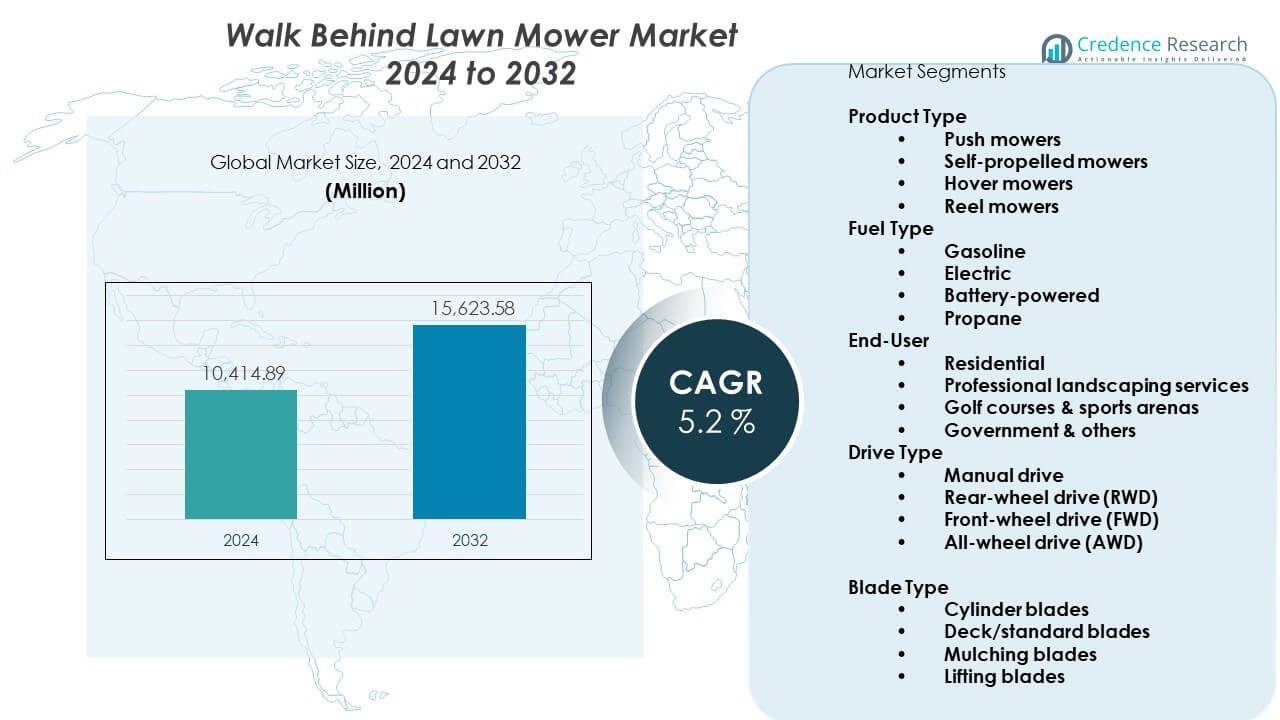
The Walk Behind Lawn Mower Market is projected to grow from USD 10,414.89 million in 2024 to USD 15,623.58 million by 2032, advancing at a CAGR of 5.2% during the forecast period.
| REPORT ATTRIBUTE | DETAILS |
|---|---|
| Historical Period | 2020-2023 |
| Base Year | 2024 |
| Forecast Period | 2025-2032 |
| Walk Behind Lawn Mower Market Size 2024 | USD 10,414.89 Million |
| Walk Behind Lawn Mower Market , CAGR | 5.2% |
| Walk Behind Lawn Mower Market Size 2032 | USD 15,623.58 Million |
Growing urban expansion, home-improvement trends, and a shift toward compact outdoor tools drive steady market demand. Users prefer walk-behind mowers for precise control and simple operation in daily lawn care. Electric and battery-powered models gain popularity among eco-focused buyers seeking quieter and low-maintenance solutions. Landscaping contractors invest in durable units that support long work hours and consistent performance. Improved comfort features, adjustable height systems, and stronger runtime encourage wider use across residential communities. Seasonal gardening habits and rising interest in organized lawn upkeep support market growth across key segments.
North America leads due to widespread lawn ownership and a strong landscaping culture within suburban areas. Europe follows with significant demand driven by compact gardens and high acceptance of electric and low-noise designs. Asia-Pacific emerges as the fastest-growing region, supported by urban development and rising household participation in outdoor care across China, India, Japan, and Australia. Latin America shows gradual growth as consumers shift from manual tools to powered mowers. The Middle East and Africa record steady expansion where new housing projects and landscaped community spaces grow. Market momentum varies across regions based on lifestyle patterns, climate, and outdoor maintenance practices.
Market Insights:
- The Walk behind lawn mower market was valued at USD 10,414.89 million in 2024 and is projected to reach USD 15,623.58 million by 2032, growing at a CAGR of 5.2% during 2024–2032.
- North America holds about 38% share, Europe around 27%, and Asia-Pacific nearly 22%, driven by strong lawn-care culture, high equipment ownership, and steady spending on residential landscaping.
- Asia-Pacific, with around 22% share, is the fastest-growing region, supported by rapid urbanisation, rising household incomes, and expanding residential projects in China, India, Japan, and Australia.
- By end-user, the residential segment accounts for roughly 55% of the Walk behind lawn mower market, driven by frequent household lawn maintenance and strong demand for compact, easy-handling models.
- By product type, push mowers contribute about 40% share, supported by lower cost, simple operation, and strong suitability for small and medium-sized lawns in core markets.
Market Drivers:
Rising Demand for Efficient Lawn Maintenance Solutions
Growing preference for neat lawns increases interest in practical mowing tools. Consumers select compact walk-behind models for ease of use and accurate cutting. Landscaping businesses depend on these machines for routine work across varied properties. The Walk Behind Lawn Mower Market benefits from rising outdoor maintenance habits in residential and commercial zones. Manufacturers focus on enhancing engine reliability to meet diverse terrain needs. Strong demand from suburban households strengthens equipment replacement cycles. Urban expansion encourages organized lawn care adoption across new housing clusters. Product upgrades help users manage routine yard maintenance with less effort.
- For instance, Honda introduced its HRN216 Series walk-behind lawn mower equipped with a GCV170 engine, which delivers up to 9% more power and 18% greater torque compared to previous models, enabling smoother operation on thick grass and variable terrain.
Shift Toward Low-Emission and Eco-Friendly Equipment
Electric and cordless mowers gain traction due to reduced noise and fewer emissions. Users choose battery models to meet local rules limiting pollution in residential zones. Brands increase investment in lithium-ion systems offering longer runtime and faster charging. It supports eco-focused buyers who want sustainable lawn maintenance tools. Lightweight frames enhance maneuverability for everyday users handling various lawn sizes. Energy-efficient motors help reduce long-term operating costs for homeowners. Outdoor care programs in cities improve awareness of clean mowing practices. Demand rises where consumers seek quieter and smoother mowing performance.
- For instance, STIHL launched the professional battery-powered RMA 765 V mower, which is ideal for low-emission city landscaping. When used with a single AP 500 S battery, it can mow an area of up to 480 m². The battery charges to full in 90 minutes using the standard AL 301 Quick Charger or in 55 minutes using the AL 500 Hi-Speed Charger.
Growing Popularity of Compact Residential Outdoor Equipment
Compact walk-behind mowers support small and mid-size lawns common in urban housing. Homeowners invest in compact devices to improve yard upkeep with better control. The Walk Behind Lawn Mower Market grows due to strong interest in simple home-care tools. Residential buyers choose models with foldable handles for easy storage in limited spaces. Demand rises across apartments with shared green areas requiring routine trimming. Modern users want lightweight units that reduce strain during yard work. Product designs now focus on comfort features such as adjustable height settings. Rising home improvement activities support consistent equipment purchases.
Rising Adoption of Smart and Feature-Rich Lawn Tools
Manufacturers adopt smart controls to create user-friendly mowing experiences. Digital adjustments support accurate height settings for different grass types. Sensors improve operational safety during movement across uneven surfaces. It helps reduce user fatigue and improves productivity for daily tasks. Brands integrate ergonomic grips for comfortable handling during longer sessions. Product differentiation increases through added mulching, bagging, and shredding options. Residential users value multiple cutting modes for varied seasonal needs. Strong interest in advanced features pushes development across multiple price categories.
Market Trends:
Growth of Electric and Cordless Lawn Mowing Solutions
Electric walk-behind models expand due to rising sustainability awareness. Users prefer cordless mowers for flexible movement without fuel handling. Battery performance improves through high-capacity packs delivering longer runtime. The Walk Behind Lawn Mower Market sees rising adoption of electric models in dense cities. Noise-sensitive neighborhoods encourage quicker acceptance of quiet tools. Brands promote long-life motors that deliver consistent performance in varied yard sizes. Lighter frames support easier operation for older users handling lawn tasks. Growth continues as regions adopt greener outdoor equipment standards.
- For instance, Greenworks' commercial line of walk-behind mowers equipped with a dual-port 82V battery system delivers up to 60 minutes of continuous mowing with two batteries. The system also supports rapid charging, which can replenish a single battery in as little as 30 minutes depending on the model and charger.
Increasing Focus on Ergonomic and User-Comfort Features
Manufacturers develop user-friendly mowers with balanced weight distribution. Adjustable handles improve comfort during longer mowing hours. Anti-vibration systems support smooth movement across uneven lawns. It improves accessibility for new users seeking simple operation. Height-adjustable wheels enhance control for different grass thickness levels. Users want safe, stable machines that reduce fatigue during yard work. Comfort-driven designs influence purchasing decisions across segments. Brands highlight ergonomic upgrades to create consistent value in modern models.
Integration of Smart Technology and Digital Controls
Smart systems enter walk-behind designs through digital control panels. Users set cutting height with simple touch adjustments. Sensor-based safety improves operation during sudden obstructions. The Walk Behind Lawn Mower Market gains value from tech-ready customers upgrading old units. Remote diagnostic features help detect motor or blade issues early. Digital indicators support battery management for cordless models. It helps streamline mowing efficiency during peak yard-care seasons. Demand grows where households adopt smart home ecosystems.
Rising Preference for Low-Maintenance and Durable Equipment
Consumers want durable components that withstand frequent outdoor use. Stainless-steel blades offer long service life for regular cutting needs. Brands focus on rust-resistant housings suitable for wet climates. It boosts long-term reliability for heavy residential usage. Tool-free maintenance attracts users with limited technical skills. Improved deck designs simplify grass discharge and cleanup. Consistent performance across seasons increases trust in modern models. Buyers shift toward machines that reduce overall effort and upkeep steps.
Market Challenges Analysis:
High Cost of Advanced Models and Limited Price Accessibility
Premium walk-behind mowers feature advanced engines and smart controls that raise costs. Price barriers affect low-income consumers seeking basic mowing solutions. The Walk Behind Lawn Mower Market faces slow adoption in price-sensitive regions. High battery costs limit faster acceptance of cordless systems in emerging markets. It raises concerns for buyers comparing maintenance costs over years of use. Repair expenses add challenges for consumers relying on service centers. Brands must balance innovation with affordability to widen market reach. Limited financing options restrict upgrades in rural and semi-urban zones.
Operational Limitations Across Large or Complex Terrains
Walk-behind models work best on small or mid-size lawns with smooth terrain. Larger properties require longer mowing hours, reducing user convenience. It limits adoption where wide landscapes dominate residential layouts. Frequent slope areas create safety concerns for manual operation. Users face fatigue during extended mowing sessions in rugged zones. Limited cutting width increases time spent maintaining bigger lawns. Weather conditions slow performance when grass grows thicker after rains. Terrain complexity encourages users to consider ride-on alternatives.
Market Opportunities:
Rising Demand for Electric, Low-Noise, and Sustainable Designs
Electric walk-behind mowers create strong opportunities due to eco-focused buyers. Battery packs produce quiet performance suitable for residential neighborhoods. The Walk Behind Lawn Mower Market gains growth from sustainability incentives in several regions. It supports adoption of energy-efficient equipment among suburban homes. Lightweight models attract older users seeking easy handling tools. Digital features create new product segments for premium buyers. Demand for clean outdoor equipment grows across regulated markets. Brands can expand portfolios with durable, zero-emission designs.
Expanding Landscaping Services and Home Improvement Activities
Landscaping firms widen their service offerings in urban and semi-urban areas. Homeowners invest in lawn reshaping activities that require frequent trimming. Walk-behind models provide dependable solutions for regular site maintenance. It encourages bulk procurement of efficient units by service companies. Compact electric tools boost adoption for shared community lawns. Seasonal promotions create strong sales opportunities in key regions. Innovation in deck design and blade durability improves user satisfaction. Growing DIY lawn-care culture supports rising equipment purchases.
Market Segmentation Analysis:
Product Type
Push mowers lead demand due to simple operation and lower cost. Self-propelled mowers gain traction among users needing support on uneven terrain. Hover mowers attract buyers managing small gardens with tight edges. Reel mowers remain popular for precise trimming on well-maintained lawns. The Walk Behind Lawn Mower Market benefits from varied product formats that meet diverse yard sizes and maintenance styles.
- For instance, the Husqvarna LC221A all-wheel-drive (AWD)self-propelled mower achieves a variable forward speed of up to 5 miles per hour. Its exclusive AWD system, which automatically shifts between 2- and 4-wheel drive, provides superior traction for efficient navigation and cutting in uneven garden landscapes.
Fuel Type
Gasoline models dominate due to strong power output for larger lawns. Electric units attract users seeking lower noise and easier upkeep. Battery-powered mowers grow fast with improved runtime and lightweight frames. Propane models serve niche users who want cleaner combustion with steady performance. Each fuel type supports different consumer priorities across regions.
- For instance, the Cub Cadet SC 500Z gas-powered mower comes with a 159cc OHV engine for powerful, efficient cutting on large lawns. In comparison, EGO’s Select Cut battery-powered design features a runtime of up to 65 minutes with the 7.5Ah 56V ARC Lithium battery, or up to 75 minutes with a 10.0Ah battery.
End-User
Residential users represent the largest segment due to routine lawn care needs. Professional landscaping services adopt durable models that handle daily field use. Golf courses and sports arenas prefer high-precision mowers for turf consistency. Government bodies purchase walk-behind units for parks and public spaces. Each user group drives steady equipment replacement cycles.
Drive Type
Manual drive systems suit small lawns with minimal resistance. Rear-wheel drive offers stronger traction on slopes and uneven ground. Front-wheel drive provides easy steering for flat surfaces. All-wheel drive supports challenging terrain that requires balanced grip. Buyers select the drive type that matches local landscape conditions.
Start Type and Blade Type
Push start and recoil start dominate for their reliability, while key start improves convenience for frequent use. Cylinder blades support fine cuts, deck blades offer general trimming, mulching blades enhance nutrient recycling, and lifting blades help clear taller grass. Strong blade variety supports wide yard-care needs.
Distribution Channel
Offline sales remain strong through dealers, specialty stores, and mass retailers. Online channels grow rapidly through e-commerce platforms and brand websites offering greater product visibility.
Segmentation:
By Product Type
- Push mowers
- Self-propelled mowers
- Hover mowers
- Reel mowers
By Fuel Type
- Gasoline
- Electric
- Battery-powered
- Propane
By End-User
- Residential
- Professional landscaping services
- Golf courses & sports arenas
- Government & others
By Drive Type
- Manual drive
- Rear-wheel drive (RWD)
- Front-wheel drive (FWD)
- All-wheel drive (AWD)
By Start Type
- Push start
- Recoil start
- Key start
- No start
By Blade Type
- Cylinder blades
- Deck/standard blades
- Mulching blades
- Lifting blades
By Distribution Channel
- Offline
- Dealers
- Specialty stores
- Mass retailers
- Online
- E-commerce platforms
- Brand websites
By Region
- North America
- U.S.
- Canada
- Mexico
- Europe
- Germany
- France
- U.K.
- Italy
- Spain
- Rest of Europe
- Asia Pacific
- China
- Japan
- India
- South Korea
- South-east Asia
- Rest of Asia Pacific
- Latin America
- Brazil
- Argentina
- Rest of Latin America
- Middle East & Africa
- GCC Countries
- South Africa
- Rest of the Middle East and Africa
Regional Analysis:
North America
North America holds the largest share of the Walk Behind Lawn Mower Market, accounting for around 38%. Strong suburban development and a long-standing lawn care culture support high equipment use. Consumers prefer self-propelled and electric models due to ease of handling and noise control. Landscaping service providers expand adoption of durable gasoline and battery-powered units. It benefits from strict maintenance standards across residential neighborhoods. Frequent replacement cycles strengthen sales in both the U.S. and Canada. Regional growth continues through innovations focused on comfort and efficiency.
Europe
Europe captures nearly 27% of the global share, supported by strong demand in the United Kingdom, Germany, France, and the Nordic region. Buyers favor electric and cordless models that meet environmental regulations. It benefits from structured city planning that includes gardens and shared green areas. Consumers invest in compact and ergonomic units suited for smaller lawn sizes. Strong retail networks support higher product visibility across rural and urban areas. Landscaping firms in Western Europe adopt advanced mowers for commercial grounds. Growth stays steady due to sustainability-driven purchasing behavior.
Asia-Pacific
Asia-Pacific accounts for close to 22% of the global share and represents the fastest-growing region. Rising urbanization in China, India, Japan, and Australia increases interest in organized lawn care. Consumers adopt lightweight and affordable models that suit varied property sizes. It gains traction through expanding residential construction and community parks. Governments encourage green landscaping in new urban zones, supporting mower demand. Online distribution helps widen access across developing markets. Growth strengthens as household income rises and outdoor upkeep becomes more common.
Key Player Analysis:
- Deere & Company (John Deere)
- Honda Motor Company
- Husqvarna Group
- Kubota Corporation
- MTD Products (including Troy-Bilt)
- Robert Bosch (Bosch)
- STIGA Group
- The Toro Company
- Briggs & Stratton
- Stanley Black & Decker
Competitive Analysis:
The Walk Behind Lawn Mower Market features strong competition among global brands focused on performance, safety, and durability. Leading companies invest in advanced engines, ergonomic frames, and quieter electric models. It attracts players who strengthen portfolios with battery-powered units to capture eco-focused buyers. Manufacturers expand distribution networks to grow market visibility across residential and landscaping segments. Brands compete through wider product assortments covering push, self-propelled, and hovering designs. New technologies such as smart controls and mulching systems help drive differentiation. Strategic pricing supports volume growth in price-sensitive regions. Partnerships with retailers and service providers help improve after-sales support and long-term customer engagement.
Recent Developments:
- In October 2025, Honda Power Sports & Products launched its all-new ProZision lineup of battery-powered zero-turn-radius lawn mowers, which was presented at Equip Exposition 2025 held in Louisville, Kentucky from October 21-24, 2025. The ProZision lineup includes 54-inch and 60-inch manual models, along with a 60-inch autonomous model-the first Honda battery-powered ZTR autonomous mower, with production scheduled to take place at the Honda manufacturing facility in Swepsonville, North Carolina, and on-sale availability planned for February 2026, with the ProZision Autonomous available in Summer 2026. Additionally, in October 2024, Honda announced its all-new line of battery-powered walk-behind lawn mowers at Equip Exposition 2024, including the Honda HRX, HRN, and HRC models, which are scheduled to go on sale at select Honda Power Equipment dealers nationwide in 2025.
- In June 2025, STIGA introduced its latest autonomous robotic mowers, the STIGA A 4 and A 8, designed for gardens up to 400 m² and 800 m² respectively. The STIGA A 4 is designed for lawns up to 440m² offering 90 minutes of scheduled daily mowing, while the STIGA A 8 is suited for larger gardens up to 880m² operating for up to 240 minutes per day, with both models featuring instant digital garden mapping and wire-free installation eliminating the need for physical perimeter wires. Additionally, in September 2024, STIGA presented its autonomous robot mower combining RTK GPS with a patented Active Guidance System technology for an unbreakable signal that prevents mowing stoppages and delivers cutting accuracy.
Report Coverage:
The research report offers an in-depth analysis based on Product Type, Fuel Type, End-User, Drive Type, Start Type, Blade Type, Distribution Channel, and Region. It details leading market players, providing an overview of their business, product offerings, investments, revenue streams, and key applications. Additionally, the report includes insights into the competitive environment, SWOT analysis, current market trends, as well as the primary drivers and constraints. Furthermore, it discusses various factors that have driven market expansion in recent years. The report also explores market dynamics, regulatory scenarios, and technological advancements that are shaping the industry. It assesses the impact of external factors and global economic changes on market growth. Lastly, it provides strategic recommendations for new entrants and established companies to navigate the complexities of the market.
Future Outlook:
- Growing electrification will create stronger demand for battery-powered walk-behind units.
- Smart features will gain wider use across premium mower categories.
- Lightweight frames will expand adoption among residential users.
- Landscaping firms will increase bulk purchasing of durable self-propelled models.
- Eco-friendly designs will shape product innovation across major markets.
- Online sales will grow through platform-based stocking and fast delivery options.
- Replacement demand will rise as households upgrade older gasoline units.
- Safety enhancements will drive engineering advancements for children-safe yards.
- Compact models will expand use across smaller urban gardens.
- Stronger dealer networks will improve service access and spare-part support.

Request a Free Sample
Fill in your details and we'll send you a free sample report.
- Sample data tables & charts
- Research methodology
Market Dynamics
Urban Expansion and Home Improvement Trends
Growing urbanization and a surge in home-improvement activities are increasing the number of lawns and gardens, driving demand for walk-behind mowers that offer precise control and are easy to operate for routine yard maintenance.
Shift Toward Electric and Battery-Powered Models
Rising environmental awareness and stricter noise and emission regulations are accelerating the adoption of electric and battery-powered walk-behind mowers, especially in urban and suburban areas where quiet, low-maintenance solutions are preferred.
Preference for Compact and User-Friendly Equipment
Consumers, particularly in residential segments, are seeking compact, lightweight, and ergonomic mowers that are easy to store and operate, supporting strong demand for walk-behind models in small and mid-sized lawns.
Growth in Landscaping Services and Organized Lawn Care
Professional landscaping firms and community maintenance services are investing in durable, high-performance walk-behind mowers to meet the needs of frequent, large-scale lawn care across residential complexes, parks, and public spaces.
Technological Advancements and Smart Features
Manufacturers are integrating smart controls, digital height adjustments, and safety sensors into walk-behind mowers, attracting tech-savvy consumers and differentiating products in a competitive market.
Need a Custom Version of This Report?
Tailor the scope, geography, or segments to your exact requirements.
- Custom geography or segment scope
- Direct access to our analyst team
Frequently Asked Questions
What is the current market size for the Walk Behind Lawn Mower Market, and what is its projected size in 2032?
At what Compound Annual Growth Rate is the Walk Behind Lawn Mower Market projected to grow between 2024 and 2032?
Which Walk Behind Lawn Mower Market segment held the largest share in 2024?
What are the primary factors fueling the growth of the Walk Behind Lawn Mower Market?
Who are the leading companies in the Walk Behind Lawn Mower Market?
Which region commanded the largest share of the Walk Behind Lawn Mower Market in 2024?
Table of Content
Chapter 1 Market Segmentation
- 1.1 Segmentation Framework
- 1.1.1 Product and Service Classification
- 1.1.2 Application and End-Use Classification
- 1.1.3 Technology and Solution Classification
- 1.1.4 Customer and Distribution Channel Classification
- 1.1.5 Geographic Segmentation
- 1.1.6 Market Segment Definitions and Boundaries
- 1.2 By End-User
- 1.2.1 Residential
- 1.2.2 Professional landscaping services
- 1.2.3 Golf courses & sports arenas
- 1.2.4 Government & others
- 1.3 By Fuel Type
- 1.3.1 Gasoline
- 1.3.2 Electric
- 1.3.3 Battery-powered
- 1.3.4 Propane
- 1.4 By Product Type
- 1.4.1 Push mowers
- 1.4.2 Self-propelled mowers
- 1.4.3 Hover mowers
- 1.4.4 Reel mowers
Chapter 2 Introduction
- 2.1 Report Objectives and Scope
- 2.2 Product Definition and Industry Terminology
- 2.3 Market Inclusions and Exclusions
- 2.4 Research Process
- 2.4.1 Primary Research and Expert Interviews
- 2.4.2 Secondary Research and Source Review
- 2.4.3 Top-Down and Bottom-Up Estimation
- 2.4.4 Data Triangulation and Verification
- 2.5 Market Size Measurement Basis
- 2.5.1 2024: USD 10,414.89 million → 2032: USD 15,623.58 million
- 2.6 Historical and Forecast Reference Periods
- 2.6.1 Base Year: 2024
- 2.6.2 Forecast Period: 2024-2032
- 2.7 Research Assumptions and Limitations
Chapter 3 Executive Summary
- 3.1 Market Snapshot and Key Findings
- 3.2 Base-Year Market Size, 2024
- 3.3 Forecast Market Size, 2032
- 3.4 Revenue and Volume Growth Outlook
- 3.5 Key Demand and Supply Indicators
- 3.6 Leading Market Segments
- 3.7 Fastest-Growing Market Opportunities
- 3.8 Regional Performance Highlights
- 3.9 Technology and Industry Transformation
- 3.10 Competitive Landscape Summary
- 3.11 Analyst View and Strategic Implications
Chapter 4 Global Walk-Behind Lawn Mower Market Trends and Developments
- 4.1 Historical Industry Development
- 4.2 Recent Market Trends and Developments
- 4.3 Demand and Customer Behavior Trends
- 4.4 Technology and Product Innovation
- 4.5 Artificial Intelligence, Automation and Digitalization
- 4.6 Local Manufacturing and Supply Chain Realignment
- 4.7 Industry Partnerships, Mergers and Acquisitions
- 4.8 Sustainability and Circular Economy Developments
- 4.9 Government and Private Sector Investment Trends
- 4.10 Emerging Business Models and Commercialization
- 4.11 Industry Developments and Announcements
Chapter 5 Global Walk-Behind Lawn Mower Market Production, Supply and Demand Analysis
- 5.1 Demand Trend and Consumption Analysis
- 5.2 Demand Forecast, 2024-2032
- 5.3 Production and Output Trend
- 5.4 Production and Output Forecast, 2024-2032
- 5.5 Installed Capacity and Capacity Utilization
- 5.6 Company-Wise Production Plants and Statistics
- 5.6.1 Installed Production Capacity
- 5.6.2 Actual Production
- 5.6.3 Planned Capacity and Expansion Targets
- 5.7 Supply Chain Structure and Procurement Trends
- 5.8 Supply-Demand Gap and Bottlenecks
- 5.9 Import Dependence and Sourcing Structure
- 5.10 Contract Manufacturing and Outsourcing
- 5.11 Regional Supply and Demand Concentration
Chapter 6 Global Walk-Behind Lawn Mower Market Pricing Analysis
- 6.1 Pricing Structure and Measurement
- 6.2 Historical Pricing Trends
- 6.3 Pricing Outlook, 2024-2032
- 6.4 Average Selling Price and Unit Economics
- 6.5 Pricing by Product and Market Segment
- 6.6 Geographic Pricing Differences
- 6.7 Key Input, Energy, Labor and Logistics Costs
- 6.8 Contract Pricing and Purchasing Models
- 6.9 Pricing Sensitivity and Competitive Positioning
- 6.10 Price, Margin and Profitability Implications
Chapter 7 Global Walk-Behind Lawn Mower Market Dynamics
- 7.1 Market Growth Drivers
- 7.1.1 Demand-Side Drivers
- 7.1.2 Technology and Innovation Drivers
- 7.1.3 Infrastructure and Investment Drivers
- 7.1.4 Regulatory and Policy Drivers
- 7.2 Market Restraints
- 7.2.1 Cost and Affordability Constraints
- 7.2.2 Technology and Adoption Barriers
- 7.2.3 Supply Chain and Operational Constraints
- 7.3 Market Challenges
- 7.3.1 Competitive Pressure and Margin Erosion
- 7.3.2 Skills, Infrastructure and Implementation Gaps
- 7.4 Emerging Market Opportunities
- 7.5 Market Dynamics Impact and Time-Horizon Assessment
Chapter 8 Global Walk-Behind Lawn Mower Value Chain Analysis
- 8.1 Industry Value Chain Overview
- 8.2 Upstream Suppliers and Critical Inputs
- 8.3 Technology and Component Providers
- 8.4 Manufacturing or Service Delivery
- 8.5 Distribution, Channel Partners and Integrators
- 8.6 Downstream Applications and End Users
- 8.7 Value Addition and Profit Pools
- 8.8 Vertical Integration and Outsourcing
- 8.9 Supplier Concentration and Risk
- 8.10 Supply Chain Localization and Resilience
Chapter 9 Global Walk-Behind Lawn Mower Market Regulations and Policies
- 9.1 Relevant Laws, Standards and Compliance Frameworks
- 9.2 Product, Service, Safety and Quality Requirements
- 9.3 Government Policies, Incentives and Subsidies
- 9.4 Imports, Exports and Trade Barriers
- 9.5 Public Procurement and Local Content Requirements
- 9.6 Environmental and Sustainability Compliance
- 9.7 Upcoming Policy Changes and Market Implications
Chapter 10 Global Walk-Behind Lawn Mower Market Hotspots and Opportunities
- 10.1 Market Opportunity Mapping and Growth Hotspots
- 10.2 High-Growth Applications and Customer Groups
- 10.3 Underserved Markets and White-Space Opportunities
- 10.4 Emerging Technology and Product Opportunities
- 10.5 New Capacity and Investment Hotspots
- 10.6 Market Entry and Expansion Opportunities
- 10.7 Distribution and Partnership Opportunities
- 10.8 Near-Term and Long-Term Commercial Potential
- 10.9 Opportunity Attractiveness and Execution Risks
Chapter 11 Global Walk-Behind Lawn Mower Market Outlook, 2024-2032
- 11.1 Market Size and Analysis
- 11.1.1 Revenue (Market Measurement: 2024: USD 10,414.89 million → 2032: USD 15,623.58 million)
- 11.1.2 Market Volume and Quantity Sold
- 11.1.3 Historical Market Size
- 11.1.4 Base-Year Market Size, 2024
- 11.2 Market Forecast, 2024-2032
- 11.2.1 Revenue Forecast to 2032
- 11.2.2 Volume Forecast to 2032
- 11.2.3 CAGR and Year-on-Year Growth
- 11.2.4 Incremental Revenue Opportunity
- 11.3 Forecast Assumptions and Scenario Analysis
- 11.3.1 Base-Case Forecast
- 11.3.2 Optimistic and Conservative Scenarios
- 11.3.3 Technology, Pricing and Policy Sensitivities
- 11.4 Market Attractiveness and Growth Outlook
Chapter 12 Global Walk-Behind Lawn Mower Market Segmentation and Outlook
- 12.1 Segmentation Summary and Market Shares, 2024
- 12.2 Largest and Fastest-Growing Segments
- 12.3 By End-User - Market Size and Forecast, 2024-2032
- 12.3.1 Segment Definition and Scope
- 12.3.2 Historical Market Size
- 12.3.3 Revenue Forecast, 2024-2032
- 12.3.4 Volume Forecast, 2024-2032
- 12.3.5 Base-Year Market Share, 2024
- 12.3.6 Segment CAGR and Growth Drivers
- 12.3.7 Subsegment Market Size and Forecast
- 12.3.7.1 Residential
- 12.3.7.2 Professional landscaping services
- 12.3.7.3 Golf courses & sports arenas
- 12.3.7.4 Government & others
- 12.3.8 Subsegment Pricing and Adoption Trends
- 12.3.9 Leading Suppliers and Competition
- 12.3.10 Regional Demand and Opportunities
- 12.4 By Fuel Type - Market Size and Forecast, 2024-2032
- 12.4.1 Segment Definition and Scope
- 12.4.2 Historical Market Size
- 12.4.3 Revenue Forecast, 2024-2032
- 12.4.4 Volume Forecast, 2024-2032
- 12.4.5 Base-Year Market Share, 2024
- 12.4.6 Segment CAGR and Growth Drivers
- 12.4.7 Subsegment Market Size and Forecast
- 12.4.7.1 Gasoline
- 12.4.7.2 Electric
- 12.4.7.3 Battery-powered
- 12.4.7.4 Propane
- 12.4.8 Subsegment Pricing and Adoption Trends
- 12.4.9 Leading Suppliers and Competition
- 12.4.10 Regional Demand and Opportunities
- 12.5 By Product Type - Market Size and Forecast, 2024-2032
- 12.5.1 Segment Definition and Scope
- 12.5.2 Historical Market Size
- 12.5.3 Revenue Forecast, 2024-2032
- 12.5.4 Volume Forecast, 2024-2032
- 12.5.5 Base-Year Market Share, 2024
- 12.5.6 Segment CAGR and Growth Drivers
- 12.5.7 Subsegment Market Size and Forecast
- 12.5.7.1 Push mowers
- 12.5.7.2 Self-propelled mowers
- 12.5.7.3 Hover mowers
- 12.5.7.4 Reel mowers
- 12.5.8 Subsegment Pricing and Adoption Trends
- 12.5.9 Leading Suppliers and Competition
- 12.5.10 Regional Demand and Opportunities
- 12.6 Segment Growth Comparison
- 12.7 Segment Attractiveness and Priority Matrix
Chapter 13 Global Walk-Behind Lawn Mower End-Use and Application Market Outlook
- 13.1 End-Use Industry and Customer Demand Structure
- 13.2 Leading Applications and Customer Groups
- 13.3 End-Use Market Size, Share and Forecast
- 13.4 Major End-Use Industry Deep Dives
- 13.4.1 Customer Requirements and Use Cases
- 13.4.2 Demand and Replacement Cycles
- 13.4.3 Technical and Regulatory Considerations
- 13.4.4 Purchasing and Procurement Models
- 13.4.5 Leading Vendors and Distribution Channels
- 13.4.6 Forecast and Commercial Opportunities
- 13.5 Emerging Applications and Cross-Segment Demand
- 13.6 End-Use Industry Investment Priorities
Chapter 14 Global Walk-Behind Lawn Mower Geographic Market Outlook, 2024-2032
- 14.1 Regional Market Size and Share, 2024
- 14.2 Regional Market Forecast, 2024-2032
- 14.3 Regional Pricing, Production and Demand Differences
- 14.4 North America
- 14.4.1 United States
- 14.4.2 Canada
- 14.4.3 Mexico
- 14.5 Europe
- 14.5.1 Germany
- 14.5.2 France
- 14.5.3 Italy
- 14.5.4 United Kingdom
- 14.5.5 Spain
- 14.5.6 Poland
- 14.5.7 Russia
- 14.5.8 Netherlands
- 14.5.9 Belgium
- 14.5.10 Sweden
- 14.5.11 Denmark
- 14.5.12 Norway
- 14.5.13 Rest of Europe
- 14.6 Asia Pacific
- 14.6.1 China
- 14.6.2 India
- 14.6.3 Japan
- 14.6.4 South Korea
- 14.6.5 Thailand
- 14.6.6 Indonesia
- 14.6.7 Vietnam
- 14.6.8 Malaysia
- 14.6.9 Australia
- 14.6.10 Rest of Asia Pacific
- 14.7 Latin America
- 14.7.1 Brazil
- 14.7.2 Argentina
- 14.7.3 Colombia
- 14.7.4 Chile
- 14.7.5 Rest of Latin America
- 14.8 Middle East
- 14.8.1 Saudi Arabia
- 14.8.2 United Arab Emirates
- 14.8.3 Turkey
- 14.8.4 Israel
- 14.8.5 Iran
- 14.8.6 Rest of the Middle East
- 14.9 Africa
- 14.9.1 South Africa
- 14.9.2 Egypt
- 14.9.3 Nigeria
- 14.9.4 Morocco
- 14.9.5 Rest of Africa
- 14.10 Regional Investment, Policy and Supply Chain Differences
- 14.11 Regional Competitive Landscape
- 14.12 Geographic Growth Hotspots
Chapter 15 Global Walk-Behind Lawn Mower Technology, Innovation and Sustainability Outlook
- 15.1 Technology Landscape and Maturity
- 15.2 Product, Process and Service Innovation
- 15.3 AI, Automation and Digital Tools in the Industry
- 15.4 Technology Adoption and Performance Benchmarking
- 15.5 Innovation Pipeline and R&D Investment
- 15.6 Patent and Intellectual Property Trends
- 15.7 Energy Efficiency and Resource Management
- 15.8 Sustainability, Recycling and Circularity
- 15.9 Technology Roadmap, 2024-2032
- 15.10 Risks of Obsolescence and Technology Substitution
Chapter 16 Global Walk-Behind Lawn Mower Market Key Strategic Imperatives
- 16.1 Growth and Market Entry Priorities
- 16.2 High-Return Products and Segments
- 16.3 Pricing, Profitability and Cost Optimization
- 16.4 Technology Investment and Product Differentiation
- 16.5 Supply Chain Localization and Resilience
- 16.6 Distribution and Customer Acquisition
- 16.7 Partnership, Acquisition and Capacity Strategy
- 16.8 Regional Expansion Priorities
- 16.9 Short-, Medium- and Long-Term Actions
Chapter 17 Competition Outlook
- 17.1 Industry Competition Characteristics
- 17.2 Market Structure and Concentration
- 17.3 Market Share and Competitive Positioning, 2024
- 17.4 Company-Wise Revenue and Product Benchmarking
- 17.5 Production and Service Capacity Benchmarking
- 17.6 Technology, Pricing and Differentiation
- 17.7 Regional Footprint and Distribution Strength
- 17.8 Mergers, Acquisitions and Strategic Alliances
- 17.9 New Entrants and Competitive Threats
- 17.10 Porter's Five Forces and Industry Attractiveness
- 17.11 Competitive Outlook, 2024-2032
Chapter 18 Company Profiles
- 18.1 Company Coverage and Selection Criteria
- 18.2 Deere & Company (John Deere)
- 18.2.1 Business Description
- 18.2.2 Company Ownership and Geographic Presence
- 18.2.3 Product and Service Portfolio
- 18.2.4 Manufacturing and Operating Footprint
- 18.2.5 Production Capacity and Expansion Plans
- 18.2.6 Financial Performance and Investment
- 18.2.7 Market Share and Competitive Position
- 18.2.8 Technology and Innovation Capabilities
- 18.2.9 Strategic Alliances or Partnerships
- 18.2.10 Recent Developments
- 18.2.11 Growth Strategy and Outlook
- 18.3 Honda Motor Company
- 18.4 Husqvarna Group
- 18.5 Kubota Corporation
- 18.6 MTD Products (including Troy-Bilt)
- 18.7 Robert Bosch (Bosch)
- 18.8 STIGA Group
- 18.9 The Toro Company
- 18.10 Briggs & Stratton
- 18.11 Stanley Black & Decker
- 18.12 Other Relevant Market Participants
Note: Every listed company is profiled on the structure shown under the first company. The company list is preliminary and may change based on research findings, market developments, data availability and client requirements.
Chapter 19 Disclaimer
- 19.1 Research and Forecast Disclaimer
- 19.2 Data Source and Estimation Limitations
Note: The depth of individual sections depends on data availability for this market. Volume, capacity, trade and other unit-based metrics are included where applicable.

