
| REPORT ATTRIBUTE | DETAILS |
|---|---|
| Historical Period | 2020-2023 |
| Base Year | 2024 |
| Forecast Period | 2025-2032 |
| White Marble Market Size 2024 | USD 16,933.6 million |
| White Marble Market, CAGR | 5.90% |
| White Marble Market Size 2032 | USD 26,786.6 million |
Market Overview
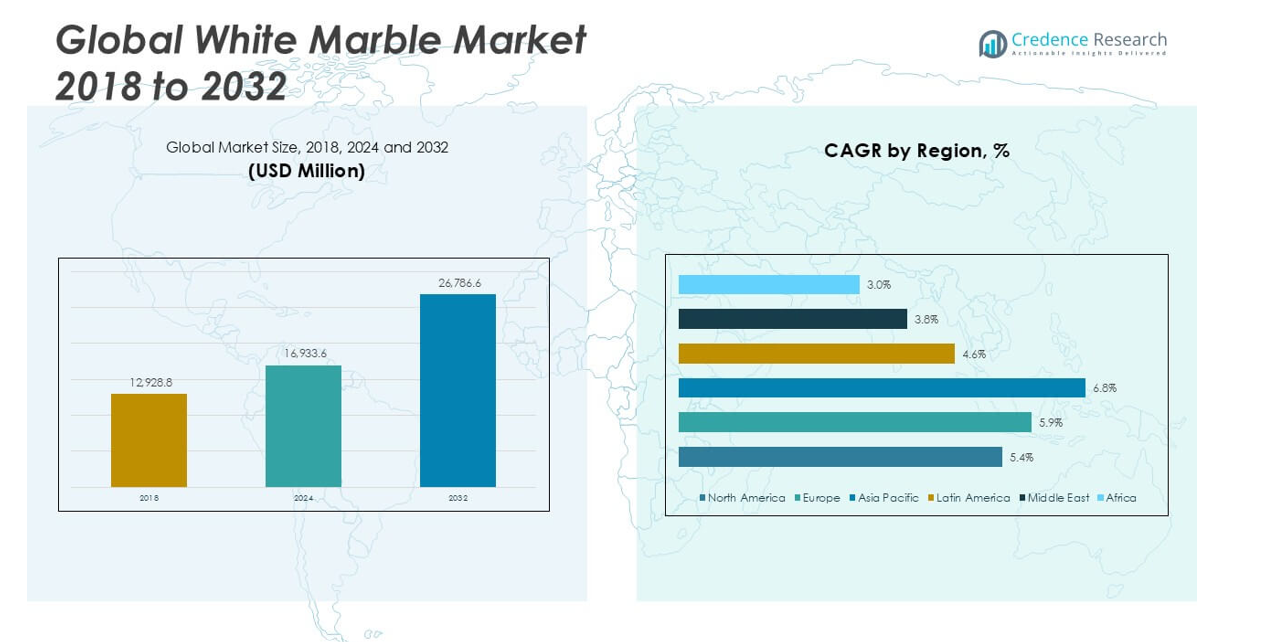
The White Marble market size was valued at USD 12,928.8 million in 2018, reached USD 16,933.6 million in 2024, and is anticipated to reach USD 26,786.6 million by 2032, at a CAGR of 5.90% during the forecast period.
Top players in the White Marble market include Levantina y Asociados de Minerales S.A., Polycor Inc., Antolini Luigi & C. S.p.A., Fox Marble Holdings plc, Temmer Marble, and R.K. Marbles India, each recognized for their extensive product portfolios and advanced processing capabilities. These companies maintain strong competitive positions through a focus on quality, innovation, and strategic partnerships across global markets. Asia Pacific emerges as the leading region, accounting for 39.2% of the global market share in 2024, driven by rapid urbanization, infrastructure development, and rising demand for luxury construction materials in countries such as China and India. Europe and North America follow, benefiting from established construction sectors and a long-standing tradition of marble usage in architectural and decorative applications.
Market Insights
- The White Marble market is projected to grow from USD 16,933.6 million in 2024 to USD 26,786.6 million by 2032, reflecting a CAGR of 5.90%.
- Rising demand from the construction and luxury interior design sectors serves as a key market driver, with natural marble leading the type segment by holding over 70% market share.
- Market trends highlight a growing preference for sustainable materials and increasing adoption of advanced marble processing technologies, enhancing product quality and customization.
- The competitive landscape features global players such as Levantina y Asociados de Minerales S.A., Polycor Inc., and R.K. Marbles India, while high costs of natural marble and strict environmental regulations present major restraints.
- Asia Pacific dominates with a 39.2% market share in 2024, followed by Europe at 26.8% and North America at 19.3%, with construction and decoration applications accounting for more than 60% of the total market.
Market Segmentation Analysis:
By Type:
The White Marble market is segmented into natural marble and artificial marble. Natural marble holds the dominant market share, accounting for over 70% of the segment in 2024. Its popularity stems from its superior aesthetic appeal, unique veining, and high durability, which make it highly sought after for luxury architectural projects. The strong consumer preference for authentic stone in both residential and commercial spaces continues to drive demand for natural marble, while artificial marble sees growth due to cost-effectiveness and ease of installation in budget-sensitive applications.
- For instance, Levantina y Asociados de Minerales S.A. operates 40 active quarries worldwide and processes over 2 million square meters of marble annually, including its signature Blanco Macael marble, which was supplied in 33,000 square meters for the Sheikh Zayed Grand Mosque in Abu Dhabi.
By Application:
Within the application segment, construction and decoration represent the dominant sub-segment, capturing more than 60% of the market share in 2024. The extensive use of white marble in flooring, wall cladding, and facades in both new and renovation projects drives this dominance. Demand is fueled by the material’s timeless appearance, versatility, and association with premium design. Statuary & monuments, as well as furniture applications, continue to grow steadily, supported by the expanding luxury real estate and art sectors.
- For instance, Polycor Inc. provided 3,000 metric tons of white marble for the Saint Patrick’s Cathedral restoration in New York, showcasing the material’s importance in historic and large-scale architectural projects.
Market Overview
Rising Demand from the Construction Sector
The construction and real estate industries drive significant growth in the white marble market. Increasing investments in commercial and residential infrastructure projects boost the demand for premium materials such as white marble for flooring, wall cladding, and decorative purposes. Urbanization and consumer preference for aesthetically pleasing interiors further propel market expansion, making white marble a preferred choice for luxury developments and iconic architectural projects worldwide.
- For instance, R.K. Marbles India supplied over 1.5 million square feet of white marble in 2023 for luxury hotels and commercial projects in India and the Middle East, demonstrating the sector’s substantial consumption.
Expansion of Luxury Interior Design Applications
The growing trend of luxury interior design acts as a major driver for the white marble market. High-end residential and hospitality projects frequently specify white marble for countertops, bathrooms, and feature walls due to its elegant appearance and unique natural patterns. Demand is particularly strong in emerging economies, where rising disposable incomes and exposure to global design trends encourage the adoption of white marble in both new construction and renovation projects.
- For instance, Antolini Luigi & C. S.p.A. delivered 2,500 customized marble kitchen countertops and vanities to residential projects across Europe in 2022, emphasizing the rising integration of marble in interiors.
Technological Advancements in Marble Processing
Innovations in quarrying and processing technologies contribute to market growth by improving extraction efficiency, reducing waste, and enabling the production of larger, more uniform slabs. Advanced cutting and finishing techniques enhance product quality and customization options, catering to diverse architectural requirements. These technological improvements reduce production costs and increase the accessibility of high-quality white marble for a broader range of applications.
Key Trends & Opportunities
Growing Preference for Sustainable and Recycled Materials
A notable trend in the white marble market is the rising demand for sustainable and recycled materials. Consumers and developers are increasingly focused on minimizing the environmental impact of construction, leading to greater use of engineered and composite marble products that offer similar aesthetics to natural marble while reducing quarrying activity. This shift presents opportunities for manufacturers to innovate and develop eco-friendly product lines.
- For instance, Fox Marble Holdings plc implemented a waste recycling initiative in Kosovo that processes 400 tonnes of marble offcuts each year, converting them into composite materials for green construction.
Expansion of Online Sales Channels
The proliferation of digital platforms and e-commerce is transforming the distribution landscape of the white marble market. Manufacturers and distributors now leverage online channels to showcase their products to a global audience, streamlining the purchasing process for designers, contractors, and end-users. This trend enhances market accessibility and opens new growth avenues, particularly in regions with limited traditional distribution networks.
- For instance, Dimpomar – Rochas Port. Lda’s online stone catalog facilitated the sale and shipment of more than 1,200 marble slabs internationally in 2023, streamlining global customer engagement and order fulfillment.
Key Challenges
High Cost of Natural Marble and Installation
The premium price of natural white marble, combined with substantial installation costs, remains a key challenge for market growth. Many budget-conscious consumers and developers opt for alternative materials such as artificial marble or ceramic tiles that mimic the look of natural stone at a lower cost. This price sensitivity limits the penetration of natural marble in mass-market construction and renovation projects.
Environmental Concerns and Regulatory Restrictions
Stringent environmental regulations governing marble quarrying and processing present a significant challenge for market participants. Concerns over land degradation, water usage, and waste management require companies to invest in sustainable practices and compliance measures. Adhering to these regulations often increases operational costs and can restrict production capacity, impacting the overall market supply.
Fluctuations in Raw Material Supply
Volatility in the availability of high-quality raw marble presents an ongoing challenge for industry players. Seasonal disruptions, geopolitical factors, and resource depletion in key quarrying regions can result in supply shortages and price instability. These fluctuations affect long-term planning for manufacturers and can hinder timely project execution for end-users.
Regional Analysis
North America
North America accounted for approximately 19.3% of the global white marble market share in 2024, with a market size rising from USD 2,689.2 million in 2018 to USD 3,268.2 million in 2024. The market is expected to reach USD 4,687.6 million by 2032, registering a CAGR of 5.4%. The region benefits from robust demand in commercial real estate, luxury residential projects, and renovation activities. Technological advancements and a strong preference for natural stone in interior décor continue to fuel steady growth across the United States and Canada.
Europe
Europe held about 26.8% of the market share in 2024, with its market size expanding from USD 3,607.1 million in 2018 to USD 4,538.2 million in 2024. The market is projected to reach USD 6,589.5 million by 2032, reflecting a CAGR of 5.9%. The region’s long-standing tradition of marble usage in architecture, coupled with increasing investment in restoration and heritage projects, underpins its growth. Demand for premium materials in luxury construction and a mature interior design sector further strengthen Europe’s position in the global white marble market.
Asia Pacific
Asia Pacific leads the global white marble market with a 39.2% share in 2024, growing from USD 4,861.2 million in 2018 to USD 6,638.0 million in 2024. The region is forecast to achieve USD 11,571.8 million by 2032 at a robust CAGR of 6.8%. Rapid urbanization, infrastructure development, and expanding middle-class populations in China and India drive significant demand. The use of white marble in high-rise buildings, luxury hotels, and residential complexes cements Asia Pacific’s status as the dominant regional market.
Latin America
Latin America represents around 4.9% of the white marble market share in 2024, advancing from USD 543.0 million in 2018 to USD 829.7 million in 2024. The market is anticipated to reach USD 1,473.3 million by 2032, growing at a CAGR of 4.6%. Regional growth is supported by rising investment in hospitality, commercial centers, and urban infrastructure projects. Increased adoption of marble in decorative applications and new residential developments continues to support moderate but steady market expansion in countries like Brazil and Mexico.
Middle East
The Middle East contributed approximately 6.5% of the global market share in 2024, with the market size moving from USD 788.7 million in 2018 to USD 1,100.7 million in 2024. Expected to reach USD 1,821.5 million by 2032, the market registers a CAGR of 3.8%. Growth is propelled by high-profile real estate projects, luxury hotels, and ongoing urban development. The region’s demand for white marble in monumental architecture and upscale commercial buildings remains strong despite economic volatility.
Africa
Africa accounted for 3.3% of the market share in 2024, with the market expanding from USD 439.6 million in 2018 to USD 558.8 million in 2024. Projected to reach USD 642.9 million by 2032, the region will grow at a CAGR of 3.0%. Growth is primarily driven by public infrastructure upgrades and emerging demand in urban centers. The adoption of white marble in residential and commercial construction is increasing, although budget constraints and limited production capacities temper overall market progress.
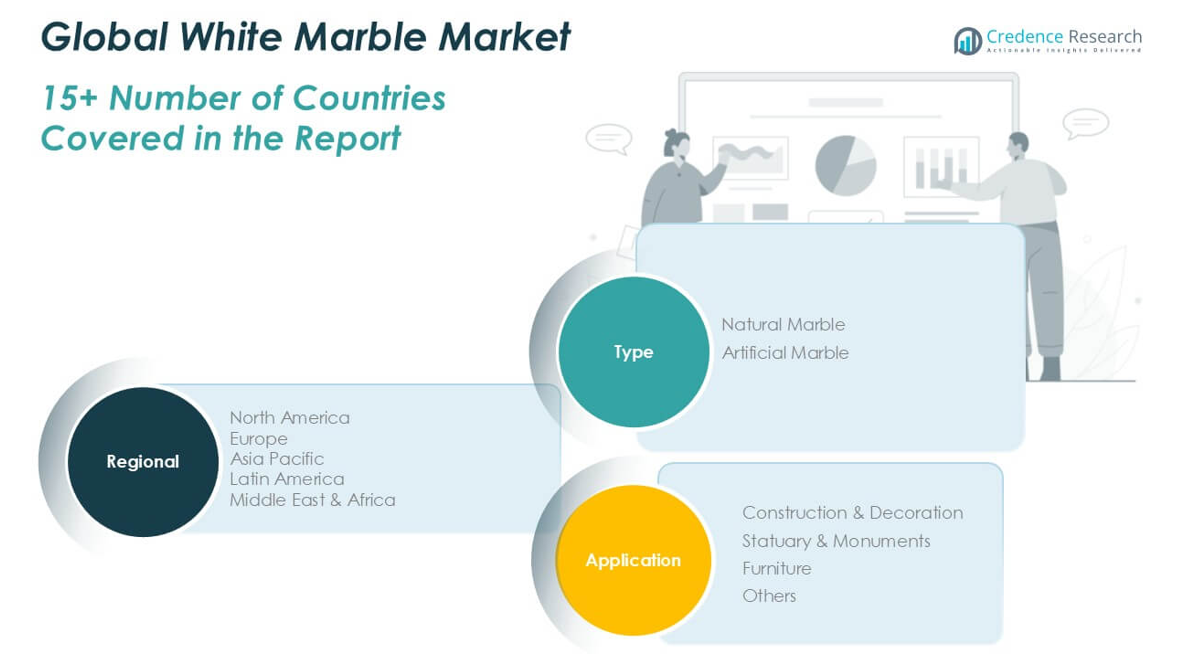
Market Segmentations:
By Type:
- Natural Marble
- Artificial Marble
By Application:
- Construction & Decoration
- Statuary & Monuments
- Furniture
- Others
By Geography:
- North America
- U.S.
- Canada
- Mexico
- Europe
- Germany
- France
- U.K.
- Italy
- Spain
- Rest of Europe
- Asia Pacific
- China
- Japan
- India
- South Korea
- South-east Asia
- Rest of Asia Pacific
- Latin America
- Brazil
- Argentina
- Rest of Latin America
- Middle East & Africa
- GCC Countries
- South Africa
- Rest of the Middle East and Africa
Competitive Landscape
The competitive landscape of the White Marble market is characterized by the presence of both international and regional players, each striving to capture a larger share through product innovation, quality enhancement, and expansion of distribution networks. Key companies such as Levantina y Asociados de Minerales S.A., Polycor Inc., Antolini Luigi & C. S.p.A., Fox Marble Holdings plc, and Temmer Marble maintain their market positions by offering diverse product portfolios and leveraging advanced extraction and processing technologies. Leading manufacturers invest in marketing strategies to strengthen brand recognition and target high-growth segments such as luxury construction, interior decoration, and monumental architecture. Collaboration with architects, designers, and contractors further extends market reach and fosters long-term client relationships. Meanwhile, regional players like R.K. Marbles India and Marble Egypt compete on cost efficiency and localized customer support. The market continues to witness mergers, acquisitions, and strategic alliances as companies seek to expand their global footprint and improve operational capabilities.
Key Player Analysis
- Levantina y Asociados de Minerales S.A.
- Polycor Inc.
- Antolini Luigi & C. S.p.A.
- Fox Marble Holdings plc
- Temmer Marble
- R.K. Marbles India
- Dimpomar - Rochas Port. Lda
- NAMCO
- Hellenic Granite Company
- Mármoles Serrat S.A.
- Topalidis S.A.
- Marmi Scala Srl
- Onyx Marble
- Marble Egypt
Recent Developments
- In June 2025, Levantina Group showcased its expanded portfolio of natural stones, including white marble, and introduced a new integrated business model. This model streamlines logistics, centralizes offerings, and enhances quality control, making Levantina a comprehensive supplier for large-scale projects. The company also highlighted ongoing innovations in its Techlam sintered surfaces, which complement their marble range for modern applications in kitchens, bathrooms, and facades.
- In April 2023, ECO Buildings Group Limitedagreed to pay 30 million pounds for Fox Marble Holdings PLC.
Market Concentration & Characteristics
The White Marble Market displays moderate to high market concentration, with several leading international players dominating global supply and a large number of regional producers catering to local and niche demands. It is characterized by a blend of consolidated control among major companies such as Levantina y Asociados de Minerales S.A., Polycor Inc., Antolini Luigi & C. S.p.A., and Temmer Marble, alongside significant competition from regional firms like R.K. Marbles India and Marble Egypt. The market emphasizes quality, aesthetics, and unique stone patterns, leading to strong brand differentiation and customer loyalty among established suppliers. Natural marble remains the preferred segment, driven by demand for luxury construction and timeless design, while artificial alternatives attract cost-conscious buyers. The market’s characteristics include high capital requirements for quarrying and processing, established global distribution networks, and a reliance on collaborations with architects, designers, and contractors. It responds dynamically to trends in architecture, sustainability, and interior design, reflecting shifts in consumer preferences and project requirements.
Report Coverage
The research report offers an in-depth analysis based on Type, Application, and Geography. It details leading market players, providing an overview of their business, product offerings, investments, revenue streams, and key applications. Additionally, the report includes insights into the competitive environment, SWOT analysis, current market trends, as well as the primary drivers and constraints. Furthermore, it discusses various factors that have driven market expansion in recent years. The report also explores market dynamics, regulatory scenarios, and technological advancements that are shaping the industry. It assesses the impact of external factors and global economic changes on market growth. Lastly, it provides strategic recommendations for new entrants and established companies to navigate the complexities of the market.
Future Outlook
- Growth will accelerate through increased use of white marble in smart city and infrastructure projects.
- Manufacturers will expand eco-friendly production by adopting water recycling and waste reduction practices.
- Demand for engineered and composite marble will rise, offering aesthetic appeal with sustainable credentials.
- Strong partnerships with global architects and designers will open opportunities in premium construction.
- Digital platforms and virtual showrooms will transform sales and broaden market reach.
- Technological innovation in robotics and AI will enhance precision and reduce manufacturing costs.
- Customization options, including tailored sizes and finishes, will gain prominence among luxury consumers.
- Regions such as Southeast Asia and the Middle East will register higher growth due to urban expansion.
- Investment in quarry automation and novel extraction techniques will improve slab yield and quality.
- Industry consolidation through mergers and acquisitions will reshape competitive dynamics and distribution strength.

Request a Free Sample
Fill in your details and we'll send you a free sample report.
- Sample data tables & charts
- Research methodology
Market Dynamics
Expansion in Construction and Real Estate
Significant investments in commercial and residential infrastructure, especially in emerging economies, are boosting the demand for premium materials like white marble for flooring, wall cladding, and decorative applications.
Growth of Luxury Interior Design
The increasing trend toward luxury interiors in both residential and hospitality sectors is driving the use of white marble for countertops, bathrooms, and feature walls, particularly in regions with rising disposable incomes.
Technological Advancements in Marble Processing
Innovations in quarrying, cutting, and finishing technologies are improving extraction efficiency, reducing waste, and enabling the production of higher-quality, customized marble slabs, making white marble more accessible for diverse applications.
Preference for Sustainable and Recycled Materials
Growing environmental awareness is leading to increased adoption of engineered and composite marble products, as well as sustainable quarrying practices, opening new market opportunities for eco-friendly offerings.
Digitalization and Online Sales Channels
The rise of digital platforms and e-commerce is transforming the distribution landscape, allowing manufacturers and distributors to reach a global customer base and streamline the purchasing process for designers and contractors.
Need a Custom Version of This Report?
Tailor the scope, geography, or segments to your exact requirements.
- Custom geography or segment scope
- Direct access to our analyst team
Frequently Asked Questions
What is the current size of the White Marble Market?
What factors are driving the growth of the White Marble Market?
What are the key segments within the White Marble Market?
Who are the major players in the White Marble Market?
Table of Content
Chapter 1 Market Segmentation
- 1.1 Segmentation Framework
- 1.1.1 Product and Service Classification
- 1.1.2 Application and End-Use Classification
- 1.1.3 Technology and Solution Classification
- 1.1.4 Customer and Distribution Channel Classification
- 1.1.5 Geographic Segmentation
- 1.1.6 Market Segment Definitions and Boundaries
- 1.2 By Type
- 1.2.1 Natural Marble
- 1.2.2 Artificial Marble
- 1.3 By Application
- 1.3.1 Construction & Decoration
- 1.3.2 Statuary & Monuments
- 1.3.3 Furniture
- 1.3.4 Others
Chapter 2 Introduction
- 2.1 Report Objectives and Scope
- 2.2 Product Definition and Industry Terminology
- 2.3 Market Inclusions and Exclusions
- 2.4 Research Process
- 2.4.1 Primary Research and Expert Interviews
- 2.4.2 Secondary Research and Source Review
- 2.4.3 Top-Down and Bottom-Up Estimation
- 2.4.4 Data Triangulation and Verification
- 2.5 Market Size Measurement Basis
- 2.5.1 2024: USD 16,933.6 million → 2032: USD 26,786.6 million
- 2.6 Historical and Forecast Reference Periods
- 2.6.1 Base Year: 2024
- 2.6.2 Forecast Period: 2024-2032
- 2.7 Research Assumptions and Limitations
Chapter 3 Executive Summary
- 3.1 Market Snapshot and Key Findings
- 3.2 Base-Year Market Size, 2024
- 3.3 Forecast Market Size, 2032
- 3.4 Revenue and Volume Growth Outlook
- 3.5 Key Demand and Supply Indicators
- 3.6 Leading Market Segments
- 3.7 Fastest-Growing Market Opportunities
- 3.8 Regional Performance Highlights
- 3.9 Technology and Industry Transformation
- 3.10 Competitive Landscape Summary
- 3.11 Analyst View and Strategic Implications
Chapter 4 Global White Marble Market Trends and Developments
- 4.1 Historical Industry Development
- 4.2 Recent Market Trends and Developments
- 4.3 Demand and Customer Behavior Trends
- 4.4 Technology and Product Innovation
- 4.5 Artificial Intelligence, Automation and Digitalization
- 4.6 Local Manufacturing and Supply Chain Realignment
- 4.7 Industry Partnerships, Mergers and Acquisitions
- 4.8 Sustainability and Circular Economy Developments
- 4.9 Government and Private Sector Investment Trends
- 4.10 Emerging Business Models and Commercialization
- 4.11 Industry Developments and Announcements
Chapter 5 Global White Marble Market Production, Supply and Demand Analysis
- 5.1 Demand Trend and Consumption Analysis
- 5.2 Demand Forecast, 2024-2032
- 5.3 Production and Output Trend
- 5.4 Production and Output Forecast, 2024-2032
- 5.5 Installed Capacity and Capacity Utilization
- 5.6 Company-Wise Production Plants and Statistics
- 5.6.1 Installed Production Capacity
- 5.6.2 Actual Production
- 5.6.3 Planned Capacity and Expansion Targets
- 5.7 Supply Chain Structure and Procurement Trends
- 5.8 Supply-Demand Gap and Bottlenecks
- 5.9 Import Dependence and Sourcing Structure
- 5.10 Contract Manufacturing and Outsourcing
- 5.11 Regional Supply and Demand Concentration
Chapter 6 Global White Marble Market Pricing Analysis
- 6.1 Pricing Structure and Measurement
- 6.2 Historical Pricing Trends
- 6.3 Pricing Outlook, 2024-2032
- 6.4 Average Selling Price and Unit Economics
- 6.5 Pricing by Product and Market Segment
- 6.6 Geographic Pricing Differences
- 6.7 Key Input, Energy, Labor and Logistics Costs
- 6.8 Contract Pricing and Purchasing Models
- 6.9 Pricing Sensitivity and Competitive Positioning
- 6.10 Price, Margin and Profitability Implications
Chapter 7 Global White Marble Market Dynamics
- 7.1 Market Growth Drivers
- 7.1.1 Demand-Side Drivers
- 7.1.2 Technology and Innovation Drivers
- 7.1.3 Infrastructure and Investment Drivers
- 7.1.4 Regulatory and Policy Drivers
- 7.2 Market Restraints
- 7.2.1 Cost and Affordability Constraints
- 7.2.2 Technology and Adoption Barriers
- 7.2.3 Supply Chain and Operational Constraints
- 7.3 Market Challenges
- 7.3.1 Competitive Pressure and Margin Erosion
- 7.3.2 Skills, Infrastructure and Implementation Gaps
- 7.4 Emerging Market Opportunities
- 7.5 Market Dynamics Impact and Time-Horizon Assessment
Chapter 8 Global White Marble Value Chain Analysis
- 8.1 Industry Value Chain Overview
- 8.2 Upstream Suppliers and Critical Inputs
- 8.3 Technology and Component Providers
- 8.4 Manufacturing or Service Delivery
- 8.5 Distribution, Channel Partners and Integrators
- 8.6 Downstream Applications and End Users
- 8.7 Value Addition and Profit Pools
- 8.8 Vertical Integration and Outsourcing
- 8.9 Supplier Concentration and Risk
- 8.10 Supply Chain Localization and Resilience
Chapter 9 Global White Marble Market Regulations and Policies
- 9.1 Relevant Laws, Standards and Compliance Frameworks
- 9.2 Product, Service, Safety and Quality Requirements
- 9.3 Government Policies, Incentives and Subsidies
- 9.4 Imports, Exports and Trade Barriers
- 9.5 Public Procurement and Local Content Requirements
- 9.6 Environmental and Sustainability Compliance
- 9.7 Upcoming Policy Changes and Market Implications
Chapter 10 Global White Marble Market Hotspots and Opportunities
- 10.1 Market Opportunity Mapping and Growth Hotspots
- 10.2 High-Growth Applications and Customer Groups
- 10.3 Underserved Markets and White-Space Opportunities
- 10.4 Emerging Technology and Product Opportunities
- 10.5 New Capacity and Investment Hotspots
- 10.6 Market Entry and Expansion Opportunities
- 10.7 Distribution and Partnership Opportunities
- 10.8 Near-Term and Long-Term Commercial Potential
- 10.9 Opportunity Attractiveness and Execution Risks
Chapter 11 Global White Marble Market Outlook, 2024-2032
- 11.1 Market Size and Analysis
- 11.1.1 Revenue (Market Measurement: 2024: USD 16,933.6 million → 2032: USD 26,786.6 million)
- 11.1.2 Market Volume and Quantity Sold
- 11.1.3 Historical Market Size
- 11.1.4 Base-Year Market Size, 2024
- 11.2 Market Forecast, 2024-2032
- 11.2.1 Revenue Forecast to 2032
- 11.2.2 Volume Forecast to 2032
- 11.2.3 CAGR and Year-on-Year Growth
- 11.2.4 Incremental Revenue Opportunity
- 11.3 Forecast Assumptions and Scenario Analysis
- 11.3.1 Base-Case Forecast
- 11.3.2 Optimistic and Conservative Scenarios
- 11.3.3 Technology, Pricing and Policy Sensitivities
- 11.4 Market Attractiveness and Growth Outlook
Chapter 12 Global White Marble Market Segmentation and Outlook
- 12.1 Segmentation Summary and Market Shares, 2024
- 12.2 Largest and Fastest-Growing Segments
- 12.3 By Type - Market Size and Forecast, 2024-2032
- 12.3.1 Segment Definition and Scope
- 12.3.2 Historical Market Size
- 12.3.3 Revenue Forecast, 2024-2032
- 12.3.4 Volume Forecast, 2024-2032
- 12.3.5 Base-Year Market Share, 2024
- 12.3.6 Segment CAGR and Growth Drivers
- 12.3.7 Subsegment Market Size and Forecast
- 12.3.7.1 Natural Marble
- 12.3.7.2 Artificial Marble
- 12.3.8 Subsegment Pricing and Adoption Trends
- 12.3.9 Leading Suppliers and Competition
- 12.3.10 Regional Demand and Opportunities
- 12.4 By Application - Market Size and Forecast, 2024-2032
- 12.4.1 Segment Definition and Scope
- 12.4.2 Historical Market Size
- 12.4.3 Revenue Forecast, 2024-2032
- 12.4.4 Volume Forecast, 2024-2032
- 12.4.5 Base-Year Market Share, 2024
- 12.4.6 Segment CAGR and Growth Drivers
- 12.4.7 Subsegment Market Size and Forecast
- 12.4.7.1 Construction & Decoration
- 12.4.7.2 Statuary & Monuments
- 12.4.7.3 Furniture
- 12.4.7.4 Others
- 12.4.8 Subsegment Pricing and Adoption Trends
- 12.4.9 Leading Suppliers and Competition
- 12.4.10 Regional Demand and Opportunities
- 12.5 Segment Growth Comparison
- 12.6 Segment Attractiveness and Priority Matrix
Chapter 13 Global White Marble End-Use and Application Market Outlook
- 13.1 End-Use Industry and Customer Demand Structure
- 13.2 Leading Applications and Customer Groups
- 13.3 End-Use Market Size, Share and Forecast
- 13.4 Major End-Use Industry Deep Dives
- 13.4.1 Customer Requirements and Use Cases
- 13.4.2 Demand and Replacement Cycles
- 13.4.3 Technical and Regulatory Considerations
- 13.4.4 Purchasing and Procurement Models
- 13.4.5 Leading Vendors and Distribution Channels
- 13.4.6 Forecast and Commercial Opportunities
- 13.5 Emerging Applications and Cross-Segment Demand
- 13.6 End-Use Industry Investment Priorities
Chapter 14 Global White Marble Geographic Market Outlook, 2024-2032
- 14.1 Regional Market Size and Share, 2024
- 14.2 Regional Market Forecast, 2024-2032
- 14.3 Regional Pricing, Production and Demand Differences
- 14.4 North America
- 14.4.1 United States
- 14.4.2 Canada
- 14.4.3 Mexico
- 14.5 Europe
- 14.5.1 Germany
- 14.5.2 France
- 14.5.3 Italy
- 14.5.4 United Kingdom
- 14.5.5 Spain
- 14.5.6 Poland
- 14.5.7 Russia
- 14.5.8 Netherlands
- 14.5.9 Belgium
- 14.5.10 Sweden
- 14.5.11 Denmark
- 14.5.12 Norway
- 14.5.13 Rest of Europe
- 14.6 Asia Pacific
- 14.6.1 China
- 14.6.2 India
- 14.6.3 Japan
- 14.6.4 South Korea
- 14.6.5 Thailand
- 14.6.6 Indonesia
- 14.6.7 Vietnam
- 14.6.8 Malaysia
- 14.6.9 Australia
- 14.6.10 Rest of Asia Pacific
- 14.7 Latin America
- 14.7.1 Brazil
- 14.7.2 Argentina
- 14.7.3 Colombia
- 14.7.4 Chile
- 14.7.5 Rest of Latin America
- 14.8 Middle East
- 14.8.1 Saudi Arabia
- 14.8.2 United Arab Emirates
- 14.8.3 Turkey
- 14.8.4 Israel
- 14.8.5 Iran
- 14.8.6 Rest of the Middle East
- 14.9 Africa
- 14.9.1 South Africa
- 14.9.2 Egypt
- 14.9.3 Nigeria
- 14.9.4 Morocco
- 14.9.5 Rest of Africa
- 14.10 Regional Investment, Policy and Supply Chain Differences
- 14.11 Regional Competitive Landscape
- 14.12 Geographic Growth Hotspots
Chapter 15 Global White Marble Technology, Innovation and Sustainability Outlook
- 15.1 Technology Landscape and Maturity
- 15.2 Product, Process and Service Innovation
- 15.3 AI, Automation and Digital Tools in the Industry
- 15.4 Technology Adoption and Performance Benchmarking
- 15.5 Innovation Pipeline and R&D Investment
- 15.6 Patent and Intellectual Property Trends
- 15.7 Energy Efficiency and Resource Management
- 15.8 Sustainability, Recycling and Circularity
- 15.9 Technology Roadmap, 2024-2032
- 15.10 Risks of Obsolescence and Technology Substitution
Chapter 16 Global White Marble Market Key Strategic Imperatives
- 16.1 Growth and Market Entry Priorities
- 16.2 High-Return Products and Segments
- 16.3 Pricing, Profitability and Cost Optimization
- 16.4 Technology Investment and Product Differentiation
- 16.5 Supply Chain Localization and Resilience
- 16.6 Distribution and Customer Acquisition
- 16.7 Partnership, Acquisition and Capacity Strategy
- 16.8 Regional Expansion Priorities
- 16.9 Short-, Medium- and Long-Term Actions
Chapter 17 Competition Outlook
- 17.1 Industry Competition Characteristics
- 17.2 Market Structure and Concentration
- 17.3 Market Share and Competitive Positioning, 2024
- 17.4 Company-Wise Revenue and Product Benchmarking
- 17.5 Production and Service Capacity Benchmarking
- 17.6 Technology, Pricing and Differentiation
- 17.7 Regional Footprint and Distribution Strength
- 17.8 Mergers, Acquisitions and Strategic Alliances
- 17.9 New Entrants and Competitive Threats
- 17.10 Porter's Five Forces and Industry Attractiveness
- 17.11 Competitive Outlook, 2024-2032
Chapter 18 Company Profiles
- 18.1 Company Coverage and Selection Criteria
- 18.2 Levantina y Asociados de Minerales S.A.
- 18.2.1 Business Description
- 18.2.2 Company Ownership and Geographic Presence
- 18.2.3 Product and Service Portfolio
- 18.2.4 Manufacturing and Operating Footprint
- 18.2.5 Production Capacity and Expansion Plans
- 18.2.6 Financial Performance and Investment
- 18.2.7 Market Share and Competitive Position
- 18.2.8 Technology and Innovation Capabilities
- 18.2.9 Strategic Alliances or Partnerships
- 18.2.10 Recent Developments
- 18.2.11 Growth Strategy and Outlook
- 18.3 Polycor Inc.
- 18.4 Antolini Luigi & C. S.p.A.
- 18.5 Fox Marble Holdings plc
- 18.6 Temmer Marble
- 18.7 R.K. Marbles India
- 18.8 Dimpomar - Rochas Port. Lda
- 18.9 NAMCO
- 18.10 Hellenic Granite Company
- 18.11 Marble Egypt
- 18.12 Other Relevant Market Participants
Note: Every listed company is profiled on the structure shown under the first company. The company list is preliminary and may change based on research findings, market developments, data availability and client requirements.
Chapter 19 Disclaimer
- 19.1 Research and Forecast Disclaimer
- 19.2 Data Source and Estimation Limitations
Note: The depth of individual sections depends on data availability for this market. Volume, capacity, trade and other unit-based metrics are included where applicable.

