| REPORT ATTRIBUTE |
DETAILS |
| Historical Period |
2019-2022 |
| Base Year |
2023 |
| Forecast Period |
2024-2032 |
| AI in Social Media Market Size 2023 |
USD 2,425.10 Million |
| AI in Social Media Market, CAGR |
35.52% |
| AI in Social Media Market Size 2032 |
USD 27,482.70 Million |
Market Overview:
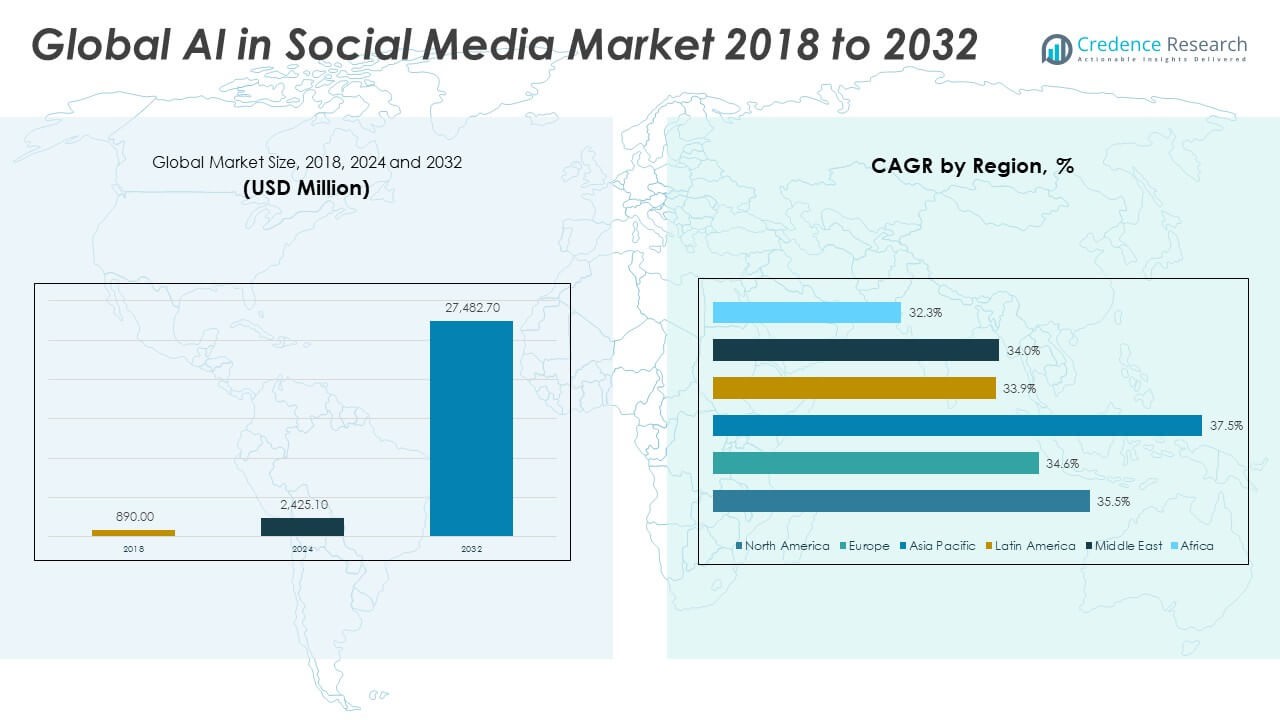
The Global AI in Social Media Market size was valued at USD 890.00 million in 2018 to USD 2,425.10 million in 2024 and is anticipated to reach USD 27,482.70 million by 2032, at a CAGR of 35.52% during the forecast period.
Several core factors are fueling the growth of the AI in Social Media Market. First and foremost is the exponential increase in social media content, which has necessitated advanced tools for content moderation, trend detection, and engagement analytics. AI algorithms enable platforms to rapidly detect hate speech, misinformation, and inappropriate content, improving safety and compliance while reducing human intervention. At the same time, brands are using AI to craft more relevant and engaging customer experiences, utilizing predictive analytics, chatbots, and recommendation engines to deliver real-time personalization. This results in higher conversion rates and improved return on investment (ROI) for digital marketing campaigns. Furthermore, AI-powered tools such as intelligent video editing, automated captioning, and synthetic media generation are becoming mainstream, empowering content creators and influencers to produce professional-grade media at lower costs. The rise of generative AI has further accelerated this trend, enabling dynamic content creation tailored to individual user preferences. Additionally, advancements in AI technology—such as transformer-based language models and multimodal learning—are pushing the boundaries of what’s possible in social listening, influencer marketing, and consumer sentiment forecasting.
From a regional perspective, North America dominates the global AI in Social Media Market, accounting for the largest revenue share due to its advanced digital infrastructure, high social media penetration, and concentration of major technology firms. The United States, in particular, leads innovation and implementation, supported by significant investments in AI R&D, favorable regulatory environments, and strong demand from enterprises across industries. Europe follows as the second-largest market, driven by a growing focus on ethical AI deployment, strict data privacy regulations (such as GDPR), and increasing adoption of AI tools by businesses to improve digital customer engagement. The Asia-Pacific region is emerging as a high-growth area, with countries like China, India, South Korea, and Japan rapidly integrating AI technologies into their social commerce and mobile-first marketing ecosystems. A surge in internet users, expanding e-commerce sectors, and government support for AI innovation are key enablers in this region. Additionally, Latin America and the Middle East & Africa are showing growing interest in AI-powered social tools, particularly among small and medium-sized businesses seeking cost-effective ways to reach mobile-centric audiences. As digital transformation continues across all regions, these emerging markets are expected to play an increasingly vital role in shaping the future landscape of AI in social media.
Access crucial information at unmatched prices!
Request your sample report today & start making informed decisions powered by Credence Research Inc.!
Download Sample
Market Insights:
- The Global AI in Social Media Market grew from USD 890.00 million in 2018 to USD 2,425.10 million in 2024 and is projected to reach USD 27,482.70 million by 2032, expanding at a CAGR of 35.52%.
- Rising volumes of user-generated content across platforms are driving adoption of AI tools for moderation, classification, and engagement analytics to enhance safety, speed, and scalability.
- Brands are investing in AI to deliver hyper-personalized experiences and targeted advertising, boosting user engagement, conversion rates, and marketing efficiency across social platforms.
- Advancements in natural language processing, computer vision, and transformer-based models are powering chatbots, sentiment analysis, and content generation, making AI a core function in platform operations.
- Businesses are using AI to drive data-backed decisions through real-time insights, predictive metrics, and behavior analytics, helping refine strategy and improve campaign ROI.
- The market faces challenges related to data privacy regulations, ethical AI practices, and compliance, which increase operational complexity and impact cross-border scalability.
- North America leads the market due to mature infrastructure and investment, while Asia-Pacific is emerging as a key growth region, supported by rising mobile usage and expanding digital commerce.
Market Drivers:
Proliferation of User-Generated Content Necessitates Scalable AI Solutions:
Brands and marketers increasingly prioritize precision in targeting social media audiences. AI enables segmentation of users based on behavior, preferences, and demographics, leading to more relevant and personalized ad placements. The Global AI in Social Media Market is expanding as businesses adopt AI tools to improve click-through rates and campaign outcomes. Real-time analytics and adaptive ad creatives powered by AI allow brands to react quickly to shifting consumer trends. Personalized experiences build customer loyalty and drive higher engagement. It creates a performance-driven advertising environment across both enterprise and small business segments.
- For instance, Meta reported in 2025 that advertisers using its AI-enabled Advantage+ products generated an average of $4.52 in revenue for every dollar spent, a 22% increase compared to traditional campaigns. Advertisers also saw a 9% lower cost per action and a 5% median decrease in cost per result when using AI-driven recommendations.
Rapid Advancements in AI Technologies Enhance Platform Capabilities:
Ongoing improvements in natural language processing, computer vision, and machine learning have transformed what AI can accomplish on social platforms. AI models now power smart chatbots, sentiment analysis tools, automated video editing, and generative content features. The Global AI in Social Media Market advances with the integration of transformer models and neural networks, delivering deeper insights and more responsive systems. Platforms enhance user experience through AI-driven recommendations, predictive search, and voice-based interactions. It increases session duration and platform stickiness while supporting content discovery and user retention. These innovations position AI as a core function rather than an add-on.
- For example, a 2024 academic study found that TikTok’s recommendation algorithm personalizes between 30% and 50% of the first 1,000 videos shown to new users based on their interests and interactions, demonstrating the platform’s sophisticated use of AI for content delivery. The system quickly adapts to user preferences, increasing engagement and content relevance.
Surging Demand for Personalized User Engagement and Targeted Advertising
Brands and marketers increasingly prioritize precision in targeting social media audiences. AI enables segmentation of users based on behavior, preferences, and demographics, leading to more relevant and personalized ad placements. The Global AI in Social Media Market is expanding as businesses adopt AI tools to improve click-through rates and campaign outcomes. Real-time analytics and adaptive ad creatives powered by AI allow brands to react quickly to shifting consumer trends. Personalized experiences build customer loyalty and drive higher engagement. It creates a performance-driven advertising environment across both enterprise and small business segments.
Need for Data-Driven Decision-Making in Social Media Strategy:
Enterprises and marketers rely on actionable insights to refine content strategy, optimize posting times, and evaluate campaign ROI. AI tools provide detailed performance metrics, trend forecasts, and audience analysis, helping businesses make faster and more accurate decisions. The Global AI in Social Media Market addresses the growing reliance on intelligent systems that convert raw data into strategic value. Automated dashboards, visual analytics, and behavior prediction models drive operational efficiency. It enables marketers to align their strategies with audience sentiment and platform algorithms. This capability is crucial in a competitive digital landscape shaped by real-time consumer behavior shifts.
Market Trends:
Integration of Generative AI for Creative Content Development:
Generative AI tools are transforming how content is created on social platforms, offering new ways to automate video production, image generation, and post captioning. These tools support influencers, brands, and agencies in producing high-quality media efficiently. The Global AI in Social Media Market is witnessing strong growth due to the demand for scalable content generation that maintains quality and creativity. AI-generated visuals and texts are being adopted for storytelling, meme creation, and influencer collaborations. It allows platforms to maintain a steady flow of relevant content tailored to diverse user interests. This trend accelerates engagement and improves creative workflows across social media environments.
- For instance, Canva launched Magic Studio in 2024, a suite of AI-powered design tools that enable users to generate images, videos, and presentations from text prompts. The platform, with over 150 million users globally, integrates features like Magic Design, Magic Write, and Magic Media to streamline content creation and editing.
AI-Powered Social Listening and Brand Reputation Management:
Social media users continuously share opinions, reviews, and feedback across platforms. Businesses now employ AI-powered social listening tools to track brand mentions, detect sentiment shifts, and monitor public perception. The Global AI in Social Media Market is evolving to meet the need for real-time, AI-based reputation management tools that deliver early warnings and strategic insights. These tools help brands respond quickly to potential crises, competitor movements, or customer dissatisfaction. It strengthens brand positioning and allows organizations to stay connected to consumer sentiment. Real-time monitoring also enhances customer service response quality and speed.
- For example, Sprout Social’s AI-driven sentiment analysis leverages deep neural networks and language models to process millions of data points in real time, enabling detailed reports on brand mentions, engagement rates, and audience sentiment. These insights help brands anticipate customer needs and optimize engagement strategies.
Expansion of AI Applications in Influencer Marketing Campaigns:
Influencer marketing continues to grow in complexity and scale. AI now plays a critical role in identifying the right influencers, forecasting campaign impact, and measuring ROI. The Global AI in Social Media Market reflects this shift through platforms offering AI-based discovery engines and fraud detection tools. These tools analyze audience authenticity, engagement patterns, and alignment with brand values. It enables brands to invest in more effective partnerships with reduced risk of fake followers or underperforming collaborations. AI also supports content optimization for influencer-led campaigns based on performance metrics and audience response.
Voice and Audio Content Optimization through AI:
Voice search, podcasts, and short-form audio are becoming central to digital communication. AI is now being used to enhance audio quality, transcribe conversations, and recommend voice-driven content. The Global AI in Social Media Market is adapting to this shift by incorporating AI tools that improve accessibility and engagement in audio formats. Smart audio captioning, real-time translation, and voice-based user interfaces are enhancing how users interact with content. It allows platforms to diversify content formats while accommodating different user preferences. This trend supports the growing demand for hands-free and audio-first social media experiences.
Market Challenges Analysis:
Data Privacy Concerns and Regulatory Uncertainty Restrict Market Expansion:
The increasing use of AI in social media raises significant concerns about user data privacy, consent, and algorithmic transparency. Regulatory frameworks such as the General Data Protection Regulation (GDPR) in Europe and similar laws in other regions are placing strict limits on data collection and usage. The Global AI in Social Media Market faces challenges in aligning AI operations with these evolving regulations while still maintaining functionality and personalization. Companies must invest in compliance infrastructure, secure data storage, and ethical AI practices to meet legal standards. It creates added operational costs and complexity for businesses deploying AI at scale. Uncertainty surrounding future legislation makes long-term strategic planning difficult, particularly for multinational platforms.
Bias in Algorithms and Dependence on Data Quality Impact Outcomes:
AI models used in social media depend heavily on the quality and diversity of the data they are trained on. Poor data inputs, including biased or incomplete datasets, can lead to skewed outputs that negatively affect user experience and brand integrity. The Global AI in Social Media Market must address concerns around algorithmic bias, which can reinforce stereotypes or exclude certain user groups. Ensuring fairness and inclusivity in AI decision-making remains a difficult task, especially in dynamic and culturally diverse environments. It requires continuous model evaluation, diverse data sampling, and transparent governance frameworks. These challenges can slow adoption rates and reduce stakeholder confidence in AI-driven tools across the social media landscape.
Market Opportunities:
Emergence of Multilingual AI Models to Tap Untapped Demographics:
The rising penetration of social media in non-English speaking regions creates a strong need for multilingual AI solutions. AI models capable of understanding local languages and dialects offer brands access to new markets with culturally relevant content. The Global AI in Social Media Market can expand its footprint by developing tools that support multilingual content moderation, sentiment analysis, and customer engagement. It allows platforms to scale user experiences across linguistically diverse populations. This opportunity also supports localized advertising strategies and enhances inclusivity. Companies that prioritize language diversity will gain competitive advantage in emerging economies.
Adoption of AI in Social Commerce to Drive Revenue Growth:
Social media platforms are evolving into full-scale commerce hubs, merging content with seamless shopping experiences. AI tools that power product recommendations, customer queries, and virtual try-ons are becoming essential to success in this space. The Global AI in Social Media Market stands to benefit from growing demand for intelligent commerce features that enhance conversion rates. It enables brands to automate sales interactions and deliver more personalized customer journeys. Integration of AI with payment systems, inventory data, and purchase behavior will further unlock monetization potential. Businesses that invest in social commerce optimization can access significant revenue streams.
Market Segmentation Analysis:
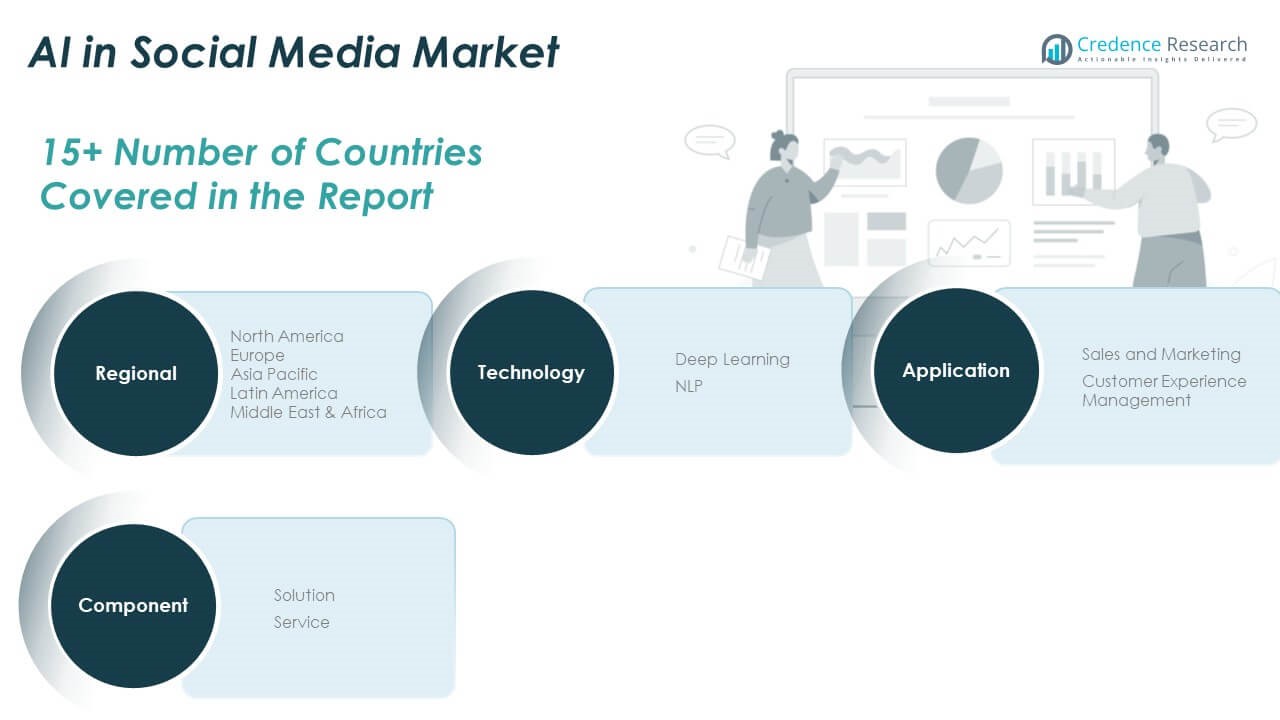
By Technology
The Global AI in Social Media Market is increasingly shaped by two key technologies: Deep Learning and Natural Language Processing (NLP). Deep learning leads the segment due to its strength in handling large volumes of unstructured social media data, powering features such as facial recognition, visual content tagging, and personalized recommendations. NLP plays a critical role in enabling real-time sentiment analysis, automated translation, and chatbot functionality. It supports seamless user interactions across multiple languages and improves platform accessibility.
- For example, TikTok’s recommendation engine utilizes deep learning to personalize between the first 1,000 videos shown to new users, resulting in an average session duration of 95 minutes per user per day and viewed content surfaced by its AI-driven For You Page algorithm.
By Application
Sales and Marketing is the largest application area, where AI enables precise audience targeting, real-time ad optimization, and detailed campaign analytics. It helps marketers understand customer behavior and improve engagement outcomes. Customer Experience Management follows, with AI tools driving proactive user support, behavioral analysis, and social listening. It strengthens platform loyalty and allows brands to deliver tailored responses based on individual user needs and preferences.
- For example, Salesforce’s Einstein AI enabled marketers to achieve increase in email engagement and improvement in conversion rates through optimized send times and content recommendations, while Sprout Social’s AI-powered sentiment analysis processed millions of data points in real time to provide actionable insights for brand engagement and reputation management.
By Component
The Solution segment dominates the market as companies deploy AI-based software for analytics, recommendation engines, and workflow automation. These tools integrate directly into social media platforms to enhance performance and decision-making. The Service segment is growing steadily, driven by demand for implementation, maintenance, and advisory support. It ensures the effective deployment of AI tools and aligns them with business objectives. The Global AI in Social Media Market reflects a growing focus on scalable, intelligent systems that enhance user experience and business outcomes.
Segmentation:
By Technology
- Deep Learning
- Natural Language Processing (NLP)
By Application
- Sales and Marketing
- Customer Experience Management
By Component
By Region
- North America
- Europe
- Asia Pacific
- Latin America
- Middle East
- Africa
Regional Analysis:
North America
The North America AI in Social Media Market size was valued at USD 358.05 million in 2018 to USD 964.93 million in 2024 and is anticipated to reach USD 10,921.67 million by 2032, at a CAGR of 35.5% during the forecast period. North America holds the largest share of the Global AI in Social Media Market, driven by widespread digital maturity and strong AI integration across platforms. The United States leads in innovation, with major players like Meta, Microsoft, and Google advancing AI adoption for content moderation, ad optimization, and user personalization. The region benefits from early enterprise adoption, high social media penetration, and advanced infrastructure. It also leverages significant R&D investments and a supportive regulatory environment. Brands rely on AI for campaign analysis, predictive engagement, and automation to improve ROI. North America remains the global leader in social media AI deployment.
Europe
The Europe AI in Social Media Market size was valued at USD 252.05 million in 2018 to USD 661.99 million in 2024 and is anticipated to reach USD 7,116.72 million by 2032, at a CAGR of 34.6% during the forecast period. Europe is the second-largest regional market, shaped by a strong commitment to ethical AI, data protection, and transparent algorithms. Countries like Germany, the UK, and France show high adoption of AI-powered analytics, customer support, and automated publishing. The Global AI in Social Media Market benefits from the region’s advanced regulatory environment, particularly the GDPR, which influences AI implementation practices. Businesses apply AI to drive customer experience while ensuring data compliance. It enables platforms to balance innovation with accountability. Growing use of multilingual AI and cross-platform tools supports Europe’s consistent market expansion.
Asia Pacific
The Asia Pacific AI in Social Media Market size was valued at USD 182.01 million in 2018 to USD 522.24 million in 2024 and is anticipated to reach USD 6,645.34 million by 2032, at a CAGR of 37.5% during the forecast period. Asia Pacific is the fastest-growing region in the Global AI in Social Media Market, fueled by large digital populations and strong mobile adoption. China, India, Japan, and South Korea are leading the charge with advanced AI applications in content generation, influencer analytics, and social commerce. Government-backed AI initiatives and public-private partnerships strengthen regional competitiveness. It reflects rapid growth in platform personalization, localized content moderation, and smart advertising tools. Startups and major tech firms drive innovation across diverse languages and user behaviors. The region holds high potential for long-term AI-driven transformation.
Latin America
The Latin America AI in Social Media Market size was valued at USD 43.52 million in 2018 to USD 117.11 million in 2024 and is anticipated to reach USD 1,202.92 million by 2032, at a CAGR of 33.9% during the forecast period. Latin America is showing strong upward momentum in AI adoption, particularly in digital marketing and customer service. Brazil and Mexico lead regional growth with increasing use of AI tools for content scheduling, audience analytics, and ad performance. The Global AI in Social Media Market in this region benefits from expanding digital access and mobile-first engagement. It also reflects growing interest from SMEs using AI for efficiency and reach. Local businesses are applying AI to personalize user journeys and boost engagement. Language-specific tools and cultural adaptation are key success factors in this market.
Middle East
The Middle East AI in Social Media Market size was valued at USD 36.67 million in 2018 to USD 94.08 million in 2024 and is anticipated to reach USD 970.29 million by 2032, at a CAGR of 34.0% during the forecast period. The Middle East is emerging as a significant market for AI in social media, supported by national AI strategies and smart city initiatives in countries like the UAE and Saudi Arabia. Businesses across retail, government, and tourism sectors are adopting AI to manage digital engagement and optimize communication. The Global AI in Social Media Market benefits from government-led innovation and increasing digital literacy. It supports regional efforts in sentiment analysis, customer feedback, and social monitoring. AI-enabled platforms help strengthen public outreach and commercial branding. Market momentum is building through strategic tech investments.
Africa
The Africa AI in Social Media Market size was valued at USD 17.71 million in 2018 to USD 64.76 million in 2024 and is anticipated to reach USD 625.76 million by 2032, at a CAGR of 32.3% during the forecast period. Africa holds emerging potential in the Global AI in Social Media Market, supported by growing connectivity and a youthful digital user base. Nigeria, South Africa, and Egypt are leading early adoption efforts with localized AI tools for content engagement and customer interaction. Startups and telecom providers are driving innovation in chatbots, campaign automation, and analytics. It reflects a growing demand for cost-effective, scalable solutions that enhance user experience. Rising mobile use and social commerce trends support gradual AI expansion. Africa presents a long-term growth opportunity as digital infrastructure continues to improve.
Shape Your Report to Specific Countries or Regions & Enjoy 30% Off!
Key Player Analysis:
- Salesforce, Inc.
- Snap Inc. (Snapchat)
- IBM Corporation
- Microsoft Corporation
- Adobe
- Hootsuite Inc.
- Facebook
- Google LLC (Alphabet)
- Amazon Web Services, Inc.
- Baidu
- Clarabridge
- Sprout Social
- Buffer
- Canva
- Instagram
Competitive Analysis:
The Global AI in Social Media Market features a competitive landscape dominated by major technology providers and platform-based innovators. Key players include Salesforce, Microsoft, IBM, Google, Meta, Adobe, and Amazon Web Services, each offering AI-driven tools for marketing automation, customer engagement, and content optimization. It also includes specialized firms like Hootsuite, Sprout Social, and Clarabridge that focus on sentiment analysis, campaign management, and social listening. These companies compete on the basis of platform integration, algorithm accuracy, scalability, and real-time analytics. Startups and regional providers are gaining traction by offering niche capabilities in language processing, influencer analytics, and video automation. The market rewards vendors that deliver actionable insights, ethical AI practices, and strong user experience across digital platforms. Strategic partnerships, continuous product innovation, and AI-powered SaaS models are key factors shaping market leadership. It continues to evolve with increasing demand for personalized, data-driven social media solutions at global scale.
Recent Developments:
- In June 2025, Hootsuite launched OwlyGPT, the first generative AI assistant for social media powered by real-time social data. OwlyGPT helps marketers generate content, analyze audience sentiment, and automate social media strategy based on live data streams. The platform also introduced new AI-powered features such as an advanced hashtag generator, automated scheduling, inbox automations, and a generative chatbot capable of handling up to 80% of messaging needs. These innovations are designed to boost efficiency and content relevance for Hootsuite users.
- In June 2025, Salesforce launched its Summer ’25 product release, introducing Agentforce—a suite of intelligent AI agents designed to automate and personalize customer engagement across sales, marketing, and service channels. The update includes Marketing Cloud Next, which embeds autonomous AI agents capable of independently generating and executing marketing campaigns, personalizing customer journeys, and optimizing performance at scale. These solutions are built to streamline workflows and enhance campaign outcomes for businesses using Salesforce’s platform.
- In May 2025, Google unveiled a major AI update at I/O 2025, introducing AI Mode for Search and Shopping. The new features include AI-powered product discovery, automated checkout, virtual try-ons, real-time translation, and 3D video calls. Google also launched next-generation AI content tools such as Veo, Imagen 4, and Flow, enabling marketers to automate creative production and optimize campaigns across Google’s ecosystem. These innovations are designed to make the consumer journey more conversational, automated, and personalized.
- In April 2025, Adobe unveiled a new suite of AI-driven marketing tools at Adobe Summit 2025. The updates include enhancements to the Adobe Sensei AI platform, which now offers deeper insights into customer data, predictive content recommendations, and dynamic personalization engines. These tools enable marketers to automate creative processes, optimize campaigns in real time, and deliver hyper-targeted content across social media channels.
Market Concentration & Characteristics:
The Global AI in Social Media Market is moderately concentrated, with a mix of established tech giants and emerging solution providers shaping competitive dynamics. It features high entry barriers due to the need for advanced algorithms, scalable infrastructure, and access to real-time social media data. Leading companies like Google, Meta, Microsoft, and Amazon Web Services hold significant market share through integrated AI capabilities and platform dominance. It is characterized by rapid innovation, short product cycles, and strong demand for personalized, real-time user experiences. Vendors differentiate through data privacy compliance, multilingual AI, and cross-platform compatibility. The market favors firms that combine deep learning and NLP technologies with robust analytics and automation features.
Report Coverage:
The research report offers an in-depth analysis based on technology, application, and component. It details leading market players, providing an overview of their business, product offerings, investments, revenue streams, and key applications. Additionally, the report includes insights into the competitive environment, SWOT analysis, current market trends, as well as the primary drivers and constraints. Furthermore, it discusses various factors that have driven market expansion in recent years. The report also explores market dynamics, regulatory scenarios, and technological advancements that are shaping the industry. It assesses the impact of external factors and global economic changes on market growth. Lastly, it provides strategic recommendations for new entrants and established companies to navigate the complexities of the market.
Future Outlook:
- AI will play a central role in automating content moderation and improving platform safety.
- Generative tools will reshape how creators produce visual, audio, and text-based content.
- Predictive algorithms will enable smarter audience segmentation and marketing decision-making.
- NLP advancements will enhance chatbot accuracy, multilingual support, and real-time engagement.
- Brands will use AI to deliver hyper-personalized experiences across customer touchpoints.
- Ethical AI design and compliance with global data privacy laws will become strategic priorities.
- Emerging markets will see rising adoption driven by mobile-first users and digital commerce.
- Cloud-native AI solutions will support faster integration and broader enterprise use.
- Influencer marketing will benefit from AI-powered fraud detection and ROI tracking tools.
- Cross-platform AI ecosystems will expand, offering seamless engagement across social channels.



