
Erucamide Market Overview:
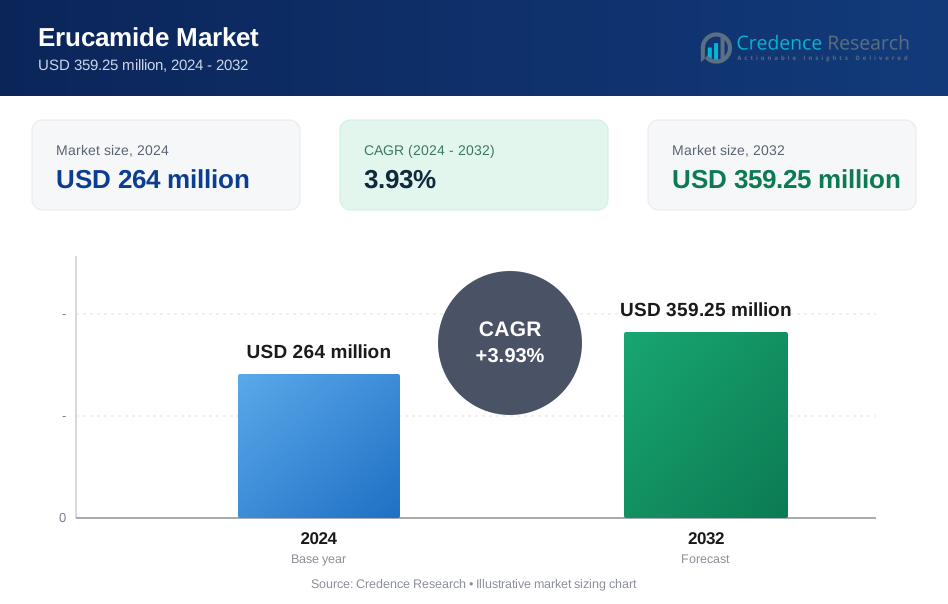
Erucamide market size was valued at USD 264 million in 2024 and is projected to reach USD 359.25 million by 2032, reflecting a CAGR of 3.93% during the forecast period.
| REPORT ATTRIBUTE | DETAILS |
|---|---|
| Historical Period | 2020-2023 |
| Base Year | 2024 |
| Forecast Period | 2025-2032 |
| Erucamide Market Size 2024 | USD 264 million |
| Erucamide Market, CAGR | 3.93% |
| Erucamide Market Size 2032 | USD 359.25 million |
Erucamide Market Insights
- Strong demand from slip agent applications drives growth, supported by rising flexible packaging production and increasing polymer output across major economies.
- Technology improvements in film processing and expansion of high-performance multilayer formats enhance erucamide adoption, supported by wider use in bead form, which leads the form segment with a 52% share.
- Key players focus on product purity, stable supply, and application innovation, while competition from alternative slip agents and raw material price fluctuations remain key restraints.
- Asia Pacific leads regional demand with a 34% share, followed by North America at 31% and Europe at 29%, while packaging dominates end-use consumption with a 46% share supported by expanding film production capacity worldwide.

Erucamide Market Segmentation Analysis:
By Application
Slip agent leads the application segment with a 58% share. Demand rises due to wide use in polyethylene and polypropylene films. Erucamide reduces surface friction and improves film handling. Anti-blocking agents increase adoption in thin film packaging. Lubricant use grows in polymer extrusion and cable production. Dispersing agents show steady demand in pigment and masterbatch processing. Growth across applications reflects strong need for performance additives in plastics. The slip agent segment benefits from reliable processing efficiency gains. This segment maintains strong alignment with expanding flexible packaging demand worldwide.
- For instance, Croda International expanded its production capacity for amide slip agents to support high-volume film converters seeking lower friction levels for their polyolefin packaging.
By Form
Bead form holds a 52% share of the form segment. Beads offer easy handling and consistent feed rates. Powder grades support niche compounding needs and coatings uses. Wax form gains attention in specialty film designs. Demand for bead grades rises in high-speed production settings. Beads enhance dispersion and reduce processing loss. Wax and powder continue as fit-for-purpose options. The bead segment benefits from strong alignment with packaging and film manufacturing. This dominance reflects producer preference for performance and workflow efficiency.
- For instance, Kao Corporation provides high-performance chemical additives that support large-scale plastic manufacturing and industrial processing.
By End-Use Industry
Packaging dominates the end-use segment with a 46% share. Film converters drive sustained demand for slip and anti-blocking benefits. Automotive applications grow through rising plastic content in interior parts. Paints and coatings use remains steady in dispersion tasks. Electronics applications expand in cable insulation and device housings. Packaging gains from strong global consumption trends. Erucamide supports film clarity and smooth converting performance. The packaging segment maintains leadership due to strong output volumes and new film formats.
Key Growth Drivers
Rising Demand from Flexible Packaging Sector
The flexible packaging sector drives significant erucamide demand as converters continue to seek efficient slip and anti-blocking properties for polyethylene and polypropylene films. Growth in consumer goods, food packaging, and e-commerce shipping materials increases output volumes and expands downstream requirements. Manufacturers value erucamide for its ability to enhance film processability, reduce surface friction, and improve line efficiency across high-speed operations. Growing replacement of rigid packaging formats also supports broader use in film and sheet production. Sustained packaging innovation, along with increased focus on material efficiency, ensures steady demand across mature and emerging markets.
- For instance, PMC Biogenix validated slip enhancement performance in biaxially oriented polypropylene films by demonstrating a significant reduction in the coefficient of friction during industrial-scale production.
Expansion of Polymer Processing and Additives Use
Rising polymer consumption supports wider erucamide use across compounding and extrusion applications. Producers rely on erucamide to achieve smooth product surfaces, stable dispersion, and consistent material flow across production steps. Increased use of masterbatches, cables, and molded parts expands functional demand beyond traditional film applications. Growth in infrastructure, consumer products, and electronics accelerates polymer output and additive requirements. Manufacturers focus on process reliability and end-use performance, which strengthens the role of erucamide in value-added polymer solutions. This trend reinforces erucamide adoption across diverse industrial supply chains.
- For instance, Qingdao Sainuo provides chemical additives and technical support to polymer processors manufacturing color masterbatches for electrical components and cable applications.
Increased Focus on High-Performance Film Applications
Strong interest in high-performance film formats boosts erucamide adoption, particularly where durability, clarity, and printability matter. Producers invest in multilayer, barrier, and specialty films for hygiene, medical, and industrial uses, enhancing need for effective slip solutions. Erucamide supports low haze, stable kinetics, and strong migration control, which improves overall conversion quality. Expanding specialty film production capacity across Asia Pacific, Europe, and North America increases additive integration. This environment enables erucamide to remain a preferred option for precision film engineering, supporting product quality, productivity, and consistent output results.
Key Trends & Opportunities
Shift Toward Bio-Based and Sustainable Solutions
Sustainability priorities present a strong opportunity for erucamide producers to develop bio-based options and traceable supply models. Growing focus on environmentally aligned packaging drives interest in plant-derived additives. Regulatory pressure encourages the use of safer and greener chemistries. Manufacturers exploring circular polymers and compostable materials create new channels for compatible slip agents. This shift allows erucamide suppliers to differentiate portfolios through eco-labels and certification programs. Strong alignment between sustainability messaging and packaging sector needs positions erucamide for long-term value creation across global markets.
- For instance, KLK Oleo achieved compliance with EU REACH registration covering 42 erucamide product grades.
Technology Advancements in Polymer Processing
Rising adoption of advanced processing technologies offers greater opportunity for erucamide integration. High-speed extrusion, multilayer barrier designs, and digital quality control systems create need for additives that deliver consistent slip performance under tighter tolerances. Manufacturers aim to reduce waste, improve surface quality, and enhance output efficiency, supporting deeper erucamide use across premium applications. Additive suppliers align with material science developments to tailor solutions for specialty films, molded parts, and engineered products. This trend improves product customisation and strengthens long-term demand potential across industrial sectors.
- For instance, Nissan Chemical Corporation demonstrated inorganic dispersion stability in various organic solvents and in water, including in coating agents for optical films and for use in multilayer structures.
Key Challenges
Fluctuating Raw Material Prices
Raw material price volatility poses a challenge for erucamide producers and downstream users. Variations in oilseed crop yields influence feedstock availability and cost stability, affecting production planning and price structures. Manufacturers face margin pressure and potential supply disruption when raw material costs shift rapidly. Buyers also encounter cost uncertainty in long-term contracts, influencing purchasing behaviour and production economics. This environment increases the need for risk mitigation strategies, diversified sourcing, and reliable supplier networks to maintain steady product flow and financial performance.
Competition from Alternative Slip Agents
Alternative slip agents present a competitive challenge, particularly where formulators seek lower migration rates or faster activation profiles. Fatty amides, silicone-based additives, and specialty processing aids compete for share in packaging and compounding applications. Some alternatives support niche performance demands such as reduced odour or enhanced thermal stability. End users may evaluate substitute options, especially in high-specification applications. To remain competitive, erucamide suppliers focus on product consistency, high diffusion efficiency, and proven film compatibility. Continuous improvement and application support remain vital to reinforce long-term market position.
Regional Analysis
North America
North America holds a 31% share of the erucamide market, driven by strong demand from packaging and polymer processing sectors. Film converters and compounding facilities in the United States and Canada rely on erucamide to enhance slip performance in polyethylene and polypropylene applications. Growth in e-commerce packaging and consumer goods supports steady volume rise. Adoption of specialty films in healthcare and industrial use also adds value. Regulatory focus on product safety and supply chain transparency influences material sourcing and production practices, shaping long-term market direction across the region.
Europe
Europe accounts for a 29% share of the erucamide market, supported by established plastics and coating industries. Demand remains strong in Germany, France, Italy, and the United Kingdom as converters enhance film clarity and processing efficiency. Increasing sustainability goals and stricter additive regulations guide product development and procurement choices. Growth in automotive and engineering plastics strengthens polymer additive needs. Packaging remains the core demand driver, with producers focusing on high-performance and recyclable film formats. These dynamics support stable erucamide consumption across the regional value chain.
Asia Pacific
Asia Pacific leads the erucamide market with a 34% share, driven by strong manufacturing output in China, India, Japan, and South Korea. Rapid expansion of packaging, textiles, automotive parts, and electronics manufacturing fuels large-scale polymer production. Film converters rely on erucamide to support high-speed output and stable slip performance. Expanding retail consumption and industrialisation continue to increase downstream demand. Regional production advantages, including raw material access and cost efficiency, strengthen supplier competitiveness. Growing investments in specialty and multilayer films enhance market potential across diverse applications.
Latin America
Latin America holds a 4% share of the erucamide market, supported by packaging growth in Brazil, Mexico, and Argentina. Manufacturers adopt erucamide to improve film quality, processing speed, and product surface properties. Expansion in food and consumer goods packaging strengthens film production volumes. Industrial plastics and cable applications provide additional demand. Supply chain diversification and increased local polymer compounding capacity contribute to consumption gains. Market growth remains influenced by economic conditions and investment cycles across key sectors.
Middle East & Africa
Middle East and Africa hold a 2% share of the erucamide market, driven by moderate industrial activity and rising packaging consumption. Growth in food distribution and retail networks increases use of polyethylene and polypropylene films. Local polymer production in the Gulf region supports stable additive demand, while emerging manufacturing hubs expand film output. Infrastructure development and rising import substitution efforts strengthen opportunities for regional converters. The market continues to develop alongside broader industrialisation and evolving supply chain networks.
Erucamide Market Segmentations:
By Application
- Slip Agent
- Anti-Blocking Agent
- Lubricant
- Dispersing Agent
By Form
- Bead
- Powder
- Wax
By End-Use Industry
- Packaging
- Automotive
- Paints & Coatings
- Electronics
By Geography
- North America
- U.S.
- Canada
- Mexico
- Europe
- Germany
- France
- U.K.
- Italy
- Spain
- Rest of Europe
- Asia Pacific
- China
- Japan
- India
- South Korea
- South-east Asia
- Rest of Asia Pacific
- Latin America
- Brazil
- Argentina
- Rest of Latin America
- Middle East & Africa
- GCC Countries
- South Africa
- Rest of the Middle East and Africa
Competitive Landscape
Competitive landscape analysis highlights key players including Croda International Plc, PMC Biogenix Inc., Fine Organics Industries Pvt. Ltd., Nissan Chemical Corporation, Hunan Er-Kang Pharmaceutical Co. Ltd., Qingdao Sainuo Chemical Co. Ltd., Nippon Fine Chemical Co. Ltd., Kao Corporation, KLK Oleo, and Haihang Industry Co. Ltd. The market features strong product differentiation based on purity levels, diffusion rates, migration performance, and film compatibility. Leading companies invest in process optimisation and application research to strengthen product quality and customer support. Producers expand portfolios to serve packaging, polymer compounding, coatings, and electronics applications, while maintaining reliable supply chains and regional distribution networks. Strategic priorities include capacity expansion, sustainability initiatives, and advanced production technologies to enhance efficiency and meet rising technical requirements. Regional manufacturers continue to gain visibility through cost competitiveness and tailored solutions for high-volume film and sheet production. Market consolidation remains moderate, with organic growth strategies shaping long-term positioning.
Key Player Analysis
- Croda International Plc
- PMC Biogenix Inc.
- Fine Organics Industries Pvt. Ltd.
- Nissan Chemical Corporation
- Hunan Er-Kang Pharmaceutical Co. Ltd.
- Qingdao Sainuo Chemical Co. Ltd.
- Nippon Fine Chemical Co. Ltd.
- Kao Corporation
- KLK Oleo
- Haihang Industry Co. Ltd.
Recent Developments
- In June 2024, PMC Biogenix announced construction of a new Armoslip® facility in Gyeongju, South Korea, to expand erucamide-related slip agent capacity by ~50%. Supply due mid-2026.
- In 2024, Fine Organics earned USDA Certified Biobased Product Labels for its range of bioplastics additives, including erucamide derivatives.
Report Coverage
The research report offers an in-depth analysis based on Application, Form, End-Use Industry and Geography. It details leading market players, providing an overview of their business, product offerings, investments, revenue streams, and key applications. Additionally, the report includes insights into the competitive environment, SWOT analysis, current market trends, as well as the primary drivers and constraints. Furthermore, it discusses various factors that have driven market expansion in recent years. The report also explores market dynamics, regulatory scenarios, and technological advancements that are shaping the industry. It assesses the impact of external factors and global economic changes on market growth. Lastly, it provides strategic recommendations for new entrants and established companies to navigate the complexities of the market.
Future Outlook
- Demand for slip agents will continue to rise with expanding flexible packaging output.
- Polymer processing growth will strengthen erucamide consumption across compounding and extrusion.
- Advancements in multilayer and specialty films will create new performance-driven applications.
- Higher focus on sustainability will support interest in bio-based and low-impact products.
- Technology upgrades in film production will increase reliance on high-purity erucamide grades.
- Regional manufacturing expansion, especially in Asia Pacific, will enhance supply chain efficiency.
- Producers will invest in capacity upgrades to support long-term volume stability.
- Competition from alternative slip agents will encourage deeper product innovation.
- New regulatory standards will influence formulation choices and quality requirements.
- End-use diversification beyond packaging will offer new growth channels in automotive, coatings, and electronics.
Request a Free Sample
Fill in your details and we'll send you a free sample report.
- Sample data tables & charts
- Research methodology
Market Dynamics
Growth in Flexible Packaging Sector
The rapid expansion of flexible packaging, especially for consumer goods, food, and e-commerce, is driving demand for erucamide as a slip and anti-blocking agent in polyethylene and polypropylene films. This sector values erucamide for its ability to enhance film processability and reduce surface friction, supporting higher production speeds and improved product quality.
Expansion of Polymer Processing and Additives Use
Increasing global polymer output, particularly in compounding, extrusion, and masterbatch production, is boosting erucamide consumption. Manufacturers rely on erucamide to ensure smooth surfaces, stable dispersion, and consistent material flow, which is critical for high-quality end products in diverse industries.
Advancements in High-Performance Film Applications
The shift toward multilayer, barrier, and specialty films for hygiene, medical, and industrial uses is increasing the need for high-purity erucamide. Its ability to deliver low haze, stable migration, and reliable slip performance makes it a preferred additive in advanced film engineering.
Sustainability and Bio-Based Product Development
Rising regulatory and consumer focus on sustainability is encouraging the development and adoption of bio-based erucamide and traceable supply chains. Producers are differentiating their offerings with eco-friendly solutions, aligning with the packaging sector’s push for greener materials.
Technology Improvements in Film Processing
The adoption of high-speed extrusion, digital quality control, and multilayer film technologies is increasing the demand for erucamide grades that offer consistent slip performance under tighter tolerances. This trend supports deeper integration of erucamide in premium and specialty film applications.
Need a Custom Version of This Report?
Tailor the scope, geography, or segments to your exact requirements.
- Custom geography or segment scope
- Direct access to our analyst team
Frequently Asked Questions
What is the current market size for the Erucamide market, and what is its projected size in 2032?
At what Compound Annual Growth Rate is the Erucamide market projected to grow between 2024 and 2032?
Which Erucamide market segment held the largest share in 2024?
What are the primary factors fueling the growth of the Erucamide market?
Who are the leading companies in the Erucamide market?
Which region commanded the largest share of the Erucamide market in 2024?
Table of Content
Chapter 1 Market Segmentation
- 1.1 Segmentation Framework
- 1.1.1 Product and Service Classification
- 1.1.2 Application and End-Use Classification
- 1.1.3 Technology and Solution Classification
- 1.1.4 Customer and Distribution Channel Classification
- 1.1.5 Geographic Segmentation
- 1.1.6 Market Segment Definitions and Boundaries
- 1.2 By Form
- 1.2.1 Bead
- 1.2.2 Powder
- 1.2.3 Wax
- 1.3 By Application
- 1.3.1 Slip Agent
- 1.3.2 Anti-Blocking Agent
- 1.3.3 Lubricant
- 1.3.4 Dispersing Agent
- 1.4 By End-Use Industry
- 1.4.1 Packaging
- 1.4.2 Automotive
- 1.4.3 Paints & Coatings
- 1.4.4 Electronics
Chapter 2 Introduction
- 2.1 Report Objectives and Scope
- 2.2 Product Definition and Industry Terminology
- 2.3 Market Inclusions and Exclusions
- 2.4 Research Process
- 2.4.1 Primary Research and Expert Interviews
- 2.4.2 Secondary Research and Source Review
- 2.4.3 Top-Down and Bottom-Up Estimation
- 2.4.4 Data Triangulation and Verification
- 2.5 Market Size Measurement Basis
- 2.5.1 2024: USD 264 million → 2032: USD 359.25 million
- 2.6 Historical and Forecast Reference Periods
- 2.6.1 Base Year: 2024
- 2.6.2 Forecast Period: 2024-2032
- 2.7 Research Assumptions and Limitations
Chapter 3 Executive Summary
- 3.1 Market Snapshot and Key Findings
- 3.2 Base-Year Market Size, 2024
- 3.3 Forecast Market Size, 2032
- 3.4 Revenue and Volume Growth Outlook
- 3.5 Key Demand and Supply Indicators
- 3.6 Leading Market Segments
- 3.7 Fastest-Growing Market Opportunities
- 3.8 Regional Performance Highlights
- 3.9 Technology and Industry Transformation
- 3.10 Competitive Landscape Summary
- 3.11 Analyst View and Strategic Implications
Chapter 4 Global Erucamide Market Trends and Developments
- 4.1 Historical Industry Development
- 4.2 Recent Market Trends and Developments
- 4.3 Demand and Customer Behavior Trends
- 4.4 Technology and Product Innovation
- 4.5 Artificial Intelligence, Automation and Digitalization
- 4.6 Local Manufacturing and Supply Chain Realignment
- 4.7 Industry Partnerships, Mergers and Acquisitions
- 4.8 Sustainability and Circular Economy Developments
- 4.9 Government and Private Sector Investment Trends
- 4.10 Emerging Business Models and Commercialization
- 4.11 Industry Developments and Announcements
Chapter 5 Global Erucamide Market Production, Supply and Demand Analysis
- 5.1 Demand Trend and Consumption Analysis
- 5.2 Demand Forecast, 2024-2032
- 5.3 Production and Output Trend
- 5.4 Production and Output Forecast, 2024-2032
- 5.5 Installed Capacity and Capacity Utilization
- 5.6 Company-Wise Production Plants and Statistics
- 5.6.1 Installed Production Capacity
- 5.6.2 Actual Production
- 5.6.3 Planned Capacity and Expansion Targets
- 5.7 Supply Chain Structure and Procurement Trends
- 5.8 Supply-Demand Gap and Bottlenecks
- 5.9 Import Dependence and Sourcing Structure
- 5.10 Contract Manufacturing and Outsourcing
- 5.11 Regional Supply and Demand Concentration
Chapter 6 Global Erucamide Market Pricing Analysis
- 6.1 Pricing Structure and Measurement
- 6.2 Historical Pricing Trends
- 6.3 Pricing Outlook, 2024-2032
- 6.4 Average Selling Price and Unit Economics
- 6.5 Pricing by Product and Market Segment
- 6.6 Geographic Pricing Differences
- 6.7 Key Input, Energy, Labor and Logistics Costs
- 6.8 Contract Pricing and Purchasing Models
- 6.9 Pricing Sensitivity and Competitive Positioning
- 6.10 Price, Margin and Profitability Implications
Chapter 7 Global Erucamide Market Dynamics
- 7.1 Market Growth Drivers
- 7.1.1 Demand-Side Drivers
- 7.1.2 Technology and Innovation Drivers
- 7.1.3 Infrastructure and Investment Drivers
- 7.1.4 Regulatory and Policy Drivers
- 7.2 Market Restraints
- 7.2.1 Cost and Affordability Constraints
- 7.2.2 Technology and Adoption Barriers
- 7.2.3 Supply Chain and Operational Constraints
- 7.3 Market Challenges
- 7.3.1 Competitive Pressure and Margin Erosion
- 7.3.2 Skills, Infrastructure and Implementation Gaps
- 7.4 Emerging Market Opportunities
- 7.5 Market Dynamics Impact and Time-Horizon Assessment
Chapter 8 Global Erucamide Value Chain Analysis
- 8.1 Industry Value Chain Overview
- 8.2 Upstream Suppliers and Critical Inputs
- 8.3 Technology and Component Providers
- 8.4 Manufacturing or Service Delivery
- 8.5 Distribution, Channel Partners and Integrators
- 8.6 Downstream Applications and End Users
- 8.7 Value Addition and Profit Pools
- 8.8 Vertical Integration and Outsourcing
- 8.9 Supplier Concentration and Risk
- 8.10 Supply Chain Localization and Resilience
Chapter 9 Global Erucamide Market Regulations and Policies
- 9.1 Relevant Laws, Standards and Compliance Frameworks
- 9.2 Product, Service, Safety and Quality Requirements
- 9.3 Government Policies, Incentives and Subsidies
- 9.4 Imports, Exports and Trade Barriers
- 9.5 Public Procurement and Local Content Requirements
- 9.6 Environmental and Sustainability Compliance
- 9.7 Upcoming Policy Changes and Market Implications
Chapter 10 Global Erucamide Market Hotspots and Opportunities
- 10.1 Market Opportunity Mapping and Growth Hotspots
- 10.2 High-Growth Applications and Customer Groups
- 10.3 Underserved Markets and White-Space Opportunities
- 10.4 Emerging Technology and Product Opportunities
- 10.5 New Capacity and Investment Hotspots
- 10.6 Market Entry and Expansion Opportunities
- 10.7 Distribution and Partnership Opportunities
- 10.8 Near-Term and Long-Term Commercial Potential
- 10.9 Opportunity Attractiveness and Execution Risks
Chapter 11 Global Erucamide Market Outlook, 2024-2032
- 11.1 Market Size and Analysis
- 11.1.1 Revenue (Market Measurement: 2024: USD 264 million → 2032: USD 359.25 million)
- 11.1.2 Market Volume and Quantity Sold
- 11.1.3 Historical Market Size
- 11.1.4 Base-Year Market Size, 2024
- 11.2 Market Forecast, 2024-2032
- 11.2.1 Revenue Forecast to 2032
- 11.2.2 Volume Forecast to 2032
- 11.2.3 CAGR and Year-on-Year Growth
- 11.2.4 Incremental Revenue Opportunity
- 11.3 Forecast Assumptions and Scenario Analysis
- 11.3.1 Base-Case Forecast
- 11.3.2 Optimistic and Conservative Scenarios
- 11.3.3 Technology, Pricing and Policy Sensitivities
- 11.4 Market Attractiveness and Growth Outlook
Chapter 12 Global Erucamide Market Segmentation and Outlook
- 12.1 Segmentation Summary and Market Shares, 2024
- 12.2 Largest and Fastest-Growing Segments
- 12.3 By Form - Market Size and Forecast, 2024-2032
- 12.3.1 Segment Definition and Scope
- 12.3.2 Historical Market Size
- 12.3.3 Revenue Forecast, 2024-2032
- 12.3.4 Volume Forecast, 2024-2032
- 12.3.5 Base-Year Market Share, 2024
- 12.3.6 Segment CAGR and Growth Drivers
- 12.3.7 Subsegment Market Size and Forecast
- 12.3.7.1 Bead
- 12.3.7.2 Powder
- 12.3.7.3 Wax
- 12.3.8 Subsegment Pricing and Adoption Trends
- 12.3.9 Leading Suppliers and Competition
- 12.3.10 Regional Demand and Opportunities
- 12.4 By Application - Market Size and Forecast, 2024-2032
- 12.4.1 Segment Definition and Scope
- 12.4.2 Historical Market Size
- 12.4.3 Revenue Forecast, 2024-2032
- 12.4.4 Volume Forecast, 2024-2032
- 12.4.5 Base-Year Market Share, 2024
- 12.4.6 Segment CAGR and Growth Drivers
- 12.4.7 Subsegment Market Size and Forecast
- 12.4.7.1 Slip Agent
- 12.4.7.2 Anti-Blocking Agent
- 12.4.7.3 Lubricant
- 12.4.7.4 Dispersing Agent
- 12.4.8 Subsegment Pricing and Adoption Trends
- 12.4.9 Leading Suppliers and Competition
- 12.4.10 Regional Demand and Opportunities
- 12.5 By End-Use Industry - Market Size and Forecast, 2024-2032
- 12.5.1 Segment Definition and Scope
- 12.5.2 Historical Market Size
- 12.5.3 Revenue Forecast, 2024-2032
- 12.5.4 Volume Forecast, 2024-2032
- 12.5.5 Base-Year Market Share, 2024
- 12.5.6 Segment CAGR and Growth Drivers
- 12.5.7 Subsegment Market Size and Forecast
- 12.5.7.1 Packaging
- 12.5.7.2 Automotive
- 12.5.7.3 Paints & Coatings
- 12.5.7.4 Electronics
- 12.5.8 Subsegment Pricing and Adoption Trends
- 12.5.9 Leading Suppliers and Competition
- 12.5.10 Regional Demand and Opportunities
- 12.6 Segment Growth Comparison
- 12.7 Segment Attractiveness and Priority Matrix
Chapter 13 Global Erucamide End-Use and Application Market Outlook
- 13.1 End-Use Industry and Customer Demand Structure
- 13.2 Leading Applications and Customer Groups
- 13.3 End-Use Market Size, Share and Forecast
- 13.4 Major End-Use Industry Deep Dives
- 13.4.1 Customer Requirements and Use Cases
- 13.4.2 Demand and Replacement Cycles
- 13.4.3 Technical and Regulatory Considerations
- 13.4.4 Purchasing and Procurement Models
- 13.4.5 Leading Vendors and Distribution Channels
- 13.4.6 Forecast and Commercial Opportunities
- 13.5 Emerging Applications and Cross-Segment Demand
- 13.6 End-Use Industry Investment Priorities
Chapter 14 Global Erucamide Geographic Market Outlook, 2024-2032
- 14.1 Regional Market Size and Share, 2024
- 14.2 Regional Market Forecast, 2024-2032
- 14.3 Regional Pricing, Production and Demand Differences
- 14.4 North America
- 14.4.1 United States
- 14.4.2 Canada
- 14.4.3 Mexico
- 14.5 Europe
- 14.5.1 Germany
- 14.5.2 France
- 14.5.3 Italy
- 14.5.4 United Kingdom
- 14.5.5 Spain
- 14.5.6 Poland
- 14.5.7 Russia
- 14.5.8 Netherlands
- 14.5.9 Belgium
- 14.5.10 Sweden
- 14.5.11 Denmark
- 14.5.12 Norway
- 14.5.13 Rest of Europe
- 14.6 Asia Pacific
- 14.6.1 China
- 14.6.2 India
- 14.6.3 Japan
- 14.6.4 South Korea
- 14.6.5 Thailand
- 14.6.6 Indonesia
- 14.6.7 Vietnam
- 14.6.8 Malaysia
- 14.6.9 Australia
- 14.6.10 Rest of Asia Pacific
- 14.7 Latin America
- 14.7.1 Brazil
- 14.7.2 Argentina
- 14.7.3 Colombia
- 14.7.4 Chile
- 14.7.5 Rest of Latin America
- 14.8 Middle East
- 14.8.1 Saudi Arabia
- 14.8.2 United Arab Emirates
- 14.8.3 Turkey
- 14.8.4 Israel
- 14.8.5 Iran
- 14.8.6 Rest of the Middle East
- 14.9 Africa
- 14.9.1 South Africa
- 14.9.2 Egypt
- 14.9.3 Nigeria
- 14.9.4 Morocco
- 14.9.5 Rest of Africa
- 14.10 Regional Investment, Policy and Supply Chain Differences
- 14.11 Regional Competitive Landscape
- 14.12 Geographic Growth Hotspots
Chapter 15 Global Erucamide Technology, Innovation and Sustainability Outlook
- 15.1 Technology Landscape and Maturity
- 15.2 Product, Process and Service Innovation
- 15.3 AI, Automation and Digital Tools in the Industry
- 15.4 Technology Adoption and Performance Benchmarking
- 15.5 Innovation Pipeline and R&D Investment
- 15.6 Patent and Intellectual Property Trends
- 15.7 Energy Efficiency and Resource Management
- 15.8 Sustainability, Recycling and Circularity
- 15.9 Technology Roadmap, 2024-2032
- 15.10 Risks of Obsolescence and Technology Substitution
Chapter 16 Global Erucamide Market Key Strategic Imperatives
- 16.1 Growth and Market Entry Priorities
- 16.2 High-Return Products and Segments
- 16.3 Pricing, Profitability and Cost Optimization
- 16.4 Technology Investment and Product Differentiation
- 16.5 Supply Chain Localization and Resilience
- 16.6 Distribution and Customer Acquisition
- 16.7 Partnership, Acquisition and Capacity Strategy
- 16.8 Regional Expansion Priorities
- 16.9 Short-, Medium- and Long-Term Actions
Chapter 17 Competition Outlook
- 17.1 Industry Competition Characteristics
- 17.2 Market Structure and Concentration
- 17.3 Market Share and Competitive Positioning, 2024
- 17.4 Company-Wise Revenue and Product Benchmarking
- 17.5 Production and Service Capacity Benchmarking
- 17.6 Technology, Pricing and Differentiation
- 17.7 Regional Footprint and Distribution Strength
- 17.8 Mergers, Acquisitions and Strategic Alliances
- 17.9 New Entrants and Competitive Threats
- 17.10 Porter's Five Forces and Industry Attractiveness
- 17.11 Competitive Outlook, 2024-2032
Chapter 18 Company Profiles
- 18.1 Company Coverage and Selection Criteria
- 18.2 Croda International Plc
- 18.2.1 Business Description
- 18.2.2 Company Ownership and Geographic Presence
- 18.2.3 Product and Service Portfolio
- 18.2.4 Manufacturing and Operating Footprint
- 18.2.5 Production Capacity and Expansion Plans
- 18.2.6 Financial Performance and Investment
- 18.2.7 Market Share and Competitive Position
- 18.2.8 Technology and Innovation Capabilities
- 18.2.9 Strategic Alliances or Partnerships
- 18.2.10 Recent Developments
- 18.2.11 Growth Strategy and Outlook
- 18.3 PMC Biogenix Inc.
- 18.4 Fine Organics Industries Pvt. Ltd.
- 18.5 Nissan Chemical Corporation
- 18.6 Hunan Er-Kang Pharmaceutical Co. Ltd.
- 18.7 Qingdao Sainuo Chemical Co. Ltd.
- 18.8 Nippon Fine Chemical Co. Ltd.
- 18.9 Kao Corporation
- 18.10 KLK Oleo
- 18.11 Haihang Industry Co. Ltd.
- 18.12 Other Relevant Market Participants
Note: Every listed company is profiled on the structure shown under the first company. The company list is preliminary and may change based on research findings, market developments, data availability and client requirements.
Chapter 19 Disclaimer
- 19.1 Research and Forecast Disclaimer
- 19.2 Data Source and Estimation Limitations
Note: The depth of individual sections depends on data availability for this market. Volume, capacity, trade and other unit-based metrics are included where applicable.

