
Market Overview:
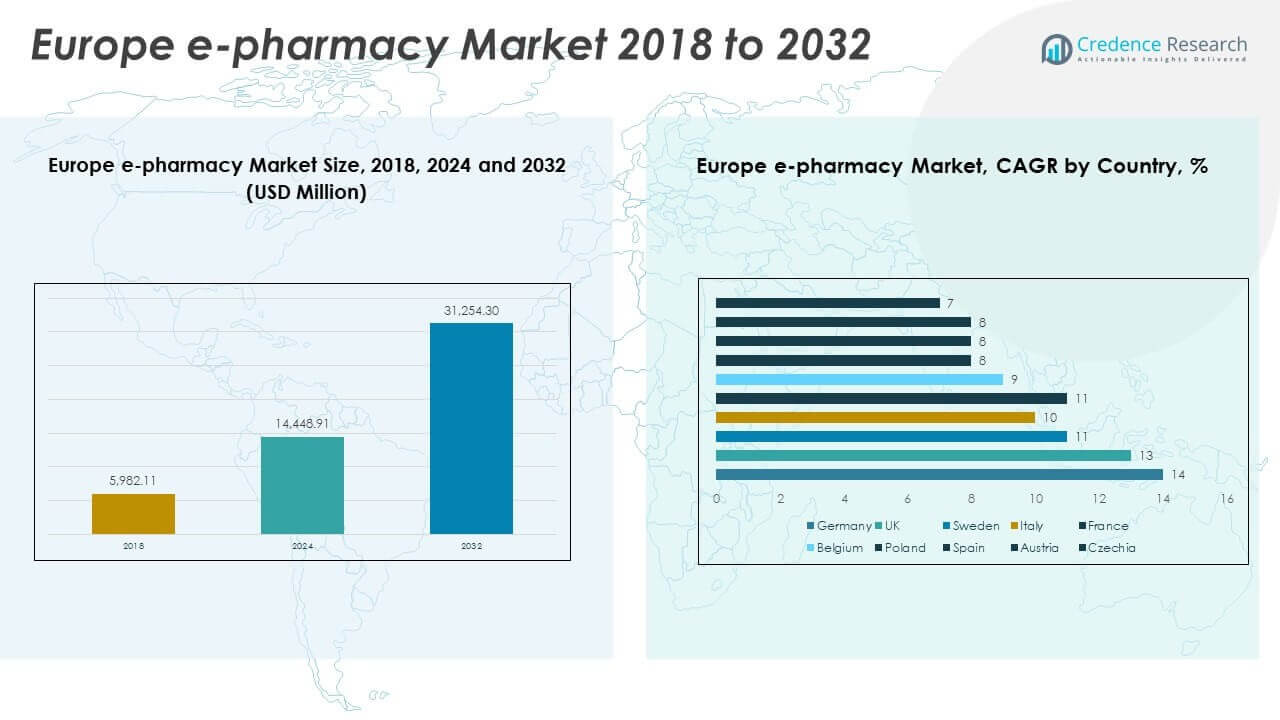
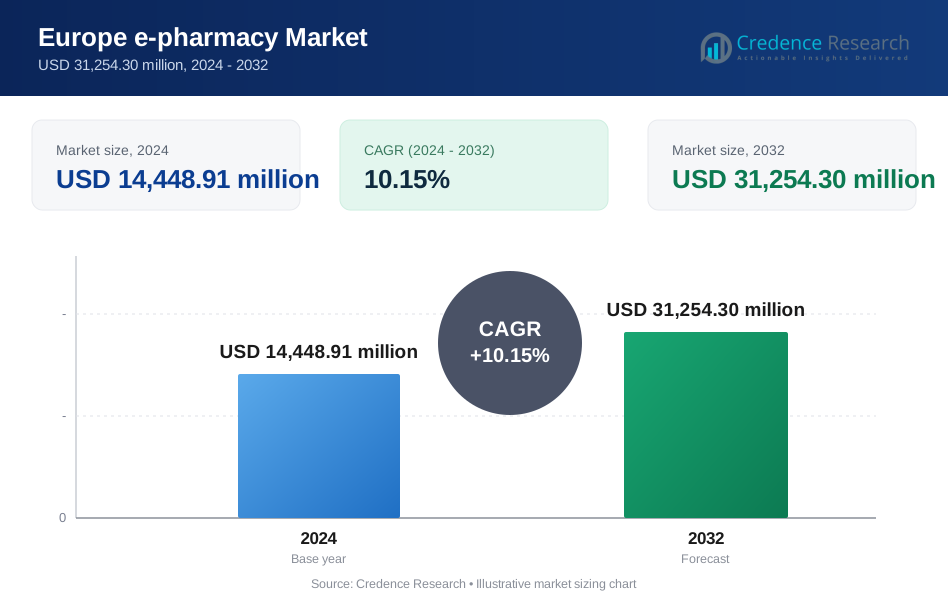
The Europe e-pharmacy Market size was valued at USD 5,982.11 million in 2018 to USD 14,448.91 million in 2024 and is anticipated to reach USD 31,254.30 million by 2032, at a CAGR of 10.15% during the forecast period.
| REPORT ATTRIBUTE | DETAILS |
|---|---|
| Historical Period | 2020-2023 |
| Base Year | 2024 |
| Forecast Period | 2025-2032 |
| Europe e-pharmacy Market Size 2024 | USD 14,448.91 million |
| Europe e-pharmacy Market, CAGR | 10.15% |
| Europe e-pharmacy Market Size 2032 | USD 31,254.30 million |
The market is driven by strong demand for convenient access to medicines and digital healthcare services. Consumers increasingly prefer online platforms for ordering prescription and OTC products due to time savings and doorstep delivery. Expansion of e-prescription frameworks across several European countries supports seamless online dispensing. Rising prevalence of chronic diseases encourages repeat purchases through digital pharmacies. Mobile app adoption improves engagement and simplifies order management. Integration of digital payments and customer support tools strengthens trust. The Europe e-pharmacy Market continues to benefit from changing consumer behavior toward digital-first healthcare solutions.
Geographically, Western Europe leads the market due to advanced digital infrastructure, strong regulatory support, and high consumer awareness. Countries such as Germany, the UK, and France show strong adoption of online pharmacy platforms backed by mature healthcare systems. Northern Europe also demonstrates steady growth driven by high digital literacy and technology acceptance. Central and Eastern Europe are emerging markets where improving internet access and healthcare digitization create new opportunities. Southern Europe shows rising adoption supported by mobile usage growth. The Europe e-pharmacy Market gains momentum as regional disparities in healthcare access accelerate online adoption.
Market Insights
- The Europe e-pharmacy market was valued at USD 5,982.11 million in 2018, reached USD 14,448.91 million in 2024, and is projected to hit USD 31,254.30 million by 2032, growing at a CAGR of 10.15%.
- Western Europe leads the regional share with approximately 40%, driven by early adoption of e-prescriptions, high digital literacy, and robust logistics infrastructure.
- Southern Europe holds around 25% share, supported by rising smartphone penetration and growing comfort with digital health solutions across Italy and Spain.
- Central and Eastern Europe contribute roughly 35% and are the fastest-growing region, with countries like Czechia and Poland seeing strong digital health policy support and improving delivery networks.
- In terms of segments, prescription medicines account for the largest share at 62%, while mobile platforms lead the access point distribution with a 68% share across the Europe e-pharmacy market.
Market Drivers
Rising Demand for Convenience and Remote Access to Medications Across All Age Groups
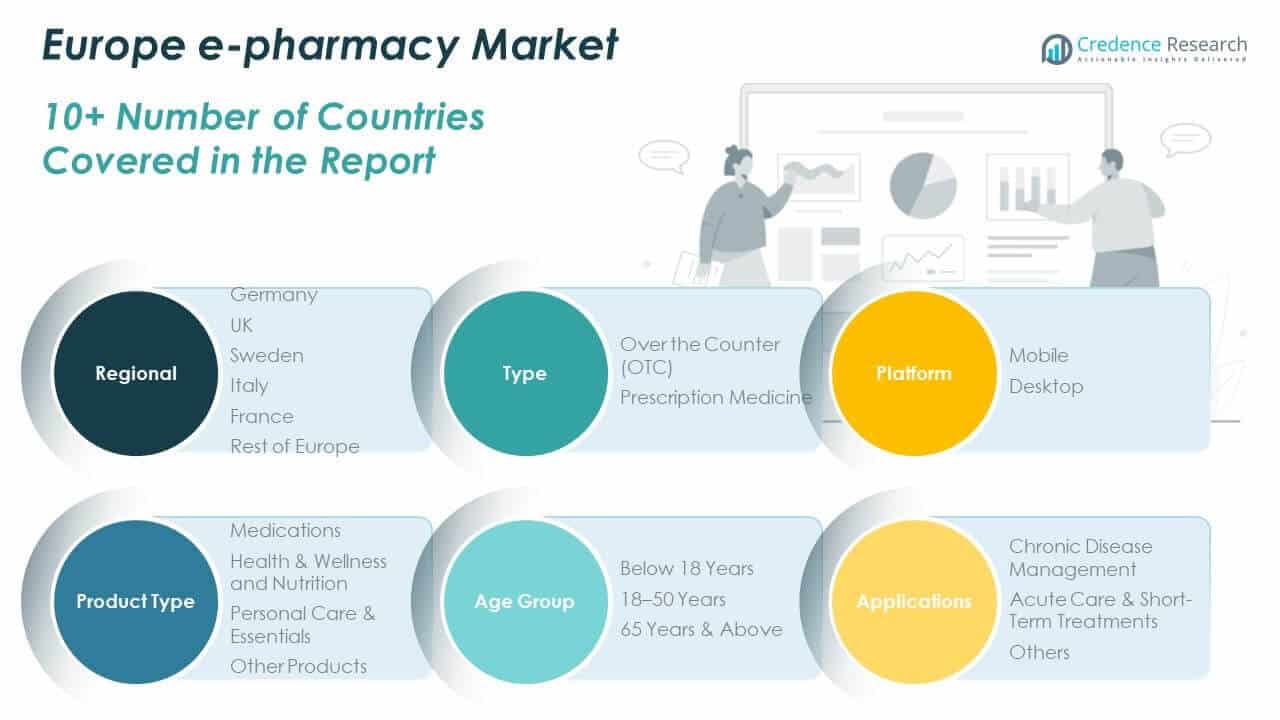
The growing preference for hassle-free, on-demand access to medications strongly supports the growth of the Europe e-pharmacy market. Consumers increasingly value the ability to order prescription and over-the-counter medicines without visiting a physical store. This shift aligns with modern lifestyles, where digital solutions dominate consumer behavior across all age brackets. Rising urbanization, higher digital literacy, and broader internet access accelerate this transition. It creates a scalable model for healthcare delivery, especially in regions with aging populations or limited mobility. For rural patients, e-pharmacies fill access gaps that traditional brick-and-mortar pharmacies cannot. The convenience of home delivery, real-time order tracking, and repeat prescription management strengthens user loyalty. The Europe e-pharmacy market benefits from this persistent demand trend that reshapes how people manage healthcare. It is evolving toward a patient-centric model.
- For instance, NHS Digital reported that the NHS App had been downloaded over 30 million times by late 2024, showing widespread consumer adoption of remote prescription ordering and access to health services.
Integration of E-Prescriptions and Supportive Regulatory Frameworks Driving Market Expansion
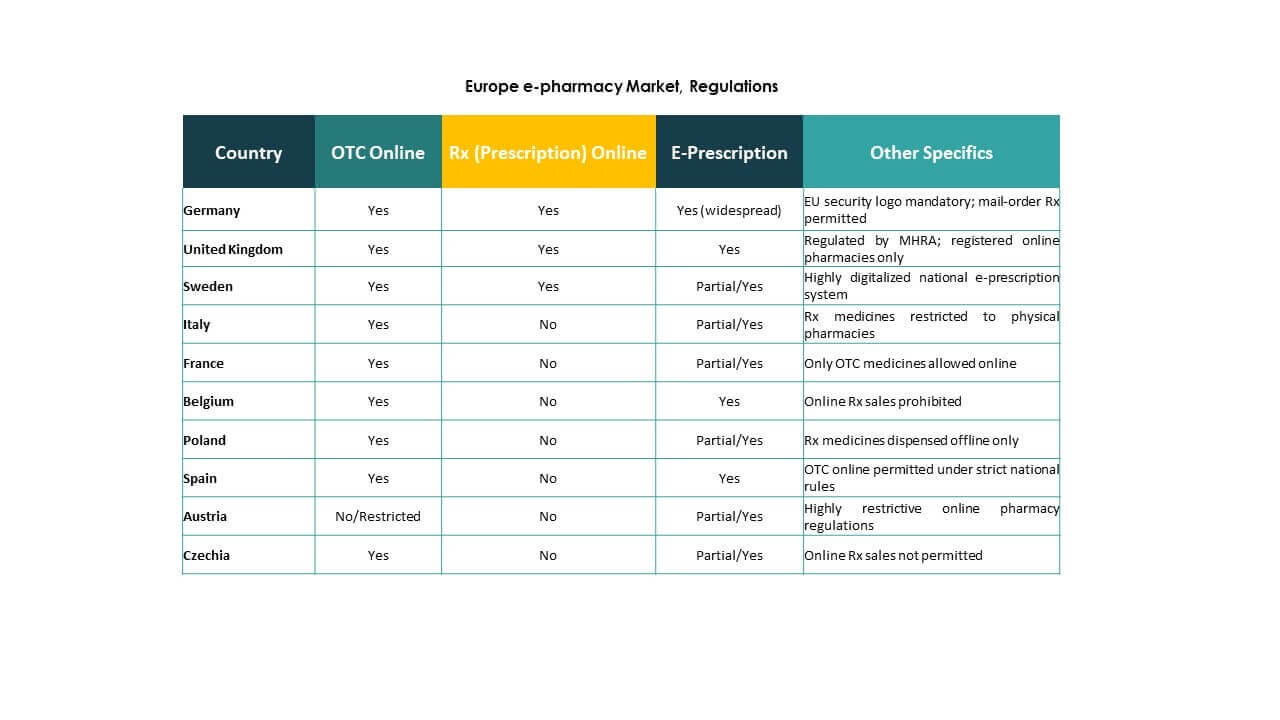
Governments across Europe are streamlining digital health adoption through national e-prescription mandates and reimbursement reforms. The rollout of electronic prescription systems enhances safety, accuracy, and convenience in medicine procurement. It empowers patients to directly upload prescriptions and get real-time validation through licensed platforms. Countries like Germany, Sweden, and France have made notable progress in legalizing and encouraging e-prescription models. This regulatory support reduces friction across the pharmaceutical supply chain. Pharmacies and doctors are integrating with centralized digital networks to ensure smoother operations. The Europe e-pharmacy market gains momentum as these initiatives remove procedural delays and increase consumer trust. It allows the digital channel to compete with traditional pharmacies while remaining compliant. These policies act as long-term enablers for platform-based healthcare ecosystems.
Growing Prevalence of Chronic Conditions Necessitating Long-Term Medication Management
Chronic disease management remains a powerful growth engine for the Europe e-pharmacy market. Rising incidences of diabetes, cardiovascular disease, and hypertension drive continuous prescription refill demand. Patients managing long-term therapies benefit from subscription-based delivery models. These models improve adherence while reducing the burden of monthly pharmacy visits. Elderly populations, who represent a large share of prescription medicine users, increasingly adopt e-pharmacies for convenience. It addresses critical gaps in accessibility for those requiring multiple medications. E-pharmacy platforms are integrating with health monitoring tools to better serve these patients. The market is witnessing the rise of automated reorder features, medication reminders, and bundled care plans. This evolution ensures continuity of care through digital channels.
Expansion of Mobile-First Platforms and Smart Technology Integration in Healthcare Delivery
The increasing use of mobile devices is transforming access to pharmacy services in real-time. Mobile apps allow users to compare prices, scan prescriptions, and track deliveries through simple interfaces. It enables companies to reach a younger, tech-savvy demographic who prefer digital-first services. Integration of AI chatbots and virtual assistants improves user engagement and support. The Europe e-pharmacy market is leveraging such innovations to enhance personalization and customer retention. Smart algorithms help optimize stock levels and recommend alternatives for out-of-stock items. Geolocation-based features direct users to nearby collection points or fastest delivery options. This fusion of convenience and intelligence boosts platform adoption across all regions. It also fosters long-term brand loyalty.
- For instance, Doctolib served over 80 million patients across France, Germany, and Italy by late 2024, offering integrated features such as e-prescriptions, secure messaging, and personal health records.
Market Trends
Emergence of Omnichannel Retail Models Combining Online and In-Store Pharmacy Experiences
Pharmacy chains are increasingly adopting hybrid approaches that integrate online storefronts with physical presence. This model blends digital access with localized delivery and consultation services. It appeals to consumers seeking both speed and trusted interactions. Pharmacies offer online ordering with same-day pick-up options from local stores. It reduces fulfillment time while retaining in-store foot traffic. Some retailers are adding digital kiosks inside outlets to bridge online–offline experiences. The Europe e-pharmacy market gains value from these blended models that offer flexibility across customer preferences. It aligns with evolving consumer expectations of seamless service.
Shift Toward Preventive Healthcare and Wellness Product Adoption Beyond Traditional Medicines
Consumers now use e-pharmacies not just for treating illness but also for maintaining wellness. The product mix has shifted toward vitamins, immunity boosters, nutrition supplements, and health monitoring devices. It reflects a larger societal trend toward proactive health management. Seasonal and lifestyle-based assortments are driving basket size growth. The Europe e-pharmacy market is expanding its catalog to include holistic wellness and lifestyle health products. It creates upselling and cross-category engagement opportunities. Brands invest in SEO-driven product discovery and reviews to drive conversion. This trend transforms e-pharmacies into comprehensive health marketplaces.
Growing Role of Personalized Marketing and AI-Based Recommendations in Customer Retention
Data-driven personalization is emerging as a core strategy for user engagement and retention. AI models analyze browsing behavior, order history, and search patterns to suggest relevant products. Dynamic discounting and loyalty programs are being tailored to individual usage profiles. The Europe e-pharmacy market is leveraging CRM tools to build lifetime value. It helps platforms reduce cart abandonment and increase repeat purchase rates. Customized email alerts, refill reminders, and product restocks enhance user convenience. It allows brands to shift from transactional relationships to continuous healthcare support. This trend is redefining how pharmacies connect with digital-first consumers.
- For instance, Pharmacy2U publicly markets its automated prescription reminder service that sends refill prompts to registered users, a feature described on its official support and FAQ pages.
Cross-Border Pharmacy Services and Multilingual Platforms Expanding Market Reach
Several leading players now serve customers beyond national boundaries through pan-European logistics networks. These platforms support multi-currency payments, regional tax compliance, and diverse delivery formats. Multilingual websites and mobile apps improve access for non-native populations. The Europe e-pharmacy market benefits from this internationalization of service that scales reach without opening physical stores. It appeals to expatriates and medical tourists who prefer familiar brands. Efficient fulfillment partners and cold chain solutions support regulated product movement. This trend is helping mid-sized players become regional leaders through technology and partnerships.
- For instance, Shop Apotheke Europe operates e‑commerce sites in multiple European languages and countries, a strategy highlighted in its investor presentations and official company disclosures.
Market Challenges Analysis
Complex Regulatory Landscape Across Countries Leading to Compliance Burdens
The fragmented regulatory environment poses a major challenge in scaling e-pharmacy services across Europe. Each country has its own prescription verification, privacy, and delivery laws. This fragmentation increases compliance costs and slows expansion. The Europe e-pharmacy market must navigate varying rules on advertising, cross-border sales, and product approvals. Data protection laws, particularly under GDPR, add complexity to personalized service delivery. Smaller players find it harder to meet all technical and legal requirements. These hurdles delay time to market for new platforms. It creates an uneven playing field where established players dominate due to legal agility. Companies need specialized legal teams and adaptive tech infrastructure to stay compliant.
Logistical Constraints in Cold Chain Management and Last-Mile Delivery Efficiency
Pharmaceutical delivery requires strict temperature control and timely handling, especially for biologics and sensitive products. Many e-pharmacies lack the infrastructure to support high-quality cold chain logistics. Missed deliveries, transit delays, or product damage can erode consumer trust. The Europe e-pharmacy market faces growing expectations for same-day or next-day delivery. Meeting these expectations across dispersed geographies is costly and operationally intensive. Rural regions with poor infrastructure further complicate last-mile fulfillment. Inconsistent courier networks and rising fuel costs increase operational burden. Companies are investing in smart packaging and fulfillment hubs to address these gaps. However, scaling logistics with quality assurance remains a persistent hurdle.
Market Opportunities
Untapped Demand in Eastern Europe and Rural Regions Offering Growth Potential
Several regions in Central and Eastern Europe remain underserved by organized e-pharmacy networks. Limited access to physical pharmacies creates an ideal entry point for digital platforms. Consumers in these areas are actively adopting mobile services for convenience. The Europe e-pharmacy market has room to grow by bridging healthcare access gaps. It can scale through partnerships with local suppliers and logistics firms. Rural demand for chronic disease medication and wellness products remains high. Offering localized language support and simplified interfaces will help penetrate these markets faster.
Rising Demand for Digital Therapeutics and Virtual Consultation Integration with E-Pharmacies
The convergence of telehealth and pharmacy services is creating new value streams. Consumers want single platforms that offer consultation, prescription, and doorstep medicine delivery. The Europe e-pharmacy market is well-positioned to evolve into digital health ecosystems. It can embed chat-based consultations, video appointments, and digital follow-ups. This adds service value and opens monetization opportunities. Integrating such features will enhance patient retention and health outcomes.
Market Segmentation Analysis
By Type
The Europe e-pharmacy market covers both Over-the-Counter (OTC) and prescription medicine segments. OTC products dominate initial visits and impulse purchases, while prescription medicines drive recurring revenue. It benefits from higher margins on self-care and wellness categories. Regulatory easing in e-prescription issuance supports faster adoption of prescription medicine fulfillment. Both categories together create a balanced revenue model with volume and value focus.
- For instance, Redcare Pharmacy reported in January 2026 that its prescription (Rx) sales in Germany grew by 100% year-over-year in 2025, reaching a total of €503 million.
By Platform
Mobile platforms are leading the shift in digital healthcare consumption. The Europe e-pharmacy market sees higher user engagement on mobile due to ease of use, push notifications, and app-based loyalty features. Desktop platforms still serve older demographics and professionals who prefer larger interfaces. Dual-platform presence allows providers to cater to a wider consumer base. Growth is strongest in mobile-first markets.
By Product Type
Medications remain the core product category but health & wellness and nutrition are growing rapidly. The Europe e-pharmacy market is witnessing increased demand for supplements, immunity boosters, and fitness-focused items. Personal care & essentials offer recurring purchase value, while "other products" include devices like thermometers and masks. Broad product variety supports upselling and higher average order value.
By Age Group
Users aged 18–50 years account for the bulk of digital pharmacy transactions. However, the segment above 65 years is growing fast due to rising chronic illness and digital adoption post-pandemic. The Europe e-pharmacy market is designing age-appropriate experiences for better accessibility. Below 18 years are usually served via parent-led purchases. Platform customization by age improves engagement.
By Application
Chronic disease management is the largest application segment with regular prescription needs. The Europe e-pharmacy market supports this through subscription plans and adherence tools. Acute care and short-term treatments show peak-seasonal demand patterns. The “Others” segment includes wellness, preventive care, and specialty therapies. Segmentation by application enables platforms to personalize service delivery at scale.
- For instance, Redcare Pharmacy commissioned a 30,000 m² fulfillment center in the Czech Republic in late 2025 to optimize the high-frequency logistics required for chronic medication delivery to the Austrian market.
Segmentation
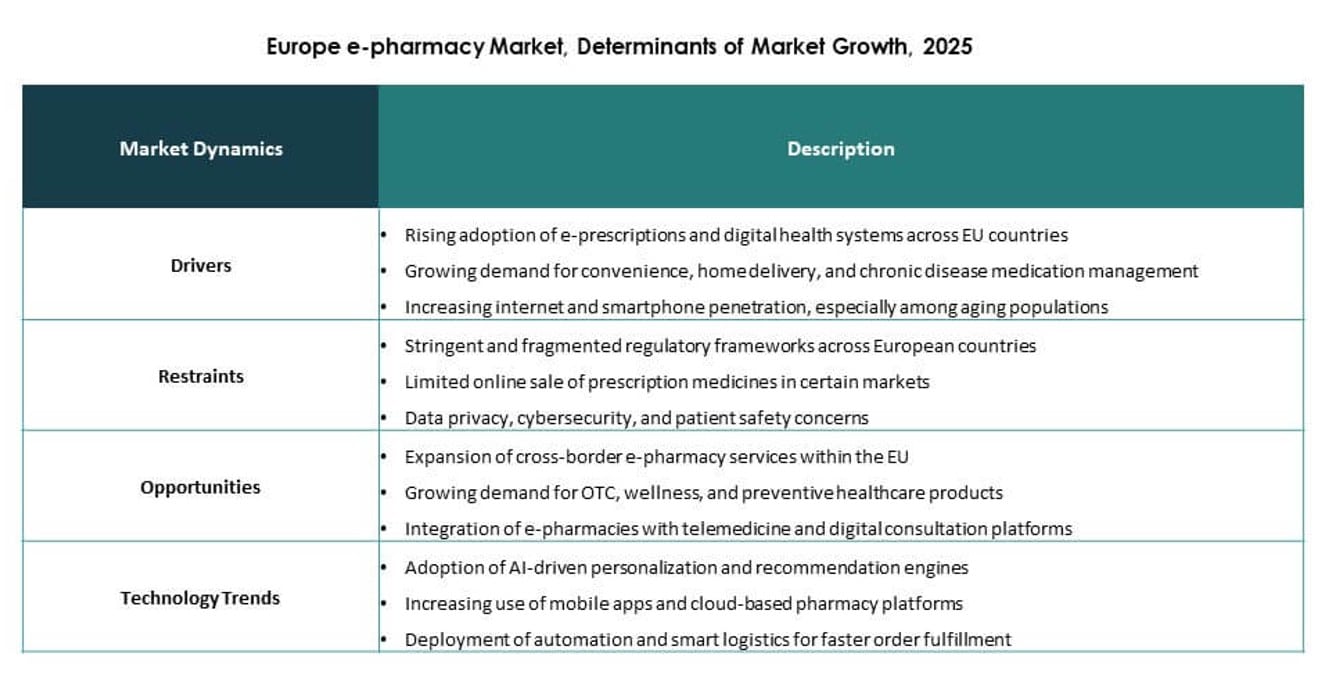
By Type
- Over-the-Counter (OTC)
- Prescription Medicine
By Platform
- Mobile
- Desktop
By Product Type
- Medications
- Health & Wellness and Nutrition
- Personal Care & Essentials
- Other Products
By Age Group
- Below 18 Years
- 18–50 Years
- 65 Years & Above
By Application
- Chronic Disease Management
- Acute Care & Short-Term Treatments
- Others
By Region
- Germany
- UK
- Sweden
- Italy
- France
- Rest of Europe
Regional Analysis
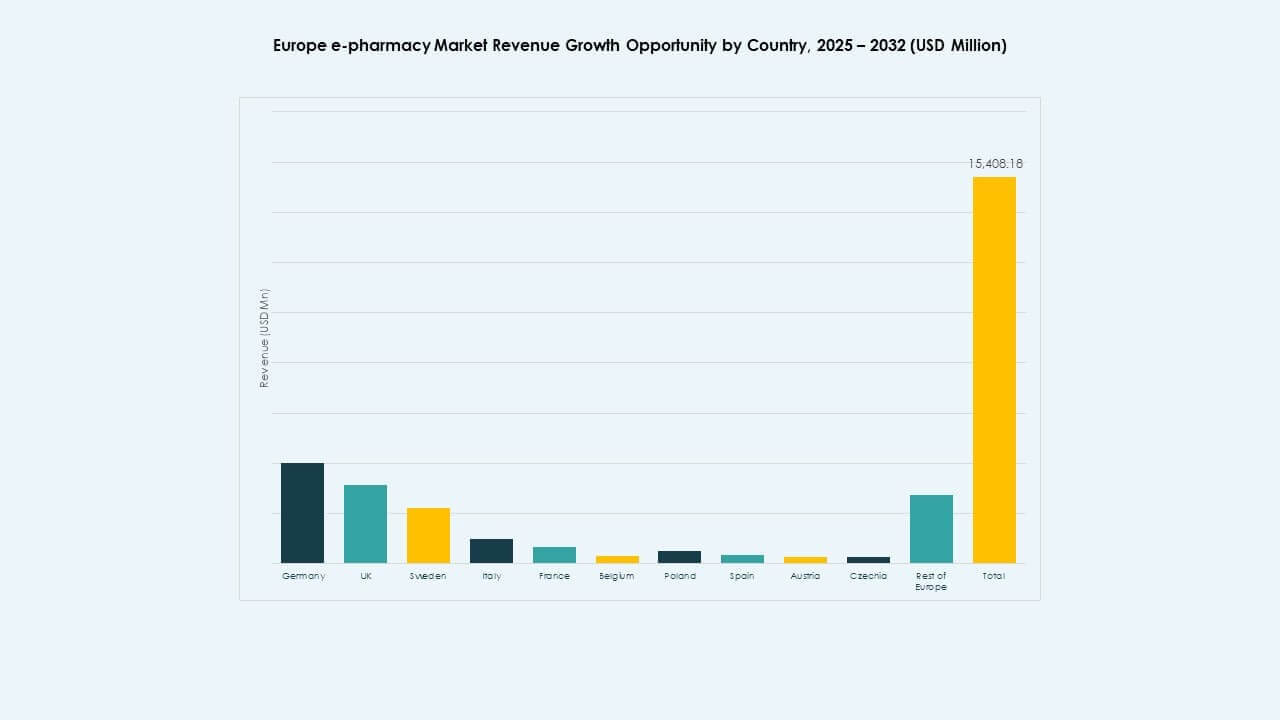
Western Europe remains the leading region in the Europe e-pharmacy market, accounting for nearly 40% of the total share. Germany, the UK, France, and Italy are key contributors, driven by established digital infrastructure and strong adoption of online healthcare services. Germany posted a CAGR of 7%, the lowest among major economies, indicating maturity and stable demand. The UK, France, and Sweden recorded 8% CAGR each, reflecting steady uptake supported by regulatory backing and rising chronic disease prevalence. Despite moderate growth rates, these countries hold significant value due to early entry and high consumer trust in e-health channels. The market here continues to expand through platform integration and mobile-first strategies.
Southern Europe, including Spain and Italy, contributes around 25% to the total market, fueled by increased awareness and rising smartphone penetration. Italy’s CAGR stands at 9%, while Spain accelerates at 11%, among the highest in the region. Local players and government-supported e-prescription programs are unlocking access across Tier 2 cities and older populations. The shift from desktop to mobile usage plays a pivotal role in driving new demand. Markets in this region are becoming more competitive with the entry of hybrid online–offline models targeting personalized services and wellness products. The Europe e-pharmacy market in Southern Europe benefits from cultural openness to digital transformation in retail.
Central and Eastern Europe represent approximately 35% of the market, with Poland and Czechia showing the fastest CAGR at 13% and 14% respectively. Austria and Belgium are growing at 11% and 10%, respectively, supported by evolving e-health policies and increased investments in healthcare digitization. This subregion holds immense potential due to its rapidly aging population and lower baseline adoption, which allows room for rapid scaling. E-pharmacies here are investing in multilingual platforms, localized inventory, and fast delivery to compete with Western counterparts. It continues to be a focus area for new entrants aiming to disrupt traditional brick-and-mortar drug distribution. The Europe e-pharmacy market in this region is undergoing rapid digitization that is reshaping access to healthcare.
Key Player Analysis
- DocMorris (Zur Rose Group)
- Redcare Pharmacy (formerly Shop Apotheke Europe)
- Atida Santé Discount
- The Boots Company PLC
- com Group
- Apotea AB
- Chemist Direct
- Chemist4U
- LloydsPharmacy (Online)
- Euro-Pharmas
- Express Pharmacy
- Pharmacy2U
- Pharmacy4U
- MedExpress Enterprises Ltd
- Parafarmacia-Online
Competitive Analysis
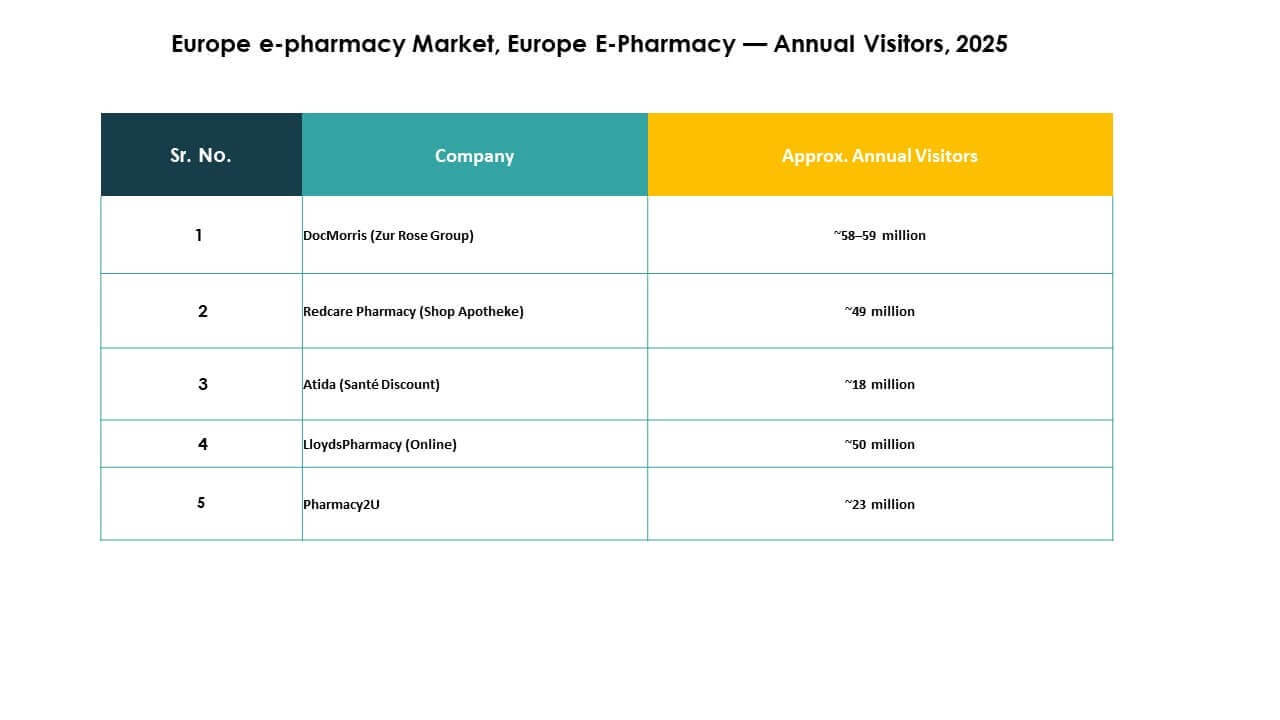
The Europe e-pharmacy market features a dynamic competitive landscape shaped by both large incumbents and digital-native players. Leading companies like DocMorris (Zur Rose Group), Redcare Pharmacy, and The Boots Company PLC leverage broad customer networks and strong logistics capabilities. Regional players such as Apotea AB and Apo.com Group maintain high visibility through localized services and strong brand presence. Pure digital pharmacies like Chemist Direct and Pharmacy2U appeal to younger consumers seeking convenience and speed. It creates a fragmented environment where customer experience and innovation drive advantage. Firms compete on pricing, delivery time, digital interface, and after-sales support. Regulatory alignment and partnerships with e-prescription providers enhance trust and efficiency. Pan-European players gain scale by integrating payment, logistics, and healthcare compliance across multiple markets. Strategic focus on mobile apps, AI-based tools, and personalized outreach separates top performers from the rest. Continuous investment in service design and platform capabilities defines future leadership in this evolving market.
Recent Developments
- In December 2025, Redcare Pharmacy officially launched a new online pharmacy operation in the Czech Republic specifically tailored to serve the Austrian market. This move, supported by a newly commissioned 30,000 m² distribution centre, aims to improve logistics efficiency and delivery speeds across the DACH region while centralizing fulfillment operations.
- In July 2025, Redcare Pharmacy secured a critical license extension for its CardLink technology, allowing it to continue digital e-prescription redemptions in Germany until January 31, 2027. This extension provides a necessary bridge for the company and its technology partner, eHealth Experts, to integrate the upcoming national PoPP standards without disrupting patient access.
Report Coverage
The research report offers an in-depth analysis based on Type, Platform, Product Type, Age Group, Application and Region. It details leading market players, providing an overview of their business, product offerings, investments, revenue streams, and key applications. Additionally, the report includes insights into the competitive environment, SWOT analysis, current market trends, as well as the primary drivers and constraints. Furthermore, it discusses various factors that have driven market expansion in recent years. The report also explores market dynamics, regulatory scenarios, and technological advancements that are shaping the industry. It assesses the impact of external factors and global economic changes on market growth. Lastly, it provides strategic recommendations for new entrants and established companies to navigate the complexities of the market.
Future Outlook
- The Europe e-pharmacy market will see steady expansion driven by increasing digital health adoption across all age groups and income levels.
- Strong mobile penetration and app-based engagement will make mobile platforms the preferred access point for most consumers.
- Chronic disease management will continue to dominate application segments due to consistent demand for long-term therapies.
- Cross-border logistics and multilingual platforms will support regional expansion and serve diverse consumer bases efficiently.
- AI-powered personalization, refill reminders, and predictive product recommendations will enhance customer retention.
- OTC and wellness product sales will increase as consumers prioritize preventive healthcare over reactive treatment.
- Strategic partnerships with hospitals, insurers, and telehealth providers will drive platform integration and service bundling.
- Cold chain and express delivery infrastructure investment will strengthen fulfillment capabilities and improve customer experience.
- Mid-sized regional players will scale quickly by localizing services and complying with country-specific regulations.
- The Europe e-pharmacy market will mature into a full-service digital health ecosystem, merging pharmacy, consultation, and wellness in one platform.
Request a Free Sample
Fill in your details and we'll send you a free sample report.
- Sample data tables & charts
- Research methodology
Need a Custom Version of This Report?
Tailor the scope, geography, or segments to your exact requirements.
- Custom geography or segment scope
- Direct access to our analyst team
Frequently Asked Questions
What is the current market size for Europe e-pharmacy Market, and what is its projected size in 2032?
At what Compound Annual Growth Rate is the Europe e-pharmacy Market projected to grow between 2024 and 2032?
Which Europe e-pharmacy Market segment held the largest share in 2024?
What are the primary factors fueling the growth of the Europe e-pharmacy Market?
Who are the leading companies in the Europe e-pharmacy Market?
Which region commanded the largest share of the Europe e-pharmacy Market in 2024?
Table of Content
Chapter 1. Report Introduction
- 1.1 Report Description & Purpose
- 1.1.1 Report Title & Market Definition
- 1.1.2 Unique Selling Propositions (USP) & Key Differentiators
- 1.1.3 Value Proposition for Stakeholders
- 1.2 Research Objectives
- 1.2.1 Market Sizing Objectives (Volume & Revenue) (Volume Where Applicable)
- 1.2.2 Segmentation Objectives
- 1.2.3 Competitive Intelligence Objectives
- 1.2.4 Forecast & Scenario Objectives
- 1.3 Report Scope
- 1.3.1 Europe e-pharmacy Scope – Segments & Subsegments Covered
- 1.3.2 Geographic Scope – Selected Region & Countries Covered
- 1.3.3 Historical Period, Base Year & Forecast Period (2024; forecast to 2032)
- 1.3.4 Inclusions & Exclusions
- 1.4 Industry Classification & Applicable Codes
- 1.5 Currency, Measurement Units & Valuation Basis
- 1.6 Target Stakeholders
- 1.7 Limitations & Assumptions
Chapter 2. Executive Summary
- 2.1 Europe e-pharmacy Snapshot
- 2.1.1 Market Size – Historical (2024) & Forecast (2024-2032) (2024: USD 14,448.91 million → 2032: USD 31,254.30 million)
- 2.1.2 Volume & Revenue – Regional Totals (Volume Where Applicable)
- 2.1.3 Key Market Highlights – Top Five Facts
- 2.2 Europe e-pharmacy Segmentation Snapshot
- 2.2.1 Market Split by Country – 2024 vs. 2032
- 2.3 Competitive Snapshot
- 2.3.1 Top 10 Players by Revenue Share – 2024
- 2.3.2 Top 10 Players by Volume Share – 2024 (Volume Where Applicable)
- 2.3.3 Recent Strategic Developments (18-Month Summary)
- 2.4 Key Investment Highlights & Strategic Conclusions
Chapter 3. Europe e-pharmacy Dynamics & Industry Analysis
- 3.1 Market Overview & Context
- 3.1.1 Europe e-pharmacy Position in the Broader Industry Value Chain
- 3.1.2 Demand Structure & Purchasing Dynamics
- 3.1.3 Market Maturity & Development Stage by Country
- 3.2 Europe e-pharmacy Drivers
- 3.3 Europe e-pharmacy Restraints & Challenges
- 3.4 Europe e-pharmacy Opportunities
- 3.5 Porter's Five Forces Analysis
- 3.5.1 Threat of New Entrants
- 3.5.2 Bargaining Power of Suppliers
- 3.5.3 Bargaining Power of Buyers
- 3.5.4 Threat of Substitutes
- 3.5.5 Competitive Rivalry – Intensity Assessment
- 3.6 Europe e-pharmacy Value Chain Analysis
- 3.6.1 Upstream – Key Inputs, Resources & Suppliers
- 3.6.1.1 Key Input/Resource 1
- 3.6.1.2 Key Input/Resource 2
- 3.6.1.3 Key Input/Resource 3
- 3.6.2 Midstream – Core Operations & Value Creation
- 3.6.2.1 Operating Model & Process Overview
- 3.6.2.2 Key Operating Locations & Capabilities by Company
- 3.6.3 Downstream – Market Channels & End Users
- 3.6.3.1 Direct Sales & Customer Engagement Channels
- 3.6.3.2 Indirect Sales, Intermediaries & Partner Channels
- 3.6.4 Value Chain Profitability Analysis
- 3.6.1 Upstream – Key Inputs, Resources & Suppliers
- 3.7 PESTEL Analysis
- 3.7.1 Political Factors
- 3.7.2 Economic Factors
- 3.7.3 Social Factors
- 3.7.4 Technological Factors
- 3.7.5 Environmental Factors
- 3.7.6 Legal Factors
- 3.8 Europe e-pharmacy Supply Chain Analysis
- 3.8.1 Critical Input & Resource Availability Risk Assessment
- 3.8.2 Supplier & Operational Concentration Risk (Geographic Exposure)
- 3.8.3 Supply & Service Disruption Impact Analysis
- 3.9 Regional & Country Regulatory Landscape
Note: The regulatory and policy landscape section covers regulations based on their applicability to the market, Europe e-pharmacy category, geography, and scope of the study. Only regulatory frameworks with a material impact on operations, compliance, trade, sustainability, or market access are analyzed in detail.
Chapter 4. Key Investment Pockets & Opportunity Analysis
- 4.1 Europe e-pharmacy Attractiveness Analysis
- 4.1.1 By Country – Investment Attractiveness Matrix (Market Size × CAGR)
- 4.2 Absolute Revenue Growth Opportunity
- 4.2.1 By Country – Absolute Revenue Growth Through 2032
- 4.3 Incremental Demand Opportunity
- 4.3.1 By Country – Incremental Demand Through 2032
- 4.3.2 Segment – Incremental Demand
- 4.4 Emerging Submarket Opportunity Deep Dive (Subject to Applicability)
- 4.5 Priority Country Opportunity Scorecards
- 4.5.1 Priority Country 1
- 4.5.2 Priority Country 2
- 4.5.3 Priority Country 3
- 4.5.4 Priority Country 4
Note: Priority countries are selected from within the region covered by the study. Numbered entries are indicative and are populated with relevant country names based on market size, growth potential, and strategic relevance.
Chapter 5. Europe e-pharmacy Cross-Border Trade & Market Access Analysis
- 5.1 Intra-Regional & Extra-Regional Trade Overview
- 5.1.1 Regional Export Value by Country (2024)
- 5.1.2 Regional Export Volume by Country (2024) (Volume Where Applicable)
- 5.1.3 Regional Import Value by Country (2024)
- 5.1.4 Regional Import Volume by Country (2024) (Volume Where Applicable)
- 5.1.5 Net Trade Balance by Country (2024)
- 5.2 Export Analysis – Segment
- 5.2.1 Category 1 (Applicable Classification Code)
- 5.2.2 Category 2 (Applicable Classification Code)
- 5.2.3 Category 3 (Applicable Classification Code)
- 5.2.4 Category 4 (Applicable Classification Code)
- 5.2.5 Category 5 (Applicable Classification Code)
- 5.3 Import Analysis – Segment
- 5.3.1 Category 1 (Applicable Classification Code)
- 5.3.2 Category 2 (Applicable Classification Code)
- 5.3.3 Category 3 (Applicable Classification Code)
- 5.3.4 Category 4 (Applicable Classification Code)
- 5.3.5 Category 5 (Applicable Classification Code)
- 5.4 Cross-Border Pricing & Transaction Benchmarks
- 5.4.1 Export Pricing – Segment & Country
- 5.4.2 Import Pricing – Segment & Source Country
- 5.4.3 Price Trends (2024)
- 5.5 Key Cross-Border Trade & Delivery Routes
- 5.5.1 Cross-Border Trade/Delivery Route 1
- 5.5.2 Cross-Border Trade/Delivery Route 2
- 5.5.3 Cross-Border Trade/Delivery Route 3
- 5.5.4 Cross-Border Trade/Delivery Route 4
- 5.5.5 Cross-Border Trade/Delivery Route 5
- 5.6 Trade Policy & Market Access Impact Assessment
- 5.6.1 Tariff & Non-Tariff Barriers
- 5.6.2 Regional Trade & Economic Integration Frameworks
- 5.6.3 Bilateral & Multilateral Trade Agreements
- 5.6.4 Cross-Border Operating, Licensing & Localization Requirements
Note: Cross-border analysis applies where relevant to Europe e-pharmacy. Country trade flows distinguish intra-regional activity from trade with markets outside the region. Regional external trade totals exclude intra-regional flows to avoid double counting. Classifications and transaction measures follow the market scope; volume and route analyses apply only where meaningful.
Chapter 6. Competitive Landscape & Company Benchmarking
- 6.1 Europe e-pharmacy Concentration & Structure
- 6.1.1 Herfindahl-Hirschman Index (HHI) – vs. 2024
- 6.1.2 Leading, Mid-Sized & Emerging Player Structure
- 6.1.3 Global, Regional & Local Player Dynamics
- 6.2 Europe e-pharmacy Share Analysis – 2024
- 6.2.1 Regional Revenue Share by Company
- 6.2.2 Regional Volume Share by Company (Volume Where Applicable)
- 6.2.3 Company Revenue Share by Country
- 6.2.4 Market Share Evolution ( vs. 2024)
- 6.2.5 Company Market Share by Key Segment
- 6.2.6 Company Market Share by Customer Group
- 6.3 Operating Scale, Capacity & Infrastructure Analysis
- 6.3.1 Regional Operating Scale & Supply Capacity
- 6.3.2 Resource Utilization & Operating Efficiency
- 6.3.3 Output, Service Delivery & Activity Metrics
- 6.3.4 Operating Footprint & Infrastructure Map
- 6.3.5 Planned Operational & Capacity Expansion
- 6.4 Europe e-pharmacy Competitive Benchmarking Matrix
- 6.4.1 Revenue, Growth, Profitability & Operating Metric Comparison
- 6.4.2 Channel Revenue Mix
- 6.4.3 Revenue Exposure by Country Within the Region
- 6.4.4 R&D Intensity
- 6.4.5 Sustainability Maturity
- 6.5 Strategic Developments in Europe e-pharmacy (Last 24 Months)
- 6.5.1 Mergers, Acquisitions & Divestments
- 6.5.2 New Products, Services & Solutions in Europe e-pharmacy
- 6.5.3 Operational & Infrastructure Expansions
- 6.5.4 Strategic Alliances, Joint Ventures & Partnerships
- 6.5.5 Distribution Expansion & Market Entry
- 6.5.6 Sustainability & ESG Initiatives
- 6.6 Competitive Strategy Mapping
- 6.6.1 Leader, Challenger, Follower & Niche Classification
- 6.6.2 Pricing Strategy Comparison
- 6.6.3 Channel Strategy Matrix
Note: Strategic developments are included based on their materiality and the availability of reliable information.
Chapter 7. Europe e-pharmacy – By Sales & Delivery Channel
- 7.1 Segment Overview
- 7.1.1 Volume & Revenue Split by Channel (2024 & 2032) (Volume Where Applicable)
- 7.1.2 Channel Mix Evolution (2024-2032)
Chapter 8. Country Market Analysis – Regional Overview
- 8.1 Country Market Overview Within the Region
- 8.1.1 Country Volume Share Within the Region (Where Applicable)
- 8.1.2 Country Revenue Share Within the Region
- 8.1.3 Market Volume by Country (Where Applicable)
- 8.1.4 Market Revenue by Country
- 8.1.5 Country Forecasts Through 2032
- 8.2 Cross-Country Segment Analysis
- 8.2.1 By Sales & Delivery Channel
- 8.2.2 By Competitive Positioning & Price Tier
Chapter 9. Europe e-pharmacy – Priority Country 1
Chapter 10. Europe e-pharmacy – Priority Country 2
Chapter 11. Europe e-pharmacy – Priority Country 3
Chapter 12. Europe e-pharmacy – Priority Country 4
Chapter 13. Europe e-pharmacy Company Profiles
- 13.1 [Company 01]
- 13.1.1 Company Overview
- 13.1.2 Key Management Personnel
- 13.1.3 Products & Services Portfolio
- 13.1.4 Financial Performance
- 13.1.5 Regional Market Focus & Country Presence
- 13.1.6 Recent Developments & Strategic Initiatives
Note: The company profile list is preliminary and may change based on research findings, market developments, data availability, and client requirements.
Chapter 14. Appendices
- Appendix A – List of Abbreviations & Acronyms
- Appendix B – Industry Classification Code Reference – Full Series
- Appendix C – Supply, Output & Operating Capacity Data Tables
- Appendix D – End-Use & Demand Base Tables
- Appendix E – Demand, Adoption & Usage Assumptions
- Appendix F – Pricing & Revenue Metric Reference Tables
- Appendix G – Company Operations & Infrastructure Database
- Appendix H – Cross-Border Trade & Activity Data Tables (Where Applicable)
- Appendix I – Regulatory Summary Tables
- Appendix J – Primary Research Participant List (Anonymized)
- Appendix K – Primary Research Questionnaire Framework
- Appendix L – Data Sources & Bibliography
- Appendix M – Market Size Divergence & Source Comparison
Chapter 15. Research Methodology
- 15.1 Research Framework & Philosophy
- 15.2 Secondary Research – Sources, Hierarchy & Data Extraction
- 15.3 Data Modeling – Country-Level Estimates & Regional Aggregation
- 15.4 Primary Research – Stakeholder Framework, LOI & Sample Sizes
- 15.5 Forecast Methodology – Regression, Scenario & Sensitivity Analysis
- 15.6 Quality Control – Four-Layer Validation Framework
- 15.7 Limitations & Standard Assumptions
- 15.8 Disclaimer
