
| REPORT ATTRIBUTE | DETAILS |
|---|---|
| Historical Period | 2019-2022 |
| Base Year | 2023 |
| Forecast Period | 2024-2032 |
| Abrasives And Abrasives Machines Market Size 2023 | USD 46,841.6 Million |
| Abrasives And Abrasives Machines Market, CAGR | 6.50% |
| Abrasives And Abrasives Machines Market Size 2032 | USD 82,561.6 Million |
Market Insights
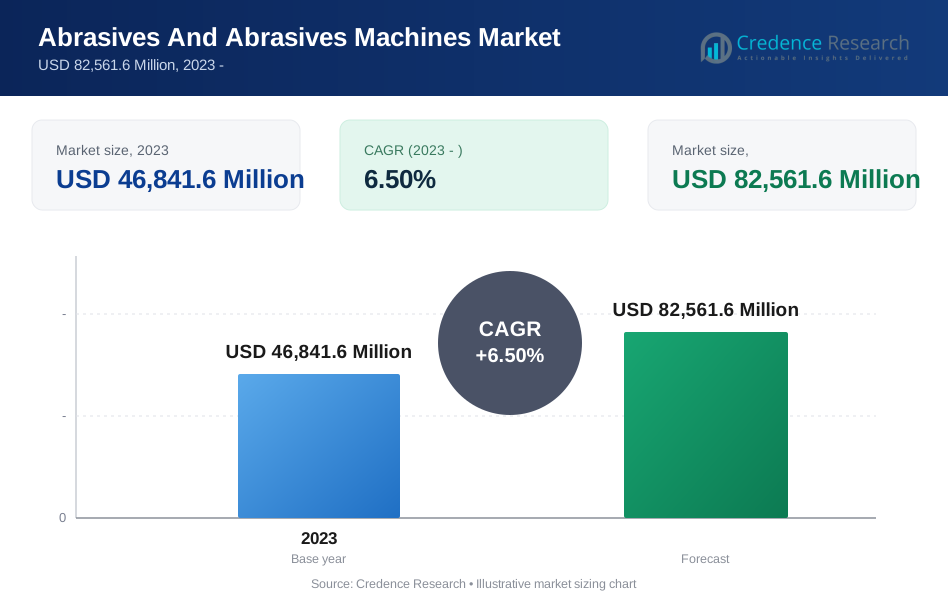
- The global demand for Abrasives And Abrasives Machines was valued at USD 46,841.6 Million in 2023 and is expected to reach USD 82,561.6 Million in 2032, growing at a CAGR of 6.50% between 2024 and 2032.
- The Coated Abrasives category contributes the most to the market and is projected to grow at a reasonable CAGR during the forecast period, as well as The bonded category is expected to rise dramatically.
- The metalworking segment is expected to increase fast during the projected period, and the product has been in strong demand across the electronics categories.
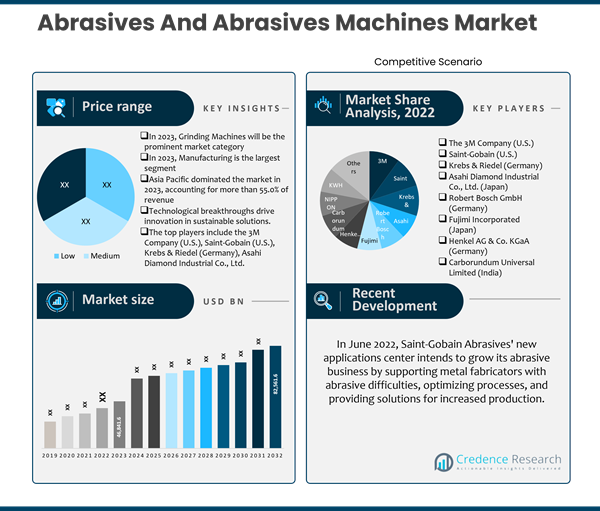
- In 2023, Grinding Machines are the prominent market segment, with Cutting Machines accounting for another significant market share.
- Manufacturing industries are the leading industry, while construction and infrastructure are another high-demand market area.
- Asia Pacific dominated the market in 2023, accounting for more than 55.0% of revenue, while North America is predicted to increase steadily between 2024 and 2032.
- The growing use of abrasives in the construction industry promotes market expansion.
- Limited access to raw materials may slow market expansion.
Executive Summary
Market Definition
Abrasives are materials used in a variety of industrial and commercial applications to shape, finish, or polish surfaces using abrasion. Abrasion is defined as the mechanical wear or loss of material from a surface caused by friction or rubbing action. Abrasives are distinguished by their hardness, toughness, and ability to resist repeated use with minimal wear. The introduction of significantly improved concrete with specialized features and characteristics, such as self-compacting and high-performance concrete, is the primary driver of the abrasives market. The need for high-quality abrasives is being driven by increased infrastructure and construction activity. Furthermore, the market for abrasives is expected to grow as people place a greater emphasis on long-lasting and powerful building materials.
Market Overview
The global Abrasives And Abrasives Machines market has witnessed steady growth in recent years and is expected to grow at a CAGR of 6.50% between 2024 and 2032. The market was valued at USD 46,841.6 million in 2023 and is expected to reach USD 82,561.6 million in 2032.
The global abrasive and abrasive machine market is expanding steadily. The market is being driven by rising demand from numerous industries, including manufacturing, construction, automotive, aerospace, and others. The demand for precision machining, surface finishing, and material shaping is driving the industry forward. Furthermore, technological advances in abrasive materials and machinery improve industrial process efficiency and productivity.
However, the market faces various constraints, such as shifting raw material prices, which can affect the entire cost of production. Environmental restrictions governing the disposal of abrasive waste and emissions from abrasive operations also provide hurdles to market expansion. Furthermore, the industry is competitive, with numerous major firms striving for market dominance, resulting in pricing pressures and fierce rivalry. These factors limit the growth of the Abrasives And Abrasive Machines Market.
Segmentation by Type of Abrasive Material
- The Coated Abrasives segment contributes the most to the market and is predicted to increase at a respectable CAGR during the forecast period. The coated section consists of grain, backing material, and bonding adhesive. These ingredients give the product a unique characteristic that makes it appropriate for a wide range of applications.
- The bonded category is likely to increase significantly. A bonded abrasive is composed of a component stored in a matrix known as a binder.
Segmentation by Applications
- The Metalworking segment is predicted to grow rapidly during the forecast period. This sort of fabrication is used to create metal structures by bending, cutting, and assembly procedures. This product is used as cut-off saws, also known as chop saws, with steel-cutting abrasive disks that cut metals to the appropriate shape.
- In automotive applications, the product is mostly utilized as grinding wheels and grinding segments to smooth or roughen surfaces before polishing, fitting, or painting. The expanding number of applications for cleaning, deburring, and repairing automobile parts will drive segment expansion.
- The product has been in high demand across electronics categories.
Segmentation by Type of Abrasive Machine
- In 2023, Grinding Machines is the dominant market segment. Grinding machines are commonly used in a variety of sectors for precision grinding, shaping, and finishing of materials. They play an important role in industrial operations that need great precision and surface quality. Grinding machines are in high demand due to their versatility and importance in the metalworking, automotive, aerospace, and other industries.
- Cutting Machines account for another major market share. Cutting machines are essential in businesses that require the precise cutting of materials into certain shapes and sizes. They are widely utilized in metalworking, woodworking, and other manufacturing operations.
Segmentation by End User
- Manufacturing Industries is the dominant segment. Abrasives and abrasive machines are widely used in the manufacturing industry for a variety of activities, including material grinding, cutting, and polishing. This segment's growth is mostly driven by demand from manufacturing sectors such as automotive, metalworking, and equipment.
- Construction and infrastructure are another high-demand market category.
Segmentation by Region
- In 2023, Asia Pacific dominated the market, accounting for more than 55.0% of revenue.
- North America is expected to see consistent growth from 2024 to 2032.
- The rest of the world, including Latin America, the Middle East, and Africa, supplies the remaining demand for Abrasives And Abrasives Machines.
In 2023, Asia Pacific dominated the market, accounting for more than 55.0% of revenues. Some of the elements projected to drive this expansion are infrastructure development, increased manufacturing investment, and more EV production in developing economies. Southeast Asian countries are prospective markets for abrasives. For example, the General Statistics Office of Vietnam reported that the industrial production index increased by 5.8% in 2023 compared to 2022. The growth of the manufacturing and processing sectors was a primary driver of the industrial sector's expansion. Developments in the country's manufacturing sector have increased the demand for machinery and products.
Moreover, North America is predicted to rise steadily in the next years, driven by rising demand for automotive, aerospace, and defense industries. Despite the pandemic-induced slowdown in 2020, the region's increased focus on electric vehicle production, combined with a revival in aircraft manufacturing, is likely to support market growth in the next years.
Key Highlights of the Report
The global Abrasives And Abrasives Machines market is segmented by Type of Abrasive Material, Applications, Type of Abrasive Machines, End User, and region. In 2023, Grinding Machines will be the dominating market sector, with the Coated Abrasives segment contributing the most. Furthermore, Cutting Machines account for a sizable market share, and Construction and Infrastructure is another in-demand industry segment. Additionally, the Metalworking segment is expected to expand substantially during the projected period, with Asia Pacific leading the market growth.
The key market drivers include increasing awareness and adoption of sustainable and eco-friendly abrasive materials, which is allowing firms to offer environmentally responsible solutions. Also, the key limits of the market are high rivalry in the industry from both incumbent firms and new entrants, which can produce pricing pressures and diminish profit margins for enterprises, Fluctuating raw material prices might affect abrasive production costs, causing pricing concerns for market players.
Nonetheless, Asia-Pacific will lead the global market in 2023. Infrastructure development has raised investment in the manufacturing sector, and the expansion of electric vehicle production in the region's growing countries is expected to drive market growth over the forecast period. In addition, North America is predicted to rise steadily in the next years due to rising demand for automotive, aerospace, and defense industries.
What Are The Main Drivers Of The Global Abrasives And Abrasives Machines Market?
The Abrasives and Abrasives Machines Market is expanding due to increased demand for accurate machining and surface finishing in critical industries such as automotive, aerospace, and construction. The growing need for high-quality surface treatment is driving the industry forward. Furthermore, technological advances in abrasive materials and gear are increasing efficiency and productivity, making abrasive solutions more appealing to a wider range of customers. Furthermore, the market is benefiting from an increased emphasis on sustainability, with businesses introducing eco-friendly abrasive products to fulfill consumers' ecologically sensitive needs.
What Are The Major Challenges Faced By The Global Abrasives And Abrasives Machines Market?
Despite the market's expansion, it confronts problems such as fluctuating raw material prices, which can affect production costs and provide pricing uncertainty for producers. Furthermore, tight rules and standards governing worker safety and environmental effect in abrasive operations provide compliance challenges for enterprises in this area. Furthermore, severe rivalry in the market, both from existing firms and new entrants, can cause pricing pressures and reduce profit margins, making it a difficult landscape for businesses to traverse.
What Are The Growth Opportunities In The Global Abrasives And Abrasives Machines Market?
The global expansion of the construction and industrial industries is driving demand for surface finishing and material shaping solutions, creating potential opportunities in the Abrasives and Abrasives Machines Market. Furthermore, the growing use of automation and robots in industrial processes necessitates modern abrasive machines that can easily interface with automated systems, opening up new opportunities for market growth.
Market Drivers
The increasing use of abrasives in the construction industry is aiding market growth
Abrasives are used in metalworking applications such as weld preparation and welding seam smoothing during the construction of bridges and structures. Abrasives are also used in slip-prone construction areas such as flooring, ramps, steps, and stairways. Similarly, mechanical and abrasive techniques such as grinding, lapping, and polishing are employed to create a wide range of building materials. The construction sector use diamond-tipped saw blades, grinding discs, cutting discs, and abrasive compounds. The global focus on infrastructure development has resulted in an increase in bridge, tunnel, highway, and airport construction projects. These projects frequently necessitate surface preparation, concrete repair, and maintenance work that involves the use of abrasives.
Market Restraints
Limited Access to Raw Materials
Restricted access to raw materials in the Abrasives and Abrasives Machines Market may further impede production, raising associated costs, because the availability of certain raw materials—abrasives, binders, and grains, in particular—is critical in the preparation of abrasive products and machines. Scarcity or limitation on vital assets would disrupt the supply chain and raise prices, impacting a firm's overall production and competitiveness. Alternative sourcing or new product creation can be difficult at times, necessitating ingenuity to overcome constraints resulting from a limited raw material supply.
Opportunities
Increase in the use of abrasives for a variety of purposes to expand the market
The abrasives and abrasives machines market has the potential for growth because abrasives are a versatile substance that is increasingly being used for non-traditional purposes. Abrasives are increasingly being used in various industries for precise grinding, surface finishing, and material shaping. The growing need for abrasives in industries such as automotive, construction, and manufacturing provides an excellent opportunity for market expansion. This trend will allow enterprises to capitalize by developing new abrasive materials and machinery to match the market's diverse uses and industries. Capitalizing on the increased use of abrasives, the market has the potential to expand rapidly and reach new highs.
Competitive Landscape
Key Players
The global Abrasives And Abrasives Machines market is highly competitive, with several key players. Some of the major players in the market and their market share are as follows:
- The 3M Company (U.S.)
- Saint-Gobain (U.S.)
- Krebs & Riedel (Germany)
- Asahi Diamond Industrial Co., Ltd. (Japan)
- Robert Bosch GmbH (Germany)
- Fujimi Incorporated (Japan)
- Henkel AG & Co. KGaA (Germany)
- Carborundum Universal Limited (India)
- NIPPON RESIBON CORPORATION (Japan)
- KWH Mirka (Finland)
- NORITAKE CO., LIMITED (Japan)
These organizations prioritize product innovation, distribution channel expansion, and mergers and acquisitions to stay competitive.
The global Abrasives And Abrasives Machines market's key players continually seek to stay ahead by offering new products and developments.
In February 2022, Carborundum Universal Ltd has announced that it is purchasing a 100% share in RHODIUS Abrasives. This acquisition will expand the company's geographical base and provide market-strengthening opportunities in the worldwide market.
In May 2022, 3M is investing $58 million in an 80,000-square-foot expansion of its Valley, Nebraska plant to increase manufacturing of respiratory and hearing protection products and create 50 new jobs.
How are Companies Performing in the Abrasives And Abrasives Machines Market?
Companies involved in the Abrasives and Abrasives Machines Market are working on innovations that improve sustainability and reduce carbon emissions. The majority of corporations invest in R&D to develop environmentally friendly abrasive products and machinery with little environmental impact. Top organizations utilize sustainable production strategies to reduce waste generation and energy use. Furthermore, the company is working to reduce carbon emissions during production and transportation in order to contribute to global sustainability. This not only expresses a sense of responsibility on the part of the firm, but it also meets the market's growing desire for green solutions.
Summary of Key Findings
- The primary market opportunity is the increased use of abrasives for a number of uses.
- Market segmented by Type of Abrasive Material, Applications, Type of Abrasive Machines, End User, and region.
- The Metalworking segment is expected to increase fast during the projected period.
- In 2023, Grinding Machines are the prominent market segment
- Asia Pacific is leading market growth; the market is highly competitive with key players including The 3M Company (U.S.), Saint-Gobain (U.S.), Krebs & Riedel (Germany), Asahi Diamond Industrial Co., Ltd. (Japan), Robert Bosch GmbH (Germany) and Others.
Future Outlook
- Increased growth fueled by rising demand for precise machining.
- Technological breakthroughs drive innovation in sustainable solutions.
- Opportunities for automated integration.
- The development of sophisticated abrasive materials and machinery.
- Issues with raw material price volatility and competitive pressures.
- Evolution in pace with the global construction and manufacturing industries.
How CXOs Can Benefit from the Credence Research Abrasives And Abrasives Machines Market Report
The Credence Research Abrasives And Abrasives Machines Market Report provides CXOs with a comprehensive overview of the market, including:
- Market size and growth forecast:The report provides detailed estimates of the global Abrasives And Abrasives Machines market size, segmented by Type of Abrasive Material, Application, Type of Abrasive Machine, End User, and region. It also includes forecasts for the market through 2032 based on key trends and drivers.
- Market segmentation:The report segments the Abrasives And Abrasives Machines market by Type of Abrasive Material, Application, Type of Abrasive Machine, End User, and region. This segmentation provides CXOs with a granular understanding of the market and the opportunities in each segment.
- Competitive Landscape:The report profiles the key players in the Abrasives And Abrasives Machines market and provides insights into their strategies, product offerings, and financial performance. This information can help CXOs to identify and assess their competition.
- Key trends and drivers:The report identifies and analyzes the key trends and drivers that are shaping the Abrasives And Abrasives Machines market. This information can help CXOs to make informed decisions about their investments and strategies.
CXOs can use the insights from the Credence Research Abrasives And Abrasives Machines Market Report to:
- Identify growth opportunities:The report can help CXOs identify new growth opportunities in the Abrasives And Abrasives Machines market. For example, by analyzing market trends and consumer preferences, CXOs can pinpoint emerging sectors with high demand for abrasives. They can also identify regions or industries where there is a growing need for specialized abrasive products or machines.
- Make informed investment decisions:The report can help CXOs make informed investment decisions about Abrasives And Abrasives Machines. For example, by analyzing market forecasts and competitive landscapes outlined in the report, CXOs can assess the potential return on investment in different segments of the market.
- Develop competitive strategies:The report can help CXOs develop competitive strategies for their Abrasives And Abrasives Machines businesses. For example, the report may offer information on innovative use cases for Abrasives And Abrasives Machines, potential partnerships or collaborations with other industry players, and strategies to differentiate products or services in the market.
- Track market developments:The report can help CXOs track market developments and stay ahead of the curve. For example, the report provides insights into the latest trends and innovations in the Abrasives And Abrasives Machines market.
Overall, the Credence Research Abrasives And Abrasives Machines Market Report is a valuable resource for CXOs who are looking to gain a deeper understanding of the market and identify opportunities for growth.
Segmentation
-
Type of Abrasive Material:
- Bonded Abrasives
- Coated Abrasives
- Superabrasives
- Loose Abrasives
-
Application:
- Metalworking
- Woodworking
- Construction
- Precision Engineering
- Electronics
- Automotive
- Medical
- Aerospace
-
Type of Abrasive Machine:
- Grinding Machines
- Cutting Machines
- Polishing Machines
- Sandblasting Machines
- Lapping Machines
- Honing Machines
- Deburring Machines
-
End User:
- Manufacturing Industries
- Construction and Infrastructure
- Woodworking and Furniture
- Medical Devices and Instruments
- Electronics and Semiconductor
- Automotive Repair and Restoration
- Aerospace and Defense
-
By Region
- North America
- US
- Canada
- Mexico
- Europe
- Germany
- France
- UK
- Italy
- Spain
- Rest of Europe
- Asia Pacific
- China
- Japan
- India
- South Korea
- South-east Asia
- Rest of Asia Pacific
- Latin America
- Brazil
- Argentina
- Rest of Latin America
- Middle East & Africa
- GCC Countries
- South Africa
- Rest of Middle East and Africa
- North America
Adjacent Markets
In the Abrasives And Abrasives Machines market, there are several adjacent markets which has high revenue growth opportunities. The key adjacent markets for Abrasives And Abrasives Machines market -
Adjacent Markets |
||
| Machine Tools Market | Metalworking Machinery Market | Surface Treatment Equipment Market |
| Cutting Tools Market | CNC Machines Market | Abrasive Belts Market |
| Industrial Robotics Market | Grinding Machines Market | Coated Abrasives Market |
Request a Free Sample
Fill in your details and we'll send you a free sample report.
- Sample data tables & charts
- Research methodology
Need a Custom Version of This Report?
Tailor the scope, geography, or segments to your exact requirements.
- Custom geography or segment scope
- Direct access to our analyst team
Frequently Asked Questions
What is the current size of the global Abrasives And Abrasives Machines market?
What is the expected growth rate of the Abrasives And Abrasives Machines market between 2024 and 2032?
Which segment is leading the market share in terms of Type of Abrasive Material?
Which Application segment governs the demand for Abrasives And Abrasives Machiness in the world?
Which Application segment is expected to post the fastest growth rate during the forecast period?
Which region is fueling the growth of the Abrasives And Abrasives Machines industry?
Who are the major players in the global Abrasives And Abrasives Machines market?
What are the major market drivers of the Abrasives And Abrasives Machines industry?
What are the major market restraints of the Abrasives And Abrasives Machines industry?
What are the major market opportunities of the Abrasives And Abrasives Machines industry?
Table of Content
Chapter 1. Report Introduction
- 1.1 Report Description & Purpose
- 1.1.1 Report Title & Market Definition
- 1.1.2 Unique Selling Propositions (USP) & Key Differentiators
- 1.1.3 Value Proposition for Stakeholders
- 1.2 Research Objectives
- 1.2.1 Market Sizing Objectives (Volume & Revenue)
- 1.2.2 Segmentation Objectives
- 1.2.3 Competitive Intelligence Objectives
- 1.2.4 Forecast & Scenario Objectives
- 1.3 Report Scope
- 1.3.1 Abrasives And Abrasives Machines Scope – Types & Subtypes Covered
- 1.3.2 Geographic Scope – Regions & Countries Covered
- 1.3.3 Historical Period, Base Year & Forecast Period (2023; forecast to the forecast period)
- 1.3.4 Inclusions & Exclusions
- 1.4 HS Code & Classification Framework
- 1.5 Currency, Units & Pricing Basis
- 1.6 Target Stakeholders
- 1.7 Limitations & Assumptions
Chapter 2. Executive Summary
- 2.1 Global Abrasives And Abrasives Machines Market Snapshot
- 2.1.1 Market Size – Historical (2023) & Forecast (the forecast period) (2023: USD 46,841.6 Million → forecast year: USD 82,561.6 Million)
- 2.1.2 Volume & Revenue – Global Totals
- 2.1.3 Key Market Highlights – Top Five Facts
- 2.2 Abrasives And Abrasives Machines Market Segmentation Snapshot
- 2.2.1 Market Split by Region – 2023 vs.
- 2.3 Competitive Snapshot
- 2.3.1 Top 10 Players by Revenue Share – 2023
- 2.3.2 Top 10 Players by Volume Share – 2023
- 2.3.3 Recent Strategic Developments (18-Month Summary)
- 2.4 Key Investment Highlights & Strategic Conclusions
Chapter 3. Abrasives And Abrasives Machines Market Dynamics & Industry Analysis
- 3.1 Market Overview & Context
- 3.1.1 Abrasives And Abrasives Machines Market Position in the Broader Automotive Value Chain
- 3.1.2 OEM vs. Replacement Market Dynamics
- 3.1.3 Market Maturity & Development Stage by Region
- 3.2 Abrasives And Abrasives Machines Market Drivers
- 3.3 Abrasives And Abrasives Machines Market Restraints & Challenges
- 3.4 Abrasives And Abrasives Machines Market Opportunities
- 3.5 Porter's Five Forces Analysis
- 3.5.1 Threat of New Entrants
- 3.5.2 Bargaining Power of Suppliers
- 3.5.3 Bargaining Power of Buyers
- 3.5.4 Threat of Substitutes
- 3.5.5 Competitive Rivalry – Intensity Assessment
- 3.6 Abrasives And Abrasives Machines Value Chain Analysis
- 3.6.1 Upstream – Raw Material/Input Suppliers
- 3.6.1.1 Raw Material/Input 1
- 3.6.1.2 Raw Material/Input 2
- 3.6.1.3 Raw Material/Input 3
- 3.6.2 Midstream – Production/Manufacturing/Service Delivery
- 3.6.2.1 Production/Process Overview
- 3.6.2.2 Key Facility Locations & Capacity by Manufacturer
- 3.6.3 Downstream – Distribution & End Consumer
- 3.6.3.1 Primary Channel – B2B/OEM
- 3.6.3.2 Secondary Channels – Dealer, Retail, Online, Direct
- 3.6.4 Value Chain Profitability Analysis
- 3.6.1 Upstream – Raw Material/Input Suppliers
- 3.7 PESTEL Analysis
- 3.7.1 Political Factors
- 3.7.2 Economic Factors
- 3.7.3 Social Factors
- 3.7.4 Technological Factors
- 3.7.5 Environmental Factors
- 3.7.6 Legal Factors
- 3.8 Abrasives And Abrasives Machines Supply Chain Analysis
- 3.8.1 Raw Material/Input Supply Risk Assessment
- 3.8.2 Manufacturing Concentration Risk (Geographic Exposure)
- 3.8.3 Trade Disruption Impact Analysis
- 3.9 Regulatory & Policy Landscape
Note: The regulatory and policy landscape section covers regulations based on their applicability to the market, Abrasives And Abrasives Machines category, geography, and scope of the study. Only regulatory frameworks with a material impact on operations, compliance, trade, sustainability, or market access are analyzed in detail.
Chapter 4. Key Investment Pockets & Opportunity Analysis
- 4.1 Abrasives And Abrasives Machines Market Attractiveness Analysis
- 4.1.1 By Region – Investment Attractiveness Matrix (Volume × CAGR)
- 4.2 Absolute Revenue Growth Opportunity
- 4.2.1 By Region – Absolute USD Growth Through the forecast period
- 4.3 Incremental Volume Opportunity
- 4.3.1 By Region – Incremental Volume Through the forecast period
- 4.3.2 Segment – Incremental Volume
- 4.4 Emerging Submarket Opportunity Deep Dive (Subject to Applicability)
- 4.5 Emerging Market Opportunity Scorecards
- 4.5.1 United States
- 4.5.2 Europe
- 4.5.3 Asia
- 4.5.4 Middle East & Africa
Note: Emerging Market Opportunity Scorecards will be included based on relevance and strategic importance. Regions listed are indicative and may vary depending on data availability and market dynamics.
Chapter 5. Abrasives And Abrasives Machines Import-Export Analysis & Trade Flows
- 5.1 Global Trade Overview
- 5.1.1 Global Export Value by Country (2023)
- 5.1.2 Global Export Volume by Country (2023)
- 5.1.3 Global Import Value by Country (2023)
- 5.1.4 Global Import Volume by Country (2023)
- 5.1.5 Net Trade Balance by Country (2023)
- 5.2 Export Analysis – Segment
- 5.2.1 Type 1 (HS Code)
- 5.2.2 Type 2 (HS Code)
- 5.2.3 Type 3 (HS Code)
- 5.2.4 Type 4 (HS Code)
- 5.2.5 Type 5 (HS Code)
- 5.3 Import Analysis – Segment
- 5.3.1 Type 1 (HS Code)
- 5.3.2 Type 2 (HS Code)
- 5.3.3 Type 3 (HS Code)
- 5.3.4 Type 4 (HS Code)
- 5.3.5 Type 5 (HS Code)
- 5.4 Average Unit Trade Prices
- 5.4.1 Average Export Price – Segment & Country
- 5.4.2 Average Import Price – Segment & Source Country
- 5.4.3 Price Trends (2023)
- 5.5 Key Trade Route Analysis
- 5.5.1 Trade Route 1
- 5.5.2 Trade Route 2
- 5.5.3 Trade Route 3
- 5.5.4 Trade Route 4
- 5.5.5 Trade Route 5
- 5.6 Trade Policy Impact Assessment
- 5.6.1 US Anti-Dumping & Section 301 Tariffs
- 5.6.2 EU Customs Union Impact
- 5.6.3 Major Free Trade Agreements
- 5.6.4 USMCA Rules of Origin
Note: Trade policy analysis will be included only where relevant to the Abrasives And Abrasives Machines market.
Chapter 6. Competitive Landscape & Company Benchmarking
- 6.1 Abrasives And Abrasives Machines Market Concentration & Structure
- 6.1.1 Herfindahl-Hirschman Index (HHI) – vs. 2023
- 6.1.2 Tier 1, Tier 2 & Tier 3 Market Structure
- 6.1.3 Global, Regional & Local Player Dynamics
- 6.2 Abrasives And Abrasives Machines Market Share Analysis – 2023
- 6.2.1 Global Revenue Share by Company
- 6.2.2 Global Volume Share by Company
- 6.2.3 Regional Revenue Share
- 6.2.4 Market Share Evolution ( vs. 2023)
- 6.2.5 OEM Segment Share by Company
- 6.2.6 Replacement Segment Share by Company
- 6.3 Production/Delivery Capacity & Facility Analysis
- 6.3.1 Global Installed Capacity
- 6.3.2 Capacity Utilization Rates
- 6.3.3 Production/Output Volume
- 6.3.4 Facility Locations & Capacity Map
- 6.3.5 Planned Capacity Additions
- 6.4 Abrasives And Abrasives Machines Competitive Benchmarking Matrix
- 6.4.1 Revenue, Volume, CAGR & Profitability Comparison
- 6.4.2 Channel Revenue Mix
- 6.4.3 Geographic Revenue Exposure
- 6.4.4 R&D Intensity
- 6.4.5 Sustainability Maturity
- 6.5 Strategic Developments in Abrasives And Abrasives Machines (Last 24 Months)
- 6.5.1 Mergers, Acquisitions & Divestments
- 6.5.2 New Abrasives And Abrasives Machines Launches
- 6.5.3 Facility Expansions
- 6.5.4 Strategic Alliances, Joint Ventures & Partnerships
- 6.5.5 Distribution Expansion & Market Entry
- 6.5.6 Sustainability & ESG Initiatives
- 6.6 Competitive Strategy Mapping
- 6.6.1 Leader, Challenger, Follower & Niche Classification
- 6.6.2 Pricing Strategy Comparison
- 6.6.3 Channel Strategy Matrix
Note: Strategic developments are included based on their materiality and the availability of reliable information.
Chapter 7. Global Abrasives And Abrasives Machines Market – By Distribution Channel
- 7.1 Segment Overview
- 7.1.1 Volume & Revenue Split by Channel (2023 & )
- 7.1.2 Channel Mix Evolution (the forecast period)
Chapter 8. Regional Market Analysis – Global Overview
- 8.1 Global Regional Overview
- 8.1.1 Regional Volume Share
- 8.1.2 Regional Revenue Share
- 8.1.3 Regional Volume by Region
- 8.1.4 Regional Revenue by Region
- 8.1.5 Regional Forecast Through the forecast period
- 8.2 Cross-Regional Segment Analysis
- 8.2.1 By Distribution Channel
- 8.2.2 By Brand/Price Tier
Chapter 9. North America Abrasives And Abrasives Machines Market
- 9.1 United States
- 9.2 Canada
- 9.3 Mexico
Chapter 10. Europe Abrasives And Abrasives Machines Market
- 10.1 Germany
- 10.2 France
- 10.3 Italy
- 10.4 United Kingdom
- 10.5 Spain
- 10.6 Poland
- 10.7 Russia
- 10.8 Netherlands
- 10.9 Belgium
- 10.10 Sweden
- 10.11 Denmark
- 10.12 Norway
- 10.13 Rest of Europe
Chapter 11. Asia Pacific Abrasives And Abrasives Machines Market
- 11.1 China
- 11.2 India
- 11.3 Japan
- 11.4 South Korea
- 11.5 Thailand
- 11.6 Indonesia
- 11.7 Vietnam
- 11.8 Malaysia
- 11.9 Australia
- 11.10 Rest of Asia Pacific
Chapter 12. Latin America Abrasives And Abrasives Machines Market
- 12.1 Brazil
- 12.2 Argentina
- 12.3 Colombia
- 12.4 Chile
- 12.5 Rest of Latin America
Chapter 13. Middle East Abrasives And Abrasives Machines Market
- 13.1 Saudi Arabia
- 13.2 United Arab Emirates
- 13.3 Turkey
- 13.4 Israel
- 13.5 Iran
- 13.6 Rest of the Middle East
Chapter 14. Africa Abrasives And Abrasives Machines Market
- 14.1 South Africa
- 14.2 Egypt
- 14.3 Nigeria
- 14.4 Morocco
- 14.5 Rest of Africa
Chapter 15. Abrasives And Abrasives Machines Company Profiles
- 15.1 [Company 01]
- 15.1.1 Company Overview
- 15.1.2 Key Management Personnel
- 15.1.3 Products & Services Portfolio
- 15.1.4 Financial Performance
- 15.1.5 Key Market Focus & Geographic Presence
- 15.1.6 Recent Developments & Strategic Initiatives
Note: The company profile list is preliminary and may change based on research findings, market developments, data availability, and client requirements.
Chapter 16. Appendices
- Appendix A – List of Abbreviations & Acronyms
- Appendix B – Industry Classification Code Reference – Full Series
- Appendix C – Production & Capacity Data Tables
- Appendix D – End-Use & Demand Base Tables
- Appendix E – Consumption & Replacement Rate Assumptions
- Appendix F – ASP Reference Tables
- Appendix G – Manufacturing & Facility Database
- Appendix H – Import-Export Data Tables
- Appendix I – Regulatory Summary Tables
- Appendix J – Primary Research Participant List (Anonymized)
- Appendix K – Primary Research Questionnaire Framework
- Appendix L – Data Sources & Bibliography
- Appendix M – Market Size Divergence & Source Comparison
Chapter 17. Research Methodology
- 17.1 Research Framework & Philosophy
- 17.2 Secondary Research – Sources, Hierarchy & Data Extraction
- 17.3 Data Modeling – Bottom-Up & Top-Down Market Sizing
- 17.4 Primary Research – Stakeholder Framework, LOI & Sample Sizes
- 17.5 Forecast Methodology – Regression, Scenario & Sensitivity Analysis
- 17.6 Quality Control – Four-Layer Validation Framework
- 17.7 Limitations & Standard Assumptions
- 17.8 Disclaimer
