Market Overview:
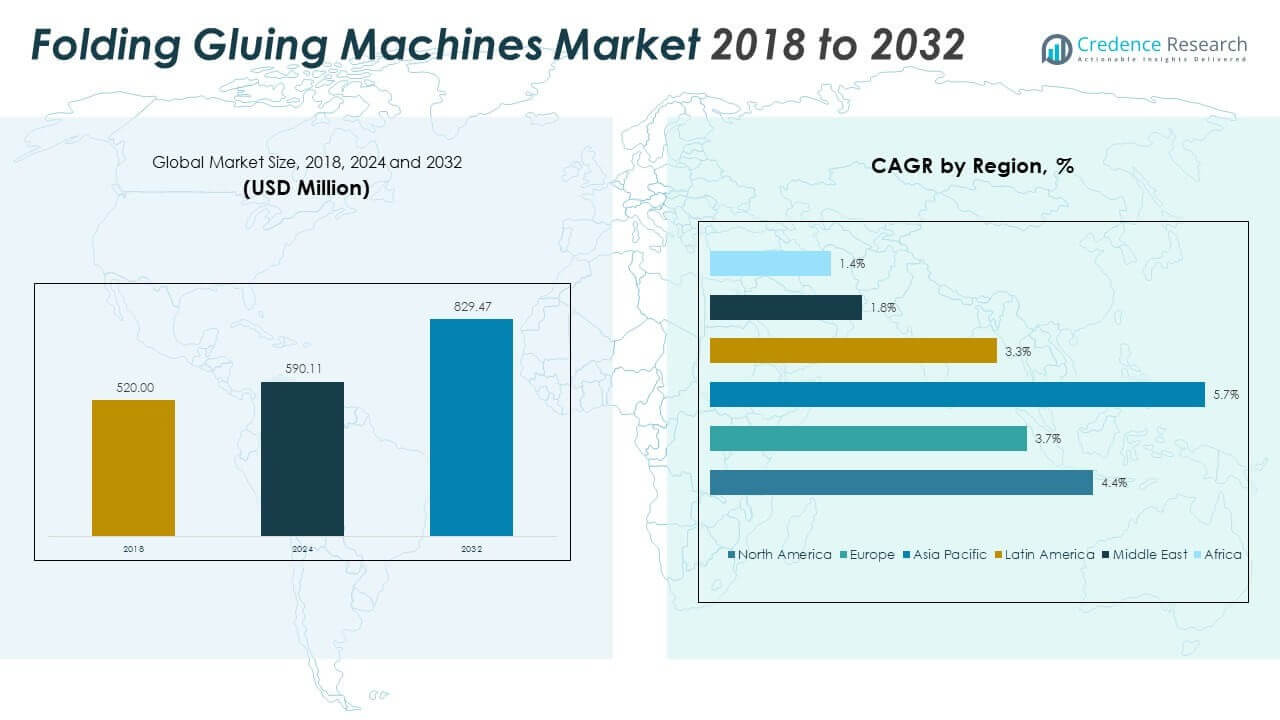
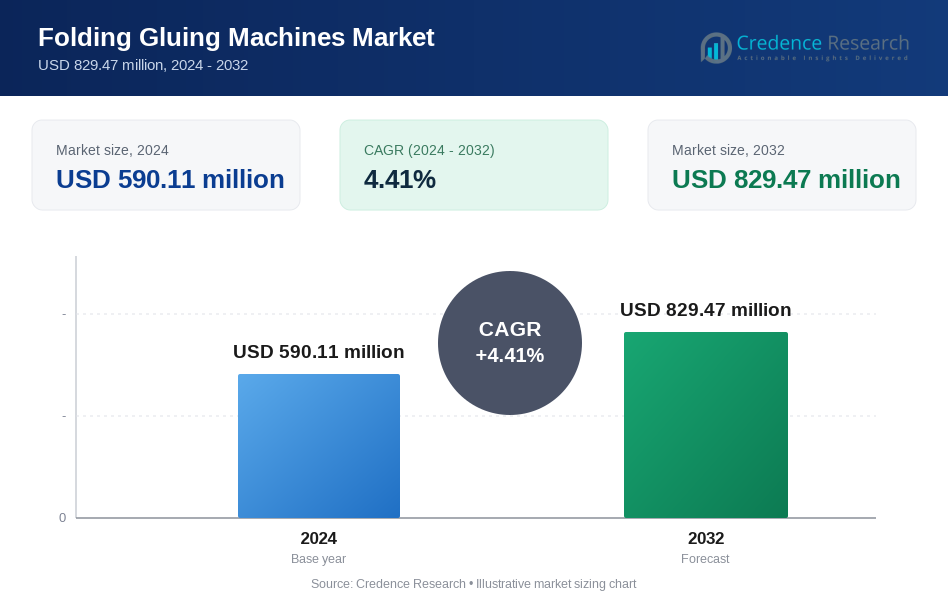
The Global Folding Gluing Machines Market size was valued at USD 520.00 million in 2018 to USD 590.11 million in 2024 and is anticipated to reach USD 829.47 million by 2032, at a CAGR of 4.41% during the forecast period.
| REPORT ATTRIBUTE | DETAILS |
|---|---|
| Historical Period | 2020-2023 |
| Base Year | 2024 |
| Forecast Period | 2025-2032 |
| Folding Carton Gluing Machines Market Size 2024 | USD 590.11 million |
| Folding Carton Gluing Machines Market, CAGR | 4.41% |
| Folding Carton Gluing Machines Market Size 2032 | USD 829.47 million |
The market grows due to rising demand for automated packaging solutions worldwide. Brand owners prefer high-speed folding and gluing for consistent carton quality. E-commerce expansion increases demand for reliable secondary packaging equipment. Food and beverage producers seek efficient machines to meet volume needs. Pharmaceutical packaging requires precision and repeatability in carton forming. Labor cost pressure encourages automation across packaging lines. Machine upgrades improve speed, accuracy, and changeover efficiency. Sustainability goals support optimized material usage. These drivers support steady market expansion.
Europe and North America lead the market due to advanced packaging industries. Germany, Italy, and the United States show strong machine adoption. These countries focus on automation and high production efficiency. Asia Pacific emerges as a fast-growing region. China and India expand packaging capacity with manufacturing growth. Rising consumer goods demand supports equipment investment. Southeast Asia gains traction through food and beverage expansion. Latin America shows gradual adoption with industrial modernization. Middle East markets grow through retail and logistics development.
Market Insights:
- The Global Folding Gluing Machines Market was valued at USD 520.00 million in 2018, reached USD 590.11 million in 2024, and is projected to hit USD 829.47 million by 2032, growing at a CAGR of 4.41%.
- North America leads with about 40.8% share, followed by Asia Pacific at 25.3% and Europe at 24.3%, driven by strong packaging automation, mature food processing, and advanced manufacturing bases.
- Asia Pacific is the fastest-growing region with a 5.7% CAGR and roughly 25.3% share, supported by manufacturing expansion, rising consumer goods demand, and increasing packaging capacity in China and India.
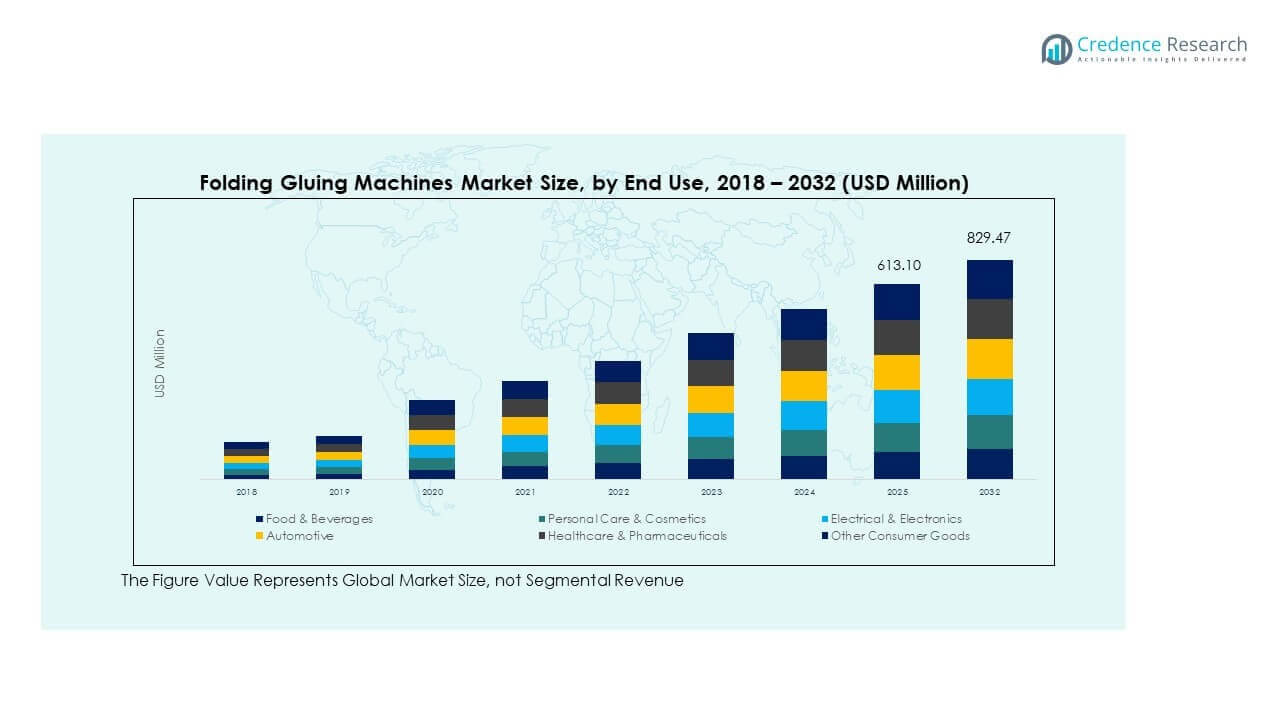
- Food & Beverages holds the largest end-use share at around 32%, reflecting high carton volumes and continuous demand from packaged and ready-to-eat food production.
- Personal Care & Cosmetics and Electrical & Electronics together account for nearly 35% share, driven by premium packaging needs, brand differentiation, and growth in consumer electronics output.
Market Drivers:
Rising Automation Demand Across High-Volume Packaging Operations
The Global Folding Gluing Machines Market benefits from strong automation demand in packaging plants. Manufacturers seek faster output with stable carton quality. High-volume production requires consistent folding and sealing accuracy. Manual processes fail to meet modern speed needs. Automation improves line balance and reduces error rates. It supports continuous operations with limited downtime. Brand owners prefer machines that ensure uniform packaging appearance. This driver strengthens capital spending across packaging facilities.
- For instance, BOBST states its EXPERTFOLD 165 achieves speeds of up to 250 m/min (or up to 450 m/min in specific high-performance configurations), enabling stable folding accuracy in high-volume carton lines through features like the ACCUFEED integrated blank aligner.
Growth In Packaged Food, Beverage, And Consumer Goods Production
The Global Folding Gluing Machines Market gains support from packaged goods expansion. Food and beverage companies require efficient secondary packaging. Carton demand rises with ready-to-eat and retail formats. Packaging lines need machines that handle varied box styles. It helps producers meet shelf-ready packaging needs. Consumer goods firms value repeatable carton forming quality. Production scale favors advanced folding gluing systems. Demand stays strong across mass-market categories.
- For instance, Heidelberg confirms the Diana Smart folding gluer handles straight-line, crash-lock, and multi-corner cartons on one platform for food packaging lines.
Pharmaceutical And Healthcare Packaging Precision Requirements
The Global Folding Gluing Machines Market advances due to strict pharma packaging standards. Drug makers require precise carton folding and sealing. Packaging errors pose compliance and safety risks. Automated machines reduce handling variation. It ensures accurate alignment and glue application. Serialization systems integrate well with modern machines. Healthcare packaging values repeatability and validation support. These needs drive steady equipment upgrades.
Labor Cost Pressure And Workforce Availability Constraints
The Global Folding Gluing Machines Market responds to rising labor challenges. Skilled machine operators remain scarce in many regions. Wage inflation increases operating costs for packaging firms. Automation reduces dependency on manual labor. It improves productivity per shift. Consistent machine output limits training needs. Firms seek long-term cost control through equipment investment. Labor dynamics support adoption momentum.
Market Trends:
Shift Toward Modular And Flexible Machine Configurations
The Global Folding Gluing Machines Market shows preference for modular designs. Manufacturers demand quick format change capability. Short production runs increase across packaging lines. Flexible systems support multiple carton types. It helps reduce idle time during changeovers. Modular layouts ease future capacity expansion. Equipment buyers value scalable investment paths. This trend reshapes machine design priorities.
- For instance, Koenig & Bauer reports the Omega Allpro uses modular sections that allow rapid format changes without full line replacement.
Integration Of Digital Controls And Smart Monitoring Features
The Global Folding Gluing Machines Market adopts advanced control systems. Digital interfaces improve setup accuracy and diagnostics. Operators gain better visibility into machine status. It supports predictive maintenance planning. Data capture improves process consistency. Smart features reduce unplanned stoppages. Machine suppliers focus on user-friendly controls. Digital adoption improves operational efficiency.
- For instance, EMBA Machinery integrates digital control panels and remote diagnostics to track glue application and folding accuracy during live operations.
Preference For Energy Efficient And Low Waste Equipment Designs
The Global Folding Gluing Machines Market aligns with sustainability goals. Packaging firms seek lower energy consumption. Efficient glue application reduces material waste. It supports corporate environmental targets. Energy-efficient motors lower operating costs. Waste reduction improves yield per carton. Buyers evaluate machines on lifecycle efficiency. Sustainability shapes procurement decisions.
Rising Demand For Compact Machines In Space-Constrained Plants
The Global Folding Gluing Machines Market sees demand for compact footprints. Urban factories face space limitations. Smaller machines fit existing production layouts. It avoids costly facility expansion. Compact systems still deliver high output rates. Flexibility supports diverse plant sizes. Suppliers optimize design for space efficiency. This trend supports wider adoption.
Market Challenges Analysis:
High Capital Investment And Long Payback Period Concerns
The Global Folding Gluing Machines Market faces cost-related barriers. Advanced machines require significant upfront investment. Small converters struggle with capital access. Payback timelines vary by production volume. It limits adoption among low-scale operators. Financing options remain uneven across regions. Maintenance costs add to ownership burden. Price sensitivity affects buying decisions.
Technical Complexity And Skilled Maintenance Requirements
The Global Folding Gluing Machines Market encounters operational challenges. Modern machines use complex mechanical systems. Skilled technicians remain limited in some regions. Improper maintenance reduces performance reliability. It increases downtime risk. Training costs add operational pressure. Spare part availability varies by supplier. Technical dependence affects buyer confidence.
Market Opportunities:
Expansion Of Packaging Capacity In Emerging Manufacturing Economies
The Global Folding Gluing Machines Market gains opportunity from industrial growth regions. Emerging economies expand consumer goods production. Local packaging capacity requires modern equipment. It supports domestic brand development. Manufacturing initiatives encourage automation. New plants adopt advanced machinery from inception. Equipment suppliers access new customer bases. Regional expansion creates long-term demand.
Customization Demand From Premium And Specialty Packaging Segments
The Global Folding Gluing Machines Market benefits from premium packaging growth. Luxury and specialty brands require complex carton designs. Custom folding and gluing add visual value. It supports brand differentiation goals. Short-run specialty packaging needs flexible machines. Advanced systems handle intricate box structures. Suppliers offer tailored solutions for niche users. Customization opens higher-margin opportunities.
Market Segmentation Analysis:
By Machine Type
The Global Folding Gluing Machines Market shows clear preference for automatic systems. Automatic folding gluing machines support high-speed operations and consistent output. Large packaging converters adopt these machines to reduce labor dependency. It suits continuous production lines with complex carton designs. Semi-automatic folding gluing machines serve small and mid-scale producers. These machines offer flexibility and lower capital requirements. They remain suitable for short runs and frequent format changes.
- For instance, Vega specifies its automatic folding gluers exceed 400 m/min, while semi-automatic models target frequent format changes.
By Fold Type
Straight line boxes account for wide usage due to simple structure. These boxes suit food, beverage, and consumer goods packaging. Pocket fold boxes support customized carton designs for retail display. Crash lock boxes gain demand from fast assembly needs. It helps improve packing efficiency at filling stations. Multi corner boxes serve premium and heavy-duty packaging needs. Complex folds support structural strength and visual appeal.
- For instance, Moll states its systems process straight-line, crash-lock, and 4–6 corner cartons, supporting both mass-market and premium packaging applications.
By End-use Industry
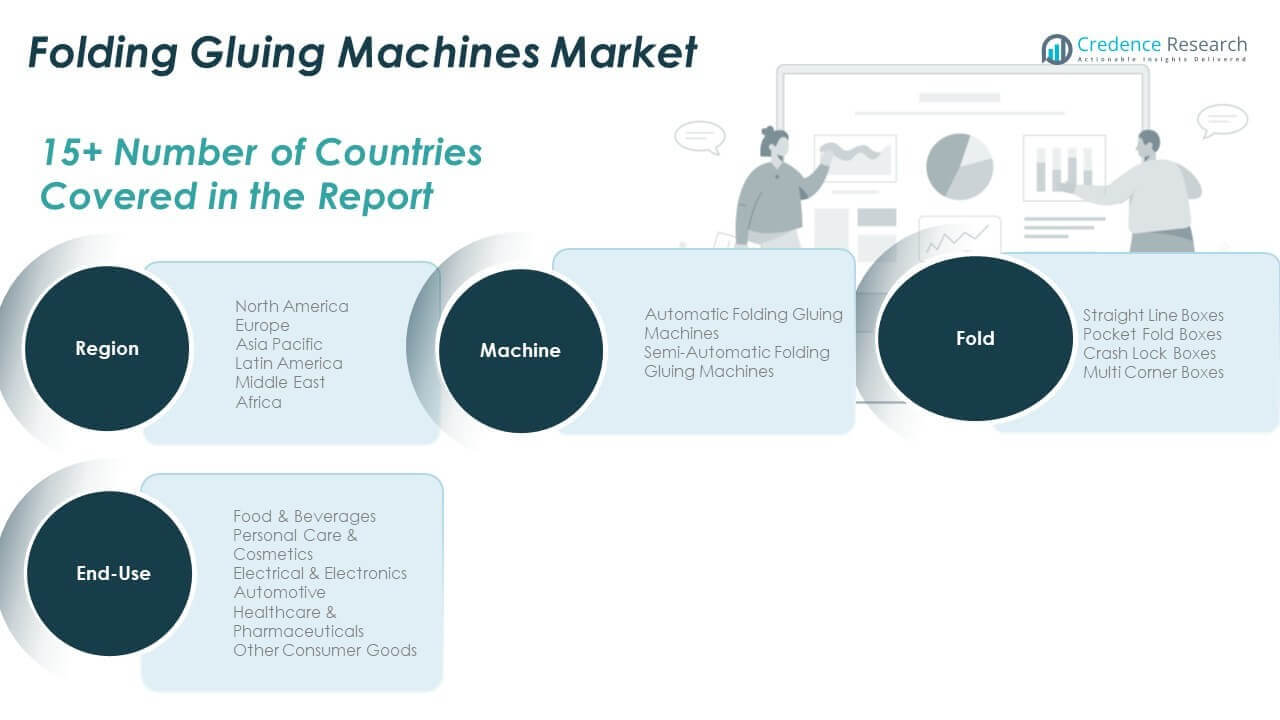
Food and beverages lead demand due to high carton volumes. Personal care and cosmetics adopt advanced folds for brand presentation. Electrical and electronics packaging requires precise carton forming. Automotive suppliers use durable cartons for parts handling. Healthcare and pharmaceuticals demand accuracy and compliance support. Other consumer goods contribute steady demand across varied packaging formats.
Segmentation:
By Machine Type- Automatic Folding Gluing Machines
- Semi-Automatic Folding Gluing Machines
- Straight Line Boxes
- Pocket Fold Boxes
- Crash Lock Boxes
- Multi Corner Boxes
- Food & Beverages
- Personal Care & Cosmetics
- Electrical & Electronics
- Automotive
- Healthcare & Pharmaceuticals
- Other Consumer Goods
- North America
- U.S.
- Canada
- Mexico
- Europe
- Germany
- France
- U.K.
- Italy
- Spain
- Rest of Europe
- Asia Pacific
- China
- Japan
- India
- South Korea
- South-east Asia
- Rest of Asia Pacific
- Latin America
- Brazil
- Argentina
- Rest of Latin America
- Middle East & Africa
- GCC Countries
- South Africa
- Rest of the Middle East and Africa
Regional Analysis:
North America
The North America Global Folding Gluing Machines Market size was valued at USD 214.66 million in 2018 to USD 241.00 million in 2024 and is anticipated to reach USD 338.34 million by 2032, at a CAGR of 4.4 during the forecast period. The Global Folding Gluing Machines Market holds a strong regional share of about 40.8 percent here. The region benefits from advanced packaging infrastructure. Food and beverage producers drive steady equipment demand. Pharmaceutical packaging requires high precision systems. Automation adoption remains high across manufacturing plants. It supports consistent quality and speed. E-commerce growth sustains carton demand. Equipment replacement cycles remain active.
Europe
The Europe Global Folding Gluing Machines Market size was valued at USD 131.66 million in 2018 to USD 143.38 million in 2024 and is anticipated to reach USD 189.91 million by 2032, at a CAGR of 3.7 during the forecast period. The Global Folding Gluing Machines Market accounts for nearly 24.3 percent regional share. Strong machinery manufacturing supports local adoption. Germany and Italy lead equipment usage. Sustainability drives demand for efficient packaging lines. Brand owners focus on premium carton quality. It benefits from skilled technical workforce. Regulatory standards favor automation. Mature industries ensure stable demand.
Asia Pacific
The Asia Pacific Global Folding Gluing Machines Market size was valued at USD 126.00 million in 2018 to USD 149.38 million in 2024 and is anticipated to reach USD 231.92 million by 2032, at a CAGR of 5.7 during the forecast period. The Global Folding Gluing Machines Market represents about 25.3 percent regional share. Manufacturing expansion supports strong equipment demand. China and India lead new installations. Consumer goods production grows rapidly. Packaging capacity expands across industries. It benefits from cost-efficient manufacturing bases. Export-driven packaging adds momentum. Technology adoption improves steadily.
Latin America
The Latin America Global Folding Gluing Machines Market size was valued at USD 28.60 million in 2018 to USD 32.10 million in 2024 and is anticipated to reach USD 41.37 million by 2032, at a CAGR of 3.3 during the forecast period. The Global Folding Gluing Machines Market holds around 5.4 percent regional share. Brazil and Mexico dominate demand. Food processing drives packaging needs. Industrial modernization supports equipment upgrades. It sees gradual automation adoption. Investment levels remain selective. Import dependence influences machine availability. Growth remains moderate and stable.
Middle East
The Middle East Global Folding Gluing Machines Market size was valued at USD 10.92 million in 2018 to USD 10.97 million in 2024 and is anticipated to reach USD 12.53 million by 2032, at a CAGR of 1.8 during the forecast period. The Global Folding Gluing Machines Market represents nearly 1.9 percent regional share. Retail expansion supports carton demand. Food packaging drives machine usage. Industrial diversification remains gradual. It relies on imported machinery. Skilled labor availability stays limited. Capital investment remains cautious. Growth progresses at a slow pace.
Africa
The Africa Global Folding Gluing Machines Market size was valued at USD 8.16 million in 2018 to USD 13.28 million in 2024 and is anticipated to reach USD 15.40 million by 2032, at a CAGR of 1.4 during the forecast period. The Global Folding Gluing Machines Market holds about 2.3 percent regional share. South Africa leads equipment adoption. Consumer goods packaging supports demand. Industrial base remains fragmented. It faces infrastructure constraints. Automation adoption stays low. Imports dominate equipment supply. Growth remains gradual across markets.
Key Player Analysis:
- Bobst Group SA
- Heidelberger Druckmaschinen AG
- Koenig & Bauer AG
- BW Papersystems (Barry-Wehmiller Companies)
- Mitsubishi Heavy Industries, Ltd.
- Duran Machinery
- Baumer HHS GmbH
- Vega Group
- Shanghai Yawa Printing Machinery Co., Ltd.
- Masterwork Machinery Co., Ltd.
Competitive Analysis:
The Global Folding Gluing Machines Market features strong competition among global and regional manufacturers. Leading players focus on automation, speed, and precision. Product portfolios cover automatic and semi-automatic systems. Companies invest in technology upgrades to support complex carton designs. It rewards suppliers with strong service networks and customization ability. European firms lead in engineering quality and innovation depth. Asian manufacturers compete through cost efficiency and expanding capacity. Strategic partnerships strengthen regional reach. Brand reputation influences buyer decisions. Competitive intensity remains moderate with clear technology leaders.
Recent Developments:
- Vega Group, operating through its Vega IT division, announced a significant strategic development in December 2025 through a 50/50 joint venture partnership with Arthur D. Little, forming Axceler8 Solutions to develop digital and AI-enabled solutions for business process optimization. This partnership, emerging from a year of successful collaboration, aims to design, develop, and operate a portfolio of cutting-edge digital solutions for industrial applications, leveraging Vega IT's expertise in digital product development and system integration across 15+ industries with 900+ specialists and 2,000+ successfully delivered projects. The Axceler8 Rx platform features a modular, sector-agnostic architecture enabling rapid application development, with initial focus on life sciences applications, demonstrating the integration of advanced digital capabilities into industrial machinery markets. Additionally, Daifuku Co., Ltd. acquired Vega Conveyors & Automation in April 2019, establishing Vega as a material handling equipment provider in India serving the broader packaging equipment ecosystem.
Report Coverage:
The research report offers an in-depth analysis based on machine type and end-use segments. It details leading market players, providing an overview of their business, product offerings, investments, revenue streams, and key applications. Additionally, the report includes insights into the competitive environment, SWOT analysis, current market trends, as well as the primary drivers and constraints. Furthermore, it discusses various factors that have driven market expansion in recent years. The report also explores market dynamics, regulatory scenarios, and technological advancements that are shaping the industry. It assesses the impact of external factors and global economic changes on market growth. Lastly, it provides strategic recommendations for new entrants and established companies to navigate the complexities of the market.
Future Outlook:
- Automation adoption will increase across large and mid-sized packaging plants.
- Demand for flexible carton formats will rise across consumer goods industries.
- Digital control systems will improve machine accuracy and operational visibility.
- Sustainability goals will influence equipment design and procurement decisions.
- Emerging markets will expand packaging capacity to support local manufacturing.
- Premium packaging demand will drive adoption of complex folding capabilities.
- Service quality and lifecycle support will shape supplier selection criteria.
- Compact machine designs will gain importance in space-constrained facilities.
- Technology partnerships will strengthen product development and regional reach.
- Custom machine configurations will support long-term competitive differentiation.
Request a Free Sample
Fill in your details and we'll send you a free sample report.
- Sample data tables & charts
- Research methodology
Market Dynamics
Rising Automation Demand Across High-Volume Packaging Operations
Manufacturers are increasingly investing in automated folding gluing machines to achieve faster output, stable carton quality, and reduced error rates. Automation supports continuous operations, limits downtime, and addresses labor shortages, making it essential for modern high-volume packaging lines.
Growth in Packaged Food, Beverage, and Consumer Goods Production
The expansion of packaged food, beverage, and consumer goods industries drives demand for efficient secondary packaging solutions. Folding gluing machines enable high-speed, repeatable carton forming, supporting the needs of mass-market and ready-to-eat product lines.
Pharmaceutical and Healthcare Packaging Precision Requirements
Strict regulatory standards in pharmaceutical and healthcare packaging require precise folding and gluing to ensure product safety and compliance. Automated machines reduce handling variation and support serialization, driving upgrades and new installations in these sectors.
Labor Cost Pressure and Workforce Availability Constraints
Rising labor costs and a shortage of skilled machine operators are pushing packaging firms toward automation. Folding gluing machines reduce dependency on manual labor, improve productivity, and help control long-term operational costs.
Sustainability and Material Efficiency Goals
Packaging companies are prioritizing energy-efficient and low-waste equipment to meet corporate sustainability targets. Modern folding gluing machines optimize glue application and material usage, reducing waste and supporting environmentally responsible operations.
Need a Custom Version of This Report?
Tailor the scope, geography, or segments to your exact requirements.
- Custom geography or segment scope
- Direct access to our analyst team
Frequently Asked Questions
What is the current market size for Global Folding Gluing Machines Market, and what is its projected size in 2032?
At what Compound Annual Growth Rate is the Global Folding Gluing Machines Market projected to grow between 2025 and 2032?
Which Global Folding Gluing Machines Market segment held the largest share in 2024?
What are the primary factors fueling the growth of the Global Folding Gluing Machines Market?
Who are the leading companies in the Global Folding Gluing Machines Market?
Which region commanded the largest share of the Global Folding Gluing Machines Market in 2024?
Table of Content
Chapter 1 Market Segmentation
- 1.1 Segmentation Framework
- 1.1.1 Product and Service Classification
- 1.1.2 Application and End-Use Classification
- 1.1.3 Technology and Solution Classification
- 1.1.4 Customer and Distribution Channel Classification
- 1.1.5 Geographic Segmentation
- 1.1.6 Market Segment Definitions and Boundaries
- 1.2 By Fold Type
- 1.2.1 Straight Line Boxes
- 1.2.2 Pocket Fold Boxes
- 1.2.3 Crash Lock Boxes
- 1.2.4 Multi Corner Boxes
- 1.3 By Machine Type
- 1.3.1 Automatic Folding Gluing Machines
- 1.3.2 Semi-Automatic Folding Gluing Machines
- 1.4 By End-use Industry
- 1.4.1 Food & Beverages
- 1.4.2 Personal Care & Cosmetics
- 1.4.3 Electrical & Electronics
- 1.4.4 Automotive
- 1.4.5 Healthcare & Pharmaceuticals
- 1.4.6 Other Consumer Goods
Chapter 2 Introduction
- 2.1 Report Objectives and Scope
- 2.2 Product Definition and Industry Terminology
- 2.3 Market Inclusions and Exclusions
- 2.4 Research Process
- 2.4.1 Primary Research and Expert Interviews
- 2.4.2 Secondary Research and Source Review
- 2.4.3 Top-Down and Bottom-Up Estimation
- 2.4.4 Data Triangulation and Verification
- 2.5 Market Size Measurement Basis
- 2.5.1 2024: USD 590.11 million → 2032: USD 829.47 million
- 2.6 Historical and Forecast Reference Periods
- 2.6.1 Base Year: 2024
- 2.6.2 Forecast Period: 2024-2032
- 2.7 Research Assumptions and Limitations
Chapter 3 Executive Summary
- 3.1 Market Snapshot and Key Findings
- 3.2 Base-Year Market Size, 2024
- 3.3 Forecast Market Size, 2032
- 3.4 Revenue and Volume Growth Outlook
- 3.5 Key Demand and Supply Indicators
- 3.6 Leading Market Segments
- 3.7 Fastest-Growing Market Opportunities
- 3.8 Regional Performance Highlights
- 3.9 Technology and Industry Transformation
- 3.10 Competitive Landscape Summary
- 3.11 Analyst View and Strategic Implications
Chapter 4 Global Folding Gluing Machines Market Trends and Developments
- 4.1 Historical Industry Development
- 4.2 Recent Market Trends and Developments
- 4.3 Demand and Customer Behavior Trends
- 4.4 Technology and Product Innovation
- 4.5 Artificial Intelligence, Automation and Digitalization
- 4.6 Local Manufacturing and Supply Chain Realignment
- 4.7 Industry Partnerships, Mergers and Acquisitions
- 4.8 Sustainability and Circular Economy Developments
- 4.9 Government and Private Sector Investment Trends
- 4.10 Emerging Business Models and Commercialization
- 4.11 Industry Developments and Announcements
Chapter 5 Global Folding Gluing Machines Market Production, Supply and Demand Analysis
- 5.1 Demand Trend and Consumption Analysis
- 5.2 Demand Forecast, 2024-2032
- 5.3 Production and Output Trend
- 5.4 Production and Output Forecast, 2024-2032
- 5.5 Installed Capacity and Capacity Utilization
- 5.6 Company-Wise Production Plants and Statistics
- 5.6.1 Installed Production Capacity
- 5.6.2 Actual Production
- 5.6.3 Planned Capacity and Expansion Targets
- 5.7 Supply Chain Structure and Procurement Trends
- 5.8 Supply-Demand Gap and Bottlenecks
- 5.9 Import Dependence and Sourcing Structure
- 5.10 Contract Manufacturing and Outsourcing
- 5.11 Regional Supply and Demand Concentration
Chapter 6 Global Folding Gluing Machines Market Pricing Analysis
- 6.1 Pricing Structure and Measurement
- 6.2 Historical Pricing Trends
- 6.3 Pricing Outlook, 2024-2032
- 6.4 Average Selling Price and Unit Economics
- 6.5 Pricing by Product and Market Segment
- 6.6 Geographic Pricing Differences
- 6.7 Key Input, Energy, Labor and Logistics Costs
- 6.8 Contract Pricing and Purchasing Models
- 6.9 Pricing Sensitivity and Competitive Positioning
- 6.10 Price, Margin and Profitability Implications
Chapter 7 Global Folding Gluing Machines Market Dynamics
- 7.1 Market Growth Drivers
- 7.1.1 Demand-Side Drivers
- 7.1.2 Technology and Innovation Drivers
- 7.1.3 Infrastructure and Investment Drivers
- 7.1.4 Regulatory and Policy Drivers
- 7.2 Market Restraints
- 7.2.1 Cost and Affordability Constraints
- 7.2.2 Technology and Adoption Barriers
- 7.2.3 Supply Chain and Operational Constraints
- 7.3 Market Challenges
- 7.3.1 Competitive Pressure and Margin Erosion
- 7.3.2 Skills, Infrastructure and Implementation Gaps
- 7.4 Emerging Market Opportunities
- 7.5 Market Dynamics Impact and Time-Horizon Assessment
Chapter 8 Global Folding Gluing Machines Value Chain Analysis
- 8.1 Industry Value Chain Overview
- 8.2 Upstream Suppliers and Critical Inputs
- 8.3 Technology and Component Providers
- 8.4 Manufacturing or Service Delivery
- 8.5 Distribution, Channel Partners and Integrators
- 8.6 Downstream Applications and End Users
- 8.7 Value Addition and Profit Pools
- 8.8 Vertical Integration and Outsourcing
- 8.9 Supplier Concentration and Risk
- 8.10 Supply Chain Localization and Resilience
Chapter 9 Global Folding Gluing Machines Market Regulations and Policies
- 9.1 Relevant Laws, Standards and Compliance Frameworks
- 9.2 Product, Service, Safety and Quality Requirements
- 9.3 Government Policies, Incentives and Subsidies
- 9.4 Imports, Exports and Trade Barriers
- 9.5 Public Procurement and Local Content Requirements
- 9.6 Environmental and Sustainability Compliance
- 9.7 Upcoming Policy Changes and Market Implications
Chapter 10 Global Folding Gluing Machines Market Hotspots and Opportunities
- 10.1 Market Opportunity Mapping and Growth Hotspots
- 10.2 High-Growth Applications and Customer Groups
- 10.3 Underserved Markets and White-Space Opportunities
- 10.4 Emerging Technology and Product Opportunities
- 10.5 New Capacity and Investment Hotspots
- 10.6 Market Entry and Expansion Opportunities
- 10.7 Distribution and Partnership Opportunities
- 10.8 Near-Term and Long-Term Commercial Potential
- 10.9 Opportunity Attractiveness and Execution Risks
Chapter 11 Global Folding Gluing Machines Market Outlook, 2024-2032
- 11.1 Market Size and Analysis
- 11.1.1 Revenue (Market Measurement: 2024: USD 590.11 million → 2032: USD 829.47 million)
- 11.1.2 Market Volume and Quantity Sold
- 11.1.3 Historical Market Size
- 11.1.4 Base-Year Market Size, 2024
- 11.2 Market Forecast, 2024-2032
- 11.2.1 Revenue Forecast to 2032
- 11.2.2 Volume Forecast to 2032
- 11.2.3 CAGR and Year-on-Year Growth
- 11.2.4 Incremental Revenue Opportunity
- 11.3 Forecast Assumptions and Scenario Analysis
- 11.3.1 Base-Case Forecast
- 11.3.2 Optimistic and Conservative Scenarios
- 11.3.3 Technology, Pricing and Policy Sensitivities
- 11.4 Market Attractiveness and Growth Outlook
Chapter 12 Global Folding Gluing Machines Market Segmentation and Outlook
- 12.1 Segmentation Summary and Market Shares, 2024
- 12.2 Largest and Fastest-Growing Segments
- 12.3 By Fold Type - Market Size and Forecast, 2024-2032
- 12.3.1 Segment Definition and Scope
- 12.3.2 Historical Market Size
- 12.3.3 Revenue Forecast, 2024-2032
- 12.3.4 Volume Forecast, 2024-2032
- 12.3.5 Base-Year Market Share, 2024
- 12.3.6 Segment CAGR and Growth Drivers
- 12.3.7 Subsegment Market Size and Forecast
- 12.3.7.1 Straight Line Boxes
- 12.3.7.2 Pocket Fold Boxes
- 12.3.7.3 Crash Lock Boxes
- 12.3.7.4 Multi Corner Boxes
- 12.3.8 Subsegment Pricing and Adoption Trends
- 12.3.9 Leading Suppliers and Competition
- 12.3.10 Regional Demand and Opportunities
- 12.4 By Machine Type - Market Size and Forecast, 2024-2032
- 12.4.1 Segment Definition and Scope
- 12.4.2 Historical Market Size
- 12.4.3 Revenue Forecast, 2024-2032
- 12.4.4 Volume Forecast, 2024-2032
- 12.4.5 Base-Year Market Share, 2024
- 12.4.6 Segment CAGR and Growth Drivers
- 12.4.7 Subsegment Market Size and Forecast
- 12.4.7.1 Automatic Folding Gluing Machines
- 12.4.7.2 Semi-Automatic Folding Gluing Machines
- 12.4.8 Subsegment Pricing and Adoption Trends
- 12.4.9 Leading Suppliers and Competition
- 12.4.10 Regional Demand and Opportunities
- 12.5 By End-use Industry - Market Size and Forecast, 2024-2032
- 12.5.1 Segment Definition and Scope
- 12.5.2 Historical Market Size
- 12.5.3 Revenue Forecast, 2024-2032
- 12.5.4 Volume Forecast, 2024-2032
- 12.5.5 Base-Year Market Share, 2024
- 12.5.6 Segment CAGR and Growth Drivers
- 12.5.7 Subsegment Market Size and Forecast
- 12.5.7.1 Food & Beverages
- 12.5.7.2 Personal Care & Cosmetics
- 12.5.7.3 Electrical & Electronics
- 12.5.7.4 Automotive
- 12.5.7.5 Healthcare & Pharmaceuticals
- 12.5.7.6 Other Consumer Goods
- 12.5.8 Subsegment Pricing and Adoption Trends
- 12.5.9 Leading Suppliers and Competition
- 12.5.10 Regional Demand and Opportunities
- 12.6 Segment Growth Comparison
- 12.7 Segment Attractiveness and Priority Matrix
Chapter 13 Global Folding Gluing Machines End-Use and Application Market Outlook
- 13.1 End-Use Industry and Customer Demand Structure
- 13.2 Leading Applications and Customer Groups
- 13.3 End-Use Market Size, Share and Forecast
- 13.4 Major End-Use Industry Deep Dives
- 13.4.1 Customer Requirements and Use Cases
- 13.4.2 Demand and Replacement Cycles
- 13.4.3 Technical and Regulatory Considerations
- 13.4.4 Purchasing and Procurement Models
- 13.4.5 Leading Vendors and Distribution Channels
- 13.4.6 Forecast and Commercial Opportunities
- 13.5 Emerging Applications and Cross-Segment Demand
- 13.6 End-Use Industry Investment Priorities
Chapter 14 Global Folding Gluing Machines Geographic Market Outlook, 2024-2032
- 14.1 Regional Market Size and Share, 2024
- 14.2 Regional Market Forecast, 2024-2032
- 14.3 Regional Pricing, Production and Demand Differences
- 14.4 North America
- 14.4.1 United States
- 14.4.2 Canada
- 14.4.3 Mexico
- 14.5 Europe
- 14.5.1 Germany
- 14.5.2 France
- 14.5.3 Italy
- 14.5.4 United Kingdom
- 14.5.5 Spain
- 14.5.6 Poland
- 14.5.7 Russia
- 14.5.8 Netherlands
- 14.5.9 Belgium
- 14.5.10 Sweden
- 14.5.11 Denmark
- 14.5.12 Norway
- 14.5.13 Rest of Europe
- 14.6 Asia Pacific
- 14.6.1 China
- 14.6.2 India
- 14.6.3 Japan
- 14.6.4 South Korea
- 14.6.5 Thailand
- 14.6.6 Indonesia
- 14.6.7 Vietnam
- 14.6.8 Malaysia
- 14.6.9 Australia
- 14.6.10 Rest of Asia Pacific
- 14.7 Latin America
- 14.7.1 Brazil
- 14.7.2 Argentina
- 14.7.3 Colombia
- 14.7.4 Chile
- 14.7.5 Rest of Latin America
- 14.8 Middle East
- 14.8.1 Saudi Arabia
- 14.8.2 United Arab Emirates
- 14.8.3 Turkey
- 14.8.4 Israel
- 14.8.5 Iran
- 14.8.6 Rest of the Middle East
- 14.9 Africa
- 14.9.1 South Africa
- 14.9.2 Egypt
- 14.9.3 Nigeria
- 14.9.4 Morocco
- 14.9.5 Rest of Africa
- 14.10 Regional Investment, Policy and Supply Chain Differences
- 14.11 Regional Competitive Landscape
- 14.12 Geographic Growth Hotspots
Chapter 15 Global Folding Gluing Machines Technology, Innovation and Sustainability Outlook
- 15.1 Technology Landscape and Maturity
- 15.2 Product, Process and Service Innovation
- 15.3 AI, Automation and Digital Tools in the Industry
- 15.4 Technology Adoption and Performance Benchmarking
- 15.5 Innovation Pipeline and R&D Investment
- 15.6 Patent and Intellectual Property Trends
- 15.7 Energy Efficiency and Resource Management
- 15.8 Sustainability, Recycling and Circularity
- 15.9 Technology Roadmap, 2024-2032
- 15.10 Risks of Obsolescence and Technology Substitution
Chapter 16 Global Folding Gluing Machines Market Key Strategic Imperatives
- 16.1 Growth and Market Entry Priorities
- 16.2 High-Return Products and Segments
- 16.3 Pricing, Profitability and Cost Optimization
- 16.4 Technology Investment and Product Differentiation
- 16.5 Supply Chain Localization and Resilience
- 16.6 Distribution and Customer Acquisition
- 16.7 Partnership, Acquisition and Capacity Strategy
- 16.8 Regional Expansion Priorities
- 16.9 Short-, Medium- and Long-Term Actions
Chapter 17 Competition Outlook
- 17.1 Industry Competition Characteristics
- 17.2 Market Structure and Concentration
- 17.3 Market Share and Competitive Positioning, 2024
- 17.4 Company-Wise Revenue and Product Benchmarking
- 17.5 Production and Service Capacity Benchmarking
- 17.6 Technology, Pricing and Differentiation
- 17.7 Regional Footprint and Distribution Strength
- 17.8 Mergers, Acquisitions and Strategic Alliances
- 17.9 New Entrants and Competitive Threats
- 17.10 Porter's Five Forces and Industry Attractiveness
- 17.11 Competitive Outlook, 2024-2032
Chapter 18 Company Profiles
- 18.1 Company Coverage and Selection Criteria
- 18.2 Bobst Group SA
- 18.2.1 Business Description
- 18.2.2 Company Ownership and Geographic Presence
- 18.2.3 Product and Service Portfolio
- 18.2.4 Manufacturing and Operating Footprint
- 18.2.5 Production Capacity and Expansion Plans
- 18.2.6 Financial Performance and Investment
- 18.2.7 Market Share and Competitive Position
- 18.2.8 Technology and Innovation Capabilities
- 18.2.9 Strategic Alliances or Partnerships
- 18.2.10 Recent Developments
- 18.2.11 Growth Strategy and Outlook
- 18.3 Heidelberger Druckmaschinen AG
- 18.4 Koenig & Bauer AG
- 18.5 BW Papersystems (Barry-Wehmiller Companies)
- 18.6 Mitsubishi Heavy Industries, Ltd.
- 18.7 Duran Machinery
- 18.8 Baumer HHS GmbH
- 18.9 Vega Group
- 18.10 Shanghai Yawa Printing Machinery Co., Ltd.
- 18.11 Masterwork Machinery Co., Ltd.
- 18.12 Other Relevant Market Participants
Note: Every listed company is profiled on the structure shown under the first company. The company list is preliminary and may change based on research findings, market developments, data availability and client requirements.
Chapter 19 Disclaimer
- 19.1 Research and Forecast Disclaimer
- 19.2 Data Source and Estimation Limitations
Note: The depth of individual sections depends on data availability for this market. Volume, capacity, trade and other unit-based metrics are included where applicable.