
Market Overview:
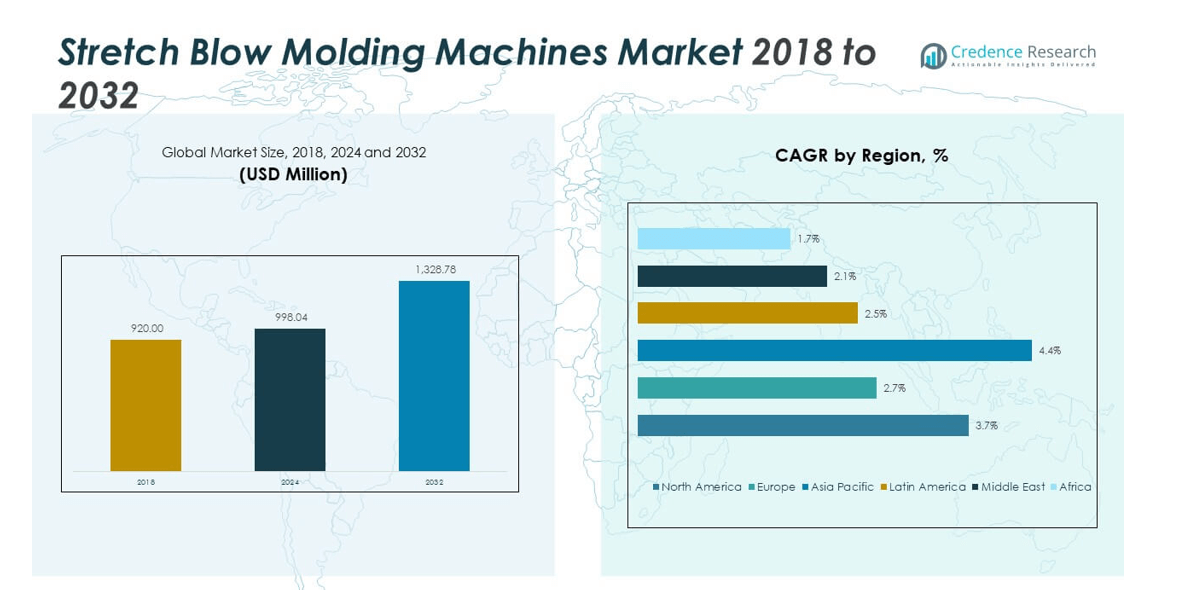
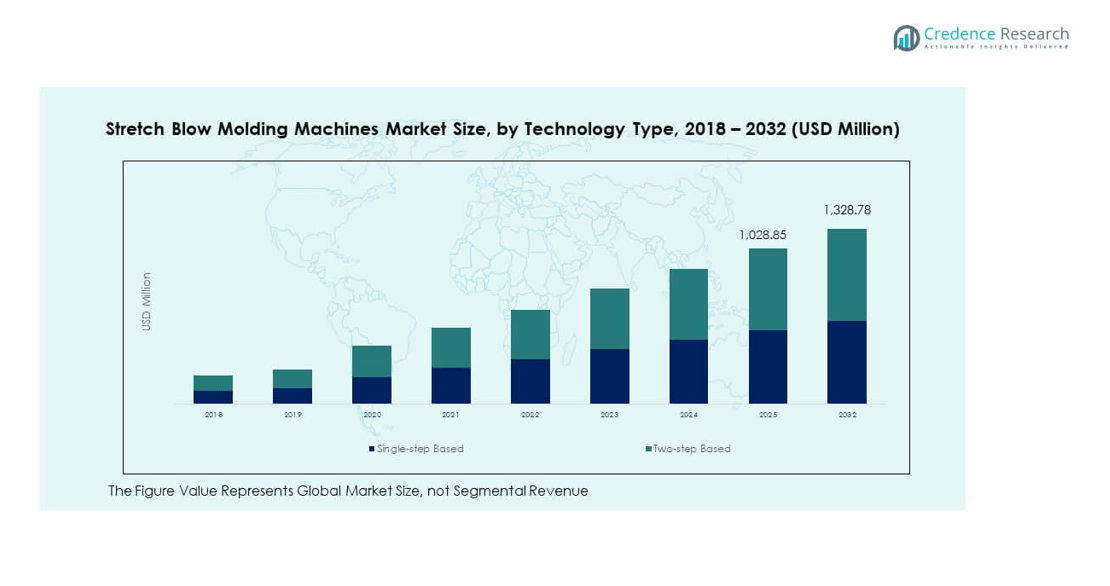
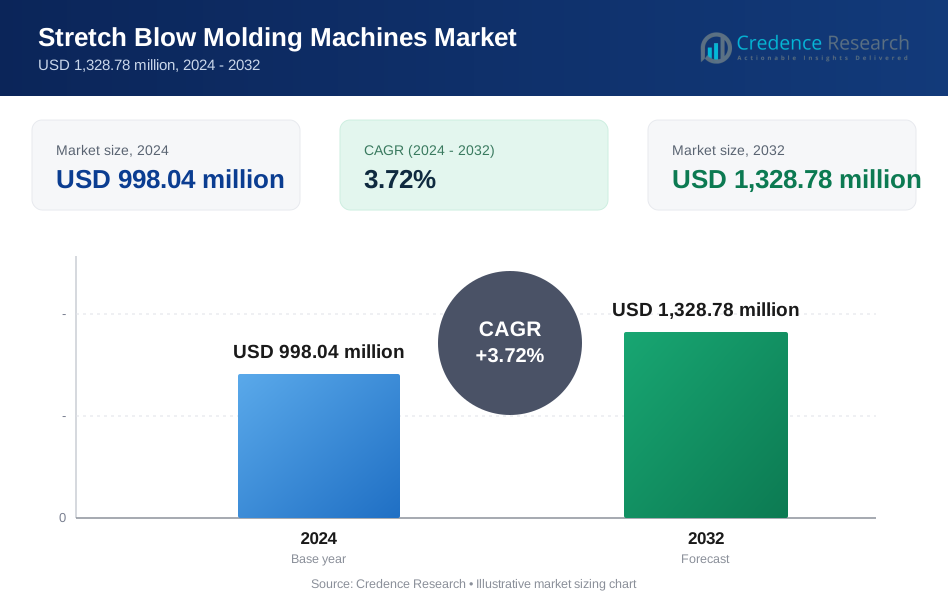
The Global Stretch Blow Molding Machines Market size was valued at USD 920.00 million in 2018 to USD 998.04 million in 2024 and is anticipated to reach USD 1,328.78 million by 2032, at a CAGR of 3.72% during the forecast period.
| REPORT ATTRIBUTE | DETAILS |
|---|---|
| Historical Period | 2020-2023 |
| Base Year | 2024 |
| Forecast Period | 2025-2032 |
| Stretch Blow Molding Machines Market Size 2024 | USD 998.04 million |
| Stretch Blow Molding Machines Market, CAGR | 3.72% |
| Stretch Blow Molding Machines Market Size 2032 | USD 1,328.78 million |
The market grows due to rising demand for PET bottles in food and beverages. Packaged water, carbonated drinks, and edible oils drive machine installations. Manufacturers focus on lightweight and recyclable packaging formats. Stretch blow molding supports high-speed and precise bottle production. Automation adoption improves energy efficiency and reduces labor costs. Pharmaceutical and personal care packaging adds steady demand. Machine upgrades help meet strict quality and hygiene standards. Cost control remains a key buyer priority.
Asia Pacific leads the market due to strong packaging demand and manufacturing scale. China and India drive volume through beverage and consumer goods growth. Japan supports demand with advanced automation and precision machinery. Europe holds a strong position with focus on sustainability and recycling compliance. Germany and Italy remain key equipment suppliers. North America shows stable demand from replacement and technology upgrades. Latin America and Southeast Asia emerge due to rising packaged product consumption.
Market Insights:
- The Global Stretch Blow Molding Machines Market was valued at USD 920.00 million in 2018, reached USD 998.04 million in 2024, and is projected to reach USD 1,328.78 million by 2032, expanding at a CAGR of 3.72% during the forecast period.
- Asia Pacific led the market with about 46.7% share in 2024 due to strong beverage demand, followed by North America at ~24.4% driven by replacement demand, and Europe at ~17.9% supported by efficiency and sustainability focus.
- Asia Pacific is the fastest-growing region with a CAGR of 4.4% and nearly 46.7% share, supported by urban population growth, expanding bottling capacity, and cost-effective manufacturing bases in China and India.
- Two-step based technology accounted for the larger share at roughly 60% in 2024, supported by high-speed production needs and large-scale beverage bottling operations.
- Single-step based machines held about 40% share, driven by demand from small batches, specialty packaging, and pharmaceutical and personal care applications.
Market Drivers:
Rising Demand For High-Volume PET Packaging Across Beverage And Food Industries
The Global Stretch Blow Molding Machines Market benefits from steady PET bottle demand. Beverage producers rely on consistent bottle quality at scale. Bottled water and soft drink volumes support machine deployment. Food-grade packaging requires uniform wall thickness and clarity. Manufacturers choose stretch blow molding for precision control. High-speed output supports large production runs. Equipment reliability reduces downtime risks. Packaging standardization supports repeat investments.
- For instance, Sidel’s SBO Universal 2 series delivers an output of up to 2,000 bottles per hour per mold, supporting large bottling plants with continuous operation and high reliability.
Growing Preference For Lightweight And Material-Efficient Bottle Designs
Brand owners seek lighter bottles to cut material use. Lightweight packaging lowers resin consumption per unit. Stretch blow molding supports thin yet strong containers. Machine precision enables uniform stretch ratios. Producers meet transport cost targets through weight reduction. Sustainability goals reinforce lightweight adoption. Equipment upgrades help meet design tolerances. This driver supports steady machine demand.
- For instance, Krones’ Contiform 3 Pro utilizes precise servo-driven stretch control and optimized heating profiles to facilitate advanced lightweighting, while achieving up to a 35% reduction in energy and compressed air consumption.
Expansion Of Pharmaceutical And Personal Care Packaging Production Capacity
Pharmaceutical packaging needs high hygiene control. Stretch blow molding meets sterile container requirements. Personal care brands demand aesthetic consistency. Bottle shape accuracy supports brand identity. Producers invest in dedicated molding lines. Equipment reliability supports regulated production schedules. Validation needs favor proven machine platforms. This segment adds stable market demand.
Automation Adoption To Improve Production Efficiency And Cost Control
Manufacturers face pressure on operating margins. Automation reduces dependency on manual handling. Stretch blow molding systems integrate robotic controls. Energy efficiency improves with modern servo drives. Output consistency supports lower rejection rates. Predictive maintenance improves machine uptime. Capital investment aligns with long-term cost savings. This driver supports technology upgrades.
Market Trends:
Integration Of Smart Monitoring And Digital Control Systems In Machines
The Global Stretch Blow Molding Machines Market shows rising digital adoption. Machine builders embed sensor-based monitoring tools. Operators track pressure and temperature in real time. Data analytics supports preventive maintenance planning. Digital dashboards improve operator decision speed. Remote diagnostics reduce service response time. Smart systems enhance production transparency. This trend supports factory digitization goals.
- For instance, SACMI’s IPS platform monitors over 120 machine parameters, enabling predictive alerts and reducing unplanned stoppages in high-speed PET lines.
Shift Toward Modular Machine Platforms With Flexible Configuration Options
Manufacturers prefer adaptable equipment layouts. Modular designs allow quick format changes. Producers switch bottle sizes with minimal downtime. Flexible platforms support multi-product lines. Capital efficiency improves through shared components. Machine customization aligns with evolving packaging needs. Suppliers focus on scalable architectures. This trend supports long-term equipment value.
- For instance, SIPA’s SFL EVO modular systems allow configuration changes across multiple cavity options while maintaining consistent output performance.
Rising Use Of Electric And Hybrid Drive Systems Over Hydraulic Designs
Energy efficiency remains a core focus area. Electric drives offer precise motion control. Hybrid systems balance power and efficiency needs. Noise reduction improves shop-floor conditions. Energy use predictability supports cost planning. Machine builders invest in advanced drive technologies. Buyers favor lower operating cost profiles. This trend reshapes equipment specifications.
Increased Focus On Compact Machine Footprints For Space Optimization
Factory space constraints influence equipment selection. Compact machines support dense production layouts. Smaller footprints reduce infrastructure modification needs. Integrated units simplify installation processes. Space efficiency improves line scalability. Urban manufacturing sites favor compact systems. Equipment suppliers refine layout efficiency. This trend supports flexible plant design.
Market Challenges Analysis:
High Initial Capital Investment And Long Replacement Cycles
The Global Stretch Blow Molding Machines Market faces capital cost pressure. Machines require significant upfront expenditure. Small manufacturers face budget constraints. Long equipment life slows replacement demand. Buyers delay upgrades during uncertainty. Financing access varies by region. Cost sensitivity affects purchase timing. This challenge limits rapid market expansion.
Technical Complexity And Skilled Workforce Dependency
Machine operation requires skilled technicians. Training gaps affect production efficiency. Advanced systems increase setup complexity. Maintenance errors raise downtime risks. Workforce availability varies across regions. Skill shortages delay technology adoption. Service dependence increases operating costs. This challenge affects utilization consistency.
Market Opportunities:
Growth Of Packaged Beverage Consumption In Emerging Economies
The Global Stretch Blow Molding Machines Market gains opportunity from emerging regions. Urban populations increase packaged drink demand. Local bottlers expand production capacity. Domestic manufacturing reduces import dependence. Equipment demand rises with new plants. Affordable machine variants support adoption. Regional suppliers enter untapped markets. This creates long-term growth potential.
Sustainability-Driven Investments In Recyclable Packaging Production Lines
Brands commit to recyclable packaging goals. Stretch blow molding supports recycled PET use. Equipment upgrades enable material consistency. Producers invest in compliant production lines. Sustainability policies encourage capital spending. Technology adaptation supports circular economy targets. Suppliers align offerings with eco-design needs. This opportunity supports future demand growth.
Market Segmentation Analysis:
By Technology Type
The Global Stretch Blow Molding Machines Market shows clear differentiation by technology type. Single-step based machines combine preform injection and bottle blowing in one system. This setup suits small batches and frequent design changes. Compact layout reduces handling and floor space needs. Two-step based machines separate preform production from bottle blowing. This design supports high-speed and large-volume output. Beverage producers favor this type for scale efficiency. It also supports better cooling and uniform material distribution.
- For instance, Nissei ASB’s PF series 1.5-step machines operate with up to 36 injection cavities (in models like the PF36/36-600), supporting precision packaging for pharmaceutical and specialty containers.
By Orientation Type
Orientation type defines production speed and layout flexibility. The Global Stretch Blow Molding Machines Market includes rotary and linear machine formats. Rotary type machines support continuous motion and high throughput. Large bottling plants prefer this format for stable mass production. Linear type machines offer straight-line movement and simpler configuration. This format suits medium output and frequent mold change needs. Maintenance access remains easier in linear systems. It fits contract manufacturers and regional bottlers.
- For instance, Tech-Long’s CPXF rotary systems achieve stable high-speed rotation with output exceeding 2,000 bottles per hour per cavity in beverage applications.
By End Use
End use segmentation reflects packaging demand diversity. The Global Stretch Blow Molding Machines Market sees strong traction from food and beverage users. Bottled water and soft drinks drive volume demand. Personal care and cosmetic brands focus on shape accuracy and surface finish. Consumer goods producers use these machines for household packaging. Pharmaceuticals rely on controlled quality and hygiene compliance. Other industries support niche container formats. It benefits from balanced demand across sectors.
Segmentation:
By Technology Type- Single-step Based
- Two-step Based
- Rotary Type Machine
- Linear Type Machine
- Food & Beverage Industry
- Personal Care & Cosmetic Industry
- Consumer Goods Industry
- Pharmaceuticals Industry
- Others
- North America
- U.S.
- Canada
- Mexico
- Europe
- Germany
- France
- U.K.
- Italy
- Spain
- Rest of Europe
- Asia Pacific
- China
- Japan
- India
- South Korea
- South-east Asia
- Rest of Asia Pacific
- Latin America
- Brazil
- Argentina
- Rest of Latin America
- Middle East & Africa
- GCC Countries
- South Africa
- Rest of the Middle East and Africa
Regional Analysis:
North America
The North America Stretch Blow Molding Machines Market size was valued at USD 228.16 million in 2018 to USD 243.12 million in 2024 and is anticipated to reach USD 323.03 million by 2032, at a CAGR of 3.7% during the forecast period, holding about 24.4% share in 2024. The Global Stretch Blow Molding Machines Market remains stable in this region due to strong beverage and packaged water demand. Replacement of aging equipment sustains purchases. Automation adoption supports productivity goals. Pharmaceutical packaging adds steady demand. Quality compliance drives technology upgrades. Service networks influence supplier selection. It benefits from predictable capital investment cycles.
Europe
The Europe Stretch Blow Molding Machines Market size was valued at USD 173.88 million in 2018 to USD 178.42 million in 2024 and is anticipated to reach USD 218.92 million by 2032, at a CAGR of 2.7% during the forecast period, accounting for nearly 17.9% share in 2024. The Global Stretch Blow Molding Machines Market in Europe focuses on efficiency and sustainability. Lightweight packaging standards shape equipment demand. Beverage and dairy segments support baseline volumes. Germany and Italy lead technology adoption. Energy efficiency influences buying decisions. Eastern Europe shows gradual capacity additions. It favors modular machine platforms.
Asia Pacific
The Asia Pacific Stretch Blow Molding Machines Market size was valued at USD 419.52 million in 2018 to USD 465.93 million in 2024 and is anticipated to reach USD 655.49 million by 2032, at a CAGR of 4.4% during the forecast period, representing around 46.7% share in 2024. The Global Stretch Blow Molding Machines Market gains strongest momentum here due to rising urban consumption. China and India dominate new installations. Local manufacturing supports cost control. Beverage producers expand high-volume lines. Automation adoption rises steadily. Japan supports advanced precision systems. It benefits from rapid industrial growth.
Latin America
The Latin America Stretch Blow Molding Machines Market size was valued at USD 44.99 million in 2018 to USD 48.20 million in 2024 and is anticipated to reach USD 58.16 million by 2032, at a CAGR of 2.5% during the forecast period, holding about 4.8% share in 2024. The Global Stretch Blow Molding Machines Market shows moderate growth in this region. Beverage demand supports equipment sales. Brazil leads regional capacity expansion. Import dependence shapes pricing sensitivity. Small and mid-scale plants dominate demand. Maintenance simplicity affects buying choices. It favors flexible machine configurations.
Middle East
The Middle East Stretch Blow Molding Machines Market size was valued at USD 29.44 million in 2018 to USD 29.54 million in 2024 and is anticipated to reach USD 34.69 million by 2032, at a CAGR of 2.1% during the forecast period, accounting for nearly 3.0% share in 2024. The Global Stretch Blow Molding Machines Market remains niche in this region. Bottled water demand drives usage. GCC countries lead investments. Import-led sourcing defines supply chains. Energy efficiency influences system selection. Smaller production units dominate installations. It relies on distributor support models.
Africa
The Africa Stretch Blow Molding Machines Market size was valued at USD 24.01 million in 2018 to USD 32.84 million in 2024 and is anticipated to reach USD 38.49 million by 2032, at a CAGR of 1.7% during the forecast period, holding about 3.3% share in 2024. The Global Stretch Blow Molding Machines Market shows early-stage development in Africa. Urban growth supports packaged beverage demand. South Africa leads adoption. Entry-level machines suit budget limits. Import logistics affect deployment speed. Skills gaps limit automation depth. It shows long-term expansion potential.
Key Player Analysis:
- Pet All Manufacturing Inc.
- R&B Plastics Machinery, LLC
- Zhejiang Huangyan Lingma Plastic Machinery
- SIPA North America, Inc.
- Nissei ASB Company
- Sidel
- Jomar Corporation
- Custom-Pak Inc.
- Tech-Long Inc.
- Sacmi Imola
- KENPLAS Industry Ltd.
Competitive Analysis:
The Global Stretch Blow Molding Machines Market features a mix of global leaders and regional manufacturers. Competition centers on technology reliability, output efficiency, and lifecycle service support. Established players invest in automation, energy efficiency, and modular machine designs. Product portfolios cover single-step and two-step systems across orientations. Suppliers compete through customization capability and faster installation timelines. Regional players focus on cost-effective solutions for local bottlers. Strategic partnerships strengthen distribution reach and service access. It shows moderate consolidation with strong brand loyalty among large beverage producers.
Recent Developments:
- In May 2025, Sidel and the Kingdom of Saudi Arabia signed a Memorandum of Understanding (MoU) to explore the establishment of advanced packaging manufacturing operations in the Kingdom. This agreement was formalized in Paris during an official visit of the Saudi Minister of Industry and Mineral Resources to France, marking a significant expansion of Sidel's regional presence in the Middle East.
- In April 2025, Jomar Corporation announced a strategic expansion of its manufacturing capabilities by acquiring the assets of a local mold-making company. The deal, approved by parent company Indel, enables Jomar to bring mold and packaging design, mold creation, and complete turnkey services in-house at its headquarters in Pleasantville, New Jersey. The company designated a portion of its 50,000-square-foot US manufacturing facility for mold design, development, and production. This strategic investment enables process engineers to be involved at every stage of the development process, from initial design through production-ready tooling. Services now include mold development on dedicated test machines using customer-supplied resins, verification and inspection to approved product drawings, and steel certification on request, enabling faster turnaround times and significantly lower pricing for customers in the pharmaceutical, personal care, beauty, food, beverage, and household product sectors.
- In February 2025, Pet All Manufacturing Inc. in partnership with CYPET Technologies announced a groundbreaking achievement: the world's first 1,000L PET Tank and 1,000L PET Preforms. These innovations represent a major breakthrough in large-volume packaging solutions, delivering approximately 40% material savings compared to HDPE versions, with material per container reducing from 12-15 kg in HDPE to less than 10 kg in PET. The technology features advanced PET blow-molding technology producing ultra-light, ultra-strong containers that lower material waste, transport weight, and energy use. The project involves strategic investment from partners in South Asia and India, with a demonstrator of the water tank launched by end of April 2025 and the Intermediate Bulk Container (IBC) project expected to be ready by summer 2025. This innovative solution is positioned to revolutionize bulk packaging for water storage and industrial containers.
Report Coverage:
The research report offers an in-depth analysis based on technology type and orientation type segments. It details leading market players, providing an overview of their business, product offerings, investments, revenue streams, and key applications. Additionally, the report includes insights into the competitive environment, SWOT analysis, current market trends, as well as the primary drivers and constraints. Furthermore, it discusses various factors that have driven market expansion in recent years. The report also explores market dynamics, regulatory scenarios, and technological advancements that are shaping the industry. It assesses the impact of external factors and global economic changes on market growth. Lastly, it provides strategic recommendations for new entrants and established companies to navigate the complexities of the market.
Future Outlook:
- Automation will improve production consistency, uptime, and overall equipment effectiveness across plants.
- Energy-efficient systems will gain preference among large bottlers seeking lower operating costs.
- Asia Pacific will remain the primary region for new capacity additions and equipment installations.
- Modular machine designs will support flexible manufacturing and faster product changeovers.
- Sustainability targets will influence machine specifications and material handling capabilities.
- Replacement demand will continue to support mature markets in North America and Europe.
- Compact machine footprints will suit space-constrained and urban production facilities.
- Strong aftersales and service networks will shape long-term supplier selection decisions.
- Digital monitoring features will improve predictive maintenance and reduce unplanned downtime.
- Regional manufacturers will strengthen their presence through cost-competitive and localized solutions.
Request a Free Sample
Fill in your details and we'll send you a free sample report.
- Sample data tables & charts
- Research methodology
Need a Custom Version of This Report?
Tailor the scope, geography, or segments to your exact requirements.
- Custom geography or segment scope
- Direct access to our analyst team
Frequently Asked Questions
What is the size of Stretch Blow Molding Machines Market?
At what Compound Annual Growth Rate is the Global Stretch Blow Molding Machines Market projected to grow between 2025 and 2032?
What are the key drivers of market growth?
What regions are driving the market's growth?
What are the challenges faced by this market?
Who are the leading companies in the Global Stretch Blow Molding Machines Market?
Table of Content
Chapter 1. Report Introduction
- 1.1 Report Description & Purpose
- 1.1.1 Report Title & Market Definition
- 1.1.2 Unique Selling Propositions (USP) & Key Differentiators
- 1.1.3 Value Proposition for Stakeholders
- 1.2 Research Objectives
- 1.2.1 Market Sizing Objectives (Volume & Revenue)
- 1.2.2 Segmentation Objectives
- 1.2.3 Competitive Intelligence Objectives
- 1.2.4 Forecast & Scenario Objectives
- 1.3 Report Scope
- 1.3.1 Stretch Blow Molding Machines Scope – Types & Subtypes Covered
- 1.3.2 Geographic Scope – Regions & Countries Covered
- 1.3.3 Historical Period, Base Year & Forecast Period (2024; forecast to 2032)
- 1.3.4 Inclusions & Exclusions
- 1.4 HS Code & Classification Framework
- 1.5 Currency, Units & Pricing Basis
- 1.6 Target Stakeholders
- 1.7 Limitations & Assumptions
Chapter 2. Executive Summary
- 2.1 Global Stretch Blow Molding Machines Market Snapshot
- 2.1.1 Market Size – Historical (2024) & Forecast (2024-2032) (2024: USD 998.04 million → 2032: USD 1,328.78 million)
- 2.1.2 Volume & Revenue – Global Totals
- 2.1.3 Key Market Highlights – Top Five Facts
- 2.2 Stretch Blow Molding Machines Market Segmentation Snapshot
- 2.2.1 Market Split by Region – 2024 vs. 2032
- 2.3 Competitive Snapshot
- 2.3.1 Top 10 Players by Revenue Share – 2024
- 2.3.2 Top 10 Players by Volume Share – 2024
- 2.3.3 Recent Strategic Developments (18-Month Summary)
- 2.4 Key Investment Highlights & Strategic Conclusions
Chapter 3. Stretch Blow Molding Machines Market Dynamics & Industry Analysis
- 3.1 Market Overview & Context
- 3.1.1 Stretch Blow Molding Machines Market Position in the Broader Automotive Value Chain
- 3.1.2 OEM vs. Replacement Market Dynamics
- 3.1.3 Market Maturity & Development Stage by Region
- 3.2 Stretch Blow Molding Machines Market Drivers
- 3.3 Stretch Blow Molding Machines Market Restraints & Challenges
- 3.4 Stretch Blow Molding Machines Market Opportunities
- 3.5 Porter's Five Forces Analysis
- 3.5.1 Threat of New Entrants
- 3.5.2 Bargaining Power of Suppliers
- 3.5.3 Bargaining Power of Buyers
- 3.5.4 Threat of Substitutes
- 3.5.5 Competitive Rivalry – Intensity Assessment
- 3.6 Stretch Blow Molding Machines Value Chain Analysis
- 3.6.1 Upstream – Raw Material/Input Suppliers
- 3.6.1.1 Raw Material/Input 1
- 3.6.1.2 Raw Material/Input 2
- 3.6.1.3 Raw Material/Input 3
- 3.6.2 Midstream – Production/Manufacturing/Service Delivery
- 3.6.2.1 Production/Process Overview
- 3.6.2.2 Key Facility Locations & Capacity by Manufacturer
- 3.6.3 Downstream – Distribution & End Consumer
- 3.6.3.1 Primary Channel – B2B/OEM
- 3.6.3.2 Secondary Channels – Dealer, Retail, Online, Direct
- 3.6.4 Value Chain Profitability Analysis
- 3.6.1 Upstream – Raw Material/Input Suppliers
- 3.7 PESTEL Analysis
- 3.7.1 Political Factors
- 3.7.2 Economic Factors
- 3.7.3 Social Factors
- 3.7.4 Technological Factors
- 3.7.5 Environmental Factors
- 3.7.6 Legal Factors
- 3.8 Stretch Blow Molding Machines Supply Chain Analysis
- 3.8.1 Raw Material/Input Supply Risk Assessment
- 3.8.2 Manufacturing Concentration Risk (Geographic Exposure)
- 3.8.3 Trade Disruption Impact Analysis
- 3.9 Regulatory & Policy Landscape
Note: The regulatory and policy landscape section covers regulations based on their applicability to the market, Stretch Blow Molding Machines category, geography, and scope of the study. Only regulatory frameworks with a material impact on operations, compliance, trade, sustainability, or market access are analyzed in detail.
Chapter 4. Key Investment Pockets & Opportunity Analysis
- 4.1 Stretch Blow Molding Machines Market Attractiveness Analysis
- 4.1.1 By Region – Investment Attractiveness Matrix (Volume × CAGR)
- 4.2 Absolute Revenue Growth Opportunity
- 4.2.1 By Region – Absolute USD Growth Through 2032
- 4.3 Incremental Volume Opportunity
- 4.3.1 By Region – Incremental Volume Through 2032
- 4.3.2 Segment – Incremental Volume
- 4.4 Emerging Submarket Opportunity Deep Dive (Subject to Applicability)
- 4.5 Emerging Market Opportunity Scorecards
- 4.5.1 United States
- 4.5.2 Europe
- 4.5.3 Asia
- 4.5.4 Middle East & Africa
Note: Emerging Market Opportunity Scorecards will be included based on relevance and strategic importance. Regions listed are indicative and may vary depending on data availability and market dynamics.
Chapter 5. Stretch Blow Molding Machines Import-Export Analysis & Trade Flows
- 5.1 Global Trade Overview
- 5.1.1 Global Export Value by Country (2024)
- 5.1.2 Global Export Volume by Country (2024)
- 5.1.3 Global Import Value by Country (2024)
- 5.1.4 Global Import Volume by Country (2024)
- 5.1.5 Net Trade Balance by Country (2024)
- 5.2 Export Analysis – Segment
- 5.2.1 Type 1 (HS Code)
- 5.2.2 Type 2 (HS Code)
- 5.2.3 Type 3 (HS Code)
- 5.2.4 Type 4 (HS Code)
- 5.2.5 Type 5 (HS Code)
- 5.3 Import Analysis – Segment
- 5.3.1 Type 1 (HS Code)
- 5.3.2 Type 2 (HS Code)
- 5.3.3 Type 3 (HS Code)
- 5.3.4 Type 4 (HS Code)
- 5.3.5 Type 5 (HS Code)
- 5.4 Average Unit Trade Prices
- 5.4.1 Average Export Price – Segment & Country
- 5.4.2 Average Import Price – Segment & Source Country
- 5.4.3 Price Trends (2024)
- 5.5 Key Trade Route Analysis
- 5.5.1 Trade Route 1
- 5.5.2 Trade Route 2
- 5.5.3 Trade Route 3
- 5.5.4 Trade Route 4
- 5.5.5 Trade Route 5
- 5.6 Trade Policy Impact Assessment
- 5.6.1 US Anti-Dumping & Section 301 Tariffs
- 5.6.2 EU Customs Union Impact
- 5.6.3 Major Free Trade Agreements
- 5.6.4 USMCA Rules of Origin
Note: Trade policy analysis will be included only where relevant to the Stretch Blow Molding Machines market.
Chapter 6. Competitive Landscape & Company Benchmarking
- 6.1 Stretch Blow Molding Machines Market Concentration & Structure
- 6.1.1 Herfindahl-Hirschman Index (HHI) – vs. 2024
- 6.1.2 Tier 1, Tier 2 & Tier 3 Market Structure
- 6.1.3 Global, Regional & Local Player Dynamics
- 6.2 Stretch Blow Molding Machines Market Share Analysis – 2024
- 6.2.1 Global Revenue Share by Company
- 6.2.2 Global Volume Share by Company
- 6.2.3 Regional Revenue Share
- 6.2.4 Market Share Evolution ( vs. 2024)
- 6.2.5 OEM Segment Share by Company
- 6.2.6 Replacement Segment Share by Company
- 6.3 Production/Delivery Capacity & Facility Analysis
- 6.3.1 Global Installed Capacity
- 6.3.2 Capacity Utilization Rates
- 6.3.3 Production/Output Volume
- 6.3.4 Facility Locations & Capacity Map
- 6.3.5 Planned Capacity Additions
- 6.4 Stretch Blow Molding Machines Competitive Benchmarking Matrix
- 6.4.1 Revenue, Volume, CAGR & Profitability Comparison
- 6.4.2 Channel Revenue Mix
- 6.4.3 Geographic Revenue Exposure
- 6.4.4 R&D Intensity
- 6.4.5 Sustainability Maturity
- 6.5 Strategic Developments in Stretch Blow Molding Machines (Last 24 Months)
- 6.5.1 Mergers, Acquisitions & Divestments
- 6.5.2 New Stretch Blow Molding Machines Launches
- 6.5.3 Facility Expansions
- 6.5.4 Strategic Alliances, Joint Ventures & Partnerships
- 6.5.5 Distribution Expansion & Market Entry
- 6.5.6 Sustainability & ESG Initiatives
- 6.6 Competitive Strategy Mapping
- 6.6.1 Leader, Challenger, Follower & Niche Classification
- 6.6.2 Pricing Strategy Comparison
- 6.6.3 Channel Strategy Matrix
Note: Strategic developments are included based on their materiality and the availability of reliable information.
Chapter 7. Global Stretch Blow Molding Machines Market – By Distribution Channel
- 7.1 Segment Overview
- 7.1.1 Volume & Revenue Split by Channel (2024 & 2032)
- 7.1.2 Channel Mix Evolution (2024-2032)
Chapter 8. Regional Market Analysis – Global Overview
- 8.1 Global Regional Overview
- 8.1.1 Regional Volume Share
- 8.1.2 Regional Revenue Share
- 8.1.3 Regional Volume by Region
- 8.1.4 Regional Revenue by Region
- 8.1.5 Regional Forecast Through 2032
- 8.2 Cross-Regional Segment Analysis
- 8.2.1 By Distribution Channel
- 8.2.2 By Brand/Price Tier
Chapter 9. North America Stretch Blow Molding Machines Market
- 9.1 United States
- 9.2 Canada
- 9.3 Mexico
Chapter 10. Europe Stretch Blow Molding Machines Market
- 10.1 Germany
- 10.2 France
- 10.3 Italy
- 10.4 United Kingdom
- 10.5 Spain
- 10.6 Poland
- 10.7 Russia
- 10.8 Netherlands
- 10.9 Belgium
- 10.10 Sweden
- 10.11 Denmark
- 10.12 Norway
- 10.13 Rest of Europe
Chapter 11. Asia Pacific Stretch Blow Molding Machines Market
- 11.1 China
- 11.2 India
- 11.3 Japan
- 11.4 South Korea
- 11.5 Thailand
- 11.6 Indonesia
- 11.7 Vietnam
- 11.8 Malaysia
- 11.9 Australia
- 11.10 Rest of Asia Pacific
Chapter 12. Latin America Stretch Blow Molding Machines Market
- 12.1 Brazil
- 12.2 Argentina
- 12.3 Colombia
- 12.4 Chile
- 12.5 Rest of Latin America
Chapter 13. Middle East Stretch Blow Molding Machines Market
- 13.1 Saudi Arabia
- 13.2 United Arab Emirates
- 13.3 Turkey
- 13.4 Israel
- 13.5 Iran
- 13.6 Rest of the Middle East
Chapter 14. Africa Stretch Blow Molding Machines Market
- 14.1 South Africa
- 14.2 Egypt
- 14.3 Nigeria
- 14.4 Morocco
- 14.5 Rest of Africa
Chapter 15. Stretch Blow Molding Machines Company Profiles
- 15.1 [Company 01]
- 15.1.1 Company Overview
- 15.1.2 Key Management Personnel
- 15.1.3 Products & Services Portfolio
- 15.1.4 Financial Performance
- 15.1.5 Key Market Focus & Geographic Presence
- 15.1.6 Recent Developments & Strategic Initiatives
Note: The company profile list is preliminary and may change based on research findings, market developments, data availability, and client requirements.
Chapter 16. Appendices
- Appendix A – List of Abbreviations & Acronyms
- Appendix B – Industry Classification Code Reference – Full Series
- Appendix C – Production & Capacity Data Tables
- Appendix D – End-Use & Demand Base Tables
- Appendix E – Consumption & Replacement Rate Assumptions
- Appendix F – ASP Reference Tables
- Appendix G – Manufacturing & Facility Database
- Appendix H – Import-Export Data Tables
- Appendix I – Regulatory Summary Tables
- Appendix J – Primary Research Participant List (Anonymized)
- Appendix K – Primary Research Questionnaire Framework
- Appendix L – Data Sources & Bibliography
- Appendix M – Market Size Divergence & Source Comparison
Chapter 17. Research Methodology
- 17.1 Research Framework & Philosophy
- 17.2 Secondary Research – Sources, Hierarchy & Data Extraction
- 17.3 Data Modeling – Bottom-Up & Top-Down Market Sizing
- 17.4 Primary Research – Stakeholder Framework, LOI & Sample Sizes
- 17.5 Forecast Methodology – Regression, Scenario & Sensitivity Analysis
- 17.6 Quality Control – Four-Layer Validation Framework
- 17.7 Limitations & Standard Assumptions
- 17.8 Disclaimer
