
| REPORT ATTRIBUTE | DETAILS |
|---|---|
| Historical Period | 2020-2023 |
| Base Year | 2024 |
| Forecast Period | 2025-2032 |
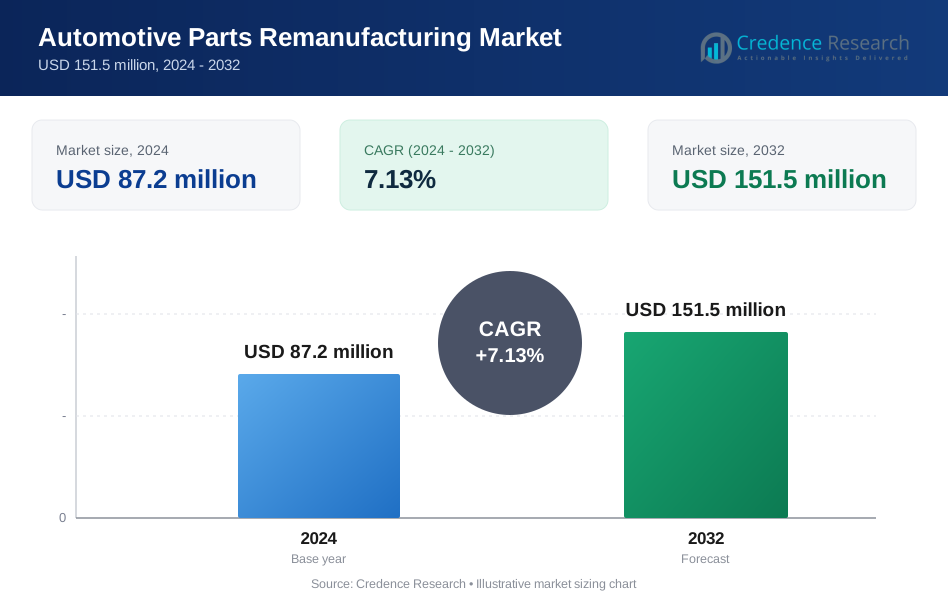
| Automotive Parts Remanufacturing Market Size 2024 | USD 87.2 million |
| Automotive Parts Remanufacturing Market, CAGR | 7.13% |
| Automotive Parts Remanufacturing Market Size 2032 | USD 151.5 million |
Market Overview
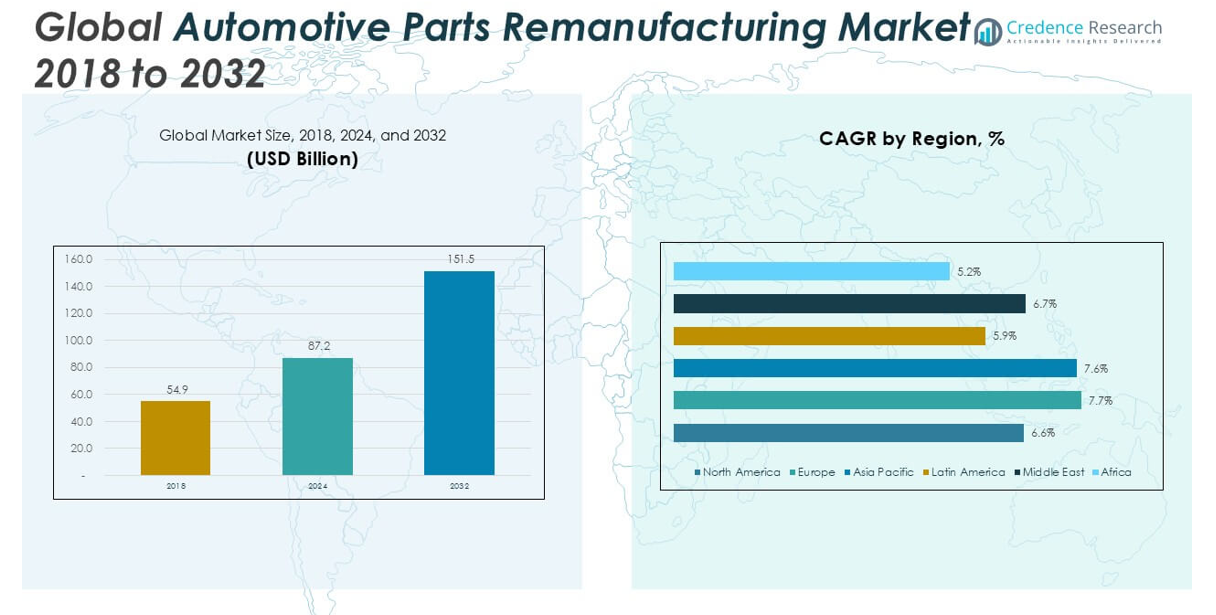
The Automotive Parts Remanufacturing Market size was valued at USD 54.9 million in 2018, increased to USD 87.2 million in 2024, and is anticipated to reach USD 151.5 million by 2032, growing at a CAGR of 7.13% during the forecast period.
The automotive parts remanufacturing market is driven by key players such as Caterpillar Inc., Robert Bosch GmbH, ZF Friedrichshafen AG, BORG Automotive A/S, Detroit Diesel Corporation, Motorcar Parts of America, Inc., Standard Motor Products Inc., Cardone Industries Inc., Maval Manufacturing Inc., and Carwood Group. These companies maintain strong competitive positions through extensive product offerings, advanced remanufacturing technologies, and global distribution networks. Asia Pacific leads the market, holding approximately 34.7% of the global share in 2024, supported by a large aging vehicle fleet and rising demand for cost-effective automotive solutions. North America and Europe follow as significant regions, driven by high consumer awareness and supportive environmental regulations.
Market Insights
- The automotive parts remanufacturing market was valued at USD 87.2 million in 2024 and is projected to reach USD 151.5 million by 2032, growing at a CAGR of 7.13% during the forecast period.
- The market is driven by rising consumer demand for cost-effective, sustainable vehicle maintenance solutions and increasing government support for circular economy practices.
- Growing trends include the adoption of remanufactured components in electric vehicles and expanding opportunities in emerging economies like Asia Pacific, which holds the largest regional share of 34.7%, followed by North America at 23.9% and Europe at 22.5%.
- The market is highly competitive, with key players such as Caterpillar Inc., Robert Bosch GmbH, and ZF Friedrichshafen AG focusing on technological advancements and certified remanufacturing processes to strengthen market presence.
- Major restraints include quality perception challenges and supply chain complexities, particularly in securing a stable core supply for remanufacturing operations.
Market Segmentation Analysis:
By Component:
In the automotive parts remanufacturing market, the Engine & Related Parts segment dominates with the largest market share, accounting for approximately 35% of the total market. This dominance is driven by the high replacement frequency and cost-effectiveness of remanufactured engines compared to new ones. Increasing demand for sustainable and affordable vehicle maintenance solutions further supports this segment’s growth. Additionally, technological advancements in remanufacturing processes are enhancing the reliability and efficiency of remanufactured engines, making them a preferred choice among consumers and contributing to the steady expansion of this segment.
- For instance, Caterpillar Inc. remanufactured over 2 million engines globally by 2022 through its Cat Reman program, with each engine saving up to 85% of the material and 65% of the energy required for new production.
By Vehicle Segment
Within the vehicle segment, Passenger Cars hold the leading position, capturing over 60% of the market share. The significant volume of passenger cars on the road, combined with rising consumer awareness about cost savings and sustainability, drives the growth of remanufactured automotive parts in this segment. Additionally, the growing adoption of electric and hybrid passenger vehicles is creating new opportunities for remanufactured electrical components. The increasing average vehicle age and demand for economical replacement parts are further propelling the passenger cars segment in the global automotive parts remanufacturing market.
- For instance, Motorcar Parts of America remanufactured over 13 million alternators and starters annually as of 2021, significantly contributing to the availability of cost-effective replacement parts for passenger vehicles worldwide.
Market Overview
Cost-Effectiveness and Consumer Demand for Affordable Solutions
The primary growth driver in the automotive parts remanufacturing market is the increasing consumer demand for cost-effective vehicle maintenance. Remanufactured parts offer substantial savings compared to new parts while maintaining quality and performance. This affordability appeals to both individual vehicle owners and fleet operators, especially in emerging economies where price sensitivity is high. The growing number of aging vehicles globally further strengthens the demand for remanufactured components as consumers seek reliable yet economical options to extend vehicle life.
- For instance, Cardone Industries processes approximately 46,000 cores per day across its North American facilities, providing a consistent supply of affordable remanufactured parts that reduce maintenance costs for fleet operators and consumers.
Rising Environmental Concerns and Regulatory Support
Environmental sustainability is significantly propelling the automotive parts remanufacturing market. Remanufacturing helps reduce waste, lower carbon emissions, and conserve raw materials, aligning with global environmental goals. Regulatory bodies in North America and Europe are increasingly supporting remanufacturing through favorable policies and incentives to encourage the circular economy. These initiatives are pushing both manufacturers and consumers to adopt remanufactured parts, contributing to a greener automotive industry and providing a long-term growth pathway for the market.
- For instance, Robert Bosch GmbH’s eXchange program remanufactures over 2,700 different automotive parts annually, saving nearly 23,000 metric tons of raw materials each year while complying with European carbon reduction standards.
Technological Advancements in Remanufacturing Processes
Advances in remanufacturing technologies are enhancing the quality, precision, and reliability of remanufactured parts, which is a critical growth enabler. Automation, robotics, and advanced cleaning and testing techniques ensure that remanufactured components meet stringent quality standards. These improvements are reducing the performance gap between new and remanufactured parts, increasing consumer confidence. Moreover, digital tracking and part certification processes are making remanufactured components more traceable and verifiable, further driving their adoption across both the passenger and commercial vehicle segments.
Key Trends & Opportunities
Growing Adoption in Electric Vehicle Segment
The increasing penetration of electric vehicles (EVs) presents a significant opportunity for the automotive parts remanufacturing market. As EVs age, there will be rising demand for remanufactured components such as electric motors, battery management systems, and power electronics. This trend allows manufacturers to diversify their remanufacturing portfolio beyond traditional internal combustion engine parts. Additionally, remanufacturing EV components aligns well with sustainability goals, offering a cost-efficient and eco-friendly alternative for vehicle owners.
- For instance, Borg Automotive has introduced remanufactured electric brake calipers and electric power steering systems, with over 5,000 SKUs in their remanufactured portfolio specifically addressing electric and hybrid vehicle components by 2023.
Expansion in Emerging Economies
Emerging markets in Asia Pacific, Latin America, and Africa are becoming critical growth regions for automotive parts remanufacturing. The large population of aging vehicles and the high cost of new automotive parts in these regions drive demand for affordable remanufactured alternatives. Additionally, increasing awareness of environmental benefits and gradual regulatory support are creating favorable conditions for market expansion. Companies that invest in local remanufacturing facilities and build strong distribution networks stand to capture substantial market share in these growing economies.
- For instance, ZF Friedrichshafen AG operates more than 20 remanufacturing sites globally, with one of its key expansions in Shanghai processing over 60,000 remanufactured units per year to meet rising demand in Asia Pacific.
Key Challenges
Quality Perception and Consumer Trust Issues
One of the key challenges in the automotive parts remanufacturing market is the lingering perception that remanufactured parts are of inferior quality compared to new components. Despite technological advancements and strict quality controls, many consumers remain skeptical about the reliability and durability of these parts. Building consumer trust through certifications, warranties, and education about the remanufacturing process is crucial for overcoming this barrier and encouraging broader market adoption.
Complexity in Supply Chain and Core Availability
Maintaining a stable supply of cores (used parts suitable for remanufacturing) is a major logistical challenge. The availability and timely collection of cores are essential to keep the remanufacturing cycle efficient and cost-effective. Fluctuations in core supply can disrupt production schedules and increase lead times. Additionally, managing reverse logistics, inspection, and disassembly processes across diverse regions adds complexity to the supply chain, posing a persistent operational challenge for manufacturers.
Regulatory Variability Across Regions
The automotive parts remanufacturing market faces challenges due to inconsistent regulations across different countries and regions. While some governments actively promote remanufacturing through supportive policies, others lack clear regulatory frameworks, creating uncertainty for market players. This regulatory disparity complicates cross-border operations and limits the ability of companies to scale globally. Standardization in quality certifications, environmental compliance, and import/export policies is necessary to facilitate smoother international trade and market growth.
Regional Analysis
North America
In 2024, North America accounted for approximately 23.9% of the global automotive parts remanufacturing market, with a market size of USD 20.83 million, up from USD 13.48 million in 2018. The region is expected to reach USD 34.85 million by 2032, growing at a CAGR of 6.6%. Growth is driven by the strong presence of established automotive manufacturers, increasing vehicle life cycles, and high consumer awareness regarding the cost benefits and environmental impact of remanufactured parts. Additionally, favorable government policies supporting circular economy initiatives continue to boost market demand in the region.
Europe
Europe held around 22.5% of the global market in 2024, with a market size of USD 19.64 million, increasing from USD 11.95 million in 2018. The market is projected to reach USD 35.67 million by 2032, advancing at a CAGR of 7.7%. The region's growth is largely fueled by stringent environmental regulations promoting remanufacturing, strong automotive aftermarket infrastructure, and increasing consumer preference for sustainable solutions. Europe’s proactive approach toward reducing carbon footprints and promoting green practices is significantly supporting the adoption of remanufactured automotive components across both passenger and commercial vehicle segments.
Asia Pacific
Asia Pacific dominated the automotive parts remanufacturing market in 2024, holding the largest share of approximately 34.7%, with a market size of USD 30.24 million, up from USD 18.50 million in 2018. The market is anticipated to reach USD 54.55 million by 2032, growing at a CAGR of 7.6%. The region’s growth is driven by the rapidly expanding automotive sector, a large population of aging vehicles, and increasing demand for affordable vehicle maintenance solutions. Additionally, emerging economies such as China and India are witnessing heightened awareness of environmental benefits, creating substantial opportunities for market expansion.
Latin America
Latin America accounted for about 9.9% of the global market in 2024, with a market size of USD 8.60 million, growing from USD 5.77 million in 2018. The market is expected to reach USD 13.64 million by 2032, at a CAGR of 5.9%. Growth in this region is supported by the rising need for cost-effective automotive parts and the increasing number of aging vehicles on the road. The relatively slow economic growth compared to other regions is balanced by the steady demand for affordable replacement parts, making remanufactured components an attractive option for budget-conscious consumers.
Middle East
The Middle East automotive parts remanufacturing market held a 6.5% share in 2024, with a market value of USD 5.69 million, up from USD 3.68 million in 2018. The market is projected to reach USD 9.55 million by 2032, registering a CAGR of 6.7%. The growth is driven by increasing vehicle ownership, a growing awareness of the cost benefits of remanufactured parts, and gradual development of the automotive aftermarket sector. The region’s focus on extending vehicle life and reducing waste contributes to the steady demand for remanufactured automotive components.
Africa
Africa captured approximately 2.5% of the global automotive parts remanufacturing market in 2024, with a market size of USD 2.17 million, up from USD 1.50 million in 2018. The market is expected to reach USD 3.27 million by 2032, growing at a CAGR of 5.2%. The region’s growth is primarily driven by the increasing number of aging vehicles and the high demand for affordable automotive parts. However, the market faces challenges such as limited infrastructure and low consumer awareness, which may restrain faster adoption. Nonetheless, growing urbanization and vehicle use offer potential for long-term market development.
Market Segmentations:
By Component:
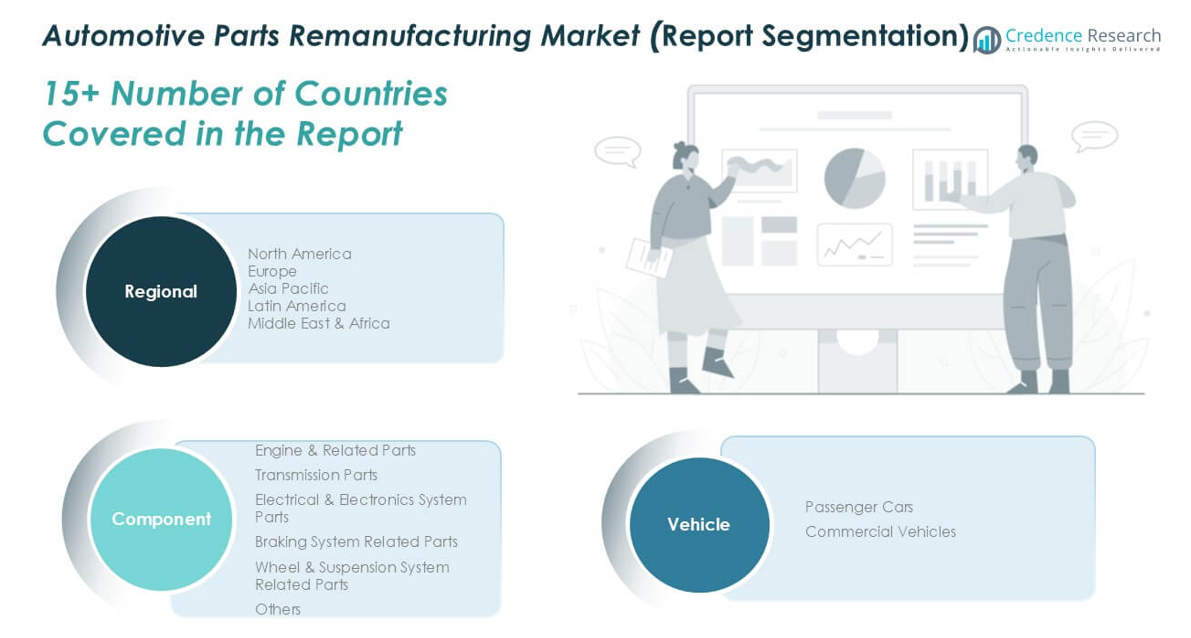
- Engine & Related Parts
- Transmission Parts
- Electrical & Electronics System Parts
- Braking System Related Parts
- Wheel & Suspension System Related Parts
- Others
By Vehicle Segment:
- Passenger Cars
- Commercial Vehicles
By Geography:
- North America
- U.S.
- Canada
- Mexico
- Europe
- Germany
- France
- U.K.
- Italy
- Spain
- Rest of Europe
- Asia Pacific
- China
- Japan
- India
- South Korea
- South-east Asia
- Rest of Asia Pacific
- Latin America
- Brazil
- Argentina
- Rest of Latin America
- Middle East & Africa
- GCC Countries
- South Africa
- Rest of the Middle East and Africa
Competitive Landscape
The automotive parts remanufacturing market is characterized by the presence of several well-established global and regional players competing based on product quality, pricing, and sustainability. Key market participants such as Caterpillar Inc., Robert Bosch GmbH, ZF Friedrichshafen AG, and BORG Automotive A/S maintain a strong market presence through extensive product portfolios and advanced remanufacturing capabilities. Companies are focusing on strategic partnerships, mergers, and acquisitions to strengthen their distribution networks and expand geographic reach. Additionally, leading players are investing in technological advancements to enhance product reliability and streamline remanufacturing processes, improving cost-efficiency and turnaround times. The competitive landscape is further shaped by increasing emphasis on offering certified remanufactured parts to build consumer trust and ensure regulatory compliance. Smaller and regional companies also play a vital role by catering to local demand, especially in emerging markets. Overall, the market exhibits moderate to high competition, with innovation and sustainability emerging as key differentiators among participants.
Key Player Analysis
- Caterpillar Inc.
- Robert Bosch GmbH
- ZF Friedrichshafen AG
- BORG Automotive A/S
- Detroit Diesel Corporation
- Motorcar Parts of America, Inc.
- Standard Motor Products Inc.
- Cardone Industries Inc.
- Maval Manufacturing Inc.
- Carwood Group
Recent Developments
- In January 2023, Robert Bosch GmbH expanded its remanufacturing facility in Germany to enhance its production capacity for remanufactured automotive parts. This expansion was driven by a growing demand for these parts in the automotive industry, according to Bosch. The expansion aimed to increase the availability of remanufactured parts, offering a cost-effective and sustainable alternative to new parts, while maintaining high quality and reliability standards.
- In June 2023, ZF Friedrichshafen AG invested in advanced remanufacturing technologies. This investment aimed to improve the efficiency and quality of their automotive parts remanufacturing processes.
- In April 2022, ATC Drivetrain acquired Treharne Automotive Engineering and its group companies. It is a U.K.-based company specializing in automotive engineering and focuses on EV battery management, recycling, and diagnostic & test equipment for powertrain systems. The company wanted to strengthen its product lines further in the automotive industry's electrification sector.
- In September 2022, Stellantis announced investment of more than USD 10 million to develop a vehicle remanufacturing facility in Italy. The company also announced that Mirafiori Complex would focus on sustainable manufacturing facilities including vehicle dismantling, reconditioning, and parts remanufacturing.
- In November 2022, Denso Corporation announced its remanufacturing program in Europe to further increase its adoption and boost awareness of the benefits of the remanufacturing process.
Market Concentration & Characteristics
The Automotive Parts Remanufacturing Market demonstrates a moderately concentrated structure, with a mix of global leaders and specialized regional players shaping the competitive landscape. It is characterized by a strong focus on cost efficiency, sustainability, and quality assurance. Major companies such as Caterpillar Inc., Robert Bosch GmbH, and ZF Friedrichshafen AG hold significant market shares due to their advanced remanufacturing capabilities and extensive distribution networks. The market prioritizes technological innovation to improve product reliability and operational efficiency. Certification, warranty offerings, and adherence to strict industry standards are critical to building consumer trust. It relies heavily on reverse logistics and the consistent availability of used components, known as cores, which directly influence production stability. Regional variations are evident, with Asia Pacific holding the largest market share, driven by a growing vehicle population and demand for affordable automotive solutions. North America and Europe follow, supported by mature automotive sectors and strong environmental regulations that encourage remanufacturing practices.
Report Coverage
The research report offers an in-depth analysis based on Type, Application, End-User and Geography. It details leading market players, providing an overview of their business, product offerings, investments, revenue streams, and key applications. Additionally, the report includes insights into the competitive environment, SWOT analysis, current market trends, as well as the primary drivers and constraints. Furthermore, it discusses various factors that have driven market expansion in recent years. The report also explores market dynamics, regulatory scenarios, and technological advancements that are shaping the industry. It assesses the impact of external factors and global economic changes on market growth. Lastly, it provides strategic recommendations for new entrants and established companies to navigate the complexities of the market.
Future Outlook
- The automotive parts remanufacturing market is expected to experience steady growth driven by increasing demand for affordable vehicle maintenance solutions.
- Rising environmental awareness will continue to encourage the adoption of remanufactured components across vehicle types.
- The market will benefit from expanding applications in electric and hybrid vehicle segments as these vehicles age.
- Technological advancements in remanufacturing processes will improve product quality, efficiency, and consumer confidence.
- Growing regulatory support for circular economy practices will further strengthen market opportunities globally.
- Asia Pacific is expected to maintain its lead in market share, supported by a large vehicle base and rising aftermarket demand.
- North America and Europe will continue to grow due to well-established automotive industries and favorable sustainability policies.
- Increasing focus on supply chain efficiency and core recovery will be critical for maintaining consistent production levels.
- Key players will prioritize certifications, warranties, and quality assurance to address consumer trust issues.
- Strategic partnerships and market expansion in emerging regions will remain essential growth strategies for industry leaders.
Request a Free Sample
Fill in your details and we'll send you a free sample report.
- Sample data tables & charts
- Research methodology
Need a Custom Version of This Report?
Tailor the scope, geography, or segments to your exact requirements.
- Custom geography or segment scope
- Direct access to our analyst team
Frequently Asked Questions
What is the current size of the Automotive Parts Remanufacturing Market?
What are the key segments within the Automotive Parts Remanufacturing Market?
What are some challenges faced by the Automotive Parts Remanufacturing Market?
Who are the major players in the Automotive Parts Remanufacturing Market?
Table of Content
Chapter 1. Report Introduction
- 1.1 Report Description & Purpose
- 1.1.1 Report Title & Market Definition
- 1.1.2 Unique Selling Propositions (USP) & Key Differentiators
- 1.1.3 Value Proposition for Stakeholders
- 1.2 Research Objectives
- 1.2.1 Market Sizing Objectives (Volume & Revenue)
- 1.2.2 Segmentation Objectives
- 1.2.3 Competitive Intelligence Objectives
- 1.2.4 Forecast & Scenario Objectives
- 1.3 Report Scope
- 1.3.1 Automotive Parts Remanufacturing Scope – Types & Subtypes Covered
- 1.3.2 Geographic Scope – Regions & Countries Covered
- 1.3.3 Historical Period, Base Year & Forecast Period (2024; forecast to 2032)
- 1.3.4 Inclusions & Exclusions
- 1.4 HS Code & Classification Framework
- 1.5 Currency, Units & Pricing Basis
- 1.6 Target Stakeholders
- 1.7 Limitations & Assumptions
Chapter 2. Executive Summary
- 2.1 Global Automotive Parts Remanufacturing Market Snapshot
- 2.1.1 Market Size – Historical (2024) & Forecast (2024-2032) (2024: USD 87.2 million → 2032: USD 151.5 million)
- 2.1.2 Volume & Revenue – Global Totals
- 2.1.3 Key Market Highlights – Top Five Facts
- 2.2 Automotive Parts Remanufacturing Market Segmentation Snapshot
- 2.2.1 Market Split by Region – 2024 vs. 2032
- 2.3 Competitive Snapshot
- 2.3.1 Top 10 Players by Revenue Share – 2024
- 2.3.2 Top 10 Players by Volume Share – 2024
- 2.3.3 Recent Strategic Developments (18-Month Summary)
- 2.4 Key Investment Highlights & Strategic Conclusions
Chapter 3. Automotive Parts Remanufacturing Market Dynamics & Industry Analysis
- 3.1 Market Overview & Context
- 3.1.1 Automotive Parts Remanufacturing Market Position in the Broader Automotive Value Chain
- 3.1.2 OEM vs. Replacement Market Dynamics
- 3.1.3 Market Maturity & Development Stage by Region
- 3.2 Automotive Parts Remanufacturing Market Drivers
- 3.3 Automotive Parts Remanufacturing Market Restraints & Challenges
- 3.4 Automotive Parts Remanufacturing Market Opportunities
- 3.5 Porter's Five Forces Analysis
- 3.5.1 Threat of New Entrants
- 3.5.2 Bargaining Power of Suppliers
- 3.5.3 Bargaining Power of Buyers
- 3.5.4 Threat of Substitutes
- 3.5.5 Competitive Rivalry – Intensity Assessment
- 3.6 Automotive Parts Remanufacturing Value Chain Analysis
- 3.6.1 Upstream – Raw Material/Input Suppliers
- 3.6.1.1 Raw Material/Input 1
- 3.6.1.2 Raw Material/Input 2
- 3.6.1.3 Raw Material/Input 3
- 3.6.2 Midstream – Production/Manufacturing/Service Delivery
- 3.6.2.1 Production/Process Overview
- 3.6.2.2 Key Facility Locations & Capacity by Manufacturer
- 3.6.3 Downstream – Distribution & End Consumer
- 3.6.3.1 Primary Channel – B2B/OEM
- 3.6.3.2 Secondary Channels – Dealer, Retail, Online, Direct
- 3.6.4 Value Chain Profitability Analysis
- 3.6.1 Upstream – Raw Material/Input Suppliers
- 3.7 PESTEL Analysis
- 3.7.1 Political Factors
- 3.7.2 Economic Factors
- 3.7.3 Social Factors
- 3.7.4 Technological Factors
- 3.7.5 Environmental Factors
- 3.7.6 Legal Factors
- 3.8 Automotive Parts Remanufacturing Supply Chain Analysis
- 3.8.1 Raw Material/Input Supply Risk Assessment
- 3.8.2 Manufacturing Concentration Risk (Geographic Exposure)
- 3.8.3 Trade Disruption Impact Analysis
- 3.9 Regulatory & Policy Landscape
Note: The regulatory and policy landscape section covers regulations based on their applicability to the market, Automotive Parts Remanufacturing category, geography, and scope of the study. Only regulatory frameworks with a material impact on operations, compliance, trade, sustainability, or market access are analyzed in detail.
Chapter 4. Key Investment Pockets & Opportunity Analysis
- 4.1 Automotive Parts Remanufacturing Market Attractiveness Analysis
- 4.1.1 By Region – Investment Attractiveness Matrix (Volume × CAGR)
- 4.2 Absolute Revenue Growth Opportunity
- 4.2.1 By Region – Absolute USD Growth Through 2032
- 4.3 Incremental Volume Opportunity
- 4.3.1 By Region – Incremental Volume Through 2032
- 4.3.2 Segment – Incremental Volume
- 4.4 Emerging Submarket Opportunity Deep Dive (Subject to Applicability)
- 4.5 Emerging Market Opportunity Scorecards
- 4.5.1 United States
- 4.5.2 Europe
- 4.5.3 Asia
- 4.5.4 Middle East & Africa
Note: Emerging Market Opportunity Scorecards will be included based on relevance and strategic importance. Regions listed are indicative and may vary depending on data availability and market dynamics.
Chapter 5. Automotive Parts Remanufacturing Import-Export Analysis & Trade Flows
- 5.1 Global Trade Overview
- 5.1.1 Global Export Value by Country (2024)
- 5.1.2 Global Export Volume by Country (2024)
- 5.1.3 Global Import Value by Country (2024)
- 5.1.4 Global Import Volume by Country (2024)
- 5.1.5 Net Trade Balance by Country (2024)
- 5.2 Export Analysis – Segment
- 5.2.1 Type 1 (HS Code)
- 5.2.2 Type 2 (HS Code)
- 5.2.3 Type 3 (HS Code)
- 5.2.4 Type 4 (HS Code)
- 5.2.5 Type 5 (HS Code)
- 5.3 Import Analysis – Segment
- 5.3.1 Type 1 (HS Code)
- 5.3.2 Type 2 (HS Code)
- 5.3.3 Type 3 (HS Code)
- 5.3.4 Type 4 (HS Code)
- 5.3.5 Type 5 (HS Code)
- 5.4 Average Unit Trade Prices
- 5.4.1 Average Export Price – Segment & Country
- 5.4.2 Average Import Price – Segment & Source Country
- 5.4.3 Price Trends (2024)
- 5.5 Key Trade Route Analysis
- 5.5.1 Trade Route 1
- 5.5.2 Trade Route 2
- 5.5.3 Trade Route 3
- 5.5.4 Trade Route 4
- 5.5.5 Trade Route 5
- 5.6 Trade Policy Impact Assessment
- 5.6.1 US Anti-Dumping & Section 301 Tariffs
- 5.6.2 EU Customs Union Impact
- 5.6.3 Major Free Trade Agreements
- 5.6.4 USMCA Rules of Origin
Note: Trade policy analysis will be included only where relevant to the Automotive Parts Remanufacturing market.
Chapter 6. Competitive Landscape & Company Benchmarking
- 6.1 Automotive Parts Remanufacturing Market Concentration & Structure
- 6.1.1 Herfindahl-Hirschman Index (HHI) – vs. 2024
- 6.1.2 Tier 1, Tier 2 & Tier 3 Market Structure
- 6.1.3 Global, Regional & Local Player Dynamics
- 6.2 Automotive Parts Remanufacturing Market Share Analysis – 2024
- 6.2.1 Global Revenue Share by Company
- 6.2.2 Global Volume Share by Company
- 6.2.3 Regional Revenue Share
- 6.2.4 Market Share Evolution ( vs. 2024)
- 6.2.5 OEM Segment Share by Company
- 6.2.6 Replacement Segment Share by Company
- 6.3 Production/Delivery Capacity & Facility Analysis
- 6.3.1 Global Installed Capacity
- 6.3.2 Capacity Utilization Rates
- 6.3.3 Production/Output Volume
- 6.3.4 Facility Locations & Capacity Map
- 6.3.5 Planned Capacity Additions
- 6.4 Automotive Parts Remanufacturing Competitive Benchmarking Matrix
- 6.4.1 Revenue, Volume, CAGR & Profitability Comparison
- 6.4.2 Channel Revenue Mix
- 6.4.3 Geographic Revenue Exposure
- 6.4.4 R&D Intensity
- 6.4.5 Sustainability Maturity
- 6.5 Strategic Developments in Automotive Parts Remanufacturing (Last 24 Months)
- 6.5.1 Mergers, Acquisitions & Divestments
- 6.5.2 New Automotive Parts Remanufacturing Launches
- 6.5.3 Facility Expansions
- 6.5.4 Strategic Alliances, Joint Ventures & Partnerships
- 6.5.5 Distribution Expansion & Market Entry
- 6.5.6 Sustainability & ESG Initiatives
- 6.6 Competitive Strategy Mapping
- 6.6.1 Leader, Challenger, Follower & Niche Classification
- 6.6.2 Pricing Strategy Comparison
- 6.6.3 Channel Strategy Matrix
Note: Strategic developments are included based on their materiality and the availability of reliable information.
Chapter 7. Global Automotive Parts Remanufacturing Market – By Distribution Channel
- 7.1 Segment Overview
- 7.1.1 Volume & Revenue Split by Channel (2024 & 2032)
- 7.1.2 Channel Mix Evolution (2024-2032)
Chapter 8. Regional Market Analysis – Global Overview
- 8.1 Global Regional Overview
- 8.1.1 Regional Volume Share
- 8.1.2 Regional Revenue Share
- 8.1.3 Regional Volume by Region
- 8.1.4 Regional Revenue by Region
- 8.1.5 Regional Forecast Through 2032
- 8.2 Cross-Regional Segment Analysis
- 8.2.1 By Distribution Channel
- 8.2.2 By Brand/Price Tier
Chapter 9. North America Automotive Parts Remanufacturing Market
- 9.1 United States
- 9.2 Canada
- 9.3 Mexico
Chapter 10. Europe Automotive Parts Remanufacturing Market
- 10.1 Germany
- 10.2 France
- 10.3 Italy
- 10.4 United Kingdom
- 10.5 Spain
- 10.6 Poland
- 10.7 Russia
- 10.8 Netherlands
- 10.9 Belgium
- 10.10 Sweden
- 10.11 Denmark
- 10.12 Norway
- 10.13 Rest of Europe
Chapter 11. Asia Pacific Automotive Parts Remanufacturing Market
- 11.1 China
- 11.2 India
- 11.3 Japan
- 11.4 South Korea
- 11.5 Thailand
- 11.6 Indonesia
- 11.7 Vietnam
- 11.8 Malaysia
- 11.9 Australia
- 11.10 Rest of Asia Pacific
Chapter 12. Latin America Automotive Parts Remanufacturing Market
- 12.1 Brazil
- 12.2 Argentina
- 12.3 Colombia
- 12.4 Chile
- 12.5 Rest of Latin America
Chapter 13. Middle East Automotive Parts Remanufacturing Market
- 13.1 Saudi Arabia
- 13.2 United Arab Emirates
- 13.3 Turkey
- 13.4 Israel
- 13.5 Iran
- 13.6 Rest of the Middle East
Chapter 14. Africa Automotive Parts Remanufacturing Market
- 14.1 South Africa
- 14.2 Egypt
- 14.3 Nigeria
- 14.4 Morocco
- 14.5 Rest of Africa
Chapter 15. Automotive Parts Remanufacturing Company Profiles
- 15.1 [Company 01]
- 15.1.1 Company Overview
- 15.1.2 Key Management Personnel
- 15.1.3 Products & Services Portfolio
- 15.1.4 Financial Performance
- 15.1.5 Key Market Focus & Geographic Presence
- 15.1.6 Recent Developments & Strategic Initiatives
Note: The company profile list is preliminary and may change based on research findings, market developments, data availability, and client requirements.
Chapter 16. Appendices
- Appendix A – List of Abbreviations & Acronyms
- Appendix B – Industry Classification Code Reference – Full Series
- Appendix C – Production & Capacity Data Tables
- Appendix D – End-Use & Demand Base Tables
- Appendix E – Consumption & Replacement Rate Assumptions
- Appendix F – ASP Reference Tables
- Appendix G – Manufacturing & Facility Database
- Appendix H – Import-Export Data Tables
- Appendix I – Regulatory Summary Tables
- Appendix J – Primary Research Participant List (Anonymized)
- Appendix K – Primary Research Questionnaire Framework
- Appendix L – Data Sources & Bibliography
- Appendix M – Market Size Divergence & Source Comparison
Chapter 17. Research Methodology
- 17.1 Research Framework & Philosophy
- 17.2 Secondary Research – Sources, Hierarchy & Data Extraction
- 17.3 Data Modeling – Bottom-Up & Top-Down Market Sizing
- 17.4 Primary Research – Stakeholder Framework, LOI & Sample Sizes
- 17.5 Forecast Methodology – Regression, Scenario & Sensitivity Analysis
- 17.6 Quality Control – Four-Layer Validation Framework
- 17.7 Limitations & Standard Assumptions
- 17.8 Disclaimer
