
| REPORT ATTRIBUTE | DETAILS |
|---|---|
| Historical Period | 2019-2022 |
| Base Year | 2023 |
| Forecast Period | 2024-2032 |
| Baby Food Packaging Products Market Size 2023 | USD 69152.2 Million |
| Baby Food Packaging Products Market, CAGR | 7.80% |
| Baby Food Packaging Products Market Size 2032 | USD 135948.6 Million |
Market Insights
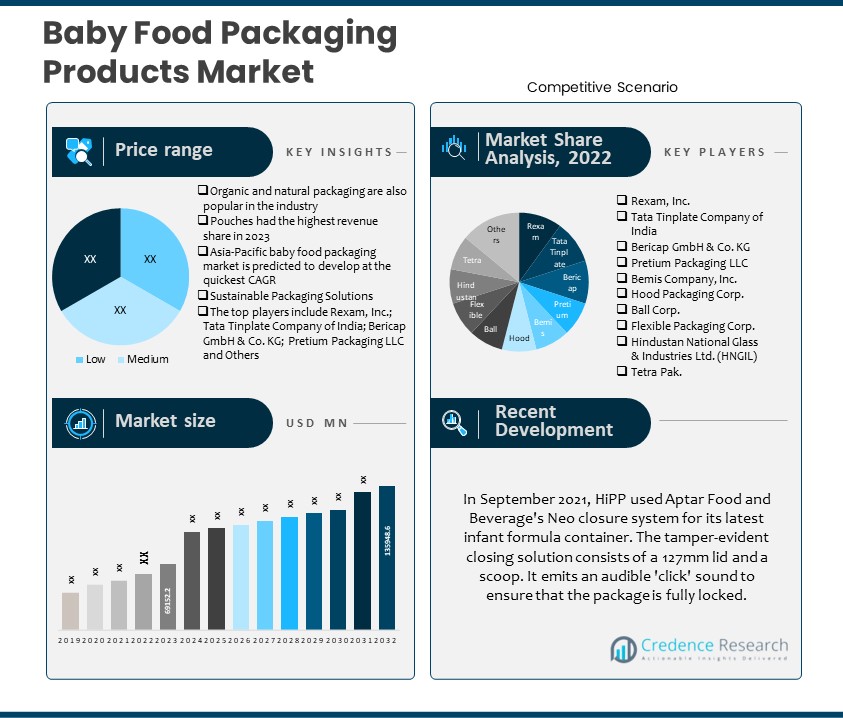
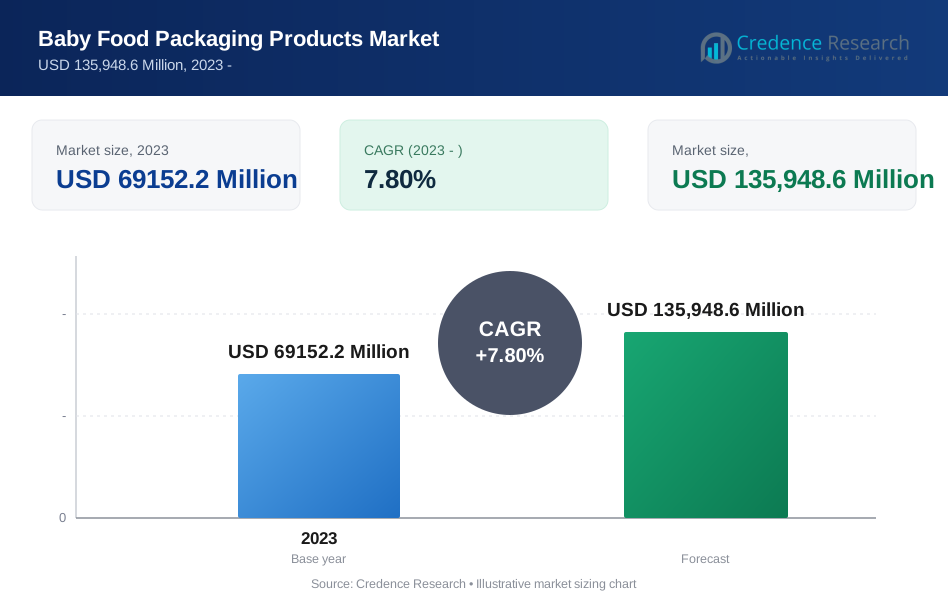
- The global demand for Baby Food Packaging Products was valued at USD 69152.2 Million in 2023 and is expected to reach USD 135948.6 Million in 2032, growing at a CAGR of 7.80% between 2024 and 2032.
- Pouches had the highest revenue share in 2023, while the bottle and jars segment is expected to grow the fastest.
- In 2023, the plastic segment held the largest share of the Baby Food Packaging Products Market. Glass is another popular material for baby food packaging.
- Peelable Lidding Films had the highest revenue (70.4%), while Snap-On Lids was the fastest-growing category throughout the projection period.
- Organic and natural packaging are also in high demand in the industry, and the Safety and Tamper-Evident Packaging market for Baby Food Packaging Products is likely to expand significantly over the forecast period.
- In 2023, North America baby food packaging will account for 40.2% of the market, while Asia-Pacific baby food packaging is predicted to develop at the quickest CAGR between 2023 and 2032.
- One of the main factors propelling the market's expansion is the rising demand for pouch packing.
- Price fluctuations for raw materials restrict the market's ability to grow for infant food packaging.
Executive Summary
Market Definition
Baby food packaging is extremely important for consumers to ensure the quality of the packed food. The baby food packaging business has moved from the usage of glass jars to plastics and other materials that are convenient to keep and inexpensive.
The increase in the number of working parents is a critical factor driving the growth of the baby food packaging market, as is the rise in demand for eco-friendly packaging of products, user safety concerns, and rapid urbanization, among other factors. Moreover, technical improvements and modernization of production techniques, as well as increased demand from emerging nations, will drive the growth of the baby food packaging market during the forecast period.
Market Overview
The global Baby Food Packaging Products Market has witnessed steady growth in recent years and is expected to grow at a CAGR of 7.80% between 2024 and 2032. The market was valued at USD 69152.2 million in 2023 and is expected to reach USD 135948.6 million in 2032.
The baby food market has been affected due to increased understanding of food origins. The nutrition science underlying food is becoming an important purchase factor for baby food items. Rapid urbanization, desire for eco-friendly packaging for baby food products, and safety concerns are among the factors predicted to drive the Baby Food Packaging market. Many infant food businesses are embracing spouted pouches as a safer alternative to glass jars. Key market players are focusing on providing convenience to busy parents as well as packaging solutions with appealing colors, shapes, and sizes that appeal to babies.
Brain and eye development, muscular growth, bone and tooth development, blood enhancement, and immune, nervous, and vascular system development are all projected to drive up demand for infant food in the near future. The demand for baby food is increasing as people become more aware of its benefits in satisfying the nutritional needs of infants and toddlers. High birth rates and robust market conditions in developed economies are two major reasons that are likely to contribute to the growth of the infant food packaging industry.
Segmentation By Packaging Type
- Pouches led them all in terms of revenue share in 2023. Their convenience and ease of use have propelled their global growth. Pouches are popular among parents who are constantly on the go because they are lightweight, transportable, and easy to store.
- The bottle and Jars segment is predicted to see the fastest revenue CAGR. Rising levels of understanding about the benefits of breastfeeding, and the resulting demand for breast milk storage bottles, are expected to be the primary drivers of revenue growth.
- The can segment is predicted to develop at a moderate rate throughout the projection period. Cans provide superior protection from environmental elements such as air, light, and moisture, ensuring the product's safety and purity.
Segmentation By Material Type
- In 2023, the plastic segment held the greatest share of the Baby Food Packaging Products Market. Plastic is the most commonly used material for infant food packaging due to its strength, flexibility, and lightweight properties. Throughout the forecast period, the plastic sector is likely to hold a large share of the market.
- Glass, which is non-toxic and non-reactive, is another popular material for baby food packaging. Glass packaging gives products a luxurious look and feel while ensuring their safety and freshness. The glass category is likely to grow significantly during the forecast period, driven by increased demand for sustainable and eco-friendly packaging choices.
Segmentation by Closure Type
- Peelable Lidding Films generated the largest revenue (70.4%) due to the strong demand for safe and flexible packaging materials.
- However, Snap-On Lids is the fastest-growing category over the forecast period, owing to an increase in the number of working mothers and a demand for alternatives to breastfeeding. Spout-top packaging is ideal for storing breast milk and formula.
Segmentation By Specialty Segments
- Organic and natural packaging are also in high demand in the market. Health-conscious consumers choose organic packaging over conventional packaging due to growing concerns about artificial components, pesticides, and antibiotics.
- During the projected period, the Safety and Tamper-Evident Packaging market for Baby Food Packaging Products is expected to increase significantly.
Segmentation by Region
- In 2023, North American infant food packaging will account for 40.2% of the market.
- The Asia-Pacific baby food packaging market is expected to grow at the fastest CAGR between 2023 and 2032.
- The rest of the world, including Latin America, the Middle East, and Africa, supplies the remaining demand for Baby Food Packaging Products.
The North American baby food packaging industry will dominate this market due to the growing demand for environmentally friendly packaging materials. Because of the high standard of living in the area, parents are growing increasingly worried about the safety and environmental impact of the items they purchase for their children. This has increased demand for environmentally friendly packaging materials, driving market expansion in this area. Furthermore, the German baby food packaging market had the highest market share, while the UK baby food packaging industry was the fastest-growing in the North American region.
Moreover, The Asia-Pacific baby food packaging market is predicted to develop at the quickest CAGR between 2023 and 2032. This is due to the growth of the e-commerce industry and the increasing popularity of online shopping in this region. Furthermore, China's baby food packaging market had the highest market share, while India's baby food packaging market was the fastest-growing in the Asia-Pacific region.
Key Highlights of the Report
Packaging Type, Material Type, Closure Type, Specialty Segments, and region segment of the global Baby Food Packaging Products Market. Pouches had the highest revenue share in 2023, while the bottle and jars segment is expected to grow the fastest. Additionally, glass is another popular material for baby food packaging, with Snap-On Lids being the fastest-growing category during the projected period. Also, organic and natural packaging are in great demand in the industry, with North America leading its expansion.
The market's primary drivers include the growing demand for portable and on-the-go items, rising health and nutritional awareness, and advancements in packaging technology. In addition, the market's main limitations include sustainability and environmental concerns, regulatory compliance and safety standards, and consumer preferences for fresh and homemade baby food. Increasing disposable income, growing markets in developing countries, and the growth of e-commerce are further important opportunities for the market.
The North America baby food packaging industry will lead this market as demand for environmentally friendly packaging materials rises. Furthermore, the Asia-Pacific infant food packaging market is expected to grow at the fastest CAGR between 2023 and 2032.
What Are The Main Drivers Of The Global Baby Food Packaging Products Market?
Several factors are driving growth in the baby food packaging products market. Consumers' preference for eco-friendly options is driving an increase in demand for sustainable packaging solutions. Furthermore, the increasing emphasis on convenience packaging, such as resealable pouches and single-serve portions, is propelling market growth. Furthermore, technological developments in packaging design improve product attractiveness and functionality, driving market growth.
What Are The Major Challenges Faced By The Global Baby Food Packaging Products Market?
On the other hand, the market has constraints that impede progress. Cost limits associated with eco-friendly materials present obstacles for enterprises seeking to implement sustainable packaging solutions. Regulatory issues in meeting packaging standards and ensuring compliance with safety laws also serve as constraints. Furthermore, the restricted availability of recyclable packaging choices limits the market's potential for long-term growth.
What Are The Growth Opportunities In The Global Baby Food Packaging Products Market?
Despite these challenges, the Baby Food Packaging Products Market has numerous potential for innovation and growth. Companies can consider expanding into emerging areas by introducing creative packaging options that cater to local preferences. Customization possibilities for personalized packaging experiences allow you to adapt to specific consumer demands and preferences.
Market Drivers
Several factors drive the global Baby Food Packaging Products Market. The following are the key drivers of the global Baby Food Packaging Products Market:
Demand For Pouch Packaging Is Increasing
This industry is experiencing an increase in demand for handy pouches, which is consistent with sealable and closure packaging trends seen in the snack sector. Stand-up pouches are expected to increase rapidly, providing greater flexibility, sustainability, and convenience than rigid alternatives. These pouches are lightweight, portable, and use less plastic, addressing consumer demand for environmentally friendly, innovative, and recyclable food packaging items.
Manufacturing procedures are efficient, allowing for customized printing of graphics, logos, and patterns, which increases brand presence in retail environments. The multi-layered construction prevents punctures while maintaining product integrity and freshness. Clear surfaces allow for simple display of components, nutritional value, portion advice, and product formulation information, which aids in consumer decision-making. Reusable and microwaveable pouches are examples of innovations that improve convenience for newborns, toddlers, and parents alike.
Market Restraints
The global Baby Food Packaging Products Market faces some challenges that may hinder its growth. These include the following:
Raw Material Prices Fluctuate
Market arrivals, demand, weather conditions, export demand, and variations between markets influence price variations. When all or some of these elements were active, raw material costs fluctuated, affecting by-products such as the Baby Food Packaging Market price, which in turn influenced the market's growth. The price of plastic packaging increased in 2021 as raw material and energy prices rose unexpectedly. The majority of food containers are made of 100% recyclable polypropylene, which is created from the residual waste of fossil fuels. As fossil fuel costs rise, so does the cost of plastic packaging. In January 2021, US polypropylene prices rose from 13.5 to 96.5 percent per pound, while HDPE and LDPE prices rose by 8% and 9%, respectively. As prices rise over time, the Baby Food Packaging Market's growth rate will slow between 2023 and 2032.
Opportunities
The global Baby Food Packaging Products Market offers significant growth opportunities. These include the following:
Growing Trend of Clean Labelling
The expanding trend of clean labeling is a major factor in the overall expansion of the sector because of a growing customer concern for simple and less synthetic chemicals on product labels. Clean labels omit information about unhealthy substances, such as synthetic chemical formulations. Sales of ingredients for clean labels, such as natural flavors and colors, fruits and vegetables, starch, and sweeteners, exceeded $38.8 billion in 2021. The fresh food packaging market is expected to be driven by the growing trend of clean-label products during the projected period.
Competitive Landscape
Key Players
The global Baby Food Packaging Products Market is highly competitive, with several key players. Some of the major players in the market and their market share are as follows:
- Rexam, Inc.
- Tata Tinplate Company of India
- Bericap GmbH & Co. KG
- Pretium Packaging LLC
- Bemis Company, Inc.
- Hood Packaging Corp.
- Ball Corp.
- Flexible Packaging Corp.
- Hindustan National Glass & Industries Ltd. (HNGIL)
- Tetra Pak.
These organizations prioritize product innovation, Closure Type expansion, and mergers and acquisitions to stay competitive.
The global Baby Food Packaging Products Market's key players continually seek to stay ahead by offering new products and developments.
In June 2021, Plasmon, the Italian infant food brand owned by Kraft-Heinz, has reintroduced its "Squeezer and Taste" in a new, 100% recyclable packaging. The Plasmon 100% fruit snack box is specifically developed for youngsters.
In March 2021, Amcor announced that it would join the Alliance to End Plastic Waste (the Alliance). Alliance participation also corresponds with Amcor's 2025 Sustainability Pledge, which calls for 100% of its packaging to be recyclable or reusable by 2025. Amcor also recently collaborated with McKinsey.org to create recycling and waste management solutions for communities in Latin America.
In August, 2021, Heinz announced an easily recyclable baby food pouch. The goods are produced entirely of polypropylene and have been evaluated by the On-Pack Recycling Label. This is consistent with the company's objective to eliminate plastic where possible and make all of its packaging reusable, recyclable, or compostable by 2025.
Summary of Key Findings
- Growing Clean Labeling Trends are Fueling Market Growth
- The market is segmented by Packaging Type, Material Type, Closure Type, Specialty Segments, and region.
- Pouches had the highest revenue share in 2023
- In 2023, the plastic segment held the largest share of the Baby Food Packaging Products Market
- North America is leading in market growth; the market is highly competitive, with key players including Rexam, Inc.; Tata Tinplate Company of India; Bericap GmbH & Co. KG; Pretium Packaging LLC and Others.
Future Outlook
- Sustainable Packaging Solutions
- Increasing need for convenient packaging.
- Growing emphasis on environmentally friendly materials.
- Technological developments in package design
- Increased adoption of resealable packaging
How CXOs Can Benefit from the Credence Research Baby Food Packaging Products Marke tReport
The Credence Research Baby Food Packaging Products Market Report provides CXOs with a comprehensive overview of the market, including:
- Market size and growth forecast: The report provides detailed estimates of the global Baby Food Packaging Products Market size, segmented By Packaging Type, Material Type, Closure Type, Specialty Segments and region. It also includes forecasts for the market through 2032 based on key trends and drivers.
- Market segmentation: The report segments the Baby Food Packaging Products Market By by Packaging Type, Material Type, Closure Type, Specialty Segments, and region. This segmentation provides CXOs with a granular understanding of the market and the opportunities in each segment.
- Competitive Landscape: The report profiles the key players in the Baby Food Packaging Products Market and provides insights into their strategies, product offerings, and financial performance. This information can help CXOs identify and assess their competition.
- Key trends and drivers: The report identifies and analyzes the key trends and drivers that are shaping the Baby Food Packaging Products Market. This information can help CXOs to make informed decisions about their investments and strategies.
CXOs can use the insights from the Credence Research Baby Food Packaging Products Market Report to:
- Identify growth opportunities: The report can help CXOs identify new growth opportunities in the Baby Food Packaging Products Market. By analyzing the data and trends in the report, they can make informed decisions about where to invest and expand their business.
- Make informed investment decisions: The report can help CXOs make informed investment decisions about Baby Food Packaging Products. For example, it may provide useful insights into market trends, customer preferences, the competitive landscape, and growth prospects in the Baby Food Packaging Products Market.
- Develop competitive strategies: The report can help CXOs develop competitive strategies for their Baby Food Packaging Products businesses. For example, by analyzing market trends, client preferences, and the competitive environment mentioned in the report, CXOs can fine-tune their strategies, differentiate their offers, and effectively position their firms in the marketplace.
- Track market developments: The report can help CXOs monitor market developments and stay ahead of the curve. For example, it provides insights into the latest trends and innovations in the Baby Food Packaging Products Market.
Overall, the Credence Research Baby Food Packaging Products Market Report is a valuable re Material Type for CXOs who want to gain a deeper understanding of the market and identify opportunities for growth.
Segmentation
- By Packaging Type:
- Bottles and Jars
- Pouches
- Cans
- Tubs and Tubs with Lids
- Squeeze Tubes
- Trays with Lidding Films
- Boxes and Cartons
- Sachets and Stick Packs
- By Material Type:
- Plastic
- Glass
- Metal
- Flexible Films
- By Closure Type:
- Screw Caps
- Flip-Top Caps
- Snap-On Lids
- Peelable Lidding Films
- Tear-Off Strips
- By Specialty Segments:
- Organic and Natural Packaging
- Allergen-Free Packaging
- Convenience Packaging
- Safety and Tamper-Evident Packaging
- By Region
- North America
- The U.S.
- Canada
- Mexico
- Europe
- Germany
- France
- The U.K.
- Italy
- Spain
- Rest of Europe
- Asia Pacific
- China
- Japan
- India
- South Korea
- South-east Asia
- Rest of Asia Pacific
- Latin America
- Brazil
- Argentina
- Rest of Latin America
- Middle East & Africa
- GCC Countries
- South Africa
- Rest of the Middle East and Africa
- North America
Request a Free Sample
Fill in your details and we'll send you a free sample report.
- Sample data tables & charts
- Research methodology
Need a Custom Version of This Report?
Tailor the scope, geography, or segments to your exact requirements.
- Custom geography or segment scope
- Direct access to our analyst team
Frequently Asked Questions
What is the current size of the global Baby Food Packaging Products Market?
What is the expected growth rate of the Baby Food Packaging Products Market between 2024 and 2032?
Which segment is leading the market share in terms of Material Type?
Which Specialty Segments segment governs the demand for Baby Food Packaging Products in the world?
Who are the major players in the global Baby Food Packaging Products Market?
Table of Content
Chapter 1. Report Introduction
- 1.1 Report Description & Purpose
- 1.1.1 Report Title & Market Definition
- 1.1.2 Unique Selling Propositions (USP) & Key Differentiators
- 1.1.3 Value Proposition for Stakeholders
- 1.2 Research Objectives
- 1.2.1 Market Sizing Objectives (Volume & Revenue) (Volume Where Applicable)
- 1.2.2 Segmentation Objectives
- 1.2.3 Competitive Intelligence Objectives
- 1.2.4 Forecast & Scenario Objectives
- 1.3 Report Scope
- 1.3.1 Baby Food Packaging Products Scope – Segments & Subsegments Covered
- 1.3.2 Geographic Scope – Regions & Countries Covered
- 1.3.3 Historical Period, Base Year & Forecast Period (2023; forecast to the forecast period)
- 1.3.4 Inclusions & Exclusions
- 1.4 Industry Classification & Applicable Codes
- 1.5 Currency, Measurement Units & Valuation Basis
- 1.6 Target Stakeholders
- 1.7 Limitations & Assumptions
Chapter 2. Executive Summary
- 2.1 Global Baby Food Packaging Products Market Snapshot
- 2.1.1 Market Size – Historical (2023) & Forecast (the forecast period) (2023: USD 69152.2 Million → forecast year: USD 135,948.6 Million)
- 2.1.2 Volume & Revenue – Global Totals (Volume Where Applicable)
- 2.1.3 Key Market Highlights – Top Five Facts
- 2.2 Baby Food Packaging Products Market Segmentation Snapshot
- 2.2.1 Market Split by Region – 2023 vs.
- 2.3 Competitive Snapshot
- 2.3.1 Top 10 Players by Revenue Share – 2023
- 2.3.2 Top 10 Players by Volume Share – 2023 (Volume Where Applicable)
- 2.3.3 Recent Strategic Developments (18-Month Summary)
- 2.4 Key Investment Highlights & Strategic Conclusions
Chapter 3. Baby Food Packaging Products Market Dynamics & Industry Analysis
- 3.1 Market Overview & Context
- 3.1.1 Baby Food Packaging Products Market Position in the Broader Industry Value Chain
- 3.1.2 Demand Structure & Purchasing Dynamics
- 3.1.3 Market Maturity & Development Stage by Region
- 3.2 Baby Food Packaging Products Market Drivers
- 3.3 Baby Food Packaging Products Market Restraints & Challenges
- 3.4 Baby Food Packaging Products Market Opportunities
- 3.5 Porter's Five Forces Analysis
- 3.5.1 Threat of New Entrants
- 3.5.2 Bargaining Power of Suppliers
- 3.5.3 Bargaining Power of Buyers
- 3.5.4 Threat of Substitutes
- 3.5.5 Competitive Rivalry – Intensity Assessment
- 3.6 Baby Food Packaging Products Value Chain Analysis
- 3.6.1 Upstream – Key Inputs, Resources & Suppliers
- 3.6.1.1 Key Input/Resource 1
- 3.6.1.2 Key Input/Resource 2
- 3.6.1.3 Key Input/Resource 3
- 3.6.2 Midstream – Core Operations & Value Creation
- 3.6.2.1 Operating Model & Process Overview
- 3.6.2.2 Key Operating Locations & Capabilities by Company
- 3.6.3 Downstream – Market Channels & End Users
- 3.6.3.1 Direct Sales & Customer Engagement Channels
- 3.6.3.2 Indirect Sales, Intermediaries & Partner Channels
- 3.6.4 Value Chain Profitability Analysis
- 3.6.1 Upstream – Key Inputs, Resources & Suppliers
- 3.7 PESTEL Analysis
- 3.7.1 Political Factors
- 3.7.2 Economic Factors
- 3.7.3 Social Factors
- 3.7.4 Technological Factors
- 3.7.5 Environmental Factors
- 3.7.6 Legal Factors
- 3.8 Baby Food Packaging Products Supply Chain Analysis
- 3.8.1 Critical Input & Resource Availability Risk Assessment
- 3.8.2 Supplier & Operational Concentration Risk (Geographic Exposure)
- 3.8.3 Supply & Service Disruption Impact Analysis
- 3.9 Regulatory & Policy Landscape
Note: The regulatory and policy landscape section covers regulations based on their applicability to the market, Baby Food Packaging Products category, geography, and scope of the study. Only regulatory frameworks with a material impact on operations, compliance, trade, sustainability, or market access are analyzed in detail.
Chapter 4. Key Investment Pockets & Opportunity Analysis
- 4.1 Baby Food Packaging Products Market Attractiveness Analysis
- 4.1.1 By Region – Investment Attractiveness Matrix (Market Size × CAGR)
- 4.2 Absolute Revenue Growth Opportunity
- 4.2.1 By Region – Absolute Revenue Growth Through the forecast period
- 4.3 Incremental Demand Opportunity
- 4.3.1 By Region – Incremental Demand Through the forecast period
- 4.3.2 Segment – Incremental Demand
- 4.4 Emerging Submarket Opportunity Deep Dive (Subject to Applicability)
- 4.5 Priority Market Opportunity Scorecards
- 4.5.1 United States
- 4.5.2 Europe
- 4.5.3 Asia
- 4.5.4 Middle East & Africa
Note: Priority market opportunity scorecards reflect the geographic scope and strategic relevance of the study. Listed markets are indicative and may be adapted to the industry.
Chapter 5. Baby Food Packaging Products Cross-Border Trade & Market Access Analysis
- 5.1 International Trade & Cross-Border Activity Overview
- 5.1.1 Global Export Value by Country (2023)
- 5.1.2 Global Export Volume by Country (2023) (Volume Where Applicable)
- 5.1.3 Global Import Value by Country (2023)
- 5.1.4 Global Import Volume by Country (2023) (Volume Where Applicable)
- 5.1.5 Net Trade Balance by Country (2023)
- 5.2 Export Analysis – Segment
- 5.2.1 Category 1 (Applicable Classification Code)
- 5.2.2 Category 2 (Applicable Classification Code)
- 5.2.3 Category 3 (Applicable Classification Code)
- 5.2.4 Category 4 (Applicable Classification Code)
- 5.2.5 Category 5 (Applicable Classification Code)
- 5.3 Import Analysis – Segment
- 5.3.1 Category 1 (Applicable Classification Code)
- 5.3.2 Category 2 (Applicable Classification Code)
- 5.3.3 Category 3 (Applicable Classification Code)
- 5.3.4 Category 4 (Applicable Classification Code)
- 5.3.5 Category 5 (Applicable Classification Code)
- 5.4 Cross-Border Pricing & Transaction Benchmarks
- 5.4.1 Export Pricing – Segment & Country
- 5.4.2 Import Pricing – Segment & Source Country
- 5.4.3 Price Trends (2023)
- 5.5 Key Cross-Border Trade & Delivery Routes
- 5.5.1 Cross-Border Trade/Delivery Route 1
- 5.5.2 Cross-Border Trade/Delivery Route 2
- 5.5.3 Cross-Border Trade/Delivery Route 3
- 5.5.4 Cross-Border Trade/Delivery Route 4
- 5.5.5 Cross-Border Trade/Delivery Route 5
- 5.6 Trade Policy & Market Access Impact Assessment
- 5.6.1 Tariff & Non-Tariff Barriers
- 5.6.2 Regional Trade & Economic Integration Frameworks
- 5.6.3 Bilateral & Multilateral Trade Agreements
- 5.6.4 Cross-Border Operating, Licensing & Localization Requirements
Note: This chapter applies where cross-border trade or delivery is relevant to Baby Food Packaging Products. Goods, services, and digital offerings are assessed using applicable classifications and transaction measures. Import-export volumes, trade balances, and route analyses are included only where meaningful to the market.
Chapter 6. Competitive Landscape & Company Benchmarking
- 6.1 Baby Food Packaging Products Market Concentration & Structure
- 6.1.1 Herfindahl-Hirschman Index (HHI) – vs. 2023
- 6.1.2 Leading, Mid-Sized & Emerging Player Structure
- 6.1.3 Global, Regional & Local Player Dynamics
- 6.2 Baby Food Packaging Products Market Share Analysis – 2023
- 6.2.1 Global Revenue Share by Company
- 6.2.2 Global Volume Share by Company (Volume Where Applicable)
- 6.2.3 Regional Revenue Share
- 6.2.4 Market Share Evolution ( vs. 2023)
- 6.2.5 Company Market Share by Key Segment
- 6.2.6 Company Market Share by Customer Group
- 6.3 Operating Scale, Capacity & Infrastructure Analysis
- 6.3.1 Global Operating Scale & Supply Capacity
- 6.3.2 Resource Utilization & Operating Efficiency
- 6.3.3 Output, Service Delivery & Activity Metrics
- 6.3.4 Operating Footprint & Infrastructure Map
- 6.3.5 Planned Operational & Capacity Expansion
- 6.4 Baby Food Packaging Products Competitive Benchmarking Matrix
- 6.4.1 Revenue, Growth, Profitability & Operating Metric Comparison
- 6.4.2 Channel Revenue Mix
- 6.4.3 Geographic Revenue Exposure
- 6.4.4 R&D Intensity
- 6.4.5 Sustainability Maturity
- 6.5 Strategic Developments in Baby Food Packaging Products (Last 24 Months)
- 6.5.1 Mergers, Acquisitions & Divestments
- 6.5.2 New Products, Services & Solutions in Baby Food Packaging Products
- 6.5.3 Operational & Infrastructure Expansions
- 6.5.4 Strategic Alliances, Joint Ventures & Partnerships
- 6.5.5 Distribution Expansion & Market Entry
- 6.5.6 Sustainability & ESG Initiatives
- 6.6 Competitive Strategy Mapping
- 6.6.1 Leader, Challenger, Follower & Niche Classification
- 6.6.2 Pricing Strategy Comparison
- 6.6.3 Channel Strategy Matrix
Note: Strategic developments are included based on their materiality and the availability of reliable information.
Chapter 7. Global Baby Food Packaging Products Market – By Sales & Delivery Channel
- 7.1 Segment Overview
- 7.1.1 Volume & Revenue Split by Channel (2023 & ) (Volume Where Applicable)
- 7.1.2 Channel Mix Evolution (the forecast period)
Chapter 8. Regional Market Analysis – Global Overview
- 8.1 Global Regional Overview
- 8.1.1 Regional Volume Share (Volume Where Applicable)
- 8.1.2 Regional Revenue Share
- 8.1.3 Regional Volume by Region (Volume Where Applicable)
- 8.1.4 Regional Revenue by Region
- 8.1.5 Regional Forecast Through the forecast period
- 8.2 Cross-Regional Segment Analysis
- 8.2.1 By Sales & Delivery Channel
- 8.2.2 By Competitive Positioning & Price Tier
Chapter 9. North America Baby Food Packaging Products Market
- 9.1 United States
- 9.2 Canada
- 9.3 Mexico
Chapter 10. Europe Baby Food Packaging Products Market
- 10.1 Germany
- 10.2 France
- 10.3 Italy
- 10.4 United Kingdom
- 10.5 Spain
- 10.6 Poland
- 10.7 Russia
- 10.8 Netherlands
- 10.9 Belgium
- 10.10 Sweden
- 10.11 Denmark
- 10.12 Norway
- 10.13 Rest of Europe
Chapter 11. Asia Pacific Baby Food Packaging Products Market
- 11.1 China
- 11.2 India
- 11.3 Japan
- 11.4 South Korea
- 11.5 Thailand
- 11.6 Indonesia
- 11.7 Vietnam
- 11.8 Malaysia
- 11.9 Australia
- 11.10 Rest of Asia Pacific
Chapter 12. Latin America Baby Food Packaging Products Market
- 12.1 Brazil
- 12.2 Argentina
- 12.3 Colombia
- 12.4 Chile
- 12.5 Rest of Latin America
Chapter 13. Middle East Baby Food Packaging Products Market
- 13.1 Saudi Arabia
- 13.2 United Arab Emirates
- 13.3 Turkey
- 13.4 Israel
- 13.5 Iran
- 13.6 Rest of the Middle East
Chapter 14. Africa Baby Food Packaging Products Market
- 14.1 South Africa
- 14.2 Egypt
- 14.3 Nigeria
- 14.4 Morocco
- 14.5 Rest of Africa
Chapter 15. Baby Food Packaging Products Company Profiles
- 15.1 [Company 01]
- 15.1.1 Company Overview
- 15.1.2 Key Management Personnel
- 15.1.3 Products & Services Portfolio
- 15.1.4 Financial Performance
- 15.1.5 Key Market Focus & Geographic Presence
- 15.1.6 Recent Developments & Strategic Initiatives
Note: The company profile list is preliminary and may change based on research findings, market developments, data availability, and client requirements.
Chapter 16. Appendices
- Appendix A – List of Abbreviations & Acronyms
- Appendix B – Industry Classification Code Reference – Full Series
- Appendix C – Supply, Output & Operating Capacity Data Tables
- Appendix D – End-Use & Demand Base Tables
- Appendix E – Demand, Adoption & Usage Assumptions
- Appendix F – Pricing & Revenue Metric Reference Tables
- Appendix G – Company Operations & Infrastructure Database
- Appendix H – Cross-Border Trade & Activity Data Tables (Where Applicable)
- Appendix I – Regulatory Summary Tables
- Appendix J – Primary Research Participant List (Anonymized)
- Appendix K – Primary Research Questionnaire Framework
- Appendix L – Data Sources & Bibliography
- Appendix M – Market Size Divergence & Source Comparison
Chapter 17. Research Methodology
- 17.1 Research Framework & Philosophy
- 17.2 Secondary Research – Sources, Hierarchy & Data Extraction
- 17.3 Data Modeling – Bottom-Up & Top-Down Market Sizing
- 17.4 Primary Research – Stakeholder Framework, LOI & Sample Sizes
- 17.5 Forecast Methodology – Regression, Scenario & Sensitivity Analysis
- 17.6 Quality Control – Four-Layer Validation Framework
- 17.7 Limitations & Standard Assumptions
- 17.8 Disclaimer
