
Bakery Ingredients Market Overview:
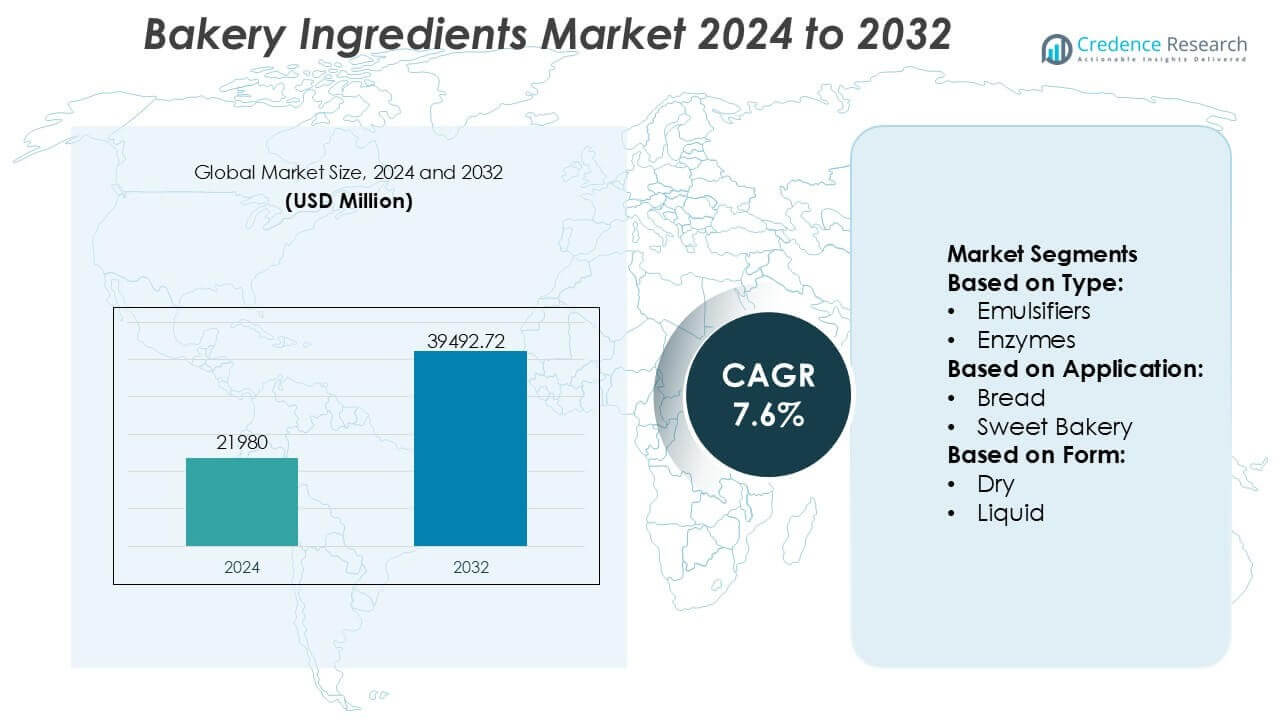
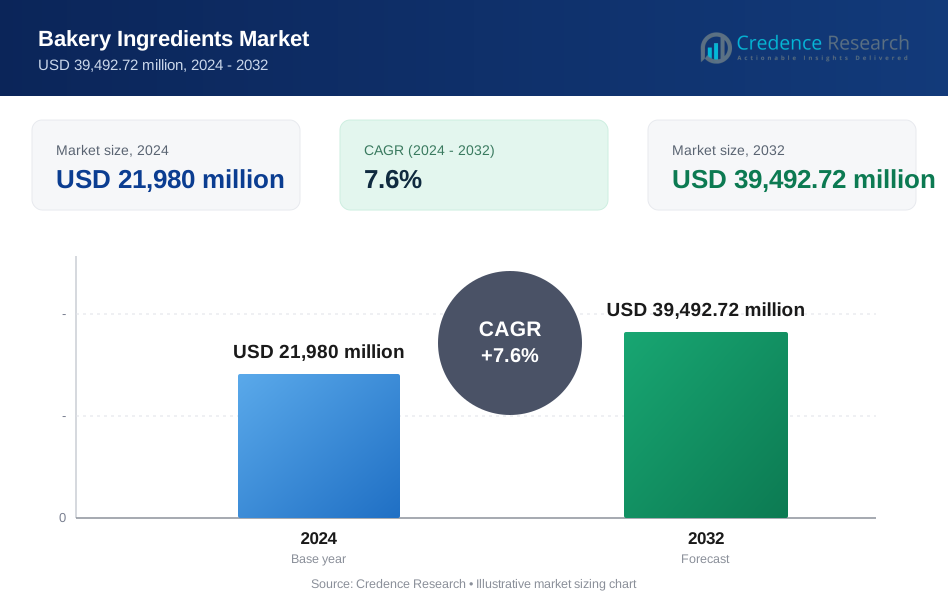
Bakery Ingredients Market size was valued USD 21980 million in 2024 and is anticipated to reach USD 39492.72 million by 2032, at a CAGR of 7.6% during the forecast period.
| REPORT ATTRIBUTE | DETAILS |
|---|---|
| Historical Period | 2020-2023 |
| Base Year | 2024 |
| Forecast Period | 2025-2032 |
| Bakery Ingredients Market Size 2024 | USD 21980 million |
| Bakery Ingredients Market, CAGR | 7.6% |
| Bakery Ingredients Market Size 2032 | USD 39492.72 million |
Bakery Ingredients Market Insights
- Market growth is primarily supported by strong demand for functional ingredients such as enzymes, emulsifiers, and specialty fats, with emulsifiers emerging as the leading segment holding an exact 29% share due to their role in texture improvement and shelf-life extension.
- Clean-label reformulation, sugar reduction, and nutritional fortification represent major market trends, prompting manufacturers to invest in enzyme-based and natural ingredient solutions for bread and sweet bakery applications.
- Competitive intensity remains high as multinational suppliers and regional players focus on R&D, customized formulations, and reliable supply chains to serve both industrial and artisanal bakers, while managing raw material price volatility.
- Regionally, North America leads with an exact 38% market share, supported by advanced baking infrastructure, high per-capita bakery consumption, and early adoption of clean-label and performance-driven ingredient innovations.
Bakery Ingredients Market Segmentation Analysis:
By Type
By type, emulsifiers represent the dominant sub-segment in the bakery ingredients market, accounting for an estimated 27% market share, driven by their critical role in dough stability, crumb softness, and shelf-life extension across industrial and artisanal baking. Emulsifiers such as mono- and diglycerides and lecithin support consistent volume and texture in high-speed production lines. Enzymes follow closely, supported by clean-label reformulation trends that reduce chemical additives. Oils, fats, and shortenings remain essential for mouthfeel and aeration, while colors, flavors, preservatives, and leavening agents support product differentiation and freshness in packaged baked goods.
- For instance, Goodman Fielder operates multiple commercial bakery and ingredient facilities across Australia and New Zealand, with individual baking lines engineered to process more than 12,000 loaves per hour, and employs emulsifier-optimized formulations validated through pilot trials exceeding 1,000 test batches annually to ensure texture consistency and extended freshness across its packaged bakery portfolio.
By Application
By application, bread is the dominant sub-segment, holding approximately 62% market share, supported by high global consumption, daily-use demand, and large-scale commercial baking operations. Ingredients for bread focus on dough strength, fermentation control, volume enhancement, and shelf-life stability, driving strong demand for enzymes, emulsifiers, and yeast-based leavening agents. Sweet bakery products follow, fueled by indulgence trends and premiumization in cakes, pastries, and cookies. This segment increasingly relies on specialty ingredients such as flavors, colors, and tailored starches to achieve distinct textures, visual appeal, and consistent performance across frozen and ready-to-bake formats.
- For instance, Aryzta AG operates an extensive network of approximately 26 industrial bakeries focused on the European and Rest-of-World markets. The company runs high-capacity bread lines supported by automated fermentation systems and an innovation-driven strategy that generated 18% of its revenue from new products in 2024.
By Form
By form, dry ingredients dominate the bakery ingredients market with nearly 71% market share, driven by their longer shelf life, ease of storage, and compatibility with automated batching systems. Dry formats are widely used for enzymes, baking powders, starches, fibers, and premixes, enabling precise dosing and reduced logistics costs. Liquid ingredients, including oils, emulsions, and liquid flavors, follow due to their superior dispersion and functional performance in high-fat or premium formulations. However, their shorter shelf life and handling requirements limit broader adoption, keeping dry forms central to industrial-scale and contract baking operations.
Key Growth Drivers
Expanding Demand for Packaged and Convenience Bakery Products
Rising urbanization, busy lifestyles, and increasing working populations continue to drive demand for packaged and ready-to-eat bakery products. Consumers increasingly prefer bread, cakes, cookies, and pastries that offer convenience, consistent quality, and longer shelf life. This shift directly supports higher consumption of bakery ingredients such as emulsifiers, enzymes, preservatives, and baking mixes that enhance texture, stability, and freshness. Growth in modern retail channels and e-commerce further strengthens demand by improving product accessibility and encouraging frequent purchases across both developed and emerging markets.
- For instance, Britannia Industries Ltd operates more than 30 manufacturing facilities across India, with several automated biscuit and bread lines capable of producing over 100,000 packs per hour, and deploys in-house quality laboratories that conduct thousands of shelf-life and texture stability tests annually to support large-scale distribution of packaged bakery products nationwide.
Product Innovation and Functional Ingredient Adoption
Continuous innovation in bakery formulations is a major driver for ingredient demand. Manufacturers increasingly use enzymes, fibers, and specialty starches to improve dough handling, volume, crumb structure, and nutritional value. Functional ingredients enable clean-label formulations, sugar reduction, and fat replacement without compromising taste or texture. The growing focus on high-protein, fortified, and digestive-health bakery products has accelerated the use of functional bakery ingredients, positioning them as essential components for product differentiation and premiumization across commercial and artisanal bakery segments.
- For instance, Tiger Brands Company operates advanced bakery and milling facilities in South Africa equipped with high-capacity automated mixing and proofing systems processing several tonnes of dough per hour, and its internal R&D and quality centers conduct thousands of controlled bake tests annually, using precision fermentation control, moisture analysis, and texture profiling instruments to validate enzyme systems, fiber inclusion rates, and starch functionality for consistent performance across its packaged bread and baked goods portfolio.
Growth of Foodservice and Industrial Baking
Rapid expansion of foodservice chains, quick-service restaurants, and industrial bakeries significantly supports market growth. Large-scale bakeries rely on standardized ingredients to ensure consistent quality, high throughput, and cost efficiency. Ingredients such as baking powders, shortenings, and stabilizers are critical for maintaining uniformity across high-volume production lines. The growth of frozen and par-baked bakery products further boosts ingredient demand, as these applications require advanced formulations that preserve freshness, texture, and sensory attributes throughout extended distribution and storage cycles.
Key Trends & Opportunities
Shift Toward Clean-Label and Natural Ingredients
Consumers increasingly scrutinize ingredient labels, driving bakeries to replace artificial additives with natural and recognizable alternatives. This trend creates strong opportunities for natural enzymes, clean-label emulsifiers, plant-based colors, and natural flavors. Ingredient suppliers are investing in fermentation-based and plant-derived solutions that deliver comparable performance to synthetic counterparts. Clean-label positioning not only improves consumer trust but also enables premium pricing, particularly in health-focused and artisanal bakery segments across developed and fast-growing urban markets.
- For instance, Grupo Bimbo S.A.B. de C.V. has implemented advanced industrial IoT platforms in over 200 of its manufacturing facilities worldwide to monitor real-time production parameters such as dough temperature, humidity, and proofing time with precision measurements logged every 60 seconds.
Rising Demand for Health-Oriented and Specialty Bakery Products
Health and wellness trends are reshaping bakery formulations, creating opportunities for ingredients that support reduced sugar, low-fat, gluten-free, and high-fiber products. Demand for whole-grain breads, fortified baked goods, and allergen-free formulations is rising steadily. This trend drives increased use of specialty fibers, alternative flours, and functional starches. Manufacturers that align ingredient portfolios with nutrition-focused claims and regulatory requirements can capture growth across both retail and foodservice bakery channels.
- For instance, Flowers Foods operates a Bakery of the Future program across its 44 bakery facilities in 19 U.S. states that collects real-time production line data tracking variables such as water usage, energy consumption, and scrap levels by the minute to optimize dough handling and minimize process inefficiencies.
Key Challenges
Volatility in Raw Material Prices and Supply Chains
Bakery ingredient manufacturers face persistent challenges from fluctuating prices of key raw materials such as wheat derivatives, vegetable oils, and specialty enzymes. Supply-chain disruptions, climate-related crop variability, and geopolitical uncertainties increase cost pressures and impact production planning. These factors limit margin stability and complicate long-term contracts with bakery producers. Managing sourcing risks while maintaining consistent quality remains a critical challenge, particularly for ingredient suppliers serving large industrial bakeries with high-volume and time-sensitive requirements.
Regulatory Compliance and Formulation Complexity
Strict food safety regulations and evolving labeling standards pose significant challenges for bakery ingredient producers. Compliance requirements related to additives, allergens, and nutritional claims vary across regions, increasing formulation complexity and development costs. Reformulating products to meet clean-label or reduced-additive standards without sacrificing performance further intensifies R&D demands. Smaller manufacturers may struggle to keep pace with regulatory changes, while larger players must balance innovation speed with extensive testing and documentation requirements.
Regional Analysis
North America
North America leads the Bakery Ingredients Market with an estimated 38% market share, supported by a highly industrialized bakery sector, strong private-label penetration, and consistent demand for packaged bread, cookies, and snack cakes. Large-scale commercial bakeries prioritize functional ingredients such as enzymes, emulsifiers, and clean-label preservatives to improve shelf life and production efficiency. Rising consumer preference for high-protein, whole-grain, and reduced-sugar bakery products further accelerates ingredient innovation. The region also benefits from advanced R&D capabilities, robust cold-chain infrastructure, and rapid adoption of enzyme-based and specialty fat solutions across industrial and foodservice bakeries.
Europe
Europe accounts for approximately 27% of the global Bakery Ingredients Market, driven by its strong tradition of artisanal and specialty bakery products alongside a well-developed industrial baking base. Demand remains high for natural emulsifiers, sourdough enzymes, fibers, and clean-label colors and flavors, reflecting strict regulatory standards and consumer focus on ingredient transparency. Western Europe dominates regional consumption due to high per-capita bakery intake, while Eastern Europe shows steady growth through modernization of bakery operations. Sustainability, organic certifications, and reduced-additive formulations strongly influence purchasing decisions, encouraging suppliers to invest in natural and plant-based ingredient portfolios.
Asia-Pacific
Asia-Pacific holds around 24% market share and represents the fastest-growing regional market for bakery ingredients. Urbanization, rising disposable incomes, and westernization of diets are expanding demand for bread, cakes, and sweet bakery products across China, India, and Southeast Asia. Manufacturers increasingly rely on improvers, enzymes, and specialty fats to ensure consistent quality in high-volume production. Growth is also supported by the rapid expansion of modern retail and QSR chains. Localized flavor development, fortified ingredients, and cost-efficient formulations are critical as suppliers balance affordability with performance across diverse consumer preferences.
Latin America
Latin America contributes close to 7% of the global market, supported by strong consumption of bread, rolls, and sweet baked goods in countries such as Brazil and Mexico. The market favors cost-effective ingredients, including baking powders, starches, and shortenings, to support mass-market bakery production. Industrial bakeries dominate demand, though artisanal and in-store bakery formats are gradually expanding in urban areas. Suppliers focus on improving texture stability and shelf life under warm climatic conditions. Economic volatility influences purchasing behavior, making flexible pricing and locally sourced raw materials key competitive factors.
Middle East & Africa
The Middle East & Africa region accounts for roughly 4% market share, driven by rising urban populations and growing demand for packaged and frozen bakery products. Bread remains a staple food, supporting steady demand for yeast, enzymes, and flour-enhancing ingredients. Gulf countries lead regional growth due to strong foodservice sectors and reliance on imported bakery ingredients, while Africa shows gradual expansion through modernization of milling and baking infrastructure. Suppliers emphasize shelf-life extension, heat-stable formulations, and halal-compliant ingredients to address climatic, regulatory, and cultural requirements across diverse regional markets.
Bakery Ingredients Market Segmentations:
By Type:
- Emulsifiers
- Enzymes
By Application:
- Bread
- Sweet Bakery
By Form:
- Dry
- Liquid
By Geography
- North America
- U.S.
- Canada
- Mexico
- Europe
- Germany
- France
- U.K.
- Italy
- Spain
- Rest of Europe
- Asia Pacific
- China
- Japan
- India
- South Korea
- South-east Asia
- Rest of Asia Pacific
- Latin America
- Brazil
- Argentina
- Rest of Latin America
- Middle East & Africa
- GCC Countries
- South Africa
- Rest of the Middle East and Africa
Competitive Landscape
The bakery ingredients market players such as Aryzta AG, Britannia Industries Ltd, George Weston Ltd, Tiger Brands Company, Finsbury Food Group, Grupo Bimbo S.A.B. de C.V., Flower Foods Inc, Nestlé S.A. The bakery ingredients market exhibits a highly competitive landscape driven by continuous innovation, scale efficiencies, and the ability to meet evolving regulatory and consumer demands. Companies compete primarily on the performance of functional ingredients such as enzymes, emulsifiers, specialty fats, and clean-label solutions that improve texture, volume, freshness, and shelf life across bread, biscuits, and sweet bakery products.
Competitive intensity is reinforced by growing demand for sugar reduction, fat optimization, and nutritional fortification, which requires strong formulation expertise and application support. Market participants invest heavily in R&D, pilot bakeries, and sensory testing to accelerate product development and customization. Supply reliability, consistent quality, and cost competitiveness remain critical differentiators, particularly for high-volume industrial bakers and private-label manufacturers. Additionally, sustainability initiatives, transparent sourcing, and compliance with regional food safety standards increasingly influence competitive positioning, shaping long-term partnerships between ingredient suppliers and bakery manufacturers.
Key Player Analysis
- Goodman Fielder
- Aryzta AG
- Britannia Industries Ltd
- George Weston Ltd
- Tiger Brands Company
- Finsbury Food Group
- Grupo Bimbo S.A.B. de C.V.
- Flower Foods Inc
- Nestlé S.A.
- Hostess Brands LLC
Recent Developments
- In January 2025, GoodMills Innovation introduced GoWell Tasty Protein, a blend of fava beans, yellow peas, sunflower seeds, and wheat. These innovative solutions are designed to seamlessly add protein to bakery products without affecting flavor.
- In October 2024, Crespel & Deiters Group introduced Lory Starch Elara, a resistant wheat starch that boosts fiber and lowers carbs, and their Lory Protein range, to create healthier pizza, pasta, and baked goods, enabling manufacturers to increase nutrient density without compromising taste or texture by easily replacing flour/semolina.
- In June 2024, Fooditive Group's Keto-Fructose sweetener is currently undergoing a Generally Recognized As Safe (GRAS) assessment by the U.S. Food and Drug Administration (FDA) and is not yet available for direct consumer purchase. It is being evaluated for use as an ingredient in manufactured food products.
Report Coverage
The research report offers an in-depth analysis based on Type, Application, Form and Geography. It details leading market players, providing an overview of their business, product offerings, investments, revenue streams, and key applications. Additionally, the report includes insights into the competitive environment, SWOT analysis, current market trends, as well as the primary drivers and constraints. Furthermore, it discusses various factors that have driven market expansion in recent years. The report also explores market dynamics, regulatory scenarios, and technological advancements that are shaping the industry. It assesses the impact of external factors and global economic changes on market growth. Lastly, it provides strategic recommendations for new entrants and established companies to navigate the complexities of the market.
Future Outlook
- The market will increasingly prioritize clean-label and natural ingredient formulations to align with stricter regulatory scrutiny and evolving consumer preferences.
- Enzyme-based solutions will gain wider adoption as manufacturers seek to improve dough stability, volume, and shelf life while reducing chemical additives.
- Sugar and fat reduction strategies will accelerate, supported by advanced sweeteners, fibers, and specialty fats that preserve taste and texture.
- Demand for functional and fortified bakery ingredients will rise, driven by interest in protein enrichment, fiber inclusion, and micronutrient enhancement.
- Sustainability will shape ingredient sourcing, with greater use of responsibly sourced oils, plant-based emulsifiers, and low-impact processing methods.
- Digitalization and data-driven formulation tools will improve consistency, quality control, and speed-to-market for new bakery ingredient solutions.
- Customized ingredient blends tailored to specific bakery applications will expand, supporting both industrial and artisanal production needs.
- Growth of frozen and par-baked bakery products will increase demand for ingredients that enhance freeze-thaw stability and extended freshness.
- Regional taste adaptation and localization will become more important as manufacturers expand into emerging and diverse consumer markets.
- Strategic collaborations between ingredient suppliers and bakery manufacturers will intensify to co-develop innovative, performance-driven formulations.
Request a Free Sample
Fill in your details and we'll send you a free sample report.
- Sample data tables & charts
- Research methodology
Need a Custom Version of This Report?
Tailor the scope, geography, or segments to your exact requirements.
- Custom geography or segment scope
- Direct access to our analyst team
Frequently Asked Questions
What is the current market size for the Bakery Ingredients Market, and what is its projected size in 2032?
At what Compound Annual Growth Rate is the Bakery Ingredients Market projected to grow between 2024 and 2032?
Which Bakery Ingredients Market segment held the largest share in 2024?
What are the primary factors fueling the growth of the Bakery Ingredients Market?
Who are the leading companies in the Bakery Ingredients Market?
Which region commanded the largest share of the Bakery Ingredients Market in 2024?
Table of Content
Chapter 1. Report Introduction
- 1.1 Report Description & Purpose
- 1.1.1 Report Title & Market Definition
- 1.1.2 Unique Selling Propositions (USP) & Key Differentiators
- 1.1.3 Value Proposition for Stakeholders
- 1.2 Research Objectives
- 1.2.1 Market Sizing Objectives (Volume & Revenue)
- 1.2.2 Segmentation Objectives
- 1.2.3 Competitive Intelligence Objectives
- 1.2.4 Forecast & Scenario Objectives
- 1.3 Report Scope
- 1.3.1 Bakery Ingredients Scope – Types & Subtypes Covered
- 1.3.2 Geographic Scope – Regions & Countries Covered
- 1.3.3 Historical Period, Base Year & Forecast Period (2024; forecast to 2032)
- 1.3.4 Inclusions & Exclusions
- 1.4 HS Code & Classification Framework
- 1.5 Currency, Units & Pricing Basis
- 1.6 Target Stakeholders
- 1.7 Limitations & Assumptions
Chapter 2. Executive Summary
- 2.1 Global Bakery Ingredients Market Snapshot
- 2.1.1 Market Size – Historical (2024) & Forecast (2024-2032) (2024: USD 21,980 million → 2032: USD 39,492.72 million)
- 2.1.2 Volume & Revenue – Global Totals
- 2.1.3 Key Market Highlights – Top Five Facts
- 2.2 Bakery Ingredients Market Segmentation Snapshot
- 2.2.1 Market Split by Region – 2024 vs. 2032
- 2.3 Competitive Snapshot
- 2.3.1 Top 10 Players by Revenue Share – 2024
- 2.3.2 Top 10 Players by Volume Share – 2024
- 2.3.3 Recent Strategic Developments (18-Month Summary)
- 2.4 Key Investment Highlights & Strategic Conclusions
Chapter 3. Bakery Ingredients Market Dynamics & Industry Analysis
- 3.1 Market Overview & Context
- 3.1.1 Bakery Ingredients Market Position in the Broader Automotive Value Chain
- 3.1.2 OEM vs. Replacement Market Dynamics
- 3.1.3 Market Maturity & Development Stage by Region
- 3.2 Bakery Ingredients Market Drivers
- 3.3 Bakery Ingredients Market Restraints & Challenges
- 3.4 Bakery Ingredients Market Opportunities
- 3.5 Porter's Five Forces Analysis
- 3.5.1 Threat of New Entrants
- 3.5.2 Bargaining Power of Suppliers
- 3.5.3 Bargaining Power of Buyers
- 3.5.4 Threat of Substitutes
- 3.5.5 Competitive Rivalry – Intensity Assessment
- 3.6 Bakery Ingredients Value Chain Analysis
- 3.6.1 Upstream – Raw Material/Input Suppliers
- 3.6.1.1 Raw Material/Input 1
- 3.6.1.2 Raw Material/Input 2
- 3.6.1.3 Raw Material/Input 3
- 3.6.2 Midstream – Production/Manufacturing/Service Delivery
- 3.6.2.1 Production/Process Overview
- 3.6.2.2 Key Facility Locations & Capacity by Manufacturer
- 3.6.3 Downstream – Distribution & End Consumer
- 3.6.3.1 Primary Channel – B2B/OEM
- 3.6.3.2 Secondary Channels – Dealer, Retail, Online, Direct
- 3.6.4 Value Chain Profitability Analysis
- 3.6.1 Upstream – Raw Material/Input Suppliers
- 3.7 PESTEL Analysis
- 3.7.1 Political Factors
- 3.7.2 Economic Factors
- 3.7.3 Social Factors
- 3.7.4 Technological Factors
- 3.7.5 Environmental Factors
- 3.7.6 Legal Factors
- 3.8 Bakery Ingredients Supply Chain Analysis
- 3.8.1 Raw Material/Input Supply Risk Assessment
- 3.8.2 Manufacturing Concentration Risk (Geographic Exposure)
- 3.8.3 Trade Disruption Impact Analysis
- 3.9 Regulatory & Policy Landscape
Note: The regulatory and policy landscape section covers regulations based on their applicability to the market, Bakery Ingredients category, geography, and scope of the study. Only regulatory frameworks with a material impact on operations, compliance, trade, sustainability, or market access are analyzed in detail.
Chapter 4. Key Investment Pockets & Opportunity Analysis
- 4.1 Bakery Ingredients Market Attractiveness Analysis
- 4.1.1 By Region – Investment Attractiveness Matrix (Volume × CAGR)
- 4.2 Absolute Revenue Growth Opportunity
- 4.2.1 By Region – Absolute USD Growth Through 2032
- 4.3 Incremental Volume Opportunity
- 4.3.1 By Region – Incremental Volume Through 2032
- 4.3.2 Segment – Incremental Volume
- 4.4 Emerging Submarket Opportunity Deep Dive (Subject to Applicability)
- 4.5 Emerging Market Opportunity Scorecards
- 4.5.1 United States
- 4.5.2 Europe
- 4.5.3 Asia
- 4.5.4 Middle East & Africa
Note: Emerging Market Opportunity Scorecards will be included based on relevance and strategic importance. Regions listed are indicative and may vary depending on data availability and market dynamics.
Chapter 5. Bakery Ingredients Import-Export Analysis & Trade Flows
- 5.1 Global Trade Overview
- 5.1.1 Global Export Value by Country (2024)
- 5.1.2 Global Export Volume by Country (2024)
- 5.1.3 Global Import Value by Country (2024)
- 5.1.4 Global Import Volume by Country (2024)
- 5.1.5 Net Trade Balance by Country (2024)
- 5.2 Export Analysis – Segment
- 5.2.1 Type 1 (HS Code)
- 5.2.2 Type 2 (HS Code)
- 5.2.3 Type 3 (HS Code)
- 5.2.4 Type 4 (HS Code)
- 5.2.5 Type 5 (HS Code)
- 5.3 Import Analysis – Segment
- 5.3.1 Type 1 (HS Code)
- 5.3.2 Type 2 (HS Code)
- 5.3.3 Type 3 (HS Code)
- 5.3.4 Type 4 (HS Code)
- 5.3.5 Type 5 (HS Code)
- 5.4 Average Unit Trade Prices
- 5.4.1 Average Export Price – Segment & Country
- 5.4.2 Average Import Price – Segment & Source Country
- 5.4.3 Price Trends (2024)
- 5.5 Key Trade Route Analysis
- 5.5.1 Trade Route 1
- 5.5.2 Trade Route 2
- 5.5.3 Trade Route 3
- 5.5.4 Trade Route 4
- 5.5.5 Trade Route 5
- 5.6 Trade Policy Impact Assessment
- 5.6.1 US Anti-Dumping & Section 301 Tariffs
- 5.6.2 EU Customs Union Impact
- 5.6.3 Major Free Trade Agreements
- 5.6.4 USMCA Rules of Origin
Note: Trade policy analysis will be included only where relevant to the Bakery Ingredients market.
Chapter 6. Competitive Landscape & Company Benchmarking
- 6.1 Bakery Ingredients Market Concentration & Structure
- 6.1.1 Herfindahl-Hirschman Index (HHI) – vs. 2024
- 6.1.2 Tier 1, Tier 2 & Tier 3 Market Structure
- 6.1.3 Global, Regional & Local Player Dynamics
- 6.2 Bakery Ingredients Market Share Analysis – 2024
- 6.2.1 Global Revenue Share by Company
- 6.2.2 Global Volume Share by Company
- 6.2.3 Regional Revenue Share
- 6.2.4 Market Share Evolution ( vs. 2024)
- 6.2.5 OEM Segment Share by Company
- 6.2.6 Replacement Segment Share by Company
- 6.3 Production/Delivery Capacity & Facility Analysis
- 6.3.1 Global Installed Capacity
- 6.3.2 Capacity Utilization Rates
- 6.3.3 Production/Output Volume
- 6.3.4 Facility Locations & Capacity Map
- 6.3.5 Planned Capacity Additions
- 6.4 Bakery Ingredients Competitive Benchmarking Matrix
- 6.4.1 Revenue, Volume, CAGR & Profitability Comparison
- 6.4.2 Channel Revenue Mix
- 6.4.3 Geographic Revenue Exposure
- 6.4.4 R&D Intensity
- 6.4.5 Sustainability Maturity
- 6.5 Strategic Developments in Bakery Ingredients (Last 24 Months)
- 6.5.1 Mergers, Acquisitions & Divestments
- 6.5.2 New Bakery Ingredients Launches
- 6.5.3 Facility Expansions
- 6.5.4 Strategic Alliances, Joint Ventures & Partnerships
- 6.5.5 Distribution Expansion & Market Entry
- 6.5.6 Sustainability & ESG Initiatives
- 6.6 Competitive Strategy Mapping
- 6.6.1 Leader, Challenger, Follower & Niche Classification
- 6.6.2 Pricing Strategy Comparison
- 6.6.3 Channel Strategy Matrix
Note: Strategic developments are included based on their materiality and the availability of reliable information.
Chapter 7. Global Bakery Ingredients Market – By Distribution Channel
- 7.1 Segment Overview
- 7.1.1 Volume & Revenue Split by Channel (2024 & 2032)
- 7.1.2 Channel Mix Evolution (2024-2032)
Chapter 8. Regional Market Analysis – Global Overview
- 8.1 Global Regional Overview
- 8.1.1 Regional Volume Share
- 8.1.2 Regional Revenue Share
- 8.1.3 Regional Volume by Region
- 8.1.4 Regional Revenue by Region
- 8.1.5 Regional Forecast Through 2032
- 8.2 Cross-Regional Segment Analysis
- 8.2.1 By Distribution Channel
- 8.2.2 By Brand/Price Tier
Chapter 9. North America Bakery Ingredients Market
- 9.1 United States
- 9.2 Canada
- 9.3 Mexico
Chapter 10. Europe Bakery Ingredients Market
- 10.1 Germany
- 10.2 France
- 10.3 Italy
- 10.4 United Kingdom
- 10.5 Spain
- 10.6 Poland
- 10.7 Russia
- 10.8 Netherlands
- 10.9 Belgium
- 10.10 Sweden
- 10.11 Denmark
- 10.12 Norway
- 10.13 Rest of Europe
Chapter 11. Asia Pacific Bakery Ingredients Market
- 11.1 China
- 11.2 India
- 11.3 Japan
- 11.4 South Korea
- 11.5 Thailand
- 11.6 Indonesia
- 11.7 Vietnam
- 11.8 Malaysia
- 11.9 Australia
- 11.10 Rest of Asia Pacific
Chapter 12. Latin America Bakery Ingredients Market
- 12.1 Brazil
- 12.2 Argentina
- 12.3 Colombia
- 12.4 Chile
- 12.5 Rest of Latin America
Chapter 13. Middle East Bakery Ingredients Market
- 13.1 Saudi Arabia
- 13.2 United Arab Emirates
- 13.3 Turkey
- 13.4 Israel
- 13.5 Iran
- 13.6 Rest of the Middle East
Chapter 14. Africa Bakery Ingredients Market
- 14.1 South Africa
- 14.2 Egypt
- 14.3 Nigeria
- 14.4 Morocco
- 14.5 Rest of Africa
Chapter 15. Bakery Ingredients Company Profiles
- 15.1 [Company 01]
- 15.1.1 Company Overview
- 15.1.2 Key Management Personnel
- 15.1.3 Products & Services Portfolio
- 15.1.4 Financial Performance
- 15.1.5 Key Market Focus & Geographic Presence
- 15.1.6 Recent Developments & Strategic Initiatives
Note: The company profile list is preliminary and may change based on research findings, market developments, data availability, and client requirements.
Chapter 16. Appendices
- Appendix A – List of Abbreviations & Acronyms
- Appendix B – Industry Classification Code Reference – Full Series
- Appendix C – Production & Capacity Data Tables
- Appendix D – End-Use & Demand Base Tables
- Appendix E – Consumption & Replacement Rate Assumptions
- Appendix F – ASP Reference Tables
- Appendix G – Manufacturing & Facility Database
- Appendix H – Import-Export Data Tables
- Appendix I – Regulatory Summary Tables
- Appendix J – Primary Research Participant List (Anonymized)
- Appendix K – Primary Research Questionnaire Framework
- Appendix L – Data Sources & Bibliography
- Appendix M – Market Size Divergence & Source Comparison
Chapter 17. Research Methodology
- 17.1 Research Framework & Philosophy
- 17.2 Secondary Research – Sources, Hierarchy & Data Extraction
- 17.3 Data Modeling – Bottom-Up & Top-Down Market Sizing
- 17.4 Primary Research – Stakeholder Framework, LOI & Sample Sizes
- 17.5 Forecast Methodology – Regression, Scenario & Sensitivity Analysis
- 17.6 Quality Control – Four-Layer Validation Framework
- 17.7 Limitations & Standard Assumptions
- 17.8 Disclaimer
