
| REPORT ATTRIBUTE | DETAILS |
|---|---|
| Historical Period | 2019-2022 |
| Base Year | 2023 |
| Forecast Period | 2024-2032 |
| Bioplastic Packaging Market Size 2023 | USD 15951.2 Million |
| Bioplastic Packaging Market, CAGR | 13.00% |
| Bioplastic Packaging Market Size 2032 | USD 47918.07 Million |
Market Insights
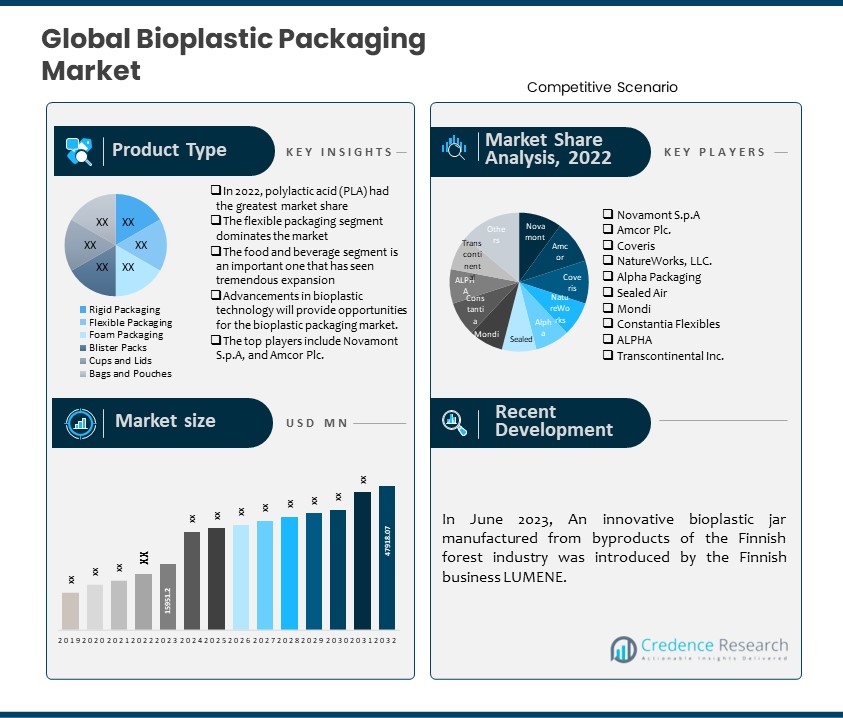
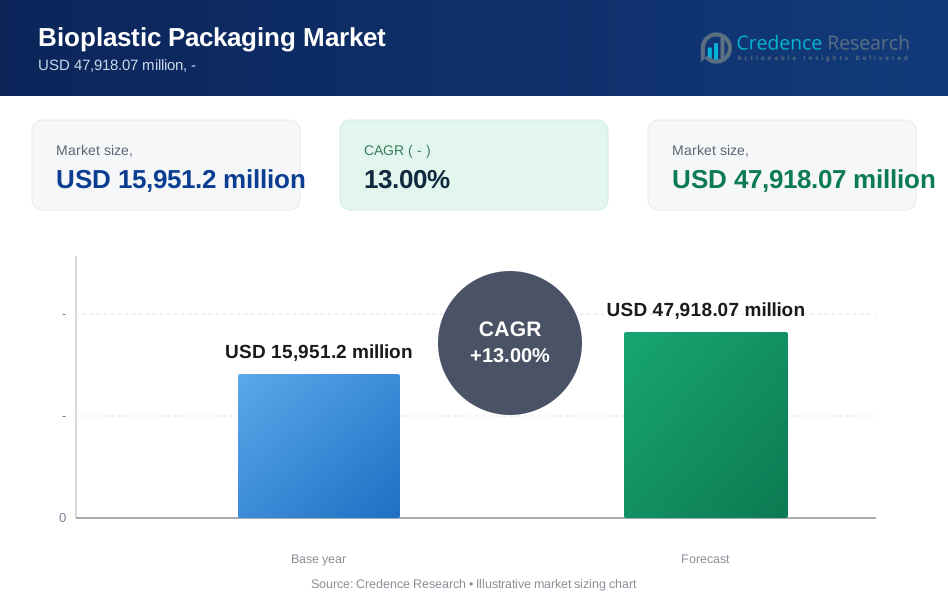
- The global market for bioplastic packaging is expected to develop at a compound annual growth rate (CAGR) of 13.00% between 2024 and 2032, from its estimated USD 15951.2 million in 2023 to USD 47918.07 million in 2032.
- The largest category is polylactic acid (PLA). Bio-based polyethylene (Bio-PE), on the other hand, is expected to grow at a strong CAGR.
- The flexible packaging category will expand at a rapid rate of growth.
- The CAGR for food and beverage is expected to be the highest during the projection period.
- Asia Pacific dominated the bioplastic packaging market.
- Regarding the market share of bioplastic packaging, Europe is expected to come second.
- In the bioplastic packaging market, North America is anticipated to grow fastest.
- The drivers propelling the growth of the global market include growing awareness of environmental issues such as plastic pollution and companies dedicated to sustainability goals seeking eco-friendly packaging options.
- The factors generating potential for the global market are advancements in bioplastics technology and government regulations and incentives encouraging the usage of bioplastics.
Executive Summary
Market Definition
Bioplastics are renewable materials that degrade naturally, and they can help lessen the amount of plastic garbage that is polluting the ecosystem and strangling the earth. Modern uses for bioplastics include 3D printing, automobile insulation, non-disposable carpet, plastic pipes, phone casings, packaging, straws, bags, and bottles, as well as medical implants and non-disposable carpet.
Market Overview
The bioplastic packaging sector is estimated to develop at a 13.00% compound annual growth rate (CAGR) between 2024 and 2032, maintaining its current upward trend. The market will continue to develop, rising from its estimated USD 15951.2 million in 2023 to USD 47918.07 million in 2032.
Due to their low environmental impact, increased emphasis on sustainability and recyclability, government emphasis on effective packaging management, growing consumer awareness, and growing restrictions on single-use plastic, bioplastic packaging solutions are finding ever-growing use in packaging. The search for more innovative plastic packaging ideas was spurred by the larger problem of climate change and the impending depletion of fossil fuels. The need for bioplastics has increased due to strict government laws prohibiting the use of traditional plastics. Petroleum-based plastic packaging may not have the same negative environmental effects as bioplastics.
Bioplastics are made of plastic components that are combined with different biodegradable elements, like biomass (waste, plants, and trees). These materials have the potential to decrease reliance on plastic packaging derived from fossil fuels, hence leading to a rise in the adoption of eco-friendly products, increased sustainability, and a greater desire to safeguard the environment. Additionally, governments everywhere are enacting laws to reduce environmental waste and enhance waste management procedures in response to worries about packaging trash, particularly waste from plastic packaging. Governments nationwide are increasing their pressure on citizens to use conventional plastics, which is contributing to the rise of bioplastic as a reliable substitute in the packaging sector.
Segmentation by Material Type
- Polylactic acid (PLA) leads the market by material type. The biocompatible and biodegradable material polylactic acid (PLA) is simple to work with. This makes it appropriate for long-term biodegradation medical devices such as stents and implanted medication dispensers. PLA is a polymer that can be produced into fibers for garments and is used in food packaging and single-use cutlery.
- The bio-based polyethylene (Bio-PE) category will exhibit a sizable CAGR during the projected period. Although it is utilized in many applications (such as flexible pipes or cable jacketing), it is most often recognized as packaging material (bags, films, bottles, etc.). Bio-PE has the same chemical makeup as PE derived from fossil fuels. As such, it can be applied to all other uses, including both rigid and flexible packaging.
- Other material types influence the need for bioplastic packaging, including starch blends, polyhydroxyalkanoates (PHA), bio-based polyethylene terephthalate (Bio-PET), and cellulose-based bioplastics.
Segmentation by Product Type
- Flexible packaging is considered the best product type category. Any package or portion of a package that may easily change shape when filled or used is considered flexible packaging. Paper, plastic, film, aluminum foil, or any combination of these materials can be used to create flexible packaging, which includes roll stock, bags, pouches, liners, wraps, and other flexible items.
- The foam packaging category will likely register a significant CAGR during forecasting. For several reasons, foam is a highly recommended packaging material. In addition to providing comfort, foam can shield surfaces from scratches and abrasions. Unlike paper or plastic sheets, foam is a flexible material. Anyone can get packaging foam in the form of peanuts, bags, rolls, blocks, and sheets.
- Other product types, including rigid packaging, blister packs, cups and lids, and bags and pouches, influence the need for bioplastic packaging.
Segmentation by End-Use Industry
- The food and beverage category is projected to grow faster over the projection period. This is due to the rising demand for bioplastic packaging from the food & beverages industry.
- Other end-use industries influence the need for bioplastic packaging, including personal care and cosmetics, pharmaceuticals and healthcare, household and consumer goods, retail and e-commerce, and agriculture and horticulture.
Segmentation by Region
- The Asia Pacific leads the bioplastic packaging industry. This is due to the rising demand for bioplastic packaging from the Asia Pacific countries like China, India, and Japan.
- Europe is estimated to rank second in market size for bioplastic packaging.
- The bioplastic packaging industry is predicted to flourish rapidly in North America.
- Regions such as Africa, the Middle East, and Latin America cover the remaining requirement for bioplastic packaging.
The strict implementation of laws prohibiting the use of single-use plastics is being observed in emerging economies, such as India, which rely significantly on these materials. As one example, the Environment Ministry declared in August 2021 that starting on July 1, 2022, single-use plastic items will be prohibited. Significant market developments are expected in the nation in order to align the targets outlined in the Plastic Waste Management Amendment Rules, 2021.
Global bioplastics production capacity is expected to expand from 2.11 million metric tons in 2020 to roughly 2.7 million metric tons in 2025, according to European Bioplastics (Association of Bioplastics). According to the organization, 1,227 metric tons of biodegradable bioplastics and 884 metric tons of non-biodegradable bioplastics derived from biobased materials were produced in 2020.
Based on projections, the bioplastic packaging market is anticipated to be controlled by Asia Pacific. The main reason for this is the rapid expansion of the Internet retail sector in conjunction with rising wages in developing countries. Online sales have increased by over 50% annually in China, India, and other Southeast Asian nations, surpassing those of developed markets. This increase has a direct effect on the need for a variety of packaging formats. Because of the growing localization of manufacturing, the Asia Pacific area presents package manufacturers with significant market potential as well.
The bioplastic packaging market in North America is anticipated to expand fastest throughout the forecast. There is a high demand for a variety of packaging across a wide range of product categories due to the size and development of the e-commerce industries in the United States and Canada. A strong logistics infrastructure combined with the ease of online shopping has made e-commerce quite popular. The region's packaging demands are thus significantly influenced by this. Furthermore, North American packaging suppliers and manufacturers give e-tailers access to a large selection of packaging options at affordable costs. It is typical to find specialized packaging for heavy, fragile, and irregularly sized items.
Key Highlights of the Report
The global bioplastic packaging market is segmented by material type, product type, end-use industry, and region. As far as the material type is concerned, polylactic acid (PLA) is the market spearhead. Flexible packaging is the top product type category. The food and beverage category is anticipated to increase at the highest CAGR throughout the projection period. The bioplastic packaging market is expanding mostly in the Asia Pacific.
During the projected period, growing governmental and regulatory activities to encourage the use of bioplastics are anticipated to support market expansion. To combat plastic waste in the ocean, Japan, for example, recently announced plans to expand the use of plant-based bioplastics. The initiative is to support bioplastics derived from plants and recycle all newly manufactured plastics in the nation by 2035.
Asia Pacific is anticipated to have the top position in the global bioplastic packaging market. Global brand owners have been encouraged to establish factories in the region due to the availability of reasonably priced labor and raw supplies. Asia Pacific is becoming a desirable location for future growth in the quickly evolving e-commerce packaging sector due to this and the growth of regional packaging solution suppliers. The North American region is also assumed to have the market's sharpest growth. Packaging developments for characteristics like quick returns, recyclable materials, and tamper-proof seals are what define the regional market. In the North American area, packaging continues to place a high priority on sustainability.
Which Key Factors Are Driving The Global Bioplastic Packaging Market?
The factors behind the expansion of the bioplastic packaging sector are improvements in waste management infrastructure, increased demand from end-use industries, and innovations in bioplastic manufacturing methods.
What are The Main Challenges Confronting The Bioplastic Packaging Market Globally?
The bioplastic packaging market is facing several significant problems, such as long-term performance issues, material selection complexity, and the difficulty of scaling up bioplastic manufacturing to meet expanding demand while preserving quality, consistency, and cost-effectiveness.
What Market Opportunities Exist For Bioplastic Packaging Globally?
The need for lightweight, environmentally friendly packaging solutions like bioplastics is increased by the rise of e-commerce, the integration of technology into packaging, and the shift towards a circular economy. These factors are likely to contribute to the growth of the bioplastic packaging market.
Market Drivers
Multiple factors propel the bioplastic packaging industry across the globe. The primary factors propelling the global bioplastic packaging market are as follows:
Technological Developments in Bioplastics
The rapid progression of bioplastic technology has been essential to the market's expansion. Bioplastics with better qualities, like stronger barrier qualities, higher tensile strength, and enhanced biodegradability, have been produced as a result of advancements in research and development. These advancements have broadened the range of applications for bioplastics, establishing them as competitive substitutes for a variety of packaging needs.
Globally, governments have been aggressively supporting bioplastics research and development in order to support their own domestic sectors. The European Union reportedly invested over €3 billion in bio-based industries and biorefinery projects, which advanced the technology of bioplastic packaging, according to the European Bioplastics.
Market Restraints
There are several obstacles that the global bioplastic packaging market must overcome to continue growing. Among them are the following:
Insufficient Availability of Feedstock
The global bioplastic packaging market is confronted with several obstacles that impede its expansion and extensive integration, despite its manifold advantages. The market for bioplastic packaging is hampered by the scarcity of appropriate feedstock. The competition from other businesses, such as food and biofuel, for these resources can cause price swings for feedstock, which would reduce the economic viability of producing bioplastics.
Vegetable oils, corn, and sugarcane are among the raw ingredients used in the manufacturing of bioplastics. The Food and Agriculture Organization (FAO) of the United Nations projects that by 2030, there will be a 20% increase in the demand for sugarcane, oilseeds, and cereals worldwide. The lack of feedstock for the production of bioplastics could be made worse by the rising demand for agricultural products, which would limit market expansion.
Opportunities
There are plenty of potential prospects in the global bioplastic packaging industry. Among these are the following:
Rising Customer Demand for Environmentally Friendly Packaging
Rising consumer preference for environmentally conscious packaging offers significant potential. Consumer preference for eco-friendly products and growing environmental consciousness are pushing people to use bioplastic packaging when it is an option. Tight laws designed to reduce the use of single-use plastics also encourage the usage of bioplastics. Costs are expected to decrease as manufacturing increases, making bioplastics more accessible and cheap for a larger spectrum of end users.
An estimated 150 million metric tons of plastic are already whirling about in the world's seas, and an additional 8 million metric tonnes enter the water every year, according to a survey conducted by the Ocean Conservancy. This is comparable to one garbage truck's worth of plastic being dumped into the ocean every minute for a year from the streets of New York City. 2025 is expected to be a turning point for environmentally friendly packaging, according to the poll. More than forty percent of them plan to use sustainable practices and cutting-edge items in the next five years. Businesses intend to include biodegradable or compostable materials in their sustainable packaging, as well as redesigned containers to reduce or eliminate waste, in order to establish a circular economy. These factors create opportunities for the bioplastic packaging market.
Competitive Landscape
Key Players
Several major competitors exist in the fiercely competitive global bioplastic packaging market. The following are a few of the leading market participants and their market shares:
- Novamont S.p.A
- Amcor Plc.
- Coveris
- NatureWorks, LLC.
- Alpha Packaging
- Sealed Air
- Mondi
- Constantia Flexibles
- ALPHA
- Transcontinental Inc.
- Others
These companies prioritize product innovation, distribution channel expansion, mergers, and acquisitions to remain competitive.
The largest suppliers in the global bioplastic packaging market continuously work to stay one step ahead of the competition by developing innovative concepts and products.
In August 2022, The largest chemical company in Korea, LG Chem Ltd., established a joint venture with the US food processing giant, Archer Daniels Midland Co. (ADM), to construct two manufacturing facilities in Illinois. The industrial facilities will be producing biodegradable polymers, which find widespread application in food packaging.
In January 2022, Vikas Ecotech Limited declared that it would invest in environmentally friendly BioPlastics (PHA) technology. The company is currently nearing completion of a technical tie-up or joint venture with Aurapha Private Ltd. (the "AuraPHA") in order to make biodegradable plastics. Using biodegradable plastics, such as polyhydroxyalkanoates (PHA), is an option.
How are Companies Performing in the Bioplastic Packaging Market?
Companies in the Bioplastic Packaging market are performing well due to several important considerations. These companies provide a variety of packaging options for different end-user sectors and specialized packaging materials to meet the needs of individual customers.
Major companies are contributing more and more to the advancement of biomaterial packaging. For example, in October 2020, SABIC and Schwarz Group, an operator of European retail stores, launched a pilot project for the use of transparent film bags in vegetable packing made from the former's certified circular polyethylene (PE). The project will make use of a range of PE technologies from SABIC that are based on materials made from recycled mixed and used plastic feedstock.
Many renowned companies, including Vittel, Coca-Cola, Heinz, and Volvic, have begun utilizing bio-based PET to make bottles of various sizes that contain sparkling drinks and other non-gaseous fluids and solutions in response to growing environmental consciousness. Many companies, including Procter & Gamble and Johnson & Johnson, use bio-based polyethylene (PE) to package a variety of cosmetic goods.
Several corporations have established themselves as leaders in the bioplastic packaging sector by creating sustainable production methods, inventing cutting-edge bioplastic packaging solutions, and serving a wide range of packaging needs. Companies such as BASF SE, Amcor, and Mondi are dedicated to offering high-performing, economical, and environmentally friendly packaging solutions. These solutions are designed to meet the increasing need for recyclable packaging options.
Summary of Key Findings
- The increasing acceptance of sustainability in numerous packaging aspects is propelling the market for bioplastic packaging. Considering the widespread usage of packaging goods and the growing aversion to plastic packaging with high contamination risk, the food and beverage sectors are acknowledged as the primary users of bioplastic packaging.
- The market is segmented by material type, product type, end-use industry, and region.
- In the market, polylactic acid (PLA) is the most widely used material.
- Flexible packaging is the foremost category.
- Food and beverage industries are expected to grow at the fastest CAGR during the forecast period.
- Asia Pacific is leading market development; the market is highly competitive with key players including Novamont S.p.A, Amcor Plc., Coveris, NatureWorks, LLC., Alpha Packaging, Sealed Air, Mondi, Constantia Flexibles, ALPHA, Transcontinental Inc., and Others.
Future Outlook
- The bioplastic packaging industry is expected to increase significantly in Asia Pacific, and its outlook is positive worldwide.
- Partnerships among merchants, packaging businesses, and producers of bioplastics facilitate product innovation and market expansion.
- Inadequate knowledge among consumers and industry players regarding bioplastic packaging options, advantages, and disposal techniques may impede market expansion and acceptance.
- To stay ahead of the competition, key enterprises must develop new products, expand their market reach, and keep their prices competitive.
How CXOs Can Benefit from the Credence Research Bioplastic Packaging Market Report
CXOs may get a detailed picture of the market in the Credence Research Bioplastic Packaging Market Report, which includes:
- Market size and growth forecast: The report provides detailed estimates of the global bioplastic packaging market size, segmented by material type, product type, end-use industry, and region. It also includes forecasts for the market through 2032 based on key trends and drivers.
- Market segmentation: The research report breaks down the bioplastic packaging market into segments based on material type, product type, end-use industry, and region. This segmentation provides CXOs with a granular understanding of the market and the opportunities in each segment.
- Competitive landscape: The research report offers a detailed analysis of the major companies in the bioplastic packaging industry, including information on their business plans, product lines, and earnings. CXOs can use this information to evaluate and identify their competitors.
- Key trends and drivers: The research report identifies and evaluates the main trends and factors influencing the bioplastic packaging market. CXOs can use this information to make well-informed choices regarding their plans and investments.
CXOs can use the insights from the Credence Research Bioplastic Packaging Market Report to:
- Identify growth opportunities: This analysis may help CXOs identify new growth opportunities in the bioplastic packaging sector. For example, the report identifies the growing demand for bioplastic packaging from household and consumer goods as a key opportunity.
- Make informed investment decisions: The report helps CXOs make wise choices regarding bioplastic packaging. For example, the research study provides information on the critical factors to consider when selecting bioplastic packaging solutions and evaluating suppliers.
- Develop competitive strategies: CXOs can use the research report to develop competitive strategies for their bioplastic packaging businesses. For example, the research paper outlines the main strategies that bioplastic packaging suppliers utilize to differentiate themselves from competitors.
- Track market developments: This research report may help CXOs stay ahead of the curve by tracking market developments. For instance, it offers insights into the most recent developments and trends in the bioplastic packaging market.
CXOs seeking to expand their industry knowledge and spot growth prospects will find the Credence Research Bioplastic Packaging Market Report useful.
Segmentation
- By Material Type
- Polylactic Acid (PLA)
- Starch Blends
- Polyhydroxyalkanoates (PHA)
- Bio-Based Polyethylene (Bio-PE)
- Bio-Based Polyethylene Terephthalate (Bio-PET)
- Cellulose-Based Bioplastics
- By Product Type
- Rigid Packaging
- Flexible Packaging
- Foam Packaging
- Blister Packs
- Cups and Lids
- Bags and Pouches
- By End-Use Industry
- Food and Beverage
- Personal Care and Cosmetics
- Pharmaceuticals and Healthcare
- Household and Consumer Goods
- Retail and E-Commerce
- Agriculture and Horticulture
- By Region
- North America
- The U.S.
- Canada
- Mexico
- Europe
- Germany
- France
- The U.K.
- Italy
- Spain
- Rest of Europe
- Asia Pacific
- China
- Japan
- India
- South Korea
- South-east Asia
- Rest of Asia Pacific
- Latin America
- Brazil
- Argentina
- Rest of Latin America
- Middle East & Africa
- GCC Countries
- South Africa
- The Rest of the Middle East and Africa
- North America
Request a Free Sample
Fill in your details and we'll send you a free sample report.
- Sample data tables & charts
- Research methodology
Need a Custom Version of This Report?
Tailor the scope, geography, or segments to your exact requirements.
- Custom geography or segment scope
- Direct access to our analyst team
Frequently Asked Questions
How much does the global market currently hold for bioplastic packaging?
What is the bioplastic packaging market's projected growth rate between 2024 and 2032?
In terms of the material type, which market category is leading?
Which end-use industry segment is estimated to have the highest CAGR throughout the forecast period?
Who are the main players in the global bioplastic packaging industry?
Table of Content
Chapter 1. Report Introduction
- 1.1 Report Description & Purpose
- 1.1.1 Report Title & Market Definition
- 1.1.2 Unique Selling Propositions (USP) & Key Differentiators
- 1.1.3 Value Proposition for Stakeholders
- 1.2 Research Objectives
- 1.2.1 Market Sizing Objectives (Volume & Revenue)
- 1.2.2 Segmentation Objectives
- 1.2.3 Competitive Intelligence Objectives
- 1.2.4 Forecast & Scenario Objectives
- 1.3 Report Scope
- 1.3.1 Bioplastic Packaging Scope – Types & Subtypes Covered
- 1.3.2 Geographic Scope – Regions & Countries Covered
- 1.3.3 Historical Period, Base Year & Forecast Period (the historical period; forecast to the forecast period)
- 1.3.4 Inclusions & Exclusions
- 1.4 HS Code & Classification Framework
- 1.5 Currency, Units & Pricing Basis
- 1.6 Target Stakeholders
- 1.7 Limitations & Assumptions
Chapter 2. Executive Summary
- 2.1 Global Bioplastic Packaging Market Snapshot
- 2.1.1 Market Size – Historical (the historical period) & Forecast (the forecast period) (base year: USD 15,951.2 million → forecast year: USD 47,918.07 million)
- 2.1.2 Volume & Revenue – Global Totals
- 2.1.3 Key Market Highlights – Top Five Facts
- 2.2 Bioplastic Packaging Market Segmentation Snapshot
- 2.2.1 Market Split by Region – vs.
- 2.3 Competitive Snapshot
- 2.3.1 Top 10 Players by Revenue Share –
- 2.3.2 Top 10 Players by Volume Share –
- 2.3.3 Recent Strategic Developments (18-Month Summary)
- 2.4 Key Investment Highlights & Strategic Conclusions
Chapter 3. Bioplastic Packaging Market Dynamics & Industry Analysis
- 3.1 Market Overview & Context
- 3.1.1 Bioplastic Packaging Market Position in the Broader Automotive Value Chain
- 3.1.2 OEM vs. Replacement Market Dynamics
- 3.1.3 Market Maturity & Development Stage by Region
- 3.2 Bioplastic Packaging Market Drivers
- 3.3 Bioplastic Packaging Market Restraints & Challenges
- 3.4 Bioplastic Packaging Market Opportunities
- 3.5 Porter's Five Forces Analysis
- 3.5.1 Threat of New Entrants
- 3.5.2 Bargaining Power of Suppliers
- 3.5.3 Bargaining Power of Buyers
- 3.5.4 Threat of Substitutes
- 3.5.5 Competitive Rivalry – Intensity Assessment
- 3.6 Bioplastic Packaging Value Chain Analysis
- 3.6.1 Upstream – Raw Material/Input Suppliers
- 3.6.1.1 Raw Material/Input 1
- 3.6.1.2 Raw Material/Input 2
- 3.6.1.3 Raw Material/Input 3
- 3.6.2 Midstream – Production/Manufacturing/Service Delivery
- 3.6.2.1 Production/Process Overview
- 3.6.2.2 Key Facility Locations & Capacity by Manufacturer
- 3.6.3 Downstream – Distribution & End Consumer
- 3.6.3.1 Primary Channel – B2B/OEM
- 3.6.3.2 Secondary Channels – Dealer, Retail, Online, Direct
- 3.6.4 Value Chain Profitability Analysis
- 3.6.1 Upstream – Raw Material/Input Suppliers
- 3.7 PESTEL Analysis
- 3.7.1 Political Factors
- 3.7.2 Economic Factors
- 3.7.3 Social Factors
- 3.7.4 Technological Factors
- 3.7.5 Environmental Factors
- 3.7.6 Legal Factors
- 3.8 Bioplastic Packaging Supply Chain Analysis
- 3.8.1 Raw Material/Input Supply Risk Assessment
- 3.8.2 Manufacturing Concentration Risk (Geographic Exposure)
- 3.8.3 Trade Disruption Impact Analysis
- 3.9 Regulatory & Policy Landscape
Note: The regulatory and policy landscape section covers regulations based on their applicability to the market, Bioplastic Packaging category, geography, and scope of the study. Only regulatory frameworks with a material impact on operations, compliance, trade, sustainability, or market access are analyzed in detail.
Chapter 4. Key Investment Pockets & Opportunity Analysis
- 4.1 Bioplastic Packaging Market Attractiveness Analysis
- 4.1.1 By Region – Investment Attractiveness Matrix (Volume × CAGR)
- 4.2 Absolute Revenue Growth Opportunity
- 4.2.1 By Region – Absolute USD Growth Through the forecast period
- 4.3 Incremental Volume Opportunity
- 4.3.1 By Region – Incremental Volume Through the forecast period
- 4.3.2 Segment – Incremental Volume
- 4.4 Emerging Submarket Opportunity Deep Dive (Subject to Applicability)
- 4.5 Emerging Market Opportunity Scorecards
- 4.5.1 United States
- 4.5.2 Europe
- 4.5.3 Asia
- 4.5.4 Middle East & Africa
Note: Emerging Market Opportunity Scorecards will be included based on relevance and strategic importance. Regions listed are indicative and may vary depending on data availability and market dynamics.
Chapter 5. Bioplastic Packaging Import-Export Analysis & Trade Flows
- 5.1 Global Trade Overview
- 5.1.1 Global Export Value by Country (the historical period)
- 5.1.2 Global Export Volume by Country (the historical period)
- 5.1.3 Global Import Value by Country (the historical period)
- 5.1.4 Global Import Volume by Country (the historical period)
- 5.1.5 Net Trade Balance by Country (the historical period)
- 5.2 Export Analysis – Segment
- 5.2.1 Type 1 (HS Code)
- 5.2.2 Type 2 (HS Code)
- 5.2.3 Type 3 (HS Code)
- 5.2.4 Type 4 (HS Code)
- 5.2.5 Type 5 (HS Code)
- 5.3 Import Analysis – Segment
- 5.3.1 Type 1 (HS Code)
- 5.3.2 Type 2 (HS Code)
- 5.3.3 Type 3 (HS Code)
- 5.3.4 Type 4 (HS Code)
- 5.3.5 Type 5 (HS Code)
- 5.4 Average Unit Trade Prices
- 5.4.1 Average Export Price – Segment & Country
- 5.4.2 Average Import Price – Segment & Source Country
- 5.4.3 Price Trends (the historical period)
- 5.5 Key Trade Route Analysis
- 5.5.1 Trade Route 1
- 5.5.2 Trade Route 2
- 5.5.3 Trade Route 3
- 5.5.4 Trade Route 4
- 5.5.5 Trade Route 5
- 5.6 Trade Policy Impact Assessment
- 5.6.1 US Anti-Dumping & Section 301 Tariffs
- 5.6.2 EU Customs Union Impact
- 5.6.3 Major Free Trade Agreements
- 5.6.4 USMCA Rules of Origin
Note: Trade policy analysis will be included only where relevant to the Bioplastic Packaging market.
Chapter 6. Competitive Landscape & Company Benchmarking
- 6.1 Bioplastic Packaging Market Concentration & Structure
- 6.1.1 Herfindahl-Hirschman Index (HHI) – vs.
- 6.1.2 Tier 1, Tier 2 & Tier 3 Market Structure
- 6.1.3 Global, Regional & Local Player Dynamics
- 6.2 Bioplastic Packaging Market Share Analysis –
- 6.2.1 Global Revenue Share by Company
- 6.2.2 Global Volume Share by Company
- 6.2.3 Regional Revenue Share
- 6.2.4 Market Share Evolution ( vs. )
- 6.2.5 OEM Segment Share by Company
- 6.2.6 Replacement Segment Share by Company
- 6.3 Production/Delivery Capacity & Facility Analysis
- 6.3.1 Global Installed Capacity
- 6.3.2 Capacity Utilization Rates
- 6.3.3 Production/Output Volume
- 6.3.4 Facility Locations & Capacity Map
- 6.3.5 Planned Capacity Additions
- 6.4 Bioplastic Packaging Competitive Benchmarking Matrix
- 6.4.1 Revenue, Volume, CAGR & Profitability Comparison
- 6.4.2 Channel Revenue Mix
- 6.4.3 Geographic Revenue Exposure
- 6.4.4 R&D Intensity
- 6.4.5 Sustainability Maturity
- 6.5 Strategic Developments in Bioplastic Packaging (Last 24 Months)
- 6.5.1 Mergers, Acquisitions & Divestments
- 6.5.2 New Bioplastic Packaging Launches
- 6.5.3 Facility Expansions
- 6.5.4 Strategic Alliances, Joint Ventures & Partnerships
- 6.5.5 Distribution Expansion & Market Entry
- 6.5.6 Sustainability & ESG Initiatives
- 6.6 Competitive Strategy Mapping
- 6.6.1 Leader, Challenger, Follower & Niche Classification
- 6.6.2 Pricing Strategy Comparison
- 6.6.3 Channel Strategy Matrix
Note: Strategic developments are included based on their materiality and the availability of reliable information.
Chapter 7. Global Bioplastic Packaging Market – By Distribution Channel
- 7.1 Segment Overview
- 7.1.1 Volume & Revenue Split by Channel ( & )
- 7.1.2 Channel Mix Evolution (the forecast period)
Chapter 8. Regional Market Analysis – Global Overview
- 8.1 Global Regional Overview
- 8.1.1 Regional Volume Share
- 8.1.2 Regional Revenue Share
- 8.1.3 Regional Volume by Region
- 8.1.4 Regional Revenue by Region
- 8.1.5 Regional Forecast Through the forecast period
- 8.2 Cross-Regional Segment Analysis
- 8.2.1 By Distribution Channel
- 8.2.2 By Brand/Price Tier
Chapter 9. North America Bioplastic Packaging Market
- 9.1 United States
- 9.2 Canada
- 9.3 Mexico
Chapter 10. Europe Bioplastic Packaging Market
- 10.1 Germany
- 10.2 France
- 10.3 Italy
- 10.4 United Kingdom
- 10.5 Spain
- 10.6 Poland
- 10.7 Russia
- 10.8 Netherlands
- 10.9 Belgium
- 10.10 Sweden
- 10.11 Denmark
- 10.12 Norway
- 10.13 Rest of Europe
Chapter 11. Asia Pacific Bioplastic Packaging Market
- 11.1 China
- 11.2 India
- 11.3 Japan
- 11.4 South Korea
- 11.5 Thailand
- 11.6 Indonesia
- 11.7 Vietnam
- 11.8 Malaysia
- 11.9 Australia
- 11.10 Rest of Asia Pacific
Chapter 12. Latin America Bioplastic Packaging Market
- 12.1 Brazil
- 12.2 Argentina
- 12.3 Colombia
- 12.4 Chile
- 12.5 Rest of Latin America
Chapter 13. Middle East Bioplastic Packaging Market
- 13.1 Saudi Arabia
- 13.2 United Arab Emirates
- 13.3 Turkey
- 13.4 Israel
- 13.5 Iran
- 13.6 Rest of the Middle East
Chapter 14. Africa Bioplastic Packaging Market
- 14.1 South Africa
- 14.2 Egypt
- 14.3 Nigeria
- 14.4 Morocco
- 14.5 Rest of Africa
Chapter 15. Bioplastic Packaging Company Profiles
- 15.1 [Company 01]
- 15.1.1 Company Overview
- 15.1.2 Key Management Personnel
- 15.1.3 Products & Services Portfolio
- 15.1.4 Financial Performance
- 15.1.5 Key Market Focus & Geographic Presence
- 15.1.6 Recent Developments & Strategic Initiatives
Note: The company profile list is preliminary and may change based on research findings, market developments, data availability, and client requirements.
Chapter 16. Appendices
- Appendix A – List of Abbreviations & Acronyms
- Appendix B – Industry Classification Code Reference – Full Series
- Appendix C – Production & Capacity Data Tables
- Appendix D – End-Use & Demand Base Tables
- Appendix E – Consumption & Replacement Rate Assumptions
- Appendix F – ASP Reference Tables
- Appendix G – Manufacturing & Facility Database
- Appendix H – Import-Export Data Tables
- Appendix I – Regulatory Summary Tables
- Appendix J – Primary Research Participant List (Anonymized)
- Appendix K – Primary Research Questionnaire Framework
- Appendix L – Data Sources & Bibliography
- Appendix M – Market Size Divergence & Source Comparison
Chapter 17. Research Methodology
- 17.1 Research Framework & Philosophy
- 17.2 Secondary Research – Sources, Hierarchy & Data Extraction
- 17.3 Data Modeling – Bottom-Up & Top-Down Market Sizing
- 17.4 Primary Research – Stakeholder Framework, LOI & Sample Sizes
- 17.5 Forecast Methodology – Regression, Scenario & Sensitivity Analysis
- 17.6 Quality Control – Four-Layer Validation Framework
- 17.7 Limitations & Standard Assumptions
- 17.8 Disclaimer
