
Market Overview
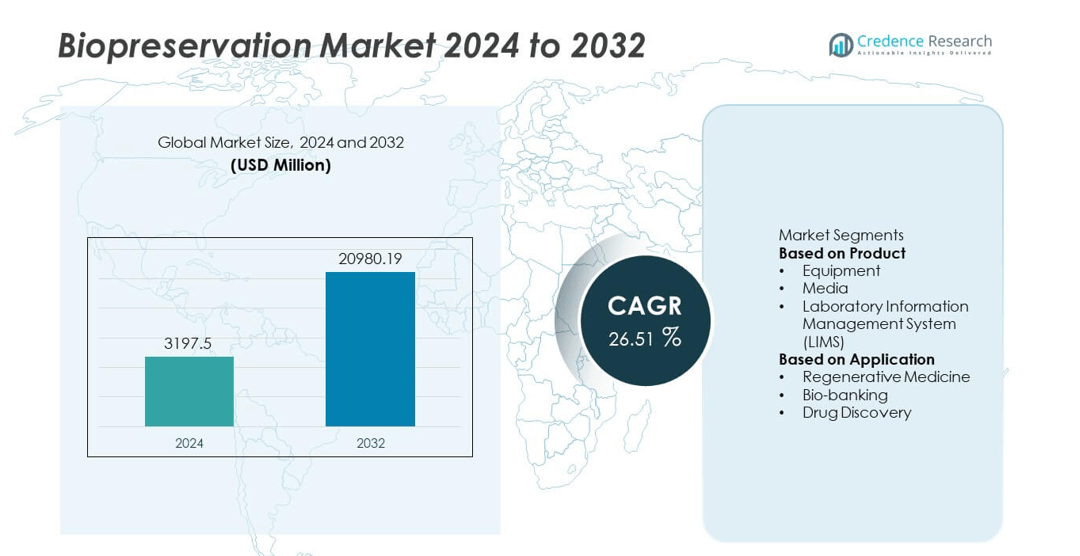
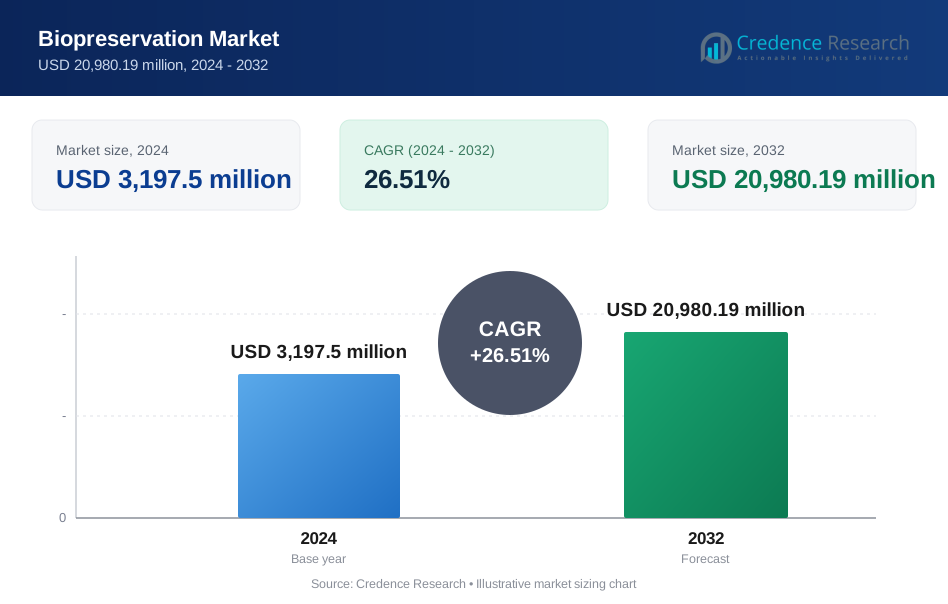
The Biopreservation market was valued at USD 3,197.5 million in 2024 and is projected to reach USD 20,980.19 million by 2032, expanding at a CAGR of 26.51% during the forecast period.
| REPORT ATTRIBUTE | DETAILS |
|---|---|
| Historical Period | 2020-2023 |
| Base Year | 2024 |
| Forecast Period | 2025-2032 |
| Biopreservation Market Size 2024 | USD 3,197.5 million |
| Biopreservation Market, CAGR | 26.51% |
| Biopreservation Market Size 2032 | USD 20,980.19 million |
The Biopreservation market is shaped by leading players such as Thermo Fisher Scientific, Inc., Panasonic Corporation, Azenta US, Inc., BioLife Solutions, MVE Biological Solutions, LabVantage Solutions, Inc., Taylor-Wharton, PrincetonCryo, X-Therma Inc., and Biomatrica, Inc. These companies provide cryogenic storage systems, advanced preservation media, and LIMS platforms that support long-term stability of cells, tissues, and genetic material. North America leads the market with a 41% share, driven by strong cell and gene therapy research and expanding biobanking networks. Europe holds 29% due to high pharmaceutical R&D investment, while Asia Pacific accounts for 22% as stem cell banking and regenerative medicine adoption grows across China, Japan, South Korea, and India.
Market Insights
- The Biopreservation market reached USD 3,197.5 million in 2024 and is projected to grow at a 26.51% CAGR through 2032, driven by rapid expansion in cell therapy, gene therapy, and long-term biological material storage.
- Growing demand for regenerative medicine, clinical biobanking, and personalized therapies accelerates adoption of preservation systems, with equipment holding a 61% segment share due to extensive use of cryogenic freezers and liquid nitrogen storage across research and clinical environments.
- Key trends include automation, AI-supported LIMS platforms, and next-generation cryoprotectants that enhance sample viability and reduce freeze–thaw degradation, supporting wider adoption in oncology, reproductive medicine, and population genomics programs.
- Competition intensifies as major companies invest in advanced cold-chain infrastructure, contamination-free storage systems, and validated logistics solutions, while high capital cost and strict regulatory compliance remain restraints for small laboratories and resource-limited healthcare settings.
- North America leads with 41% regional share, followed by Europe at 29% and Asia Pacific at 22%, reflecting strong investment in genomic research; Latin America holds 5% and Middle East & Africa 3%, supported by gradual expansion of biobanking and fertility preservation services.
Market Segmentation Analysis:
By Product:
Equipment dominates the Biopreservation market with a 61% share, supported by the rising demand for advanced cryogenic freezers, cold-chain storage units, and liquid nitrogen systems to preserve cells, tissues, and viral vectors. Pharmaceutical companies, biobanks, and stem cell research centers increasingly adopt automated storage and monitoring solutions to maintain sample integrity and traceability. The media segment continues to grow as cryoprotectants and specialized preservation solutions gain importance in maintaining cell viability for cell and gene therapy development. Laboratory Information Management Systems (LIMS) hold a smaller but expanding share as digital platforms streamline sample tracking, regulatory compliance, and data management across research and clinical environments.
- For instance, BioLife Solutions reported in peer-reviewed studies and company data sheets that its CryoStor CS10 solution generally results in superior post-thaw T-cell and stem cell recovery and viability compared to conventional home-brew formulations, often showing a 1.5 to 2.3-fold increase in the recovery of viable specific cell populations (such as viable CD34+ cells and granulocytes) and enhanced post-thaw functionality.
By Application:
Regenerative medicine leads with a 48% share, driven by rapid growth of stem cell therapies, CAR-T cell treatments, and personalized medicine, all of which require highly controlled preservation to maintain therapeutic potential. The biobanking segment shows strong expansion as public and private organizations store human biological samples for genomic, translational, and population health research. Drug discovery applications benefit from biopreservation systems that support high-throughput screening, cell-line preservation, and long-term storage of biomaterials used in therapeutic development. Advances in reproductive medicine, oncology, and precision therapies continue to reinforce market adoption across research and clinical applications.
- For instance, Panasonic Corporation deployed ultra-low temperature systems operating at –150°C that supported storage of 8,000 engineered cell lines for oncology drug screening studies.
Key Growth Drivers
Rising Demand for Cell and Gene Therapies
Growing adoption of cell and gene therapies accelerates the need for reliable biopreservation systems that maintain cell viability and functional stability. CAR-T therapy, stem cell treatments, and personalized immunotherapies rely on cryogenic preservation to support transportation, long-term storage, and clinical use. Pharmaceutical companies and research institutes expand biobanking capacities to store therapeutic cell lines and clinical-grade biomaterials. Increased FDA and EMA approvals for advanced therapies reinforce demand for next-generation freezers, cryoprotectants, and temperature-controlled logistics. This driver strongly supports market expansion across regenerative medicine, oncology, and rare disease treatment.
- For instance, MVE Biological Solutions manufactures high-efficiency cryogenic freezers, such as the MVE 1894R-190 model, capable of storing up to 94,500 1.2/2.0 mL clinical cell therapy vials at temperatures around –190°C. These systems are designed for reliable use in global logistics networks and life science applications.
Expansion of Biobanking and Genomic Research Programs
Rapid growth of biobanking initiatives enables long-term preservation of DNA, RNA, tissues, and biofluids for population health studies and precision medicine programs. Public health agencies and academic institutes invest in large-scale sample repositories to support biomarker discovery and disease surveillance. Pharmaceutical companies rely on preserved biological materials for high-throughput screening and preclinical research. Increasing funding for genomics and personalized medicine boosts adoption of liquid nitrogen storage systems and automated sample management platforms. This expansion strengthens commercial opportunities for media, cryogenic equipment, and LIMS software.
- For instance, Thermo Fisher Scientific provides equipment and infrastructure for the storage of biological and genomic samples at cryogenic temperatures, including in national research programs.
Increasing Focus on Cold-Chain and Temperature-Controlled Logistics
Global distribution of biological therapeutics, vaccines, and clinical trial specimens strengthens demand for advanced cold-chain biopreservation solutions. Ultra-low temperature freezers, portable cryogenic containers, and real-time monitoring systems ensure sample quality during long-distance transportation. Growth in decentralized clinical trials and cross-border research collaborations increases reliance on validated shipping protocols and insulated biologics containers. Pharmaceutical logistics providers integrate IoT-enabled tracking to prevent temperature excursions, reducing sample loss and regulatory risk. This trend reinforces equipment upgrades and logistics partnerships across biotechnology and healthcare networks.
Key Trends & Opportunities
Adoption of Automated and AI-Enabled Preservation Systems
Automation in storage, retrieval, and sample tracking reduces manual handling errors and enhances regulatory compliance. AI-driven LIMS platforms improve sample lifecycle management, integrity monitoring, and predictive maintenance of cryogenic systems. Robotic sample handling and barcode/RFID tracking support large biobanks and high-throughput research environments. Cloud-based data integration offers remote accessibility for distributed research teams. These advancements create strong opportunities for technology vendors focused on workflow optimization and digitalization of biological repositories.
- For instance, Azenta Life Sciences offers a range of automated cryogenic storage systems, such as the CryoArc Deca model, which is capable of rapid box-level retrieval in less than 60 seconds.
Growing Opportunity in Fertility Preservation and Reproductive Medicine
Demand for cryopreservation of embryos, oocytes, and reproductive tissues rises as fertility clinics expand treatment services and preservation programs. Cancer patients undergoing chemotherapy increasingly pursue cryopreservation for fertility protection. Advancements in vitrification media and closed-system freezing devices improve post-thaw success rates. Growth of elective egg freezing and third-party reproduction further strengthens adoption. This emerging segment supports broader use of biopreservation solutions in clinical practices beyond traditional biobanking and therapeutic research.
- For instance, PrincetonCryo supplies cryogenic equipment and storage systems that support the use of modern closed-chamber vitrification technology, which enables fertility centers to improve workflow throughput.
Key Challenges
High Cost of Cryogenic Storage and Infrastructure
Significant capital investment is required for ultra-low temperature freezers, liquid nitrogen systems, and specialized monitoring devices. Maintenance, energy consumption, and backup power needs increase operational costs, particularly for large biobanks. Small research labs and low-resource healthcare systems face affordability barriers that limit technology adoption. High insurance and regulatory compliance costs also challenge new entrants and emerging markets.
Regulatory Complexity and Sample Safety Concerns
Strict global regulations govern handling, transport, and storage of biological materials to ensure sample viability and patient safety. Variations in compliance standards across regions complicate international collaboration and cross-border sample sharing. Contamination risk, cold-chain failure, and labeling errors threaten sample integrity and research outcomes. Ensuring end-to-end traceability and data security remains a major challenge, especially for large-scale repositories and decentralized research networks.
Regional Analysis
North America
North America holds a 41% share of the Biopreservation market, driven by strong investment in cell and gene therapy development, well-established biobanking networks, and advanced cold-chain logistics. The United States leads regional demand due to a high number of clinical trials, FDA approvals for regenerative therapies, and growing adoption of cryogenic storage systems across research institutes and pharmaceutical companies. Expanding personalized medicine programs and large population genomic projects support continued infrastructure growth. Canada contributes through government-supported biobanking initiatives and increasing collaboration in precision medicine. Strong reimbursement pathways and digital LIMS integration further strengthen market leadership.
Europe
Europe accounts for a 29% share, supported by robust biomedical research, national biobank programs, and strict quality standards for biological material handling. The United Kingdom, Germany, and France lead market growth due to advanced stem cell research, fertility preservation services, and strong regulatory frameworks guiding biosample management. EU-funded genomics and rare disease research initiatives drive demand for cryogenic freezers and preservation media. Increasing pharmaceutical investment in cancer immunotherapy and cross-border research consortia enhances sample storage infrastructure. Rising interest in population health biorepositories and digital sample traceability platforms further supports adoption across leading healthcare systems.
Asia Pacific
Asia Pacific holds a 22% share and represents the fastest-growing region due to expanding biotechnology investment, growth in clinical stem cell applications, and increased demand for fertility preservation solutions. China, Japan, India, and South Korea demonstrate strong adoption of cryogenic biopreservation for regenerative medicine, oncology trials, and translational research. Government-supported genome projects and rising medical tourism for IVF enhance market expansion. Local manufacturing of biopreservation equipment and media contributes to cost-competitive availability. Growing partnerships between hospitals, research institutes, and biobanks strengthen infrastructure and support wider use of LIMS platforms for secure biospecimen management.
Latin America
Latin America holds a 5% share, driven by expanding research collaborations, growth in fertility cryopreservation, and development of public and private biobanks. Brazil and Mexico lead regional adoption as healthcare systems incorporate cryogenic storage for oncology, immunology, and population research programs. Economic constraints encourage demand for cost-efficient preservation media and controlled-temperature logistics solutions. Rising focus on personalized medicine and clinical trial participation supports gradual technology upgrades. Partnerships with global biotechnology suppliers and university-led research networks improve access to advanced storage systems and biospecimen tracking platforms throughout the region.
Middle East & Africa
The Middle East & Africa region accounts for a 3% share, supported by emerging cell therapy research, growing investment in precision medicine, and development of fertility preservation centers. The United Arab Emirates and Saudi Arabia lead adoption with increased funding for genomic medicine and hospital-based biobanking. Africa shows incremental progress, led by South Africa’s biorepository networks and international research partnerships focused on infectious disease and molecular epidemiology. Limited infrastructure and high equipment costs remain key barriers, yet government-led healthcare modernization, training initiatives, and expanding cold-chain logistics gradually improve access to advanced biopreservation technologies.
Market Segmentations:
By Product
- Equipment
- Media
- Laboratory Information Management System (LIMS)
By Application
- Regenerative Medicine
- Bio-banking
- Drug Discovery
By Geography
- North America
- U.S.
- Canada
- Mexico
- Europe
- Germany
- France
- U.K.
- Italy
- Spain
- Rest of Europe
- Asia Pacific
- China
- Japan
- India
- South Korea
- South-east Asia
- Rest of Asia Pacific
- Latin America
- Brazil
- Argentina
- Rest of Latin America
- Middle East & Africa
- GCC Countries
- South Africa
- Rest of the Middle East and Africa
Competitive Landscape
Competitive landscape or analysis of the Biopreservation market includes key players such as Panasonic Corporation, PrincetonCryo, Taylor-Wharton, LabVantage Solutions, Inc., X-Therma Inc., Thermo Fisher Scientific, Inc., MVE Biological Solutions, Azenta US, Inc., BioLife Solutions, and Biomatrica, Inc. The market remains highly competitive, driven by strong demand for cell and gene therapy storage, clinical biobanking, and advanced cold-chain solutions. Companies focus on cryogenic freezers, controlled-rate freezing systems, preservation media, and Laboratory Information Management Systems to support secure biological sample storage and transport. Leading vendors invest in R&D to improve viability rates, reduce freeze-thaw damage, and strengthen compliance with GMP and regulatory requirements. Strategic collaborations with biopharma companies and research institutes help expand global distribution and long-term storage capabilities. Digital sample tracking, automation, and AI-based temperature monitoring also shape differentiation as providers enhance data security and traceability. Continuous product innovation and capacity expansion support long-term market positioning.
Key Player Analysis
- Panasonic Corporation
- PrincetonCryo
- Taylor-Wharton
- LabVantage Solutions, Inc.
- X-Therma Inc.
- Thermo Fisher Scientific, Inc.
- MVE Biological Solutions
- Azenta US, Inc.
- BioLife Solutions
- Biomatrica, Inc.
Recent Developments
- In June 2025, X-Therma appointed Neil Warma to its Board of Directors to support its biopreservation technology growth.
- In May 2025, Azenta US, Inc. and Form Bio announced a strategic partnership to advance AAV gene-therapy development.
- In March 2024, X‑Therma Inc. completed a US $22.4 million Series B funding round to scale its platform for organ, tissue and cell preservation
Report Coverage
The research report offers an in-depth analysis based on Product, Application and Geography. It details leading market players, providing an overview of their business, product offerings, investments, revenue streams, and key applications. Additionally, the report includes insights into the competitive environment, SWOT analysis, current market trends, as well as the primary drivers and constraints. Furthermore, it discusses various factors that have driven market expansion in recent years. The report also explores market dynamics, regulatory scenarios, and technological advancements that are shaping the industry. It assesses the impact of external factors and global economic changes on market growth. Lastly, it provides strategic recommendations for new entrants and established companies to navigate the complexities of the market.
Future Outlook
- Demand for biopreservation systems will grow with expansion of cell and gene therapies.
- Automated cryogenic storage will enhance sample security and reduce handling errors.
- AI-enabled LIMS software will support large-scale biobank data management.
- New cryoprotectants will improve cell viability during long-term preservation.
- Personalized medicine programs will increase adoption of advanced preservation platforms.
- Growth in fertility preservation and stem cell banking will strengthen market usage.
- Cold-chain logistics innovation will improve safe transport of sensitive biological materials.
- Partnerships between drug developers and biobanks will expand long-term sample storage demand.
- Sustainability goals will drive energy-efficient cryogenic and ultra-low temperature systems.
- Regulatory harmonization will support international sharing of high-value biological samples.
Request a Free Sample
Fill in your details and we'll send you a free sample report.
- Sample data tables & charts
- Research methodology
Need a Custom Version of This Report?
Tailor the scope, geography, or segments to your exact requirements.
- Custom geography or segment scope
- Direct access to our analyst team
Frequently Asked Questions
What is the current market size for the Biopreservation market, and what is its projected size in 2032?
At what Compound Annual Growth Rate is the Biopreservation market projected to grow between 2025 and 2032?
Which is the leading region of the market for biopreservation?
What are the key drivers for the growth of the biopreservation market?
Which is the major segment in the biopreservation market by product?
Who are the leading companies in the Biopreservation market?
Table of Content
Chapter 1. Report Introduction
- 1.1 Report Description & Purpose
- 1.1.1 Report Title & Market Definition
- 1.1.2 Unique Selling Propositions (USP) & Key Differentiators
- 1.1.3 Value Proposition for Stakeholders
- 1.2 Research Objectives
- 1.2.1 Market Sizing Objectives (Volume & Revenue)
- 1.2.2 Segmentation Objectives
- 1.2.3 Competitive Intelligence Objectives
- 1.2.4 Forecast & Scenario Objectives
- 1.3 Report Scope
- 1.3.1 Biopreservation Scope – Types & Subtypes Covered
- 1.3.2 Geographic Scope – Regions & Countries Covered
- 1.3.3 Historical Period, Base Year & Forecast Period (2024; forecast to 2032)
- 1.3.4 Inclusions & Exclusions
- 1.4 HS Code & Classification Framework
- 1.5 Currency, Units & Pricing Basis
- 1.6 Target Stakeholders
- 1.7 Limitations & Assumptions
Chapter 2. Executive Summary
- 2.1 Global Biopreservation Market Snapshot
- 2.1.1 Market Size – Historical (2024) & Forecast (2024-2032) (2024: USD 3,197.5 million → 2032: USD 20,980.19 million)
- 2.1.2 Volume & Revenue – Global Totals
- 2.1.3 Key Market Highlights – Top Five Facts
- 2.2 Biopreservation Market Segmentation Snapshot
- 2.2.1 Market Split by Region – 2024 vs. 2032
- 2.3 Competitive Snapshot
- 2.3.1 Top 10 Players by Revenue Share – 2024
- 2.3.2 Top 10 Players by Volume Share – 2024
- 2.3.3 Recent Strategic Developments (18-Month Summary)
- 2.4 Key Investment Highlights & Strategic Conclusions
Chapter 3. Biopreservation Market Dynamics & Industry Analysis
- 3.1 Market Overview & Context
- 3.1.1 Biopreservation Market Position in the Broader Automotive Value Chain
- 3.1.2 OEM vs. Replacement Market Dynamics
- 3.1.3 Market Maturity & Development Stage by Region
- 3.2 Biopreservation Market Drivers
- 3.3 Biopreservation Market Restraints & Challenges
- 3.4 Biopreservation Market Opportunities
- 3.5 Porter's Five Forces Analysis
- 3.5.1 Threat of New Entrants
- 3.5.2 Bargaining Power of Suppliers
- 3.5.3 Bargaining Power of Buyers
- 3.5.4 Threat of Substitutes
- 3.5.5 Competitive Rivalry – Intensity Assessment
- 3.6 Biopreservation Value Chain Analysis
- 3.6.1 Upstream – Raw Material/Input Suppliers
- 3.6.1.1 Raw Material/Input 1
- 3.6.1.2 Raw Material/Input 2
- 3.6.1.3 Raw Material/Input 3
- 3.6.2 Midstream – Production/Manufacturing/Service Delivery
- 3.6.2.1 Production/Process Overview
- 3.6.2.2 Key Facility Locations & Capacity by Manufacturer
- 3.6.3 Downstream – Distribution & End Consumer
- 3.6.3.1 Primary Channel – B2B/OEM
- 3.6.3.2 Secondary Channels – Dealer, Retail, Online, Direct
- 3.6.4 Value Chain Profitability Analysis
- 3.6.1 Upstream – Raw Material/Input Suppliers
- 3.7 PESTEL Analysis
- 3.7.1 Political Factors
- 3.7.2 Economic Factors
- 3.7.3 Social Factors
- 3.7.4 Technological Factors
- 3.7.5 Environmental Factors
- 3.7.6 Legal Factors
- 3.8 Biopreservation Supply Chain Analysis
- 3.8.1 Raw Material/Input Supply Risk Assessment
- 3.8.2 Manufacturing Concentration Risk (Geographic Exposure)
- 3.8.3 Trade Disruption Impact Analysis
- 3.9 Regulatory & Policy Landscape
Note: The regulatory and policy landscape section covers regulations based on their applicability to the market, Biopreservation category, geography, and scope of the study. Only regulatory frameworks with a material impact on operations, compliance, trade, sustainability, or market access are analyzed in detail.
Chapter 4. Key Investment Pockets & Opportunity Analysis
- 4.1 Biopreservation Market Attractiveness Analysis
- 4.1.1 By Region – Investment Attractiveness Matrix (Volume × CAGR)
- 4.2 Absolute Revenue Growth Opportunity
- 4.2.1 By Region – Absolute USD Growth Through 2032
- 4.3 Incremental Volume Opportunity
- 4.3.1 By Region – Incremental Volume Through 2032
- 4.3.2 Segment – Incremental Volume
- 4.4 Emerging Submarket Opportunity Deep Dive (Subject to Applicability)
- 4.5 Emerging Market Opportunity Scorecards
- 4.5.1 United States
- 4.5.2 Europe
- 4.5.3 Asia
- 4.5.4 Middle East & Africa
Note: Emerging Market Opportunity Scorecards will be included based on relevance and strategic importance. Regions listed are indicative and may vary depending on data availability and market dynamics.
Chapter 5. Biopreservation Import-Export Analysis & Trade Flows
- 5.1 Global Trade Overview
- 5.1.1 Global Export Value by Country (2024)
- 5.1.2 Global Export Volume by Country (2024)
- 5.1.3 Global Import Value by Country (2024)
- 5.1.4 Global Import Volume by Country (2024)
- 5.1.5 Net Trade Balance by Country (2024)
- 5.2 Export Analysis – Segment
- 5.2.1 Type 1 (HS Code)
- 5.2.2 Type 2 (HS Code)
- 5.2.3 Type 3 (HS Code)
- 5.2.4 Type 4 (HS Code)
- 5.2.5 Type 5 (HS Code)
- 5.3 Import Analysis – Segment
- 5.3.1 Type 1 (HS Code)
- 5.3.2 Type 2 (HS Code)
- 5.3.3 Type 3 (HS Code)
- 5.3.4 Type 4 (HS Code)
- 5.3.5 Type 5 (HS Code)
- 5.4 Average Unit Trade Prices
- 5.4.1 Average Export Price – Segment & Country
- 5.4.2 Average Import Price – Segment & Source Country
- 5.4.3 Price Trends (2024)
- 5.5 Key Trade Route Analysis
- 5.5.1 Trade Route 1
- 5.5.2 Trade Route 2
- 5.5.3 Trade Route 3
- 5.5.4 Trade Route 4
- 5.5.5 Trade Route 5
- 5.6 Trade Policy Impact Assessment
- 5.6.1 US Anti-Dumping & Section 301 Tariffs
- 5.6.2 EU Customs Union Impact
- 5.6.3 Major Free Trade Agreements
- 5.6.4 USMCA Rules of Origin
Note: Trade policy analysis will be included only where relevant to the Biopreservation market.
Chapter 6. Competitive Landscape & Company Benchmarking
- 6.1 Biopreservation Market Concentration & Structure
- 6.1.1 Herfindahl-Hirschman Index (HHI) – vs. 2024
- 6.1.2 Tier 1, Tier 2 & Tier 3 Market Structure
- 6.1.3 Global, Regional & Local Player Dynamics
- 6.2 Biopreservation Market Share Analysis – 2024
- 6.2.1 Global Revenue Share by Company
- 6.2.2 Global Volume Share by Company
- 6.2.3 Regional Revenue Share
- 6.2.4 Market Share Evolution ( vs. 2024)
- 6.2.5 OEM Segment Share by Company
- 6.2.6 Replacement Segment Share by Company
- 6.3 Production/Delivery Capacity & Facility Analysis
- 6.3.1 Global Installed Capacity
- 6.3.2 Capacity Utilization Rates
- 6.3.3 Production/Output Volume
- 6.3.4 Facility Locations & Capacity Map
- 6.3.5 Planned Capacity Additions
- 6.4 Biopreservation Competitive Benchmarking Matrix
- 6.4.1 Revenue, Volume, CAGR & Profitability Comparison
- 6.4.2 Channel Revenue Mix
- 6.4.3 Geographic Revenue Exposure
- 6.4.4 R&D Intensity
- 6.4.5 Sustainability Maturity
- 6.5 Strategic Developments in Biopreservation (Last 24 Months)
- 6.5.1 Mergers, Acquisitions & Divestments
- 6.5.2 New Biopreservation Launches
- 6.5.3 Facility Expansions
- 6.5.4 Strategic Alliances, Joint Ventures & Partnerships
- 6.5.5 Distribution Expansion & Market Entry
- 6.5.6 Sustainability & ESG Initiatives
- 6.6 Competitive Strategy Mapping
- 6.6.1 Leader, Challenger, Follower & Niche Classification
- 6.6.2 Pricing Strategy Comparison
- 6.6.3 Channel Strategy Matrix
Note: Strategic developments are included based on their materiality and the availability of reliable information.
Chapter 7. Global Biopreservation Market – By Distribution Channel
- 7.1 Segment Overview
- 7.1.1 Volume & Revenue Split by Channel (2024 & 2032)
- 7.1.2 Channel Mix Evolution (2024-2032)
Chapter 8. Regional Market Analysis – Global Overview
- 8.1 Global Regional Overview
- 8.1.1 Regional Volume Share
- 8.1.2 Regional Revenue Share
- 8.1.3 Regional Volume by Region
- 8.1.4 Regional Revenue by Region
- 8.1.5 Regional Forecast Through 2032
- 8.2 Cross-Regional Segment Analysis
- 8.2.1 By Distribution Channel
- 8.2.2 By Brand/Price Tier
Chapter 9. North America Biopreservation Market
- 9.1 United States
- 9.2 Canada
- 9.3 Mexico
Chapter 10. Europe Biopreservation Market
- 10.1 Germany
- 10.2 France
- 10.3 Italy
- 10.4 United Kingdom
- 10.5 Spain
- 10.6 Poland
- 10.7 Russia
- 10.8 Netherlands
- 10.9 Belgium
- 10.10 Sweden
- 10.11 Denmark
- 10.12 Norway
- 10.13 Rest of Europe
Chapter 11. Asia Pacific Biopreservation Market
- 11.1 China
- 11.2 India
- 11.3 Japan
- 11.4 South Korea
- 11.5 Thailand
- 11.6 Indonesia
- 11.7 Vietnam
- 11.8 Malaysia
- 11.9 Australia
- 11.10 Rest of Asia Pacific
Chapter 12. Latin America Biopreservation Market
- 12.1 Brazil
- 12.2 Argentina
- 12.3 Colombia
- 12.4 Chile
- 12.5 Rest of Latin America
Chapter 13. Middle East Biopreservation Market
- 13.1 Saudi Arabia
- 13.2 United Arab Emirates
- 13.3 Turkey
- 13.4 Israel
- 13.5 Iran
- 13.6 Rest of the Middle East
Chapter 14. Africa Biopreservation Market
- 14.1 South Africa
- 14.2 Egypt
- 14.3 Nigeria
- 14.4 Morocco
- 14.5 Rest of Africa
Chapter 15. Biopreservation Company Profiles
- 15.1 [Company 01]
- 15.1.1 Company Overview
- 15.1.2 Key Management Personnel
- 15.1.3 Products & Services Portfolio
- 15.1.4 Financial Performance
- 15.1.5 Key Market Focus & Geographic Presence
- 15.1.6 Recent Developments & Strategic Initiatives
Note: The company profile list is preliminary and may change based on research findings, market developments, data availability, and client requirements.
Chapter 16. Appendices
- Appendix A – List of Abbreviations & Acronyms
- Appendix B – Industry Classification Code Reference – Full Series
- Appendix C – Production & Capacity Data Tables
- Appendix D – End-Use & Demand Base Tables
- Appendix E – Consumption & Replacement Rate Assumptions
- Appendix F – ASP Reference Tables
- Appendix G – Manufacturing & Facility Database
- Appendix H – Import-Export Data Tables
- Appendix I – Regulatory Summary Tables
- Appendix J – Primary Research Participant List (Anonymized)
- Appendix K – Primary Research Questionnaire Framework
- Appendix L – Data Sources & Bibliography
- Appendix M – Market Size Divergence & Source Comparison
Chapter 17. Research Methodology
- 17.1 Research Framework & Philosophy
- 17.2 Secondary Research – Sources, Hierarchy & Data Extraction
- 17.3 Data Modeling – Bottom-Up & Top-Down Market Sizing
- 17.4 Primary Research – Stakeholder Framework, LOI & Sample Sizes
- 17.5 Forecast Methodology – Regression, Scenario & Sensitivity Analysis
- 17.6 Quality Control – Four-Layer Validation Framework
- 17.7 Limitations & Standard Assumptions
- 17.8 Disclaimer
