
| REPORT ATTRIBUTE | DETAILS |
|---|---|
| Historical Period | 2019-2022 |
| Base Year | 2023 |
| Forecast Period | 2024-2032 |
| Brushless DC (BLDC) Motors Market Size 2023 | USD 20,879.5 Million |
| Brushless DC (BLDC) Motors Market, CAGR | 5.80% |
| Brushless DC (BLDC) Motors Market Size 2032 | USD 32,779.73 Million |
Market Overview
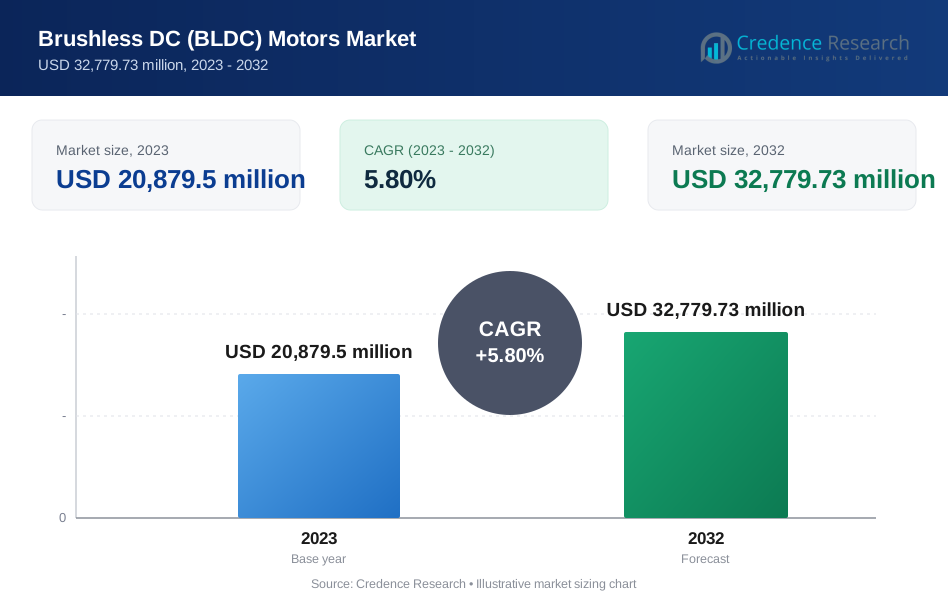
The Brushless DC (BLDC) Motors Market is projected to grow from USD 20,879.5 million in 2023 to an estimated USD 32,779.73 million by 2032, with a compound annual growth rate (CAGR) of 5.80% from 2024 to 2032. This growth is attributed to the rising adoption of energy-efficient motors across various industries, including automotive, consumer electronics, and industrial applications.
The market’s expansion is driven by several key factors, including the increasing need for improved energy efficiency and the growing emphasis on reducing greenhouse gas emissions. Moreover, advancements in electronics and motor control technologies are paving the way for more efficient BLDC motor applications. The automotive sector, particularly in electric vehicles (EVs), is seeing significant growth in the adoption of BLDC motors due to their superior efficiency and power density, driving market demand. Additionally, trends such as the shift towards automation in industries further accelerate the need for reliable motor solutions like BLDC motors.
Geographically, the Asia-Pacific region dominates the BLDC motors market due to its robust manufacturing base, expanding automotive industry, and rising consumer electronics sector, particularly in China, Japan, and India. North America and Europe follow, with growing demand in sectors like healthcare, industrial automation, and electric vehicles. Key players driving the market include Nidec Corporation, ABB Ltd., AMETEK Inc., Johnson Electric Holdings Limited, and Oriental Motor Co., Ltd., each contributing to innovations and enhancing the global market landscape through strategic partnerships and technology advancements.
Market Drivers
Increasing Demand for Energy-Efficient Motor Solutions
The push for energy efficiency is a primary driver for the BLDC motors market. As industries and governments worldwide seek to reduce energy consumption and carbon emissions, the adoption of energy-efficient motor solutions becomes essential. BLDC motors are inherently more efficient than brushed DC motors due to their reduced friction and lower maintenance requirements, which aligns with global sustainability goals. For instance, BLDC motors can achieve efficiencies greater than 85% compared to 75% in traditional brushed motors. In the automotive sector, BLDC motors are extensively used in electric vehicles, providing benefits such as increased power density and maximum efficiency. In HVAC systems, BLDC motors offer high efficiency, easy control, low operating temperatures, extended lifespan, and superior controllability compared to traditional AC motors. This shift towards energy-efficient solutions is further supported by global regulations on energy efficiency standards. In sectors like automotive, consumer electronics, and HVAC systems, manufacturers are prioritizing motors that can deliver high performance with lower energy use. This shift has positioned BLDC motors as an optimal solution, especially as global regulations tighten around energy efficiency standards. As a result, the BLDC motors market is poised to expand as industries continue to replace traditional motors with advanced, efficient alternatives.
Growing Adoption in the Electric Vehicle (EV) Sector
The expanding electric vehicle (EV) industry is another significant driver of the BLDC motors market. As the global automotive market increasingly embraces electrification to address environmental concerns, BLDC motors have emerged as a preferred choice for EV manufacturers. Known for their efficiency, compact size, and excellent torque control, BLDC motors are ideal for electric drivetrains. They offer high power density and contribute to the extended range of EVs, two critical factors for consumer adoption. The rising adoption of EVs across major markets like North America, Europe, and Asia-Pacific has fueled demand for high-performance BLDC motors. Government incentives and subsidies for EV purchases further boost the industry, leading automotive manufacturers to invest in BLDC motor technology to enhance vehicle efficiency and meet regulatory standards. As EV production scales, demand for BLDC motors is expected to see sustained growth. For instance, BLDC motors are used in the majority of electric scooters and motorcycles, including models like the Ather 450X and Pure EV Etrance Neo. Additionally, many three-wheeler manufacturers, such as Goenka Electric Motors and Kinetic Green, also utilize BLDC motors. This widespread adoption highlights the growing importance of BLDC motors in the electric vehicle sector.
Advancements in Motor Control and Electronics Technologies
Recent technological advancements in electronics and motor control systems have contributed to the increasing adoption of BLDC motors. Improved control technologies have allowed for enhanced precision, smoother operation, and greater efficiency in BLDC motors, making them suitable for a wider range of applications. Developments in semiconductor technology, such as efficient power electronics and microcontrollers, have enabled manufacturers to produce more affordable and effective BLDC motor solutions. This is particularly impactful in sectors like consumer electronics, robotics, and home appliances, where compact, high-performance motor solutions are essential. For instance, the use of advanced Pulse Width Modulation (PWM) techniques in motor controllers has led to a 20% increase in efficiency and 30% reduction in noise levels in electric vehicles. Additionally, these advancements reduce the cost of producing and integrating BLDC motors, making them an attractive option for industries aiming to improve operational efficiency and reduce costs. The rapid pace of innovation in motor control technologies is expected to accelerate BLDC motor adoption further.
Rising Demand in Industrial Automation and Robotics
The industrial automation and robotics sectors are driving increased demand for BLDC motors, as manufacturers in these sectors seek reliable and high-precision motor solutions for automated systems. As industries continue to automate processes to improve efficiency and productivity, the need for durable and efficient motor systems has grown. BLDC motors are ideal for automated systems because of their high torque-to-weight ratio, precision control capabilities, and longer operational life. The trend towards Industry 4.0, characterized by increased connectivity and intelligent systems in manufacturing environments, has also spurred demand for BLDC motors. Automated machinery and robotics require highly responsive and energy-efficient motors to maintain consistent performance in complex industrial applications. The continued shift towards automation in sectors such as manufacturing, warehousing, and logistics is expected to drive further demand for BLDC motors, reinforcing their role as a cornerstone of modern automated systems.
Market Trends
Integration of Smart and IoT-Enabled BLDC Motors
A significant trend in the BLDC motors market is the integration of smart and Internet of Things (IoT)-enabled technologies. With the rise of Industry 4.0, manufacturers and industries increasingly seek to optimize and monitor motor performance in real time. IoT-enabled BLDC motors allow for enhanced monitoring, diagnostics, and maintenance capabilities by collecting and transmitting data on parameters such as temperature, vibration, and efficiency. This enables predictive maintenance, which minimizes downtime and reduces operational costs. For instance, the integration of IoT-enabled BLDC motors in industrial applications has resulted in a 50% reduction in energy loss and a significant decrease in carbon footprint. Industries like manufacturing, healthcare, and home automation are rapidly adopting these smart motors to improve productivity and efficiency. Moreover, IoT-integrated BLDC motors allow for remote operation and control, which is particularly advantageous in automated systems and robotic applications. The trend of adopting connected motor solutions is expected to grow as industries continue to prioritize efficiency and integrate more smart systems into their operations.
Increasing Application of BLDC Motors in Renewable Energy Systems
As the global focus on renewable energy sources intensifies, BLDC motors are finding new applications within renewable energy systems. Wind turbines, solar tracking systems, and electric vehicle charging infrastructure increasingly incorporate BLDC motors due to their high efficiency, durability, and compatibility with sustainable energy solutions. In wind turbines, for example, BLDC motors facilitate precise control and efficient power generation, while in solar tracking systems, they optimize panel positioning to maximize energy capture. Additionally, the rise in demand for residential and commercial solar power systems has driven the adoption of BLDC motors in solar inverters, helping to convert and manage solar power with greater efficiency. As governments and industries invest more heavily in renewable energy projects, the application of BLDC motors in these sectors is expected to grow, reinforcing their role in supporting sustainable energy solutions worldwide.
Market Restraints and Challenges
High Initial Costs and Complex Manufacturing Process
One of the primary challenges facing the BLDC motors market is the high initial cost associated with their production and installation. BLDC motors require advanced electronic components and materials, such as permanent magnets, which are often expensive. Additionally, their manufacturing process is complex and involves precision engineering, leading to higher production costs. This makes BLDC motors more costly than traditional brushed motors, potentially limiting their adoption in cost-sensitive applications and markets. For small and medium-sized enterprises (SMEs), especially in developing regions, the higher initial investment needed for BLDC motor implementation can act as a significant barrier, discouraging adoption despite the motors' long-term efficiency benefits. As the demand for affordable energy solutions continues to rise, the high costs associated with BLDC motors remain a notable restraint on market expansion.
Dependence on Rare Earth Materials and Supply Chain Vulnerabilities
The BLDC motor market is also challenged by its reliance on rare earth materials, particularly neodymium and dysprosium, which are essential for the production of high-performance permanent magnets. These rare earth elements are primarily sourced from a limited number of regions, creating supply chain vulnerabilities and potential price volatility due to geopolitical factors and export restrictions. Fluctuations in the availability and cost of these materials directly impact the production costs of BLDC motors. Additionally, environmental concerns related to the extraction and processing of rare earth elements have led to stricter regulations, further complicating supply stability. This dependence on rare earth materials introduces risks for BLDC motor manufacturers and creates challenges in scaling production sustainably, which may hinder the market’s growth, especially as industries face pressure to reduce dependency on scarce resources and adopt more sustainable practices.
Market Segmentation Analysis
By Type
The BLDC motors market is segmented into Inner Rotor and Outer Rotor types, each suited to specific application needs and offering unique advantages. Inner Rotor Motors, with the rotor inside the stator, are commonly used in industrial and automotive applications due to their high torque density, superior cooling, and precise control, making them ideal for electric vehicles, robotics, and high-speed machinery. This design also supports efficient heat dissipation, crucial for high-performance needs. The demand for inner rotor motors is expected to grow alongside the automation and EV markets. On the other hand, Outer Rotor Motors, featuring the rotor on the outside of the stator, offer a compact, high-inertia design suitable for applications that prioritize smooth, stable, low-speed operation, such as fans, pumps, and household appliances. Known for quieter operation and increased efficiency due to lower cogging torque, outer rotor motors are gaining traction in consumer electronics and medical devices, where noise reduction and efficiency are paramount. Consequently, the outer rotor segment is projected to grow steadily with the rising demand for efficient, quiet motor solutions in household and commercial appliances.
By Speed
The speed segmentation of BLDC motors spans <500 RPM, 501 – 2,000 RPM, 2,001 – 10,000 RPM, and above 10,000 RPM, each catering to specific operational needs. Motors below 500 RPM are well-suited for heavy-duty industrial applications requiring low-speed, high-torque output, such as conveyor belts and mixers, with steady demand anticipated from manufacturing sectors. The 501 – 2,000 RPM range serves diverse commercial and residential uses, such as fans, air conditioning units, and pumps, where a balance between speed and torque is essential, particularly as HVAC and energy-efficient building systems grow. The mid-speed category of 2,001 – 10,000 RPM finds applications in automotive and industrial automation, driven by the increasing demand for electric vehicles and automated equipment. Lastly, high-speed motors above 10,000 RPM deliver precision and power for advanced applications, including medical devices, aerospace systems, and power tools, with growth expected in sectors requiring rapid acceleration and compact, high-performance motor solutions.
Segments
Based on type
- Inner Rotor
- Outer Rotor
Based on speed
- <500 RPM
- 501 – 2,000 RPM
- 2,001 – 10,000 RPM
- Above 10,000 RPM
Based on end-user
- Consumer Electronics
- Automotive
- Manufacturing
- Medical Devices
- Others
Based on region
- North America
- US
- Canada
- Mexico
- Europe
- Germany
- France
- UK
- Italy
- Spain
- Rest of Europe
- Asia Pacific
- China
- Japan
- India
- South Korea
- South-east Asia
- Rest of Asia Pacific
- Latin America
- Brazil
- Argentina
- Rest of Latin America
- Middle East & Africa
- GCC Countries
- South Africa
Regional Analysis
North America (25%):
North America holds a significant portion of the BLDC motors market, accounting for around 25% of the global market share. The region’s growth is driven by advancements in technology, increasing adoption of electric vehicles, and the rising demand for energy-efficient systems in both residential and commercial applications. The U.S. leads the region’s demand, with a strong emphasis on high-performance automotive and aerospace applications that require BLDC motors for their reliability and efficiency. Additionally, North America’s industrial automation sector is experiencing considerable growth, particularly in robotics and automation solutions, further propelling BLDC motor demand. The market in this region is anticipated to expand steadily as industries continue to prioritize energy savings and advanced motor technology.
Europe (20%):
Europe represents approximately 20% of the global BLDC motors market share, with key contributions from countries such as Germany, France, and the United Kingdom. The region's growth is fueled by a strong automotive sector, particularly in electric vehicle manufacturing, where BLDC motors are preferred for their high efficiency and compact size. Europe’s commitment to reducing carbon emissions aligns well with the adoption of energy-efficient BLDC motors in various sectors, including industrial automation and renewable energy systems. Government initiatives and regulations aimed at achieving sustainability targets play a critical role in driving demand for BLDC motors across the region. As European countries increase investments in green technologies, the demand for BLDC motors is likely to see continued growth.
Key players
- Ametek Inc. (US)
- Allied Motion, Inc. (US)
- NIDEC Corporation (Japan)
- MinebeaMitsumi Inc. (Japan)
- Johnson Electric Holdings Limited (China)
Competitive Analysis
The Global Brushless DC (BLDC) Motors Market is highly competitive, with key players focusing on technological advancements, strategic partnerships, and regional expansion to strengthen their market positions. Companies like NIDEC Corporation and MinebeaMitsumi Inc. leverage their extensive R&D capabilities to deliver innovative, high-performance motor solutions tailored for electric vehicles, automation, and consumer electronics. Ametek Inc. and Allied Motion, Inc. emphasize expanding their product portfolios and developing energy-efficient motors, which align with increasing global demand for sustainable solutions. Johnson Electric Holdings Limited, a prominent player in the Asia-Pacific region, continues to expand its footprint by addressing diverse industry needs, from automotive to home appliances. These companies face competition on multiple fronts, including price, product quality, and technological innovation. As industries prioritize efficiency and automation, market players are likely to continue investing in advanced BLDC motor technology to gain a competitive edge.
Recent Developments
- In November 2022, Ametek announced the acquisition of Navitar, Inc. and RTDS Technologies Inc. for approximately $430 million. These acquisitions expand Ametek’s capabilities in high-end precision optics and power test and measurement.
- In May 2022, Allied Motion completed the acquisition of ThinGap, a developer and manufacturer of high-performance, zero cogging slotless motors.
- In January 2024, Nidec announced a strategy change in its EV traction motor business to focus on high-efficiency brushless DC motors.
- In May 2024, MinebeaMitsumi completed the acquisition of Hitachi Power Semiconductor Device, Ltd. and its overseas sales business.
- In August 2024, Johnson Electric unveiled a revolutionary air suspension pump brushless motor.
Market Concentration and Characteristics
The Global Brushless DC (BLDC) Motors Market is moderately concentrated, with a mix of prominent multinational corporations and specialized regional players competing for market share. Key companies like NIDEC Corporation, Johnson Electric Holdings Limited, Ametek Inc., and MinebeaMitsumi Inc. hold significant shares due to their strong research and development capabilities, extensive product portfolios, and established distribution networks. Market characteristics include a high focus on innovation, driven by the demand for energy-efficient, low-maintenance, and durable motor solutions across diverse applications, from electric vehicles and industrial automation to consumer electronics and renewable energy systems. Additionally, increasing environmental regulations and the push for sustainable solutions are accelerating technological advancements within the market, encouraging players to develop BLDC motors with improved efficiency, enhanced control systems, and IoT connectivity. As the market evolves, competitive dynamics will likely intensify, with companies investing heavily in advanced technologies and strategic partnerships to gain a competitive edge.
Report Coverage
The research report offers an in-depth analysis based on type, speed, end-user and Region. It details leading market players, providing an overview of their business, product offerings, investments, revenue streams, and key applications. Additionally, the report includes insights into the competitive environment, SWOT analysis, current market trends, as well as the primary drivers and constraints. Furthermore, it discusses various factors that have driven market expansion in recent years. The report also explores market dynamics, regulatory scenarios, and technological advancements that are shaping the industry. It assesses the impact of external factors and global economic changes on market growth. Lastly, it provides strategic recommendations for new entrants and established companies to navigate the complexities of the market.
Future Outlook
- The rise of electric vehicles globally will drive demand for efficient, high-performance BLDC motors, enhancing EV efficiency and range.
- BLDC motors will see growing use in wind turbines and solar tracking systems, supporting the renewable energy sector’s shift toward sustainable energy solutions.
- As industries prioritize real-time monitoring and predictive maintenance, the adoption of IoT-enabled BLDC motors for enhanced operational control will increase.
- Stricter energy regulations and sustainability goals will lead various industries to replace traditional motors with energy-efficient BLDC motors.
- The global push toward automation will expand BLDC motor applications in manufacturing, logistics, and warehousing, especially in robotic and automated systems.
- Technological innovations in power electronics and control systems will improve BLDC motor performance, making them more attractive for high-precision applications.
- The consumer electronics market will contribute to BLDC motor growth, particularly for energy-efficient home appliances and cooling systems.
- Demand for compact and precise motors in medical devices, such as imaging systems and surgical tools, will boost BLDC motor usage in healthcare.
- The Asia-Pacific region will continue to lead market growth due to expanding EV production, industrial automation, and consumer electronics manufacturing.
- Due to supply chain vulnerabilities, manufacturers will explore alternative materials and designs for BLDC motors, aiming to reduce reliance on rare earth elements.
Request a Free Sample
Fill in your details and we'll send you a free sample report.
- Sample data tables & charts
- Research methodology
Need a Custom Version of This Report?
Tailor the scope, geography, or segments to your exact requirements.
- Custom geography or segment scope
- Direct access to our analyst team
Frequently Asked Questions
What is the projected market size of the Global BLDC Motors Market in 2023 and 2032, and what is its CAGR?
What factors are driving the growth of the BLDC Motors Market?
Which region holds the largest market share in the BLDC Motors Market?
How are BLDC motors used in the renewable energy sector?
What role do IoT and smart technologies play in the BLDC Motors Market?
What are the primary applications for BLDC motors in the automotive industry?
Table of Content
Chapter 1. Report Introduction
- 1.1 Report Description & Purpose
- 1.1.1 Report Title & Market Definition
- 1.1.2 Unique Selling Propositions (USP) & Key Differentiators
- 1.1.3 Value Proposition for Stakeholders
- 1.2 Research Objectives
- 1.2.1 Market Sizing Objectives (Volume & Revenue)
- 1.2.2 Segmentation Objectives
- 1.2.3 Competitive Intelligence Objectives
- 1.2.4 Forecast & Scenario Objectives
- 1.3 Report Scope
- 1.3.1 Brushless DC (BLDC) Motors Scope – Types & Subtypes Covered
- 1.3.2 Geographic Scope – Regions & Countries Covered
- 1.3.3 Historical Period, Base Year & Forecast Period (2023; forecast to 2032)
- 1.3.4 Inclusions & Exclusions
- 1.4 HS Code & Classification Framework
- 1.5 Currency, Units & Pricing Basis
- 1.6 Target Stakeholders
- 1.7 Limitations & Assumptions
Chapter 2. Executive Summary
- 2.1 Global Brushless DC (BLDC) Motors Market Snapshot
- 2.1.1 Market Size – Historical (2023) & Forecast (2023-2032) (2023: USD 20,879.5 million → 2032: USD 32,779.73 million)
- 2.1.2 Volume & Revenue – Global Totals
- 2.1.3 Key Market Highlights – Top Five Facts
- 2.2 Brushless DC (BLDC) Motors Market Segmentation Snapshot
- 2.2.1 Market Split by Region – 2023 vs. 2032
- 2.3 Competitive Snapshot
- 2.3.1 Top 10 Players by Revenue Share – 2023
- 2.3.2 Top 10 Players by Volume Share – 2023
- 2.3.3 Recent Strategic Developments (18-Month Summary)
- 2.4 Key Investment Highlights & Strategic Conclusions
Chapter 3. Brushless DC (BLDC) Motors Market Dynamics & Industry Analysis
- 3.1 Market Overview & Context
- 3.1.1 Brushless DC (BLDC) Motors Market Position in the Broader Automotive Value Chain
- 3.1.2 OEM vs. Replacement Market Dynamics
- 3.1.3 Market Maturity & Development Stage by Region
- 3.2 Brushless DC (BLDC) Motors Market Drivers
- 3.3 Brushless DC (BLDC) Motors Market Restraints & Challenges
- 3.4 Brushless DC (BLDC) Motors Market Opportunities
- 3.5 Porter's Five Forces Analysis
- 3.5.1 Threat of New Entrants
- 3.5.2 Bargaining Power of Suppliers
- 3.5.3 Bargaining Power of Buyers
- 3.5.4 Threat of Substitutes
- 3.5.5 Competitive Rivalry – Intensity Assessment
- 3.6 Brushless DC (BLDC) Motors Value Chain Analysis
- 3.6.1 Upstream – Raw Material/Input Suppliers
- 3.6.1.1 Raw Material/Input 1
- 3.6.1.2 Raw Material/Input 2
- 3.6.1.3 Raw Material/Input 3
- 3.6.2 Midstream – Production/Manufacturing/Service Delivery
- 3.6.2.1 Production/Process Overview
- 3.6.2.2 Key Facility Locations & Capacity by Manufacturer
- 3.6.3 Downstream – Distribution & End Consumer
- 3.6.3.1 Primary Channel – B2B/OEM
- 3.6.3.2 Secondary Channels – Dealer, Retail, Online, Direct
- 3.6.4 Value Chain Profitability Analysis
- 3.6.1 Upstream – Raw Material/Input Suppliers
- 3.7 PESTEL Analysis
- 3.7.1 Political Factors
- 3.7.2 Economic Factors
- 3.7.3 Social Factors
- 3.7.4 Technological Factors
- 3.7.5 Environmental Factors
- 3.7.6 Legal Factors
- 3.8 Brushless DC (BLDC) Motors Supply Chain Analysis
- 3.8.1 Raw Material/Input Supply Risk Assessment
- 3.8.2 Manufacturing Concentration Risk (Geographic Exposure)
- 3.8.3 Trade Disruption Impact Analysis
- 3.9 Regulatory & Policy Landscape
Note: The regulatory and policy landscape section covers regulations based on their applicability to the market, Brushless DC (BLDC) Motors category, geography, and scope of the study. Only regulatory frameworks with a material impact on operations, compliance, trade, sustainability, or market access are analyzed in detail.
Chapter 4. Key Investment Pockets & Opportunity Analysis
- 4.1 Brushless DC (BLDC) Motors Market Attractiveness Analysis
- 4.1.1 By Region – Investment Attractiveness Matrix (Volume × CAGR)
- 4.2 Absolute Revenue Growth Opportunity
- 4.2.1 By Region – Absolute USD Growth Through 2032
- 4.3 Incremental Volume Opportunity
- 4.3.1 By Region – Incremental Volume Through 2032
- 4.3.2 Segment – Incremental Volume
- 4.4 Emerging Submarket Opportunity Deep Dive (Subject to Applicability)
- 4.5 Emerging Market Opportunity Scorecards
- 4.5.1 United States
- 4.5.2 Europe
- 4.5.3 Asia
- 4.5.4 Middle East & Africa
Note: Emerging Market Opportunity Scorecards will be included based on relevance and strategic importance. Regions listed are indicative and may vary depending on data availability and market dynamics.
Chapter 5. Brushless DC (BLDC) Motors Import-Export Analysis & Trade Flows
- 5.1 Global Trade Overview
- 5.1.1 Global Export Value by Country (2023)
- 5.1.2 Global Export Volume by Country (2023)
- 5.1.3 Global Import Value by Country (2023)
- 5.1.4 Global Import Volume by Country (2023)
- 5.1.5 Net Trade Balance by Country (2023)
- 5.2 Export Analysis – Segment
- 5.2.1 Type 1 (HS Code)
- 5.2.2 Type 2 (HS Code)
- 5.2.3 Type 3 (HS Code)
- 5.2.4 Type 4 (HS Code)
- 5.2.5 Type 5 (HS Code)
- 5.3 Import Analysis – Segment
- 5.3.1 Type 1 (HS Code)
- 5.3.2 Type 2 (HS Code)
- 5.3.3 Type 3 (HS Code)
- 5.3.4 Type 4 (HS Code)
- 5.3.5 Type 5 (HS Code)
- 5.4 Average Unit Trade Prices
- 5.4.1 Average Export Price – Segment & Country
- 5.4.2 Average Import Price – Segment & Source Country
- 5.4.3 Price Trends (2023)
- 5.5 Key Trade Route Analysis
- 5.5.1 Trade Route 1
- 5.5.2 Trade Route 2
- 5.5.3 Trade Route 3
- 5.5.4 Trade Route 4
- 5.5.5 Trade Route 5
- 5.6 Trade Policy Impact Assessment
- 5.6.1 US Anti-Dumping & Section 301 Tariffs
- 5.6.2 EU Customs Union Impact
- 5.6.3 Major Free Trade Agreements
- 5.6.4 USMCA Rules of Origin
Note: Trade policy analysis will be included only where relevant to the Brushless DC (BLDC) Motors market.
Chapter 6. Competitive Landscape & Company Benchmarking
- 6.1 Brushless DC (BLDC) Motors Market Concentration & Structure
- 6.1.1 Herfindahl-Hirschman Index (HHI) – vs. 2023
- 6.1.2 Tier 1, Tier 2 & Tier 3 Market Structure
- 6.1.3 Global, Regional & Local Player Dynamics
- 6.2 Brushless DC (BLDC) Motors Market Share Analysis – 2023
- 6.2.1 Global Revenue Share by Company
- 6.2.2 Global Volume Share by Company
- 6.2.3 Regional Revenue Share
- 6.2.4 Market Share Evolution ( vs. 2023)
- 6.2.5 OEM Segment Share by Company
- 6.2.6 Replacement Segment Share by Company
- 6.3 Production/Delivery Capacity & Facility Analysis
- 6.3.1 Global Installed Capacity
- 6.3.2 Capacity Utilization Rates
- 6.3.3 Production/Output Volume
- 6.3.4 Facility Locations & Capacity Map
- 6.3.5 Planned Capacity Additions
- 6.4 Brushless DC (BLDC) Motors Competitive Benchmarking Matrix
- 6.4.1 Revenue, Volume, CAGR & Profitability Comparison
- 6.4.2 Channel Revenue Mix
- 6.4.3 Geographic Revenue Exposure
- 6.4.4 R&D Intensity
- 6.4.5 Sustainability Maturity
- 6.5 Strategic Developments in Brushless DC (BLDC) Motors (Last 24 Months)
- 6.5.1 Mergers, Acquisitions & Divestments
- 6.5.2 New Brushless DC (BLDC) Motors Launches
- 6.5.3 Facility Expansions
- 6.5.4 Strategic Alliances, Joint Ventures & Partnerships
- 6.5.5 Distribution Expansion & Market Entry
- 6.5.6 Sustainability & ESG Initiatives
- 6.6 Competitive Strategy Mapping
- 6.6.1 Leader, Challenger, Follower & Niche Classification
- 6.6.2 Pricing Strategy Comparison
- 6.6.3 Channel Strategy Matrix
Note: Strategic developments are included based on their materiality and the availability of reliable information.
Chapter 7. Global Brushless DC (BLDC) Motors Market – By Distribution Channel
- 7.1 Segment Overview
- 7.1.1 Volume & Revenue Split by Channel (2023 & 2032)
- 7.1.2 Channel Mix Evolution (2023-2032)
Chapter 8. Regional Market Analysis – Global Overview
- 8.1 Global Regional Overview
- 8.1.1 Regional Volume Share
- 8.1.2 Regional Revenue Share
- 8.1.3 Regional Volume by Region
- 8.1.4 Regional Revenue by Region
- 8.1.5 Regional Forecast Through 2032
- 8.2 Cross-Regional Segment Analysis
- 8.2.1 By Distribution Channel
- 8.2.2 By Brand/Price Tier
Chapter 9. North America Brushless DC (BLDC) Motors Market
- 9.1 United States
- 9.2 Canada
- 9.3 Mexico
Chapter 10. Europe Brushless DC (BLDC) Motors Market
- 10.1 Germany
- 10.2 France
- 10.3 Italy
- 10.4 United Kingdom
- 10.5 Spain
- 10.6 Poland
- 10.7 Russia
- 10.8 Netherlands
- 10.9 Belgium
- 10.10 Sweden
- 10.11 Denmark
- 10.12 Norway
- 10.13 Rest of Europe
Chapter 11. Asia Pacific Brushless DC (BLDC) Motors Market
- 11.1 China
- 11.2 India
- 11.3 Japan
- 11.4 South Korea
- 11.5 Thailand
- 11.6 Indonesia
- 11.7 Vietnam
- 11.8 Malaysia
- 11.9 Australia
- 11.10 Rest of Asia Pacific
Chapter 12. Latin America Brushless DC (BLDC) Motors Market
- 12.1 Brazil
- 12.2 Argentina
- 12.3 Colombia
- 12.4 Chile
- 12.5 Rest of Latin America
Chapter 13. Middle East Brushless DC (BLDC) Motors Market
- 13.1 Saudi Arabia
- 13.2 United Arab Emirates
- 13.3 Turkey
- 13.4 Israel
- 13.5 Iran
- 13.6 Rest of the Middle East
Chapter 14. Africa Brushless DC (BLDC) Motors Market
- 14.1 South Africa
- 14.2 Egypt
- 14.3 Nigeria
- 14.4 Morocco
- 14.5 Rest of Africa
Chapter 15. Brushless DC (BLDC) Motors Company Profiles
- 15.1 [Company 01]
- 15.1.1 Company Overview
- 15.1.2 Key Management Personnel
- 15.1.3 Products & Services Portfolio
- 15.1.4 Financial Performance
- 15.1.5 Key Market Focus & Geographic Presence
- 15.1.6 Recent Developments & Strategic Initiatives
Note: The company profile list is preliminary and may change based on research findings, market developments, data availability, and client requirements.
Chapter 16. Appendices
- Appendix A – List of Abbreviations & Acronyms
- Appendix B – Industry Classification Code Reference – Full Series
- Appendix C – Production & Capacity Data Tables
- Appendix D – End-Use & Demand Base Tables
- Appendix E – Consumption & Replacement Rate Assumptions
- Appendix F – ASP Reference Tables
- Appendix G – Manufacturing & Facility Database
- Appendix H – Import-Export Data Tables
- Appendix I – Regulatory Summary Tables
- Appendix J – Primary Research Participant List (Anonymized)
- Appendix K – Primary Research Questionnaire Framework
- Appendix L – Data Sources & Bibliography
- Appendix M – Market Size Divergence & Source Comparison
Chapter 17. Research Methodology
- 17.1 Research Framework & Philosophy
- 17.2 Secondary Research – Sources, Hierarchy & Data Extraction
- 17.3 Data Modeling – Bottom-Up & Top-Down Market Sizing
- 17.4 Primary Research – Stakeholder Framework, LOI & Sample Sizes
- 17.5 Forecast Methodology – Regression, Scenario & Sensitivity Analysis
- 17.6 Quality Control – Four-Layer Validation Framework
- 17.7 Limitations & Standard Assumptions
- 17.8 Disclaimer
