
Market Overview:
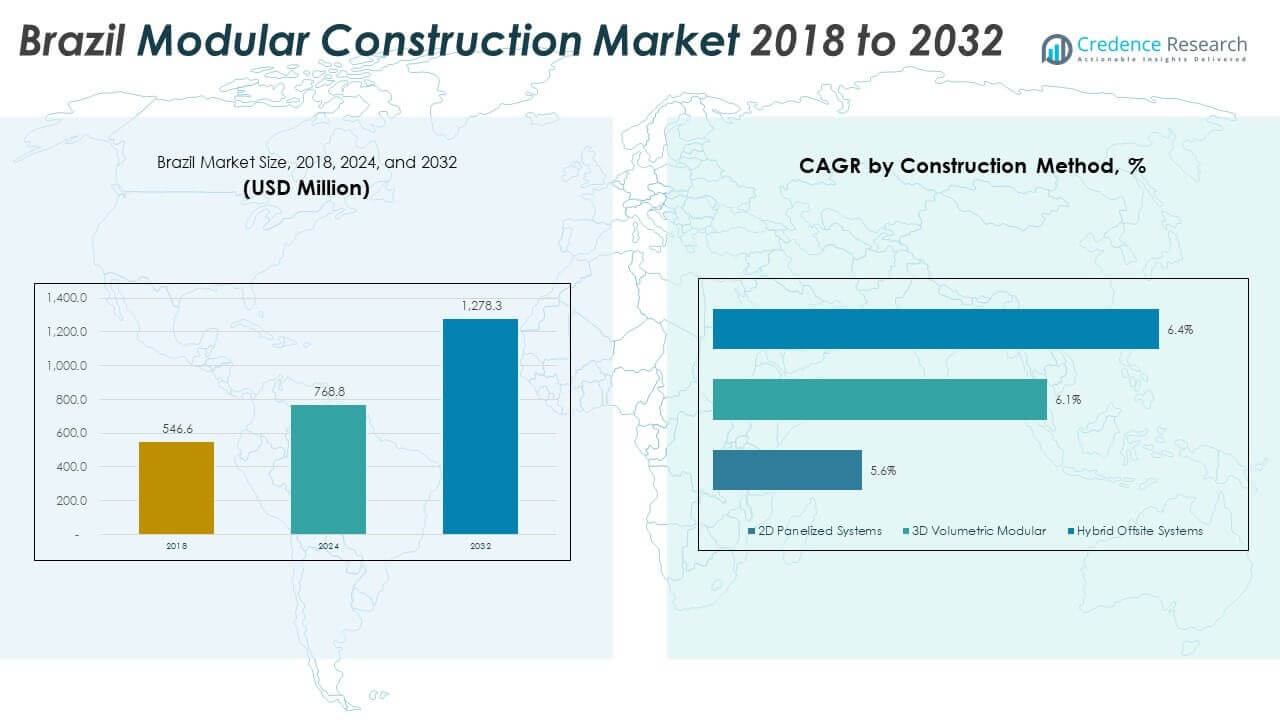
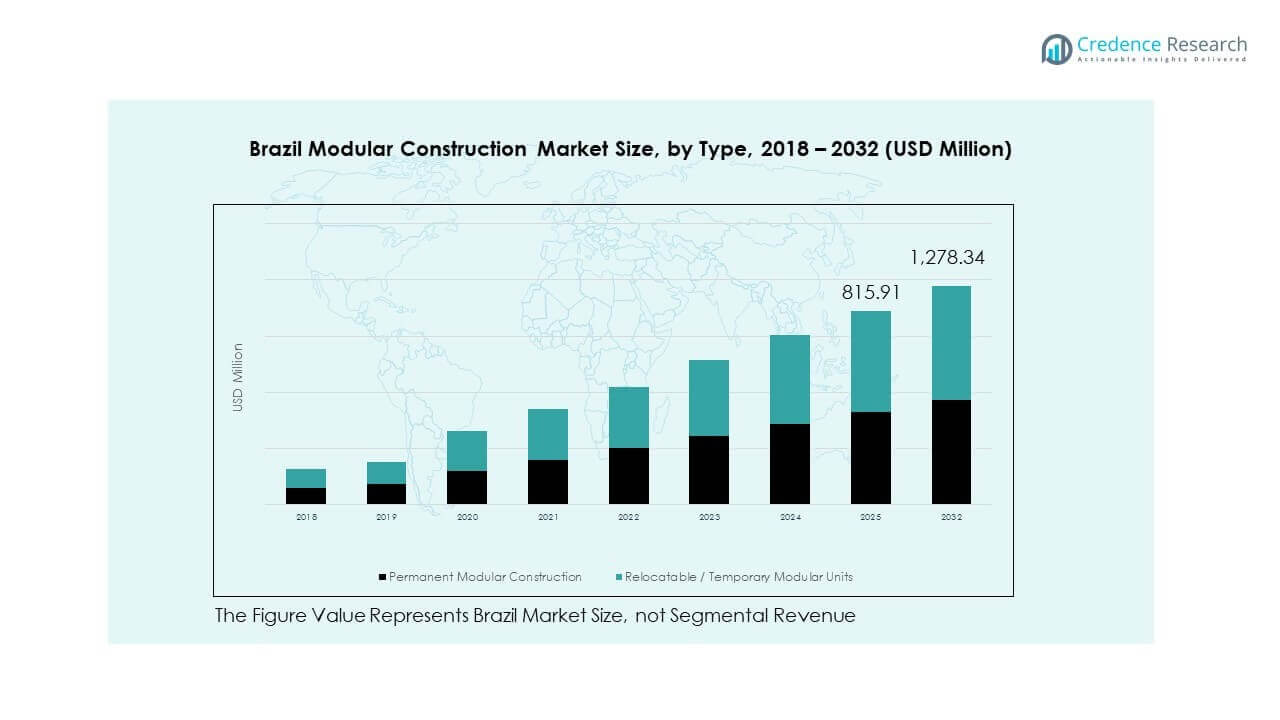
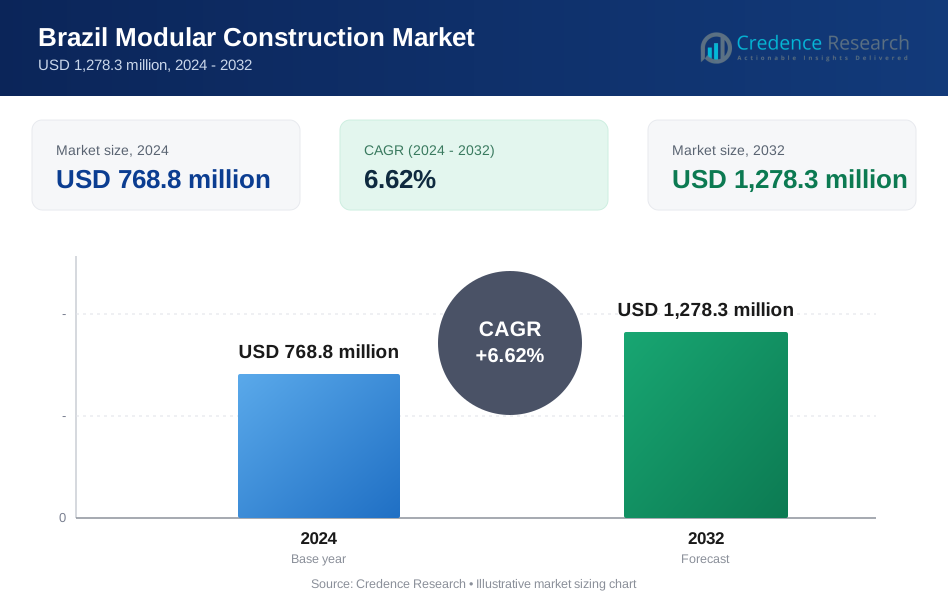
The Brazil Modular Construction Market size was valued at USD 546.6 million in 2018 to USD 768.8 million in 2024 and is anticipated to reach USD 1,278.3 million by 2032, at a CAGR of 6.62% during the forecast period.
| REPORT ATTRIBUTE | DETAILS |
|---|---|
| Historical Period | 2020-2023 |
| Base Year | 2024 |
| Forecast Period | 2025-2032 |
| Brazil Modular Construction Market Size 2024 | USD 768.8 million |
| Brazil Modular Construction Market, CAGR | 6.62% |
| Brazil Modular Construction Market Size 2032 | USD 1,278.3 million |
Growth in the market is driven by rising demand for faster construction timelines, cost control, and reduced labor dependency. Developers prefer modular techniques for consistent quality, reduced site disruption, and better project predictability. Government investments in public housing, education, and healthcare projects further push modular adoption. The ability to streamline approvals and speed up delivery aligns with national infrastructure goals. Industrial and commercial sectors use modular systems to cut lead times. Sustainability regulations also encourage the shift to modular formats. These factors position modular construction as a scalable and cost-efficient solution.
The Southeast region leads the market due to high urbanization, real estate activity, and supportive infrastructure. São Paulo and Rio de Janeiro anchor demand with multi-sector modular adoption. The South region is expanding with uptake in healthcare and institutional projects. The Northeast and Central-West regions are emerging markets, supported by housing programs and remote site deployments. The North region gains traction from public sector initiatives and industrial uses in remote areas. Modular methods help overcome logistics and labor challenges across diverse geographies.
Market Insights
- The Brazil Modular Construction Market was valued at USD 546.6 million in 2018, grew to USD 768.8 million in 2024, and is expected to reach USD 1,278.3 million by 2032, growing at a CAGR of 6.62%.
- The Southeast region led with approximately 45% market share, driven by high urban density and real estate demand. The South region followed with around 22%, supported by education and healthcare growth. The Northeast held nearly 18%, aided by public housing programs and infrastructure needs.
- The Central-West region is the fastest-growing, holding about 9% share, with strong modular adoption in industrial logistics and agricultural infrastructure projects.
- By type, Permanent Modular Construction accounted for an estimated 64% share in 2024, supported by demand in long-term residential and institutional buildings.
- Relocatable or Temporary Modular Units held the remaining 36% share in 2024, with rising use in industrial, rental, and emergency deployment settings.
Market Drivers
Rising Demand For Faster And Predictable Construction Timelines
The Brazil Modular Construction Market gains momentum from demand for faster project delivery. Developers seek shorter build cycles to reduce financing pressure. Modular methods shift work to factories with fixed schedules. This approach limits weather delays common in traditional construction. Public housing agencies favor speed to meet social targets. Private builders value predictable timelines for commercial projects. Faster completion improves cash flow and asset turnover. It supports rapid scale across repeatable building designs.
Growing Housing Shortage And Urban Population Pressure
Urban population growth intensifies housing demand across major cities. The Brazil Modular Construction Market addresses shortages through repeatable housing units. Modular systems support mass housing with uniform quality control. Urban land scarcity increases need for vertical modular designs. Authorities favor standardized units for affordable housing programs. Developers benefit from reduced on-site disruption in dense areas. Faster occupancy helps meet urgent housing needs. Modular supply aligns well with long-term urban planning goals.
- For instance, CMC Módulos Construtivos Ltda in Mirassol, São Paulo, delivered modular housing units for urban residential projects since 1971, enabling repeatable deployment in high-density areas with standardized factory quality.
Cost Control And Labor Productivity Improvements
Construction firms face rising labor and material cost pressure. The Brazil Modular Construction Market supports better cost planning through factory production. Controlled environments reduce material waste and rework. Firms require fewer on-site workers over shorter periods. This model improves productivity per labor hour. Contractors gain cost certainty across large-scale developments. Reduced site risk lowers insurance and safety expenses. These benefits strengthen adoption across public and private sectors.
- For instance, Brasil ao Cubo constructed a hospital annex in São Paulo using volumetric modules from three Santa Catarina factories, minimizing on-site labor through off-site assembly of 70 modules.
Public Infrastructure Expansion And Institutional Project Demand
Government investment supports schools, clinics, and public housing projects. The Brazil Modular Construction Market fits institutional needs through rapid deployment. Modular buildings allow phased expansion for public services. Standardized layouts simplify approval and compliance processes. Authorities prefer solutions with consistent quality outcomes. Off-site production limits disruption near operational facilities. Faster delivery supports urgent social infrastructure gaps. Public tenders increasingly include modular design criteria.
Market Trends
Shift Toward Permanent Modular Buildings In Urban Developments
Developers adopt permanent modular structures for long-term use. The Brazil Modular Construction Market shows growth in multi-story modular buildings. Improved structural systems enhance durability and load capacity. Urban projects favor permanent modules over temporary units. Architects integrate modular designs with modern aesthetics. Municipal approvals improve due to proven performance standards. Permanent modular buildings gain acceptance in housing and offices. This trend supports long-term market credibility.
Integration Of Digital Design And Prefabrication Planning Tools
Digital tools shape design precision in modular projects. The Brazil Modular Construction Market benefits from advanced building modeling use. Design teams coordinate structure, services, and finishes early. This process reduces errors during factory production. Digital planning improves logistics and installation sequencing. Stakeholders gain better visibility across project phases. Prefabrication accuracy improves overall construction quality. Technology adoption supports scalable modular deployment.
Rising Focus On Sustainable And Low-Waste Construction Methods
Sustainability goals influence construction decisions nationwide. The Brazil Modular Construction Market aligns with waste reduction priorities. Factory fabrication optimizes material usage and recycling. Developers track lower environmental impact per project. Green certifications favor modular construction methods. Reduced site disturbance improves local environmental outcomes. Sustainable design appeals to institutional investors. Environmental compliance strengthens modular market positioning.
- For instance, Urbem supplied over 1,300 m³ of FSC-certified Cross-Laminated Timber and Glulam panels for the Open Mall Praça Pitiguari project in Atibaia, São Paulo. The 7,000 m² development is among Latin America’s largest mass timber retail complexes and sequesters more than 900 tons of CO₂, integrating carbon-negative construction into Brazil’s modular landscape.
Expansion Of Modular Use Beyond Residential Applications
Modular construction expands into commercial and industrial uses. The Brazil Modular Construction Market supports offices, hotels, and retail units. Businesses value quick setup for operational readiness. Industrial sites prefer modular units for workforce housing. Hospitality developers adopt modular rooms for faster launches. Standard modules allow easy replication across locations. This diversification reduces dependence on housing cycles. Broader use cases strengthen long-term demand stability.
- For instance, Tecno Fast operates modular production lines in Brazil capable of manufacturing prefabricated units for offices, camps, and industrial sites, offering fully equipped modules with integrated HVAC, electrical, and sanitation systems for rapid deployment across South American markets.
Market Challenges Analysis
Limited Standardization And Regulatory Alignment Across Regions
Regulatory inconsistency creates hurdles for modular adoption. The Brazil Modular Construction Market faces varied approval processes by region. Local codes often lack modular-specific guidelines. This uncertainty delays project clearance and design approval. Developers adjust designs to meet local interpretations. Inconsistent standards raise compliance costs. Authorities require greater technical awareness of modular systems. Harmonized regulations remain essential for scale expansion.
Supply Chain Constraints And Limited Local Manufacturing Capacity
Local module manufacturing capacity remains uneven. The Brazil Modular Construction Market depends on reliable factory output. Limited plants increase transport distance and logistics costs. Heavy modules face road and permit challenges. Supply bottlenecks affect project timelines. Smaller developers struggle to secure factory slots. Investment in manufacturing infrastructure remains uneven. Capacity gaps restrict faster nationwide deployment.
Market Opportunities
Expansion Of Modular Manufacturing And Regional Production Hubs
New factories can strengthen domestic supply chains. The Brazil Modular Construction Market offers scope for regional hubs. Local production reduces transport complexity and costs. Regional plants improve delivery speed for nearby projects. Investors gain stable demand from public contracts. Manufacturing growth supports job creation and skill development. Scaled production improves cost efficiency. Regional hubs support long-term market maturity.
Adoption In Remote, Industrial, And Social Infrastructure Projects
Remote regions require fast and reliable construction solutions. The Brazil Modular Construction Market meets these needs effectively. Modular units suit mining, energy, and infrastructure sites. Social housing projects benefit from rapid deployment. Remote logistics favor factory-built components. Public agencies seek durable solutions with quick setup. Industrial growth drives demand for worker accommodation. These use cases open strong future growth avenues.
Market Segmentation Analysis
By Type
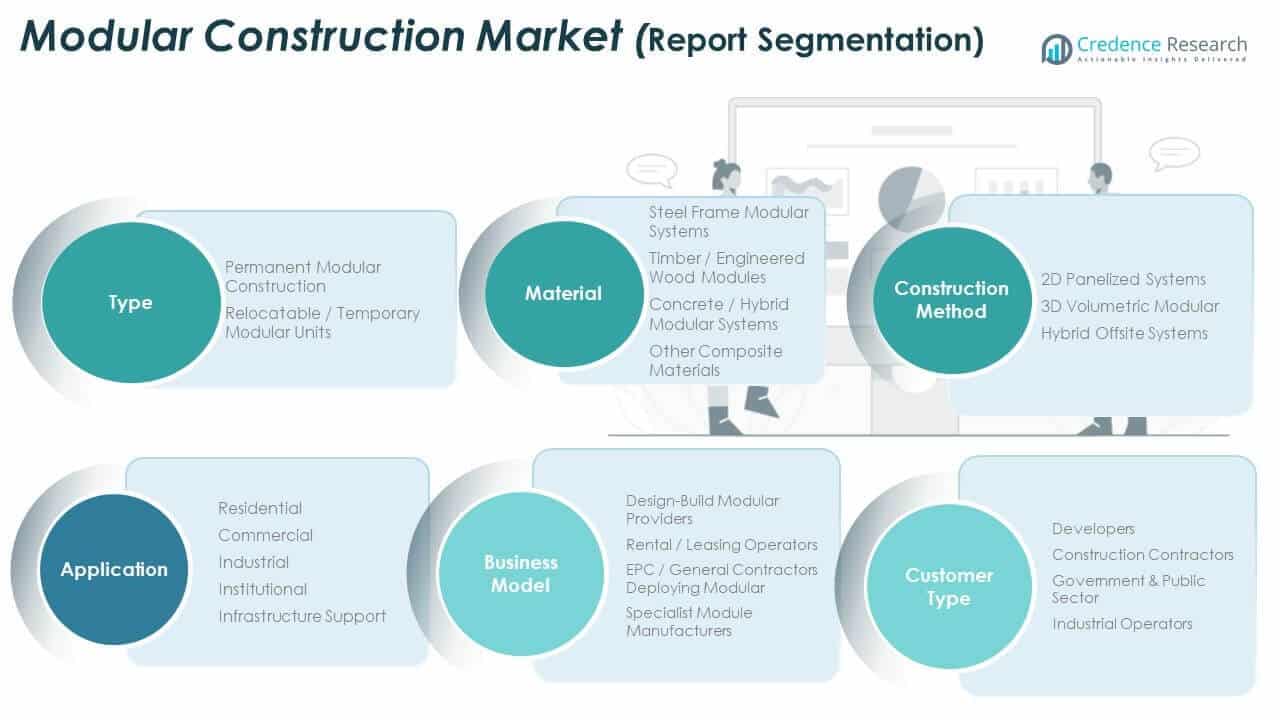
Permanent modular construction dominates due to its suitability for long-term housing and commercial projects. It supports faster delivery while meeting safety and design codes. Relocatable or temporary modular units follow in demand for industrial camps, education facilities, and disaster relief. These units offer flexibility and reusability, especially in remote or temporary infrastructure needs. The Brazil Modular Construction Market leverages both formats across urban and rural development zones.
- For instance, Brasil ao Cubo delivered a multi-story modular school using permanent steel modules in Santa Catarina, completing structural assembly in just 30 days.
By Material
Steel frame modular systems lead due to strength, design flexibility, and structural performance. They align with mid-to-high-rise residential and commercial applications. Timber or engineered wood modules attract sustainability-focused projects. Concrete and hybrid systems gain traction in infrastructure and institutional segments due to their durability. Other composite materials cater to lightweight, cost-efficient modules for short-term use. It supports varied material use based on location, budget, and application.
By Construction Method
3D volumetric modular construction is the leading method, supporting full-room units with integrated systems. It reduces on-site work significantly. 2D panelized systems serve lower-rise or customizable projects, offering more on-site assembly. Hybrid offsite systems combine both methods, used in large-scale or phased developments. The Brazil Modular Construction Market applies these methods based on project scale, logistics, and client preferences.
By Business Model
Design-build modular providers lead with end-to-end solutions, ensuring design compliance and build speed. Rental and leasing operators serve temporary construction and industrial segments. EPC and general contractors integrate modular to meet project schedules. Specialist module manufacturers support both public and private sector needs. It creates diverse business model participation across project types.
By Customer Type
Developers remain the primary customers, driving residential and mixed-use projects. Construction contractors use modular for speed and cost gains. The government and public sector adopt modular in education, health, and housing initiatives. Industrial operators seek modular for remote operations and workforce housing. It serves each customer type with tailored module formats and delivery models.
- For instance, the State Government of São Paulo partnered with Brasil ao Cubo to deploy modular healthcare annexes for public hospitals, using prefabricated steel units to expand capacity during COVID-19.
By Application
Residential applications lead with affordable housing and urban vertical expansion. Commercial use includes office parks and retail shells needing rapid occupancy. Industrial sites use modular for camps and facilities in isolated regions. Institutional applications cover schools, clinics, and public offices. Infrastructure support includes control rooms, utility enclosures, and transport hubs. The Brazil Modular Construction Market addresses each application with scalable modular formats.
Segmentation
By Type
- Permanent Modular Construction
- Relocatable / Temporary Modular Units
By Material
- Steel Frame Modular Systems
- Timber / Engineered Wood Modules
- Concrete / Hybrid Modular Systems
- Other Composite Materials
By Construction Method
- 2D Panelized Systems
- 3D Volumetric Modular
- Hybrid Offsite Systems
By Business Model
- Design-Build Modular Providers
- Rental / Leasing Operators
- EPC / General Contractors Deploying Modular
- Specialist Module Manufacturers
By Customer Type
- Developers
- Construction Contractors
- Government & Public Sector
- Industrial Operators
By Application
- Residential
- Commercial
- Industrial
- Institutional
- Infrastructure Support
Regional Analysis
The Brazil Modular Construction Market shows strong concentration in the Southeast region, which accounts for nearly 45% of national demand. São Paulo and Rio de Janeiro lead adoption due to dense urban populations and active real estate pipelines. Developers in these states favor modular methods to shorten delivery cycles and control costs. Industrial and commercial projects also support regional dominance. Financial access and skilled labor further strengthen leadership. It benefits from better logistics and established prefabrication facilities.
The South region holds about 22% of the market and shows steady expansion. States such as Paraná and Santa Catarina support modular adoption in healthcare, education, and residential housing. The Northeast represents roughly 18% share, driven by social housing programs and public infrastructure needs. Developers use modular units to manage climate and labor constraints. Public sector demand supports consistent project flow. It gains traction where speed and cost control matter most.
The Central-West and North regions together contribute nearly 15% of total share. The Central-West benefits from industrial projects linked to agribusiness and logistics hubs. The North region adopts modular construction for remote housing and infrastructure support. Challenging terrain increases appeal for off-site construction. Transport efficiency improves project feasibility in isolated areas. It sees rising interest from government-led initiatives and private investors.
Key Player Analysis
- Brasil ao Cubo
- Modularis Offsite Construction
- Tecno Fast
- Modulaire Group / Algeco
- Urbem
- Other Key Players
Competitive Analysis
Competition in the Brazil Modular Construction Market reflects a mix of domestic specialists and global modular providers. Local players compete through regional expertise, faster delivery, and customized design solutions. Firms such as Brasil ao Cubo and Modularis focus on permanent modular structures for residential and commercial use. Tecno Fast strengthens its position through relocatable and rental-based modular units for industrial clients. International groups like Modulaire and Algeco bring scale, standardized systems, and leasing models. Market leaders invest in factory automation to improve cost efficiency and quality control. Strategic partnerships with developers and EPC contractors support steady order flow. Companies differentiate through material choices, sustainability credentials, and turnkey delivery capabilities. It remains moderately consolidated, with leading players holding strong regional footprints while smaller firms address niche applications. Competitive intensity rises as public infrastructure projects attract more bidders.
Recent Developments
- In December 2025, Urbemannounced the successful completion of the Open Mall Praça Pitiguari, which now stands as the largest mass timber project in Latin America at approximately 7,000 square meters. The company continues to lead Brazil's wood modular segment by scaling the production of cross-laminated timber (CLT) and glulam panels sourced from certified sustainable plantations.
- In December 2024, steel producer CSN launched a modular data center installation at its Presidente Vargas plant in Rio de Janeiro. The modular facility was delivered by Brazilian modular specialist Gemelo Data Centers and aims to improve automation infrastructure reliability and efficiency at the site.
Report Coverage
The research report offers an in-depth analysis based on Type, Material, Construction Method, Business Model, Customer Type, and Application. It details leading market players, providing an overview of their business, product offerings, investments, revenue streams, and key applications. Additionally, the report includes insights into the competitive environment, SWOT analysis, current market trends, as well as the primary drivers and constraints. Furthermore, it discusses various factors that have driven market expansion in recent years. The report also explores market dynamics, regulatory scenarios, and technological advancements that are shaping the industry. It assesses the impact of external factors and global economic changes on market growth. Lastly, it provides strategic recommendations for new entrants and established companies to navigate the complexities of the market.
Future Outlook
- Urban expansion and housing demand will continue to drive modular adoption across metro regions.
- Government-led investments in schools, clinics, and social housing will strengthen public sector demand.
- Factory-built 3D volumetric modules will gain preference in high-density residential and commercial projects.
- Modular leasing models will expand to serve temporary needs in infrastructure, industrial, and disaster response.
- Regional manufacturers will increase capacity to reduce logistics costs and improve delivery times.
- Sustainability regulations and green building certifications will push adoption of timber and hybrid materials.
- Integration of digital design tools will optimize project planning and enhance supply chain visibility.
- Partnerships between developers and modular firms will lead to faster deployment of large-scale projects.
- Institutional investors will favor modular construction for its predictable timelines and repeatable returns.
- Rising demand in underdeveloped regions will open new markets for cost-efficient modular formats.
Request a Free Sample
Fill in your details and we'll send you a free sample report.
- Sample data tables & charts
- Research methodology
Need a Custom Version of This Report?
Tailor the scope, geography, or segments to your exact requirements.
- Custom geography or segment scope
- Direct access to our analyst team
Frequently Asked Questions
What is the current market size for Brazil Modular Construction Market, and what is its projected size in 2032?
At what Compound Annual Growth Rate is the Brazil Modular Construction Market projected to grow between 2024 and 2032?
Which Brazil Modular Construction Market segment held the largest share in 2024?
What are the primary factors fueling the growth of the Brazil Modular Construction Market?
Who are the leading companies in the Brazil Modular Construction Market?
Table of Content
Chapter 1. Report Introduction
- 1.1 Report Description & Purpose
- 1.1.1 Report Title & Market Definition
- 1.1.2 Unique Selling Propositions (USP) & Key Differentiators
- 1.1.3 Value Proposition for Stakeholders
- 1.2 Research Objectives
- 1.2.1 Market Sizing Objectives (Volume & Revenue)
- 1.2.2 Segmentation Objectives
- 1.2.3 Competitive Intelligence Objectives
- 1.2.4 Forecast & Scenario Objectives
- 1.3 Report Scope
- 1.3.1 Brazil Modular Construction Scope – Types & Subtypes Covered
- 1.3.2 Geographic Scope – Regions & Countries Covered
- 1.3.3 Historical Period, Base Year & Forecast Period (2024; forecast to 2032)
- 1.3.4 Inclusions & Exclusions
- 1.4 HS Code & Classification Framework
- 1.5 Currency, Units & Pricing Basis
- 1.6 Target Stakeholders
- 1.7 Limitations & Assumptions
Chapter 2. Executive Summary
- 2.1 Global Brazil Modular Construction Market Snapshot
- 2.1.1 Market Size – Historical (2024) & Forecast (2024-2032) (2024: USD 768.8 million → 2032: USD 1,278.3 million)
- 2.1.2 Volume & Revenue – Global Totals
- 2.1.3 Key Market Highlights – Top Five Facts
- 2.2 Brazil Modular Construction Market Segmentation Snapshot
- 2.2.1 Market Split by Region – 2024 vs. 2032
- 2.3 Competitive Snapshot
- 2.3.1 Top 10 Players by Revenue Share – 2024
- 2.3.2 Top 10 Players by Volume Share – 2024
- 2.3.3 Recent Strategic Developments (18-Month Summary)
- 2.4 Key Investment Highlights & Strategic Conclusions
Chapter 3. Brazil Modular Construction Market Dynamics & Industry Analysis
- 3.1 Market Overview & Context
- 3.1.1 Brazil Modular Construction Market Position in the Broader Automotive Value Chain
- 3.1.2 OEM vs. Replacement Market Dynamics
- 3.1.3 Market Maturity & Development Stage by Region
- 3.2 Brazil Modular Construction Market Drivers
- 3.3 Brazil Modular Construction Market Restraints & Challenges
- 3.4 Brazil Modular Construction Market Opportunities
- 3.5 Porter's Five Forces Analysis
- 3.5.1 Threat of New Entrants
- 3.5.2 Bargaining Power of Suppliers
- 3.5.3 Bargaining Power of Buyers
- 3.5.4 Threat of Substitutes
- 3.5.5 Competitive Rivalry – Intensity Assessment
- 3.6 Brazil Modular Construction Value Chain Analysis
- 3.6.1 Upstream – Raw Material/Input Suppliers
- 3.6.1.1 Raw Material/Input 1
- 3.6.1.2 Raw Material/Input 2
- 3.6.1.3 Raw Material/Input 3
- 3.6.2 Midstream – Production/Manufacturing/Service Delivery
- 3.6.2.1 Production/Process Overview
- 3.6.2.2 Key Facility Locations & Capacity by Manufacturer
- 3.6.3 Downstream – Distribution & End Consumer
- 3.6.3.1 Primary Channel – B2B/OEM
- 3.6.3.2 Secondary Channels – Dealer, Retail, Online, Direct
- 3.6.4 Value Chain Profitability Analysis
- 3.6.1 Upstream – Raw Material/Input Suppliers
- 3.7 PESTEL Analysis
- 3.7.1 Political Factors
- 3.7.2 Economic Factors
- 3.7.3 Social Factors
- 3.7.4 Technological Factors
- 3.7.5 Environmental Factors
- 3.7.6 Legal Factors
- 3.8 Brazil Modular Construction Supply Chain Analysis
- 3.8.1 Raw Material/Input Supply Risk Assessment
- 3.8.2 Manufacturing Concentration Risk (Geographic Exposure)
- 3.8.3 Trade Disruption Impact Analysis
- 3.9 Regulatory & Policy Landscape
Note: The regulatory and policy landscape section covers regulations based on their applicability to the market, Brazil Modular Construction category, geography, and scope of the study. Only regulatory frameworks with a material impact on operations, compliance, trade, sustainability, or market access are analyzed in detail.
Chapter 4. Key Investment Pockets & Opportunity Analysis
- 4.1 Brazil Modular Construction Market Attractiveness Analysis
- 4.1.1 By Region – Investment Attractiveness Matrix (Volume × CAGR)
- 4.2 Absolute Revenue Growth Opportunity
- 4.2.1 By Region – Absolute USD Growth Through 2032
- 4.3 Incremental Volume Opportunity
- 4.3.1 By Region – Incremental Volume Through 2032
- 4.3.2 Segment – Incremental Volume
- 4.4 Emerging Submarket Opportunity Deep Dive (Subject to Applicability)
- 4.5 Emerging Market Opportunity Scorecards
- 4.5.1 United States
- 4.5.2 Europe
- 4.5.3 Asia
- 4.5.4 Middle East & Africa
Note: Emerging Market Opportunity Scorecards will be included based on relevance and strategic importance. Regions listed are indicative and may vary depending on data availability and market dynamics.
Chapter 5. Brazil Modular Construction Import-Export Analysis & Trade Flows
- 5.1 Global Trade Overview
- 5.1.1 Global Export Value by Country (2024)
- 5.1.2 Global Export Volume by Country (2024)
- 5.1.3 Global Import Value by Country (2024)
- 5.1.4 Global Import Volume by Country (2024)
- 5.1.5 Net Trade Balance by Country (2024)
- 5.2 Export Analysis – Segment
- 5.2.1 Type 1 (HS Code)
- 5.2.2 Type 2 (HS Code)
- 5.2.3 Type 3 (HS Code)
- 5.2.4 Type 4 (HS Code)
- 5.2.5 Type 5 (HS Code)
- 5.3 Import Analysis – Segment
- 5.3.1 Type 1 (HS Code)
- 5.3.2 Type 2 (HS Code)
- 5.3.3 Type 3 (HS Code)
- 5.3.4 Type 4 (HS Code)
- 5.3.5 Type 5 (HS Code)
- 5.4 Average Unit Trade Prices
- 5.4.1 Average Export Price – Segment & Country
- 5.4.2 Average Import Price – Segment & Source Country
- 5.4.3 Price Trends (2024)
- 5.5 Key Trade Route Analysis
- 5.5.1 Trade Route 1
- 5.5.2 Trade Route 2
- 5.5.3 Trade Route 3
- 5.5.4 Trade Route 4
- 5.5.5 Trade Route 5
- 5.6 Trade Policy Impact Assessment
- 5.6.1 US Anti-Dumping & Section 301 Tariffs
- 5.6.2 EU Customs Union Impact
- 5.6.3 Major Free Trade Agreements
- 5.6.4 USMCA Rules of Origin
Note: Trade policy analysis will be included only where relevant to the Brazil Modular Construction market.
Chapter 6. Competitive Landscape & Company Benchmarking
- 6.1 Brazil Modular Construction Market Concentration & Structure
- 6.1.1 Herfindahl-Hirschman Index (HHI) – vs. 2024
- 6.1.2 Tier 1, Tier 2 & Tier 3 Market Structure
- 6.1.3 Global, Regional & Local Player Dynamics
- 6.2 Brazil Modular Construction Market Share Analysis – 2024
- 6.2.1 Global Revenue Share by Company
- 6.2.2 Global Volume Share by Company
- 6.2.3 Regional Revenue Share
- 6.2.4 Market Share Evolution ( vs. 2024)
- 6.2.5 OEM Segment Share by Company
- 6.2.6 Replacement Segment Share by Company
- 6.3 Production/Delivery Capacity & Facility Analysis
- 6.3.1 Global Installed Capacity
- 6.3.2 Capacity Utilization Rates
- 6.3.3 Production/Output Volume
- 6.3.4 Facility Locations & Capacity Map
- 6.3.5 Planned Capacity Additions
- 6.4 Brazil Modular Construction Competitive Benchmarking Matrix
- 6.4.1 Revenue, Volume, CAGR & Profitability Comparison
- 6.4.2 Channel Revenue Mix
- 6.4.3 Geographic Revenue Exposure
- 6.4.4 R&D Intensity
- 6.4.5 Sustainability Maturity
- 6.5 Strategic Developments in Brazil Modular Construction (Last 24 Months)
- 6.5.1 Mergers, Acquisitions & Divestments
- 6.5.2 New Brazil Modular Construction Launches
- 6.5.3 Facility Expansions
- 6.5.4 Strategic Alliances, Joint Ventures & Partnerships
- 6.5.5 Distribution Expansion & Market Entry
- 6.5.6 Sustainability & ESG Initiatives
- 6.6 Competitive Strategy Mapping
- 6.6.1 Leader, Challenger, Follower & Niche Classification
- 6.6.2 Pricing Strategy Comparison
- 6.6.3 Channel Strategy Matrix
Note: Strategic developments are included based on their materiality and the availability of reliable information.
Chapter 7. Global Brazil Modular Construction Market – By Distribution Channel
- 7.1 Segment Overview
- 7.1.1 Volume & Revenue Split by Channel (2024 & 2032)
- 7.1.2 Channel Mix Evolution (2024-2032)
Chapter 8. Regional Market Analysis – Global Overview
- 8.1 Global Regional Overview
- 8.1.1 Regional Volume Share
- 8.1.2 Regional Revenue Share
- 8.1.3 Regional Volume by Region
- 8.1.4 Regional Revenue by Region
- 8.1.5 Regional Forecast Through 2032
- 8.2 Cross-Regional Segment Analysis
- 8.2.1 By Distribution Channel
- 8.2.2 By Brand/Price Tier
Chapter 9. North America Brazil Modular Construction Market
- 9.1 United States
- 9.2 Canada
- 9.3 Mexico
Chapter 10. Europe Brazil Modular Construction Market
- 10.1 Germany
- 10.2 France
- 10.3 Italy
- 10.4 United Kingdom
- 10.5 Spain
- 10.6 Poland
- 10.7 Russia
- 10.8 Netherlands
- 10.9 Belgium
- 10.10 Sweden
- 10.11 Denmark
- 10.12 Norway
- 10.13 Rest of Europe
Chapter 11. Asia Pacific Brazil Modular Construction Market
- 11.1 China
- 11.2 India
- 11.3 Japan
- 11.4 South Korea
- 11.5 Thailand
- 11.6 Indonesia
- 11.7 Vietnam
- 11.8 Malaysia
- 11.9 Australia
- 11.10 Rest of Asia Pacific
Chapter 12. Latin America Brazil Modular Construction Market
- 12.1 Brazil
- 12.2 Argentina
- 12.3 Colombia
- 12.4 Chile
- 12.5 Rest of Latin America
Chapter 13. Middle East Brazil Modular Construction Market
- 13.1 Saudi Arabia
- 13.2 United Arab Emirates
- 13.3 Turkey
- 13.4 Israel
- 13.5 Iran
- 13.6 Rest of the Middle East
Chapter 14. Africa Brazil Modular Construction Market
- 14.1 South Africa
- 14.2 Egypt
- 14.3 Nigeria
- 14.4 Morocco
- 14.5 Rest of Africa
Chapter 15. Brazil Modular Construction Company Profiles
- 15.1 [Company 01]
- 15.1.1 Company Overview
- 15.1.2 Key Management Personnel
- 15.1.3 Products & Services Portfolio
- 15.1.4 Financial Performance
- 15.1.5 Key Market Focus & Geographic Presence
- 15.1.6 Recent Developments & Strategic Initiatives
Note: The company profile list is preliminary and may change based on research findings, market developments, data availability, and client requirements.
Chapter 16. Appendices
- Appendix A – List of Abbreviations & Acronyms
- Appendix B – Industry Classification Code Reference – Full Series
- Appendix C – Production & Capacity Data Tables
- Appendix D – End-Use & Demand Base Tables
- Appendix E – Consumption & Replacement Rate Assumptions
- Appendix F – ASP Reference Tables
- Appendix G – Manufacturing & Facility Database
- Appendix H – Import-Export Data Tables
- Appendix I – Regulatory Summary Tables
- Appendix J – Primary Research Participant List (Anonymized)
- Appendix K – Primary Research Questionnaire Framework
- Appendix L – Data Sources & Bibliography
- Appendix M – Market Size Divergence & Source Comparison
Chapter 17. Research Methodology
- 17.1 Research Framework & Philosophy
- 17.2 Secondary Research – Sources, Hierarchy & Data Extraction
- 17.3 Data Modeling – Bottom-Up & Top-Down Market Sizing
- 17.4 Primary Research – Stakeholder Framework, LOI & Sample Sizes
- 17.5 Forecast Methodology – Regression, Scenario & Sensitivity Analysis
- 17.6 Quality Control – Four-Layer Validation Framework
- 17.7 Limitations & Standard Assumptions
- 17.8 Disclaimer
