
Market Overview
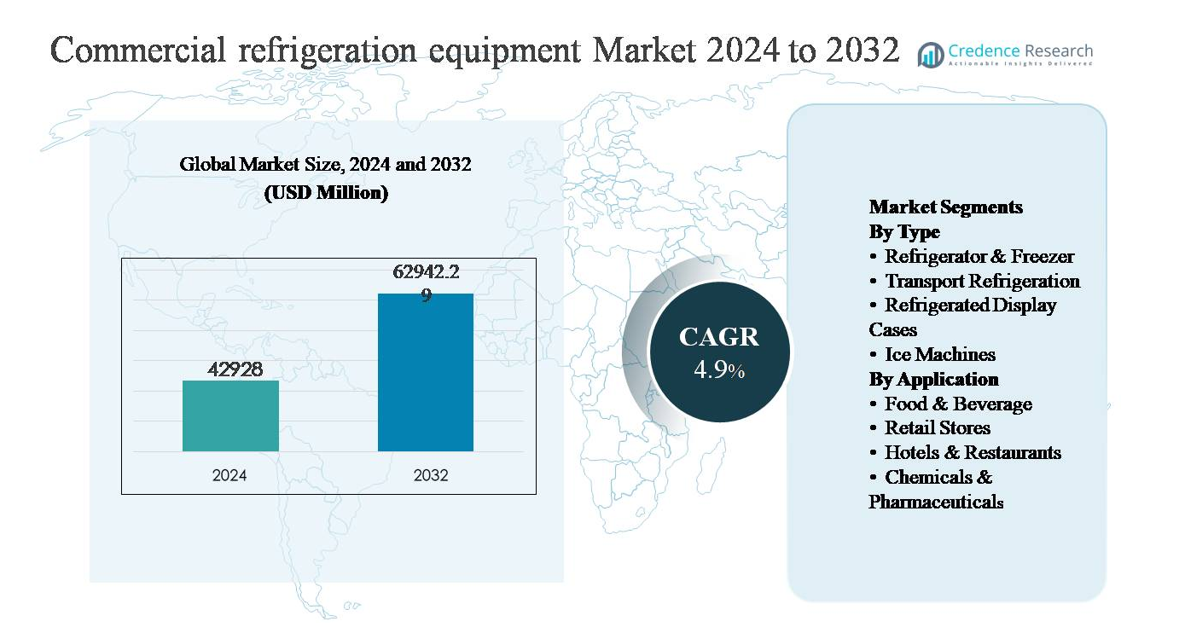
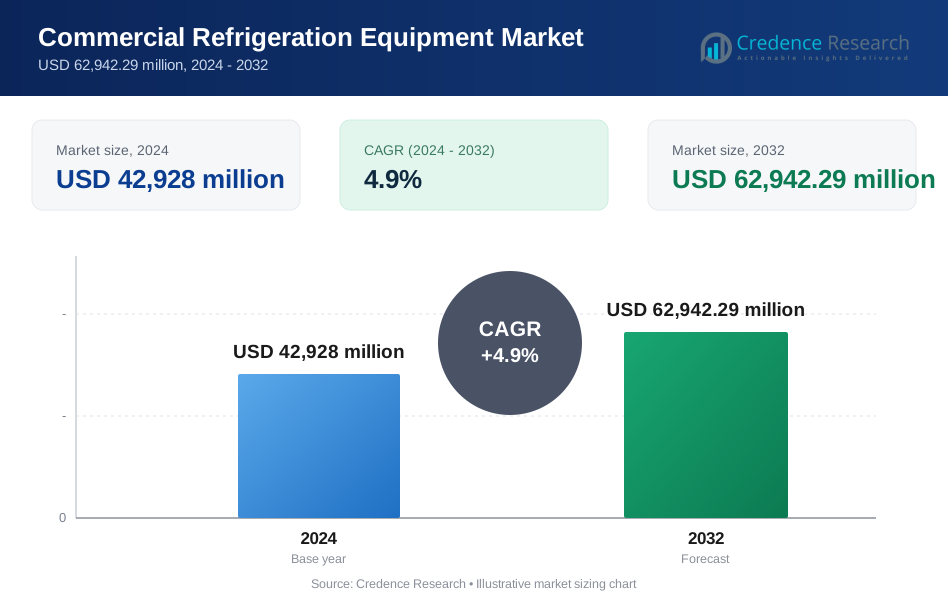
The commercial refrigeration equipment market was valued at USD 42,928 million in 2024 and is projected to reach USD 62,942.29 million by 2032, expanding at a compound annual growth rate (CAGR) of 4.9% during the forecast period.
| REPORT ATTRIBUTE | DETAILS |
|---|---|
| Historical Period | 2020-2023 |
| Base Year | 2024 |
| Forecast Period | 2025-2032 |
| Commercial Refrigeration Equipment Market Size 2024 | USD 42,928 million |
| Commercial Refrigeration Equipment Market, CAGR | 4.9% |
| Commercial Refrigeration Equipment Market Size 2032 | USD 62,942.29 million |
The commercial refrigeration equipment market is led by a mix of global conglomerates and specialized manufacturers, including Daikin Industries, Danfoss, GEA Group Aktiengesellschaft, Carrier Global Corporation, Johnson Controls, AB Electrolux, The Middleby Corporation, Welbilt, Nor-Lake, and Imbera. These players compete through energy-efficient system designs, low-GWP refrigerant adoption, digital monitoring capabilities, and application-specific solutions for food retail, foodservice, cold storage, and pharmaceuticals. Strategic portfolio optimization, technology upgrades, and service-led differentiation remain central to competition. North America is the leading regional market, accounting for approximately 32% of global market share, supported by a mature retail sector, advanced cold-chain infrastructure, and strict regulatory standards. Europe and Asia Pacific follow closely, driven by sustainability mandates and rapid retail and cold-chain expansion, respectively.
Market Insights
- The commercial refrigeration equipment market was valued at USD 42,928 million in 2024 and is projected to reach USD 62,942.29 million by 2032, expanding at a CAGR of 4.9% over the forecast period, driven by sustained demand across food retail, foodservice, cold storage, and pharmaceutical applications.
- Market growth is primarily driven by expansion of organized food retail, cold-chain logistics, and stricter food safety regulations, with refrigerators & freezers dominating by type at over 40% share due to widespread use in storage and back-of-house operations.
- Key trends include rising adoption of energy-efficient systems, low-GWP refrigerants, and smart refrigeration technologies, while competition centers on technology upgrades, portfolio optimization, and service differentiation among global and regional players.
- High initial equipment costs, maintenance expenses, and regulatory complexity related to refrigerant transitions act as key market restraints, particularly impacting small and medium-sized end users.
- Regionally, North America leads with ~32% market share, followed by Asia Pacific at ~29% driven by retail expansion, and Europe at ~27% supported by sustainability regulations, while Latin America and Middle East & Africa together account for the remaining share.
Market Segmentation Analysis:
By Type:
By type, the commercial refrigeration equipment market is led by Refrigerators & Freezers, which represent the dominant sub-segment with an estimated over 40% market share. Their leadership is driven by ubiquitous deployment across supermarkets, convenience stores, foodservice outlets, and institutional kitchens, where reliable chilled and frozen storage is essential. Demand is further supported by the replacement cycle for aging units, stricter food safety standards, and rapid adoption of energy-efficient compressors and natural refrigerants. Transport refrigeration follows as a fast-growing segment, supported by cold-chain expansion and growth in temperature-sensitive logistics.
- For instance, Emerson’s Copeland™ CO₂ transcritical compressors are engineered to operate at discharge pressures up to 130 bar and support medium-temperature applications down to -10 °C and low-temperature applications to -35 °C, enabling wide adoption in modern supermarket racks.
By Application:
By application, the Food & Beverage sector is the dominant sub-segment, accounting for more than 45% of total demand, driven by high refrigeration intensity across food processing, storage, and distribution environments. Continuous operation requirements, stringent hygiene regulations, and increasing consumption of frozen and ready-to-eat products underpin sustained equipment demand. Retail stores and hotels & restaurants contribute significantly through investments in modern display and back-of-house systems, while chemicals & pharmaceuticals represent a specialized, high-value segment driven by precise temperature control needs for drug storage and chemical stability.
- For instance, Carrier Commercial Refrigeration offers specialized industrial refrigeration solutions and modular cold rooms for food processing facilities. These systems are highly customizable and designed to maintain a range of stable product temperatures, including the low-temperature (LT) range down to −40 °C for freezing applications.
Key Growth Driver
Expansion of Food Retail and Cold-Chain Infrastructure
The rapid expansion of organized food retail and cold-chain infrastructure is a primary driver of the commercial refrigeration equipment market. Growth in supermarkets, hypermarkets, convenience stores, and online grocery fulfillment centers is increasing demand for reliable refrigeration across storage, display, and logistics stages. Rising consumption of frozen foods, dairy products, meat, and fresh produce requires continuous temperature control to maintain quality and comply with food safety regulations. Additionally, investments in cold storage warehouses and temperature-controlled transportation networks are accelerating in emerging economies to reduce post-harvest losses. As food supply chains become more complex and geographically extended, operators increasingly prioritize advanced refrigeration systems that offer durability, precise temperature management, and high uptime, reinforcing sustained equipment demand.
- For instance, Lineage Logistics has deployed large-scale automated cold storage facilities equipped with ammonia and CO₂-based refrigeration systems capable of maintaining storage temperatures as low as −30 °C across warehouse capacities exceeding 100,000 pallet positions per site.
Stringent Food Safety and Regulatory Compliance Requirements
Stricter food safety standards and regulatory oversight are significantly driving adoption of modern commercial refrigeration equipment. Governments and regulatory bodies worldwide enforce rigorous requirements for temperature monitoring, hygiene, and traceability across foodservice, retail, and pharmaceutical storage environments. Compliance with these regulations compels businesses to upgrade legacy systems with modern refrigeration units featuring digital controls, automated alarms, and real-time monitoring capabilities. In sectors such as meat processing, dairy handling, and vaccine storage, even minor temperature deviations can result in product spoilage or regulatory penalties. As a result, end users increasingly invest in high-performance refrigeration systems designed to deliver consistent cooling, regulatory compliance, and operational reliability, strengthening long-term market growth.
- For instance, Danfoss’ ADAP-KOOL® system managers deployed in food retail environments support temperature logging intervals as low as 10 seconds and alarm response times under 5 seconds, enabling rapid corrective action during deviations.
Rising Demand from Pharmaceutical and Healthcare Applications
Growing demand from pharmaceutical and healthcare sectors is emerging as a strong growth driver for commercial refrigeration equipment. Temperature-sensitive drugs, vaccines, biologics, and chemical reagents require tightly controlled storage conditions throughout manufacturing, distribution, and point-of-use stages. Expansion of pharmaceutical production capacity, increased vaccination programs, and growth in specialty drugs are driving investments in medical-grade refrigeration systems. These applications demand high precision, redundancy, and compliance with strict storage standards, favoring technologically advanced refrigeration solutions. As healthcare supply chains expand and diversify globally, especially in emerging markets, demand for reliable refrigeration infrastructure continues to rise, supporting sustained market expansion beyond traditional food-focused applications.
Key Trend & Opportunity
Shift Toward Energy-Efficient and Low-GWP Refrigeration Systems
A major trend shaping the commercial refrigeration equipment market is the transition toward energy-efficient systems using low global warming potential (GWP) refrigerants. Rising electricity costs and stricter environmental regulations are pushing end users to adopt equipment that minimizes energy consumption and refrigerant emissions. Manufacturers are increasingly integrating high-efficiency compressors, advanced insulation materials, and natural refrigerants such as CO₂ and hydrocarbons. This shift creates opportunities for equipment upgrades and retrofits, particularly in developed markets with aging infrastructure. Energy-efficient refrigeration not only reduces operating costs but also supports corporate sustainability goals, making it a key differentiator and long-term opportunity for technology-focused suppliers.
- For instance, Thermo Fisher Scientific’s TSX Universal Series ultra-low freezers, widely used in regulated pharmaceutical storage, maintain setpoints down to −80 °C with temperature uniformity of ±3 °C, while embedded controllers record continuous temperature histories compliant with regulatory audit requirements.
Digitalization and Smart Refrigeration Solutions
Digitalization is creating new opportunities within the commercial refrigeration equipment market through the adoption of smart and connected systems. Modern refrigeration units increasingly incorporate sensors, cloud-based monitoring, and data analytics to enable real-time temperature tracking, predictive maintenance, and remote diagnostics. These capabilities reduce downtime, prevent spoilage, and improve operational efficiency for retailers and foodservice operators. Smart refrigeration also supports compliance reporting and energy optimization, adding value beyond basic cooling functionality. As businesses adopt digital asset management strategies, demand is growing for refrigeration systems that integrate seamlessly with broader facility management and supply chain platforms, opening avenues for value-added services and long-term customer engagement.
- For instance, GEA Group Aktiengesellschaft deploys its GEA Omni™ control platform in industrial and commercial refrigeration systems, enabling continuous monitoring of compressor performance, suction pressure, and discharge temperatures across installations exceeding 20,000 I/O data points per plant.
Key Challenge
High Initial Capital and Maintenance Costs
High upfront capital investment and ongoing maintenance costs remain a significant challenge for the commercial refrigeration equipment market. Advanced refrigeration systems with energy-efficient components, digital controls, and low-GWP refrigerants often involve higher purchase and installation costs compared to conventional units. For small and medium-sized businesses, especially in cost-sensitive markets, these expenses can delay equipment upgrades or replacements. Additionally, specialized maintenance requirements and the need for trained technicians increase total cost of ownership. These financial barriers can slow adoption rates, particularly in developing regions, despite long-term operational savings and regulatory benefits offered by modern refrigeration technologies.
Regulatory Complexity and Refrigerant Transition Risks
Navigating evolving environmental regulations and refrigerant transition requirements poses a major challenge for market participants. Regulations targeting the phase-down of high-GWP refrigerants vary by region, creating compliance complexity for manufacturers and end users operating across multiple markets. Transitioning to alternative refrigerants may require system redesigns, safety considerations, and technician retraining. Improper handling or lack of infrastructure for new refrigerants can increase operational risk and implementation costs. These regulatory and technical uncertainties can delay purchasing decisions and complicate long-term planning, particularly for businesses managing large, geographically distributed refrigeration assets.
Regional Analysis
North America:
North America holds a leading position in the commercial refrigeration equipment market, accounting for approximately 32% of global market share. The region benefits from a highly developed food retail ecosystem, extensive cold-chain infrastructure, and strict food safety and energy-efficiency regulations. Strong demand from supermarkets, quick-service restaurants, and pharmaceutical storage facilities drives continuous equipment replacement and upgrades. Adoption of low-GWP refrigerants, smart refrigeration systems, and energy-efficient compressors is particularly high. The presence of major manufacturers, along with consistent investments in cold storage warehouses and last-mile refrigerated logistics, further reinforces North America’s dominant market position.
Europe:
Europe represents around 27% of the global commercial refrigeration equipment market, supported by stringent environmental regulations and aggressive refrigerant transition policies. The region is at the forefront of adopting natural refrigerants such as CO₂ and hydrocarbons, driving modernization of retail and foodservice refrigeration systems. High penetration of organized retail, strong hospitality activity, and well-established pharmaceutical manufacturing contribute to stable demand. Replacement of legacy systems to comply with energy efficiency directives remains a key growth factor. Western Europe leads regional consumption, while Central and Eastern Europe show steady growth driven by expanding retail and cold-chain infrastructure.
Asia Pacific:
Asia Pacific accounts for approximately 29% of the global market share, making it the fastest-growing regional market. Rapid urbanization, rising disposable incomes, and expansion of organized food retail are significantly boosting demand for commercial refrigeration equipment. Growth in food processing, cold storage facilities, and temperature-controlled logistics is particularly strong in China, India, and Southeast Asia. Increasing pharmaceutical manufacturing and vaccine distribution further support demand. While cost sensitivity remains a factor, governments and large retailers are increasingly investing in energy-efficient and compliant refrigeration systems, positioning Asia Pacific as a key long-term growth engine.
Latin America:
Latin America holds about 7% of the global commercial refrigeration equipment market, driven by gradual expansion of modern retail formats and foodservice chains. Countries such as Brazil and Mexico lead regional demand due to their large consumer bases and growing cold-chain investments. The food and beverage sector remains the primary application, particularly for refrigerated display cases and storage units. However, economic volatility and budget constraints can delay large-scale upgrades. Despite these challenges, increasing focus on reducing food waste and improving supply chain efficiency continues to support steady adoption of commercial refrigeration solutions.
Middle East & Africa:
The Middle East & Africa region accounts for roughly 5% of global market share, supported by growth in hospitality, food retail, and pharmaceutical distribution. Hot climatic conditions create strong dependence on reliable refrigeration systems across retail and foodservice environments. Gulf countries lead adoption due to large investments in supermarkets, hotels, and cold storage infrastructure, while Africa shows emerging demand driven by improving food security and healthcare logistics. Although market penetration remains lower compared to other regions, rising urban populations and infrastructure development are expected to support gradual long-term growth.
Market Segmentations:
By Type
- Refrigerator & Freezer
- Transport Refrigeration
- Refrigerated Display Cases
- Ice Machines
By Application
- Food & Beverage
- Retail Stores
- Hotels & Restaurants
- Chemicals & Pharmaceuticals
By Geography
- North America
- U.S.
- Canada
- Mexico
- Europe
- Germany
- France
- U.K.
- Italy
- Spain
- Rest of Europe
- Asia Pacific
- China
- Japan
- India
- South Korea
- South-east Asia
- Rest of Asia Pacific
- Latin America
- Brazil
- Argentina
- Rest of Latin America
- Middle East & Africa
- GCC Countries
- South Africa
- Rest of the Middle East and Africa
Competitive Landscape
The competitive landscape of the commercial refrigeration equipment market is defined by intense rivalry among global and regional players focused on innovation, sustainability, and service differentiation. Key incumbents such as Carrier Global Corporation, Danfoss, GEA Group, Daikin Industries, Johnson Controls, and niche specialists like Nor-Lake and Imbera compete on product performance, energy efficiency, and regulatory compliance. Manufacturers are strategically responding to stringent environmental regulations by advancing low-GWP refrigerants, smart controls, and high-efficiency systems, which have become essential decision criteria for end users. Partnerships, mergers and acquisitions, and portfolio rationalization also shape competition; for example, divestitures and focus shifts among major conglomerates underscore the importance of core competencies in refrigeration technology. Regional diversification and tailored solutions for retail, foodservice, cold chain, and pharmaceutical applications further differentiate players. With rising demand for connected, digitally monitored systems, companies that integrate IoT capabilities and provide robust after-sales support stand to gain market share in an evolving landscape.
Key Player Analysis
- GEA Group Aktiengesellschaft (Germany)
- Imbera (Mexico)
- Johnson Controls (Ireland)
- Welbilt (U.S.)
- Daikin Industries, Ltd. (Japan)
- Nor-Lake, Inc. (U.S.)
- AB Electrolux (Sweden)
- Carrier Global Corporation (U.S.)
- The Middleby Corporation (U.S.)
- Danfoss (Denmark)
Recent Developments
- In October 26, 2025, Johnson Controls announced it would showcase advanced industrial refrigeration and digital solutions for the food & beverage sector at Gulfood Manufacturing 2025 in Dubai, highlighting energy-efficient modular refrigeration technologies and digital integration platforms tailored for operational performance and sustainability in manufacturing environments.
- In October 6, 2025, Johnson Controls announced a strategic investment in Accelsius, a firm specializing in two-phase, direct-to-chip liquid cooling technology for data centers. The collaboration supports scalable cooling platforms ranging from 500 kW to over 10 MW, underscoring technological breadth that overlaps data-center and high-performance refrigeration domains.
- In January 17, 2025, GEA AWP introduced the HSX high-pressure float valve tailored for industrial ammonia (NH₃) and CO₂ refrigeration systems, enabling improved energy efficiency by reducing pressure fluctuations and lowering compressor power consumption in large-scale refrigeration environments.
Report Coverage
The research report offers an in-depth analysis based on Type, Application and Geography. It details leading market players, providing an overview of their business, product offerings, investments, revenue streams, and key applications. Additionally, the report includes insights into the competitive environment, SWOT analysis, current market trends, as well as the primary drivers and constraints. Furthermore, it discusses various factors that have driven market expansion in recent years. The report also explores market dynamics, regulatory scenarios, and technological advancements that are shaping the industry. It assesses the impact of external factors and global economic changes on market growth. Lastly, it provides strategic recommendations for new entrants and established companies to navigate the complexities of the market.
Future Outlook
- Demand for commercial refrigeration equipment will continue to rise with the expansion of organized food retail and cold-chain logistics globally.
- Energy efficiency will remain a top priority, driving accelerated replacement of legacy systems with high-efficiency units.
- Adoption of low-GWP and natural refrigerants will increase as environmental regulations tighten across major regions.
- Smart and connected refrigeration systems will gain wider adoption for real-time monitoring and predictive maintenance.
- Growth in frozen and ready-to-eat food consumption will sustain demand for reliable refrigeration infrastructure.
- Pharmaceutical and healthcare applications will increasingly require precision refrigeration with strict compliance standards.
- Manufacturers will focus on modular and customizable designs to address diverse end-use requirements.
- After-sales services and lifecycle management offerings will become key competitive differentiators.
- Emerging markets will see rising investments in cold storage and temperature-controlled transportation.
- Strategic partnerships and technology-driven innovation will shape long-term competitive positioning.Top of FormBottom of Form
Request a Free Sample
Fill in your details and we'll send you a free sample report.
- Sample data tables & charts
- Research methodology
Need a Custom Version of This Report?
Tailor the scope, geography, or segments to your exact requirements.
- Custom geography or segment scope
- Direct access to our analyst team
Frequently Asked Questions
What is the current market size for Commercial refrigeration equipment, and what is its projected size in 2032?
At what Compound Annual Growth Rate is the Commercial refrigeration equipment market projected to grow between 2024 and 2032?
Who are the major players in the global Commercial Refrigeration Equipment Market?
What are the primary factors fueling the growth of the Commercial refrigeration equipment market?
Who are the leading companies in the Commercial refrigeration equipment market?
Table of Content
Chapter 1. Report Introduction
- 1.1 Report Description & Purpose
- 1.1.1 Report Title & Market Definition
- 1.1.2 Unique Selling Propositions (USP) & Key Differentiators
- 1.1.3 Value Proposition for Stakeholders
- 1.2 Research Objectives
- 1.2.1 Market Sizing Objectives (Volume & Revenue)
- 1.2.2 Segmentation Objectives
- 1.2.3 Competitive Intelligence Objectives
- 1.2.4 Forecast & Scenario Objectives
- 1.3 Report Scope
- 1.3.1 Commercial Refrigeration Equipment Scope – Types & Subtypes Covered
- 1.3.2 Geographic Scope – Regions & Countries Covered
- 1.3.3 Historical Period, Base Year & Forecast Period (2024; forecast to 2032)
- 1.3.4 Inclusions & Exclusions
- 1.4 HS Code & Classification Framework
- 1.5 Currency, Units & Pricing Basis
- 1.6 Target Stakeholders
- 1.7 Limitations & Assumptions
Chapter 2. Executive Summary
- 2.1 Global Commercial Refrigeration Equipment Market Snapshot
- 2.1.1 Market Size – Historical (2024) & Forecast (2024-2032) (2024: USD 42,928 million → 2032: USD 62,942.29 million)
- 2.1.2 Volume & Revenue – Global Totals
- 2.1.3 Key Market Highlights – Top Five Facts
- 2.2 Commercial Refrigeration Equipment Market Segmentation Snapshot
- 2.2.1 Market Split by Region – 2024 vs. 2032
- 2.3 Competitive Snapshot
- 2.3.1 Top 10 Players by Revenue Share – 2024
- 2.3.2 Top 10 Players by Volume Share – 2024
- 2.3.3 Recent Strategic Developments (18-Month Summary)
- 2.4 Key Investment Highlights & Strategic Conclusions
Chapter 3. Commercial Refrigeration Equipment Market Dynamics & Industry Analysis
- 3.1 Market Overview & Context
- 3.1.1 Commercial Refrigeration Equipment Market Position in the Broader Automotive Value Chain
- 3.1.2 OEM vs. Replacement Market Dynamics
- 3.1.3 Market Maturity & Development Stage by Region
- 3.2 Commercial Refrigeration Equipment Market Drivers
- 3.3 Commercial Refrigeration Equipment Market Restraints & Challenges
- 3.4 Commercial Refrigeration Equipment Market Opportunities
- 3.5 Porter's Five Forces Analysis
- 3.5.1 Threat of New Entrants
- 3.5.2 Bargaining Power of Suppliers
- 3.5.3 Bargaining Power of Buyers
- 3.5.4 Threat of Substitutes
- 3.5.5 Competitive Rivalry – Intensity Assessment
- 3.6 Commercial Refrigeration Equipment Value Chain Analysis
- 3.6.1 Upstream – Raw Material/Input Suppliers
- 3.6.1.1 Raw Material/Input 1
- 3.6.1.2 Raw Material/Input 2
- 3.6.1.3 Raw Material/Input 3
- 3.6.2 Midstream – Production/Manufacturing/Service Delivery
- 3.6.2.1 Production/Process Overview
- 3.6.2.2 Key Facility Locations & Capacity by Manufacturer
- 3.6.3 Downstream – Distribution & End Consumer
- 3.6.3.1 Primary Channel – B2B/OEM
- 3.6.3.2 Secondary Channels – Dealer, Retail, Online, Direct
- 3.6.4 Value Chain Profitability Analysis
- 3.6.1 Upstream – Raw Material/Input Suppliers
- 3.7 PESTEL Analysis
- 3.7.1 Political Factors
- 3.7.2 Economic Factors
- 3.7.3 Social Factors
- 3.7.4 Technological Factors
- 3.7.5 Environmental Factors
- 3.7.6 Legal Factors
- 3.8 Commercial Refrigeration Equipment Supply Chain Analysis
- 3.8.1 Raw Material/Input Supply Risk Assessment
- 3.8.2 Manufacturing Concentration Risk (Geographic Exposure)
- 3.8.3 Trade Disruption Impact Analysis
- 3.9 Regulatory & Policy Landscape
Note: The regulatory and policy landscape section covers regulations based on their applicability to the market, Commercial Refrigeration Equipment category, geography, and scope of the study. Only regulatory frameworks with a material impact on operations, compliance, trade, sustainability, or market access are analyzed in detail.
Chapter 4. Key Investment Pockets & Opportunity Analysis
- 4.1 Commercial Refrigeration Equipment Market Attractiveness Analysis
- 4.1.1 By Region – Investment Attractiveness Matrix (Volume × CAGR)
- 4.2 Absolute Revenue Growth Opportunity
- 4.2.1 By Region – Absolute USD Growth Through 2032
- 4.3 Incremental Volume Opportunity
- 4.3.1 By Region – Incremental Volume Through 2032
- 4.3.2 Segment – Incremental Volume
- 4.4 Emerging Submarket Opportunity Deep Dive (Subject to Applicability)
- 4.5 Emerging Market Opportunity Scorecards
- 4.5.1 United States
- 4.5.2 Europe
- 4.5.3 Asia
- 4.5.4 Middle East & Africa
Note: Emerging Market Opportunity Scorecards will be included based on relevance and strategic importance. Regions listed are indicative and may vary depending on data availability and market dynamics.
Chapter 5. Commercial Refrigeration Equipment Import-Export Analysis & Trade Flows
- 5.1 Global Trade Overview
- 5.1.1 Global Export Value by Country (2024)
- 5.1.2 Global Export Volume by Country (2024)
- 5.1.3 Global Import Value by Country (2024)
- 5.1.4 Global Import Volume by Country (2024)
- 5.1.5 Net Trade Balance by Country (2024)
- 5.2 Export Analysis – Segment
- 5.2.1 Type 1 (HS Code)
- 5.2.2 Type 2 (HS Code)
- 5.2.3 Type 3 (HS Code)
- 5.2.4 Type 4 (HS Code)
- 5.2.5 Type 5 (HS Code)
- 5.3 Import Analysis – Segment
- 5.3.1 Type 1 (HS Code)
- 5.3.2 Type 2 (HS Code)
- 5.3.3 Type 3 (HS Code)
- 5.3.4 Type 4 (HS Code)
- 5.3.5 Type 5 (HS Code)
- 5.4 Average Unit Trade Prices
- 5.4.1 Average Export Price – Segment & Country
- 5.4.2 Average Import Price – Segment & Source Country
- 5.4.3 Price Trends (2024)
- 5.5 Key Trade Route Analysis
- 5.5.1 Trade Route 1
- 5.5.2 Trade Route 2
- 5.5.3 Trade Route 3
- 5.5.4 Trade Route 4
- 5.5.5 Trade Route 5
- 5.6 Trade Policy Impact Assessment
- 5.6.1 US Anti-Dumping & Section 301 Tariffs
- 5.6.2 EU Customs Union Impact
- 5.6.3 Major Free Trade Agreements
- 5.6.4 USMCA Rules of Origin
Note: Trade policy analysis will be included only where relevant to the Commercial Refrigeration Equipment market.
Chapter 6. Competitive Landscape & Company Benchmarking
- 6.1 Commercial Refrigeration Equipment Market Concentration & Structure
- 6.1.1 Herfindahl-Hirschman Index (HHI) – vs. 2024
- 6.1.2 Tier 1, Tier 2 & Tier 3 Market Structure
- 6.1.3 Global, Regional & Local Player Dynamics
- 6.2 Commercial Refrigeration Equipment Market Share Analysis – 2024
- 6.2.1 Global Revenue Share by Company
- 6.2.2 Global Volume Share by Company
- 6.2.3 Regional Revenue Share
- 6.2.4 Market Share Evolution ( vs. 2024)
- 6.2.5 OEM Segment Share by Company
- 6.2.6 Replacement Segment Share by Company
- 6.3 Production/Delivery Capacity & Facility Analysis
- 6.3.1 Global Installed Capacity
- 6.3.2 Capacity Utilization Rates
- 6.3.3 Production/Output Volume
- 6.3.4 Facility Locations & Capacity Map
- 6.3.5 Planned Capacity Additions
- 6.4 Commercial Refrigeration Equipment Competitive Benchmarking Matrix
- 6.4.1 Revenue, Volume, CAGR & Profitability Comparison
- 6.4.2 Channel Revenue Mix
- 6.4.3 Geographic Revenue Exposure
- 6.4.4 R&D Intensity
- 6.4.5 Sustainability Maturity
- 6.5 Strategic Developments in Commercial Refrigeration Equipment (Last 24 Months)
- 6.5.1 Mergers, Acquisitions & Divestments
- 6.5.2 New Commercial Refrigeration Equipment Launches
- 6.5.3 Facility Expansions
- 6.5.4 Strategic Alliances, Joint Ventures & Partnerships
- 6.5.5 Distribution Expansion & Market Entry
- 6.5.6 Sustainability & ESG Initiatives
- 6.6 Competitive Strategy Mapping
- 6.6.1 Leader, Challenger, Follower & Niche Classification
- 6.6.2 Pricing Strategy Comparison
- 6.6.3 Channel Strategy Matrix
Note: Strategic developments are included based on their materiality and the availability of reliable information.
Chapter 7. Global Commercial Refrigeration Equipment Market – By Distribution Channel
- 7.1 Segment Overview
- 7.1.1 Volume & Revenue Split by Channel (2024 & 2032)
- 7.1.2 Channel Mix Evolution (2024-2032)
Chapter 8. Regional Market Analysis – Global Overview
- 8.1 Global Regional Overview
- 8.1.1 Regional Volume Share
- 8.1.2 Regional Revenue Share
- 8.1.3 Regional Volume by Region
- 8.1.4 Regional Revenue by Region
- 8.1.5 Regional Forecast Through 2032
- 8.2 Cross-Regional Segment Analysis
- 8.2.1 By Distribution Channel
- 8.2.2 By Brand/Price Tier
Chapter 9. North America Commercial Refrigeration Equipment Market
- 9.1 United States
- 9.2 Canada
- 9.3 Mexico
Chapter 10. Europe Commercial Refrigeration Equipment Market
- 10.1 Germany
- 10.2 France
- 10.3 Italy
- 10.4 United Kingdom
- 10.5 Spain
- 10.6 Poland
- 10.7 Russia
- 10.8 Netherlands
- 10.9 Belgium
- 10.10 Sweden
- 10.11 Denmark
- 10.12 Norway
- 10.13 Rest of Europe
Chapter 11. Asia Pacific Commercial Refrigeration Equipment Market
- 11.1 China
- 11.2 India
- 11.3 Japan
- 11.4 South Korea
- 11.5 Thailand
- 11.6 Indonesia
- 11.7 Vietnam
- 11.8 Malaysia
- 11.9 Australia
- 11.10 Rest of Asia Pacific
Chapter 12. Latin America Commercial Refrigeration Equipment Market
- 12.1 Brazil
- 12.2 Argentina
- 12.3 Colombia
- 12.4 Chile
- 12.5 Rest of Latin America
Chapter 13. Middle East Commercial Refrigeration Equipment Market
- 13.1 Saudi Arabia
- 13.2 United Arab Emirates
- 13.3 Turkey
- 13.4 Israel
- 13.5 Iran
- 13.6 Rest of the Middle East
Chapter 14. Africa Commercial Refrigeration Equipment Market
- 14.1 South Africa
- 14.2 Egypt
- 14.3 Nigeria
- 14.4 Morocco
- 14.5 Rest of Africa
Chapter 15. Commercial Refrigeration Equipment Company Profiles
- 15.1 [Company 01]
- 15.1.1 Company Overview
- 15.1.2 Key Management Personnel
- 15.1.3 Products & Services Portfolio
- 15.1.4 Financial Performance
- 15.1.5 Key Market Focus & Geographic Presence
- 15.1.6 Recent Developments & Strategic Initiatives
Note: The company profile list is preliminary and may change based on research findings, market developments, data availability, and client requirements.
Chapter 16. Appendices
- Appendix A – List of Abbreviations & Acronyms
- Appendix B – Industry Classification Code Reference – Full Series
- Appendix C – Production & Capacity Data Tables
- Appendix D – End-Use & Demand Base Tables
- Appendix E – Consumption & Replacement Rate Assumptions
- Appendix F – ASP Reference Tables
- Appendix G – Manufacturing & Facility Database
- Appendix H – Import-Export Data Tables
- Appendix I – Regulatory Summary Tables
- Appendix J – Primary Research Participant List (Anonymized)
- Appendix K – Primary Research Questionnaire Framework
- Appendix L – Data Sources & Bibliography
- Appendix M – Market Size Divergence & Source Comparison
Chapter 17. Research Methodology
- 17.1 Research Framework & Philosophy
- 17.2 Secondary Research – Sources, Hierarchy & Data Extraction
- 17.3 Data Modeling – Bottom-Up & Top-Down Market Sizing
- 17.4 Primary Research – Stakeholder Framework, LOI & Sample Sizes
- 17.5 Forecast Methodology – Regression, Scenario & Sensitivity Analysis
- 17.6 Quality Control – Four-Layer Validation Framework
- 17.7 Limitations & Standard Assumptions
- 17.8 Disclaimer
