
| REPORT ATTRIBUTE | DETAILS |
|---|---|
| Historical Period | 2019-2022 |
| Base Year | 2023 |
| Forecast Period | 2024-2032 |
| Distribution Automation Market Size 2023 | USD 16581.20 million |
| Distribution Automation Market, CAGR | 8.00% |
| Distribution Automation Market Size 2032 | USD 33145.90 million |
Market Insights
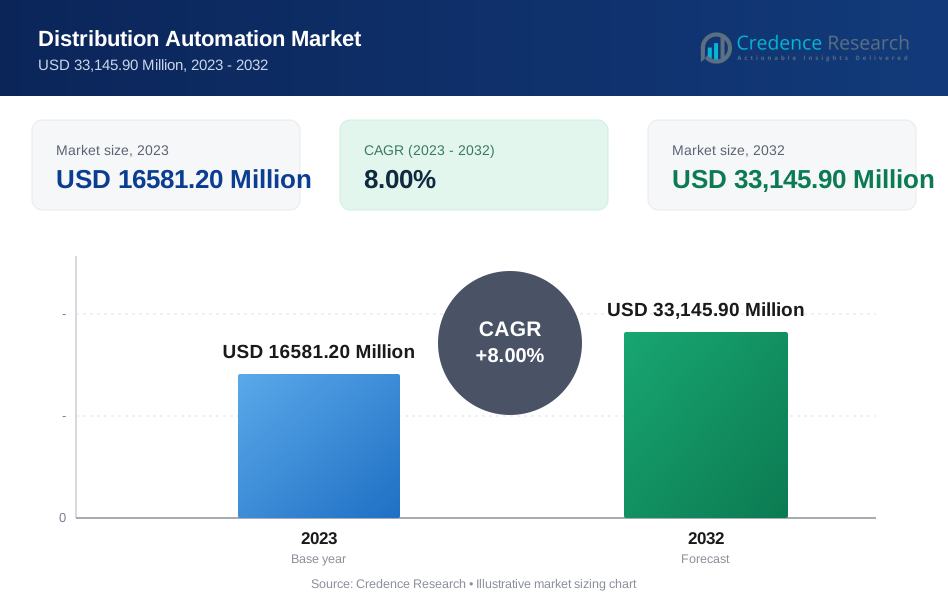
- The global demand for Distribution Automation was valued at USD 16581.20 Million in 2023 and is expected to reach USD 33145.90 Million in 2032, growing at a CAGR of 8.00% between 2024 and 2032.
- The Communication Systems is the market leader by component type, accounting for a significant portion of total value in 2023, while the Field Devices segment is expected to grow rapidly throughout the forecast period.
- The Smart Grid Technologies segment dominates the global need by technology, accounting for a significant portion in 2023. The Distributed Energy Resources (DER) Integration segment is predicted to expand at a high CAGR.
- Over the projection period, Asset Management and Predictive Maintenance are expected to expand at the highest rate, while Load Management and Demand Response dominate the market in 2023 with a substantial share.
- The utilities (Electricity, Water, Gas) segment boasts the dominating portion with a substantial market share in 2023, while the Transportation (Electric Vehicles, Charging Infrastructure) segment is expected to grow at the highest rate.
- Asia Pacific is dominating the Distribution Automation industry with a substantial share in 2023, while North America is expected to grow at the highest rate during the forecast period.
- The market's primary possibilities include the evolution of smart technology, including Artificial Intelligence (AI), the Internet of Things (IoT), and Autonomous Mobile Robots (AMRs).
Executive Summary
Market Definition
Distribution Automation (DA) refers to the integration of digital technology and automated control systems into the electrical power distribution network, aimed at enhancing its efficiency, reliability, and resilience. This involves advanced metering infrastructure (AMI) that enables two-way communication between utilities and consumers, facilitating detailed monitoring of electricity usage and demand response initiatives. DA encompasses a range of functions, including real-time monitoring, fault detection and isolation, remote control of network devices, voltage regulation, and the integration of distributed energy resources. By enabling dynamic management of the grid, DA enhances service quality, reduces outage durations, and supports the sustainable incorporation of renewable energy sources. DA supports the integration of distributed energy resources (DERs), such as solar panels and wind turbines, into the grid, ensuring stable and efficient energy management.
Market Overview
The global Distribution Automation Market has witnessed steady growth in recent years and is expected to grow at a CAGR of 8.00% between 2024 and 2032. The market was valued at USD 16581.20 million in 2023 and is expected to reach USD 33145.90 million in 2032.
The expansion of smart grid infrastructure poses a significant factor propelling the growth of the distribution automation market. Smart grids address challenges such as aging infrastructure, increasing energy demands, and the overuse of non-renewable resources like fossil fuels. This comprehensive approach involves real-time monitoring systems, decision-making algorithms, control systems, forecasting, and optimized algorithms. By automating smart grids, operational efficiency is improved, leading to cost savings and increased customer satisfaction. Moreover, Government mandates to augment grid efficiency are also propelling the adoption of distribution automation technology across various utility and energy sectors. Regulatory frameworks that encourage the modernization of grid infrastructure and the integration of advanced technologies are significant drivers for the market.
Furthermore, the rising share of renewable energy resources in the power mix drives the adoption of distribution automation systems. These systems facilitate the efficient integration and management of renewable energy sources, enhancing the overall sustainability and reliability of the power distribution network. Additionally, technological advancements and innovations are providing valuable opportunities for companies in the global distribution automation market. The growing adoption of sophisticated computerized power supply innovations supports this trend. For instance, in December 2021, ABB India collaborated with Indore Smart City Development Limited to deliver state-of-the-art computerized innovations that enable an uninterrupted power supply to homes and institutions.
In addition, significant investments and upgrades in existing power infrastructure also contribute to market growth. In June 2021, Snohomish County PUD made electric system improvements in their substations, including automation upgrades, equipment replacement, and standard maintenance. The PUD also planned to replace aging poles and underground cables, enhancing the overall efficiency and reliability of the distribution network.
Segmentation by Component Type
- Communication system is the leading segment by component type and hold a substantial share in 2023, as they are essential for facilitating data exchange, control, and monitoring within distribution automation networks
- The field devices are estimated to have the highest growth during the forecasted period due to the increasing demand for smart grid technologies that require real-time data collection and monitoring. These devices play a crucial role in gathering data on various aspects of the grid, including voltage levels, power flows, and equipment health. This data is then used to optimize grid performance, improve reliability, and reduce energy losses.
Segmentation by Technology
- The Smart Grid Technologies boasts the dominating position in the Distribution Automation industry, holding a massive share in 2023. This is attributed to their ability to improve the efficiency, reliability, and self-healing capabilities of the power grid.
- The Distributed Energy Resources (DER) Integration is expected to grow with the highest CAGR during the projected period due to the increasing adoption of renewable energy sources like solar and wind power, which require integration with the grid.
- The Grid Edge Devices technology is anticipated to have moderate growth.
Segmentation by Application
- The Load Management and Demand Response currently boasts the highest share in terms of value in 2023. This is driven by the growing need to manage peak demand periods and integrate renewable energy sources with fluctuating power generation.
- The Asset Management and Predictive Maintenance are expected to witness the highest growth rate during the forecasted period. This is due to the increasing focus on proactive maintenance strategies to extend the lifespan of grid assets and optimize resource allocation.
- Fault Detection and Isolation holds a significant share due to its ability to quickly identify and isolate faults on the grid, minimizing downtime and improving overall reliability.
- Voltage Regulation and Optimization is anticipated to have a moderate growth rate. It plays a crucial role in maintaining consistent voltage levels, ensuring efficient power delivery, and reducing equipment stress.
Segmentation by End-Use Industry
- The Utilities (Electricity, Water, Gas) hold the highest share due to their direct responsibility for managing and optimizing the power grid infrastructure.
- The Industrial sector holds a significant share as it is a significant adopter of distribution automation technologies to improve energy efficiency and production processes.
- Commercial and Residential sectors are witnessing steady growth as automation solutions offer benefits like remote monitoring and control.
- Transportation (Electric Vehicles, Charging Infrastructure) is projected to be the fastest-growing segment due to the rapid expansion of electric vehicles and the need for a robust charging infrastructure.
- Other end-use industries, such as Healthcare, Government and Defense, Agriculture, Education, and Institutions, are expected to experience moderate growth as they increasingly recognize the benefits of distribution automation for efficient power management.
Segmentation by Region
- Asia Pacific is fueling the growth of the distribution automation industry with a massive share in 2023 due to rapid urbanization, increasing investments in smart grid technologies, and the growing need for reliable and efficient power distribution systems in the region.
- The North American market is expected to grow at the highest rate during the forecasted period.
- The rest of the world, including Latin America, the Middle East, and Africa, supplies the remaining demand for the Distribution Automation industry.
Asia Pacific is the dominant region in the distribution automation market, with countries such as China, Japan, India, South Korea, Southeast Asia, and others in the region. This dominance is primarily due to the high demand for electricity, driven by the region's large population. According to the International Energy Agency (IEA), over 70% of the global electricity demand growth in the next three years will originate from China, India, and Southeast Asia. By 2025, Asia is projected to contribute half of the world's electricity consumption for the first time. Countries like China, Japan, and South Korea are actively investing in grid expansion projects to bolster the reliability and resilience of distribution grids, thereby fostering demand for distribution automation solutions and related services.
Moreover, India's strategic focus on modernizing its energy sector is exemplified by its adoption and development of Smart Grid technologies. Spearheaded by the Ministry of Power, the Indian Smart Grid Forum (ISGF) serves as a pivotal entity in this transformation. Functioning not only as an administrative body but also as a think tank, the ISGF brings together expertise from government bodies, the private sector, and academia to establish comprehensive standards and robust policies conducive to the widespread deployment of Smart Grids across the region.
On the other hand, the North American market is poised for significant expansion during the forecast period, propelled by advancements in IoT and communication systems. Notably, the region benefits from the presence of several key players, augmenting market growth prospects. For example, Schweitzer Engineering Laboratories (SEL) recently introduced the SEL-421 Protection, Automation, and Control System featuring enhanced Time-Domain Link (TiDL) technology. TiDL technology revolutionizes protection-centered digital secondary systems by replacing copper connections with fiber, enhancing safety while reducing costs. With data-sharing capabilities, purpose-built merging units, and modern configuration software, TiDL represents a paradigm shift in automation solutions.
Furthermore, the North American market is expected to witness substantial revenue growth due to the continuous advancement of communication and IoT technologies. The region's rapid growth is further fueled by the presence of numerous major industries, fostering a conducive environment for market expansion and innovation. For instance, in June 2021, GE announced an expansion of its Proficy suite of software solutions, introducing Proficy Operations Analytics to bolster digital transformation initiatives. Proficy Operations Analytics, a self-provisioning predictive operations center, is SaaS-based and tailored for AI and industrial IoT applications, providing effortless deployment and pre-configured capabilities.
Key Highlights of the Report
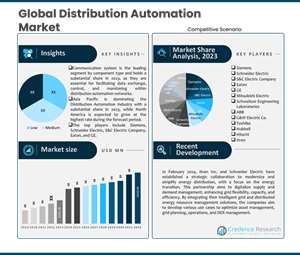
The global Distribution Automation market is segmented by component type, technology, application, end-use industry, and region. Due to the rising demand for real-time data collection in smart grids, field devices are poised for the highest growth, playing a critical role in optimizing grid performance, reliability, and energy loss reduction. In addition, Load Management and Demand Response is the most demanding application, with the Asia Pacific region leading the market growth.
The expansion of the Distribution Automation market is driven by rising needs for dependable electricity distribution, stemming from modernization and technological dependence. This prompts utility firms to embrace distribution automation for heightened grid reliability and service excellence. Furthermore, the smooth integration of renewable energy sources like solar and wind power benefits from the real-time monitoring and control features of distribution automation systems, driving market growth.
Nonetheless, Asia-Pacific is anticipated to have the greatest share of the worldwide distribution automation market due to rapid economic growth, increasing urbanization, and growing investments in grid modernization. Furthermore, the market is anticipated to expand at the highest rate in the North American region due to aging grid infrastructure, growing focus on energy efficiency, and government initiatives promoting smart grid technologies.
What Are the Main Drivers of the Global Distribution Automation Market?
The growth of the Distribution Automation market is propelled by increasing demands for reliable electricity distribution due to modernization and technological reliance, prompting utility companies to adopt distribution automation for improved grid reliability and service quality. Additionally, the seamless integration of renewable energy sources, including solar and wind power, is facilitated by real-time monitoring and control capabilities of distribution automation systems. Grid modernization initiatives worldwide emphasize infrastructure updates and technological advancements, with distribution automation serving as a crucial component in these efforts, further propelling market expansion.
What Are the Major Challenges Faced by the Global Distribution Automation Market?
The high initial investment required for implementation is a major challenge for the expansion of the distribution automation market. Despite its benefits in improving reliability and efficiency, the substantial upfront costs may deter utility companies with limited budgets. Additionally, integrating automation systems into existing infrastructure and the need for skilled personnel further complicate adoption, hindering market growth.
What Are the Growth Opportunities in the Global Distribution Automation Market?
The evolution of smart technology, including Artificial Intelligence (AI), the Internet of Things (IoT), and Autonomous Mobile Robots (AMRs), presents promising prospects for the Distribution Automation (DA) sector. Integrating AI algorithms with IoT sensor data enables efficient analysis of vast information, empowering utilities to optimize operations. AI enhances safety and reliability by intelligently monitoring distribution automation terminals, while AMRs offer innovative solutions for improving operational efficiency.
Market Drivers
Expansion of Smart Grid Infrastructure
The expansion of smart grid infrastructure is a significant driver of growth in the global distribution automation market. Smart grids, designed to address challenges such as aging infrastructure, increasing energy demands, and the overuse of non-renewable resources like fossil fuels, represent a comprehensive approach to upgrading traditional power grids. This involves real-time monitoring systems, decision-making algorithms, control systems, forecasting, and optimized algorithms. Distribution Automation (DA) plays a crucial role in smart grids by providing real-time operational information about distribution grid components such as voltage regulators, capacitor bank controllers, fault detectors, and switches.
Moreover, significant investments in smart grid infrastructure by major economies are further propelling the market. For example, in November 2023, the U.S. Department of Energy (DOE) announced a major USD 3.46 billion investment in 58 projects aimed at unlocking more than 35 GW of renewable energy across 44 states. These projects include system-hardening upgrades, resilience measures against wildfires and extreme weather, and technological deployments for distributed energy resources (DERs), battery energy storage systems (BESS), and smart grids.
Moreover, initiatives such as the Smart Grid Naroda Pilot Project in India highlight the global commitment to innovative energy solutions. Selected as one of eight pilot projects nationwide, it serves as a model for the future of India’s power distribution system, incorporating functionalities such as Advanced Metering Infrastructure for residential and industrial consumers, effective peak load management, and seamless integration of renewable energy sources. As these trends continue, distribution automation will play a significant role in the evolution of the global energy landscape, ensuring a more reliable, resilient, and efficient power distribution network.
Market Restraints
High Initial Investment and Complexity of Integration
While distribution automation offers numerous benefits, such as improved reliability, efficiency, and integration of renewable energy sources, the upfront costs associated with upgrading infrastructure and deploying advanced automation systems can be substantial. This financial barrier may deter some utility companies, particularly those operating on tight budgets, from investing in distribution automation solutions. Additionally, the complexity of integrating automation systems into existing grid infrastructure and the need for skilled personnel to manage and maintain these systems may pose further challenges. It necessitates meticulous planning, precise execution, and often the recruitment of specialized talent to manage and maintain these sophisticated systems effectively. As a result, the adoption rate may be hindered, delaying the realization of the full potential of distribution automation in revolutionizing power distribution networks.
Opportunities
Advancement in Smart Technology
Advancements in smart technology, particularly in areas such as Artificial Intelligence (AI), Internet of Things (IoT), and Autonomous Mobile Robots (AMRs), are poised to create significant opportunities in the Distribution Automation (DA) sector. Embracing these cutting-edge technologies is paramount for enhancing the efficiency and reliability of DA systems. The integration of AI algorithms with IoT sensor data holds immense potential for enabling smart cities to analyze vast volumes of information efficiently. IoT devices, including sensors, processors, and communication networks, empower utilities to gather, automate, and optimize data, thereby improving operational efficiency.
AI emerges as a pivotal enabler in DA systems, facilitating intelligent verification and monitoring of distribution automation terminals, thereby enhancing safety reliability and reducing operational costs. Moreover, ongoing research endeavors focus on exploring various AI-based methods and algorithms tailored for distribution automation terminals. Additionally, the adoption of Autonomous Mobile Robots (AMRs) in DA systems presents an innovative avenue for enhancing operational efficiency and reliability, heralding a promising future for the Distribution Automation market.
Competitive Landscape
Key Players
The global distribution automation market is highly competitive, with several key players. Some of the major players in the market and their market share are as follows:
- Siemens
- Schneider Electric
- S&C Electric Company
- Eaton
- GE
- Mitsubishi Electric
- Schweitzer Engineering Laboratories
- ABB Ltd.
- G&W Electric Co.
- Toshiba
- Hubbell
- Hitachi
- Itron
- Others
These organizations prioritize product innovation to stay competitive.
The global distribution automation market's key players continually seek to stay ahead by offering new products and developments.
In March 2024, Hitachi, Ltd. announced an investment of over USD 32 million to expand its power transformer plant in Bad Honnef, Germany. Scheduled for completion by 2026, the project will create up to 100 jobs and support Europe's clean energy transition. The facility will expand to over 15,000 square meters, improving efficiency and manufacturing capacity.
In February 2024, Itron, Inc. and Schneider Electric established a strategic collaboration to modernize and simplify energy distribution, with a focus on the energy transition. This partnership aims to digitalize supply and demand management, enhancing grid flexibility, capacity, and efficiency. By integrating their intelligent grid and distributed energy resource management solutions, the companies aim to develop various use cases to optimize asset management, grid planning, operations, and DER management.
In March 2023, S&C Electric Company announced a new 275,000-square-foot manufacturing facility in Palatine, Illinois, expanding its U.S. operations near its existing Chicago campus to enhance support for a robust electrical grid.
In March 2023, TOSHIBA CORPORATION invested in UK-based Open Utility Ltd., a startup specializing in distributed energy resources (DER) trading. This investment aims to improve Toshiba ESS's understanding of DER markets in Europe and the U.S. and develop services for future DER flexibility markets.
In March 2022, ABB opened the ABB Innovation Center (AIC) in Bengaluru, India, focusing on digital solutions and the electrification and motion business segments while providing global engineering and support services for process automation.
How are Companies Performing in the Distribution Automation Market?
The global Distribution Automation Market is highly competitive, with several key players.
Startups in the Distribution Automation Industry
Startups are playing a crucial role in shaping the distribution automation market through cutting-edge technologies and disruptive business models to address emerging challenges and opportunities in the energy sector. By focusing on niche areas and offering specialized solutions, startups are driving advancements in distribution automation and accelerating the pace of innovation. These companies are developing innovative hardware and software solutions tailored to specific needs, contributing to the growth of the industry. For example, GridCure offers advanced analytics platforms that utilize machine learning and predictive algorithms to optimize grid performance and detect anomalies in real time. Another startup, Atom Power, specializes in developing digital circuit breakers that enable faster, safer, and more efficient distribution of electricity.
Moreover, startups are actively involved in deploying IoT sensors and communication networks to enable real-time monitoring and control of distribution grids. By leveraging IoT technology, startups, including Novinium, offer predictive maintenance solutions that help utilities identify and address potential failures before they occur, thereby minimizing downtime and reducing maintenance costs. Furthermore, startups are driving innovation in renewable energy integration and grid modernization efforts. For instance, Packetized Energy develops software platforms that enable the aggregation and optimization of distributed energy resources, such as solar panels and electric vehicles, to support grid stability and flexibility. Through their innovative solutions and agile approach, startups are driving the evolution of distribution automation and shaping the future of energy distribution globally.
Summary of Key Findings
- The demand for Distribution Automation is increasing due to three key factors: the growing need for reliable power delivery, integration of renewable energy sources, and focus on improving energy efficiency. These factors are driving the need for smarter grids that can optimize performance, reduce losses, and adapt to changing demands
- Market segmented by component type, technology, application, end-use industry, and region.
- The communication system segment is the leading component type, holding a significant market share in 2023 as they are crucial for enabling data exchange, control, and monitoring within distribution automation networks.
- Asia Pacific is leading market growth; the market is highly competitive with key players including Siemens, Schneider Electric, S&C Electric Company, Eaton, GE, Mitsubishi Electric, Schweitzer Engineering Laboratories, ABB, G&W Electric Co., Toshiba, Hubbell, Hitachi, Itron, Others.
Future Outlook
- Positive outlook for the global distribution automation market with significant growth potential in the North American region.
- One of the key drivers of market growth is the rising demand for reliable electricity distribution. This need is fueled by modernization efforts and an increasing dependence on technology, leading utility companies to implement distribution automation to enhance grid reliability and service quality.
- During the forecast period, the high initial investment required for the implementation of distribution automation is expected to act as a significant factor restraining the growth of the distribution automation market
- To stay competitive, key firms in the Distribution Automation Market should prioritize the integration of artificial intelligence (AI), the Internet of Things (IoT), and autonomous mobile robots (AMRs).
How CXOs Can Benefit from the Credence Research Distribution Automation Market Report
The Credence Research Distribution Automation Market Report provides CXOs with a comprehensive overview of the market, including:
- Market size and growth forecast:The report provides detailed estimates of the global Distribution Automation Market size, segmented by component type, technology, application, end-user industry, and region. It also includes forecasts for the market through 2032 based on key trends and drivers.
- Market segmentation:The report segments the Distribution Automation Market by type, technology, application, end-user industry, and region. This segmentation provides CXOs with a granular understanding of the market and the opportunities in each segment.
- Competitive Landscape:The report profiles the key players in the Distribution Automation Market and provides insights into their strategies, product offerings, and financial performance. This information can help CXOs to identify and assess their competition.
- Key trends and drivers:The report identifies and analyses the key trends and drivers shaping the Distribution Automation Market. This information can help CXOs make informed decisions about their investments and strategies.
CXOs can use the insights from the Credence Research Distribution Automation Market Report to:
- Identify growth opportunities:The report can help CXOs to identify new growth opportunities in the Distribution Automation market. For example, the report identifies the rising demand for electricity distribution due to modernization and technological dependence.
- Make informed investment decisions:The report can help CXOs make informed investment decisions about the Distribution Automation industry. For example, it provides insights into the key factors to consider when evaluating and selecting Distribution Automation providers.
- Develop competitive strategies:The report can help CXOs develop competitive strategies for their Distribution Automation businesses. For example, the report identifies the key strategies that Distribution Automation providers are using to differentiate themselves from their competitors.
- Track market developments:The report can help CXOs monitor market developments and stay ahead of the curve. For example, it provides insights into the latest trends and innovations in the Distribution Automation Market.
Overall, the Credence Research Distribution Automation Market Report is a valuable resource for CXOs who are looking to gain a deeper understanding of the market and identify opportunities for growth.
Segmentation
-
By Component Type
- Field Devices
- Communication Systems
- Software and Services
-
By Technology
- Smart Grid Technologies
- Grid Edge Devices
- Distributed Energy Resources (DER) Integration
-
By Application
- Fault Detection and Isolation
- Voltage Regulation and Optimization
- Load Management and Demand Response
- Asset Management and Predictive Maintenance
-
By End-Use Industry
- Utilities (Electricity, Water, Gas)
- Industrial
- Commercial and Residential
- Transportation (Electric Vehicles, Charging Infrastructure)
- Healthcare
- Government and Defense
- Agriculture
- Education and Institutions
-
By Region
- North America
- US
- Canada
- Mexico
- Europe
- Germany
- France
- UK.
- Italy
- Spain
- Rest of Europe
- Asia Pacific
- China
- Japan
- India
- South Korea
- South-east Asia
- Rest of Asia Pacific
- Latin America
- Brazil
- Argentina
- Rest of Latin America
- Middle East & Africa
- GCC Countries
- South Africa
- Rest of the Middle East and Africa
- North America
Adjacent Markets
In the Distribution Automation Market, several adjacent markets have high revenue growth opportunities. The key adjacent markets for the Distribution Automation Market -
Adjacent Markets |
||
| Smart Grid Market | Power Distribution Market | Predictive Maintenance Market |
| Energy Management Systems Market | Advanced Metering Infrastructure (AMI) Market | Renewable Energy Integration Market |
| Grid Modernization Market | SCADA (Supervisory Control and Data Acquisition) Market | Energy Storage Systems Market |
Request a Free Sample
Fill in your details and we'll send you a free sample report.
- Sample data tables & charts
- Research methodology
Need a Custom Version of This Report?
Tailor the scope, geography, or segments to your exact requirements.
- Custom geography or segment scope
- Direct access to our analyst team
Frequently Asked Questions
What is the current size of the global Distribution Automation market?
What is the expected growth rate of the Distribution Automation Market between 2024 and 2032?
Which segment is leading the market share in terms of component type?
Which segment is leading the market share in terms of technology?
Which segment is expected to post the highest CAGR during the forecast period in terms of Application?
Which region is fueling the growth of the Distribution Automation Market?
Who are the major players in the global Distribution Automation Market?
What are the major market drivers of the global Distribution Automation market?
What is the major market restraint of the Distribution Automation market?
What are the major market opportunities of the global Distribution Automation market?
Table of Content
Chapter 1. Report Introduction
- 1.1 Report Description & Purpose
- 1.1.1 Report Title & Market Definition
- 1.1.2 Unique Selling Propositions (USP) & Key Differentiators
- 1.1.3 Value Proposition for Stakeholders
- 1.2 Research Objectives
- 1.2.1 Market Sizing Objectives (Volume & Revenue) (Volume Where Applicable)
- 1.2.2 Segmentation Objectives
- 1.2.3 Competitive Intelligence Objectives
- 1.2.4 Forecast & Scenario Objectives
- 1.3 Report Scope
- 1.3.1 Distribution Automation Scope – Segments & Subsegments Covered
- 1.3.2 Geographic Scope – Regions & Countries Covered
- 1.3.3 Historical Period, Base Year & Forecast Period (2023; forecast to 2032)
- 1.3.4 Inclusions & Exclusions
- 1.4 Industry Classification & Applicable Codes
- 1.5 Currency, Measurement Units & Valuation Basis
- 1.6 Target Stakeholders
- 1.7 Limitations & Assumptions
Chapter 2. Executive Summary
- 2.1 Global Distribution Automation Market Snapshot
- 2.1.1 Market Size – Historical (2023) & Forecast (2023-2032) (2023: USD 16581.20 Million → 2032: USD 33,145.90 Million)
- 2.1.2 Volume & Revenue – Global Totals (Volume Where Applicable)
- 2.1.3 Key Market Highlights – Top Five Facts
- 2.2 Distribution Automation Market Segmentation Snapshot
- 2.2.1 Market Split by Region – 2023 vs. 2032
- 2.3 Competitive Snapshot
- 2.3.1 Top 10 Players by Revenue Share – 2023
- 2.3.2 Top 10 Players by Volume Share – 2023 (Volume Where Applicable)
- 2.3.3 Recent Strategic Developments (18-Month Summary)
- 2.4 Key Investment Highlights & Strategic Conclusions
Chapter 3. Distribution Automation Market Dynamics & Industry Analysis
- 3.1 Market Overview & Context
- 3.1.1 Distribution Automation Market Position in the Broader Industry Value Chain
- 3.1.2 Demand Structure & Purchasing Dynamics
- 3.1.3 Market Maturity & Development Stage by Region
- 3.2 Distribution Automation Market Drivers
- 3.3 Distribution Automation Market Restraints & Challenges
- 3.4 Distribution Automation Market Opportunities
- 3.5 Porter's Five Forces Analysis
- 3.5.1 Threat of New Entrants
- 3.5.2 Bargaining Power of Suppliers
- 3.5.3 Bargaining Power of Buyers
- 3.5.4 Threat of Substitutes
- 3.5.5 Competitive Rivalry – Intensity Assessment
- 3.6 Distribution Automation Value Chain Analysis
- 3.6.1 Upstream – Key Inputs, Resources & Suppliers
- 3.6.1.1 Key Input/Resource 1
- 3.6.1.2 Key Input/Resource 2
- 3.6.1.3 Key Input/Resource 3
- 3.6.2 Midstream – Core Operations & Value Creation
- 3.6.2.1 Operating Model & Process Overview
- 3.6.2.2 Key Operating Locations & Capabilities by Company
- 3.6.3 Downstream – Market Channels & End Users
- 3.6.3.1 Direct Sales & Customer Engagement Channels
- 3.6.3.2 Indirect Sales, Intermediaries & Partner Channels
- 3.6.4 Value Chain Profitability Analysis
- 3.6.1 Upstream – Key Inputs, Resources & Suppliers
- 3.7 PESTEL Analysis
- 3.7.1 Political Factors
- 3.7.2 Economic Factors
- 3.7.3 Social Factors
- 3.7.4 Technological Factors
- 3.7.5 Environmental Factors
- 3.7.6 Legal Factors
- 3.8 Distribution Automation Supply Chain Analysis
- 3.8.1 Critical Input & Resource Availability Risk Assessment
- 3.8.2 Supplier & Operational Concentration Risk (Geographic Exposure)
- 3.8.3 Supply & Service Disruption Impact Analysis
- 3.9 Regulatory & Policy Landscape
Note: The regulatory and policy landscape section covers regulations based on their applicability to the market, Distribution Automation category, geography, and scope of the study. Only regulatory frameworks with a material impact on operations, compliance, trade, sustainability, or market access are analyzed in detail.
Chapter 4. Key Investment Pockets & Opportunity Analysis
- 4.1 Distribution Automation Market Attractiveness Analysis
- 4.1.1 By Region – Investment Attractiveness Matrix (Market Size × CAGR)
- 4.2 Absolute Revenue Growth Opportunity
- 4.2.1 By Region – Absolute Revenue Growth Through 2032
- 4.3 Incremental Demand Opportunity
- 4.3.1 By Region – Incremental Demand Through 2032
- 4.3.2 Segment – Incremental Demand
- 4.4 Emerging Submarket Opportunity Deep Dive (Subject to Applicability)
- 4.5 Priority Market Opportunity Scorecards
- 4.5.1 United States
- 4.5.2 Europe
- 4.5.3 Asia
- 4.5.4 Middle East & Africa
Note: Priority market opportunity scorecards reflect the geographic scope and strategic relevance of the study. Listed markets are indicative and may be adapted to the industry.
Chapter 5. Distribution Automation Cross-Border Trade & Market Access Analysis
- 5.1 International Trade & Cross-Border Activity Overview
- 5.1.1 Global Export Value by Country (2023)
- 5.1.2 Global Export Volume by Country (2023) (Volume Where Applicable)
- 5.1.3 Global Import Value by Country (2023)
- 5.1.4 Global Import Volume by Country (2023) (Volume Where Applicable)
- 5.1.5 Net Trade Balance by Country (2023)
- 5.2 Export Analysis – Segment
- 5.2.1 Category 1 (Applicable Classification Code)
- 5.2.2 Category 2 (Applicable Classification Code)
- 5.2.3 Category 3 (Applicable Classification Code)
- 5.2.4 Category 4 (Applicable Classification Code)
- 5.2.5 Category 5 (Applicable Classification Code)
- 5.3 Import Analysis – Segment
- 5.3.1 Category 1 (Applicable Classification Code)
- 5.3.2 Category 2 (Applicable Classification Code)
- 5.3.3 Category 3 (Applicable Classification Code)
- 5.3.4 Category 4 (Applicable Classification Code)
- 5.3.5 Category 5 (Applicable Classification Code)
- 5.4 Cross-Border Pricing & Transaction Benchmarks
- 5.4.1 Export Pricing – Segment & Country
- 5.4.2 Import Pricing – Segment & Source Country
- 5.4.3 Price Trends (2023)
- 5.5 Key Cross-Border Trade & Delivery Routes
- 5.5.1 Cross-Border Trade/Delivery Route 1
- 5.5.2 Cross-Border Trade/Delivery Route 2
- 5.5.3 Cross-Border Trade/Delivery Route 3
- 5.5.4 Cross-Border Trade/Delivery Route 4
- 5.5.5 Cross-Border Trade/Delivery Route 5
- 5.6 Trade Policy & Market Access Impact Assessment
- 5.6.1 Tariff & Non-Tariff Barriers
- 5.6.2 Regional Trade & Economic Integration Frameworks
- 5.6.3 Bilateral & Multilateral Trade Agreements
- 5.6.4 Cross-Border Operating, Licensing & Localization Requirements
Note: This chapter applies where cross-border trade or delivery is relevant to Distribution Automation. Goods, services, and digital offerings are assessed using applicable classifications and transaction measures. Import-export volumes, trade balances, and route analyses are included only where meaningful to the market.
Chapter 6. Competitive Landscape & Company Benchmarking
- 6.1 Distribution Automation Market Concentration & Structure
- 6.1.1 Herfindahl-Hirschman Index (HHI) – vs. 2023
- 6.1.2 Leading, Mid-Sized & Emerging Player Structure
- 6.1.3 Global, Regional & Local Player Dynamics
- 6.2 Distribution Automation Market Share Analysis – 2023
- 6.2.1 Global Revenue Share by Company
- 6.2.2 Global Volume Share by Company (Volume Where Applicable)
- 6.2.3 Regional Revenue Share
- 6.2.4 Market Share Evolution ( vs. 2023)
- 6.2.5 Company Market Share by Key Segment
- 6.2.6 Company Market Share by Customer Group
- 6.3 Operating Scale, Capacity & Infrastructure Analysis
- 6.3.1 Global Operating Scale & Supply Capacity
- 6.3.2 Resource Utilization & Operating Efficiency
- 6.3.3 Output, Service Delivery & Activity Metrics
- 6.3.4 Operating Footprint & Infrastructure Map
- 6.3.5 Planned Operational & Capacity Expansion
- 6.4 Distribution Automation Competitive Benchmarking Matrix
- 6.4.1 Revenue, Growth, Profitability & Operating Metric Comparison
- 6.4.2 Channel Revenue Mix
- 6.4.3 Geographic Revenue Exposure
- 6.4.4 R&D Intensity
- 6.4.5 Sustainability Maturity
- 6.5 Strategic Developments in Distribution Automation (Last 24 Months)
- 6.5.1 Mergers, Acquisitions & Divestments
- 6.5.2 New Products, Services & Solutions in Distribution Automation
- 6.5.3 Operational & Infrastructure Expansions
- 6.5.4 Strategic Alliances, Joint Ventures & Partnerships
- 6.5.5 Distribution Expansion & Market Entry
- 6.5.6 Sustainability & ESG Initiatives
- 6.6 Competitive Strategy Mapping
- 6.6.1 Leader, Challenger, Follower & Niche Classification
- 6.6.2 Pricing Strategy Comparison
- 6.6.3 Channel Strategy Matrix
Note: Strategic developments are included based on their materiality and the availability of reliable information.
Chapter 7. Global Distribution Automation Market – By Sales & Delivery Channel
- 7.1 Segment Overview
- 7.1.1 Volume & Revenue Split by Channel (2023 & 2032) (Volume Where Applicable)
- 7.1.2 Channel Mix Evolution (2023-2032)
Chapter 8. Regional Market Analysis – Global Overview
- 8.1 Global Regional Overview
- 8.1.1 Regional Volume Share (Volume Where Applicable)
- 8.1.2 Regional Revenue Share
- 8.1.3 Regional Volume by Region (Volume Where Applicable)
- 8.1.4 Regional Revenue by Region
- 8.1.5 Regional Forecast Through 2032
- 8.2 Cross-Regional Segment Analysis
- 8.2.1 By Sales & Delivery Channel
- 8.2.2 By Competitive Positioning & Price Tier
Chapter 9. North America Distribution Automation Market
- 9.1 United States
- 9.2 Canada
- 9.3 Mexico
Chapter 10. Europe Distribution Automation Market
- 10.1 Germany
- 10.2 France
- 10.3 Italy
- 10.4 United Kingdom
- 10.5 Spain
- 10.6 Poland
- 10.7 Russia
- 10.8 Netherlands
- 10.9 Belgium
- 10.10 Sweden
- 10.11 Denmark
- 10.12 Norway
- 10.13 Rest of Europe
Chapter 11. Asia Pacific Distribution Automation Market
- 11.1 China
- 11.2 India
- 11.3 Japan
- 11.4 South Korea
- 11.5 Thailand
- 11.6 Indonesia
- 11.7 Vietnam
- 11.8 Malaysia
- 11.9 Australia
- 11.10 Rest of Asia Pacific
Chapter 12. Latin America Distribution Automation Market
- 12.1 Brazil
- 12.2 Argentina
- 12.3 Colombia
- 12.4 Chile
- 12.5 Rest of Latin America
Chapter 13. Middle East Distribution Automation Market
- 13.1 Saudi Arabia
- 13.2 United Arab Emirates
- 13.3 Turkey
- 13.4 Israel
- 13.5 Iran
- 13.6 Rest of the Middle East
Chapter 14. Africa Distribution Automation Market
- 14.1 South Africa
- 14.2 Egypt
- 14.3 Nigeria
- 14.4 Morocco
- 14.5 Rest of Africa
Chapter 15. Distribution Automation Company Profiles
- 15.1 [Company 01]
- 15.1.1 Company Overview
- 15.1.2 Key Management Personnel
- 15.1.3 Products & Services Portfolio
- 15.1.4 Financial Performance
- 15.1.5 Key Market Focus & Geographic Presence
- 15.1.6 Recent Developments & Strategic Initiatives
Note: The company profile list is preliminary and may change based on research findings, market developments, data availability, and client requirements.
Chapter 16. Appendices
- Appendix A – List of Abbreviations & Acronyms
- Appendix B – Industry Classification Code Reference – Full Series
- Appendix C – Supply, Output & Operating Capacity Data Tables
- Appendix D – End-Use & Demand Base Tables
- Appendix E – Demand, Adoption & Usage Assumptions
- Appendix F – Pricing & Revenue Metric Reference Tables
- Appendix G – Company Operations & Infrastructure Database
- Appendix H – Cross-Border Trade & Activity Data Tables (Where Applicable)
- Appendix I – Regulatory Summary Tables
- Appendix J – Primary Research Participant List (Anonymized)
- Appendix K – Primary Research Questionnaire Framework
- Appendix L – Data Sources & Bibliography
- Appendix M – Market Size Divergence & Source Comparison
Chapter 17. Research Methodology
- 17.1 Research Framework & Philosophy
- 17.2 Secondary Research – Sources, Hierarchy & Data Extraction
- 17.3 Data Modeling – Bottom-Up & Top-Down Market Sizing
- 17.4 Primary Research – Stakeholder Framework, LOI & Sample Sizes
- 17.5 Forecast Methodology – Regression, Scenario & Sensitivity Analysis
- 17.6 Quality Control – Four-Layer Validation Framework
- 17.7 Limitations & Standard Assumptions
- 17.8 Disclaimer
