
Market Overview
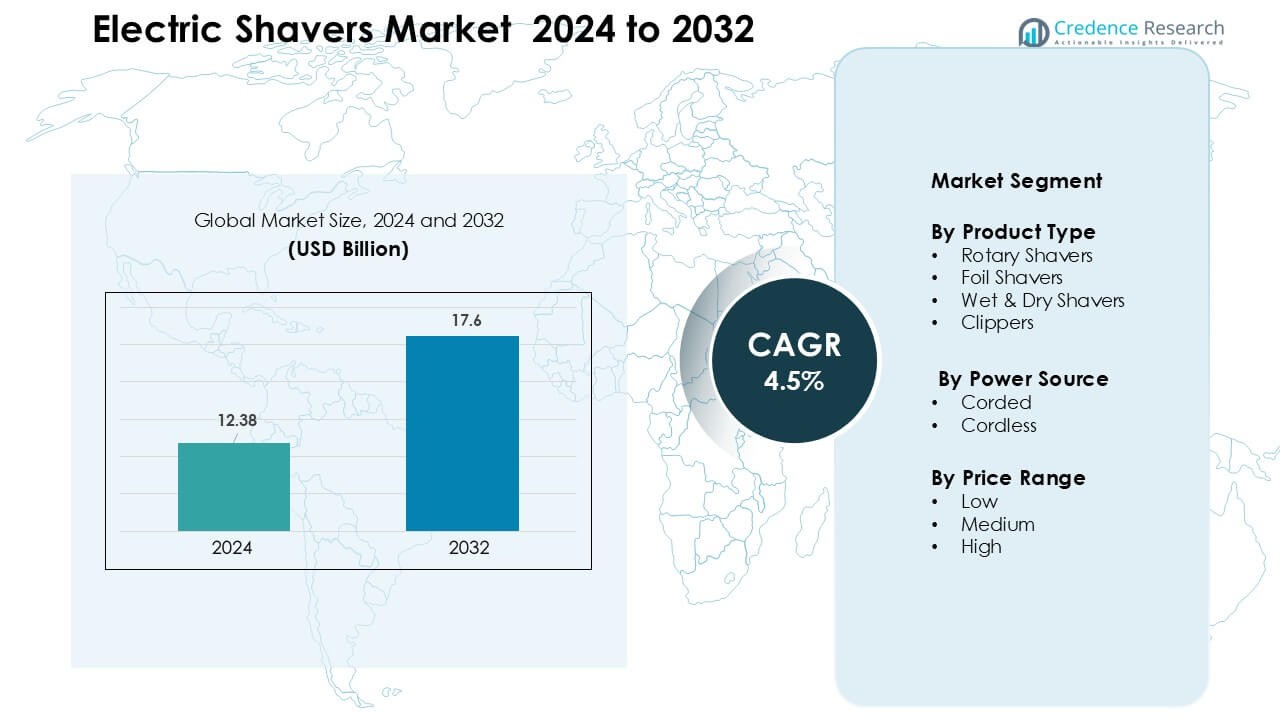
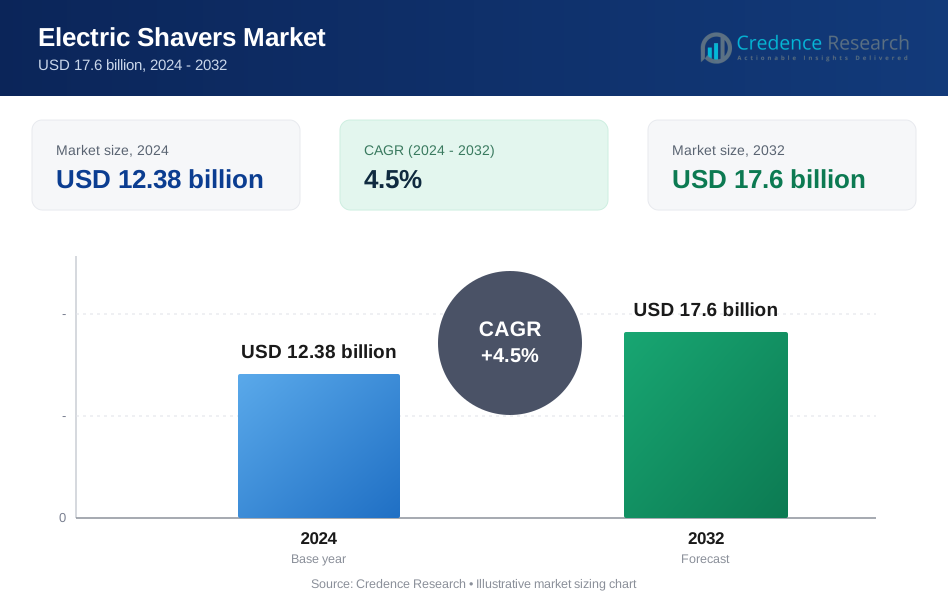
Electric Shavers Market was valued at USD 12.38 billion in 2024 and is anticipated to reach USD 17.6 billion by 2032, growing at a CAGR of 4.5% during the forecast period.
| REPORT ATTRIBUTE | DETAILS |
|---|---|
| Historical Period | 2020-2023 |
| Base Year | 2024 |
| Forecast Period | 2025-2032 |
| Electric Shavers Market Size 2024 | USD 12.38 Billion |
| Electric Shavers Market, CAGR | 4.5% |
| Electric Shavers Market Size 2032 | USD 17.6 Billion |
The Electric Shavers Market is shaped by leading players such as Philips, Panasonic, Braun, Remington (Spectrum), Andis, Conair, Manscaped, Havells, Hattekar, and Runwe Pro, each expanding innovative grooming solutions across rotary, foil, and cordless segments. These companies compete through advanced blade systems, long-life batteries, ergonomic designs, and strong digital marketing. Premium brands strengthen their positions with smart features and skin-protection technologies, while regional manufacturers gain traction with value-driven models. Asia-Pacific emerged as the leading region with about 41% market share in 2024, supported by rising grooming awareness, urbanization, and rapid e-commerce adoption across major economies.
Market Insights
- The Electric Shavers Market was valued at USD 12.38 billion in 2024 and is projected to reach USD 17.6 billion by 2032, growing at a CAGR of 4.5 % during the forecast period.
- Demand rises as consumers prefer fast, skin-friendly grooming, with rotary shavers holding the largest share and cordless models leading power-source adoption.
- Smart features, wet-and-dry use, ergonomic designs, and long-life batteries shape key trends while premium grooming habits expand across global markets.
- Competition intensifies among Philips, Panasonic, Braun, Remington (Spectrum), Andis, Conair, Manscaped, Havells, Hattekar, and Runwe Pro as brands innovate and widen digital presence.
- Asia-Pacific leads with about 41% share, followed by North America at 34% and Europe at 29%, while the medium price range remains the dominant segment due to strong value and performance balance.
Market Segmentation Analysis:
By Product Type
Rotary shavers held the dominant share in 2024 with about 42% due to strong demand for flexible shaving heads that handle coarse and multi-directional hair. Users preferred rotary designs because they work well on curved facial areas and reduce irritation during long strokes. Growth stayed steady as brands added self-sharpening blades and skin-protection rings. Foil shavers gained traction among buyers who sought precision for daily grooming, while wet & dry shavers expanded through rising preference for shower-safe devices. Clippers continued to grow in home grooming, yet rotary shavers remained the top choice due to broad suitability.
- For instance, Philips integrated self-sharpening blades in its 5000-series rotary shavers, and its 360-degree flexing heads perform up to 90,000 cutting actions per minute, enabling smooth adaptation to facial contours without multiple passes.
By Power Source
Cordless shavers led the segment in 2024 with nearly 68% share owing to strong adoption of rechargeable batteries and improved runtime. Consumers valued cordless models because they offer mobility, faster grooming, and cleaner handling than corded units. Demand increased as lithium-ion packs enabled quick charging and consistent power output across trimming cycles. Corded models held a stable position among budget and professional users who required continuous operation, but growth remained slower. The cordless category dominated because modern battery systems supported high-speed motors and reliable performance for daily shaving routines.
- For instance, the Philips Series 7000 Wet & Dry Electric Shaver uses a lithium-ion battery that gives about 60 minutes of runtime after a full charge roughly enough for 20 shaves with a full charge taking about 1 hour.
By Price Range
The medium price range dominated the market in 2024 with around 51% share as buyers sought a balance between advanced features and affordability. Brands in this segment offered multi-blade systems, waterproof designs, and adjustable speed modes at accessible prices, driving wide adoption across urban consumers. The low-price range grew through rising entry-level demand in developing regions, while the high price range advanced as premium users shifted to smart and self-cleaning shavers. Still, the medium segment maintained the lead because it delivered strong durability, comfort, and performance without premium-level costs.
Key Growth Drivers
Rising Demand for Convenient Grooming Solutions
Demand for convenient grooming solutions continues to lift the Electric Shavers Market as users prefer faster shaving with less skin strain. Busy work routines push consumers toward devices that reduce grooming time and offer smooth results without blades or gels. Brands strengthen this demand by adding flexible shaving heads, upgraded motors, and precision sensors that guide trimming. Wider access to personal grooming products across online channels broadens reach in both developed and emerging regions. Compact designs also appeal to frequent travelers and young users who value easy handling. Growing hygiene awareness further drives repeat purchases. As grooming becomes a daily habit for many men, and increasingly for women, the shift toward electric formats gains pace. This growth driver remains one of the strongest forces shaping the market.
- For instance, the Philips Men’s Rechargeable Cordless Shaver can shave a full face in about 3–5 minutes compared to 15+ minutes for traditional wet-razor shaving.
Advancement in Battery and Motor Technologies
Advances in battery and motor systems strengthen market adoption by boosting performance, safety, and reliability. Modern lithium-ion packs deliver longer runtime, quick charging, and stable power across each shave. High-speed motors cut thick or curly hair with lower friction, improving comfort for sensitive skin users. These upgrades reduce the need for frequent replacements, which builds stronger brand loyalty. Manufacturers also integrate smart charging controls that prevent overheat issues and extend device life. Enhanced waterproof sealing and shock-resistant frames support wet and dry use across varied settings. As technology advances spread across mid-range models, more buyers access features once seen only in premium devices. Growing innovation in compact motor designs further improves portability. This driver plays a major role in expanding the global customer base.
- For instance, the Braun Series 9 Pro 9465cc Wet & Dry Electric Shaver uses a rechargeable battery that provides around 60 minutes of shaving time after a full charge, and supports “quick-charge” giving enough power for one shave in about 5 minutes offering reliable battery performance for daily or frequent users.
Growth of E-commerce and Digital Brand Visibility
E-commerce expansion creates major growth opportunities as digital platforms expose buyers to wider choices and competitive pricing. Online marketplaces help users compare features, view demonstrations, and read detailed reviews, which speeds decision-making. Subscription programs and flash sales increase trial rates, especially among younger shoppers who prefer online purchasing. Brands also use targeted ads, influencer partnerships, and short product videos to strengthen awareness and trust. Easy returns and doorstep delivery reduce buying barriers, while online-exclusive models attract value-driven buyers. Cross-border sales increase access to premium shavers in developing countries, raising overall demand. This growth driver remains vital as grooming brands depend heavily on digital presence for reach and customer engagement.
Key Trend & Opportunity
Rise of Smart and Connected Grooming Devices
Smart grooming devices create strong opportunities as users show rising interest in personalized and tech-enabled shaving. App-linked shavers track usage, detect pressure levels, and guide shaving patterns to reduce skin irritation. Sensors monitor hair density and adjust speed or blade movement for smoother output. Brands also add self-cleaning docks, AI-based coaching, and automated lubrication systems that increase hygiene and extend device life. These innovations attract tech-savvy users and premium buyers who value precise results. As component costs fall, more mid-range models are expected to adopt connected features. This trend opens new value streams for global manufacturers.
- For instance, Philips Men’s Shaver S7887/35 (part of the latest range from Philips) uses “SkinIQ” sensors that read hair density and skin resistance hundreds of times per second to auto-adapt shaving power and suggest optimal shaving motions.
Growing Adoption of Female and Unisex Electric Grooming Products
Female and unisex grooming categories grow steadily as shaving habits broaden across age groups. More women choose electric shavers for faster routines, travel use, and lower irritation compared to razors. Brands respond with ergonomic designs, soft-edge foils, and attachments for legs and sensitive areas. Marketing campaigns highlight skin safety and convenience, drawing more first-time buyers. This expansion increases product diversity and unlocks new revenue streams outside traditional male-focused segments. As gender-neutral grooming rises worldwide, brands see strong opportunity to widen their consumer base through inclusive product lines.
- For instance, Philips Facial Hair Remover 5000 Series is a compact cordless device tailored for women’s facial hair, with a hypoallergenic head designed to minimise skin irritation, making it suitable for delicate skin and frequent use.
Shift Toward Sustainable and Durable Shaving Devices
Sustainability creates strong opportunities as users seek long-lasting and eco-friendly devices. Manufacturers introduce replaceable blade cartridges, recyclable materials, and energy-efficient motors to extend product life. Packaging also shifts toward paper-based formats that reduce plastic waste. Longer-life batteries and modular designs reduce early disposal, which appeals to environmentally aware buyers. These upgrades help brands strengthen credibility and win users who prefer responsible consumption. This trend is expected to gain more traction as global regulations tighten around waste and energy use.
Key Challenge
High Competition and Price Pressure Across Brands
Intense competition among global and regional brands creates strong price pressure that limits margins. Companies face challenges in differentiating products because core features often appear similar across categories. Lower-priced brands in developing markets attract cost-sensitive buyers, which reduces demand for mid-range offerings. Premium players must invest heavily in advertising, design upgrades, and innovation to stay ahead. These rising expenses make it difficult to maintain strong profit levels. The challenge increases as e-commerce platforms expose buyers to more alternatives with minimal switching cost, creating a crowded market landscape.
Repairability, Durability, and Battery Replacement Concerns
Repairability and battery life issues create obstacles for long-term customer satisfaction. Users often find it hard to replace dead batteries or damaged blades due to sealed designs or limited-service centers. This leads to early device disposal and reduced brand trust. High repair costs discourage maintenance, especially in budget models. Water damage, weaker plastic frames, and poor sealing also shorten device lifespan in low-priced products. As users grow more concerned about sustainability and value, manufacturers must address durability gaps. This challenge remains critical for improving retention and reducing negative reviews.
Regional Analysis
North America
North America held about 34% share in 2024, driven by strong grooming habits, high disposable income, and widespread adoption of premium electric shavers. Consumers preferred advanced rotary and foil models with smart features, which lifted sales across the US and Canada. E-commerce platforms supported fast expansion as users compared specifications and relied heavily on reviews before purchase. Grooming culture among millennials and professionals strengthened brand loyalty for leading global manufacturers. Growing interest in women’s electric grooming tools also added momentum. The region maintained its lead due to mature retail networks and sustained demand for high-performance devices.
Europe
Europe accounted for nearly 29% of the market in 2024, supported by strong demand for precision shaving and high-quality grooming equipment. Countries such as Germany, the UK, and France drove adoption through established male grooming routines and preference for durable foil shavers. Buyers valued ergonomic designs and low-irritation features, lifting mid-range and premium product sales. Sustainability trends encouraged interest in long-lasting materials and reduced-waste packaging. Online retail channels also expanded category visibility. With steady replacement cycles and rising demand for wet-and-dry models, Europe sustained a strong market position across both household and travel grooming segments.
Asia-Pacific
Asia-Pacific captured the largest share with about 41% in 2024 due to rapid urbanization, rising incomes, and expanding grooming awareness across China, Japan, India, and Southeast Asia. Young consumers preferred affordable cordless shavers, boosting the mid-price range. E-commerce growth and strong discount cycles accelerated adoption across both urban and semi-urban areas. Local and global brands expanded product lines with skin-friendly foils and long-life batteries to meet regional needs. Japan and South Korea also influenced premium demand through innovative technologies. Strong population growth and expanding grooming culture ensured Asia-Pacific’s leading share.
Latin America
Latin America held around 8% share in 2024, supported by growing grooming habits and higher adoption of mid-range electric shavers. Brazil, Mexico, and Argentina contributed most to sales as consumers shifted from manual razors to faster electric alternatives. Affordable cordless models gained traction due to better charging features and lightweight designs. Broad retail coverage and online marketplaces improved access to global brands. Economic fluctuations moderated spending, yet grooming remained resilient. Growth stayed strong among younger users who favored multifunctional devices. Improving import availability and rising lifestyle awareness supported the region’s stable contribution.
Middle East & Africa
The Middle East & Africa accounted for nearly 6% share in 2024, with rising grooming interest across the UAE, Saudi Arabia, South Africa, and Nigeria. Urban consumers adopted electric shavers for convenience, hygiene, and reduced skin irritation. Premium products performed well in Gulf nations, while low and mid-range cordless models dominated wider markets. Expanding online retail platforms improved product availability and influenced purchase decisions. Grooming awareness among young men and working professionals strengthened demand. Although price sensitivity restrained rapid premium growth, steady household adoption kept the region on a moderate but positive growth path.
Market Segmentations
By Product Type
- Rotary Shavers
- Foil Shavers
- Wet & Dry Shavers
- Clippers
By Power Source
- Corded
- Cordless
By Price Range
- Low
- Medium
- High
By Geography
- North America
- U.S.
- Canada
- Mexico
- Europe
- Germany
- France
- U.K.
- Italy
- Spain
- Rest of Europe
- Asia Pacific
- China
- Japan
- India
- South Korea
- South-east Asia
- Rest of Asia Pacific
- Latin America
- Brazil
- Argentina
- Rest of Latin America
- Middle East & Africa
- GCC Countries
- South Africa
- Rest of the Middle East and Africa
Competitive Landscape
The Electric Shavers Market features strong competition driven by global brands and fast-growing regional manufacturers. Leading companies such as Philips, Panasonic, Braun, Remington (Spectrum), Andis, Conair, Manscaped, Havells, Hattekar, and Runwe Pro focus on expanding product portfolios with rotary, foil, and multifunctional grooming devices. These brands invest in advanced motors, skin-protection technologies, and long-life lithium-ion batteries to strengthen performance across mid-range and premium segments. E-commerce platforms intensify competition by giving buyers instant comparison of features, reviews, and prices, reducing switching barriers. Companies also use influencer campaigns, grooming tutorials, and digital branding to differentiate themselves. Premium players maintain an edge through patented blade systems and smart connectivity, while regional firms compete through affordability and localized designs. Strategic partnerships with retailers, improved after-sales support, and broader distribution networks help manufacturers retain market share in a rapidly evolving grooming landscape.
Key Player Analysis
Recent Developments
- In April 2025, Philips launched a new range of premium electric shavers in India: the Series 7000, i9000, and i9000 Prestige Ultra.
- In 2024, Manscaped introduced “The Chairman Pro” electric foil shaver along with a face shaving kit, marking a strategic expansion beyond body grooming into more general facial grooming.
- In October 2024, Andis product launches for adjacent grooming segments (trimmers/clipper lines) company continued to refresh/extend its professional grooming portfolio (e.g., Explorer series trimmers), signalling ongoing investment in barber-grade tools that tie into the electric shaving/finishing market.
Report Coverage
The research report offers an in-depth analysis based on Product Type, Power Source, Price Range and Geography. It details leading market players, providing an overview of their business, product offerings, investments, revenue streams, and key applications. Additionally, the report includes insights into the competitive environment, SWOT analysis, current market trends, as well as the primary drivers and constraints. Furthermore, it discusses various factors that have driven market expansion in recent years. The report also explores market dynamics, regulatory scenarios, and technological advancements that are shaping the industry. It assesses the impact of external factors and global economic changes on market growth. Lastly, it provides strategic recommendations for new entrants and established companies to navigate the complexities of the market.
Future Outlook
- Demand for electric shavers will rise as grooming habits strengthen across global markets.
- Smart and connected shavers will gain wider adoption as users seek personalized grooming.
- Cordless models will continue to dominate due to longer battery life and faster charging.
- Premium segments will expand as consumers shift toward comfort-focused and skin-safe designs.
- Women’s and unisex grooming devices will grow as brands widen product portfolios.
- Sustainable materials and longer-life components will become key focus areas for manufacturers.
- Replacement cycles will shorten as users prefer upgraded motors, blades, and digital features.
- E-commerce will remain the strongest sales channel due to convenience and product comparison.
- Regional brands will increase competition by offering affordable and locally adapted designs.
- Innovation in blades, motors, and waterproofing will shape next-generation grooming devices.
Request a Free Sample
Fill in your details and we'll send you a free sample report.
- Sample data tables & charts
- Research methodology
Need a Custom Version of This Report?
Tailor the scope, geography, or segments to your exact requirements.
- Custom geography or segment scope
- Direct access to our analyst team
Frequently Asked Questions
What is the current market size for Electric Shavers Market, and what is its projected size in 2032?
At what Compound Annual Growth Rate is Electric Shavers Market projected to grow between 2024 and 2032?
Which Electric Shavers Market segment held the largest share in 2024?
What are the primary factors fueling the growth of Electric Shavers Market?
Who are the leading companies in Electric Shavers Market?
Which region commanded the largest share of Electric Shavers Market?
Table of Content
Chapter 1. Report Introduction
- 1.1 Report Description & Purpose
- 1.1.1 Report Title & Market Definition
- 1.1.2 Unique Selling Propositions (USP) & Key Differentiators
- 1.1.3 Value Proposition for Stakeholders
- 1.2 Research Objectives
- 1.2.1 Market Sizing Objectives (Volume & Revenue)
- 1.2.2 Segmentation Objectives
- 1.2.3 Competitive Intelligence Objectives
- 1.2.4 Forecast & Scenario Objectives
- 1.3 Report Scope
- 1.3.1 Electric Shavers Scope – Types & Subtypes Covered
- 1.3.2 Geographic Scope – Regions & Countries Covered
- 1.3.3 Historical Period, Base Year & Forecast Period (2024; forecast to 2032)
- 1.3.4 Inclusions & Exclusions
- 1.4 HS Code & Classification Framework
- 1.5 Currency, Units & Pricing Basis
- 1.6 Target Stakeholders
- 1.7 Limitations & Assumptions
Chapter 2. Executive Summary
- 2.1 Global Electric Shavers Market Snapshot
- 2.1.1 Market Size – Historical (2024) & Forecast (2024-2032) (2024: USD 12.38 billion → 2032: USD 17.6 billion)
- 2.1.2 Volume & Revenue – Global Totals
- 2.1.3 Key Market Highlights – Top Five Facts
- 2.2 Electric Shavers Market Segmentation Snapshot
- 2.2.1 Market Split by Region – 2024 vs. 2032
- 2.3 Competitive Snapshot
- 2.3.1 Top 10 Players by Revenue Share – 2024
- 2.3.2 Top 10 Players by Volume Share – 2024
- 2.3.3 Recent Strategic Developments (18-Month Summary)
- 2.4 Key Investment Highlights & Strategic Conclusions
Chapter 3. Electric Shavers Market Dynamics & Industry Analysis
- 3.1 Market Overview & Context
- 3.1.1 Electric Shavers Market Position in the Broader Automotive Value Chain
- 3.1.2 OEM vs. Replacement Market Dynamics
- 3.1.3 Market Maturity & Development Stage by Region
- 3.2 Electric Shavers Market Drivers
- 3.3 Electric Shavers Market Restraints & Challenges
- 3.4 Electric Shavers Market Opportunities
- 3.5 Porter's Five Forces Analysis
- 3.5.1 Threat of New Entrants
- 3.5.2 Bargaining Power of Suppliers
- 3.5.3 Bargaining Power of Buyers
- 3.5.4 Threat of Substitutes
- 3.5.5 Competitive Rivalry – Intensity Assessment
- 3.6 Electric Shavers Value Chain Analysis
- 3.6.1 Upstream – Raw Material/Input Suppliers
- 3.6.1.1 Raw Material/Input 1
- 3.6.1.2 Raw Material/Input 2
- 3.6.1.3 Raw Material/Input 3
- 3.6.2 Midstream – Production/Manufacturing/Service Delivery
- 3.6.2.1 Production/Process Overview
- 3.6.2.2 Key Facility Locations & Capacity by Manufacturer
- 3.6.3 Downstream – Distribution & End Consumer
- 3.6.3.1 Primary Channel – B2B/OEM
- 3.6.3.2 Secondary Channels – Dealer, Retail, Online, Direct
- 3.6.4 Value Chain Profitability Analysis
- 3.6.1 Upstream – Raw Material/Input Suppliers
- 3.7 PESTEL Analysis
- 3.7.1 Political Factors
- 3.7.2 Economic Factors
- 3.7.3 Social Factors
- 3.7.4 Technological Factors
- 3.7.5 Environmental Factors
- 3.7.6 Legal Factors
- 3.8 Electric Shavers Supply Chain Analysis
- 3.8.1 Raw Material/Input Supply Risk Assessment
- 3.8.2 Manufacturing Concentration Risk (Geographic Exposure)
- 3.8.3 Trade Disruption Impact Analysis
- 3.9 Regulatory & Policy Landscape
Note: The regulatory and policy landscape section covers regulations based on their applicability to the market, Electric Shavers category, geography, and scope of the study. Only regulatory frameworks with a material impact on operations, compliance, trade, sustainability, or market access are analyzed in detail.
Chapter 4. Key Investment Pockets & Opportunity Analysis
- 4.1 Electric Shavers Market Attractiveness Analysis
- 4.1.1 By Region – Investment Attractiveness Matrix (Volume × CAGR)
- 4.2 Absolute Revenue Growth Opportunity
- 4.2.1 By Region – Absolute USD Growth Through 2032
- 4.3 Incremental Volume Opportunity
- 4.3.1 By Region – Incremental Volume Through 2032
- 4.3.2 Segment – Incremental Volume
- 4.4 Emerging Submarket Opportunity Deep Dive (Subject to Applicability)
- 4.5 Emerging Market Opportunity Scorecards
- 4.5.1 United States
- 4.5.2 Europe
- 4.5.3 Asia
- 4.5.4 Middle East & Africa
Note: Emerging Market Opportunity Scorecards will be included based on relevance and strategic importance. Regions listed are indicative and may vary depending on data availability and market dynamics.
Chapter 5. Electric Shavers Import-Export Analysis & Trade Flows
- 5.1 Global Trade Overview
- 5.1.1 Global Export Value by Country (2024)
- 5.1.2 Global Export Volume by Country (2024)
- 5.1.3 Global Import Value by Country (2024)
- 5.1.4 Global Import Volume by Country (2024)
- 5.1.5 Net Trade Balance by Country (2024)
- 5.2 Export Analysis – Segment
- 5.2.1 Type 1 (HS Code)
- 5.2.2 Type 2 (HS Code)
- 5.2.3 Type 3 (HS Code)
- 5.2.4 Type 4 (HS Code)
- 5.2.5 Type 5 (HS Code)
- 5.3 Import Analysis – Segment
- 5.3.1 Type 1 (HS Code)
- 5.3.2 Type 2 (HS Code)
- 5.3.3 Type 3 (HS Code)
- 5.3.4 Type 4 (HS Code)
- 5.3.5 Type 5 (HS Code)
- 5.4 Average Unit Trade Prices
- 5.4.1 Average Export Price – Segment & Country
- 5.4.2 Average Import Price – Segment & Source Country
- 5.4.3 Price Trends (2024)
- 5.5 Key Trade Route Analysis
- 5.5.1 Trade Route 1
- 5.5.2 Trade Route 2
- 5.5.3 Trade Route 3
- 5.5.4 Trade Route 4
- 5.5.5 Trade Route 5
- 5.6 Trade Policy Impact Assessment
- 5.6.1 US Anti-Dumping & Section 301 Tariffs
- 5.6.2 EU Customs Union Impact
- 5.6.3 Major Free Trade Agreements
- 5.6.4 USMCA Rules of Origin
Note: Trade policy analysis will be included only where relevant to the Electric Shavers market.
Chapter 6. Competitive Landscape & Company Benchmarking
- 6.1 Electric Shavers Market Concentration & Structure
- 6.1.1 Herfindahl-Hirschman Index (HHI) – vs. 2024
- 6.1.2 Tier 1, Tier 2 & Tier 3 Market Structure
- 6.1.3 Global, Regional & Local Player Dynamics
- 6.2 Electric Shavers Market Share Analysis – 2024
- 6.2.1 Global Revenue Share by Company
- 6.2.2 Global Volume Share by Company
- 6.2.3 Regional Revenue Share
- 6.2.4 Market Share Evolution ( vs. 2024)
- 6.2.5 OEM Segment Share by Company
- 6.2.6 Replacement Segment Share by Company
- 6.3 Production/Delivery Capacity & Facility Analysis
- 6.3.1 Global Installed Capacity
- 6.3.2 Capacity Utilization Rates
- 6.3.3 Production/Output Volume
- 6.3.4 Facility Locations & Capacity Map
- 6.3.5 Planned Capacity Additions
- 6.4 Electric Shavers Competitive Benchmarking Matrix
- 6.4.1 Revenue, Volume, CAGR & Profitability Comparison
- 6.4.2 Channel Revenue Mix
- 6.4.3 Geographic Revenue Exposure
- 6.4.4 R&D Intensity
- 6.4.5 Sustainability Maturity
- 6.5 Strategic Developments in Electric Shavers (Last 24 Months)
- 6.5.1 Mergers, Acquisitions & Divestments
- 6.5.2 New Electric Shavers Launches
- 6.5.3 Facility Expansions
- 6.5.4 Strategic Alliances, Joint Ventures & Partnerships
- 6.5.5 Distribution Expansion & Market Entry
- 6.5.6 Sustainability & ESG Initiatives
- 6.6 Competitive Strategy Mapping
- 6.6.1 Leader, Challenger, Follower & Niche Classification
- 6.6.2 Pricing Strategy Comparison
- 6.6.3 Channel Strategy Matrix
Note: Strategic developments are included based on their materiality and the availability of reliable information.
Chapter 7. Global Electric Shavers Market – By Distribution Channel
- 7.1 Segment Overview
- 7.1.1 Volume & Revenue Split by Channel (2024 & 2032)
- 7.1.2 Channel Mix Evolution (2024-2032)
Chapter 8. Regional Market Analysis – Global Overview
- 8.1 Global Regional Overview
- 8.1.1 Regional Volume Share
- 8.1.2 Regional Revenue Share
- 8.1.3 Regional Volume by Region
- 8.1.4 Regional Revenue by Region
- 8.1.5 Regional Forecast Through 2032
- 8.2 Cross-Regional Segment Analysis
- 8.2.1 By Distribution Channel
- 8.2.2 By Brand/Price Tier
Chapter 9. North America Electric Shavers Market
- 9.1 United States
- 9.2 Canada
- 9.3 Mexico
Chapter 10. Europe Electric Shavers Market
- 10.1 Germany
- 10.2 France
- 10.3 Italy
- 10.4 United Kingdom
- 10.5 Spain
- 10.6 Poland
- 10.7 Russia
- 10.8 Netherlands
- 10.9 Belgium
- 10.10 Sweden
- 10.11 Denmark
- 10.12 Norway
- 10.13 Rest of Europe
Chapter 11. Asia Pacific Electric Shavers Market
- 11.1 China
- 11.2 India
- 11.3 Japan
- 11.4 South Korea
- 11.5 Thailand
- 11.6 Indonesia
- 11.7 Vietnam
- 11.8 Malaysia
- 11.9 Australia
- 11.10 Rest of Asia Pacific
Chapter 12. Latin America Electric Shavers Market
- 12.1 Brazil
- 12.2 Argentina
- 12.3 Colombia
- 12.4 Chile
- 12.5 Rest of Latin America
Chapter 13. Middle East Electric Shavers Market
- 13.1 Saudi Arabia
- 13.2 United Arab Emirates
- 13.3 Turkey
- 13.4 Israel
- 13.5 Iran
- 13.6 Rest of the Middle East
Chapter 14. Africa Electric Shavers Market
- 14.1 South Africa
- 14.2 Egypt
- 14.3 Nigeria
- 14.4 Morocco
- 14.5 Rest of Africa
Chapter 15. Electric Shavers Company Profiles
- 15.1 [Company 01]
- 15.1.1 Company Overview
- 15.1.2 Key Management Personnel
- 15.1.3 Products & Services Portfolio
- 15.1.4 Financial Performance
- 15.1.5 Key Market Focus & Geographic Presence
- 15.1.6 Recent Developments & Strategic Initiatives
Note: The company profile list is preliminary and may change based on research findings, market developments, data availability, and client requirements.
Chapter 16. Appendices
- Appendix A – List of Abbreviations & Acronyms
- Appendix B – Industry Classification Code Reference – Full Series
- Appendix C – Production & Capacity Data Tables
- Appendix D – End-Use & Demand Base Tables
- Appendix E – Consumption & Replacement Rate Assumptions
- Appendix F – ASP Reference Tables
- Appendix G – Manufacturing & Facility Database
- Appendix H – Import-Export Data Tables
- Appendix I – Regulatory Summary Tables
- Appendix J – Primary Research Participant List (Anonymized)
- Appendix K – Primary Research Questionnaire Framework
- Appendix L – Data Sources & Bibliography
- Appendix M – Market Size Divergence & Source Comparison
Chapter 17. Research Methodology
- 17.1 Research Framework & Philosophy
- 17.2 Secondary Research – Sources, Hierarchy & Data Extraction
- 17.3 Data Modeling – Bottom-Up & Top-Down Market Sizing
- 17.4 Primary Research – Stakeholder Framework, LOI & Sample Sizes
- 17.5 Forecast Methodology – Regression, Scenario & Sensitivity Analysis
- 17.6 Quality Control – Four-Layer Validation Framework
- 17.7 Limitations & Standard Assumptions
- 17.8 Disclaimer
