
| REPORT ATTRIBUTE | DETAILS |
|---|---|
| Historical Period | 2019-2022 |
| Base Year | 2023 |
| Forecast Period | 2024-2032 |
| Fermented Beverages Market Size 2023 | USD 2258495.2 Million |
| Fermented Beverages Market, CAGR | 6.00% |
| Fermented Beverages Market Size 2032 | USD 3815680.11 Million |
Market Insights
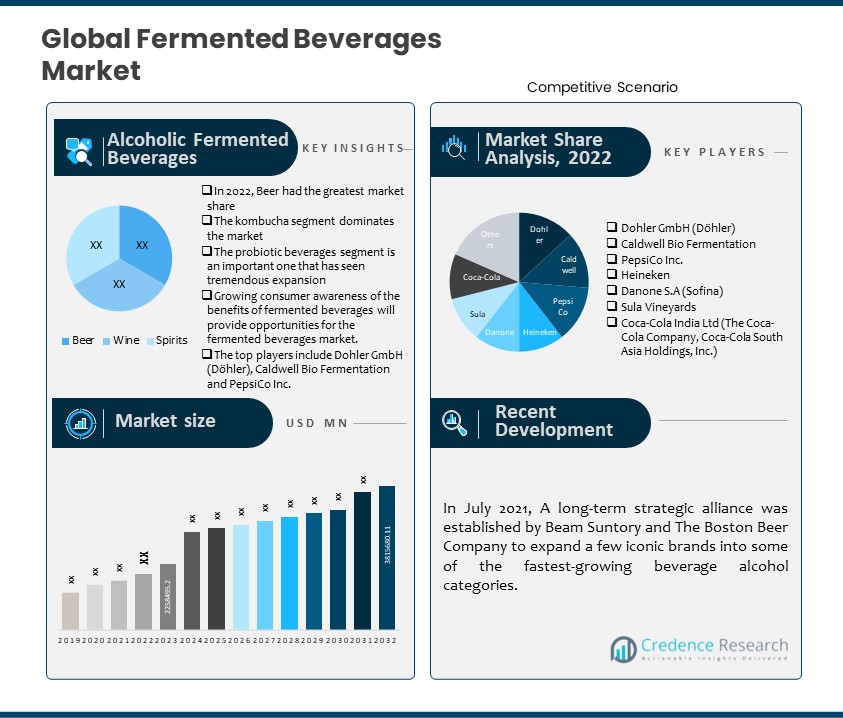
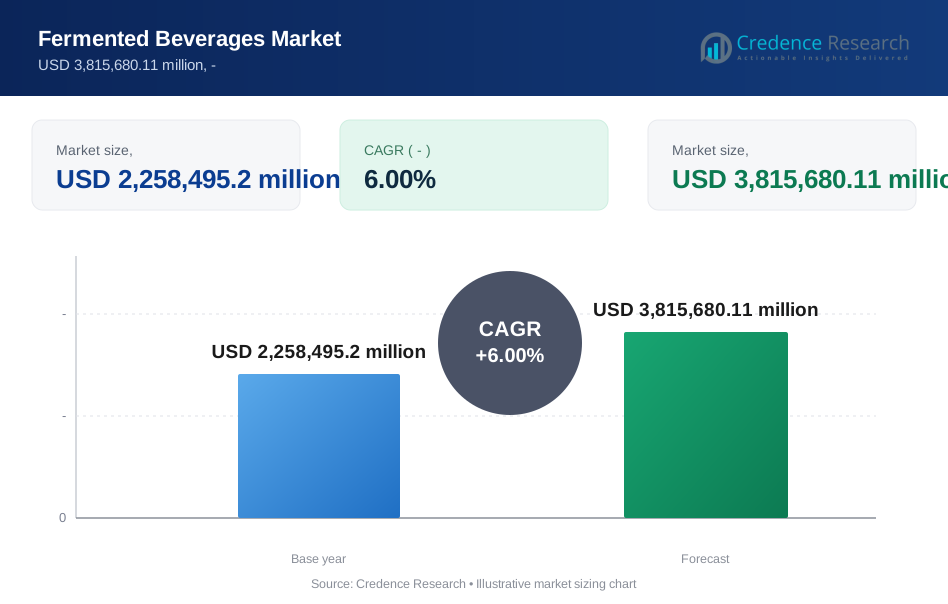
- The global market for fermented beverages is expected to develop at a compound annual growth rate (CAGR) of 6.00% between 2024 and 2032, from its estimated USD 2258495.2 million in 2023 to USD 3815680.11 million in 2032.
- The largest category is beer. Wine, on the other hand, is expected to grow at a strong CAGR.
- The leading category of fermented non-alcoholic beverages is kombucha.
- The CAGR for probiotic beverages is expected to be the highest during the projection period.
- The traditional fermented beverages will have the highest CAGR throughout the prediction period.
- Fruit-infused varieties are estimated to have the greatest CAGR during the forecast period.
- Asia Pacific dominated the fermented beverages market.
- Regarding the market share of fermented beverages, Europe is expected to come second.
- In the fermented beverages market, North America is anticipated to grow fastest.
- The global market for fermented beverages is being influenced by advancements in technology and fermentation techniques, as well as growing consumer awareness of the benefits of fermented beverages for gut health.
- Growth in e-commerce and distribution channels, as well as the growing demand for upscale and artisanal fermented drinks, are some of the factors driving the potential of the global fermented beverage market.
Executive Summary
Market Definition
The global industry of producing, distributing, and selling beverages that go through fermentation during production is included in the Fermented Beverages Market. Microorganisms like yeast, bacteria, or fungi metabolize sugars and turn them into acids, alcohol, or gases during the natural metabolic process known as fermentation. This process changes the beverage's flavor, texture, and nutritional makeup.
Market Overview
The fermented beverages sector is estimated to develop at a 6.00% compound annual growth rate (CAGR) between 2024 and 2032, maintaining its current upward trend. The market will continue to develop, rising from its estimated USD 2258495.2 million in 2023 to USD 3815680.11 million in 2032.
Probiotic-rich beverage demand has been largely driven by health and wellness trends, which have also contributed to the market expansion for fermented beverages. Functional beverages, those that provide particular health advantages above and beyond basic nourishment, are becoming more and more popular among consumers. Fermented drinks high in probiotics fall into this category since they are not only hydrating but may also be beneficial to digestive health. Fermented drinks are becoming more and more popular as a result of the demand for functional beverages. In the world of health and wellness, gut health is becoming more and more important. Probiotics have drawn a lot of attention because they are good bacteria that support a balanced population of gut flora. Probiotic-rich fermented drinks like kombucha, kefir, and kvass are appealing choices for customers trying to enhance their digestive systems.
A growing trend among consumers is a preference for natural and organic products as they become more health conscious. Because of their traditional production methods, which involve fermentation using yeasts and beneficial bacteria, fermented beverages are often thought to be more natural. This is in line with the demand for organic and minimally processed foods. As consumers become more aware of the potential health hazards linked to consuming large amounts of sugar, they are actively looking for sugar-free beverages to replace soda and juices with added sweetness. Fermented drinks high in probiotics provide a tasty substitute that is frequently lower in sugar and still delivers a pleasing flavor profile. Social media networks and wellness influencers are important factors in determining consumer trends and preferences.
Segmentation by Alcoholic Fermented Beverages
- Beer is the market leader in alcoholic fermented beverages. As one of the most traditional and extensively consumed alcoholic beverages globally, beer occupies a significant market share in the fermented beverage industry. Four main ingredients are usually used to make it: yeast, hops, malted barley (or other grains like wheat, corn, or rice), and water. Mashing, boiling, fermenting, conditioning, and packaging are some of the steps in the brewing process.
- The wine category will exhibit a sizable CAGR during the projected period. Winemaking entails the fermentation of sugars, mostly by yeast, present in grapes or other fruits. The wine acquires its distinct flavors, aromas, and alcohol content through the fermentation process, which turns sugars into alcohol and carbon dioxide.
- Other alcoholic fermented beverages, including spirits, also support the need for fermented beverages.
Segmentation by Non-Alcoholic Fermented Beverages
- The best non-alcoholic fermented beverages category is kombucha. Usually, a SCOBY, sugar, and black or green tea are used to make kombucha. As the sugar is consumed during fermentation, the SCOBY creates carbon dioxide, organic acids, and minute amounts of alcohol.
- The kefir category will likely register a significant CAGR during forecasting. Kefir is produced by fermenting milk with kefir grains. The microbes in the kefir grains break down the lactose in milk during fermentation, producing lactic acid and other chemicals. This process results in kefir's distinctive effervescence and tart flavor.
- Other non-alcoholic fermented beverages, such as fermented fruit juices and fermented vegetable juices, also contribute to the demand for fermented beverages.
Segmentation by Functional Fermented Beverages
- The probiotic beverages category is projected to grow faster over the projection period. Drinks containing probiotics are frequently linked to a number of health advantages, most notably in relation to digestive health. These beverages include live microbes that can aid with constipation, gas, bloating, and immune system stimulation, as well as better digestion and nutrient absorption.
- Other functional fermented beverages influence the need for fermented beverages, including herbal fermented beverages and fermented tea blends.
Segmentation by Cultural and Regional Segments
- The traditional fermented beverages category will likely have the highest CAGR during the projection period. Traditional fermented drinks are made with age-old techniques that have been handed down through generations within certain cultures or geographical areas. These drinks are frequently firmly ingrained in the customs and legacy of the people who make them, and they have significant cultural value.
- Other cultural and regional segments, such as craft fermented beverages, also contribute to the demand for fermented beverages.
Segmentation by Ingredient and Flavor Variations
- Fruit-infused varieties are expected to have the foremost CAGR during the prediction period. In the Fermented Beverages Market, a subset of fermented drinks that include fruit as a main ingredient or flavoring agent during fermentation is referred to as fruit-infused variations.
- Other ingredient and flavor variations, such as herbal and botanical varieties and seasonal and limited editions, also contribute to the demand for fermented beverages.
Segmentation by Region
- The Asia Pacific leads the fermented beverages industry. This is due to the growing economy, a constantly growing population, and rising food consumption in the Asia Pacific.
- Europe is estimated to rank second in market size for fermented beverages.
- The fermented beverages industry is predicted to flourish rapidly in North America.
- The remaining need for fermented beverages is met by regions including Latin America, Africa, and the Middle East.
The factors driving the fermented beverages market are advancements in technology and techniques, an increase in the availability of fermented beverages in online retail channels, and a rise in consumer interest in homebrewing and DIY fermentation kits.
Based on projections, the fermented beverages market is anticipated to be controlled by Asia Pacific. Probiotics and antioxidants are only two of the health advantages that are frequently linked to fermented drinks. Beverages such as kombucha, kefir, and traditional Asian fermented drinks are becoming more and more popular among consumers who are becoming health-conscious due to their supposed health benefits. The area is home to a wide variety of fermentable components, such as grains, barley, fruits, herbs, and more. This abundance makes it possible to produce a large range of distinctive fermented drinks, each with its particular flavors and attributes. The Asia Pacific area has a sizable market for fermented beverages due to its vast population and expanding middle class. There is a growing consumer demand for premium fermented beverages as they become more interested in artisanal and handmade items.
The fermented beverages market in North America is anticipated to expand fastest throughout the forecast. A vast range of fermented beverages that suit a range of tastes and preferences are available in the North American market. The business is growing because customers have so many options to select from, from more modern items like kombucha and probiotic beverages to more conventional fermented drinks like wine and beer. Drinks that have undergone fermentation are frequently linked to a number of health advantages, such as enhanced immunological response, gut health, and digestion. The demand for functional products among more health-conscious customers is propelling the expansion of fermented beverages.
Key Highlights of the Report
The global fermented beverages market is segmented by alcoholic fermented beverages, non-alcoholic fermented beverages, functional fermented beverages, cultural and regional segments, ingredient and flavor variations, and region. As far as alcoholic fermented beverages are concerned, beer is the market spearhead. Kombucha is the top category. The probiotic beverages category is anticipated to increase at the highest CAGR throughout the projection period. The traditional fermented beverages category will experience the highest CAGR during the forecast period. The fermented beverages market is expanding mostly in the Asia Pacific.
The fermented beverage market is driven primarily by ongoing technological and methodological advancements in fermentation. Beyond the conventional possibilities of beer and wine, a plethora of other fermented beverages can be produced through sophisticated fermentation techniques. This diversity broadens the market base by drawing in customers who are seeking unique experiences and tastes. Probiotic-rich beverages with benefits for digestive health can be produced using modern fermentation techniques, satisfying the needs of health-conscious consumers. The market is growing because there is a growing demand for these items as people become more health conscious.
Asia Pacific is expected to account for the largest fermented beverages market globally. The area has a history of introducing novel fermenting techniques and updating classic recipes to suit contemporary palates. Adapting to shifting consumer preferences involves creating new flavors, packaging designs, and marketing techniques. Exporting their products to overseas markets is becoming more and more important for producers in the Asia Pacific region as the demand for fermented beverages rises worldwide. This presents opportunities for development and international expansion. The North American region is also assumed to have the market's sharpest growth. Businesses in North America have taken the initiative to promote fermented drinks by emphasizing their distinct flavors and health advantages. Through effective branding and marketing strategies, they have raised consumer awareness of these products, which has boosted demand and aided in the expansion of the sector.
Which Key Factors Are Driving The Global Fermented Beverages Market?
A number of factors are driving the growth of the fermented beverage market, including the need for convenient, on-the-go beverage options among health-conscious consumers and their desire for sugar-free alternatives.
What are the main challenges confronting the global Fermented Beverages market?
Several barriers include reduced shelf life and storage needs of certain fermented goods, limited availability of raw materials for fermentation owing to climate change, and rising production costs from labor and energy costs.
What Market Opportunities Exist For Fermented Beverages Globally?
There are a number of reasons why the market for fermented drinks could expand, including collaborating with local suppliers and farmers to guarantee a steady supply of premium ingredients and partnering with health and wellness authorities to inform customers about the advantages of fermented drinks.
Market Drivers
Multiple factors propel the fermented beverages industry across the globe. The primary factors propelling the global fermented beverages market are as follows:
A Rise in the Demand for Traditional and Ethnic Fermented Drinks
A growing number of food and beverage industries are favoring artisanal and craft items. Customary fermented drinks are created by hand or in limited quantities, which contributes to their exclusivity and artisanal appeal. Numerous customary fermented drinks have been a part of many societies for hundreds, if not thousands, of years. There's a built-in preference for these classic drinks as individuals become increasingly interested in conserving cultural heritage and trying out new foods. When opposed to industrialized manufacturing processes, traditional fermentation procedures are generally more sustainable and favorable to the environment. Traditional fermented beverages are becoming more and more appealing as customers' concerns about sustainability grow. Through marketing efforts and educational initiatives, companies and groups are actively encouraging the consumption of traditional fermented beverages. Demand for these beverages rises as people become more conscious of the cultural and health benefits linked to them.
Market Restraints
There are several obstacles that the global fermented beverages market must overcome to continue growing. Among them are the following:
Increased Import Taxes and Levies on Alcoholic Beverages
Beer and other alcoholic beverages, especially those that are fermented, become more expensive due to high taxes and excise levies. Price increases may cause consumers to choose less expensive options or cut back on their usage overall, which could hamper the market for fermented drinks. Excessive taxes and excise levies encourage the illegal trade and smuggling of alcoholic beverages. Legal sales of these items may decline if consumers can get fermented beverages through illegal routes for less money, which would have an impact on the growth of the market as a whole as well as legitimate enterprises. Non-alcoholic substitutes pose a threat to manufacturers of fermented beverages in addition to other alcoholic ones. Excessive taxes and excise levies might worsen this rivalry by lowering the price competitiveness of fermented beverages.
Additionally, the majority of granola bars and health bars cost between $2 and $3 each piece. Furthermore, there are plenty of less expensive alternatives to the bar on the market. It is a significant aspect that affects how purchasing decisions alter, which hampers market expansion.
Opportunities
There are plenty of potential prospects in the global fermented beverages industry. Among these are the following:
Increased Fermented Dairy Demand Drives Market Expansion
Customers are actively looking for meals and beverages that provide health benefits as they become more health-conscious. Probiotics, found in fermented dairy products like kefir, yogurt, and cultured milk drinks, are believed to strengthen the immune system and improve gut health. Demand is being driven by consumers adding more fermented dairy products to their diets as they become more conscious of these advantages. In order to accommodate a wide range of consumer preferences, the market for fermented dairy beverages has grown. There is something for everyone, ranging from classic yogurt drinks to cutting-edge probiotic-rich beverages like kombucha and lacto-fermented fruit juices. The market is expanding and drawing in more customers as a result of this variety in product offerings.
Competitive Landscape
Key Players
Several major competitors exist in the fiercely competitive global fermented beverages market. The following are a few of the leading market participants and their market shares:
- Dohler GmbH (Döhler)
- Caldwell Bio Fermentation
- PepsiCo Inc.
- Heineken
- Danone S.A (Sofina)
- Sula Vineyards
- Coca-Cola India Ltd (The Coca-Cola Company, Coca-Cola South Asia Holdings, Inc.)
- Others
These companies prioritize product innovation, distribution channel expansion, mergers, and acquisitions to remain competitive.
The largest suppliers in the global fermented beverages market continuously work to stay one step ahead of the competition by developing innovative concepts and products.
In March 2022, Nestlé USA announced that it would build a new beverage factory in Glendale, Arizona, for USD 675 million. Nestlé is one of the leading makers of creamers and flavored milk, and this investment strengthens its position in the market and expands its manufacturing capacity to meet customers' growing demands.
In August 2021, Boston Beer Company and PepsiCo declared their intention to form a joint venture to manufacture HARD MTN DEW alcoholic drinks. Through this relationship, one of PepsiCo's most recognizable and cherished brands will be combined with Boston Beer's expertise in alcoholic beverages.
Summary of Key Findings
- The market is being driven by its expansion into emerging markets, where disposable incomes are rising and consumer preferences are shifting.
- The market is segmented by alcoholic fermented beverages, non-alcoholic fermented beverages, functional fermented beverages, cultural and regional segments, ingredient and flavor variations, and region.
- The most popular alcoholic fermented beverage in the market is beer.
- Kombucha is the foremost non-alcoholic fermented beverages category.
- Probiotic beverages are expected to grow fastest in terms of CAGR during the forecast period.
- The fruit-infused varieties category will likely see the highest CAGR during the anticipated time frame.
- Asia Pacific is leading market development; the market is highly competitive with key players including Dohler GmbH (Döhler), Caldwell Bio Fermentation, PepsiCo Inc., Heineken, Danone S.A (Sofina), Sula Vineyards, Coca-Cola India Ltd (The Coca-Cola Company, Coca-Cola South Asia Holdings, Inc.), and Others.
Future Outlook
- The fermented beverages industry is expected to increase significantly in Asia Pacific, and its outlook is positive worldwide.
- When it comes to luxury purchases, consumers are willing to pay more. The demand for premium fermented beverages—which are made using premium alcoholic fermented beverages and have a more complex profile than non-alcoholic fermented beverages—will, therefore, most likely grow.
- Price variations for staples, such as cereals, fruits, and herbs, may hamper the market for fermented beverages.
- To stay ahead of the competition, key enterprises must develop new products, expand their market reach, and keep their prices competitive.
How CXOs Can Benefit from the Credence Research Fermented Beverages Market Report
CXOs may get a detailed picture of the market in the Credence Research Fermented Beverages Market Report, which includes:
- Market size and growth forecast: The report provides detailed estimates of the global fermented beverages market size, segmented by alcoholic fermented beverages, non-alcoholic fermented beverages, functional fermented beverages, cultural and regional segments, ingredient and flavor variations, and region. It also includes forecasts for the market through 2032 based on key trends and drivers.
- Market segmentation: The research report breaks down the market for fermented beverages into segments based on alcoholic fermented beverages, non-alcoholic fermented beverages, functional fermented beverages, cultural and regional segments, ingredient and flavor variations, and region. This segmentation provides CXOs with a granular understanding of the market and the opportunities in each segment.
- Competitive landscape: The research report offers a detailed analysis of the major companies in the fermented beverages industry, including information on their business plans, product lines, and earnings. CXOs can use this information to evaluate and identify their competitors.
- Key trends and drivers: The research report identifies and evaluates the main trends and factors influencing the fermented beverages market. CXOs can use this information to make well-informed choices regarding their plans and investments.
CXOs can use the insights from the Credence Research Fermented Beverages Market Report to:
- Identify growth opportunities: This analysis may help CXOs identify new growth opportunities in the fermented beverages sector. For example, the report identifies the growing demand for fermented beverages from consumers as a key opportunity.
- Make informed investment decisions: The report helps CXOs wisely choose fermented beverages. For example, the research study provides information on the critical factors to consider when selecting fermented beverage solutions and evaluating suppliers.
- Develop competitive strategies: CXOs can use the research report to develop competitive strategies for their fermented beverages businesses. For example, the research paper outlines the main strategies that fermented beverage suppliers utilize to differentiate themselves from competitors.
- Track market developments: This research report may help CXOs stay ahead of the curve by tracking market developments. For instance, it offers insights into the most recent developments and trends in the fermented beverages market.
CXOs seeking to expand their industry knowledge and spot growth prospects will find the Credence Research Fermented Beverages Market Report useful.
Segmentation
- By Alcoholic Fermented Beverages
- Beer
- Wine
- Spirits
- By Non-Alcoholic Fermented Beverages
- Kombucha
- Kefir
- Fermented Fruit Juices
- Fermented Vegetable Juices
- By Functional Fermented Beverages
- Probiotic Beverages
- Herbal Fermented Beverages
- Fermented Tea Blends
- By Cultural and Regional Segments
- Traditional Fermented Beverages
- Craft Fermented Beverages
- By Ingredient and Flavor Variations
- Fruit-infused Varieties
- Herbal and Botanical Varieties
- Seasonal and Limited Editions
- By Region
- North America
- The U.S.
- Canada
- Mexico
- Europe
- Germany
- France
- K.
- Italy
- Spain
- Rest of Europe
- Asia Pacific
- China
- Japan
- India
- South Korea
- South-east Asia
- Rest of Asia Pacific
- Latin America
- Brazil
- Argentina
- Rest of Latin America
- Middle East & Africa
- GCC Countries
- South Africa
- The Rest of the Middle East and Africa
- North America
Request a Free Sample
Fill in your details and we'll send you a free sample report.
- Sample data tables & charts
- Research methodology
Need a Custom Version of This Report?
Tailor the scope, geography, or segments to your exact requirements.
- Custom geography or segment scope
- Direct access to our analyst team
Frequently Asked Questions
How much does the global market currently hold for fermented beverages?
What is the fermented beverages market's projected growth rate between 2024 and 2032?
In terms of alcoholic fermented beverages, which market category is leading?
Regarding non-alcoholic fermented beverages, which market category is in the lead?
Who are the main players in the fermented beverages industry globally?
Table of Content
Chapter 1. Report Introduction
- 1.1 Report Description & Purpose
- 1.1.1 Report Title & Market Definition
- 1.1.2 Unique Selling Propositions (USP) & Key Differentiators
- 1.1.3 Value Proposition for Stakeholders
- 1.2 Research Objectives
- 1.2.1 Market Sizing Objectives (Volume & Revenue)
- 1.2.2 Segmentation Objectives
- 1.2.3 Competitive Intelligence Objectives
- 1.2.4 Forecast & Scenario Objectives
- 1.3 Report Scope
- 1.3.1 Fermented Beverages Scope – Types & Subtypes Covered
- 1.3.2 Geographic Scope – Regions & Countries Covered
- 1.3.3 Historical Period, Base Year & Forecast Period (the historical period; forecast to the forecast period)
- 1.3.4 Inclusions & Exclusions
- 1.4 HS Code & Classification Framework
- 1.5 Currency, Units & Pricing Basis
- 1.6 Target Stakeholders
- 1.7 Limitations & Assumptions
Chapter 2. Executive Summary
- 2.1 Global Fermented Beverages Market Snapshot
- 2.1.1 Market Size – Historical (the historical period) & Forecast (the forecast period) (base year: USD 2,258,495.2 million → forecast year: USD 3,815,680.11 million)
- 2.1.2 Volume & Revenue – Global Totals
- 2.1.3 Key Market Highlights – Top Five Facts
- 2.2 Fermented Beverages Market Segmentation Snapshot
- 2.2.1 Market Split by Region – vs.
- 2.3 Competitive Snapshot
- 2.3.1 Top 10 Players by Revenue Share –
- 2.3.2 Top 10 Players by Volume Share –
- 2.3.3 Recent Strategic Developments (18-Month Summary)
- 2.4 Key Investment Highlights & Strategic Conclusions
Chapter 3. Fermented Beverages Market Dynamics & Industry Analysis
- 3.1 Market Overview & Context
- 3.1.1 Fermented Beverages Market Position in the Broader Automotive Value Chain
- 3.1.2 OEM vs. Replacement Market Dynamics
- 3.1.3 Market Maturity & Development Stage by Region
- 3.2 Fermented Beverages Market Drivers
- 3.3 Fermented Beverages Market Restraints & Challenges
- 3.4 Fermented Beverages Market Opportunities
- 3.5 Porter's Five Forces Analysis
- 3.5.1 Threat of New Entrants
- 3.5.2 Bargaining Power of Suppliers
- 3.5.3 Bargaining Power of Buyers
- 3.5.4 Threat of Substitutes
- 3.5.5 Competitive Rivalry – Intensity Assessment
- 3.6 Fermented Beverages Value Chain Analysis
- 3.6.1 Upstream – Raw Material/Input Suppliers
- 3.6.1.1 Raw Material/Input 1
- 3.6.1.2 Raw Material/Input 2
- 3.6.1.3 Raw Material/Input 3
- 3.6.2 Midstream – Production/Manufacturing/Service Delivery
- 3.6.2.1 Production/Process Overview
- 3.6.2.2 Key Facility Locations & Capacity by Manufacturer
- 3.6.3 Downstream – Distribution & End Consumer
- 3.6.3.1 Primary Channel – B2B/OEM
- 3.6.3.2 Secondary Channels – Dealer, Retail, Online, Direct
- 3.6.4 Value Chain Profitability Analysis
- 3.6.1 Upstream – Raw Material/Input Suppliers
- 3.7 PESTEL Analysis
- 3.7.1 Political Factors
- 3.7.2 Economic Factors
- 3.7.3 Social Factors
- 3.7.4 Technological Factors
- 3.7.5 Environmental Factors
- 3.7.6 Legal Factors
- 3.8 Fermented Beverages Supply Chain Analysis
- 3.8.1 Raw Material/Input Supply Risk Assessment
- 3.8.2 Manufacturing Concentration Risk (Geographic Exposure)
- 3.8.3 Trade Disruption Impact Analysis
- 3.9 Regulatory & Policy Landscape
Note: The regulatory and policy landscape section covers regulations based on their applicability to the market, Fermented Beverages category, geography, and scope of the study. Only regulatory frameworks with a material impact on operations, compliance, trade, sustainability, or market access are analyzed in detail.
Chapter 4. Key Investment Pockets & Opportunity Analysis
- 4.1 Fermented Beverages Market Attractiveness Analysis
- 4.1.1 By Region – Investment Attractiveness Matrix (Volume × CAGR)
- 4.2 Absolute Revenue Growth Opportunity
- 4.2.1 By Region – Absolute USD Growth Through the forecast period
- 4.3 Incremental Volume Opportunity
- 4.3.1 By Region – Incremental Volume Through the forecast period
- 4.3.2 Segment – Incremental Volume
- 4.4 Emerging Submarket Opportunity Deep Dive (Subject to Applicability)
- 4.5 Emerging Market Opportunity Scorecards
- 4.5.1 United States
- 4.5.2 Europe
- 4.5.3 Asia
- 4.5.4 Middle East & Africa
Note: Emerging Market Opportunity Scorecards will be included based on relevance and strategic importance. Regions listed are indicative and may vary depending on data availability and market dynamics.
Chapter 5. Fermented Beverages Import-Export Analysis & Trade Flows
- 5.1 Global Trade Overview
- 5.1.1 Global Export Value by Country (the historical period)
- 5.1.2 Global Export Volume by Country (the historical period)
- 5.1.3 Global Import Value by Country (the historical period)
- 5.1.4 Global Import Volume by Country (the historical period)
- 5.1.5 Net Trade Balance by Country (the historical period)
- 5.2 Export Analysis – Segment
- 5.2.1 Type 1 (HS Code)
- 5.2.2 Type 2 (HS Code)
- 5.2.3 Type 3 (HS Code)
- 5.2.4 Type 4 (HS Code)
- 5.2.5 Type 5 (HS Code)
- 5.3 Import Analysis – Segment
- 5.3.1 Type 1 (HS Code)
- 5.3.2 Type 2 (HS Code)
- 5.3.3 Type 3 (HS Code)
- 5.3.4 Type 4 (HS Code)
- 5.3.5 Type 5 (HS Code)
- 5.4 Average Unit Trade Prices
- 5.4.1 Average Export Price – Segment & Country
- 5.4.2 Average Import Price – Segment & Source Country
- 5.4.3 Price Trends (the historical period)
- 5.5 Key Trade Route Analysis
- 5.5.1 Trade Route 1
- 5.5.2 Trade Route 2
- 5.5.3 Trade Route 3
- 5.5.4 Trade Route 4
- 5.5.5 Trade Route 5
- 5.6 Trade Policy Impact Assessment
- 5.6.1 US Anti-Dumping & Section 301 Tariffs
- 5.6.2 EU Customs Union Impact
- 5.6.3 Major Free Trade Agreements
- 5.6.4 USMCA Rules of Origin
Note: Trade policy analysis will be included only where relevant to the Fermented Beverages market.
Chapter 6. Competitive Landscape & Company Benchmarking
- 6.1 Fermented Beverages Market Concentration & Structure
- 6.1.1 Herfindahl-Hirschman Index (HHI) – vs.
- 6.1.2 Tier 1, Tier 2 & Tier 3 Market Structure
- 6.1.3 Global, Regional & Local Player Dynamics
- 6.2 Fermented Beverages Market Share Analysis –
- 6.2.1 Global Revenue Share by Company
- 6.2.2 Global Volume Share by Company
- 6.2.3 Regional Revenue Share
- 6.2.4 Market Share Evolution ( vs. )
- 6.2.5 OEM Segment Share by Company
- 6.2.6 Replacement Segment Share by Company
- 6.3 Production/Delivery Capacity & Facility Analysis
- 6.3.1 Global Installed Capacity
- 6.3.2 Capacity Utilization Rates
- 6.3.3 Production/Output Volume
- 6.3.4 Facility Locations & Capacity Map
- 6.3.5 Planned Capacity Additions
- 6.4 Fermented Beverages Competitive Benchmarking Matrix
- 6.4.1 Revenue, Volume, CAGR & Profitability Comparison
- 6.4.2 Channel Revenue Mix
- 6.4.3 Geographic Revenue Exposure
- 6.4.4 R&D Intensity
- 6.4.5 Sustainability Maturity
- 6.5 Strategic Developments in Fermented Beverages (Last 24 Months)
- 6.5.1 Mergers, Acquisitions & Divestments
- 6.5.2 New Fermented Beverages Launches
- 6.5.3 Facility Expansions
- 6.5.4 Strategic Alliances, Joint Ventures & Partnerships
- 6.5.5 Distribution Expansion & Market Entry
- 6.5.6 Sustainability & ESG Initiatives
- 6.6 Competitive Strategy Mapping
- 6.6.1 Leader, Challenger, Follower & Niche Classification
- 6.6.2 Pricing Strategy Comparison
- 6.6.3 Channel Strategy Matrix
Note: Strategic developments are included based on their materiality and the availability of reliable information.
Chapter 7. Global Fermented Beverages Market – By Distribution Channel
- 7.1 Segment Overview
- 7.1.1 Volume & Revenue Split by Channel ( & )
- 7.1.2 Channel Mix Evolution (the forecast period)
Chapter 8. Regional Market Analysis – Global Overview
- 8.1 Global Regional Overview
- 8.1.1 Regional Volume Share
- 8.1.2 Regional Revenue Share
- 8.1.3 Regional Volume by Region
- 8.1.4 Regional Revenue by Region
- 8.1.5 Regional Forecast Through the forecast period
- 8.2 Cross-Regional Segment Analysis
- 8.2.1 By Distribution Channel
- 8.2.2 By Brand/Price Tier
Chapter 9. North America Fermented Beverages Market
- 9.1 United States
- 9.2 Canada
- 9.3 Mexico
Chapter 10. Europe Fermented Beverages Market
- 10.1 Germany
- 10.2 France
- 10.3 Italy
- 10.4 United Kingdom
- 10.5 Spain
- 10.6 Poland
- 10.7 Russia
- 10.8 Netherlands
- 10.9 Belgium
- 10.10 Sweden
- 10.11 Denmark
- 10.12 Norway
- 10.13 Rest of Europe
Chapter 11. Asia Pacific Fermented Beverages Market
- 11.1 China
- 11.2 India
- 11.3 Japan
- 11.4 South Korea
- 11.5 Thailand
- 11.6 Indonesia
- 11.7 Vietnam
- 11.8 Malaysia
- 11.9 Australia
- 11.10 Rest of Asia Pacific
Chapter 12. Latin America Fermented Beverages Market
- 12.1 Brazil
- 12.2 Argentina
- 12.3 Colombia
- 12.4 Chile
- 12.5 Rest of Latin America
Chapter 13. Middle East Fermented Beverages Market
- 13.1 Saudi Arabia
- 13.2 United Arab Emirates
- 13.3 Turkey
- 13.4 Israel
- 13.5 Iran
- 13.6 Rest of the Middle East
Chapter 14. Africa Fermented Beverages Market
- 14.1 South Africa
- 14.2 Egypt
- 14.3 Nigeria
- 14.4 Morocco
- 14.5 Rest of Africa
Chapter 15. Fermented Beverages Company Profiles
- 15.1 [Company 01]
- 15.1.1 Company Overview
- 15.1.2 Key Management Personnel
- 15.1.3 Products & Services Portfolio
- 15.1.4 Financial Performance
- 15.1.5 Key Market Focus & Geographic Presence
- 15.1.6 Recent Developments & Strategic Initiatives
Note: The company profile list is preliminary and may change based on research findings, market developments, data availability, and client requirements.
Chapter 16. Appendices
- Appendix A – List of Abbreviations & Acronyms
- Appendix B – Industry Classification Code Reference – Full Series
- Appendix C – Production & Capacity Data Tables
- Appendix D – End-Use & Demand Base Tables
- Appendix E – Consumption & Replacement Rate Assumptions
- Appendix F – ASP Reference Tables
- Appendix G – Manufacturing & Facility Database
- Appendix H – Import-Export Data Tables
- Appendix I – Regulatory Summary Tables
- Appendix J – Primary Research Participant List (Anonymized)
- Appendix K – Primary Research Questionnaire Framework
- Appendix L – Data Sources & Bibliography
- Appendix M – Market Size Divergence & Source Comparison
Chapter 17. Research Methodology
- 17.1 Research Framework & Philosophy
- 17.2 Secondary Research – Sources, Hierarchy & Data Extraction
- 17.3 Data Modeling – Bottom-Up & Top-Down Market Sizing
- 17.4 Primary Research – Stakeholder Framework, LOI & Sample Sizes
- 17.5 Forecast Methodology – Regression, Scenario & Sensitivity Analysis
- 17.6 Quality Control – Four-Layer Validation Framework
- 17.7 Limitations & Standard Assumptions
- 17.8 Disclaimer
