
Flavored Syrup Market Overview:
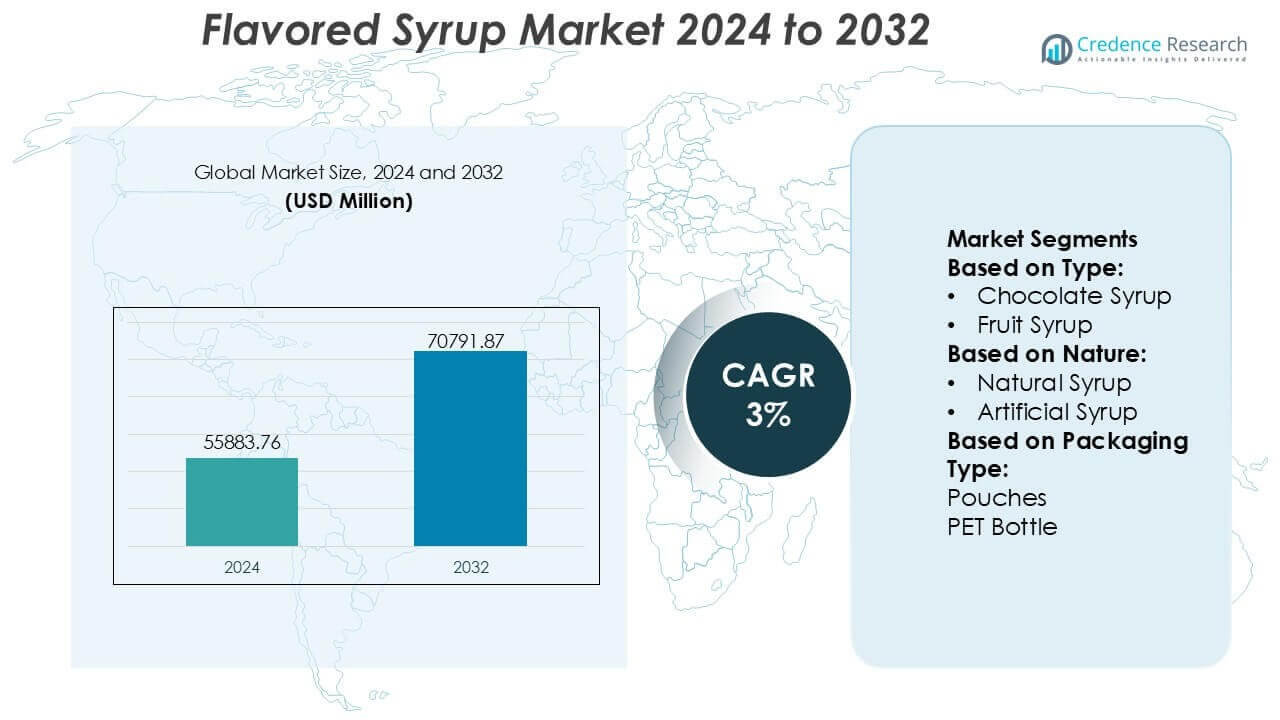
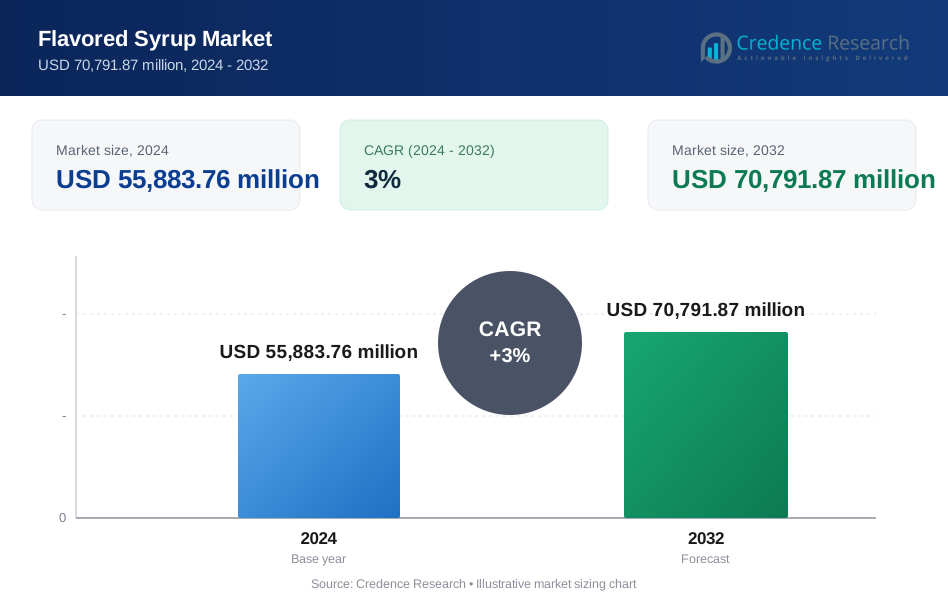
Flavored Syrup Market size was valued USD 55883.76 million in 2024 and is anticipated to reach USD 70791.87 million by 2032, at a CAGR of 3% during the forecast period.
| REPORT ATTRIBUTE | DETAILS |
|---|---|
| Historical Period | 2020-2023 |
| Base Year | 2024 |
| Forecast Period | 2025-2032 |
| Flavored Syrup Market Size 2024 | USD 55883.76 million |
| Flavored Syrup Market, CAGR | 3% |
| Flavored Syrup Market Size 2032 | USD 70791.87 million |
Flavored Syrup Market Insights
- Market growth is driven by rising consumption of flavored beverages, strong demand from cafés and quick-service restaurants, and increasing use of syrups in desserts, dairy products, and home beverages, with fruit and chocolate syrups together accounting for over 50% of total segment share.
- Key trends include a shift toward clean-label and natural syrups, sugar-reduction formulations, premium and artisanal flavors, and customized syrups for foodservice chains, supporting higher value realization.
- The competitive landscape remains moderately fragmented, with global ingredient suppliers and branded manufacturers competing through flavor innovation, private-label expansion, and sustainable packaging investments.
- North America leads the market with an exact 38% regional share, supported by a mature foodservice ecosystem, high specialty coffee consumption, and strong retail penetration, while Asia-Pacific shows faster adoption in flavored beverage applications.
Flavored Syrup Market Segmentation Analysis:
By Type
By type, the flavored syrup market is led by fruit syrup, which holds an estimated 38% market share, driven by its broad application across beverages, desserts, dairy products, and breakfast foods. Fruit syrups benefit from strong consumer preference for familiar flavors such as strawberry, mango, and blueberry, along with rising demand from cafés and quick-service restaurants. Chocolate syrup follows closely, supported by its extensive use in confectionery and milk-based drinks. Maple syrup maintains steady demand in premium breakfast applications, while other syrups cater to niche culinary and regional flavor requirements.
- For instance, Tate & Lyle’s innovation portfolio includes sweetening and texturant technologies that directly support fruit-forward and flavored beverage formulations, such as the TASTEVA® Sol stevia sweetener with over 200× the solubility of conventional stevia extracts, enabling stable, high-sugar-replacement syrup bases even at elevated processing temperatures without crystallization issues.
By Nature
By nature, artificial syrup dominates the market with an approximate 57% share, primarily due to its cost efficiency, longer shelf life, and consistent flavor stability in large-scale foodservice and industrial applications. Manufacturers favor artificial formulations for mass production and standardized taste profiles across geographies. However, natural syrup is gaining traction, driven by clean-label trends and rising consumer awareness of ingredient transparency. Demand for natural syrups is especially strong in premium retail channels, organic food products, and specialty beverages, where authenticity and perceived health benefits influence purchasing decisions.
- For instance, Smucker’s portion-control breakfast syrup units feature encoded batch traceability on each 1.0 ounce dispenser, allowing precise tracking of process and quality parameters across production runs a capability used to support manufacturing reproducibility and food safety protocols from raw ingredient intake to finished goods distribution.
By Packaging Type
By packaging type, PET bottles account for nearly 44% of total market share, supported by their lightweight nature, durability, and cost-effective logistics across retail and foodservice channels. PET bottles offer convenience for both household and commercial users, making them the preferred choice for high-volume distribution. Glass bottles retain importance in premium and gourmet segments due to their superior shelf appeal and flavor preservation. Pouches are witnessing growing adoption in institutional and bulk-use settings, driven by reduced packaging material usage and improved storage efficiency.
Key Growth Drivers
Rising Demand from Foodservice and Beverage Applications
The flavored syrup market benefits strongly from expanding foodservice consumption across cafés, quick-service restaurants, and beverage chains. Syrups are integral to coffee-based drinks, milkshakes, mocktails, desserts, and breakfast items, offering consistency, flavor customization, and ease of use. Rapid urbanization, rising café culture, and growth in out-of-home consumption support higher volume demand. In parallel, beverage brands increasingly rely on flavored syrups to launch seasonal and limited-edition offerings, enabling faster product innovation and improved customer engagement without major formulation changes.
- For instance, Toschi’s Zero+ syrup and topping range was engineered to achieve 50 % fewer calories compared with conventional dessert toppings, purpose-built via reformulated carbohydrate matrices and fruit solids (as shown in Toschi product specifications), while maintaining sensory profiles acceptable to professional baristas and gelato artisans.
Growth of Home Consumption and DIY Beverage Culture
Increasing at-home consumption of specialty beverages significantly supports flavored syrup demand. Consumers are recreating café-style drinks at home, including flavored coffees, teas, sodas, and dessert toppings, driving retail syrup sales. E-commerce expansion and improved product availability across supermarkets further accelerate adoption. Compact packaging, longer shelf life, and versatility across multiple recipes make flavored syrups attractive household staples. Social media influence, recipe sharing, and home entertaining trends also encourage experimentation with new flavors, supporting steady growth across both premium and mass-market segments.
- For instance, Kerry has invested over 3 billion cumulatively in science and technology infrastructure, supporting 22 core technology platforms, 70+ technology and innovation centres worldwide, and a global R&D and applications workforce of 1,200+ scientists dedicated to taste, texture, functional, and nutritional systems development.
Product Innovation and Expanding Flavor Portfolios
Continuous innovation in flavor profiles remains a key growth driver for the flavored syrup market. Manufacturers are expanding beyond traditional chocolate and fruit flavors into botanicals, spices, floral notes, and regional specialties. Seasonal launches and limited-edition variants help brands differentiate and maintain consumer interest. Improved processing technologies also enhance flavor stability and color retention, improving product quality. These innovations enable manufacturers to address diverse taste preferences across age groups, regions, and applications, strengthening brand loyalty and driving repeat purchases.
Key Trends & Opportunities
Shift Toward Natural and Clean-Label Formulations
A strong trend in the flavored syrup market is the shift toward natural ingredients and clean-label positioning. Consumers increasingly prefer syrups made with natural sweeteners, fruit extracts, and minimal artificial additives. This creates opportunities for manufacturers to reformulate products using plant-based colors, natural flavors, and reduced-sugar profiles. Clean-label syrups appeal strongly to health-conscious consumers and premium foodservice operators, supporting higher margins. Transparency in ingredient sourcing and simplified labels also enhances brand credibility and aligns with broader wellness-driven purchasing behavior.
- For instance, Torani has embedded measurable operational and product innovation into its syrup business. According to credible reporting on the company’s San Leandro, California production facility, Torani produces approximately 450,000 bottles of flavored syrup per day, with advanced bottling technology that wraps 150 bottles per minute using automated capping and labeling systems, reflecting high-throughput quality manufacturing practices.
Premiumization and Gourmet Flavor Positioning
Premiumization represents a major opportunity within the flavored syrup market. Consumers are increasingly willing to pay more for artisanal, gourmet, and specialty syrups that offer unique taste experiences. Small-batch production, exotic ingredients, and origin-specific flavors support premium positioning. This trend is particularly strong in specialty coffee, craft beverages, and upscale dessert applications. Premium syrups help foodservice operators differentiate menus and improve perceived product quality, while manufacturers benefit from stronger brand differentiation and improved profitability.
- For instance, Symrise also operates a global portfolio of over 35,000 distinct flavor, fragrance, and functional ingredient solutions used by approximately 6,000 customers across 150 countries, reflecting extensive product breadth and standardized quality frameworks that support its innovation pipeline across multiple application areas.
Growth Opportunities in Emerging Markets
Emerging economies present significant growth opportunities for the flavored syrup market due to rising disposable incomes and evolving consumption habits. Expanding café chains, western-style desserts, and flavored beverage adoption are increasing syrup usage across Asia-Pacific, Latin America, and the Middle East. Urban youth populations drive experimentation with new flavors and beverage formats. Improved cold-chain logistics and retail penetration further support market expansion, enabling both global and regional players to strengthen their presence in these high-growth regions.
Key Challenges
Health Concerns Related to Sugar Content
Health concerns associated with high sugar intake pose a key challenge for the flavored syrup market. Increasing awareness of obesity, diabetes, and related lifestyle diseases has led consumers to reduce consumption of sugary products. Regulatory pressure and sugar taxation in several regions further impact demand. These factors compel manufacturers to invest in reduced-sugar and alternative-sweetener formulations, which can increase production complexity and costs. Balancing taste, texture, and shelf stability while meeting health expectations remains a persistent challenge.
Volatility in Raw Material Prices and Supply Chains
Fluctuations in the prices of sugar, fruit concentrates, cocoa, and flavoring ingredients challenge cost stability in the flavored syrup market. Agricultural dependency exposes manufacturers to climate-related risks and supply disruptions. Packaging material price volatility also affects overall production costs. These factors can pressure profit margins, especially for mass-market products with limited pricing flexibility. Managing supplier diversification, inventory planning, and cost optimization is essential for manufacturers to maintain consistent quality and competitive pricing in a dynamic supply environment.
Regional Analysis
North America
North America leads the flavored syrup market, accounting for an estimated 38% share, driven by strong café culture, high consumption of specialty coffee, and widespread adoption across foodservice and retail channels. The region benefits from a mature quick-service restaurant ecosystem and strong penetration of flavored beverages, desserts, and breakfast applications. Consumers show high acceptance of seasonal and premium flavors, supporting frequent product innovation. In addition, rising at-home beverage preparation and strong e-commerce distribution further reinforce demand, making North America the most dominant and innovation-driven regional market.
Europe Europe represents approximately 27% of the flavored syrup market, supported by established bakery, confectionery, and café traditions. Flavored syrups are widely used in coffee, pastries, desserts, and dairy-based beverages. Demand is further strengthened by growing interest in premium and natural flavor formulations, particularly in Western Europe. Regulatory emphasis on ingredient transparency encourages clean-label and reduced-sugar variants. While growth is moderate compared to emerging regions, strong brand loyalty, diversified applications, and steady foodservice demand ensure Europe remains a key contributor to overall market revenue.
Asia-Pacific
Asia-Pacific holds an estimated 24% share of the flavored syrup market and is the fastest-growing regional segment. Rapid urbanization, expanding café chains, and increasing western-style beverage consumption drive strong demand. Countries such as China, Japan, South Korea, and India show rising adoption of flavored coffees, teas, and desserts among younger consumers. Growth is further supported by increasing disposable incomes and experimentation with fusion and regional flavors. Expanding retail infrastructure and foodservice outlets position Asia-Pacific as a critical growth engine for global market expansion.
Latin America
Latin America accounts for around 6% of the flavored syrup market, supported by rising consumption of flavored beverages, desserts, and bakery products. Growth is driven by expanding urban populations and increasing penetration of café and quick-service restaurant formats. Flavored syrups are commonly used in dairy drinks, iced beverages, and local dessert applications. Although price sensitivity remains a constraint, improving retail access and growing middle-class demand support gradual market expansion. Regional flavor preferences also encourage localized product development, enhancing long-term growth potential.
Middle East & Africa
The Middle East & Africa region represents approximately 5% of the flavored syrup market. Demand is supported by strong hospitality, tourism, and café culture, particularly in the Gulf countries. Flavored syrups are widely used in mocktails, specialty coffees, and desserts across hotels and restaurants. Rising urbanization and increasing adoption of western-style foodservice concepts support steady growth. However, market development remains uneven across Africa due to infrastructure and pricing challenges, keeping overall regional share comparatively limited despite positive long-term prospects.
Flavored Syrup Market Segmentations:
By Type:
- Chocolate Syrup
- Fruit Syrup
By Nature:
- Natural Syrup
- Artificial Syrup
By Packaging Type:
- Pouches
- PET Bottle
By Geography
- North America
- U.S.
- Canada
- Mexico
- Europe
- Germany
- France
- U.K.
- Italy
- Spain
- Rest of Europe
- Asia Pacific
- China
- Japan
- India
- South Korea
- South-east Asia
- Rest of Asia Pacific
- Latin America
- Brazil
- Argentina
- Rest of Latin America
- Middle East & Africa
- GCC Countries
- South Africa
- Rest of the Middle East and Africa
Competitive Landscape
The flavored syrup market players such as Panos Brands, Tate & Lyle, Monin Inc., The J.M. Smucker Company, Toschi Vignola s.r.l., Kerry Group, Torani, The Kraft Heinz Company, Fuerst Day Lawson. The flavored syrup market is characterized by intense competition driven by product differentiation, innovation, and channel diversification across retail and foodservice segments. Companies compete by expanding flavor portfolios, improving formulation quality, and aligning products with evolving consumer preferences such as clean-label ingredients, reduced sugar content, and natural flavor sources. Strong relationships with cafés, beverage chains, and food manufacturers play a critical role in sustaining volumes and ensuring repeat demand, while private-label offerings intensify price-based competition in mass retail. Operational scale, sourcing efficiency, and consistent quality standards remain essential for maintaining margins in a cost-sensitive environment. At the same time, premiumization trends support growth for suppliers offering specialty, artisanal, or customizable syrups tailored to coffee, cocktail, and dessert applications. Overall, the competitive landscape is shaped by continuous product innovation, brand positioning, supply-chain resilience, and the ability to balance premium offerings with cost-effective solutions across global markets.
Key Player Analysis
- Panos Brands
- Tate & Lyle
- Monin Inc.
- The J.M. Smucker Company
- Toschi Vignola s.r.l.
- Kerry Group
- Torani
- The Kraft Heinz Company
- Fuerst Day Lawson
- The Hershey Company
Recent Developments
- In April 2024, Torani did launch a new dragon fruit syrup responding to growing consumer interest, offering a sweet, slightly tart, pear-like flavor for drinks and desserts, made with pure cane sugar and natural flavors, perfect for iced teas, lemonades, and tropical creations.
- In January 2024, Brookside Flavors and Ingredients (BFI) has acquired Sterling Food Flavorings, LLC, a manufacturer of flavoring systems for the food and beverage industry. This strategic move enables BFI to broaden its customer reach, expand its product and service offerings, and strengthen its overall product portfolio.
- In November 2023, Canadian Maple Co. launched an innovative digital platform, spearheaded by Yanik Guillemette, to directly export Canadian maple syrup globally, combining tech (Shopify) with tradition to overcome distribution hurdles, ensuring authenticity, and reaching health-conscious consumers through content marketing and streamlined e-commerce, proving digital tools are vital for niche food exports.
Report Coverage
The research report offers an in-depth analysis based on Type, Nature, Packaging Type and Geography. It details leading market players, providing an overview of their business, product offerings, investments, revenue streams, and key applications. Additionally, the report includes insights into the competitive environment, SWOT analysis, current market trends, as well as the primary drivers and constraints. Furthermore, it discusses various factors that have driven market expansion in recent years. The report also explores market dynamics, regulatory scenarios, and technological advancements that are shaping the industry. It assesses the impact of external factors and global economic changes on market growth. Lastly, it provides strategic recommendations for new entrants and established companies to navigate the complexities of the market.
Request a Free Sample
Fill in your details and we'll send you a free sample report.
- Sample data tables & charts
- Research methodology
Need a Custom Version of This Report?
Tailor the scope, geography, or segments to your exact requirements.
- Custom geography or segment scope
- Direct access to our analyst team
Frequently Asked Questions
What is the current market size for the Flavored Syrup Market, and what is its projected size in 2032?
At what Compound Annual Growth Rate is the Flavored Syrup Market projected to grow between 2024 and 2032?
Which Flavored Syrup segment held the largest share in 2024?
What are the primary factors fueling the growth of the Flavored Syrup Market?
Who are the leading companies in the Flavored Syrup Market?
Which region commanded the largest share of the Flavored Syrup Market in 2024?
Table of Content
Chapter 1. Report Introduction
- 1.1 Report Description & Purpose
- 1.1.1 Report Title & Market Definition
- 1.1.2 Unique Selling Propositions (USP) & Key Differentiators
- 1.1.3 Value Proposition for Stakeholders
- 1.2 Research Objectives
- 1.2.1 Market Sizing Objectives (Volume & Revenue)
- 1.2.2 Segmentation Objectives
- 1.2.3 Competitive Intelligence Objectives
- 1.2.4 Forecast & Scenario Objectives
- 1.3 Report Scope
- 1.3.1 Flavored Syrup Scope – Types & Subtypes Covered
- 1.3.2 Geographic Scope – Regions & Countries Covered
- 1.3.3 Historical Period, Base Year & Forecast Period (2024; forecast to 2032)
- 1.3.4 Inclusions & Exclusions
- 1.4 HS Code & Classification Framework
- 1.5 Currency, Units & Pricing Basis
- 1.6 Target Stakeholders
- 1.7 Limitations & Assumptions
Chapter 2. Executive Summary
- 2.1 Global Flavored Syrup Market Snapshot
- 2.1.1 Market Size – Historical (2024) & Forecast (2024-2032) (2024: USD 55,883.76 million → 2032: USD 70,791.87 million)
- 2.1.2 Volume & Revenue – Global Totals
- 2.1.3 Key Market Highlights – Top Five Facts
- 2.2 Flavored Syrup Market Segmentation Snapshot
- 2.2.1 Market Split by Region – 2024 vs. 2032
- 2.3 Competitive Snapshot
- 2.3.1 Top 10 Players by Revenue Share – 2024
- 2.3.2 Top 10 Players by Volume Share – 2024
- 2.3.3 Recent Strategic Developments (18-Month Summary)
- 2.4 Key Investment Highlights & Strategic Conclusions
Chapter 3. Flavored Syrup Market Dynamics & Industry Analysis
- 3.1 Market Overview & Context
- 3.1.1 Flavored Syrup Market Position in the Broader Automotive Value Chain
- 3.1.2 OEM vs. Replacement Market Dynamics
- 3.1.3 Market Maturity & Development Stage by Region
- 3.2 Flavored Syrup Market Drivers
- 3.3 Flavored Syrup Market Restraints & Challenges
- 3.4 Flavored Syrup Market Opportunities
- 3.5 Porter's Five Forces Analysis
- 3.5.1 Threat of New Entrants
- 3.5.2 Bargaining Power of Suppliers
- 3.5.3 Bargaining Power of Buyers
- 3.5.4 Threat of Substitutes
- 3.5.5 Competitive Rivalry – Intensity Assessment
- 3.6 Flavored Syrup Value Chain Analysis
- 3.6.1 Upstream – Raw Material/Input Suppliers
- 3.6.1.1 Raw Material/Input 1
- 3.6.1.2 Raw Material/Input 2
- 3.6.1.3 Raw Material/Input 3
- 3.6.2 Midstream – Production/Manufacturing/Service Delivery
- 3.6.2.1 Production/Process Overview
- 3.6.2.2 Key Facility Locations & Capacity by Manufacturer
- 3.6.3 Downstream – Distribution & End Consumer
- 3.6.3.1 Primary Channel – B2B/OEM
- 3.6.3.2 Secondary Channels – Dealer, Retail, Online, Direct
- 3.6.4 Value Chain Profitability Analysis
- 3.6.1 Upstream – Raw Material/Input Suppliers
- 3.7 PESTEL Analysis
- 3.7.1 Political Factors
- 3.7.2 Economic Factors
- 3.7.3 Social Factors
- 3.7.4 Technological Factors
- 3.7.5 Environmental Factors
- 3.7.6 Legal Factors
- 3.8 Flavored Syrup Supply Chain Analysis
- 3.8.1 Raw Material/Input Supply Risk Assessment
- 3.8.2 Manufacturing Concentration Risk (Geographic Exposure)
- 3.8.3 Trade Disruption Impact Analysis
- 3.9 Regulatory & Policy Landscape
Note: The regulatory and policy landscape section covers regulations based on their applicability to the market, Flavored Syrup category, geography, and scope of the study. Only regulatory frameworks with a material impact on operations, compliance, trade, sustainability, or market access are analyzed in detail.
Chapter 4. Key Investment Pockets & Opportunity Analysis
- 4.1 Flavored Syrup Market Attractiveness Analysis
- 4.1.1 By Region – Investment Attractiveness Matrix (Volume × CAGR)
- 4.2 Absolute Revenue Growth Opportunity
- 4.2.1 By Region – Absolute USD Growth Through 2032
- 4.3 Incremental Volume Opportunity
- 4.3.1 By Region – Incremental Volume Through 2032
- 4.3.2 Segment – Incremental Volume
- 4.4 Emerging Submarket Opportunity Deep Dive (Subject to Applicability)
- 4.5 Emerging Market Opportunity Scorecards
- 4.5.1 United States
- 4.5.2 Europe
- 4.5.3 Asia
- 4.5.4 Middle East & Africa
Note: Emerging Market Opportunity Scorecards will be included based on relevance and strategic importance. Regions listed are indicative and may vary depending on data availability and market dynamics.
Chapter 5. Flavored Syrup Import-Export Analysis & Trade Flows
- 5.1 Global Trade Overview
- 5.1.1 Global Export Value by Country (2024)
- 5.1.2 Global Export Volume by Country (2024)
- 5.1.3 Global Import Value by Country (2024)
- 5.1.4 Global Import Volume by Country (2024)
- 5.1.5 Net Trade Balance by Country (2024)
- 5.2 Export Analysis – Segment
- 5.2.1 Type 1 (HS Code)
- 5.2.2 Type 2 (HS Code)
- 5.2.3 Type 3 (HS Code)
- 5.2.4 Type 4 (HS Code)
- 5.2.5 Type 5 (HS Code)
- 5.3 Import Analysis – Segment
- 5.3.1 Type 1 (HS Code)
- 5.3.2 Type 2 (HS Code)
- 5.3.3 Type 3 (HS Code)
- 5.3.4 Type 4 (HS Code)
- 5.3.5 Type 5 (HS Code)
- 5.4 Average Unit Trade Prices
- 5.4.1 Average Export Price – Segment & Country
- 5.4.2 Average Import Price – Segment & Source Country
- 5.4.3 Price Trends (2024)
- 5.5 Key Trade Route Analysis
- 5.5.1 Trade Route 1
- 5.5.2 Trade Route 2
- 5.5.3 Trade Route 3
- 5.5.4 Trade Route 4
- 5.5.5 Trade Route 5
- 5.6 Trade Policy Impact Assessment
- 5.6.1 US Anti-Dumping & Section 301 Tariffs
- 5.6.2 EU Customs Union Impact
- 5.6.3 Major Free Trade Agreements
- 5.6.4 USMCA Rules of Origin
Note: Trade policy analysis will be included only where relevant to the Flavored Syrup market.
Chapter 6. Competitive Landscape & Company Benchmarking
- 6.1 Flavored Syrup Market Concentration & Structure
- 6.1.1 Herfindahl-Hirschman Index (HHI) – vs. 2024
- 6.1.2 Tier 1, Tier 2 & Tier 3 Market Structure
- 6.1.3 Global, Regional & Local Player Dynamics
- 6.2 Flavored Syrup Market Share Analysis – 2024
- 6.2.1 Global Revenue Share by Company
- 6.2.2 Global Volume Share by Company
- 6.2.3 Regional Revenue Share
- 6.2.4 Market Share Evolution ( vs. 2024)
- 6.2.5 OEM Segment Share by Company
- 6.2.6 Replacement Segment Share by Company
- 6.3 Production/Delivery Capacity & Facility Analysis
- 6.3.1 Global Installed Capacity
- 6.3.2 Capacity Utilization Rates
- 6.3.3 Production/Output Volume
- 6.3.4 Facility Locations & Capacity Map
- 6.3.5 Planned Capacity Additions
- 6.4 Flavored Syrup Competitive Benchmarking Matrix
- 6.4.1 Revenue, Volume, CAGR & Profitability Comparison
- 6.4.2 Channel Revenue Mix
- 6.4.3 Geographic Revenue Exposure
- 6.4.4 R&D Intensity
- 6.4.5 Sustainability Maturity
- 6.5 Strategic Developments in Flavored Syrup (Last 24 Months)
- 6.5.1 Mergers, Acquisitions & Divestments
- 6.5.2 New Flavored Syrup Launches
- 6.5.3 Facility Expansions
- 6.5.4 Strategic Alliances, Joint Ventures & Partnerships
- 6.5.5 Distribution Expansion & Market Entry
- 6.5.6 Sustainability & ESG Initiatives
- 6.6 Competitive Strategy Mapping
- 6.6.1 Leader, Challenger, Follower & Niche Classification
- 6.6.2 Pricing Strategy Comparison
- 6.6.3 Channel Strategy Matrix
Note: Strategic developments are included based on their materiality and the availability of reliable information.
Chapter 7. Global Flavored Syrup Market – By Distribution Channel
- 7.1 Segment Overview
- 7.1.1 Volume & Revenue Split by Channel (2024 & 2032)
- 7.1.2 Channel Mix Evolution (2024-2032)
Chapter 8. Regional Market Analysis – Global Overview
- 8.1 Global Regional Overview
- 8.1.1 Regional Volume Share
- 8.1.2 Regional Revenue Share
- 8.1.3 Regional Volume by Region
- 8.1.4 Regional Revenue by Region
- 8.1.5 Regional Forecast Through 2032
- 8.2 Cross-Regional Segment Analysis
- 8.2.1 By Distribution Channel
- 8.2.2 By Brand/Price Tier
Chapter 9. North America Flavored Syrup Market
- 9.1 United States
- 9.2 Canada
- 9.3 Mexico
Chapter 10. Europe Flavored Syrup Market
- 10.1 Germany
- 10.2 France
- 10.3 Italy
- 10.4 United Kingdom
- 10.5 Spain
- 10.6 Poland
- 10.7 Russia
- 10.8 Netherlands
- 10.9 Belgium
- 10.10 Sweden
- 10.11 Denmark
- 10.12 Norway
- 10.13 Rest of Europe
Chapter 11. Asia Pacific Flavored Syrup Market
- 11.1 China
- 11.2 India
- 11.3 Japan
- 11.4 South Korea
- 11.5 Thailand
- 11.6 Indonesia
- 11.7 Vietnam
- 11.8 Malaysia
- 11.9 Australia
- 11.10 Rest of Asia Pacific
Chapter 12. Latin America Flavored Syrup Market
- 12.1 Brazil
- 12.2 Argentina
- 12.3 Colombia
- 12.4 Chile
- 12.5 Rest of Latin America
Chapter 13. Middle East Flavored Syrup Market
- 13.1 Saudi Arabia
- 13.2 United Arab Emirates
- 13.3 Turkey
- 13.4 Israel
- 13.5 Iran
- 13.6 Rest of the Middle East
Chapter 14. Africa Flavored Syrup Market
- 14.1 South Africa
- 14.2 Egypt
- 14.3 Nigeria
- 14.4 Morocco
- 14.5 Rest of Africa
Chapter 15. Flavored Syrup Company Profiles
- 15.1 [Company 01]
- 15.1.1 Company Overview
- 15.1.2 Key Management Personnel
- 15.1.3 Products & Services Portfolio
- 15.1.4 Financial Performance
- 15.1.5 Key Market Focus & Geographic Presence
- 15.1.6 Recent Developments & Strategic Initiatives
Note: The company profile list is preliminary and may change based on research findings, market developments, data availability, and client requirements.
Chapter 16. Appendices
- Appendix A – List of Abbreviations & Acronyms
- Appendix B – Industry Classification Code Reference – Full Series
- Appendix C – Production & Capacity Data Tables
- Appendix D – End-Use & Demand Base Tables
- Appendix E – Consumption & Replacement Rate Assumptions
- Appendix F – ASP Reference Tables
- Appendix G – Manufacturing & Facility Database
- Appendix H – Import-Export Data Tables
- Appendix I – Regulatory Summary Tables
- Appendix J – Primary Research Participant List (Anonymized)
- Appendix K – Primary Research Questionnaire Framework
- Appendix L – Data Sources & Bibliography
- Appendix M – Market Size Divergence & Source Comparison
Chapter 17. Research Methodology
- 17.1 Research Framework & Philosophy
- 17.2 Secondary Research – Sources, Hierarchy & Data Extraction
- 17.3 Data Modeling – Bottom-Up & Top-Down Market Sizing
- 17.4 Primary Research – Stakeholder Framework, LOI & Sample Sizes
- 17.5 Forecast Methodology – Regression, Scenario & Sensitivity Analysis
- 17.6 Quality Control – Four-Layer Validation Framework
- 17.7 Limitations & Standard Assumptions
- 17.8 Disclaimer
