
Market Overview:
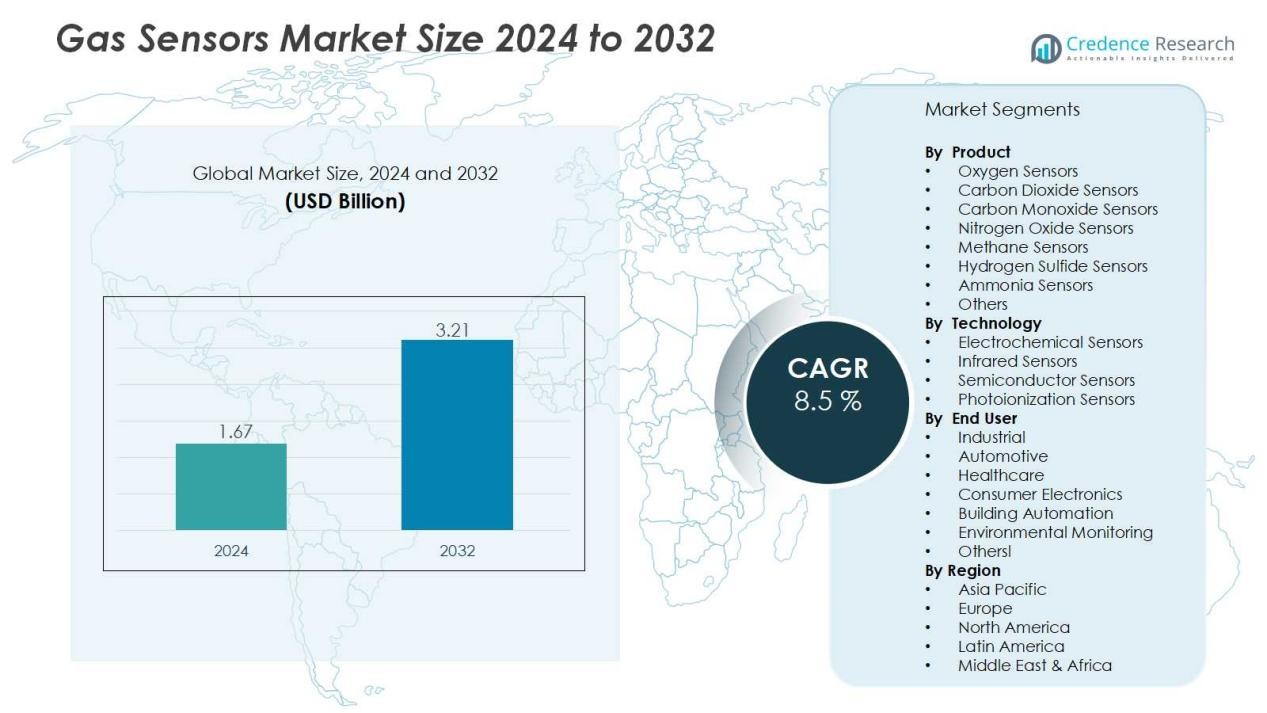
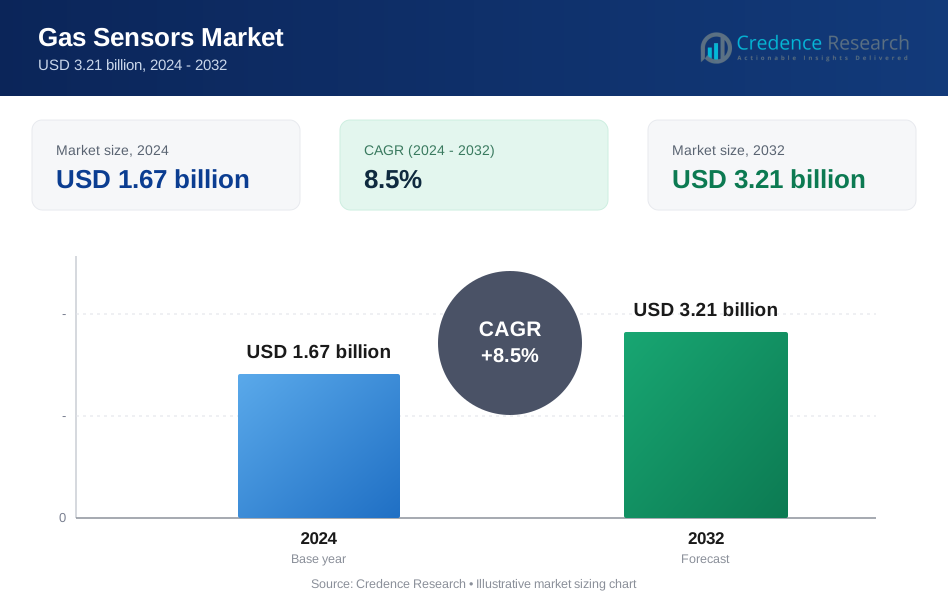
The gas sensors market size was valued at USD 1.67 billion in 2024 and is anticipated to reach USD 3.21 billion by 2032, at a CAGR of 8.5 % during the forecast period (2024-2032).
| REPORT ATTRIBUTE | DETAILS |
|---|---|
| Historical Period | 2020-2023 |
| Base Year | 2024 |
| Forecast Period | 2025-2032 |
| Gas Sensors Market Size 2024 | USD 1.67 Billion |
| Gas Sensors Market, CAGR | 8.5 % |
| Gas Sensors Market Size 2032 | USD 3.21 Billion |
Key drivers include increasing emphasis on workplace safety and environmental monitoring, particularly in industries handling hazardous gases. Governments and international organizations are enforcing stringent emission control policies, further fueling adoption. Technological advancements such as miniaturization, wireless connectivity, and integration with IoT platforms have enhanced the efficiency of gas sensors. Their use in smart home devices, air quality monitoring systems, and wearable electronics is also accelerating demand, creating opportunities in both developed and emerging markets.
Regionally, North America holds a dominant share due to advanced industrial infrastructure, strong safety regulations, and rapid adoption of smart sensing solutions. Europe follows closely, driven by environmental standards and widespread integration in automotive and manufacturing sectors. Asia-Pacific is expected to record the fastest growth, supported by urbanization, rising industrial output, and government-led air quality initiatives in countries such as China and India. Latin America and the Middle East & Africa are emerging markets with increasing awareness and adoption of gas detection technologies.
Market Insights:
- The gas sensors market size was valued at USD 1.67 billion in 2024 and is expected to reach USD 3.21 billion by 2032, growing at a CAGR of 8.5% between 2024 and 2032.
- Rising workplace safety regulations and the need for environmental monitoring drive strong adoption across oil and gas, mining, and chemical industries.
- Consumer and automotive applications are expanding, with sensors embedded in smartphones, wearables, air purifiers, and vehicles for emission control and cabin air quality.
- Advances in miniaturization, IoT integration, and low-power designs enhance performance and create opportunities in smart cities, healthcare, and industrial automation.
- Government policies enforcing emission targets and investments in clean air programs strengthen demand for eco-friendly, energy-efficient gas sensors.
- Challenges include high calibration costs, limited multi-gas detection in complex environments, and regulatory differences that increase compliance burdens for manufacturers.
- North America led with 32% market share in 2024, Europe followed with 28%, while Asia-Pacific held 25% and is projected to grow fastest, supported by urbanization, industrialization, and government-led air quality initiatives.
Market Drivers:
Rising Need for Workplace and Environmental Safety:
The gas sensors market size benefits from strict regulations focused on worker protection and environmental safety. Industries such as oil and gas, mining, and chemicals deploy gas sensors to detect leaks and prevent accidents. It helps companies comply with occupational safety standards and avoid penalties. Growing awareness about air pollution and its health impacts strengthens the demand for continuous monitoring systems. This focus on safety directly supports market adoption.
- For instance, ExxonMobil partnered with Scepter Inc. in 2021 to deploy satellite technology for real-time methane emissions detection, with plans to expand to over 24 satellites within three years.
Expanding Applications Across Consumer and Automotive Sectors:
Gas sensors are increasingly integrated into consumer electronics and smart home devices. Smartphones, wearables, and air purifiers now feature compact sensors for air quality tracking. The automotive sector uses them in emission control systems, cabin air quality monitoring, and electric vehicle safety. The gas sensors market size grows steadily as manufacturers embed sensors to meet customer expectations. It opens opportunities across both premium and mass-market product categories.
- For Instance, The Eve Room Indoor Air Quality Monitor, manufactured by Eve Systems, uses advanced VOC sensors to measure volatile organic compounds and has a typical temperature accuracy of ±0.3°C.
Technological Advancements and IoT Integration:
Advances in sensor technology, miniaturization, and low-power designs drive broader usage. Wireless connectivity and IoT integration allow sensors to connect with smart infrastructure for real-time monitoring. It creates opportunities in smart cities, industrial automation, and healthcare devices. Enhanced durability and accuracy improve their performance in harsh environments. These innovations extend the market’s relevance across multiple industries.
Government Policies and Sustainability Initiatives:
Governments worldwide are setting strict emission targets and investing in clean air programs. Public health campaigns highlight the importance of detecting harmful gases in urban areas. The gas sensors market size expands as cities adopt monitoring networks for pollution control. It also benefits from subsidies and incentives for companies developing energy-efficient, eco-friendly sensors. Sustainability goals continue to push adoption across developed and developing regions.
Market Trends:
Growing Integration of Smart and Connected Sensor Solutions:
The gas sensors market size is witnessing strong momentum with the rise of smart and connected technologies. IoT-enabled gas sensors allow industries, municipalities, and households to monitor air quality in real time. It supports predictive maintenance in industrial settings, reducing downtime and preventing hazardous leaks. Smart home adoption also strengthens growth, as consumers demand air quality features in appliances, wearables, and security systems. Cloud connectivity enables centralized data analysis and faster responses to safety incidents. This trend reinforces the role of gas sensors as critical components in smart city projects and advanced industrial automation systems.
- For instance, in March 2024, Teledyne Technologies launched the OLCT 100-XP-MS, which uses MEMS technology to detect over 14 combustible gases with a detection range down to 1 part per million (ppm), providing precise detection and enhanced environmental resistance for real-time industrial safety monitoring.
Shift Toward Miniaturized, Energy-Efficient, and Eco-Friendly Designs:
Manufacturers are focusing on miniaturized and low-power gas sensors to expand use across portable and battery-powered devices. Wearable health monitors and mobile electronics now integrate compact sensors for continuous air quality assessment. It reflects consumer preference for devices that balance portability with advanced functionality. Eco-friendly sensor designs also align with global sustainability initiatives, reducing energy consumption and extending product lifespans. Advances in nanomaterials and MEMS technology improve detection accuracy while lowering production costs. The gas sensors market size benefits from these innovations, creating opportunities in healthcare, consumer electronics, and environmental monitoring applications.
- For Instance, ams OSRAM's AS6200 digital temperature sensor, released in 2016, is utilized in medical, mobile, and wearable applications, providing a digital resolution of 12 bits.
Market Challenges Analysis:
High Costs, Calibration Needs, and Performance Limitations:
The gas sensors market size faces challenges due to high initial costs and ongoing calibration requirements. Industrial users often need frequent sensor replacement or recalibration to maintain accuracy, which raises operational expenses. It also struggles with limited sensitivity in detecting multiple gases simultaneously, especially in complex environments. Harsh operating conditions such as extreme humidity, temperature, or chemical interference reduce performance reliability. These technical constraints slow adoption among small and medium-sized enterprises with limited budgets.
Intense Competition and Regulatory Complexity:
The market also contends with stiff competition among global and regional players, creating pricing pressures that impact profit margins. It forces manufacturers to balance innovation with affordability, which can delay large-scale commercialization of advanced models. Regulatory frameworks differ widely across countries, adding complexity for companies expanding internationally. Compliance with safety, emission, and environmental standards requires significant investment in testing and certification. Evolving government policies on air quality and emissions create uncertainty, making long-term planning difficult for suppliers. These obstacles limit growth despite strong underlying demand drivers.
Market Opportunities:
Expanding Role in Smart Cities and Healthcare Applications:
The gas sensors market size is positioned to benefit from rapid investments in smart city projects worldwide. Governments are deploying air quality monitoring networks to address pollution and public health concerns. It creates demand for connected, low-power sensors integrated with IoT and cloud platforms. Healthcare applications also present growth opportunities, with sensors used in respiratory monitoring, medical devices, and hospital safety systems. Rising awareness about indoor air quality in residential and commercial buildings further supports adoption. These opportunities highlight the growing role of gas sensors in ensuring sustainable and healthy living environments.
Advancements in Materials and Industrial Automation Adoption:
Innovations in nanotechnology and MEMS-based designs are expanding the range of gas sensor applications. Smaller, energy-efficient, and cost-effective sensors enable broader use in consumer electronics, wearables, and portable safety devices. It allows manufacturers to cater to new end markets while improving performance in traditional industries. Industrial automation and Industry 4.0 trends also create opportunities for embedded sensor solutions. Companies are investing in smart manufacturing systems where gas sensors ensure operational safety and efficiency. These advancements position the market for accelerated growth in both mature and emerging economies.
Market Segmentation Analysis:
By Product:
The gas sensors market size is segmented into oxygen sensors, carbon dioxide sensors, carbon monoxide sensors, nitrogen oxide sensors, and others. Oxygen and carbon monoxide sensors account for a significant share due to wide use in automotive, industrial, and residential safety systems. It is expected that demand for carbon dioxide sensors will rise strongly with growing indoor air quality monitoring requirements. Nitrogen oxide sensors also gain traction from stringent emission control policies in automotive and industrial applications.
- For instance, in 2024, RedNOx demonstrated a solid-state nitrogen oxide sensor based on the OSU platform, capable of detecting NOx levels from 125 parts per billion (ppb) up to 5 parts per million (ppm) for in-situ environmental and agricultural monitoring.
By End-use:
End-use segments include industrial, automotive, healthcare, consumer electronics, and building automation. Industrial applications dominate due to strict safety regulations in oil and gas, mining, and chemical sectors. The automotive sector is expanding its share as vehicles integrate sensors for emission control and passenger safety. Healthcare adoption is increasing with the use of sensors in medical equipment and hospital air monitoring. It also finds opportunities in consumer electronics and smart homes, where demand for portable air quality monitoring devices continues to grow.
- For instance, Montrose Environmental Group deployed continuous methane monitoring systems (CMMS) across over 40 oil and gas sites in the United States to comply with new EPA NSPS Subpart OOOOb standards, enabling real-time detection of VOC and methane leaks in 2025.
By Technology:
Key technologies in the market include electrochemical, infrared, semiconductor, photoionization, and catalytic sensors. Electrochemical sensors remain widely used for their precision in detecting toxic gases. Infrared sensors are gaining importance in carbon dioxide and hydrocarbon detection for industrial and commercial uses. Semiconductor sensors offer cost advantages and compact designs suitable for consumer devices. It benefits from photoionization and catalytic sensors that deliver high sensitivity in specific industrial environments, ensuring reliable performance under demanding conditions.
Segmentations:
By Product
- Oxygen Sensors
- Carbon Dioxide Sensors
- Carbon Monoxide Sensors
- Nitrogen Oxide Sensors
- Methane Sensors
- Hydrogen Sulfide Sensors
- Ammonia Sensors
- Others
By End-use:
- Industrial
- Automotive
- Healthcare
- Consumer Electronics
- Building Automation
- Environmental Monitoring
- Others
By Technology:
- Electrochemical Sensors
- Infrared Sensors
- Semiconductor Sensors
- Photoionization Sensors
- Catalytic Sensors
- Others
By Region:
- North America
- Europe
- Asia-Pacific
- Latin America
- Middle East & Africa
Regional Analysis:
North America and Europe:
North America accounted for 32% market share in 2024, supported by strong adoption across industries and strict workplace safety norms. Europe followed with 28% market share, driven by robust environmental regulations and automotive integration. The gas sensors market size in these regions benefits from early technology adoption and advanced industrial infrastructure. It is reinforced by government initiatives targeting emission reductions and air quality monitoring. Strong demand in oil and gas, automotive, and healthcare further supports growth. Partnerships between sensor manufacturers and IoT providers enhance the ecosystem. This regional strength positions North America and Europe as consistent revenue contributors.
Asia-Pacific:
Asia-Pacific held 25% market share in 2024, with China, India, and Japan driving expansion. The region is projected to record the fastest CAGR due to rapid industrialization and urbanization. The gas sensors market size in Asia-Pacific benefits from large-scale investments in smart city projects and pollution monitoring systems. It is supported by government-led clean air initiatives and growing consumer adoption of smart appliances. Rising manufacturing activities and demand for industrial safety solutions further fuel adoption. Local suppliers also compete strongly by offering cost-efficient products. The combination of regulatory push and consumer demand ensures sustained regional momentum.
Latin America and Middle East & Africa:
Latin America accounted for 9% market share in 2024, supported by energy and mining industries. The Middle East & Africa captured 6% market share, with opportunities linked to oil and gas exploration. The gas sensors market size in these regions benefits from gradual improvements in industrial infrastructure and regulatory frameworks. It is supported by growing awareness of workplace safety and environmental health. Government investments in industrial modernization create new opportunities for suppliers. Adoption is also increasing in healthcare and smart building applications. These markets are expected to expand steadily as infrastructure and regulations mature.
Key Player Analysis:
- ABB Ltd.
- City Technology Ltd.
- AlphaSense Inc.
- Siemens
- Dynament
- Membrapor
- Nemoto & Co. Ltd.
- Figaro Engineering Inc.
- Robert Bosch LLC
- GfG Gas Detection UK Ltd.
- FLIR Systems, Inc.
Competitive Analysis:
The gas sensors market size is characterized by strong competition among global and regional players. Key companies include ABB Ltd., City Technology Ltd., AlphaSense Inc., Siemens, Dynament, Membrapor, Nemoto & Co. Ltd., Figaro Engineering Inc., and Robert Bosch LLC. It is marked by continuous innovation in sensor design, with firms focusing on accuracy, miniaturization, and connectivity to meet diverse end-user demands. Leading players invest in research and development to enhance performance and align with sustainability goals. Strategic partnerships with IoT and automation solution providers strengthen their presence in smart city and industrial applications. Companies also expand their portfolios by targeting emerging sectors such as healthcare, consumer electronics, and building automation. The competitive landscape is expected to intensify as new entrants bring cost-effective products and established players enhance global distribution networks to secure long-term growth.
Recent Developments:
- In July 2025, ABB Ltd. introduced new electrical products, including the 2000V OTDC Disconnect Switch, ReliaMod Modular Metering, ReliaGear neXT Power Panelboards, and the FT-14D Digital Flexitest Switch, as part of its third-quarter product lineup.
- In June 2025, AlphaSense Inc. launched Deep Research, an AI-driven workflow agent that automates and accelerates in-depth market research using its proprietary content platform.
Report Coverage:
The research report offers an in-depth analysis based on Product, End-use, Technology and Region. It details leading Market players, providing an overview of their business, product offerings, investments, revenue streams, and key applications. Additionally, the report includes insights into the competitive environment, SWOT analysis, current Market trends, as well as the primary drivers and constraints. Furthermore, it discusses various factors that have driven Market expansion in recent years. The report also explores Market dynamics, regulatory scenarios, and technological advancements that are shaping the industry. It assesses the impact of external factors and global economic changes on Market growth. Lastly, it provides strategic recommendations for new entrants and established companies to navigate the complexities of the Market.
Future Outlook:
- The gas sensors market size will expand through rising adoption in smart city infrastructure and connected ecosystems.
- It will gain traction from growing deployment in healthcare devices for respiratory monitoring and hospital safety.
- The market will see wider use in automotive applications, including emission control and cabin air quality systems.
- It will benefit from continuous innovation in nanotechnology and MEMS-based sensor designs that improve accuracy and efficiency.
- The market will experience growth through integration with IoT platforms, enabling real-time data collection and predictive analytics.
- It will find opportunities in consumer electronics, including smartphones, wearables, and home appliances with embedded sensing capabilities.
- The market will advance through strong regulatory push for emission monitoring and air quality management globally.
- It will expand further in industrial automation, where sensors ensure safety, efficiency, and compliance in manufacturing facilities.
- The market will evolve through eco-friendly designs that align with sustainability initiatives and energy efficiency goals.
- It will witness increasing competition and consolidation among global and regional players to capture high-potential applications.
Request a Free Sample
Fill in your details and we'll send you a free sample report.
- Sample data tables & charts
- Research methodology
Need a Custom Version of This Report?
Tailor the scope, geography, or segments to your exact requirements.
- Custom geography or segment scope
- Direct access to our analyst team
Frequently Asked Questions
What is the current market size for the gas sensors market, and what is its projected size in 2032?
At what Compound Annual Growth Rate is the gas sensors market projected to grow between 2024 and 2032?
Which gas sensors market segment held the largest share in 2024?
What are the primary factors fueling the growth of the gas sensors market?
Who are the leading companies in the gas sensors market?
Which region commanded the largest share of the gas sensors market in 2024?
Table of Content
Chapter 1. Report Introduction
- 1.1 Report Description & Purpose
- 1.1.1 Report Title & Market Definition
- 1.1.2 Unique Selling Propositions (USP) & Key Differentiators
- 1.1.3 Value Proposition for Stakeholders
- 1.2 Research Objectives
- 1.2.1 Market Sizing Objectives (Volume & Revenue)
- 1.2.2 Segmentation Objectives
- 1.2.3 Competitive Intelligence Objectives
- 1.2.4 Forecast & Scenario Objectives
- 1.3 Report Scope
- 1.3.1 Gas Sensors Scope – Types & Subtypes Covered
- 1.3.2 Geographic Scope – Regions & Countries Covered
- 1.3.3 Historical Period, Base Year & Forecast Period (2024; forecast to 2032)
- 1.3.4 Inclusions & Exclusions
- 1.4 HS Code & Classification Framework
- 1.5 Currency, Units & Pricing Basis
- 1.6 Target Stakeholders
- 1.7 Limitations & Assumptions
Chapter 2. Executive Summary
- 2.1 Global Gas Sensors Market Snapshot
- 2.1.1 Market Size – Historical (2024) & Forecast (2024-2032) (2024: USD 1.67 billion → 2032: USD 3.21 billion)
- 2.1.2 Volume & Revenue – Global Totals
- 2.1.3 Key Market Highlights – Top Five Facts
- 2.2 Gas Sensors Market Segmentation Snapshot
- 2.2.1 Market Split by Region – 2024 vs. 2032
- 2.3 Competitive Snapshot
- 2.3.1 Top 10 Players by Revenue Share – 2024
- 2.3.2 Top 10 Players by Volume Share – 2024
- 2.3.3 Recent Strategic Developments (18-Month Summary)
- 2.4 Key Investment Highlights & Strategic Conclusions
Chapter 3. Gas Sensors Market Dynamics & Industry Analysis
- 3.1 Market Overview & Context
- 3.1.1 Gas Sensors Market Position in the Broader Automotive Value Chain
- 3.1.2 OEM vs. Replacement Market Dynamics
- 3.1.3 Market Maturity & Development Stage by Region
- 3.2 Gas Sensors Market Drivers
- 3.3 Gas Sensors Market Restraints & Challenges
- 3.4 Gas Sensors Market Opportunities
- 3.5 Porter's Five Forces Analysis
- 3.5.1 Threat of New Entrants
- 3.5.2 Bargaining Power of Suppliers
- 3.5.3 Bargaining Power of Buyers
- 3.5.4 Threat of Substitutes
- 3.5.5 Competitive Rivalry – Intensity Assessment
- 3.6 Gas Sensors Value Chain Analysis
- 3.6.1 Upstream – Raw Material/Input Suppliers
- 3.6.1.1 Raw Material/Input 1
- 3.6.1.2 Raw Material/Input 2
- 3.6.1.3 Raw Material/Input 3
- 3.6.2 Midstream – Production/Manufacturing/Service Delivery
- 3.6.2.1 Production/Process Overview
- 3.6.2.2 Key Facility Locations & Capacity by Manufacturer
- 3.6.3 Downstream – Distribution & End Consumer
- 3.6.3.1 Primary Channel – B2B/OEM
- 3.6.3.2 Secondary Channels – Dealer, Retail, Online, Direct
- 3.6.4 Value Chain Profitability Analysis
- 3.6.1 Upstream – Raw Material/Input Suppliers
- 3.7 PESTEL Analysis
- 3.7.1 Political Factors
- 3.7.2 Economic Factors
- 3.7.3 Social Factors
- 3.7.4 Technological Factors
- 3.7.5 Environmental Factors
- 3.7.6 Legal Factors
- 3.8 Gas Sensors Supply Chain Analysis
- 3.8.1 Raw Material/Input Supply Risk Assessment
- 3.8.2 Manufacturing Concentration Risk (Geographic Exposure)
- 3.8.3 Trade Disruption Impact Analysis
- 3.9 Regulatory & Policy Landscape
Note: The regulatory and policy landscape section covers regulations based on their applicability to the market, Gas Sensors category, geography, and scope of the study. Only regulatory frameworks with a material impact on operations, compliance, trade, sustainability, or market access are analyzed in detail.
Chapter 4. Key Investment Pockets & Opportunity Analysis
- 4.1 Gas Sensors Market Attractiveness Analysis
- 4.1.1 By Region – Investment Attractiveness Matrix (Volume × CAGR)
- 4.2 Absolute Revenue Growth Opportunity
- 4.2.1 By Region – Absolute USD Growth Through 2032
- 4.3 Incremental Volume Opportunity
- 4.3.1 By Region – Incremental Volume Through 2032
- 4.3.2 Segment – Incremental Volume
- 4.4 Emerging Submarket Opportunity Deep Dive (Subject to Applicability)
- 4.5 Emerging Market Opportunity Scorecards
- 4.5.1 United States
- 4.5.2 Europe
- 4.5.3 Asia
- 4.5.4 Middle East & Africa
Note: Emerging Market Opportunity Scorecards will be included based on relevance and strategic importance. Regions listed are indicative and may vary depending on data availability and market dynamics.
Chapter 5. Gas Sensors Import-Export Analysis & Trade Flows
- 5.1 Global Trade Overview
- 5.1.1 Global Export Value by Country (2024)
- 5.1.2 Global Export Volume by Country (2024)
- 5.1.3 Global Import Value by Country (2024)
- 5.1.4 Global Import Volume by Country (2024)
- 5.1.5 Net Trade Balance by Country (2024)
- 5.2 Export Analysis – Segment
- 5.2.1 Type 1 (HS Code)
- 5.2.2 Type 2 (HS Code)
- 5.2.3 Type 3 (HS Code)
- 5.2.4 Type 4 (HS Code)
- 5.2.5 Type 5 (HS Code)
- 5.3 Import Analysis – Segment
- 5.3.1 Type 1 (HS Code)
- 5.3.2 Type 2 (HS Code)
- 5.3.3 Type 3 (HS Code)
- 5.3.4 Type 4 (HS Code)
- 5.3.5 Type 5 (HS Code)
- 5.4 Average Unit Trade Prices
- 5.4.1 Average Export Price – Segment & Country
- 5.4.2 Average Import Price – Segment & Source Country
- 5.4.3 Price Trends (2024)
- 5.5 Key Trade Route Analysis
- 5.5.1 Trade Route 1
- 5.5.2 Trade Route 2
- 5.5.3 Trade Route 3
- 5.5.4 Trade Route 4
- 5.5.5 Trade Route 5
- 5.6 Trade Policy Impact Assessment
- 5.6.1 US Anti-Dumping & Section 301 Tariffs
- 5.6.2 EU Customs Union Impact
- 5.6.3 Major Free Trade Agreements
- 5.6.4 USMCA Rules of Origin
Note: Trade policy analysis will be included only where relevant to the Gas Sensors market.
Chapter 6. Competitive Landscape & Company Benchmarking
- 6.1 Gas Sensors Market Concentration & Structure
- 6.1.1 Herfindahl-Hirschman Index (HHI) – vs. 2024
- 6.1.2 Tier 1, Tier 2 & Tier 3 Market Structure
- 6.1.3 Global, Regional & Local Player Dynamics
- 6.2 Gas Sensors Market Share Analysis – 2024
- 6.2.1 Global Revenue Share by Company
- 6.2.2 Global Volume Share by Company
- 6.2.3 Regional Revenue Share
- 6.2.4 Market Share Evolution ( vs. 2024)
- 6.2.5 OEM Segment Share by Company
- 6.2.6 Replacement Segment Share by Company
- 6.3 Production/Delivery Capacity & Facility Analysis
- 6.3.1 Global Installed Capacity
- 6.3.2 Capacity Utilization Rates
- 6.3.3 Production/Output Volume
- 6.3.4 Facility Locations & Capacity Map
- 6.3.5 Planned Capacity Additions
- 6.4 Gas Sensors Competitive Benchmarking Matrix
- 6.4.1 Revenue, Volume, CAGR & Profitability Comparison
- 6.4.2 Channel Revenue Mix
- 6.4.3 Geographic Revenue Exposure
- 6.4.4 R&D Intensity
- 6.4.5 Sustainability Maturity
- 6.5 Strategic Developments in Gas Sensors (Last 24 Months)
- 6.5.1 Mergers, Acquisitions & Divestments
- 6.5.2 New Gas Sensors Launches
- 6.5.3 Facility Expansions
- 6.5.4 Strategic Alliances, Joint Ventures & Partnerships
- 6.5.5 Distribution Expansion & Market Entry
- 6.5.6 Sustainability & ESG Initiatives
- 6.6 Competitive Strategy Mapping
- 6.6.1 Leader, Challenger, Follower & Niche Classification
- 6.6.2 Pricing Strategy Comparison
- 6.6.3 Channel Strategy Matrix
Note: Strategic developments are included based on their materiality and the availability of reliable information.
Chapter 7. Global Gas Sensors Market – By Distribution Channel
- 7.1 Segment Overview
- 7.1.1 Volume & Revenue Split by Channel (2024 & 2032)
- 7.1.2 Channel Mix Evolution (2024-2032)
Chapter 8. Regional Market Analysis – Global Overview
- 8.1 Global Regional Overview
- 8.1.1 Regional Volume Share
- 8.1.2 Regional Revenue Share
- 8.1.3 Regional Volume by Region
- 8.1.4 Regional Revenue by Region
- 8.1.5 Regional Forecast Through 2032
- 8.2 Cross-Regional Segment Analysis
- 8.2.1 By Distribution Channel
- 8.2.2 By Brand/Price Tier
Chapter 9. North America Gas Sensors Market
- 9.1 United States
- 9.2 Canada
- 9.3 Mexico
Chapter 10. Europe Gas Sensors Market
- 10.1 Germany
- 10.2 France
- 10.3 Italy
- 10.4 United Kingdom
- 10.5 Spain
- 10.6 Poland
- 10.7 Russia
- 10.8 Netherlands
- 10.9 Belgium
- 10.10 Sweden
- 10.11 Denmark
- 10.12 Norway
- 10.13 Rest of Europe
Chapter 11. Asia Pacific Gas Sensors Market
- 11.1 China
- 11.2 India
- 11.3 Japan
- 11.4 South Korea
- 11.5 Thailand
- 11.6 Indonesia
- 11.7 Vietnam
- 11.8 Malaysia
- 11.9 Australia
- 11.10 Rest of Asia Pacific
Chapter 12. Latin America Gas Sensors Market
- 12.1 Brazil
- 12.2 Argentina
- 12.3 Colombia
- 12.4 Chile
- 12.5 Rest of Latin America
Chapter 13. Middle East Gas Sensors Market
- 13.1 Saudi Arabia
- 13.2 United Arab Emirates
- 13.3 Turkey
- 13.4 Israel
- 13.5 Iran
- 13.6 Rest of the Middle East
Chapter 14. Africa Gas Sensors Market
- 14.1 South Africa
- 14.2 Egypt
- 14.3 Nigeria
- 14.4 Morocco
- 14.5 Rest of Africa
Chapter 15. Gas Sensors Company Profiles
- 15.1 [Company 01]
- 15.1.1 Company Overview
- 15.1.2 Key Management Personnel
- 15.1.3 Products & Services Portfolio
- 15.1.4 Financial Performance
- 15.1.5 Key Market Focus & Geographic Presence
- 15.1.6 Recent Developments & Strategic Initiatives
Note: The company profile list is preliminary and may change based on research findings, market developments, data availability, and client requirements.
Chapter 16. Appendices
- Appendix A – List of Abbreviations & Acronyms
- Appendix B – Industry Classification Code Reference – Full Series
- Appendix C – Production & Capacity Data Tables
- Appendix D – End-Use & Demand Base Tables
- Appendix E – Consumption & Replacement Rate Assumptions
- Appendix F – ASP Reference Tables
- Appendix G – Manufacturing & Facility Database
- Appendix H – Import-Export Data Tables
- Appendix I – Regulatory Summary Tables
- Appendix J – Primary Research Participant List (Anonymized)
- Appendix K – Primary Research Questionnaire Framework
- Appendix L – Data Sources & Bibliography
- Appendix M – Market Size Divergence & Source Comparison
Chapter 17. Research Methodology
- 17.1 Research Framework & Philosophy
- 17.2 Secondary Research – Sources, Hierarchy & Data Extraction
- 17.3 Data Modeling – Bottom-Up & Top-Down Market Sizing
- 17.4 Primary Research – Stakeholder Framework, LOI & Sample Sizes
- 17.5 Forecast Methodology – Regression, Scenario & Sensitivity Analysis
- 17.6 Quality Control – Four-Layer Validation Framework
- 17.7 Limitations & Standard Assumptions
- 17.8 Disclaimer
