
| REPORT ATTRIBUTE | DETAILS |
|---|---|
| Historical Period | 2019-2022 |
| Base Year | 2023 |
| Forecast Period | 2024-2032 |
| Gourmet Salts Market Size 2023 | USD 1725.8 Million |
| Gourmet Salts Market, CAGR | 5.30% |
| Gourmet Salts Market Size 2032 | USD 2746.9 Million |
Market Insights
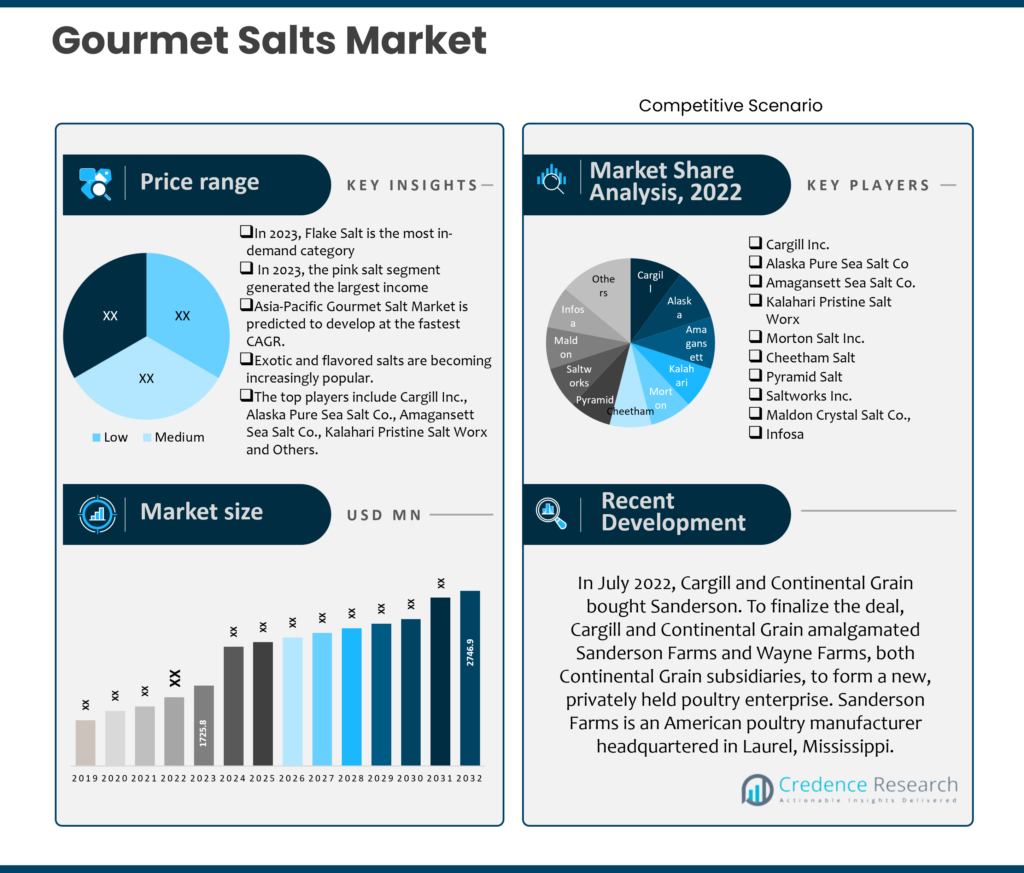
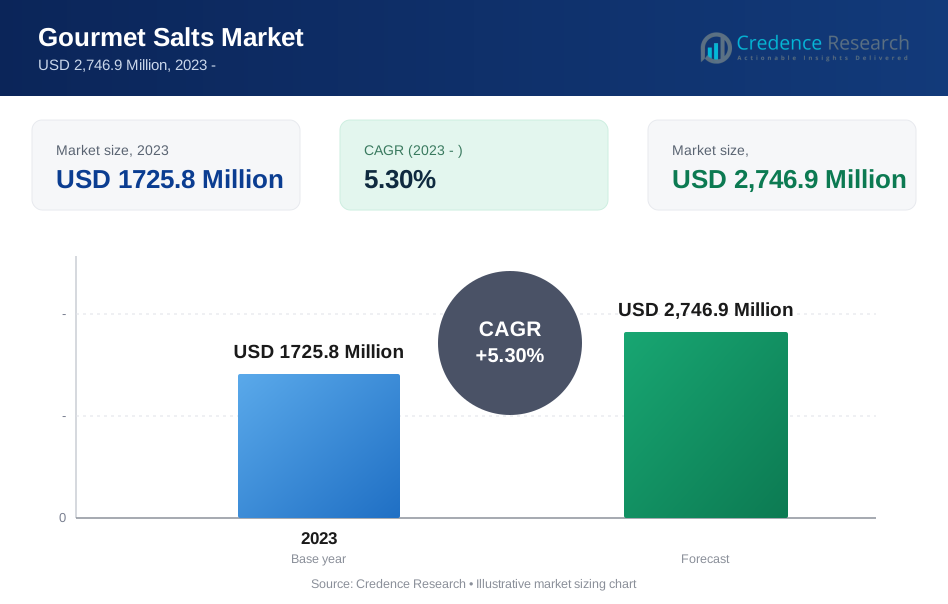
- The global demand for Gourmet Salts was valued at USD 1725.8 Million in 2023 and is expected to reach USD 2746.9 Million in 2032, growing at a CAGR of 5.30% between 2024 and 2032.
- In 2023, the Himalayan salt segment dominated the global market, while the fleur de sel segment is likely to rise fast during the forecast period.
- In 2023, Flake Salt is the most popular and holds a considerable part of the market, followed by Powdered Salt.
- In 2023, the pink salt segment generated the largest income, while the black salts category is expected to grow significantly.
- Gift sets are a popular niche, and Retail Packaging is a big market niche.
- The cooking and baking area is expected to dominate the market, while the Culinary Styles category is also popular.
- In 2023, Europe had the greatest market share, accounting for 38.1%; North America's gourmet salt market had the second-largest market share; and Asia-Pacific Gourmet Salt Market is predicted to develop at the fastest CAGR.
- Consumer demand for luxury and high-end cuisine fuels industry expansion.
- High-cost products limit market expansion.
Executive Summary
Market Definition
Gourmet salt is unprocessed, naturally collected salt with more taste and flavor than other salts. It is a high-quality salt that is often used in cooking to improve the flavor and texture of food. Gourmet salt has a high mineral content and superior solubility qualities. This salt is also used to preserve canned foods, increasing their shelf life. Furthermore, gourmet salt is used in the manufacture of pickles to assist retain the moisture content of the food product, as well as in the preparation of dressings and seasonings due to their distinctive flavors.
Market Overview
The global Gourmet Salts Market has witnessed steady growth in recent years and is expected to grow at a CAGR of 5.30% between 2024 and 2032. The market was valued at USD 1725.8 million in 2023 and is expected to reach USD 2746.9 million in 2032.
Gourmet salt industry growth is being driven by rising consumer demand for processed foods. As consumers grow more health conscious, they are more inclined to include gourmet salt into their daily life, which benefits the gourmet salt industry by lessening the risk of heart disease and high blood pressure. Gourmet salts are specialty salts that differ significantly from regular table salt in flake size, texture, flavor, and color, among other characteristics. They are specialist salts with distinct flavor profiles that are great for embellishing otherwise conventional dishes or drinks. When ingested in moderation, it is said to lower blood pressure, improve circulation, and assist the body rid itself of heavy metals.
According to the World Health Organization (WHO), an estimated 1.28 billion persons aged 30-79 years will have hypertension in 2021, with the majority (two-thirds) living in low- and middle-income nations. Thus, Gourmet Salt's market is driven by its health benefits.
Segmentation By Type of Gourmet Salts
- In 2023, the Himalayan salt segment dominated the global market, accounting for 53.8%. The distinctive pink color of Himalayan salt is due to its high concentration of trace minerals such as iron, potassium, and magnesium. Customers feel these minerals benefit their entire health and well-being.
- However, the fleur de sel segment is expected to grow rapidly during the projected period due to increased demand from its widespread use in vegetable meals, roasted dinners, and salads. It has several features, including high mineral content, wetness, a distinct flavor, and increased solubility.
Segmentation By Grain Size
- Flake Salt is regarded as the most demanding and significant share-holding category. Flake salt is distinguished by its unusual texture and delicate flavor, making it a popular choice for improving food presentation and taste.
- Powdered Salt is another maximum share-holding segment in the market in 2023.
Segmentation By Color and Appearance
- The pink salt segment had the highest income in 2023. Pink salt is a naturally pink-colored salt mined from the Himalayan Mountains in South Asia. Pink Himalayan salt is mined in the same way that rock salt is, but it contains sea salt. Because of its health benefits, Himalayan pink salt is used as a substitute for table salt.
- The black salts category is predicted to experience significant expansion during the forecast period. Black salts can be further classified as Indian black salt, Cyprus black flake salt, Hawaiian black lava salt, and others. Among other variations, Indian black salt is predicted to have the largest market share.
Segmentation by Packaging and Presentation
- Gift sets are a popular niche. Gift sets are popular among shoppers looking for unusual and attractive gifts for important occasions, as well as gourmet connoisseurs. These sets often include a selection of gourmet salts in appealing packaging, making them a popular choice for both gifting and personal usage.
- Retail Packaging are another significant market niche.
Segmentation by Application and Cuisine
- The Cooking and Baking segment is likely to account for a significant portion of the market in the next years due to increased demand from bakeries, since it is widely used in bakery products to flavor chocolates, breads, and caramels.
- The Culinary Styles segment is another popular segment.
Segmentation by Region
- In 2023, Europe had the biggest market share, accounting for 38.1%.
- North America's gourmet salt market has the second-largest market share, and Asia-Pacific Gourmet Salt Market is expected to grow at the quickest CAGR.
- The rest of the world, including Latin America, the Middle East, and Africa, supplies the remaining demand for Gourmet Salts.
In 2023, Europe had the biggest market share, accounting for 38.1%. Gourmet cuisine and its many culinary traditions are well-known throughout Europe. A passion for great eating and culinary exploration in countries such as France, Italy, and Spain drives premium gourmet salts. Furthermore, customers in Europe are becoming more conscious of their wellness and health. Gourmet salts complement these wellness trends and appeal to health-conscious clients because they are perceived as natural and mineral-rich.
Moreover, North America's gourmet salt market has the second-largest market share due to the rise of novel edible items, followed by different tastes communicated by gourmet salt in numerous delicacies, which are driving the expansion of the regional gourmet salt industry. Furthermore, the United States gourmet salt market had the biggest market share, while Canada's gourmet salt industry was the fastest-growing in the European region.
The Asia-Pacific Gourmet Salt Market is expected to grow at the quickest CAGR over the projected period. This is due to rising living standards, growing economies, increased demand for processed foods, and health-conscious behavior, combined with development in the food and beverage industry.
Key Highlights of the Report
Type of Gourmet Salts, Grain Size, Color and Appearance, Packaging and Presentation, Application and Cuisine and region segment the global Gourmet Salts Market. The Himalayan salt category led the world market in 2023, and the category with the highest share-holding requirements is thought to be flake salt. Additionally, the pink salt industry generated the most revenue in 2023, and gift packages are a well-liked specialty and Europe, leading the market growth.
The market is being driven by increasing consumer interest in distinctive and high-quality food products, health-conscious consumers looking for alternatives to regular table salt, and the expansion of the culinary industry and gourmet food trends. In addition, the high cost connected with gourmet salts compared to conventional table salt, limited knowledge and availability in certain countries, and potential health risks related to excessive salt use are the main limitations of the market.
In 2023, Europe held the largest market share, accounting for 38.1%. Gourmet food and its many culinary traditions are well-known across Europe. Furthermore, North America's gourmet salt market holds the second-largest market share. The Asia-Pacific Gourmet Salt Market is predicted to develop at the fastest CAGR during the projected period.
What Are The Main Drivers Of The Global Gourmet Salts Market?
The profusion of gourmet salt varieties, including fleur de sel, smoked salt, sea salt, Himalayan salt, and black lava salt, allows consumers to experiment with different flavors and textures. Furthermore, owing to an increased interest in cooking and culinary discovery, consumers are looking for uncommon ingredients, such as gourmet salts, to enhance their cooking experiences and develop new sensations.
What Are The Major Challenges Faced By The Global Gourmet Salts Market?
Gourmet salts are usually more expensive than regular table salt, and because they are seen as luxury items by some customers, affordability concerns may arise. Despite efforts to raise awareness, some customers may still be unaware of the variations, tastes, and applications of gourmet salts, limiting their adoption.
What Are The Growth Opportunities In The Global Gourmet Salts Market?
Funding instructional programs to increase consumer awareness of the various types of gourmet salts, their flavors, and their culinary applications might lead to market expansion opportunities. Furthermore, emphasizing the nutritional benefits of gourmet salts, such as their high mineral content, can entice health-conscious shoppers looking for table salt alternatives.
Market Drivers
Consumer Demand for Luxury and High-End Cuisine
Many chefs consider Gourmet Salt to be the greatest sea salt available, praising it for its exquisite appearance, subtle flavor, and moist texture. Gourmet salt complements everything, from fried eggs to vegetables, salads, and roasted or baked meats or shellfish. For example, smoked salts pair well with grill-cooked meats, grilled chicken, and corn on the cob. They transform stovetop recipes into meals that taste like they were cooked over a campfire. According to Kitchen Infinity, 10% of Americans own a BBQ grill. 34% of Americans enjoy grilling steak. BBQ grill sales increased by 40% between 2020 and 2021.
Less conventionally, they add depth to stews, tacos, mac and cheese, and caramel dessert combos. The desire for premium traditional cuisines with enhanced flavors is continuously expanding, propelling the Gourmet Salt Market's growth.
Market Restraints
High-Cost Products
Gourmet salts have distinct sensory and aesthetic features that culinary chefs are learning to exploit to amplify and improve the flavor and presentation of their meals. This is due to the diverse manufacturing procedures used to manufacture them, which result in varying crystallization and chemical composition. According to Spruce Eats, fleur de sel costs around $30 per pound or more since it must be manually skimmed off with specialized sieves and occurs naturally under specific, extremely limited weather conditions. Gourmet salts bring significant economic value and can help to ensure the long-term viability of artisanal salt operations that harvest salt in the conventional method.
Gourmet salt harvesting necessitates large capital expenditures for processing, packaging, labeling, and marketing, which ultimately increase the cost of the completed product. The higher cost of processing Gourmet Salt is a significant hindrance to the market's growth over the forecast period 2023-2032.
Opportunities
Rising Demand From The Booming Processed Food Industry
A processed food product has undergone some form of alteration during preparation, such as freezing, canning, or baking. Canned, frozen, or half-cooked food products require a longer shelf life, and gourmet salt aids in food preservation and the extension of the shelf life of processed foods. The demand for gourmet salt rises in tandem with the demand for processed foods.
For instance, in April 2022, the Ministry of Food Processing Industries of India approved investment applications from 119 processed food companies as part of the Production Linked Incentive Scheme For Food Processing Industry (PLISFPI) to stimulate domestic growth of processed foods. As a result, the growing demand for processed foods propels the gourmet salt market forward.
Competitive Landscape
Key Players
The global Gourmet Salts Market is highly competitive, with several key players. Some of the major players in the market and their market share are as follows:
- Cargill Inc.
- Alaska Pure Sea Salt Co
- Amagansett Sea Salt Co.
- Kalahari Pristine Salt Worx
- Morton Salt Inc.
- Cheetham Salt
- Pyramid Salt
- Saltworks Inc.
- Maldon Crystal Salt Co.,
- Infosa etc.
These organizations prioritize product innovation, Application and Cuisine expansion, and mergers and acquisitions to stay competitive.
The global Gourmet Salts Market's key players continually seek to stay ahead by offering new products and developments.
In January 2021, Cargill Salt has introduced a new pure sea salt flour. The active ingredient is sodium chloride, which is chopped into ultra-fine powders. It's ideal for blending applications that demand extremely fine size, such dry soup, cereal, flour, and spice mixes, as well as topping snack foods. Cargill Salt is North America's major salt producer, specializing in food processing additives.
In April 2020, SaltWorks has announced the introduction of sophisticated new B2B eCommerce capabilities to enhance the customer experience and boost sales growth. The new platform, designed in conjunction with B2B eCommerce developer OroCommerce, gives SaltWorks the powerful, adaptable sales infrastructure it needs to satisfy the different needs of its customers on a large scale. SaltWorks is America’s sea salt company.
Summary of Key Findings
- The gourmet salt sector rushes ahead with increased demand from the thriving processed food industry.
- The market is segmented by Type of Gourmet Salts, Grain Size, Color and Appearance, Packaging and Presentation, Application and Cuisine, and region.
- Gift sets are a popular niche
- Cooking & Baking is expected to account for a large share of the market
- Europe is leading in market growth; the market is highly competitive with key players, including Cargill Inc., Alaska Pure Sea Salt Co., Amagansett Sea Salt Co., Kalahari Pristine Salt Worx and Others.
Future Outlook
- Exotic and flavored salts are becoming increasingly popular.
- Increased customer interest in natural and organic components.
- Growth of the foodservice business
- Innovative product offerings and packaging.
How CXOs Can Benefit from the Credence Research Gourmet Salts Market Report
The Credence Research Gourmet Salts Market Report provides CXOs with a comprehensive overview of the market, including:
- Market size and growth forecast:The report provides detailed estimates of the global Gourmet Salts Market size, segmented By Type of Gourmet Salts, Grain Size, Color and Appearance, Packaging and Presentation , Application and Cuisine and region. It also includes forecasts for the market through 2032 based on key trends and drivers.
- Market segmentation:The report segments the Gourmet Salts Market By Type of Gourmet Salts, Grain Size, Color and Appearance, Packaging and Presentation , Application and Cuisine and region. This segmentation provides CXOs with a granular understanding of the market and the opportunities in each segment.
- Competitive Landscape:The report profiles the key players in the Gourmet Salts Market and provides insights into their strategies, product offerings, and financial performance. This information can help CXOs to identify and assess their competition.
- Key trends and drivers:The report identifies and analyzes the key trends and drivers that are shaping the Gourmet Salts Market. This information can help CXOs to make informed decisions about their investments and strategies.
CXOs can use the insights from the Credence Research Gourmet Salts Market Report to:
- Identify growth opportunities:The report can help CXOs identify new growth opportunities in the Gourmet Salts Market. By analyzing the data and trends in the report, they can make informed decisions about where to invest and expand their business.
- Make informed investment decisions:The report can help CXOs make informed investment decisions about Gourmet Salts. By examining the insights and trends in the report, they can strategically allocate resources and capitalize on the right opportunities in the market.
- Develop competitive strategies:The report can help CXOs develop competitive strategies for their Gourmet Salts businesses. For example, by delving into the insights and trends within the report, they can strategically position themselves in the market and stay ahead of the competition.
- Track market developments:The report can help CXOs monitor market developments and stay ahead of the curve. For example, it provides insights into the latest trends and innovations in the Gourmet Salts Market.
Overall, the Credence Research Gourmet Salts Market Report is a valuable resource for CXOs who are looking to gain a deeper understanding of the market and identify opportunities for growth.
Segmentation
- By Type of Gourmet Salts:
- Sea Salt
- Himalayan Salt
- Flavored Salt
- Smoked Salt
- Fleur de Sel
- Black Salt
- Truffle Salt
- Kosher Salt
- Cyprus Flake Salt
- By Grain Size:
- Coarse Salt
- Fine Salt
- Flake Salt
- Rock Salt
- Powdered Salt
- By Color and Appearance:
- White Salt
- Pink Salt
- Black Salt
- Gray Salt
- Red Salt
- By Packaging and Presentation:
- Bulk Packaging
- Retail Packaging
- Gift Sets
- Specialty Formats
- By Application and Cuisine:
- Cooking and Baking
- Finishing and Garnishing
- Culinary Styles
- By Region
- North America
- US
- Canada
- Mexico
- Europe
- Germany
- France
- UK.
- Italy
- Spain
- Rest of Europe
- Asia Pacific
- China
- Japan
- India
- South Korea
- South-east Asia
- Rest of Asia Pacific
- Latin America
- Brazil
- Argentina
- Rest of Latin America
- Middle East & Africa
- GCC Countries
- South Africa
- Rest of the Middle East and Africa
- North America
Adjacent Markets
In the Gourmet Salts Market, several adjacent markets have high revenue growth opportunities. The key adjacent markets for Gourmet Salts Market-
| Adjacent Markets | ||
| Specialty spices market | Premium olive oil market | Handcrafted beer market |
| Artisanal cheese market | Organic tea market | Small-batch coffee market |
| Craft chocolate market | Fine wine market | Artisanal bread market |
Request a Free Sample
Fill in your details and we'll send you a free sample report.
- Sample data tables & charts
- Research methodology
Need a Custom Version of This Report?
Tailor the scope, geography, or segments to your exact requirements.
- Custom geography or segment scope
- Direct access to our analyst team
Frequently Asked Questions
What is the current size of the global Gourmet Salts Market?
What is the expected growth rate of the Gourmet Salts Market between 2024 and 2032?
Which segment is leading the market share in terms of Type of Gourmet Salts?
Which Grain Size segment governs the demand for Gourmet Salts in the world?
Which Type of Gourmet Salts segment is expected to post the fastest growth during the forecast period?
Which region is fueling the growth of the Gourmet Salts industry?
Who are the major players in the global Gourmet Salts Market?
What are the major market drivers of the Gourmet Salts industry?
What are the major market restraints of the Gourmet Salts industry?
What are the major market opportunities of the Gourmet Salts industry?
Table of Content
Chapter 1. Report Introduction
- 1.1 Report Description & Purpose
- 1.1.1 Report Title & Market Definition
- 1.1.2 Unique Selling Propositions (USP) & Key Differentiators
- 1.1.3 Value Proposition for Stakeholders
- 1.2 Research Objectives
- 1.2.1 Market Sizing Objectives (Volume & Revenue)
- 1.2.2 Segmentation Objectives
- 1.2.3 Competitive Intelligence Objectives
- 1.2.4 Forecast & Scenario Objectives
- 1.3 Report Scope
- 1.3.1 Gourmet Salts Scope – Types & Subtypes Covered
- 1.3.2 Geographic Scope – Regions & Countries Covered
- 1.3.3 Historical Period, Base Year & Forecast Period (2023; forecast to the forecast period)
- 1.3.4 Inclusions & Exclusions
- 1.4 HS Code & Classification Framework
- 1.5 Currency, Units & Pricing Basis
- 1.6 Target Stakeholders
- 1.7 Limitations & Assumptions
Chapter 2. Executive Summary
- 2.1 Global Gourmet Salts Market Snapshot
- 2.1.1 Market Size – Historical (2023) & Forecast (the forecast period) (2023: USD 1725.8 Million → forecast year: USD 2,746.9 Million)
- 2.1.2 Volume & Revenue – Global Totals
- 2.1.3 Key Market Highlights – Top Five Facts
- 2.2 Gourmet Salts Market Segmentation Snapshot
- 2.2.1 Market Split by Region – 2023 vs.
- 2.3 Competitive Snapshot
- 2.3.1 Top 10 Players by Revenue Share – 2023
- 2.3.2 Top 10 Players by Volume Share – 2023
- 2.3.3 Recent Strategic Developments (18-Month Summary)
- 2.4 Key Investment Highlights & Strategic Conclusions
Chapter 3. Gourmet Salts Market Dynamics & Industry Analysis
- 3.1 Market Overview & Context
- 3.1.1 Gourmet Salts Market Position in the Broader Automotive Value Chain
- 3.1.2 OEM vs. Replacement Market Dynamics
- 3.1.3 Market Maturity & Development Stage by Region
- 3.2 Gourmet Salts Market Drivers
- 3.3 Gourmet Salts Market Restraints & Challenges
- 3.4 Gourmet Salts Market Opportunities
- 3.5 Porter's Five Forces Analysis
- 3.5.1 Threat of New Entrants
- 3.5.2 Bargaining Power of Suppliers
- 3.5.3 Bargaining Power of Buyers
- 3.5.4 Threat of Substitutes
- 3.5.5 Competitive Rivalry – Intensity Assessment
- 3.6 Gourmet Salts Value Chain Analysis
- 3.6.1 Upstream – Raw Material/Input Suppliers
- 3.6.1.1 Raw Material/Input 1
- 3.6.1.2 Raw Material/Input 2
- 3.6.1.3 Raw Material/Input 3
- 3.6.2 Midstream – Production/Manufacturing/Service Delivery
- 3.6.2.1 Production/Process Overview
- 3.6.2.2 Key Facility Locations & Capacity by Manufacturer
- 3.6.3 Downstream – Distribution & End Consumer
- 3.6.3.1 Primary Channel – B2B/OEM
- 3.6.3.2 Secondary Channels – Dealer, Retail, Online, Direct
- 3.6.4 Value Chain Profitability Analysis
- 3.6.1 Upstream – Raw Material/Input Suppliers
- 3.7 PESTEL Analysis
- 3.7.1 Political Factors
- 3.7.2 Economic Factors
- 3.7.3 Social Factors
- 3.7.4 Technological Factors
- 3.7.5 Environmental Factors
- 3.7.6 Legal Factors
- 3.8 Gourmet Salts Supply Chain Analysis
- 3.8.1 Raw Material/Input Supply Risk Assessment
- 3.8.2 Manufacturing Concentration Risk (Geographic Exposure)
- 3.8.3 Trade Disruption Impact Analysis
- 3.9 Regulatory & Policy Landscape
Note: The regulatory and policy landscape section covers regulations based on their applicability to the market, Gourmet Salts category, geography, and scope of the study. Only regulatory frameworks with a material impact on operations, compliance, trade, sustainability, or market access are analyzed in detail.
Chapter 4. Key Investment Pockets & Opportunity Analysis
- 4.1 Gourmet Salts Market Attractiveness Analysis
- 4.1.1 By Region – Investment Attractiveness Matrix (Volume × CAGR)
- 4.2 Absolute Revenue Growth Opportunity
- 4.2.1 By Region – Absolute USD Growth Through the forecast period
- 4.3 Incremental Volume Opportunity
- 4.3.1 By Region – Incremental Volume Through the forecast period
- 4.3.2 Segment – Incremental Volume
- 4.4 Emerging Submarket Opportunity Deep Dive (Subject to Applicability)
- 4.5 Emerging Market Opportunity Scorecards
- 4.5.1 United States
- 4.5.2 Europe
- 4.5.3 Asia
- 4.5.4 Middle East & Africa
Note: Emerging Market Opportunity Scorecards will be included based on relevance and strategic importance. Regions listed are indicative and may vary depending on data availability and market dynamics.
Chapter 5. Gourmet Salts Import-Export Analysis & Trade Flows
- 5.1 Global Trade Overview
- 5.1.1 Global Export Value by Country (2023)
- 5.1.2 Global Export Volume by Country (2023)
- 5.1.3 Global Import Value by Country (2023)
- 5.1.4 Global Import Volume by Country (2023)
- 5.1.5 Net Trade Balance by Country (2023)
- 5.2 Export Analysis – Segment
- 5.2.1 Type 1 (HS Code)
- 5.2.2 Type 2 (HS Code)
- 5.2.3 Type 3 (HS Code)
- 5.2.4 Type 4 (HS Code)
- 5.2.5 Type 5 (HS Code)
- 5.3 Import Analysis – Segment
- 5.3.1 Type 1 (HS Code)
- 5.3.2 Type 2 (HS Code)
- 5.3.3 Type 3 (HS Code)
- 5.3.4 Type 4 (HS Code)
- 5.3.5 Type 5 (HS Code)
- 5.4 Average Unit Trade Prices
- 5.4.1 Average Export Price – Segment & Country
- 5.4.2 Average Import Price – Segment & Source Country
- 5.4.3 Price Trends (2023)
- 5.5 Key Trade Route Analysis
- 5.5.1 Trade Route 1
- 5.5.2 Trade Route 2
- 5.5.3 Trade Route 3
- 5.5.4 Trade Route 4
- 5.5.5 Trade Route 5
- 5.6 Trade Policy Impact Assessment
- 5.6.1 US Anti-Dumping & Section 301 Tariffs
- 5.6.2 EU Customs Union Impact
- 5.6.3 Major Free Trade Agreements
- 5.6.4 USMCA Rules of Origin
Note: Trade policy analysis will be included only where relevant to the Gourmet Salts market.
Chapter 6. Competitive Landscape & Company Benchmarking
- 6.1 Gourmet Salts Market Concentration & Structure
- 6.1.1 Herfindahl-Hirschman Index (HHI) – vs. 2023
- 6.1.2 Tier 1, Tier 2 & Tier 3 Market Structure
- 6.1.3 Global, Regional & Local Player Dynamics
- 6.2 Gourmet Salts Market Share Analysis – 2023
- 6.2.1 Global Revenue Share by Company
- 6.2.2 Global Volume Share by Company
- 6.2.3 Regional Revenue Share
- 6.2.4 Market Share Evolution ( vs. 2023)
- 6.2.5 OEM Segment Share by Company
- 6.2.6 Replacement Segment Share by Company
- 6.3 Production/Delivery Capacity & Facility Analysis
- 6.3.1 Global Installed Capacity
- 6.3.2 Capacity Utilization Rates
- 6.3.3 Production/Output Volume
- 6.3.4 Facility Locations & Capacity Map
- 6.3.5 Planned Capacity Additions
- 6.4 Gourmet Salts Competitive Benchmarking Matrix
- 6.4.1 Revenue, Volume, CAGR & Profitability Comparison
- 6.4.2 Channel Revenue Mix
- 6.4.3 Geographic Revenue Exposure
- 6.4.4 R&D Intensity
- 6.4.5 Sustainability Maturity
- 6.5 Strategic Developments in Gourmet Salts (Last 24 Months)
- 6.5.1 Mergers, Acquisitions & Divestments
- 6.5.2 New Gourmet Salts Launches
- 6.5.3 Facility Expansions
- 6.5.4 Strategic Alliances, Joint Ventures & Partnerships
- 6.5.5 Distribution Expansion & Market Entry
- 6.5.6 Sustainability & ESG Initiatives
- 6.6 Competitive Strategy Mapping
- 6.6.1 Leader, Challenger, Follower & Niche Classification
- 6.6.2 Pricing Strategy Comparison
- 6.6.3 Channel Strategy Matrix
Note: Strategic developments are included based on their materiality and the availability of reliable information.
Chapter 7. Global Gourmet Salts Market – By Distribution Channel
- 7.1 Segment Overview
- 7.1.1 Volume & Revenue Split by Channel (2023 & )
- 7.1.2 Channel Mix Evolution (the forecast period)
Chapter 8. Regional Market Analysis – Global Overview
- 8.1 Global Regional Overview
- 8.1.1 Regional Volume Share
- 8.1.2 Regional Revenue Share
- 8.1.3 Regional Volume by Region
- 8.1.4 Regional Revenue by Region
- 8.1.5 Regional Forecast Through the forecast period
- 8.2 Cross-Regional Segment Analysis
- 8.2.1 By Distribution Channel
- 8.2.2 By Brand/Price Tier
Chapter 9. North America Gourmet Salts Market
- 9.1 United States
- 9.2 Canada
- 9.3 Mexico
Chapter 10. Europe Gourmet Salts Market
- 10.1 Germany
- 10.2 France
- 10.3 Italy
- 10.4 United Kingdom
- 10.5 Spain
- 10.6 Poland
- 10.7 Russia
- 10.8 Netherlands
- 10.9 Belgium
- 10.10 Sweden
- 10.11 Denmark
- 10.12 Norway
- 10.13 Rest of Europe
Chapter 11. Asia Pacific Gourmet Salts Market
- 11.1 China
- 11.2 India
- 11.3 Japan
- 11.4 South Korea
- 11.5 Thailand
- 11.6 Indonesia
- 11.7 Vietnam
- 11.8 Malaysia
- 11.9 Australia
- 11.10 Rest of Asia Pacific
Chapter 12. Latin America Gourmet Salts Market
- 12.1 Brazil
- 12.2 Argentina
- 12.3 Colombia
- 12.4 Chile
- 12.5 Rest of Latin America
Chapter 13. Middle East Gourmet Salts Market
- 13.1 Saudi Arabia
- 13.2 United Arab Emirates
- 13.3 Turkey
- 13.4 Israel
- 13.5 Iran
- 13.6 Rest of the Middle East
Chapter 14. Africa Gourmet Salts Market
- 14.1 South Africa
- 14.2 Egypt
- 14.3 Nigeria
- 14.4 Morocco
- 14.5 Rest of Africa
Chapter 15. Gourmet Salts Company Profiles
- 15.1 [Company 01]
- 15.1.1 Company Overview
- 15.1.2 Key Management Personnel
- 15.1.3 Products & Services Portfolio
- 15.1.4 Financial Performance
- 15.1.5 Key Market Focus & Geographic Presence
- 15.1.6 Recent Developments & Strategic Initiatives
Note: The company profile list is preliminary and may change based on research findings, market developments, data availability, and client requirements.
Chapter 16. Appendices
- Appendix A – List of Abbreviations & Acronyms
- Appendix B – Industry Classification Code Reference – Full Series
- Appendix C – Production & Capacity Data Tables
- Appendix D – End-Use & Demand Base Tables
- Appendix E – Consumption & Replacement Rate Assumptions
- Appendix F – ASP Reference Tables
- Appendix G – Manufacturing & Facility Database
- Appendix H – Import-Export Data Tables
- Appendix I – Regulatory Summary Tables
- Appendix J – Primary Research Participant List (Anonymized)
- Appendix K – Primary Research Questionnaire Framework
- Appendix L – Data Sources & Bibliography
- Appendix M – Market Size Divergence & Source Comparison
Chapter 17. Research Methodology
- 17.1 Research Framework & Philosophy
- 17.2 Secondary Research – Sources, Hierarchy & Data Extraction
- 17.3 Data Modeling – Bottom-Up & Top-Down Market Sizing
- 17.4 Primary Research – Stakeholder Framework, LOI & Sample Sizes
- 17.5 Forecast Methodology – Regression, Scenario & Sensitivity Analysis
- 17.6 Quality Control – Four-Layer Validation Framework
- 17.7 Limitations & Standard Assumptions
- 17.8 Disclaimer
