
Market Insights
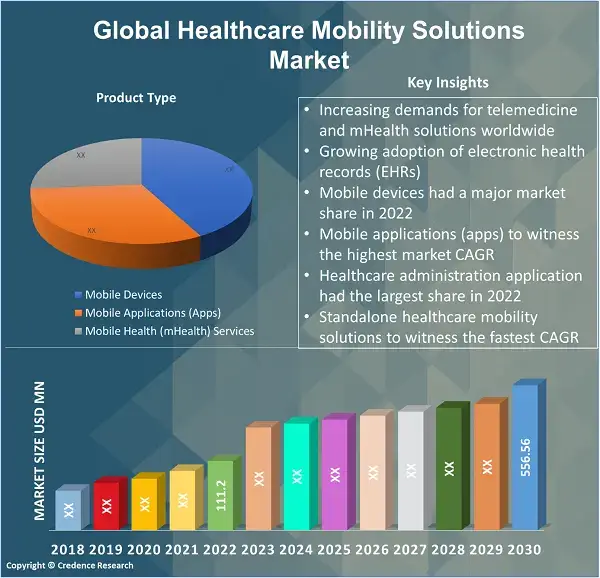
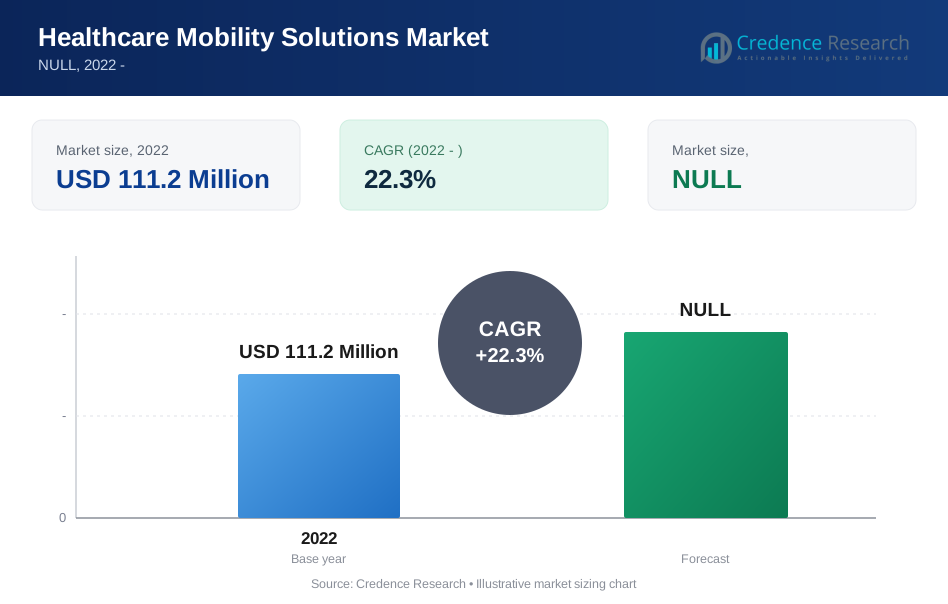
- The global demand for healthcare mobility solutions was valued at USD 111.2 Million in 2022 and is expected to reach USD 556.56 Million in 2030, growing at a CAGR of 22.3% between 2023 and 2030.
- The mobile devices segment is the market leader by product type, accounting for more than 45% of total value in 2022, while the mobile applications (apps) segment is estimated to grow rapidly over the projection period.
- The healthcare administration application category is expected to expand rapidly in the forecast period, while the patient care management segment has the highest market share in 2022.
- Connected healthcare mobility solutions dominate the global need for healthcare mobility solutions, accounting for more than 58% in 2022 and is predicted to expand at a high CAGR.
- The hospitals and clinics category dominated the market with 30% of the total revenue share by end-user. In contrast, the home healthcare settings category will expand fastest over the projected time frame.
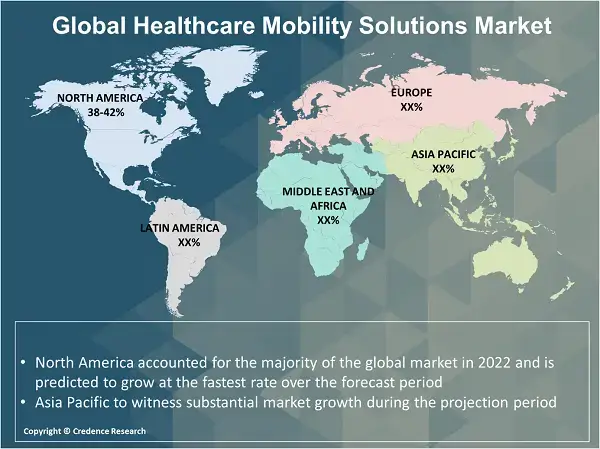
- North America is fueling the rapid growth of the healthcare mobility solutions industry with over one-third share in 2022, while Asia Pacific and Europe collectively account for just under 54% share in 2022. Europe held over 20% market revenue share in 2022.
- The current healthcare revolution and installation of upgraded technologies are increasing efficiency and providing a better experience for end users, driving global market demands for healthcare mobility solutions.
- The COVID-19 pandemic has accelerated the adoption of remote monitoring solutions. Patients and healthcare providers increasingly rely on mobile health apps and remote monitoring devices to track and manage chronic conditions, reducing the need for in-person visits and hospitalizations.
Executive Summary
Market Definition
The healthcare mobility solutions market refers to adopting and implementing mobile technologies, applications, and devices in the healthcare sector to enhance the efficiency, accessibility, and quality of healthcare services. These solutions encompass various applications, including mobile health (mHealth) apps, telehealth, remote patient monitoring, wearable devices, and mobile-enabled electronic health records (EHRs). Healthcare mobility solutions enable healthcare providers, professionals, and patients to access and exchange medical information, monitor health conditions, streamline clinical workflows, and improve healthcare delivery through mobile devices and wireless communication technologies. These solutions are designed to address challenges in healthcare delivery, promote patient engagement, and support the shift towards more patient-centric care models.
Market Overview
The global healthcare mobility solutions market has witnessed rapid growth in recent years and is expected to grow at a CAGR of 22.3% between 2023 and 2030. The market was valued at USD 111.2 million in 2022 and is expected to reach USD 556.56 million in 2030.
The healthcare industry is witnessing substantial changes as it has become one of the early users of advanced mobile technologies in its products and services. With the help of the fast realization of the benefits of the mobile-enabled application, healthcare providers have overcome most of their obstacles. In the past, the health business faced numerous problems, such as remote locations, high overhead costs, and complex regulatory requirements, significantly impacting its entire services.
Healthcare mobility involves the use of mobile applications, mobile devices, and corporate platforms to interact securely and more efficiently and effectively distribute clinical data among multiple end users, such as healthcare providers, payers, and patients. Healthcare mobility also refers to technical improvements that enable the delivery of medical and healthcare services such as remote monitoring, telemedicine, and virtual diagnostics.
Mobility has emerged as an essential technology for the healthcare industry in recent years, allowing the medical community to embrace a patient-centric strategy while lowering healthcare costs and the repercussions of nursing and healthcare worker shortages.
Segmentation by Product Type
- The mobile health (mHealth) services segment is expected to grow substantially due to healthcare providers' increasing adoption of mobile apps and remote monitoring solutions.
- Mobile devices, such as smartphones & tablets, accounted for over 45% of the market share in 2022, driven by their versatility and compatibility with healthcare applications.
Segmentation by Application
- Patient care management solutions, including remote patient monitoring and telemedicine applications, are projected to achieve a high CAGR during the forecasted period, fueled by the demand for improved patient outcomes and reduced healthcare costs.
- Healthcare administration solutions, encompassing electronic health records (EHR) management and administrative workflow optimization, led the market in 2022 with a share of approximately 24%, driven by the need for efficient healthcare operations.
Segmentation by End-User
- Hospitals and clinics were the primary end-users in 2022, contributing to more than 30% of the global demand for healthcare mobility solutions. This substantial usage is attributed to integrating mobility solutions into clinical settings, enhancing patient care.
- Home healthcare settings, which provide healthcare services in patients' homes, have seen increased adoption, and this segment is expected to grow at a CAGR of 17% in the forecast period.
Segmentation by Connectivity
- Standalone healthcare mobility solutions are anticipated to grow significantly due to their independence from external networks and data sources.
- Connected healthcare mobility solutions, with a market share of over 58% in 2022, are favored for their ability to access real-time data and enhance communication between healthcare providers.
Segmentation by Region
- North America led the global market in 2022, accounting for over one-third of the global market share, driven by advanced healthcare infrastructure and technology adoption.
- Europe and Asia Pacific collectively contributed to just under 54% of the market in 2022. Europe, with over 20% market share, reflects a strong presence due to its developed healthcare systems.
- The rest of the world, including Latin America, the Middle East, and Africa, accounted for the remaining demand for healthcare mobility solutions.
The increased utilization of mobile devices like tablets and smartphones in healthcare systems, a rising focus on patient-centric mobility apps, and improved connectivity to enhance the quality of healthcare services are driving the healthcare mobility solutions market growth.
In 2022, North America held the majority of the revenue share of the global healthcare mobility solutions market. The region has a well-established and advanced healthcare infrastructure, including hospitals, clinics, and healthcare facilities, which readily adopt mobility solutions for improved patient care and management. Also, there is a high regional awareness and acceptance of mobile health technologies among healthcare providers and patients. Besides, government initiatives and regulatory support for integrating healthcare IT solutions, including mobility solutions, have further boosted the market in North America. Moreover, numerous key players and innovative startups in the region have contributed to technological advancements and the overall growth of the healthcare mobility solutions market.
Over the projection period, Asia Pacific is expected to be the fastest-growing region. The region is witnessing rapid economic growth, leading to increased healthcare infrastructure and technology investments. Besides, a rising aging population and an increasing burden of chronic diseases drive the need for efficient healthcare solutions. Governments like India and China are also actively promoting healthcare digitization and adopting mobile health technologies to improve healthcare accessibility and affordability. The prevalence of smartphones and mobile internet connectivity is rising, making healthcare mobility solutions more accessible to a larger population. These factors combined create a conducive environment for the rapid growth of the healthcare mobility solutions market in Asia Pacific.
A global shortage of nursing personnel, expanding digitization in the healthcare industry, improved healthcare infrastructure, wireless network penetration, and increased healthcare spending all benefit the healthcare mobility solutions market share. Developing novel healthcare mobility systems supporting a greater volume and variety of linked devices is further anticipated to boost the global healthcare mobility solutions market revenue.
Key Highlights of the Report
The global healthcare mobility solutions market is segmented by product type, application, end-user, connectivity, and region. Among product types, mobile health (mHealth) services are expected to exhibit significant growth, driven by the increasing adoption of mobile devices and telehealth solutions. Patient care management is set to achieve the highest growth rate within the application segment due to the growing emphasis on patient-centered care. Hospitals and clinics dominate the end-user category, fulfilling the highest global demand for healthcare mobility solutions in 2022, with continued growth prospects. In terms of connectivity, connected healthcare mobility solutions currently hold the largest market share.
The market for healthcare mobility solutions is positively influenced by digitization and the rising use of smart devices. Other factors driving the expansion of the healthcare mobility solutions market include increased demand for point-of-care treatment and diagnosis, heightened public awareness of the potential benefits of healthcare management, the growing influence of social media in healthcare, and a greater emphasis on personalized medications. On the other hand, data security concerns and a shortage of skilled professionals will pose major challenges to the global healthcare mobility solutions market's growth over the forecast period.
North America, specifically the United States, has traditionally dominated the global market due to its advanced healthcare infrastructure, early adoption of healthcare mobility solutions, and robust investment in digital health technologies. The Asia Pacific region, particularly India, China, and Southeast Asian nations, presents immense growth potential. The rapid expansion of healthcare access, increasing mobile device penetration, and government initiatives to digitize healthcare services contribute to this regional market growth.
What Are The Main Drivers Of The Global Healthcare Mobility Solutions Market?
The main drivers of the global healthcare mobility solutions market include the increasing demand for improved patient care and engagement, the growing adoption of mobile devices and smartphones, and the need for efficient healthcare delivery systems. These solutions empower healthcare providers and patients by offering convenient access to medical information, enabling real-time communication, and enhancing care coordination. Besides, the COVID-19 pandemic has accelerated the adoption of telehealth and remote monitoring solutions, further boosting the market. Moreover, government initiatives, such as promoting electronic health records (EHRs) and developing healthcare infrastructure, contribute to the market's growth by encouraging healthcare organizations to invest in mobile technology for better patient outcomes and cost savings.
What Are The Major Challenges Faced By The Global Healthcare Mobility Solutions Market?
The major challenges faced by the healthcare mobility solutions market are data security and privacy concerns, interoperability issues, regulatory compliance, and the high cost of implementation. Protecting sensitive patient data from breaches and ensuring compliance with healthcare regulations like HIPAA are critical concerns in an increasingly digital healthcare landscape. In addition, achieving seamless interoperability among various healthcare systems and devices is challenging, as different platforms and vendors may use incompatible standards. Meeting regulatory requirements and obtaining necessary certifications can be time-consuming and expensive. Also, while healthcare mobility solutions offer long-term benefits, the initial investments and ongoing maintenance costs can be a barrier, especially for smaller healthcare organizations.
What Are The Growth Opportunities In The Global Healthcare Mobility Solutions Market?
The continued expansion of telemedicine and virtual care services, fueled by the need for remote healthcare access and technological advancements, presents a significant avenue for mobility solutions. Additionally, the proliferation of mobile health applications and wearable devices for patient engagement and monitoring enhances the market's potential. Integrating the IoT and data analytics into healthcare mobility solutions enables real-time data collection & analysis, leading to more informed decision-making. Moreover, optimizing healthcare workflows, including electronic health records (EHR) access and administrative processes, can significantly improve efficiency in healthcare delivery. The increasing emphasis on patient-centric care and personalized medicine further drives the demand for innovative mobility solutions in the healthcare sector.
Market Drivers
Several factors drive the global healthcare mobility solutions market. The following are the key drivers of the global healthcare mobility solutions market:
Increased Demand for Remote Patient Monitoring
The ageing population, the prevalence of chronic illnesses, and the necessity for ongoing healthcare management have all contributed to an increase in the market demand for remote patient monitoring (RPM) systems. By allowing patients to monitor their health status from the comfort of their homes, healthcare mobility solutions play a crucial part in RPM. To capture and communicate patient data to healthcare practitioners in real time, these systems link with wearable gadgets like fitness trackers and smartwatches. RPM improves patient outcomes and reduces hospital readmissions and healthcare costs. Mobile devices have enabled healthcare providers to track and evaluate their patients' progress.
According to GSMA real-time intelligence data, 50% of the world's 5.13 billion individuals have mHealth apps for fitness tracking and vital health signs loaded on their phones. These apps also assist users in managing their drugs and medical issues. The usage of mobile devices for remote clinical treatment more than tenfold increased during the COVID-19 epidemic. Several companies have begun to provide digital solutions for improved medical workflow. Patients' diseases can be diagnosed using mobile devices and access tools, even in intensive care units or emergencies. As a point of care, electronic health records (EHRs), clinical decision support systems (CDSS), and picture archiving communication systems (PACS) are widely chosen over mobile devices. The increasing use of digital devices in clinical care is expected to propel the healthcare mobility solutions market forward.
Market Restraints
The global healthcare mobility solutions market faces challenges that may hinder its growth. These include the following:
Data Security Concerns, Technical Difficulties, and a Lack of Awareness Concerning Healthcare Mobility Solutions
The healthcare sector deals with sensitive patient data, including medical records, diagnoses, and personal information. With the increasing use of mobile devices and applications, there is a growing concern regarding the security and privacy of this data. Breaches or unauthorized access to patient health information leads to severe consequences, including identity theft, insurance fraud, and compromised patient care. Healthcare organizations must adhere to strict regulations like the Health Insurance Portability and Accountability Act (HIPAA) in the United States, which mandates the protection of patient data. Data security and privacy compliance is a major challenge for healthcare mobility solution providers, often requiring substantial investments in encryption, authentication, and cybersecurity measures.
Various gadgets, such as fitness bands, glucometers, and blood pressure monitors, frequently fail to connect with applications, causing patient discomfort and irritation. Furthermore, there is a lack of awareness and adoption of mobile healthcare solutions in isolated rural locations. These challenges impede the expansion of the global healthcare mobility solutions market.
Opportunities
The global healthcare mobility solutions market offers significant growth opportunities. These include the following:
Population Health Management
Population health management focuses on improving the overall health outcomes of a defined group of individuals, such as patients in a particular geographic area or with specific health conditions. Healthcare mobility solutions can contribute significantly to population health initiatives. They collect and analyze data from multiple sources, including wearables, EHRs, and patient-reported data, to identify health trends and risks within a population. These solutions can then assist healthcare providers in developing targeted interventions, preventive measures, and personalized care plans. With the shift toward value-based care and accountable care organizations, there is a growing demand for population health management tools, presenting a substantial opportunity for healthcare mobility solution providers to offer comprehensive platforms that support data aggregation, analytics, and care coordination.
Competitive Landscape
Key Players
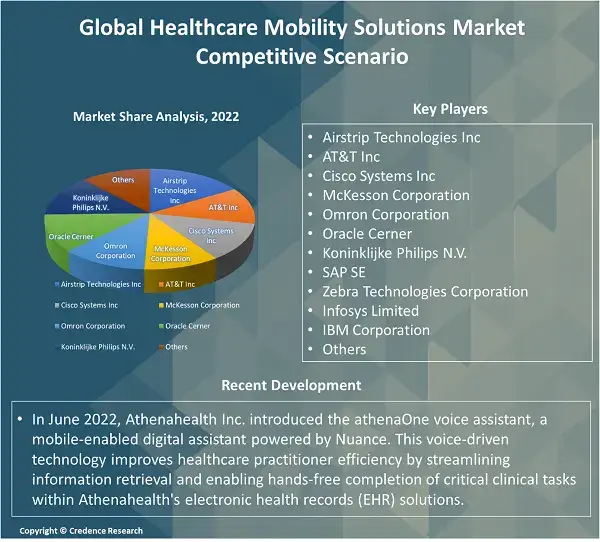
The healthcare mobility solutions industry is highly competitive, with several major players offering an extensive range of products and services. Some of the main players in the market and their market share are as follows:
- Airstrip Technologies Inc
- AT&T Inc
- Cisco Systems Inc
- McKesson Corporation
- Omron Corporation
- Oracle Cerner
- Koninklijke Philips N.V.
- SAP SE
- Zebra Technologies Corporation
- Infosys Limited
- IBM Corporation
- Others
These companies often engage in strategic collaborations, partnerships, and acquisitions to broaden the product portfolios and enhance their market presence. The market competition primarily centers on providing user-friendly and secure mobility solutions catering to healthcare providers, patients, and payers. Key focus areas include mobile health applications, remote patient monitoring, healthcare data management, and telemedicine platforms.
The major healthcare mobility solutions industry players are focused on new product introductions, such as basic cardiology and blood glucose monitors. In addition, smartwatches, health monitors, pedometers, and activity trackers are among the popular wearable devices introduced by various companies. As the demand for healthcare mobility solutions continues to rise, competition is expected to intensify, promoting innovations and technological advancements in the sector.
In April 2022, Royal Philips, a global leader in healthcare technology, and Prisma Health, South Carolina's largest non-profit healthcare system, formed a long-term collaboration to achieve patient monitoring. The partnership enables the health system to develop innovative imaging technologies that increase clinical performance and care quality.
In November 2021, OMRON Corporation introduced the world's fastest VT-X750-V3 system. The system is a CT-type X-ray inspection equipment that delivers 3D inspection of electronic substrates to fulfill the needs of 5G mobile communication networks.
Summary of Key Findings
- The growing need to reduce healthcare costs and enhance clinical efficiency, as well as the increasing acceptance of smartphones, tablets, and PDAs (personal digital assistants) in the healthcare ecosystem, technologically advanced connectivity for boosting the quality of healthcare mobility solutions, and better cost efficiency promoting medical professionals to embrace healthcare mobility solutions, all contribute to market development.
- Market segmented by product type, application, end-user, connectivity, and region.
- Patient care management solutions and healthcare administration applications are leading the market, emphasizing the importance of efficient care delivery and streamlined operations.
- The focus on patient-centric care is propelling the adoption of healthcare mobility solutions. Patients increasingly manage their health through mobile apps, and healthcare providers prioritize patient engagement and satisfaction.
- One of the challenges in the healthcare mobility solutions market is ensuring interoperability between different systems and devices.
- Healthcare mobility solutions are increasingly adopted in developing regions with limited access to traditional healthcare services.
Future Outlook
- The healthcare mobility solutions market is expected to continue its growth trajectory, driven by the emerging adoption of mobile health (mHealth) services, patient care management applications, and mobile devices.
- The demand for connected healthcare mobility solutions is expected to rise as they offer real-time data sharing, remote patient monitoring, and streamlined communication among healthcare professionals.
- Home healthcare settings are anticipated to expand substantially, providing patients with more accessible and convenient care options.
- Integrating telemedicine into healthcare mobility solutions will facilitate remote consultations and expand access to healthcare services.
Segmentation
- By Product Type
- Mobile Devices
- Smartphones
- Tablets
- Wearable Devices (Smartwatches, Fitness Trackers)
- Mobile Applications (Apps)
- Patient Engagement Apps
- Clinical Apps
- Medical Reference Apps
- Telemedicine Apps
- Mobile Health (mHealth) Services
- Remote Monitoring Services
- Mobile Health Information Services
- Mobile Health Management Services
- By Application
- Patient Care Management
- Healthcare Administration
- Chronic Disease Management
- Medication Management
- Remote Monitoring and Telehealth
- Hospital Workflow Management
- Medical Education and Training
- By End-User
- Hospitals and Clinics
- Home Healthcare Settings
- Pharmaceutical Companies
- Healthcare Payers
- Research Institutions
- Others
- By Connectivity
- Connected Healthcare Mobility Solutions
- Standalone Healthcare Mobility Solutions
- By Region
- North America
- The U.S.
- Canada
- Mexico
- Europe
- Germany
- France
- The U.K.
- Italy
- Spain
- Rest of Europe
- Asia Pacific
- China
- Japan
- India
- South Korea
- South-east Asia
- Rest of Asia Pacific
- Latin America
- Brazil
- Argentina
- Rest of Latin America
- Middle East & Africa
- GCC Countries
- South Africa
- Rest of the Middle East and Africa
- North America
- Mobile Devices
Adjacent Markets
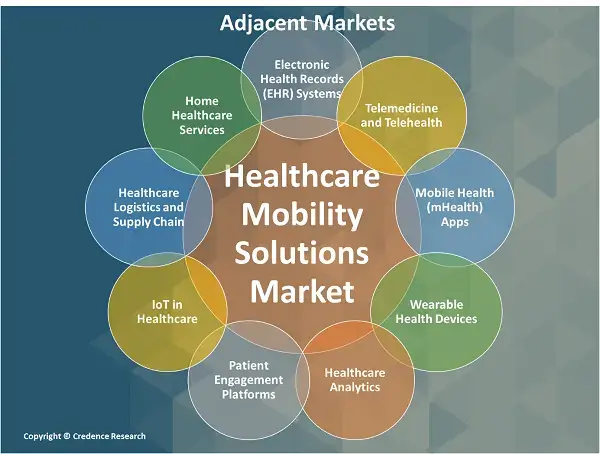
Several adjacent markets have high revenue growth opportunities in the global healthcare mobility solutions market. The key adjacent markets for healthcare mobility solutions market –
Request a Free Sample
Fill in your details and we'll send you a free sample report.
- Sample data tables & charts
- Research methodology
Need a Custom Version of This Report?
Tailor the scope, geography, or segments to your exact requirements.
- Custom geography or segment scope
- Direct access to our analyst team
Frequently Asked Questions
What is the current size of the global healthcare mobility solutions market?
What is the expected growth rate of the healthcare mobility solutions market between 2023 and 2030?
Which segment is leading the market share in terms of product type?
Which application segment governs the global demand for healthcare mobility solutions?
Which connectivity segment will post the highest CAGR in the forecast period?
Which region is fueling the growth of the healthcare mobility solutions industry?
Who are the major players in the global healthcare mobility solutions market?
What are the major market drivers of the healthcare mobility solutions industry?
What are the major market restraints of the healthcare mobility solutions industry?
What are the major market opportunities in the healthcare mobility solutions industry?
Table of Content
Chapter 1. Report Introduction
- 1.1 Report Description & Purpose
- 1.1.1 Report Title & Market Definition
- 1.1.2 Unique Selling Propositions (USP) & Key Differentiators
- 1.1.3 Value Proposition for Stakeholders
- 1.2 Research Objectives
- 1.2.1 Market Sizing Objectives (Volume & Revenue)
- 1.2.2 Segmentation Objectives
- 1.2.3 Competitive Intelligence Objectives
- 1.2.4 Forecast & Scenario Objectives
- 1.3 Report Scope
- 1.3.1 Healthcare Mobility Solutions Scope – Types & Subtypes Covered
- 1.3.2 Geographic Scope – Regions & Countries Covered
- 1.3.3 Historical Period, Base Year & Forecast Period (2022; forecast to the forecast period)
- 1.3.4 Inclusions & Exclusions
- 1.4 HS Code & Classification Framework
- 1.5 Currency, Units & Pricing Basis
- 1.6 Target Stakeholders
- 1.7 Limitations & Assumptions
Chapter 2. Executive Summary
- 2.1 Global Healthcare Mobility Solutions Market Snapshot
- 2.1.1 Market Size – Historical (2022) & Forecast (the forecast period) (2022: USD 111.2 Million → forecast year: NULL)
- 2.1.2 Volume & Revenue – Global Totals
- 2.1.3 Key Market Highlights – Top Five Facts
- 2.2 Healthcare Mobility Solutions Market Segmentation Snapshot
- 2.2.1 Market Split by Region – 2022 vs.
- 2.3 Competitive Snapshot
- 2.3.1 Top 10 Players by Revenue Share – 2022
- 2.3.2 Top 10 Players by Volume Share – 2022
- 2.3.3 Recent Strategic Developments (18-Month Summary)
- 2.4 Key Investment Highlights & Strategic Conclusions
Chapter 3. Healthcare Mobility Solutions Market Dynamics & Industry Analysis
- 3.1 Market Overview & Context
- 3.1.1 Healthcare Mobility Solutions Market Position in the Broader Automotive Value Chain
- 3.1.2 OEM vs. Replacement Market Dynamics
- 3.1.3 Market Maturity & Development Stage by Region
- 3.2 Healthcare Mobility Solutions Market Drivers
- 3.3 Healthcare Mobility Solutions Market Restraints & Challenges
- 3.4 Healthcare Mobility Solutions Market Opportunities
- 3.5 Porter's Five Forces Analysis
- 3.5.1 Threat of New Entrants
- 3.5.2 Bargaining Power of Suppliers
- 3.5.3 Bargaining Power of Buyers
- 3.5.4 Threat of Substitutes
- 3.5.5 Competitive Rivalry – Intensity Assessment
- 3.6 Healthcare Mobility Solutions Value Chain Analysis
- 3.6.1 Upstream – Raw Material/Input Suppliers
- 3.6.1.1 Raw Material/Input 1
- 3.6.1.2 Raw Material/Input 2
- 3.6.1.3 Raw Material/Input 3
- 3.6.2 Midstream – Production/Manufacturing/Service Delivery
- 3.6.2.1 Production/Process Overview
- 3.6.2.2 Key Facility Locations & Capacity by Manufacturer
- 3.6.3 Downstream – Distribution & End Consumer
- 3.6.3.1 Primary Channel – B2B/OEM
- 3.6.3.2 Secondary Channels – Dealer, Retail, Online, Direct
- 3.6.4 Value Chain Profitability Analysis
- 3.6.1 Upstream – Raw Material/Input Suppliers
- 3.7 PESTEL Analysis
- 3.7.1 Political Factors
- 3.7.2 Economic Factors
- 3.7.3 Social Factors
- 3.7.4 Technological Factors
- 3.7.5 Environmental Factors
- 3.7.6 Legal Factors
- 3.8 Healthcare Mobility Solutions Supply Chain Analysis
- 3.8.1 Raw Material/Input Supply Risk Assessment
- 3.8.2 Manufacturing Concentration Risk (Geographic Exposure)
- 3.8.3 Trade Disruption Impact Analysis
- 3.9 Regulatory & Policy Landscape
Note: The regulatory and policy landscape section covers regulations based on their applicability to the market, Healthcare Mobility Solutions category, geography, and scope of the study. Only regulatory frameworks with a material impact on operations, compliance, trade, sustainability, or market access are analyzed in detail.
Chapter 4. Key Investment Pockets & Opportunity Analysis
- 4.1 Healthcare Mobility Solutions Market Attractiveness Analysis
- 4.1.1 By Region – Investment Attractiveness Matrix (Volume × CAGR)
- 4.2 Absolute Revenue Growth Opportunity
- 4.2.1 By Region – Absolute USD Growth Through the forecast period
- 4.3 Incremental Volume Opportunity
- 4.3.1 By Region – Incremental Volume Through the forecast period
- 4.3.2 Segment – Incremental Volume
- 4.4 Emerging Submarket Opportunity Deep Dive (Subject to Applicability)
- 4.5 Emerging Market Opportunity Scorecards
- 4.5.1 United States
- 4.5.2 Europe
- 4.5.3 Asia
- 4.5.4 Middle East & Africa
Note: Emerging Market Opportunity Scorecards will be included based on relevance and strategic importance. Regions listed are indicative and may vary depending on data availability and market dynamics.
Chapter 5. Healthcare Mobility Solutions Import-Export Analysis & Trade Flows
- 5.1 Global Trade Overview
- 5.1.1 Global Export Value by Country (2022)
- 5.1.2 Global Export Volume by Country (2022)
- 5.1.3 Global Import Value by Country (2022)
- 5.1.4 Global Import Volume by Country (2022)
- 5.1.5 Net Trade Balance by Country (2022)
- 5.2 Export Analysis – Segment
- 5.2.1 Type 1 (HS Code)
- 5.2.2 Type 2 (HS Code)
- 5.2.3 Type 3 (HS Code)
- 5.2.4 Type 4 (HS Code)
- 5.2.5 Type 5 (HS Code)
- 5.3 Import Analysis – Segment
- 5.3.1 Type 1 (HS Code)
- 5.3.2 Type 2 (HS Code)
- 5.3.3 Type 3 (HS Code)
- 5.3.4 Type 4 (HS Code)
- 5.3.5 Type 5 (HS Code)
- 5.4 Average Unit Trade Prices
- 5.4.1 Average Export Price – Segment & Country
- 5.4.2 Average Import Price – Segment & Source Country
- 5.4.3 Price Trends (2022)
- 5.5 Key Trade Route Analysis
- 5.5.1 Trade Route 1
- 5.5.2 Trade Route 2
- 5.5.3 Trade Route 3
- 5.5.4 Trade Route 4
- 5.5.5 Trade Route 5
- 5.6 Trade Policy Impact Assessment
- 5.6.1 US Anti-Dumping & Section 301 Tariffs
- 5.6.2 EU Customs Union Impact
- 5.6.3 Major Free Trade Agreements
- 5.6.4 USMCA Rules of Origin
Note: Trade policy analysis will be included only where relevant to the Healthcare Mobility Solutions market.
Chapter 6. Competitive Landscape & Company Benchmarking
- 6.1 Healthcare Mobility Solutions Market Concentration & Structure
- 6.1.1 Herfindahl-Hirschman Index (HHI) – vs. 2022
- 6.1.2 Tier 1, Tier 2 & Tier 3 Market Structure
- 6.1.3 Global, Regional & Local Player Dynamics
- 6.2 Healthcare Mobility Solutions Market Share Analysis – 2022
- 6.2.1 Global Revenue Share by Company
- 6.2.2 Global Volume Share by Company
- 6.2.3 Regional Revenue Share
- 6.2.4 Market Share Evolution ( vs. 2022)
- 6.2.5 OEM Segment Share by Company
- 6.2.6 Replacement Segment Share by Company
- 6.3 Production/Delivery Capacity & Facility Analysis
- 6.3.1 Global Installed Capacity
- 6.3.2 Capacity Utilization Rates
- 6.3.3 Production/Output Volume
- 6.3.4 Facility Locations & Capacity Map
- 6.3.5 Planned Capacity Additions
- 6.4 Healthcare Mobility Solutions Competitive Benchmarking Matrix
- 6.4.1 Revenue, Volume, CAGR & Profitability Comparison
- 6.4.2 Channel Revenue Mix
- 6.4.3 Geographic Revenue Exposure
- 6.4.4 R&D Intensity
- 6.4.5 Sustainability Maturity
- 6.5 Strategic Developments in Healthcare Mobility Solutions (Last 24 Months)
- 6.5.1 Mergers, Acquisitions & Divestments
- 6.5.2 New Healthcare Mobility Solutions Launches
- 6.5.3 Facility Expansions
- 6.5.4 Strategic Alliances, Joint Ventures & Partnerships
- 6.5.5 Distribution Expansion & Market Entry
- 6.5.6 Sustainability & ESG Initiatives
- 6.6 Competitive Strategy Mapping
- 6.6.1 Leader, Challenger, Follower & Niche Classification
- 6.6.2 Pricing Strategy Comparison
- 6.6.3 Channel Strategy Matrix
Note: Strategic developments are included based on their materiality and the availability of reliable information.
Chapter 7. Global Healthcare Mobility Solutions Market – By Distribution Channel
- 7.1 Segment Overview
- 7.1.1 Volume & Revenue Split by Channel (2022 & )
- 7.1.2 Channel Mix Evolution (the forecast period)
Chapter 8. Regional Market Analysis – Global Overview
- 8.1 Global Regional Overview
- 8.1.1 Regional Volume Share
- 8.1.2 Regional Revenue Share
- 8.1.3 Regional Volume by Region
- 8.1.4 Regional Revenue by Region
- 8.1.5 Regional Forecast Through the forecast period
- 8.2 Cross-Regional Segment Analysis
- 8.2.1 By Distribution Channel
- 8.2.2 By Brand/Price Tier
Chapter 9. North America Healthcare Mobility Solutions Market
- 9.1 United States
- 9.2 Canada
- 9.3 Mexico
Chapter 10. Europe Healthcare Mobility Solutions Market
- 10.1 Germany
- 10.2 France
- 10.3 Italy
- 10.4 United Kingdom
- 10.5 Spain
- 10.6 Poland
- 10.7 Russia
- 10.8 Netherlands
- 10.9 Belgium
- 10.10 Sweden
- 10.11 Denmark
- 10.12 Norway
- 10.13 Rest of Europe
Chapter 11. Asia Pacific Healthcare Mobility Solutions Market
- 11.1 China
- 11.2 India
- 11.3 Japan
- 11.4 South Korea
- 11.5 Thailand
- 11.6 Indonesia
- 11.7 Vietnam
- 11.8 Malaysia
- 11.9 Australia
- 11.10 Rest of Asia Pacific
Chapter 12. Latin America Healthcare Mobility Solutions Market
- 12.1 Brazil
- 12.2 Argentina
- 12.3 Colombia
- 12.4 Chile
- 12.5 Rest of Latin America
Chapter 13. Middle East Healthcare Mobility Solutions Market
- 13.1 Saudi Arabia
- 13.2 United Arab Emirates
- 13.3 Turkey
- 13.4 Israel
- 13.5 Iran
- 13.6 Rest of the Middle East
Chapter 14. Africa Healthcare Mobility Solutions Market
- 14.1 South Africa
- 14.2 Egypt
- 14.3 Nigeria
- 14.4 Morocco
- 14.5 Rest of Africa
Chapter 15. Healthcare Mobility Solutions Company Profiles
- 15.1 [Company 01]
- 15.1.1 Company Overview
- 15.1.2 Key Management Personnel
- 15.1.3 Products & Services Portfolio
- 15.1.4 Financial Performance
- 15.1.5 Key Market Focus & Geographic Presence
- 15.1.6 Recent Developments & Strategic Initiatives
Note: The company profile list is preliminary and may change based on research findings, market developments, data availability, and client requirements.
Chapter 16. Appendices
- Appendix A – List of Abbreviations & Acronyms
- Appendix B – Industry Classification Code Reference – Full Series
- Appendix C – Production & Capacity Data Tables
- Appendix D – End-Use & Demand Base Tables
- Appendix E – Consumption & Replacement Rate Assumptions
- Appendix F – ASP Reference Tables
- Appendix G – Manufacturing & Facility Database
- Appendix H – Import-Export Data Tables
- Appendix I – Regulatory Summary Tables
- Appendix J – Primary Research Participant List (Anonymized)
- Appendix K – Primary Research Questionnaire Framework
- Appendix L – Data Sources & Bibliography
- Appendix M – Market Size Divergence & Source Comparison
Chapter 17. Research Methodology
- 17.1 Research Framework & Philosophy
- 17.2 Secondary Research – Sources, Hierarchy & Data Extraction
- 17.3 Data Modeling – Bottom-Up & Top-Down Market Sizing
- 17.4 Primary Research – Stakeholder Framework, LOI & Sample Sizes
- 17.5 Forecast Methodology – Regression, Scenario & Sensitivity Analysis
- 17.6 Quality Control – Four-Layer Validation Framework
- 17.7 Limitations & Standard Assumptions
- 17.8 Disclaimer
