
Market Overview
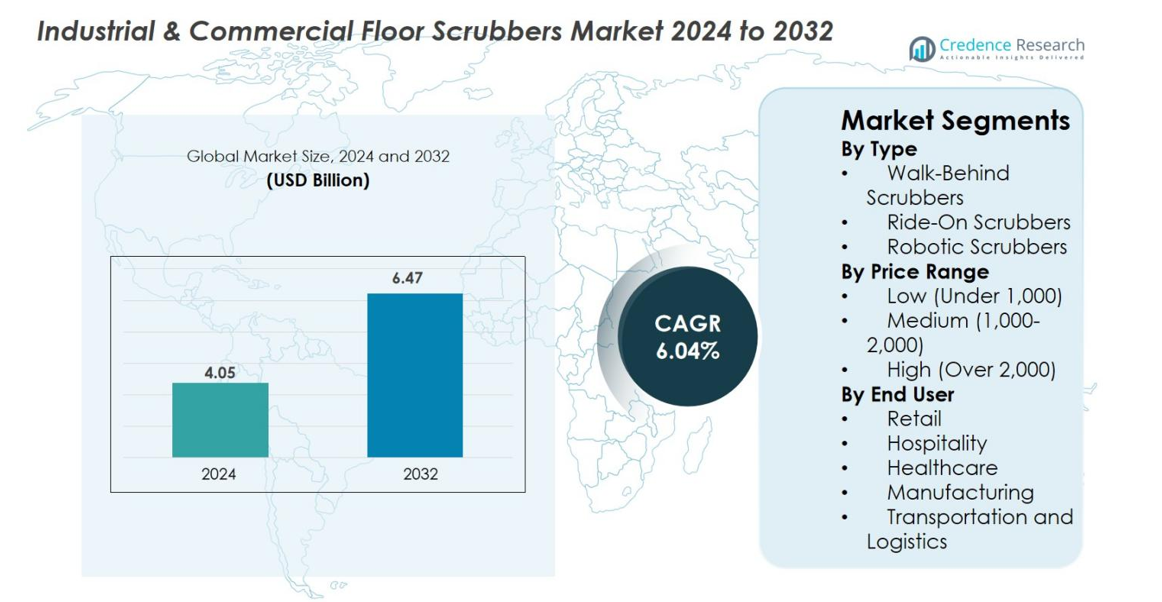
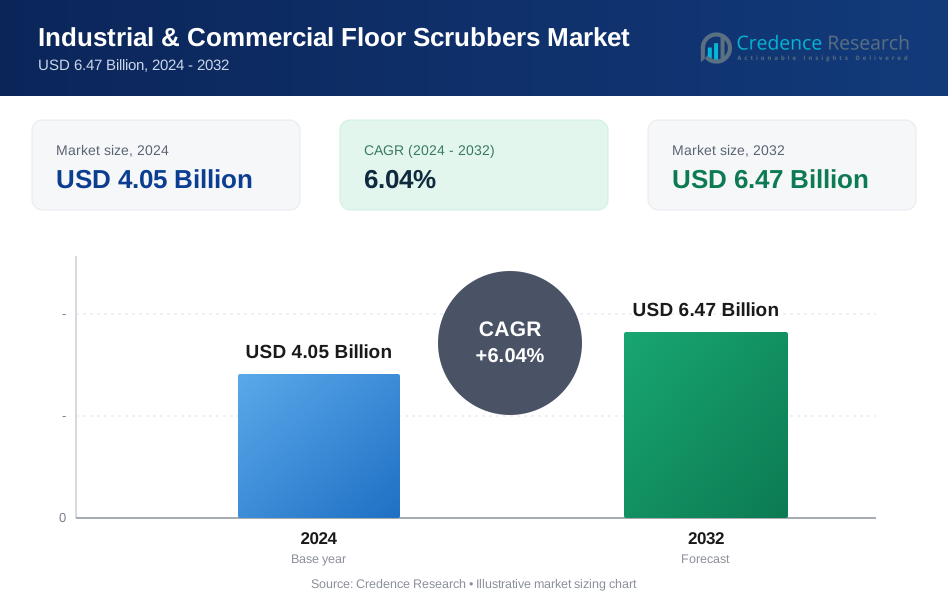
Industrial & Commercial Floor Scrubbers Market size was valued at USD 4.05 Billion in 2024 and is anticipated to reach USD 6.47 Billion by 2032, at a CAGR of 6.04% during the forecast period.
| REPORT ATTRIBUTE | DETAILS |
|---|---|
| Historical Period | 2020-2023 |
| Base Year | 2024 |
| Forecast Period | 2025-2032 |
| Industrial & Commercial Floor Scrubbers Market Size 2024 | USD 4.05 Billion |
| Industrial & Commercial Floor Scrubbers Market , CAGR | 6.04% |
| Industrial & Commercial Floor Scrubbers Market Size 2032 | USD 6.47 Billion |
Industrial & Commercial Floor Scrubbers Market features strong participation from leading players such as Tennant Company, Nilfisk Group, Hako GmbH, Diversey Inc., Numatic International, Dulevo S.p.A., Powr-Flite, Amano Corporation, Polivac International, and TRUVOX International, all of whom focus on advanced cleaning technologies, automation, and energy-efficient designs to strengthen their market presence. North America emerged as the leading region with a 34.2% share in 2024, driven by high adoption of automated cleaning solutions and strong facility-management standards. Europe followed with a 29.6% share, supported by stringent hygiene regulations and strong demand for sustainable cleaning equipment across commercial and industrial sectors.
Market Insights
- Industrial & Commercial Floor Scrubbers Market was valued at USD 4.05 Billion in 2024 and is projected to reach USD 6.47 Billion by 2032, growing at a CAGR of 6.04%.
- Strong demand is driven by rising hygiene standards, rapid facility modernization, and increasing adoption of automated scrubbers across retail, healthcare, hospitality, and industrial environments; walk-behind scrubbers led the market with a 46.8% share.
- Key trends include the expansion of autonomous and IoT-enabled scrubbers, sustainability-focused designs, and growing use of lithium-ion batteries to improve efficiency and reduce operating costs.
- Market competition is shaped by manufacturers such as Tennant Company, Nilfisk Group, Hako GmbH, and Diversey Inc., focusing on automation, product innovation, and expanded service networks to strengthen their presence.
- Regionally, North America held 34.2% share in 2024, followed by Europe at 29.6% and Asia-Pacific at 24.7%, supported by robust commercial infrastructure growth and rising adoption of advanced cleaning technologies.
Market Segmentation Analysis
By Type
Walk-behind scrubbers dominated the Industrial & Commercial Floor Scrubbers Market in 2024 with an 46.8% share, driven by their affordability, ease of maneuverability, and suitability for small to medium commercial spaces. Ride-on scrubbers continue to gain traction as large industrial facilities prioritize higher cleaning productivity and reduced labor costs. Robotic scrubbers, though smaller in share, are expanding rapidly due to automation trends, labor shortages, and increased adoption in airports, warehouses, and modern retail environments. Advancements in sensors, AI navigation, and battery efficiency further accelerate demand across this segment.
- For instance, A walk-behind scrubber is often recommended for clinics, small retail shops, or narrow-corridor office buildings because of its “compact size and easy manoeuvrability.
By Price Range
The medium price range (USD 1,000–2,000) led the market with 42.5% share in 2024, supported by strong adoption from small and mid-sized businesses seeking durable and cost-effective cleaning solutions. This range offers an optimal balance between performance and affordability, making it popular across retail, hospitality, and healthcare facilities. Low-priced scrubbers attract budget-conscious buyers but offer limited durability, while high-priced scrubbers gain adoption in industrial and logistics spaces where advanced features, high-capacity tanks, and automation justify the premium investment.
- For instance, Budget scrubbers those well below the mid-price range tend to be limited in tank capacity, brush size, and battery life, making them less durable or effective for regular commercial use.
By End User
The retail segment held the largest share at 29.7% in 2024, driven by high footfall, strict cleanliness standards, and continuous demand for efficient floor maintenance. Hospitality and healthcare sectors also show strong adoption as they prioritize hygiene and operational efficiency. Manufacturing and logistics facilities increasingly invest in heavy-duty and automated scrubbers to meet regulatory standards and enhance productivity. Growth across all end-user categories is supported by rising facility management outsourcing, hygiene awareness, and expansion of commercial infrastructure.
Key Growth Drivers
Rising Hygiene Standards and Regulatory Compliance
Growing emphasis on hygiene, sanitation, and workplace safety remains a major force accelerating the adoption of industrial and commercial floor scrubbers. Industries such as healthcare, food processing, retail, and hospitality operate under stringent cleanliness regulations that require frequent and consistent floor sanitation. Traditional manual cleaning methods fail to meet modern standards for microbial control, efficiency, and uniformity, compelling organizations to invest in advanced scrubbers. Post-pandemic awareness has amplified expectations for clean public environments, driving demand for efficient, chemical-compatible, and quick-drying scrubber solutions. Regulatory frameworks around workplace safety also encourage mechanized cleaning to reduce slip hazards and cross-contamination risks. As facility sizes increase and maintenance budgets tighten, businesses prioritize equipment that enhances cleaning productivity while lowering long-term operational costs.
- For instance, in large facilities and warehouses, industrial floor scrubbers are more effective than mops in removing bacteria, grease, and allergens from floors combining cleaning solution, mechanical scrubbing, and vacuum extraction in one pass for deeper, more hygienic results.
Automation and Technological Advancements in Cleaning Equipment
Technological innovation plays a significant role in transforming the floor scrubber landscape, with automation, IoT integration, AI navigation, and energy-efficient designs reshaping user expectations. Modern scrubbers offer intelligent features such as route mapping, real-time performance monitoring, predictive maintenance alerts, and optimized water-detergent usage. Autonomous robotic scrubbers, equipped with sensors, LiDAR, and machine-learning algorithms, are increasingly deployed across airports, retail chains, and logistics centers to reduce labor dependence and improve cleaning consistency. Battery advancements extend run times and reduce downtime, enhancing efficiency in large facilities. Connected scrubbers that share usage data help facility managers optimize cleaning schedules and reduce resource waste. These technological shifts support sustainability goals while redefining operational efficiency across commercial environments.
- For instance, Tennant’s T7AMR robotic scrubber, powered by BrainOS, uses LiDAR and 3D sensors for autonomous navigation and has been deployed in airports and retail chains to improve consistency and reduce labor dependency.
Growth of Commercial Infrastructure and Facility Management Services
Rapid expansion of commercial establishments including supermarkets, malls, hotels, hospitals, warehouses, and manufacturing facilities continues to fuel strong demand for floor scrubbers. The rise of organized retail in developing economies boosts demand for efficient, large-scale cleaning operations as foot traffic intensifies. The global growth of facility management outsourcing further drives adoption, as service providers prioritize modern equipment that enhances productivity and reduces labor dependency. Industrial facilities increasingly rely on mechanized cleaning to support safety audits, reduce dust accumulation, and protect sensitive machinery. Urbanization trends add to the number of commercial spaces requiring frequent cleaning. Sustainability-focused facility models also encourage adoption of energy-efficient scrubbers with lower lifecycle costs, making mechanized cleaning a core component of operational excellence.
Key Trends & Opportunities
Rapid Adoption of Autonomous and Smart Scrubber Technologies
One of the most transformative trends in the market is the rapid adoption of autonomous and AI-enabled floor scrubbers. Organizations facing labor shortages or high cleaning labor costs increasingly turn to robotic solutions that operate independently and deliver consistent cleaning results. Smart scrubbers equipped with IoT sensors, telematics, and remote dashboards enable facility managers to track performance, optimize cleaning routes, and identify maintenance needs in real time. Integration with building management systems enhances automation and streamlines workflows. This trend opens opportunities for subscription-based services, remote diagnostics, and fleet-management software. Industries with large floor areas such as airports, distribution centers, and large retail formats are adopting smart scrubbers to improve efficiency and cleanliness. As robotics become more affordable and reliable, adoption is expected to accelerate globally.
- For instance, Tennant’s T7AMR, powered by BrainOS, is widely deployed in airports and retail chains, where its AI-based navigation and obstacle-detection sensors enable autonomous operation with minimal human intervention.
Sustainability and Energy-Efficient Cleaning Solutions
A strong shift toward environmentally responsible cleaning processes is creating substantial opportunities for manufacturers offering sustainable scrubber technologies. End users increasingly seek equipment that reduces water consumption, minimizes chemical usage, and delivers energy-efficient performance. Technologies such as water-recycling systems, chemical-free cleaning options, and lithium-ion batteries are gaining traction as organizations emphasize environmental compliance. Industries such as healthcare and hospitality prioritize green cleaning protocols to support indoor air quality and ESG objectives. Manufacturers with recyclable components, durable brush systems, and lower-noise operation align well with evolving buyer expectations. As sustainability becomes a central purchasing criterion, companies offering eco-certified products and transparent lifecycle assessments stand to capture significant market share.
- For instance, Tennant’s ec-H2O NanoClean® technology converts plain water into a cleaning solution eliminating the need for traditional chemicals and helping facilities reduce environmental impact.
Key Challenges
High Upfront Costs and Budget Constraints for Small Enterprises
Despite the long-term benefits of mechanized cleaning, high initial investment remains a major hurdle, especially for small and mid-sized businesses. Many organizations continue using manual cleaning methods due to lower upfront costs, even though long-term labor expenses are higher. Advanced scrubbers particularly robotic and ride-on models require substantial capital outlay, limiting adoption in cost-sensitive markets. Sectors such as small retail stores, local hospitality operators, and public facilities often face budget constraints that hinder technology adoption. Additional costs for maintenance, replacement parts, and periodic servicing further increase total cost of ownership. Financing, leasing, and rental programs can reduce barriers, but accessibility varies widely by region. To expand market penetration, manufacturers must balance innovation with affordability and offer flexible procurement options.
Operational Complexity and Need for Skilled Maintenance
Operational complexity associated with modern floor scrubbers presents another challenge, as these machines require skilled personnel for proper operation, troubleshooting, and maintenance. Robotic scrubbers rely on sophisticated navigation systems, sensors, and software that may overwhelm untrained staff, leading to improper use or reduced cleaning performance. Maintenance requirements for batteries, brushes, filters, and software updates can create additional operational burdens. Inadequate training often results in frequent downtime and higher repair costs. Availability of skilled technicians varies across regions, causing service delays. Facilities transitioning from manual to mechanized cleaning also face adoption resistance and workflow adjustments. Addressing these issues requires intuitive machine interfaces, comprehensive training programs, strong after-sales support, and simplified maintenance designs to ensure consistent and reliable performance.
Regional Analysis
North America
North America led the Industrial & Commercial Floor Scrubbers Market with an 34.2% share in 2024, driven by strong adoption of automated cleaning equipment across retail chains, airports, healthcare facilities, and large industrial complexes. The region benefits from advanced facility management practices, high labor costs encouraging mechanization, and rapid integration of robotic scrubbers in commercial spaces. Stringent hygiene regulations and strong replacement demand further strengthen market growth. Rising investment in smart buildings and IoT-enabled cleaning systems continues to accelerate uptake, positioning North America as a technology-driven and mature market for high-performance floor scrubbers.
Europe
Europe accounted for 29.6% share of the Industrial & Commercial Floor Scrubbers Market in 2024, supported by strict environmental regulations, widespread facility modernization, and demand for sustainable cleaning technologies. Industries such as hospitality, healthcare, manufacturing, and transportation prioritize high-efficiency scrubbers to meet hygiene and safety standards. The region’s strong presence of established cleaning equipment manufacturers further enhances product innovation and adoption. Growing interest in low-noise, energy-efficient, and eco-friendly models aligns with Europe’s sustainability agenda. Increased deployment of robotic scrubbers in airports, logistics hubs, and retail stores continues to advance the region’s market growth.
Asia-Pacific
Asia-Pacific captured 24.7% share in 2024 and represents the fastest-growing region, driven by rapid urbanization, expanding commercial infrastructure, and rising investments in modern facility management. Countries such as China, India, Japan, and South Korea are experiencing strong demand from retail malls, manufacturing facilities, hospitals, and transportation hubs. Labor shortages and rising wage levels in developed APAC markets further encourage adoption of automated scrubbers. Growing emphasis on workplace hygiene, driven by public-health awareness, fuels adoption across commercial sectors. Government initiatives supporting smart cities and digital infrastructure add momentum to advanced cleaning technology adoption.
Latin America
Latin America held an 7.4% share of the Industrial & Commercial Floor Scrubbers Market in 2024, with growth supported by expanding retail formats, rising hospitality investments, and modernization of industrial cleaning practices. Countries such as Brazil, Mexico, and Chile are increasingly adopting mechanized cleaning solutions to improve operational efficiency and hygiene compliance. Budget constraints continue to slow penetration of high-end robotic models, but demand for mid-range scrubbers remains strong. Strengthening facility management outsourcing and improved commercial infrastructure development contribute to steady market expansion across the region.
Middle East & Africa
The Middle East & Africa region accounted for 4.1% share in 2024, driven by expanding commercial establishments, rapid development of hospitality and tourism infrastructure, and growth of large public facilities such as airports and healthcare centers. The Gulf countries, in particular, are investing heavily in automated cleaning technologies to maintain high cleanliness standards across premium commercial spaces. Industrial facilities in Africa are gradually transitioning toward mechanized cleaning as modernization accelerates. While adoption remains lower than other regions, increasing urban development and facility-management contracts support long-term market growth.
Market Segmentations
By Type
- Walk-Behind Scrubbers
- Ride-On Scrubbers
- Robotic Scrubbers
By Price Range
- Low (Under 1,000)
- Medium (1,000-2,000)
- High (Over 2,000)
By End User
- Retail
- Hospitality
- Healthcare
- Manufacturing
- Transportation and Logistics
By Geography
- North America
- U.S.
- Canada
- Mexico
- Europe
- Germany
- France
- U.K.
- Italy
- Spain
- Rest of Europe
- Asia Pacific
- China
- Japan
- India
- South Korea
- South-east Asia
- Rest of Asia Pacific
- Latin America
- Brazil
- Argentina
- Rest of Latin America
- Middle East & Africa
- GCC Countries
- South Africa
- Rest of the Middle East and Africa
Competitive Landscape
The competitive landscape of the Industrial & Commercial Floor Scrubbers Market is characterized by the presence of established global manufacturers alongside emerging automation-focused players, each striving to strengthen their market position through innovation, product diversification, and geographic expansion. Key companies such as Tennant Company, Nilfisk Group, Hako GmbH, Diversey Inc., Numatic International, Dulevo S.p.A., Powr-Flite, Amano Corporation, Polivac International, and TRUVOX International actively invest in technologies that enhance cleaning efficiency, reduce labor dependency, and support sustainability goals. Manufacturers increasingly focus on autonomous scrubbers, lithium-ion battery systems, low-noise operation, and IoT-enabled monitoring to meet evolving facility-management requirements. Strategic initiatives including mergers, partnerships, equipment leasing models, and after-sales service expansion play a crucial role in strengthening brand presence. Growing preference for robotic solutions is reshaping competition, encouraging players to integrate AI navigation, telematics, and real-time data analytics to differentiate offerings and capture emerging opportunities across commercial and industrial sectors.
Key Player Analysis
- Nilfisk Group
- TRUVOX International
- Tennant Company
- Dulevo S.p.A.
- Powr-Flite
- Diversey, Inc
- Numatic International
- Hako GmbH
- Polivac International Company Ltd
- Amano Corporation
Recent Developments
- In September 2025, DAILIS announced a pre-sale program for new floor scrubbers and exhibited at the Russian International Cleaning Exhibition signaling its expansion efforts in the commercial scrubber space.
- In May 2024, Nilfisk Group partnered with LionsBot to launch an advanced autonomous cleaning machine for commercial/industrial cleaning
Report Coverage
The research report offers an in-depth analysis based on Type, Price Range, End-User and Geography. It details leading market players, providing an overview of their business, product offerings, investments, revenue streams, and key applications. Additionally, the report includes insights into the competitive environment, SWOT analysis, current market trends, as well as the primary drivers and constraints. Furthermore, it discusses various factors that have driven market expansion in recent years. The report also explores market dynamics, regulatory scenarios, and technological advancements that are shaping the industry. It assesses the impact of external factors and global economic changes on market growth. Lastly, it provides strategic recommendations for new entrants and established companies to navigate the complexities of the market.
Future Outlook
- The market will grow steadily as automation and smart cleaning technologies become widely adopted across commercial and industrial facilities.
- Robotic floor scrubbers will see rapid adoption driven by labor shortages and increasing demand for autonomous cleaning solutions.
- IoT-enabled scrubbers will expand as organizations prioritize real-time performance monitoring and predictive maintenance.
- Sustainability initiatives will boost demand for energy-efficient, low-water, and chemical-free cleaning systems.
- Lithium-ion battery technology will replace conventional power systems, enabling longer run times and faster charging cycles.
- Hygiene-focused sectors such as healthcare, hospitality, and retail will further increase investment in advanced cleaning equipment.
- Service-based and subscription models for equipment use and maintenance will gain popularity among end users.
- Rapid commercial infrastructure development in Asia-Pacific and the Middle East will significantly drive future demand.
- Manufacturers will focus on innovations that improve maneuverability, reduce noise, and enhance compact design efficiency.
- Integration of scrubbers with building management systems and automated facility platforms will become more widespread.
Request a Free Sample
Fill in your details and we'll send you a free sample report.
- Sample data tables & charts
- Research methodology
Need a Custom Version of This Report?
Tailor the scope, geography, or segments to your exact requirements.
- Custom geography or segment scope
- Direct access to our analyst team
Frequently Asked Questions
What is the current market size for Industrial and Commercial Floor Scrubbers, and what is its projected size in 2032?
At what Compound Annual Growth Rate is the Industrial and Commercial Floor Scrubbers market projected to grow between 2025 and 2032?
Which Industrial and Commercial Floor Scrubbers segment held the largest share in 2024?
What are the primary factors fueling the growth of the Industrial and Commercial Floor Scrubbers market?
Who are the leading companies in the Industrial and Commercial Floor Scrubbers market?
Table of Content
Chapter 1. Report Introduction
- 1.1 Report Description & Purpose
- 1.1.1 Report Title & Market Definition
- 1.1.2 Unique Selling Propositions (USP) & Key Differentiators
- 1.1.3 Value Proposition for Stakeholders
- 1.2 Research Objectives
- 1.2.1 Market Sizing Objectives (Volume & Revenue)
- 1.2.2 Segmentation Objectives
- 1.2.3 Competitive Intelligence Objectives
- 1.2.4 Forecast & Scenario Objectives
- 1.3 Report Scope
- 1.3.1 Industrial & Commercial Floor Scrubbers Scope – Types & Subtypes Covered
- 1.3.2 Geographic Scope – Regions & Countries Covered
- 1.3.3 Historical Period, Base Year & Forecast Period (2024; forecast to 2032)
- 1.3.4 Inclusions & Exclusions
- 1.4 HS Code & Classification Framework
- 1.5 Currency, Units & Pricing Basis
- 1.6 Target Stakeholders
- 1.7 Limitations & Assumptions
Chapter 2. Executive Summary
- 2.1 Global Industrial & Commercial Floor Scrubbers Market Snapshot
- 2.1.1 Market Size – Historical (2024) & Forecast (2024-2032) (2024: USD 4.05 Billion → 2032: USD 6.47 Billion)
- 2.1.2 Volume & Revenue – Global Totals
- 2.1.3 Key Market Highlights – Top Five Facts
- 2.2 Industrial & Commercial Floor Scrubbers Market Segmentation Snapshot
- 2.2.1 Market Split by Region – 2024 vs. 2032
- 2.3 Competitive Snapshot
- 2.3.1 Top 10 Players by Revenue Share – 2024
- 2.3.2 Top 10 Players by Volume Share – 2024
- 2.3.3 Recent Strategic Developments (18-Month Summary)
- 2.4 Key Investment Highlights & Strategic Conclusions
Chapter 3. Industrial & Commercial Floor Scrubbers Market Dynamics & Industry Analysis
- 3.1 Market Overview & Context
- 3.1.1 Industrial & Commercial Floor Scrubbers Market Position in the Broader Automotive Value Chain
- 3.1.2 OEM vs. Replacement Market Dynamics
- 3.1.3 Market Maturity & Development Stage by Region
- 3.2 Industrial & Commercial Floor Scrubbers Market Drivers
- 3.3 Industrial & Commercial Floor Scrubbers Market Restraints & Challenges
- 3.4 Industrial & Commercial Floor Scrubbers Market Opportunities
- 3.5 Porter's Five Forces Analysis
- 3.5.1 Threat of New Entrants
- 3.5.2 Bargaining Power of Suppliers
- 3.5.3 Bargaining Power of Buyers
- 3.5.4 Threat of Substitutes
- 3.5.5 Competitive Rivalry – Intensity Assessment
- 3.6 Industrial & Commercial Floor Scrubbers Value Chain Analysis
- 3.6.1 Upstream – Raw Material/Input Suppliers
- 3.6.1.1 Raw Material/Input 1
- 3.6.1.2 Raw Material/Input 2
- 3.6.1.3 Raw Material/Input 3
- 3.6.2 Midstream – Production/Manufacturing/Service Delivery
- 3.6.2.1 Production/Process Overview
- 3.6.2.2 Key Facility Locations & Capacity by Manufacturer
- 3.6.3 Downstream – Distribution & End Consumer
- 3.6.3.1 Primary Channel – B2B/OEM
- 3.6.3.2 Secondary Channels – Dealer, Retail, Online, Direct
- 3.6.4 Value Chain Profitability Analysis
- 3.6.1 Upstream – Raw Material/Input Suppliers
- 3.7 PESTEL Analysis
- 3.7.1 Political Factors
- 3.7.2 Economic Factors
- 3.7.3 Social Factors
- 3.7.4 Technological Factors
- 3.7.5 Environmental Factors
- 3.7.6 Legal Factors
- 3.8 Industrial & Commercial Floor Scrubbers Supply Chain Analysis
- 3.8.1 Raw Material/Input Supply Risk Assessment
- 3.8.2 Manufacturing Concentration Risk (Geographic Exposure)
- 3.8.3 Trade Disruption Impact Analysis
- 3.9 Regulatory & Policy Landscape
Note: The regulatory and policy landscape section covers regulations based on their applicability to the market, Industrial & Commercial Floor Scrubbers category, geography, and scope of the study. Only regulatory frameworks with a material impact on operations, compliance, trade, sustainability, or market access are analyzed in detail.
Chapter 4. Key Investment Pockets & Opportunity Analysis
- 4.1 Industrial & Commercial Floor Scrubbers Market Attractiveness Analysis
- 4.1.1 By Region – Investment Attractiveness Matrix (Volume × CAGR)
- 4.2 Absolute Revenue Growth Opportunity
- 4.2.1 By Region – Absolute USD Growth Through 2032
- 4.3 Incremental Volume Opportunity
- 4.3.1 By Region – Incremental Volume Through 2032
- 4.3.2 Segment – Incremental Volume
- 4.4 Emerging Submarket Opportunity Deep Dive (Subject to Applicability)
- 4.5 Emerging Market Opportunity Scorecards
- 4.5.1 United States
- 4.5.2 Europe
- 4.5.3 Asia
- 4.5.4 Middle East & Africa
Note: Emerging Market Opportunity Scorecards will be included based on relevance and strategic importance. Regions listed are indicative and may vary depending on data availability and market dynamics.
Chapter 5. Industrial & Commercial Floor Scrubbers Import-Export Analysis & Trade Flows
- 5.1 Global Trade Overview
- 5.1.1 Global Export Value by Country (2024)
- 5.1.2 Global Export Volume by Country (2024)
- 5.1.3 Global Import Value by Country (2024)
- 5.1.4 Global Import Volume by Country (2024)
- 5.1.5 Net Trade Balance by Country (2024)
- 5.2 Export Analysis – Segment
- 5.2.1 Type 1 (HS Code)
- 5.2.2 Type 2 (HS Code)
- 5.2.3 Type 3 (HS Code)
- 5.2.4 Type 4 (HS Code)
- 5.2.5 Type 5 (HS Code)
- 5.3 Import Analysis – Segment
- 5.3.1 Type 1 (HS Code)
- 5.3.2 Type 2 (HS Code)
- 5.3.3 Type 3 (HS Code)
- 5.3.4 Type 4 (HS Code)
- 5.3.5 Type 5 (HS Code)
- 5.4 Average Unit Trade Prices
- 5.4.1 Average Export Price – Segment & Country
- 5.4.2 Average Import Price – Segment & Source Country
- 5.4.3 Price Trends (2024)
- 5.5 Key Trade Route Analysis
- 5.5.1 Trade Route 1
- 5.5.2 Trade Route 2
- 5.5.3 Trade Route 3
- 5.5.4 Trade Route 4
- 5.5.5 Trade Route 5
- 5.6 Trade Policy Impact Assessment
- 5.6.1 US Anti-Dumping & Section 301 Tariffs
- 5.6.2 EU Customs Union Impact
- 5.6.3 Major Free Trade Agreements
- 5.6.4 USMCA Rules of Origin
Note: Trade policy analysis will be included only where relevant to the Industrial & Commercial Floor Scrubbers market.
Chapter 6. Competitive Landscape & Company Benchmarking
- 6.1 Industrial & Commercial Floor Scrubbers Market Concentration & Structure
- 6.1.1 Herfindahl-Hirschman Index (HHI) – vs. 2024
- 6.1.2 Tier 1, Tier 2 & Tier 3 Market Structure
- 6.1.3 Global, Regional & Local Player Dynamics
- 6.2 Industrial & Commercial Floor Scrubbers Market Share Analysis – 2024
- 6.2.1 Global Revenue Share by Company
- 6.2.2 Global Volume Share by Company
- 6.2.3 Regional Revenue Share
- 6.2.4 Market Share Evolution ( vs. 2024)
- 6.2.5 OEM Segment Share by Company
- 6.2.6 Replacement Segment Share by Company
- 6.3 Production/Delivery Capacity & Facility Analysis
- 6.3.1 Global Installed Capacity
- 6.3.2 Capacity Utilization Rates
- 6.3.3 Production/Output Volume
- 6.3.4 Facility Locations & Capacity Map
- 6.3.5 Planned Capacity Additions
- 6.4 Industrial & Commercial Floor Scrubbers Competitive Benchmarking Matrix
- 6.4.1 Revenue, Volume, CAGR & Profitability Comparison
- 6.4.2 Channel Revenue Mix
- 6.4.3 Geographic Revenue Exposure
- 6.4.4 R&D Intensity
- 6.4.5 Sustainability Maturity
- 6.5 Strategic Developments in Industrial & Commercial Floor Scrubbers (Last 24 Months)
- 6.5.1 Mergers, Acquisitions & Divestments
- 6.5.2 New Industrial & Commercial Floor Scrubbers Launches
- 6.5.3 Facility Expansions
- 6.5.4 Strategic Alliances, Joint Ventures & Partnerships
- 6.5.5 Distribution Expansion & Market Entry
- 6.5.6 Sustainability & ESG Initiatives
- 6.6 Competitive Strategy Mapping
- 6.6.1 Leader, Challenger, Follower & Niche Classification
- 6.6.2 Pricing Strategy Comparison
- 6.6.3 Channel Strategy Matrix
Note: Strategic developments are included based on their materiality and the availability of reliable information.
Chapter 7. Global Industrial & Commercial Floor Scrubbers Market – By Distribution Channel
- 7.1 Segment Overview
- 7.1.1 Volume & Revenue Split by Channel (2024 & 2032)
- 7.1.2 Channel Mix Evolution (2024-2032)
Chapter 8. Regional Market Analysis – Global Overview
- 8.1 Global Regional Overview
- 8.1.1 Regional Volume Share
- 8.1.2 Regional Revenue Share
- 8.1.3 Regional Volume by Region
- 8.1.4 Regional Revenue by Region
- 8.1.5 Regional Forecast Through 2032
- 8.2 Cross-Regional Segment Analysis
- 8.2.1 By Distribution Channel
- 8.2.2 By Brand/Price Tier
Chapter 9. North America Industrial & Commercial Floor Scrubbers Market
- 9.1 United States
- 9.2 Canada
- 9.3 Mexico
Chapter 10. Europe Industrial & Commercial Floor Scrubbers Market
- 10.1 Germany
- 10.2 France
- 10.3 Italy
- 10.4 United Kingdom
- 10.5 Spain
- 10.6 Poland
- 10.7 Russia
- 10.8 Netherlands
- 10.9 Belgium
- 10.10 Sweden
- 10.11 Denmark
- 10.12 Norway
- 10.13 Rest of Europe
Chapter 11. Asia Pacific Industrial & Commercial Floor Scrubbers Market
- 11.1 China
- 11.2 India
- 11.3 Japan
- 11.4 South Korea
- 11.5 Thailand
- 11.6 Indonesia
- 11.7 Vietnam
- 11.8 Malaysia
- 11.9 Australia
- 11.10 Rest of Asia Pacific
Chapter 12. Latin America Industrial & Commercial Floor Scrubbers Market
- 12.1 Brazil
- 12.2 Argentina
- 12.3 Colombia
- 12.4 Chile
- 12.5 Rest of Latin America
Chapter 13. Middle East Industrial & Commercial Floor Scrubbers Market
- 13.1 Saudi Arabia
- 13.2 United Arab Emirates
- 13.3 Turkey
- 13.4 Israel
- 13.5 Iran
- 13.6 Rest of the Middle East
Chapter 14. Africa Industrial & Commercial Floor Scrubbers Market
- 14.1 South Africa
- 14.2 Egypt
- 14.3 Nigeria
- 14.4 Morocco
- 14.5 Rest of Africa
Chapter 15. Industrial & Commercial Floor Scrubbers Company Profiles
- 15.1 [Company 01]
- 15.1.1 Company Overview
- 15.1.2 Key Management Personnel
- 15.1.3 Products & Services Portfolio
- 15.1.4 Financial Performance
- 15.1.5 Key Market Focus & Geographic Presence
- 15.1.6 Recent Developments & Strategic Initiatives
Note: The company profile list is preliminary and may change based on research findings, market developments, data availability, and client requirements.
Chapter 16. Appendices
- Appendix A – List of Abbreviations & Acronyms
- Appendix B – Industry Classification Code Reference – Full Series
- Appendix C – Production & Capacity Data Tables
- Appendix D – End-Use & Demand Base Tables
- Appendix E – Consumption & Replacement Rate Assumptions
- Appendix F – ASP Reference Tables
- Appendix G – Manufacturing & Facility Database
- Appendix H – Import-Export Data Tables
- Appendix I – Regulatory Summary Tables
- Appendix J – Primary Research Participant List (Anonymized)
- Appendix K – Primary Research Questionnaire Framework
- Appendix L – Data Sources & Bibliography
- Appendix M – Market Size Divergence & Source Comparison
Chapter 17. Research Methodology
- 17.1 Research Framework & Philosophy
- 17.2 Secondary Research – Sources, Hierarchy & Data Extraction
- 17.3 Data Modeling – Bottom-Up & Top-Down Market Sizing
- 17.4 Primary Research – Stakeholder Framework, LOI & Sample Sizes
- 17.5 Forecast Methodology – Regression, Scenario & Sensitivity Analysis
- 17.6 Quality Control – Four-Layer Validation Framework
- 17.7 Limitations & Standard Assumptions
- 17.8 Disclaimer
