
Market Overviews
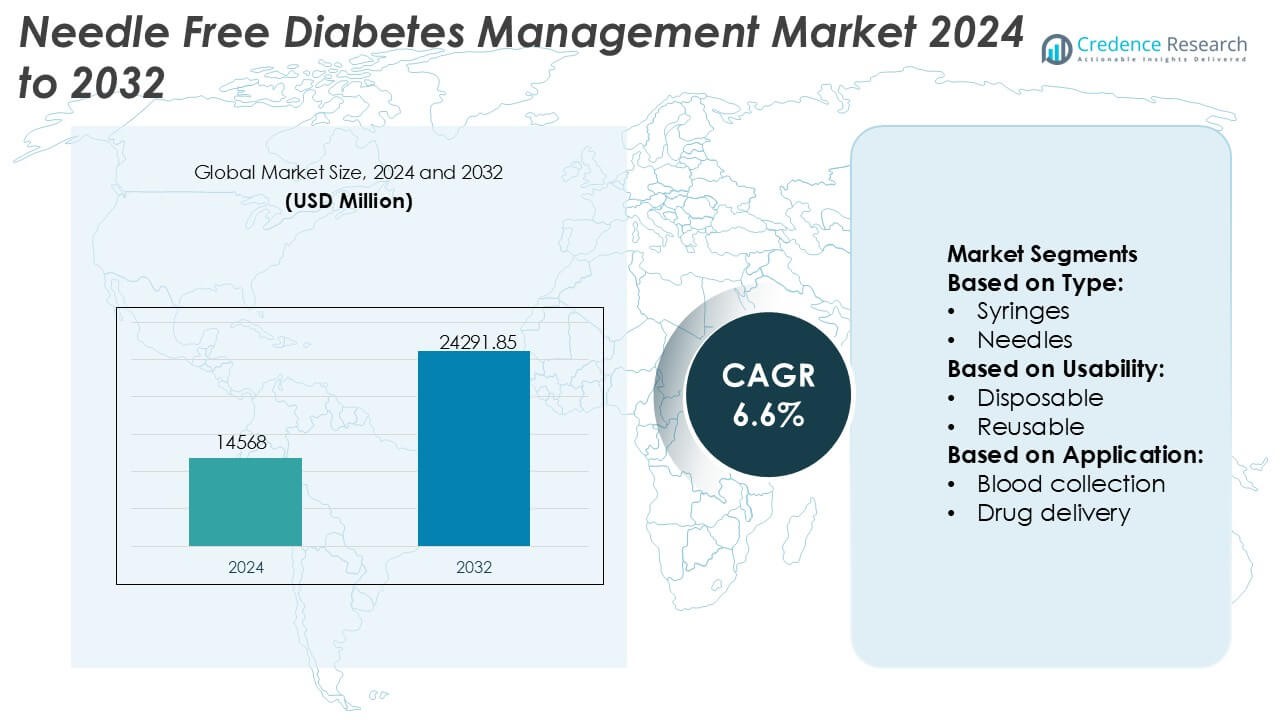
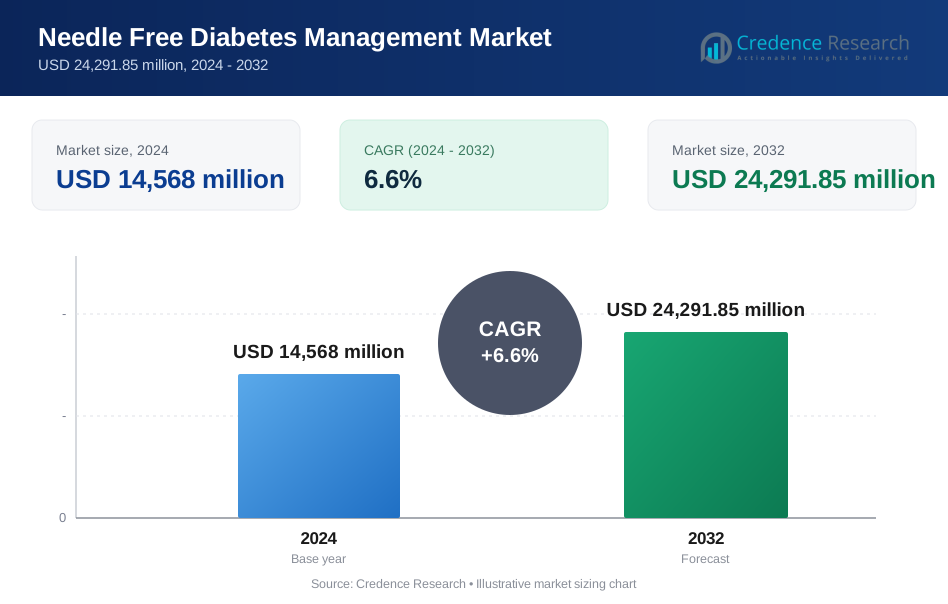
Needle Free Diabetes Management Market size was valued USD 14568 million in 2024 and is anticipated to reach USD 24291.85 million by 2032, at a CAGR of 6.6% during the forecast period.
| REPORT ATTRIBUTE | DETAILS |
|---|---|
| Historical Period | 2020-2023 |
| Base Year | 2024 |
| Forecast Period | 2025-2032 |
| Needle Free Diabetes Management Market Size 2024 | USD 14568 Million |
| Needle Free Diabetes Management Market, CAGR | 6.6% |
| Needle Free Diabetes Management Market Size 2032 | USD 24291.85 Million |
The Needle Free Diabetes Management Market is led by established medical technology providers and specialized device manufacturers that compete through innovation, clinical reliability, and patient-focused design. Top players emphasize advanced needle-free drug delivery systems, non-invasive glucose monitoring, and integration with digital health platforms to improve therapy adherence and outcomes. Strong investment in research, regulatory compliance, and global distribution supports competitive positioning. Regionally, North America leads the market with an exact 38% share, driven by high diabetes prevalence, advanced healthcare infrastructure, strong reimbursement frameworks, and early adoption of patient-centric technologies. Widespread acceptance of homecare solutions and connected diabetes management systems further reinforces regional leadership, while ongoing product innovation sustains competitive intensity across global markets.
Market Insights
- The Needle Free Diabetes Management Market was valued at USD 14,568 million in 2024 and is projected to reach USD 24,291.85 million by 2032, expanding at a CAGR of 6.6% during the forecast period.
- Rising diabetes prevalence and demand for pain-free, long-term therapy solutions act as key market drivers, with needle-free drug delivery and non-invasive glucose monitoring emerging as dominant segments holding the majority share.
- Market trends highlight growing integration of digital health platforms, connected monitoring systems, and homecare-compatible devices that support personalized care and improve patient adherence.
- The competitive landscape remains strong, led by established medical technology providers focusing on innovation, clinical validation, regulatory compliance, and global distribution strategies.
- Regionally, North America leads with an exact 38% market share, supported by advanced healthcare infrastructure, favorable reimbursement, and early adoption of patient-centric diabetes management technologies.
Market Segmentation Analysis:
By Type
Within the Needle Free Diabetes Management Market, the needles segment remains the dominant sub-segment, accounting for an estimated 58% market share. This dominance reflects the widespread installed base of conventional insulin delivery systems and blood sampling devices, particularly in hospital and home-care settings. Needles continue to benefit from established clinical familiarity, low unit costs, and broad compatibility with existing insulin pens and syringes. However, syringe-free and needle-free alternatives are gaining attention due to pain reduction and improved patient comfort, yet penetration remains limited by higher device costs and regulatory validation requirements.
- For instance, B. Braun (or embecta), through its medical device portfolio, manufactures insulin delivery needles engineered in ultra-fine gauges such as 31G with lengths down to 4 mm, designed to reduce insertion force while maintaining dose accuracy.
By Usability
By usability, disposable systems lead the market with an approximate 63% share, driven by strong demand for infection control, convenience, and regulatory compliance. Disposable needle-free components and accessories reduce cross-contamination risks and eliminate sterilization needs, making them preferred in hospitals, clinics, and home-based diabetes care. Rising awareness of hygiene, especially among immunocompromised diabetic patients, further supports adoption. Reusable systems attract interest for long-term cost efficiency, but concerns around cleaning protocols, durability, and compliance limit broader uptake compared to single-use solutions.
- For instance, Medtronic has advanced the usability of its disposable diabetes care consumables with its MiniMed™ 780G system and compatible Simplera Sync™ disposable CGM sensor, which integrates a single-use sensor that can be applied in under 10 seconds and interfaces with automated insulin delivery algorithms that adjust insulin delivery every 5 minutes based on real-time glucose readings a frequency derived directly from device specifications and clinical product descriptions.
By Application
In terms of application, insulin administration represents the dominant sub-segment, holding nearly 47% market share. This leadership stems from the large global diabetic population requiring frequent insulin dosing and growing demand for less painful, anxiety-free delivery methods. Needle-free insulin devices support improved adherence, particularly among pediatric and geriatric patients. Blood collection and drug delivery follow as secondary segments, while vaccination and other applications show steady expansion as needle-free platforms gain validation for broader therapeutic use beyond routine glucose and insulin management.
Key Growth Drivers
Rising Prevalence of Diabetes and Need for Long-Term Therapy
The global increase in diabetes prevalence continues to expand the patient pool requiring lifelong insulin and glucose management. Needle-free solutions address pain, anxiety, and adherence challenges associated with frequent injections and finger-prick testing. These systems improve patient comfort and reduce injection-related complications, supporting consistent therapy compliance. Healthcare providers increasingly favor alternatives that enhance quality of life while maintaining clinical efficacy. This sustained demand for patient-centric diabetes care solutions directly accelerates adoption of needle-free diabetes management technologies.
- For instance, Hilgenberg manufactures glass capillaries and micro-tubes with inner diameters down to 0.1 mm, length tolerances below ±0.02 mm, and volumetric accuracy suitable for microliter-scale dosing and sampling. Its components comply with ISO 11040 and ISO 3585 standards and withstand thermal loads above 500 °C during forming and sterilization, enabling reliable integration into high-frequency diabetes management systems documented in company technical datasheets.
Growing Focus on Patient Comfort, Safety, and Adherence
Patient preference is shifting toward non-invasive and minimally invasive diabetes management methods. Needle-free devices reduce needle-stick injuries, cross-contamination risks, and biohazard waste, aligning with safety priorities in both homecare and clinical settings. Improved comfort encourages regular insulin administration and glucose monitoring, leading to better glycemic control. Manufacturers emphasize ergonomic design, ease of use, and portability, which further strengthens acceptance among elderly patients and pediatric populations, driving sustained market growth.
- For instance, Novo Nordisk A/S has embedded smart technology into its NovoPen® 6 and NovoPen Echo® Plus reusable insulin pens, which automatically record and store up to 800 past insulin doses including time, date, and units injected to help patients and clinicians analyze dosing history and refine therapy plans a capability documented in the devices’ specifications on the company’s product pages.
Technological Advancements in Drug Delivery and Monitoring Systems
Continuous innovation in jet injectors, transdermal delivery, microneedle patches, and sensor-based glucose monitoring enhances the performance of needle-free solutions. Improved dose accuracy, faster drug absorption, and integrated digital connectivity strengthen clinical outcomes and patient engagement. Advances in wearable technology and smart monitoring platforms enable real-time data tracking and personalized therapy adjustments. These technological improvements increase physician confidence and broaden clinical applications, accelerating commercialization and adoption across diabetes care settings.
Key Trends & Opportunities
Integration of Digital Health and Connected Care Platforms
Needle-free diabetes management systems increasingly integrate with mobile applications, cloud platforms, and remote monitoring tools. Connected devices enable real-time glucose tracking, automated insulin delivery insights, and data sharing with healthcare professionals. This trend supports personalized treatment plans and proactive disease management. The convergence of needle-free delivery with digital therapeutics creates opportunities for value-added services, subscription models, and long-term patient engagement solutions.
- For instance, Boston Scientific Corporation has demonstrated large-scale connected-care capability through its LATITUDE™ NXT Patient Management System, a cloud-based remote monitoring platform documented by the company to support more than 2 million implanted devices worldwide and process billions of data points annually.
Expansion in Homecare and Self-Management Applications
The shift toward home-based diabetes management creates strong opportunities for needle-free devices designed for self-administration. Compact, user-friendly systems support independent disease management while reducing dependence on clinical visits. This trend aligns with broader healthcare decentralization and cost-containment strategies. Growing awareness programs and patient education initiatives further encourage adoption, particularly among newly diagnosed patients seeking convenient and less intimidating treatment options.
- For instance, ICU Medical, Inc. (Smiths Medical, Inc.) has advanced homecare-ready safety and needle-free infusion technologies through products such as the MicroClave™ and NanoClave™ needle-free connectors, which are validated for up to 7 days of continuous use, support flow rates exceeding 300 mL/min, and withstand hundreds of access cycles without leakage or reflux.
Emerging Opportunities in Pediatric and Geriatric Care
Needle anxiety remains high among children and elderly patients with diabetes, creating targeted opportunities for needle-free solutions. Devices tailored for sensitive skin, reduced handling complexity, and simplified dosing protocols address unmet needs in these demographics. Healthcare providers increasingly recommend needle-free options to improve adherence and reduce treatment resistance, positioning these segments as high-potential growth areas.
Key Challenges
High Device Costs and Reimbursement Limitations
Needle-free diabetes management devices often involve higher upfront costs compared to conventional needles and syringes. Limited reimbursement coverage in several healthcare systems restricts affordability, particularly in price-sensitive markets. Cost concerns may slow adoption among individual patients and smaller healthcare providers. Manufacturers face pressure to balance innovation with cost optimization while demonstrating long-term economic benefits to payers and policymakers.
Clinical Acceptance and Standardization Barriers
Despite technological progress, variability in drug delivery efficiency and limited long-term clinical data for certain needle-free technologies create hesitation among clinicians. Standardization of dosing accuracy, regulatory pathways, and clinical guidelines remains inconsistent across regions. Overcoming these barriers requires robust clinical validation, physician education, and regulatory alignment. Without clear standards, adoption may remain uneven across healthcare systems and clinical practices.
Regional Analysis
North America
North America leads the Needle Free Diabetes Management Market with an estimated 38% market share, driven by high diabetes prevalence, advanced healthcare infrastructure, and early adoption of patient-centric technologies. Strong awareness of needle-free alternatives, combined with favorable regulatory support for innovative drug delivery and glucose monitoring systems, accelerates market penetration. The region benefits from robust reimbursement frameworks, widespread use of homecare devices, and strong presence of technology-driven manufacturers. High adoption of digital health platforms and connected diabetes management solutions further strengthens North America’s leadership position.
Europe
Europe accounts for approximately 27% of the global market share, supported by well-established healthcare systems and a strong emphasis on patient safety and comfort. Increasing adoption of non-invasive diabetes management solutions aligns with regional efforts to reduce needle-stick injuries and medical waste. Government-backed chronic disease management programs and growing acceptance of home-based care contribute to steady demand. Countries with high diabetes awareness and strong regulatory oversight promote clinical validation and standardization, supporting consistent adoption of needle-free technologies across hospitals and outpatient settings.
Asia-Pacific
Asia-Pacific holds an estimated 25% market share and represents the fastest-growing regional market due to a rapidly expanding diabetic population and improving healthcare access. Rising urbanization, lifestyle changes, and increased screening programs drive demand for convenient and less painful diabetes management solutions. Governments and private healthcare providers increasingly invest in advanced medical technologies to address chronic disease burdens. Growing middle-class populations, expanding homecare adoption, and rising awareness of patient-friendly devices create strong long-term opportunities for needle-free diabetes management solutions.
Latin America
Latin America captures around 6% of the global market share, supported by gradual improvements in healthcare infrastructure and increasing diabetes awareness. Public health initiatives focused on chronic disease management encourage adoption of innovative treatment approaches, including needle-free options. However, market growth remains moderated by cost sensitivity and limited reimbursement coverage in several countries. Expanding private healthcare networks and growing demand for home-based diabetes management support steady uptake, particularly in urban centers with better access to advanced medical devices.
Middle East & Africa
The Middle East & Africa region accounts for approximately 4% of the market share, with growth driven by rising diabetes prevalence and expanding healthcare investments. Gulf countries lead regional adoption due to higher healthcare spending, strong government initiatives, and growing awareness of advanced diabetes care technologies. In contrast, adoption across parts of Africa remains limited by affordability and infrastructure constraints. Increasing focus on preventive care, gradual expansion of homecare services, and improving access to medical technologies support moderate but steady market development.
Market Segmentations:
By Type:
- Syringes
- Needles
By Usability:
- Disposable
- Reusable
By Application:
- Blood collection
- Drug delivery
By Geography
- North America
- U.S.
- Canada
- Mexico
- Europe
- Germany
- France
- U.K.
- Italy
- Spain
- Rest of Europe
- Asia Pacific
- China
- Japan
- India
- South Korea
- South-east Asia
- Rest of Asia Pacific
- Latin America
- Brazil
- Argentina
- Rest of Latin America
- Middle East & Africa
- GCC Countries
- South Africa
- Rest of the Middle East and Africa
Competitive Landscape
The Needle Free Diabetes Management Market players such as Fresenius SE & Co. KGaA, Medtronic, Hilgenberg GmbH, Novo Nordisk A/S, Boston Scientific Corporation, ICU Medical, Inc. (Smiths Medical, Inc.), Thermo Fisher Scientific Inc., Ethicon (Johnson & Johnson Services, Inc.), BD, and Stryker. The Needle Free Diabetes Management Market exhibits a competitive landscape defined by rapid technological innovation, product differentiation, and a strong focus on patient-centric care. Market participants compete on device accuracy, safety, ease of use, and integration with digital health platforms that support personalized diabetes management. Continuous advancements in needle-free drug delivery and non-invasive glucose monitoring drive competition, while regulatory compliance and clinical validation remain critical success factors. Companies prioritize expanding homecare-compatible solutions, improving patient adherence, and reducing total cost of ownership. Strategic initiatives such as research collaborations, product pipeline expansion, and entry into emerging markets further intensify competition. The landscape favors players that can deliver reliable performance, scalable production, and seamless connectivity within evolving diabetes care ecosystems.
Key Player Analysis
- Fresenius SE & Co. KGaA
- Medtronic
- Hilgenberg GmbH
- Novo Nordisk A/S
- Boston Scientific Corporation
- ICU Medical, Inc. (Smiths Medical, Inc.)
- Thermo Fisher Scientific Inc.
- Ethicon (Johnson & Johnson Services, Inc.)
- BD
- Stryker
Recent Developments
- In June 2025, FedEx and IIT Bombay inaugurated the IITB-FedEx Centre for Advanced Logistics and Focused Analytics (FedEx ALFA) to foster student entrepreneurship, develop innovative supply chain solutions using data, and promote real-world problem-solving for future talent, aligning with goals for a more intelligent and sustainable logistics future in India.
- In May 2025, ThingsRecon, a specialist in Digital Asset Discovery & Supply Chain Attack Surface Management (EASM), announced a significant launch including their new Supply Chain Discovery product and an expanded strategic partnership program to enhance visibility into hidden digital exposures within extended enterprise networks and third-party risks, aiming to connect technical vulnerabilities to real business risks.
- In November 2024, Medtronic plc announced the FDA clearance for its InPen app, which now includes a missed meal dose detection feature. This advancement sets the stage for the upcoming launch of its Smart MDI system, which will be integrated with the Simplera continuous glucose monitor (CGM).
- In January 2024, Abbott and Tandem Diabetes Care, Inc. announced that the t:slim X2 insulin pump with Control-IQ technology is now integrated with Abbott's FreeStyle Libre 2 Plus sensor, offering users in the U.S. the benefits of a hybrid closed-loop system that helps manage and prevent high and low blood sugar levels.
Report Coverage
The research report offers an in-depth analysis based on Type, Usability, Application and Geography. It details leading market players, providing an overview of their business, product offerings, investments, revenue streams, and key applications. Additionally, the report includes insights into the competitive environment, SWOT analysis, current market trends, as well as the primary drivers and constraints. Furthermore, it discusses various factors that have driven market expansion in recent years. The report also explores market dynamics, regulatory scenarios, and technological advancements that are shaping the industry. It assesses the impact of external factors and global economic changes on market growth. Lastly, it provides strategic recommendations for new entrants and established companies to navigate the complexities of the market.
Future Outlook
- Needle-free technologies will gain wider acceptance as healthcare systems prioritize patient comfort and long-term therapy adherence.
- Continuous innovation will improve dose accuracy, reliability, and consistency of needle-free drug delivery systems.
- Integration with digital health platforms will strengthen personalized diabetes management and remote monitoring capabilities.
- Homecare adoption will increase as compact and user-friendly needle-free devices support self-management.
- Pediatric and geriatric patient segments will drive demand due to reduced needle anxiety and improved usability.
- Regulatory clarity and clinical validation will support broader physician acceptance and standardization.
- Emerging economies will present strong growth opportunities with rising diabetes awareness and healthcare access.
- Manufacturers will focus on cost optimization to improve affordability and expand market reach.
- Strategic partnerships will accelerate product development and geographic expansion.
- Sustainability considerations will encourage adoption of solutions that reduce sharps waste and biohazard risks.
Request a Free Sample
Fill in your details and we'll send you a free sample report.
- Sample data tables & charts
- Research methodology
Need a Custom Version of This Report?
Tailor the scope, geography, or segments to your exact requirements.
- Custom geography or segment scope
- Direct access to our analyst team
Frequently Asked Questions
What is the current market size for the Needle Free Diabetes Management Market, and what is its projected size in 2032?
At what Compound Annual Growth Rate is the Needle Free Diabetes Management Market projected to grow between 2024 and 2032?
Which Needle Free Diabetes Management Market segment held the largest share in 2024?
What are the primary factors fueling the growth of the Needle Free Diabetes Management Market?
Who are the leading companies in the Needle Free Diabetes Management Market?
Which region commanded the largest share of the Needle Free Diabetes Management Market in 2024?
Table of Content
Chapter 1. Report Introduction
- 1.1 Report Description & Purpose
- 1.1.1 Report Title & Market Definition
- 1.1.2 Unique Selling Propositions (USP) & Key Differentiators
- 1.1.3 Value Proposition for Stakeholders
- 1.2 Research Objectives
- 1.2.1 Market Sizing Objectives (Volume & Revenue)
- 1.2.2 Segmentation Objectives
- 1.2.3 Competitive Intelligence Objectives
- 1.2.4 Forecast & Scenario Objectives
- 1.3 Report Scope
- 1.3.1 Needle Free Diabetes Management Scope – Types & Subtypes Covered
- 1.3.2 Geographic Scope – Regions & Countries Covered
- 1.3.3 Historical Period, Base Year & Forecast Period (2024; forecast to 2032)
- 1.3.4 Inclusions & Exclusions
- 1.4 HS Code & Classification Framework
- 1.5 Currency, Units & Pricing Basis
- 1.6 Target Stakeholders
- 1.7 Limitations & Assumptions
Chapter 2. Executive Summary
- 2.1 Global Needle Free Diabetes Management Market Snapshot
- 2.1.1 Market Size – Historical (2024) & Forecast (2024-2032) (2024: USD 14,568 million → 2032: USD 24,291.85 million)
- 2.1.2 Volume & Revenue – Global Totals
- 2.1.3 Key Market Highlights – Top Five Facts
- 2.2 Needle Free Diabetes Management Market Segmentation Snapshot
- 2.2.1 Market Split by Region – 2024 vs. 2032
- 2.3 Competitive Snapshot
- 2.3.1 Top 10 Players by Revenue Share – 2024
- 2.3.2 Top 10 Players by Volume Share – 2024
- 2.3.3 Recent Strategic Developments (18-Month Summary)
- 2.4 Key Investment Highlights & Strategic Conclusions
Chapter 3. Needle Free Diabetes Management Market Dynamics & Industry Analysis
- 3.1 Market Overview & Context
- 3.1.1 Needle Free Diabetes Management Market Position in the Broader Automotive Value Chain
- 3.1.2 OEM vs. Replacement Market Dynamics
- 3.1.3 Market Maturity & Development Stage by Region
- 3.2 Needle Free Diabetes Management Market Drivers
- 3.3 Needle Free Diabetes Management Market Restraints & Challenges
- 3.4 Needle Free Diabetes Management Market Opportunities
- 3.5 Porter's Five Forces Analysis
- 3.5.1 Threat of New Entrants
- 3.5.2 Bargaining Power of Suppliers
- 3.5.3 Bargaining Power of Buyers
- 3.5.4 Threat of Substitutes
- 3.5.5 Competitive Rivalry – Intensity Assessment
- 3.6 Needle Free Diabetes Management Value Chain Analysis
- 3.6.1 Upstream – Raw Material/Input Suppliers
- 3.6.1.1 Raw Material/Input 1
- 3.6.1.2 Raw Material/Input 2
- 3.6.1.3 Raw Material/Input 3
- 3.6.2 Midstream – Production/Manufacturing/Service Delivery
- 3.6.2.1 Production/Process Overview
- 3.6.2.2 Key Facility Locations & Capacity by Manufacturer
- 3.6.3 Downstream – Distribution & End Consumer
- 3.6.3.1 Primary Channel – B2B/OEM
- 3.6.3.2 Secondary Channels – Dealer, Retail, Online, Direct
- 3.6.4 Value Chain Profitability Analysis
- 3.6.1 Upstream – Raw Material/Input Suppliers
- 3.7 PESTEL Analysis
- 3.7.1 Political Factors
- 3.7.2 Economic Factors
- 3.7.3 Social Factors
- 3.7.4 Technological Factors
- 3.7.5 Environmental Factors
- 3.7.6 Legal Factors
- 3.8 Needle Free Diabetes Management Supply Chain Analysis
- 3.8.1 Raw Material/Input Supply Risk Assessment
- 3.8.2 Manufacturing Concentration Risk (Geographic Exposure)
- 3.8.3 Trade Disruption Impact Analysis
- 3.9 Regulatory & Policy Landscape
Note: The regulatory and policy landscape section covers regulations based on their applicability to the market, Needle Free Diabetes Management category, geography, and scope of the study. Only regulatory frameworks with a material impact on operations, compliance, trade, sustainability, or market access are analyzed in detail.
Chapter 4. Key Investment Pockets & Opportunity Analysis
- 4.1 Needle Free Diabetes Management Market Attractiveness Analysis
- 4.1.1 By Region – Investment Attractiveness Matrix (Volume × CAGR)
- 4.2 Absolute Revenue Growth Opportunity
- 4.2.1 By Region – Absolute USD Growth Through 2032
- 4.3 Incremental Volume Opportunity
- 4.3.1 By Region – Incremental Volume Through 2032
- 4.3.2 Segment – Incremental Volume
- 4.4 Emerging Submarket Opportunity Deep Dive (Subject to Applicability)
- 4.5 Emerging Market Opportunity Scorecards
- 4.5.1 United States
- 4.5.2 Europe
- 4.5.3 Asia
- 4.5.4 Middle East & Africa
Note: Emerging Market Opportunity Scorecards will be included based on relevance and strategic importance. Regions listed are indicative and may vary depending on data availability and market dynamics.
Chapter 5. Needle Free Diabetes Management Import-Export Analysis & Trade Flows
- 5.1 Global Trade Overview
- 5.1.1 Global Export Value by Country (2024)
- 5.1.2 Global Export Volume by Country (2024)
- 5.1.3 Global Import Value by Country (2024)
- 5.1.4 Global Import Volume by Country (2024)
- 5.1.5 Net Trade Balance by Country (2024)
- 5.2 Export Analysis – Segment
- 5.2.1 Type 1 (HS Code)
- 5.2.2 Type 2 (HS Code)
- 5.2.3 Type 3 (HS Code)
- 5.2.4 Type 4 (HS Code)
- 5.2.5 Type 5 (HS Code)
- 5.3 Import Analysis – Segment
- 5.3.1 Type 1 (HS Code)
- 5.3.2 Type 2 (HS Code)
- 5.3.3 Type 3 (HS Code)
- 5.3.4 Type 4 (HS Code)
- 5.3.5 Type 5 (HS Code)
- 5.4 Average Unit Trade Prices
- 5.4.1 Average Export Price – Segment & Country
- 5.4.2 Average Import Price – Segment & Source Country
- 5.4.3 Price Trends (2024)
- 5.5 Key Trade Route Analysis
- 5.5.1 Trade Route 1
- 5.5.2 Trade Route 2
- 5.5.3 Trade Route 3
- 5.5.4 Trade Route 4
- 5.5.5 Trade Route 5
- 5.6 Trade Policy Impact Assessment
- 5.6.1 US Anti-Dumping & Section 301 Tariffs
- 5.6.2 EU Customs Union Impact
- 5.6.3 Major Free Trade Agreements
- 5.6.4 USMCA Rules of Origin
Note: Trade policy analysis will be included only where relevant to the Needle Free Diabetes Management market.
Chapter 6. Competitive Landscape & Company Benchmarking
- 6.1 Needle Free Diabetes Management Market Concentration & Structure
- 6.1.1 Herfindahl-Hirschman Index (HHI) – vs. 2024
- 6.1.2 Tier 1, Tier 2 & Tier 3 Market Structure
- 6.1.3 Global, Regional & Local Player Dynamics
- 6.2 Needle Free Diabetes Management Market Share Analysis – 2024
- 6.2.1 Global Revenue Share by Company
- 6.2.2 Global Volume Share by Company
- 6.2.3 Regional Revenue Share
- 6.2.4 Market Share Evolution ( vs. 2024)
- 6.2.5 OEM Segment Share by Company
- 6.2.6 Replacement Segment Share by Company
- 6.3 Production/Delivery Capacity & Facility Analysis
- 6.3.1 Global Installed Capacity
- 6.3.2 Capacity Utilization Rates
- 6.3.3 Production/Output Volume
- 6.3.4 Facility Locations & Capacity Map
- 6.3.5 Planned Capacity Additions
- 6.4 Needle Free Diabetes Management Competitive Benchmarking Matrix
- 6.4.1 Revenue, Volume, CAGR & Profitability Comparison
- 6.4.2 Channel Revenue Mix
- 6.4.3 Geographic Revenue Exposure
- 6.4.4 R&D Intensity
- 6.4.5 Sustainability Maturity
- 6.5 Strategic Developments in Needle Free Diabetes Management (Last 24 Months)
- 6.5.1 Mergers, Acquisitions & Divestments
- 6.5.2 New Needle Free Diabetes Management Launches
- 6.5.3 Facility Expansions
- 6.5.4 Strategic Alliances, Joint Ventures & Partnerships
- 6.5.5 Distribution Expansion & Market Entry
- 6.5.6 Sustainability & ESG Initiatives
- 6.6 Competitive Strategy Mapping
- 6.6.1 Leader, Challenger, Follower & Niche Classification
- 6.6.2 Pricing Strategy Comparison
- 6.6.3 Channel Strategy Matrix
Note: Strategic developments are included based on their materiality and the availability of reliable information.
Chapter 7. Global Needle Free Diabetes Management Market – By Distribution Channel
- 7.1 Segment Overview
- 7.1.1 Volume & Revenue Split by Channel (2024 & 2032)
- 7.1.2 Channel Mix Evolution (2024-2032)
Chapter 8. Regional Market Analysis – Global Overview
- 8.1 Global Regional Overview
- 8.1.1 Regional Volume Share
- 8.1.2 Regional Revenue Share
- 8.1.3 Regional Volume by Region
- 8.1.4 Regional Revenue by Region
- 8.1.5 Regional Forecast Through 2032
- 8.2 Cross-Regional Segment Analysis
- 8.2.1 By Distribution Channel
- 8.2.2 By Brand/Price Tier
Chapter 9. North America Needle Free Diabetes Management Market
- 9.1 United States
- 9.2 Canada
- 9.3 Mexico
Chapter 10. Europe Needle Free Diabetes Management Market
- 10.1 Germany
- 10.2 France
- 10.3 Italy
- 10.4 United Kingdom
- 10.5 Spain
- 10.6 Poland
- 10.7 Russia
- 10.8 Netherlands
- 10.9 Belgium
- 10.10 Sweden
- 10.11 Denmark
- 10.12 Norway
- 10.13 Rest of Europe
Chapter 11. Asia Pacific Needle Free Diabetes Management Market
- 11.1 China
- 11.2 India
- 11.3 Japan
- 11.4 South Korea
- 11.5 Thailand
- 11.6 Indonesia
- 11.7 Vietnam
- 11.8 Malaysia
- 11.9 Australia
- 11.10 Rest of Asia Pacific
Chapter 12. Latin America Needle Free Diabetes Management Market
- 12.1 Brazil
- 12.2 Argentina
- 12.3 Colombia
- 12.4 Chile
- 12.5 Rest of Latin America
Chapter 13. Middle East Needle Free Diabetes Management Market
- 13.1 Saudi Arabia
- 13.2 United Arab Emirates
- 13.3 Turkey
- 13.4 Israel
- 13.5 Iran
- 13.6 Rest of the Middle East
Chapter 14. Africa Needle Free Diabetes Management Market
- 14.1 South Africa
- 14.2 Egypt
- 14.3 Nigeria
- 14.4 Morocco
- 14.5 Rest of Africa
Chapter 15. Needle Free Diabetes Management Company Profiles
- 15.1 [Company 01]
- 15.1.1 Company Overview
- 15.1.2 Key Management Personnel
- 15.1.3 Products & Services Portfolio
- 15.1.4 Financial Performance
- 15.1.5 Key Market Focus & Geographic Presence
- 15.1.6 Recent Developments & Strategic Initiatives
Note: The company profile list is preliminary and may change based on research findings, market developments, data availability, and client requirements.
Chapter 16. Appendices
- Appendix A – List of Abbreviations & Acronyms
- Appendix B – Industry Classification Code Reference – Full Series
- Appendix C – Production & Capacity Data Tables
- Appendix D – End-Use & Demand Base Tables
- Appendix E – Consumption & Replacement Rate Assumptions
- Appendix F – ASP Reference Tables
- Appendix G – Manufacturing & Facility Database
- Appendix H – Import-Export Data Tables
- Appendix I – Regulatory Summary Tables
- Appendix J – Primary Research Participant List (Anonymized)
- Appendix K – Primary Research Questionnaire Framework
- Appendix L – Data Sources & Bibliography
- Appendix M – Market Size Divergence & Source Comparison
Chapter 17. Research Methodology
- 17.1 Research Framework & Philosophy
- 17.2 Secondary Research – Sources, Hierarchy & Data Extraction
- 17.3 Data Modeling – Bottom-Up & Top-Down Market Sizing
- 17.4 Primary Research – Stakeholder Framework, LOI & Sample Sizes
- 17.5 Forecast Methodology – Regression, Scenario & Sensitivity Analysis
- 17.6 Quality Control – Four-Layer Validation Framework
- 17.7 Limitations & Standard Assumptions
- 17.8 Disclaimer
