
Market Overview:
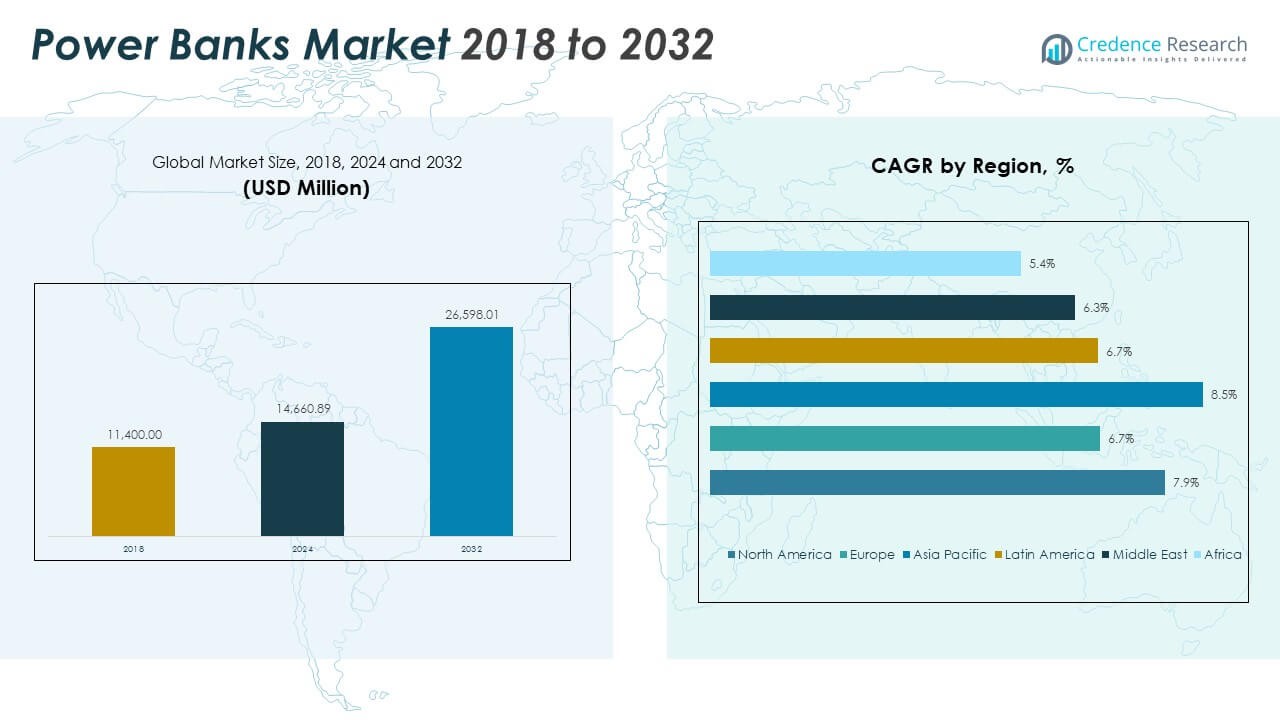
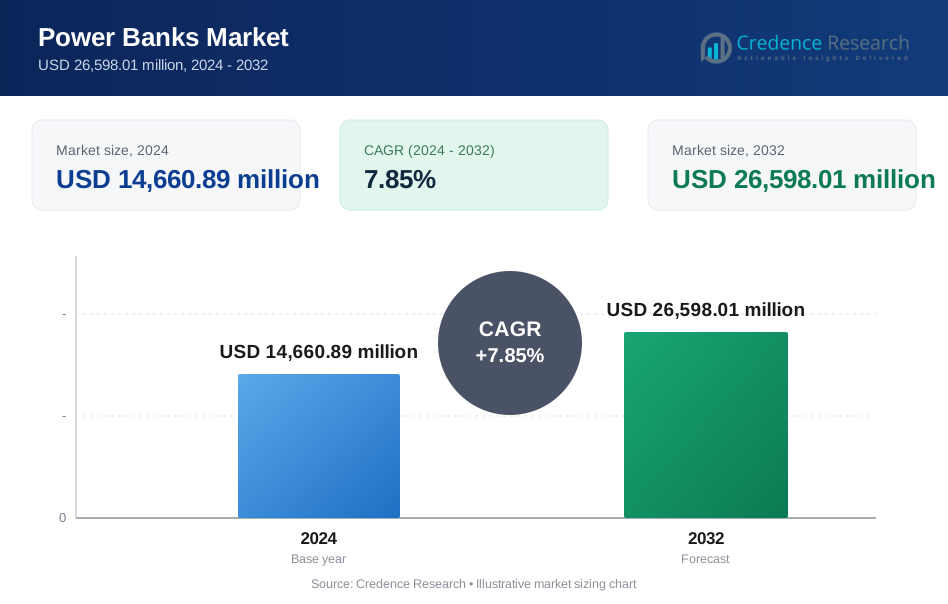
The Power Banks Market size was valued at USD 11,400.00 million in 2018 to USD 14,660.89 million in 2024 and is anticipated to reach USD 26,598.01 million by 2032, at a CAGR of 7.85% during the forecast period.| REPORT ATTRIBUTE | DETAILS |
|---|---|
| Historical Period | 2020-2023 |
| Base Year | 2024 |
| Forecast Period | 2025-2032 |
| Power Banks Market Size 2024 | USD 14,660.89 Million |
| Power Banks Market, CAGR | 7.85% |
| Power Banks Market Size 2032 | USD 26,598.01 Million |
Market Insights:
- The Power Banks Market size was valued at USD 11,400.00 million in 2018, reached USD 14,660.89 million in 2024, and is projected to hit USD 26,598.01 million by 2032, growing at a CAGR of 7.85%.
- Asia Pacific leads with a 48.3% share due to its large smartphone base, manufacturing capacity, and strong e-commerce. North America follows with 19.9%, driven by premium product adoption, while Europe holds 14.3%, supported by sustainability trends and regulatory standards.
- Asia Pacific is the fastest-growing region, supported by expanding digital infrastructure, rising smartphone penetration, and competitive pricing strategies.
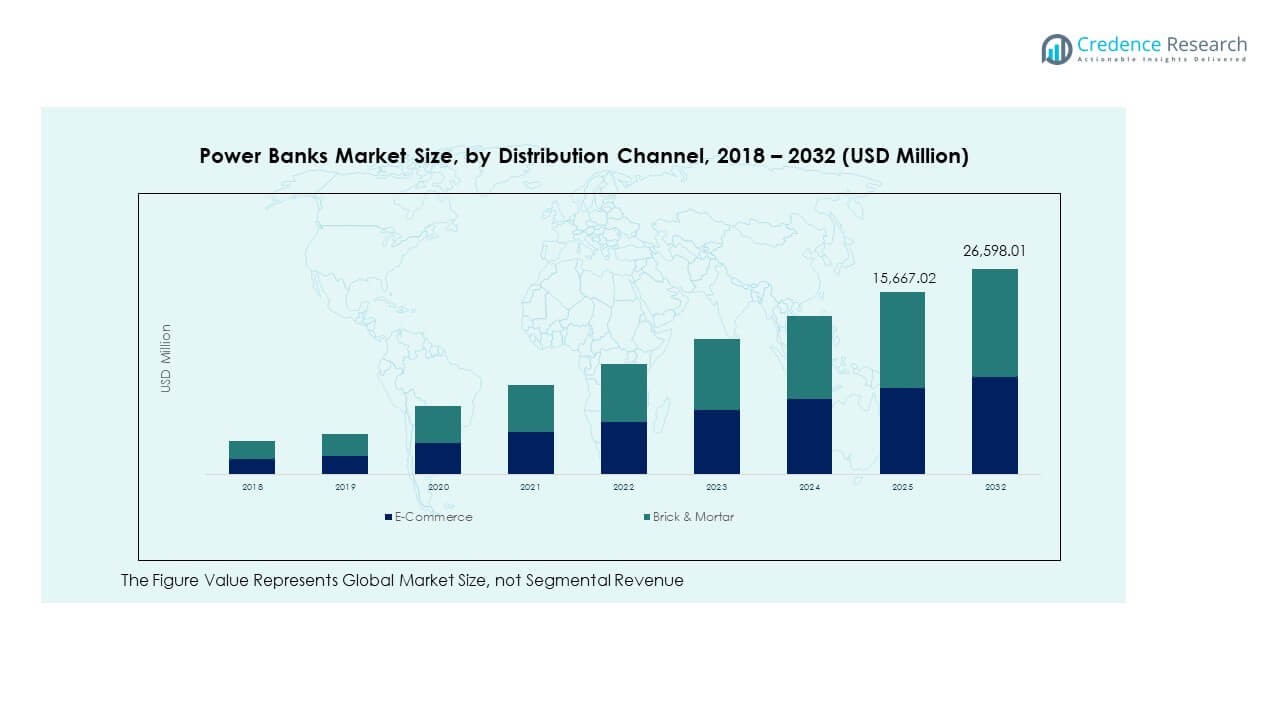
- E-Commerce accounted for approximately 45% of the total market in 2024, showing strong growth momentum.
- Brick & Mortar contributed nearly 55% in 2024, reflecting sustained demand from offline retail and in-store purchases.
Market Drivers
Rising Smartphone Usage Driving Demand for Portable Energy Backup Solutions The growing smartphone penetration is a key factor fueling the Power Banks Market. Consumers rely on mobile devices for communication, work, and entertainment, increasing the need for efficient backup charging. High daily usage drains battery life quickly, creating consistent demand for portable power solutions. Power banks support uninterrupted usage during travel, emergencies, and outdoor activities. The availability of multi-port charging enhances user convenience. Compact and lightweight designs make products suitable for daily use. Manufacturers are expanding capacity options to meet varied consumer needs. It continues to gain traction across both developed and emerging markets.- For instance, Anker Innovations launched its 25,000 mAh, 165 W power bank at CES 2025 with three USB-C ports and one USB-A. It features retractable cables, supports Power Delivery, and can charge a 16-inch MacBook Pro to 50% in just over 30 minutes. The product allows simultaneous charging for multiple devices.
- For instance, Baseus introduced its 65W GaN charger (Model CCGAN65S2-X) featuring GaN technology for higher efficiency and a more compact design. It supports multiple fast-charging protocols and includes three output ports for powering multiple devices at once. The charger is smaller and more heat-efficient than traditional silicon-based models.
Market Trends
Integration of Sustainable and Eco-Friendly Materials in Power Bank Manufacturing Sustainability is shaping consumer choices in the Power Banks Market. Manufacturers are adopting recyclable and eco-friendly materials to meet environmental standards. Consumers are becoming more conscious of product impact on the environment. Solar-enabled charging solutions are gaining traction among outdoor users. Eco-label certifications influence product selection. Companies position their products as green alternatives to attract environmentally aware buyers. Governments are introducing regulations supporting sustainable electronics. It benefits from the alignment between consumer preferences and green product innovations. Increased Adoption of Wireless and Magnetic Charging Technologies Wireless charging is gaining popularity for its convenience and reduced cable dependency. Magnetic alignment improves charging efficiency and user experience. Companies integrate advanced Qi wireless standards into compact designs. This feature supports seamless charging for smartphones and wearables. The trend boosts product appeal among premium users. Magnetic technology enhances portability and eliminates cable clutter. Integration with multiple device ecosystems improves adoption rates. It is benefiting from rising consumer demand for modern charging solutions.- For instance, Belkin launched its BoostCharge Pro Magnetic Power Bank (Qi2 15W 5K) featuring Qi2-certified magnetic alignment and 15W wireless fast charging. It includes USB-C connectivity and is made with post-consumer recycled plastic, aligning with sustainability goals. The product supports secure magnetic attachment for Qi2-enabled devices.
- For instance, the Xiaomi Ultra Slim Power Bank (5000mAh) supports 20W bidirectional USB-C fast charging and features an ultra-thin design of around 10 mm. It is designed for portability and everyday use, reflecting advancements in compact power bank design.
Market Challenges Analysis
Rising Market Saturation and Price Competition Among Key Players Intense competition among global and regional brands is a major challenge for the Power Banks Market. The entry of low-cost manufacturers puts pricing pressure on established companies. Price wars reduce profit margins and limit investment capacity for innovation. Product differentiation becomes difficult in a crowded marketplace. Many brands offer similar capacities and features, creating uniformity. Consumer loyalty is difficult to maintain in such conditions. Brands must balance affordability with quality and safety standards. It faces pressure to sustain value amid intense market rivalry. Growing Safety Concerns and Regulatory Compliance Requirements Battery safety remains a critical concern for manufacturers and users. Faulty products can overheat, leak, or explode, leading to trust issues. Governments are enforcing strict certification standards to ensure compliance. Meeting safety requirements increases production costs. Substandard products entering markets damage brand reputation. Companies must invest in testing and quality control to maintain trust. Non-compliance can lead to recalls and regulatory penalties. It operates under rising scrutiny from safety and quality authorities.Market Opportunities
Rising Demand for High-Capacity and Fast-Charging Solutions Across Industries The growing need for reliable energy storage creates strong opportunities for the Power Banks Market. High-capacity models are gaining popularity among travelers, remote workers, and gamers. Fast-charging technology expands usage scenarios across consumer and enterprise segments. The expanding use of mobile devices in business environments drives adoption. Manufacturers can target niche sectors such as outdoor, logistics, and events. Technological improvements support this expansion. It can capture untapped segments through focused product development strategies. Expansion of Emerging Markets Through Strategic Distribution Networks Emerging economies offer significant potential for market growth. Rising smartphone adoption creates demand for affordable power solutions. Expanding retail and online distribution increases market reach. Localization strategies enhance product acceptance. Partnerships with telecom operators and electronics retailers strengthen sales channels. Companies can leverage these networks to boost revenue. It can build a strong position by aligning with local consumer behavior.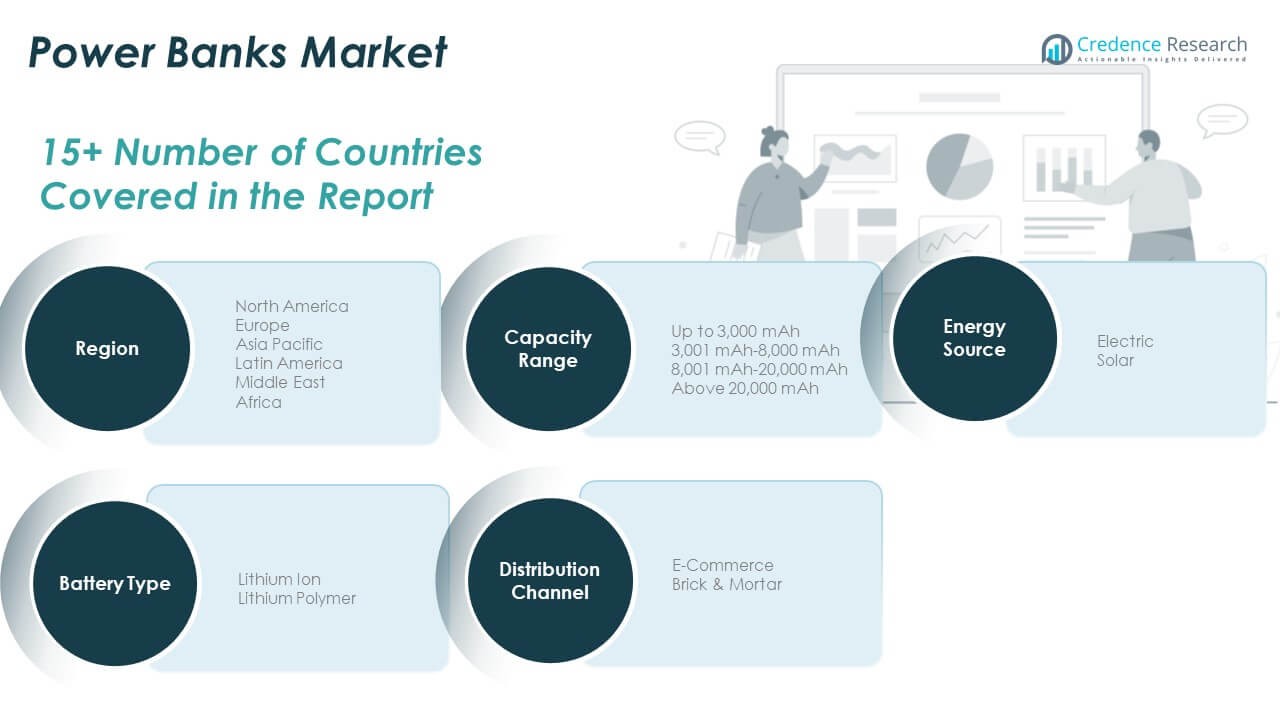
Market Segmentation Analysis:
By Capacity The Power Banks Market is segmented into four capacity ranges: up to 3,000 mAh, 3,001 mAh–8,000 mAh, 8,001 mAh–20,000 mAh, and above 20,000 mAh. Mid to high-capacity power banks between 8,001 mAh and 20,000 mAh are widely preferred for their ability to charge multiple devices, making them suitable for travelers, professionals, and students. Ultra-high-capacity models above 20,000 mAh are gaining adoption among users with extended usage requirements, including gamers and remote workers. Lower-capacity models remain relevant for quick top-ups and light usage, offering compact and affordable options. This balanced demand across capacity ranges ensures broad consumer reach and strong sales momentum. By Energy Source The market is divided into electric and solar power banks based on energy source. Electric models dominate due to their fast charging, consistent performance, and easy accessibility across retail and online channels. Consumers prefer these products for everyday and travel use. Solar-powered power banks are expanding their presence among environmentally conscious users, especially in outdoor and remote settings. The increasing interest in sustainable energy solutions is supporting the gradual growth of this segment.- For instance, BigBlue’s SolarPowa 28 is a 28W foldable solar charger featuring SunPower panels and multiple USB output ports. It supports charging multiple devices simultaneously and is designed for outdoor use, according to BigBlue’s official product listings and verified reviews.
- For instance, the Xiaomi Mi Power Bank 3 Ultra Compact (Model PB1022ZM) integrates a lithium-ion polymer battery rated at 10,000 mAh (37 Wh) and supports up to 22.5 W output via USB-A and USB-C ports. It features a slim design that fits easily in a pocket and weighs approximately 200 g.
Segmentation:
By Capacity
- Up to 3,000 mAh
- 3,001 mAh – 8,000 mAh
- 8,001 mAh – 20,000 mAh
- Above 20,000 mAh
By Energy Source
- Electric
- Solar
By Battery Type
- Lithium Ion
- Lithium Polymer
By Distribution Channel
- E-Commerce
- Brick & Mortar
By Region
- North America
- U.S.
- Canada
- Mexico
- Europe
- Germany
- France
- U.K.
- Italy
- Spain
- Rest of Europe
- Asia Pacific
- China
- Japan
- India
- South Korea
- South-east Asia
- Rest of Asia Pacific
- Latin America
- Brazil
- Argentina
- Rest of Latin America
- Middle East & Africa
- GCC Countries
- South Africa
- Rest of the Middle East and Africa
Regional Analysis:
North America The North America Power Banks Market size was valued at USD 2,316.48 million in 2018 to USD 2,914.50 million in 2024 and is anticipated to reach USD 5,274.43 million by 2032, at a CAGR of 7.9% during the forecast period. North America accounts for 19.9% of the global market share. The region benefits from strong adoption of smartphones, laptops, and wearables, creating consistent demand for portable charging solutions. High consumer spending power supports sales of premium, fast-charging, and high-capacity models. E-commerce platforms and large retail chains ensure broad product availability. Technological innovation and early adoption rates drive growth in wireless and GaN-enabled power banks. The U.S. leads the region, supported by high connectivity and travel activity. Canada and Mexico contribute to growth through increasing smartphone penetration and rising digital usage. It benefits from advanced distribution channels and strong brand presence. Europe The Europe Power Banks Market size was valued at USD 2,088.48 million in 2018 to USD 2,535.93 million in 2024 and is anticipated to reach USD 4,227.82 million by 2032, at a CAGR of 6.7% during the forecast period. Europe holds a 14.3% share of the global market. The region is witnessing steady demand supported by widespread mobile device usage and increased outdoor travel. Eco-conscious consumers are driving interest in solar-powered and sustainable product designs. High regulatory standards ensure product quality and safety, supporting consumer trust. Western Europe leads demand with Germany, France, and the UK as major markets. Eastern Europe shows growing adoption, supported by expanding e-commerce access. Manufacturers focus on design innovation and energy efficiency to attract consumers. It remains an important region for strategic brand expansion. Asia Pacific The Asia Pacific Power Banks Market size was valued at USD 5,745.60 million in 2018 to USD 7,548.10 million in 2024 and is anticipated to reach USD 14,397.52 million by 2032, at a CAGR of 8.5% during the forecast period. Asia Pacific holds a 48.3% share of the global market, making it the largest regional contributor. The region is driven by a vast smartphone user base and rapid urbanization. High demand for affordable and mid-range power banks fuels strong sales volumes. China and India lead production and consumption due to large populations and thriving e-commerce ecosystems. Japan, South Korea, and Southeast Asia add growth momentum through early adoption of advanced charging technologies. Local and global brands compete aggressively through pricing and product innovation. It benefits from large-scale manufacturing and strategic distribution networks. Latin America The Latin America Power Banks Market size was valued at USD 622.44 million in 2018 to USD 791.54 million in 2024 and is anticipated to reach USD 1,315.80 million by 2032, at a CAGR of 6.7% during the forecast period. Latin America represents 4.4% of the global market share. Expanding smartphone adoption and growing mobile data consumption are key growth factors. Consumers prefer budget-friendly, high-capacity models that support daily connectivity. Brazil remains the dominant market, followed by Argentina and other emerging countries. E-commerce platforms are improving access to power banks, driving regional distribution. Market growth is supported by increasing travel activity and mobile payment adoption. It benefits from improving infrastructure and competitive pricing strategies. Middle East The Middle East Power Banks Market size was valued at USD 387.60 million in 2018 to USD 463.19 million in 2024 and is anticipated to reach USD 747.55 million by 2032, at a CAGR of 6.3% during the forecast period. The region accounts for 2.5% of the global market share. Growing mobile device usage and increasing reliance on portable technology support market expansion. High internet penetration in GCC countries strengthens demand for fast-charging and compact designs. Consumers show strong interest in products compatible with multiple devices. Regional brands and international players are strengthening retail networks. Israel and Turkey show increasing adoption due to rising digital lifestyles. Solar-powered models are gaining interest in off-grid locations. It benefits from stable connectivity growth and rising tech awareness. Africa The Africa Power Banks Market size was valued at USD 239.40 million in 2018 to USD 407.63 million in 2024 and is anticipated to reach USD 634.87 million by 2032, at a CAGR of 5.4% during the forecast period. Africa holds a 2.1% share of the global market. Rising smartphone penetration is driving steady demand for low and mid-capacity models. Limited power infrastructure in some regions supports adoption of portable charging solutions. Countries like South Africa and Egypt lead the regional market. E-commerce growth is improving product availability and competitive pricing. Solar-based power banks are gaining appeal among consumers in remote and rural areas. International brands are expanding presence through local partnerships. It benefits from rising mobile usage and expanding retail access.Key Player Analysis:
- Ambrane India Private Ltd.
- Anker Technology Co. Ltd.
- ASUSTeK Computer Inc.
- Beijing Xiaomi Technology Co., Ltd.
- Intex Technologies
- Lenovo Group Ltd.
- Microsoft Corporation
- Panasonic Corporation
- Samsung SDI Co., Ltd.
- Sony Corporation
Competitive Analysis:
The Power Banks Market is characterized by strong competition among global and regional brands. Leading players focus on innovation, capacity expansion, and advanced charging technologies to strengthen market presence. Anker Technology Co. Ltd., Ambrane India Private Ltd., Xiaomi, Samsung SDI Co., Ltd., Sony Corporation, Lenovo Group Ltd., and Panasonic Corporation hold significant shares. Companies emphasize fast charging, lightweight designs, and compatibility with multiple devices. Strategic partnerships with e-commerce platforms support wider reach. New product launches and mergers enhance brand positioning. Price competitiveness remains a key factor influencing consumer choice. It benefits players that combine advanced features with strong distribution capabilities.Recent Developments:
- In October 2025, Anker Technology Co. Ltd. unveiled the Anker Laptop Powerbank and expanded the Nano series, focusing on fast charging and next-gen wireless convenience for a mobile lifestyle. The Laptop Powerbank, built for travelers and professionals, offers four charging ports, including USB-C cables capable of up to 100W output, supporting rapid charging for devices like the MacBook Air and iPhone 17.
- In September 2025, Anker launched its new lineup of Prime power and charging products during IFA 2025 in Berlin. Among the latest launches, the Anker Prime Power Bank gained notable attention for its 300W total output capacity, featuring two bidirectional USB-C ports capable of handling 140W each and one 22.5W USB-A port.
- In August 2025, Energy Monster completed a significant $327 million management buyout, led by Trustar Capital and company executives. The move marked the company’s privatization and strategic shift to streamline operations and strengthen its long-term growth potential in China’s competitive shared power bank market
- In August 2025, Ambrane India Private Ltd. introduced the PowerMini 20, a compact 20,000mAh power bank engineered for simultaneous charging of smartphones and laptops. The device, priced at ₹1,999, features a 35W Type-C port, an 18W USB-A port, and boasts integrated BoostedSpeed charging technology along with comprehensive safety protections such as SafeCharge for overcharge, overheating, and short circuit defense.
- In July 2025, Beijing Xiaomi Technology Co., Ltd. launched a new 20,000mAh Compact Power Bank designed to deliver 22.5W fast charging via USB-A and USB-C ports; it includes an integrated USB-C cable to streamline connectivity.
Report Coverage:
The research report offers an in-depth analysis based on Capacity, Energy Source, Battery Type and Distribution Channel. It details leading market players, providing an overview of their business, product offerings, investments, revenue streams, and key applications. Additionally, the report includes insights into the competitive environment, SWOT analysis, current market trends, as well as the primary drivers and constraints. Furthermore, it discusses various factors that have driven market expansion in recent years. The report also explores market dynamics, regulatory scenarios, and technological advancements that are shaping the industry. It assesses the impact of external factors and global economic changes on market growth. Lastly, it provides strategic recommendations for new entrants and established companies to navigate the complexities of the market.Future Outlook:
- Rising smartphone and wearable device usage will drive sustained demand for portable charging solutions.
- Advancements in fast-charging and GaN-based technologies will reshape product performance standards.
- Compact, lightweight, and multi-device power banks will gain more market traction.
- Solar-powered power banks will expand in off-grid and eco-conscious consumer segments.
- Strategic e-commerce growth will continue to boost global accessibility.
- Battery innovation will focus on higher energy density and improved thermal efficiency.
- Competitive pricing strategies will shape brand positioning in both developed and emerging markets.
- Regional manufacturers will strengthen market share through localization and volume production.
- Integration of smart features and IoT capabilities will improve product functionality.
- Sustainable material use will play a stronger role in product differentiation and regulatory compliance.
Request a Free Sample
Fill in your details and we'll send you a free sample report.
- Sample data tables & charts
- Research methodology
Need a Custom Version of This Report?
Tailor the scope, geography, or segments to your exact requirements.
- Custom geography or segment scope
- Direct access to our analyst team
Frequently Asked Questions
What is the current market size for Power Banks Market, and what is its projected size in 2032?
At what Compound Annual Growth Rate is the Power Banks Market projected to grow between 2024 and 2032?
Which Power Banks Market market segment held the largest share in 2024?
What are the primary factors fueling the growth of the Power Banks Market?
Who are the leading companies in the Power Banks Market?
Which region commanded the largest share of the Power Banks Market in 2024?
Table of Content
Chapter 1. Report Introduction
- 1.1 Report Description & Purpose
- 1.1.1 Report Title & Market Definition
- 1.1.2 Unique Selling Propositions (USP) & Key Differentiators
- 1.1.3 Value Proposition for Stakeholders
- 1.2 Research Objectives
- 1.2.1 Market Sizing Objectives (Volume & Revenue)
- 1.2.2 Segmentation Objectives
- 1.2.3 Competitive Intelligence Objectives
- 1.2.4 Forecast & Scenario Objectives
- 1.3 Report Scope
- 1.3.1 Power Banks Scope – Types & Subtypes Covered
- 1.3.2 Geographic Scope – Regions & Countries Covered
- 1.3.3 Historical Period, Base Year & Forecast Period (2024; forecast to 2032)
- 1.3.4 Inclusions & Exclusions
- 1.4 HS Code & Classification Framework
- 1.5 Currency, Units & Pricing Basis
- 1.6 Target Stakeholders
- 1.7 Limitations & Assumptions
Chapter 2. Executive Summary
- 2.1 Global Power Banks Market Snapshot
- 2.1.1 Market Size – Historical (2024) & Forecast (2024-2032) (2024: USD 14,660.89 million → 2032: USD 26,598.01 million)
- 2.1.2 Volume & Revenue – Global Totals
- 2.1.3 Key Market Highlights – Top Five Facts
- 2.2 Power Banks Market Segmentation Snapshot
- 2.2.1 Market Split by Region – 2024 vs. 2032
- 2.3 Competitive Snapshot
- 2.3.1 Top 10 Players by Revenue Share – 2024
- 2.3.2 Top 10 Players by Volume Share – 2024
- 2.3.3 Recent Strategic Developments (18-Month Summary)
- 2.4 Key Investment Highlights & Strategic Conclusions
Chapter 3. Power Banks Market Dynamics & Industry Analysis
- 3.1 Market Overview & Context
- 3.1.1 Power Banks Market Position in the Broader Automotive Value Chain
- 3.1.2 OEM vs. Replacement Market Dynamics
- 3.1.3 Market Maturity & Development Stage by Region
- 3.2 Power Banks Market Drivers
- 3.3 Power Banks Market Restraints & Challenges
- 3.4 Power Banks Market Opportunities
- 3.5 Porter's Five Forces Analysis
- 3.5.1 Threat of New Entrants
- 3.5.2 Bargaining Power of Suppliers
- 3.5.3 Bargaining Power of Buyers
- 3.5.4 Threat of Substitutes
- 3.5.5 Competitive Rivalry – Intensity Assessment
- 3.6 Power Banks Value Chain Analysis
- 3.6.1 Upstream – Raw Material/Input Suppliers
- 3.6.1.1 Raw Material/Input 1
- 3.6.1.2 Raw Material/Input 2
- 3.6.1.3 Raw Material/Input 3
- 3.6.2 Midstream – Production/Manufacturing/Service Delivery
- 3.6.2.1 Production/Process Overview
- 3.6.2.2 Key Facility Locations & Capacity by Manufacturer
- 3.6.3 Downstream – Distribution & End Consumer
- 3.6.3.1 Primary Channel – B2B/OEM
- 3.6.3.2 Secondary Channels – Dealer, Retail, Online, Direct
- 3.6.4 Value Chain Profitability Analysis
- 3.6.1 Upstream – Raw Material/Input Suppliers
- 3.7 PESTEL Analysis
- 3.7.1 Political Factors
- 3.7.2 Economic Factors
- 3.7.3 Social Factors
- 3.7.4 Technological Factors
- 3.7.5 Environmental Factors
- 3.7.6 Legal Factors
- 3.8 Power Banks Supply Chain Analysis
- 3.8.1 Raw Material/Input Supply Risk Assessment
- 3.8.2 Manufacturing Concentration Risk (Geographic Exposure)
- 3.8.3 Trade Disruption Impact Analysis
- 3.9 Regulatory & Policy Landscape
Note: The regulatory and policy landscape section covers regulations based on their applicability to the market, Power Banks category, geography, and scope of the study. Only regulatory frameworks with a material impact on operations, compliance, trade, sustainability, or market access are analyzed in detail.
Chapter 4. Key Investment Pockets & Opportunity Analysis
- 4.1 Power Banks Market Attractiveness Analysis
- 4.1.1 By Region – Investment Attractiveness Matrix (Volume × CAGR)
- 4.2 Absolute Revenue Growth Opportunity
- 4.2.1 By Region – Absolute USD Growth Through 2032
- 4.3 Incremental Volume Opportunity
- 4.3.1 By Region – Incremental Volume Through 2032
- 4.3.2 Segment – Incremental Volume
- 4.4 Emerging Submarket Opportunity Deep Dive (Subject to Applicability)
- 4.5 Emerging Market Opportunity Scorecards
- 4.5.1 United States
- 4.5.2 Europe
- 4.5.3 Asia
- 4.5.4 Middle East & Africa
Note: Emerging Market Opportunity Scorecards will be included based on relevance and strategic importance. Regions listed are indicative and may vary depending on data availability and market dynamics.
Chapter 5. Power Banks Import-Export Analysis & Trade Flows
- 5.1 Global Trade Overview
- 5.1.1 Global Export Value by Country (2024)
- 5.1.2 Global Export Volume by Country (2024)
- 5.1.3 Global Import Value by Country (2024)
- 5.1.4 Global Import Volume by Country (2024)
- 5.1.5 Net Trade Balance by Country (2024)
- 5.2 Export Analysis – Segment
- 5.2.1 Type 1 (HS Code)
- 5.2.2 Type 2 (HS Code)
- 5.2.3 Type 3 (HS Code)
- 5.2.4 Type 4 (HS Code)
- 5.2.5 Type 5 (HS Code)
- 5.3 Import Analysis – Segment
- 5.3.1 Type 1 (HS Code)
- 5.3.2 Type 2 (HS Code)
- 5.3.3 Type 3 (HS Code)
- 5.3.4 Type 4 (HS Code)
- 5.3.5 Type 5 (HS Code)
- 5.4 Average Unit Trade Prices
- 5.4.1 Average Export Price – Segment & Country
- 5.4.2 Average Import Price – Segment & Source Country
- 5.4.3 Price Trends (2024)
- 5.5 Key Trade Route Analysis
- 5.5.1 Trade Route 1
- 5.5.2 Trade Route 2
- 5.5.3 Trade Route 3
- 5.5.4 Trade Route 4
- 5.5.5 Trade Route 5
- 5.6 Trade Policy Impact Assessment
- 5.6.1 US Anti-Dumping & Section 301 Tariffs
- 5.6.2 EU Customs Union Impact
- 5.6.3 Major Free Trade Agreements
- 5.6.4 USMCA Rules of Origin
Note: Trade policy analysis will be included only where relevant to the Power Banks market.
Chapter 6. Competitive Landscape & Company Benchmarking
- 6.1 Power Banks Market Concentration & Structure
- 6.1.1 Herfindahl-Hirschman Index (HHI) – vs. 2024
- 6.1.2 Tier 1, Tier 2 & Tier 3 Market Structure
- 6.1.3 Global, Regional & Local Player Dynamics
- 6.2 Power Banks Market Share Analysis – 2024
- 6.2.1 Global Revenue Share by Company
- 6.2.2 Global Volume Share by Company
- 6.2.3 Regional Revenue Share
- 6.2.4 Market Share Evolution ( vs. 2024)
- 6.2.5 OEM Segment Share by Company
- 6.2.6 Replacement Segment Share by Company
- 6.3 Production/Delivery Capacity & Facility Analysis
- 6.3.1 Global Installed Capacity
- 6.3.2 Capacity Utilization Rates
- 6.3.3 Production/Output Volume
- 6.3.4 Facility Locations & Capacity Map
- 6.3.5 Planned Capacity Additions
- 6.4 Power Banks Competitive Benchmarking Matrix
- 6.4.1 Revenue, Volume, CAGR & Profitability Comparison
- 6.4.2 Channel Revenue Mix
- 6.4.3 Geographic Revenue Exposure
- 6.4.4 R&D Intensity
- 6.4.5 Sustainability Maturity
- 6.5 Strategic Developments in Power Banks (Last 24 Months)
- 6.5.1 Mergers, Acquisitions & Divestments
- 6.5.2 New Power Banks Launches
- 6.5.3 Facility Expansions
- 6.5.4 Strategic Alliances, Joint Ventures & Partnerships
- 6.5.5 Distribution Expansion & Market Entry
- 6.5.6 Sustainability & ESG Initiatives
- 6.6 Competitive Strategy Mapping
- 6.6.1 Leader, Challenger, Follower & Niche Classification
- 6.6.2 Pricing Strategy Comparison
- 6.6.3 Channel Strategy Matrix
Note: Strategic developments are included based on their materiality and the availability of reliable information.
Chapter 7. Global Power Banks Market – By Distribution Channel
- 7.1 Segment Overview
- 7.1.1 Volume & Revenue Split by Channel (2024 & 2032)
- 7.1.2 Channel Mix Evolution (2024-2032)
Chapter 8. Regional Market Analysis – Global Overview
- 8.1 Global Regional Overview
- 8.1.1 Regional Volume Share
- 8.1.2 Regional Revenue Share
- 8.1.3 Regional Volume by Region
- 8.1.4 Regional Revenue by Region
- 8.1.5 Regional Forecast Through 2032
- 8.2 Cross-Regional Segment Analysis
- 8.2.1 By Distribution Channel
- 8.2.2 By Brand/Price Tier
Chapter 9. North America Power Banks Market
- 9.1 United States
- 9.2 Canada
- 9.3 Mexico
Chapter 10. Europe Power Banks Market
- 10.1 Germany
- 10.2 France
- 10.3 Italy
- 10.4 United Kingdom
- 10.5 Spain
- 10.6 Poland
- 10.7 Russia
- 10.8 Netherlands
- 10.9 Belgium
- 10.10 Sweden
- 10.11 Denmark
- 10.12 Norway
- 10.13 Rest of Europe
Chapter 11. Asia Pacific Power Banks Market
- 11.1 China
- 11.2 India
- 11.3 Japan
- 11.4 South Korea
- 11.5 Thailand
- 11.6 Indonesia
- 11.7 Vietnam
- 11.8 Malaysia
- 11.9 Australia
- 11.10 Rest of Asia Pacific
Chapter 12. Latin America Power Banks Market
- 12.1 Brazil
- 12.2 Argentina
- 12.3 Colombia
- 12.4 Chile
- 12.5 Rest of Latin America
Chapter 13. Middle East Power Banks Market
- 13.1 Saudi Arabia
- 13.2 United Arab Emirates
- 13.3 Turkey
- 13.4 Israel
- 13.5 Iran
- 13.6 Rest of the Middle East
Chapter 14. Africa Power Banks Market
- 14.1 South Africa
- 14.2 Egypt
- 14.3 Nigeria
- 14.4 Morocco
- 14.5 Rest of Africa
Chapter 15. Power Banks Company Profiles
- 15.1 [Company 01]
- 15.1.1 Company Overview
- 15.1.2 Key Management Personnel
- 15.1.3 Products & Services Portfolio
- 15.1.4 Financial Performance
- 15.1.5 Key Market Focus & Geographic Presence
- 15.1.6 Recent Developments & Strategic Initiatives
Note: The company profile list is preliminary and may change based on research findings, market developments, data availability, and client requirements.
Chapter 16. Appendices
- Appendix A – List of Abbreviations & Acronyms
- Appendix B – Industry Classification Code Reference – Full Series
- Appendix C – Production & Capacity Data Tables
- Appendix D – End-Use & Demand Base Tables
- Appendix E – Consumption & Replacement Rate Assumptions
- Appendix F – ASP Reference Tables
- Appendix G – Manufacturing & Facility Database
- Appendix H – Import-Export Data Tables
- Appendix I – Regulatory Summary Tables
- Appendix J – Primary Research Participant List (Anonymized)
- Appendix K – Primary Research Questionnaire Framework
- Appendix L – Data Sources & Bibliography
- Appendix M – Market Size Divergence & Source Comparison
Chapter 17. Research Methodology
- 17.1 Research Framework & Philosophy
- 17.2 Secondary Research – Sources, Hierarchy & Data Extraction
- 17.3 Data Modeling – Bottom-Up & Top-Down Market Sizing
- 17.4 Primary Research – Stakeholder Framework, LOI & Sample Sizes
- 17.5 Forecast Methodology – Regression, Scenario & Sensitivity Analysis
- 17.6 Quality Control – Four-Layer Validation Framework
- 17.7 Limitations & Standard Assumptions
- 17.8 Disclaimer
